Restaurant playground hygiene standards are the combined local requirements, label directions, equipment-care instructions, and site procedures used to keep a play area clean, separate from food service, safe to reopen, and auditable. They are not one universal timetable.
Direct answer: verify local requirements first, keep food out of the play zone, clean visible soil prior to application of a label-approved product, introduce disinfection when illness or an incident warrants it, inspect physical hazards separately, and reopen only after both hygiene and safety checks pass.
Updated August 2026. Prepared by Dreamland Playground as a source-bound operating guide. It is not legal, medical, or product-label advice.
Build a Five-Layer Hygiene Standard
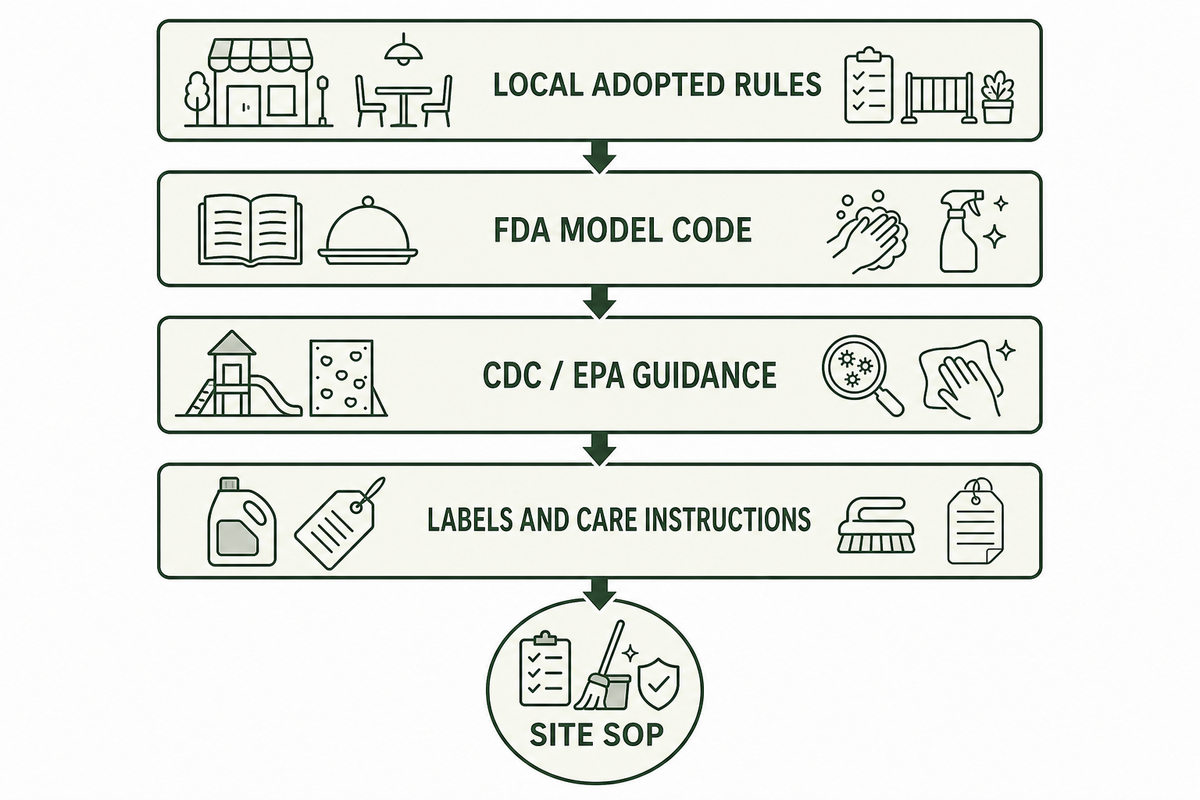
Direct answer: construct the SOP from five layers: adopted local rules, the FDA Food Code where adopted, CDC and EPA guidance, chemical labels and equipment care instructions, then the restaurant’s own procedures, training, and records. As a source-bound operating guide, that order makes the authority chain auditable.
The FDA Food Code 2022 is a model offered to government jurisdictions. It is not a single self-executing playground law for every U.S. restaurant. Ask the local or state food-safety authority which edition, amendments, employee-health rules, and vomiting/diarrheal procedure requirements apply to your site.
The compliance stack: what each layer can decide
Layer
Use it to decide
Do not assume
Local adopted rules
Legal duties, reporting, inspection, employee health
Another state’s schedule applies
FDA model code
A reference point for adopted food rules
Model text equals local law
CDC/EPA guidance
Public-health method and product-label literacy
Guidance overrides a label
Labels and care instructions
Allowed use, dilution, contact time, rinsing, compatibility
One chemical suits every material
Site SOP
Roles, triggers, logs, escalation, release
Internal policy can weaken higher layers
For indoor play areas in restaurants, state and local environmental health rules carry more weight than a voluntary restaurant association checklist. Health inspectors may ask how food establishments apply regulatory cleaning standards, sanitization, sanitary maintenance protocols, and good personal hygiene. If a statute or local rule differs from supplier advice or an internal maintenance policy, record which authority controlled the establishment’s decision.
Separate Food Service from the Play Zone
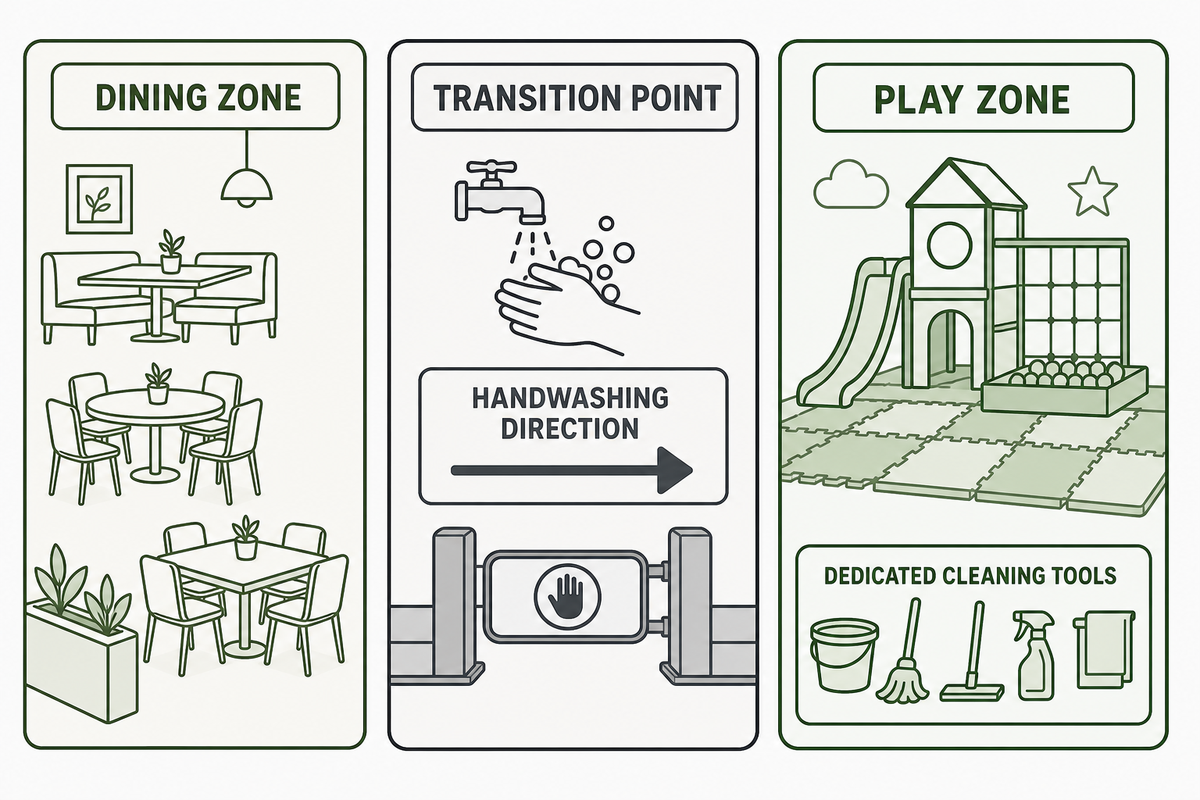
Direct answer: use a dining zone, a transition point, and a play zone. Keep food and drinks at tables, make handwashing cues visible, and dedicate cleaning tools by zone so play-area soil doesn’t travel toward food preparation or service.
Minnesota Department of Health indoor-play guidance tells food businesses to designate eating areas away from play and says hand sanitizer isn’t a replacement for handwashing. That’s a useful operating model, but its Minnesota-specific provisions must not be presented as the law in every state.
Transition point: signs, handwashing direction, shoe or sock rules, age cues, and the closure barrier sit here.
Play zone: no eating; staff use dedicated cloths, mop heads, buckets, waste supplies, and storage.
A clear barrier also discourages customers from taking food into the structure and keeps play-zone supplies away from prep areas. Signs should connect personal hygiene, handwashing, and good hygiene behavior without implying that a sign alone prevents the spread of germs.
Separation is routine prevention, not an invisible shield. Norovirus can spread through tiny droplets from vomit that land on surfaces or food. After vomiting, close and assess the full affected area rather than assuming the normal zone line contained the event.
Match access rules to the children who use the structure. Dreamland’s age-band and standards selector can help operators document which user groups and touch patterns the surface register must cover.
Map Every Surface Before Choosing a Product
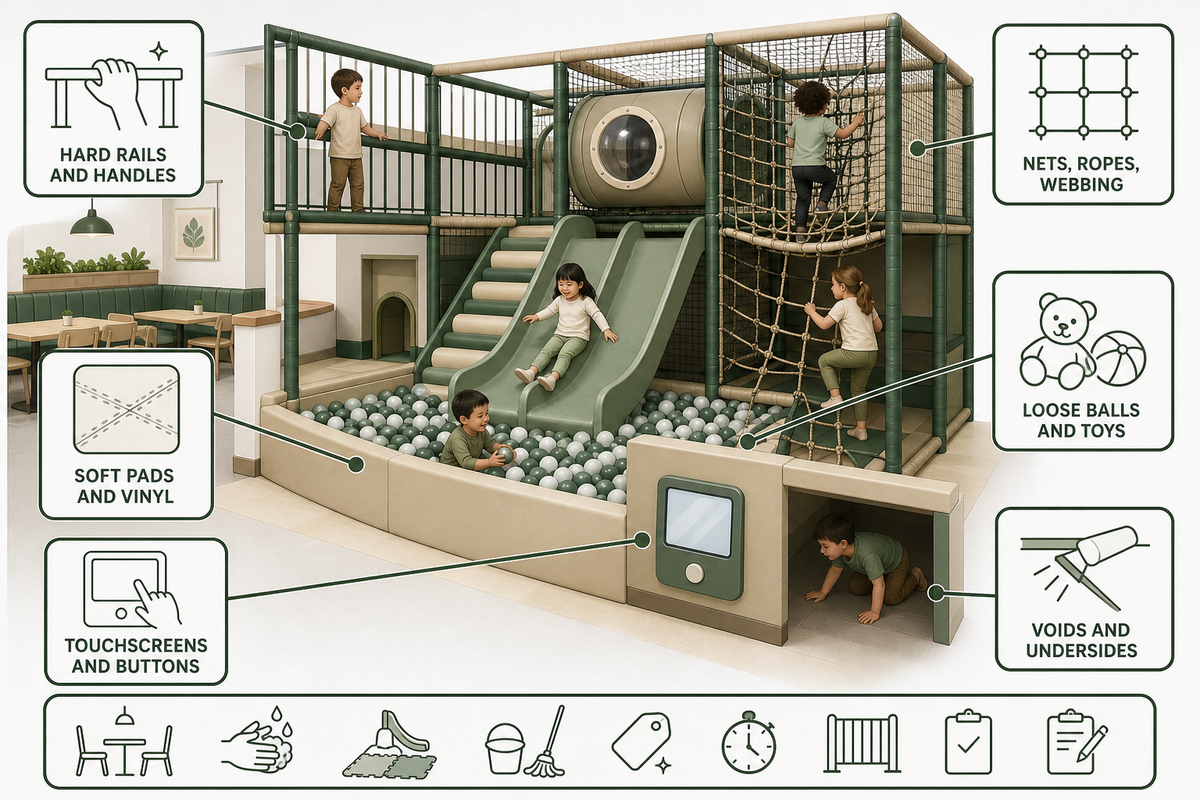
Direct answer: inventory surfaces before approving a chemical. Record material, touch or mouthing risk, typical soil, access, manufacturer restrictions, compatible method, rinse and drying needs, inspection point, and replacement trigger.
A coated metal rail, vinyl pad, rope net, foam block, touchscreen, ball, carpet tile, and hidden void do not behave alike. A product may be registered for a pathogen yet still be unsuitable for a porous item, food-contact surface, electronic control, or material that cannot remain wet for the required contact time.
Starter surface risk register
Surface class
Primary concern
Control question
Limitation
Hard rails and handles
Frequent hand contact
Can the surface stay wet for label time?
Finish may react with chemicals
Soft pads and vinyl
Seams, tears, absorbed soil
Are seams intact and wipe-accessible?
Damage may require replacement
Nets, ropes, webbing
Porosity and difficult access
What does the maker allow?
Wiping may not reach the full material
Loose balls and toys
Mouthing and mixed clean status
How are clean and used items separated?
Large volume can defeat manual tracking
Touchscreens and buttons
High touch plus electronics
Does the device maker approve the method?
Liquids can damage components
Floors and surfacing
Shoes, spills, slip risk
How is the wet zone isolated until dry?
Cleaning can create a temporary hazard
Voids and undersides
Hidden debris or fluids
Can staff inspect without unsafe access?
May require trained maintenance access
Cloths, mops, wipes, buckets
Transfer between surfaces
How are clean, in-use, and dirty tools separated?
Tool zoning here is an internal control
Walk the entire indoor playground route: each play structure, slide, ramp, mat, soft play panel, and adjoining playground structures. Record every crack, sharp edge, loose netting, sign of wear and tear, and whether the play equipment remains in good repair. These observations catch safety hazards and health and safety risks that a chemical log cannot resolve.
Good hygiene and cleanliness controls reduce opportunities for bacteria and fecal material to travel, but strict cleaning language cannot prove that a surface is sanitary or pathogen-free. If soil, damage, or chemical residue makes an area hazardous, close it and route the defect to the responsible owner.
Know When to Clean, Sanitize, or Disinfect
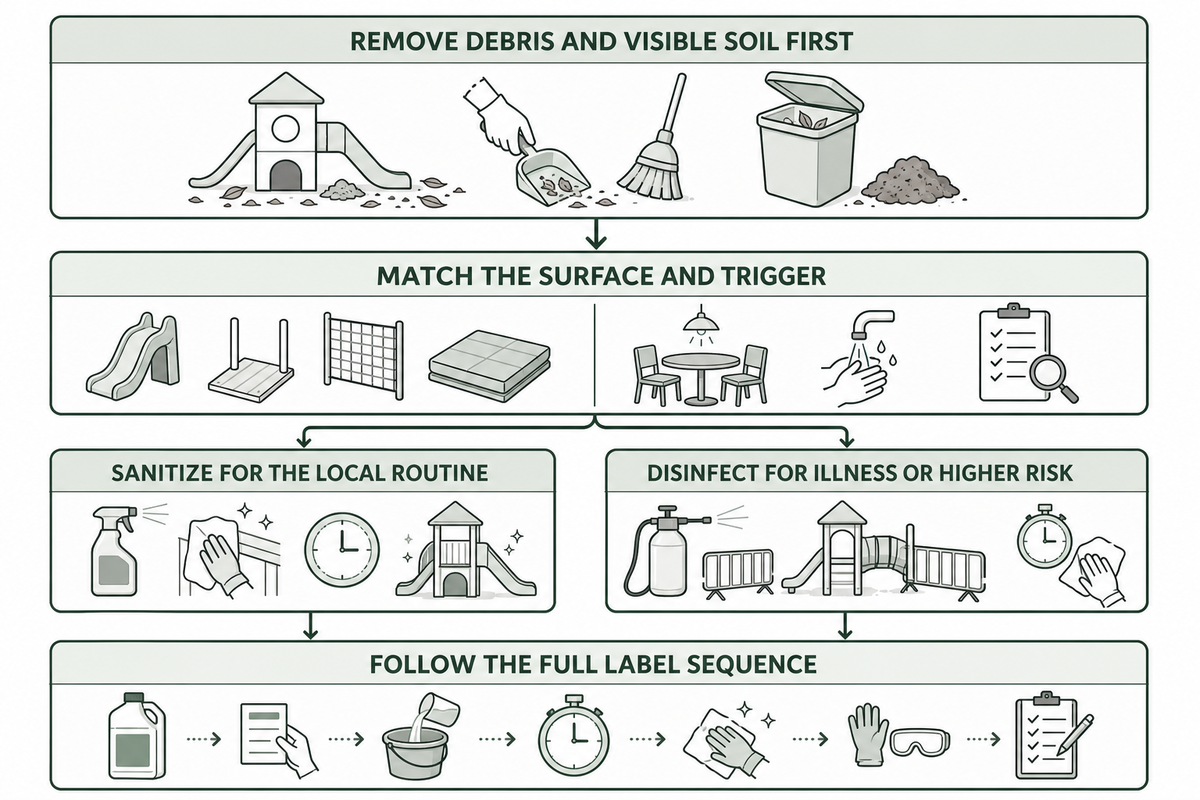
Direct answer: cleaning removes soil. Sanitizing reduces germs on a cleaned surface to the level addressed by the applicable method. Disinfecting uses a registered product to control label-listed pathogens on a cleaned surface. These actions are related, but they are not interchangeable.
CDC facility guidance says regular cleaning is usually enough under ordinary conditions and adds disinfection when someone is sick or when risk is higher. The CDC child-setting guide reinforces cleaning first, ventilation, label directions, and chemical safety.
Do
Remove debris and visible soil first.
Match the next action to the surface and trigger.
Follow the full label sequence and equipment instructions.
Record why disinfection was added.
Don’t
Spray over dirt and call the surface finished.
Use fragrance as evidence of hygiene.
Assume routine disinfection is always required.
Mix products or improvise an application method.
Scenario 1 — ordinary close: staff find no illness event or body-fluid contamination. They remove debris, clean every scheduled surface, sanitize only where the local program and approved method call for it, dry and inspect, then sign the closing record. Routine disinfection is not added merely to make the log look stronger.
Set a Baseline, Then Add Trigger-Based Cleaning
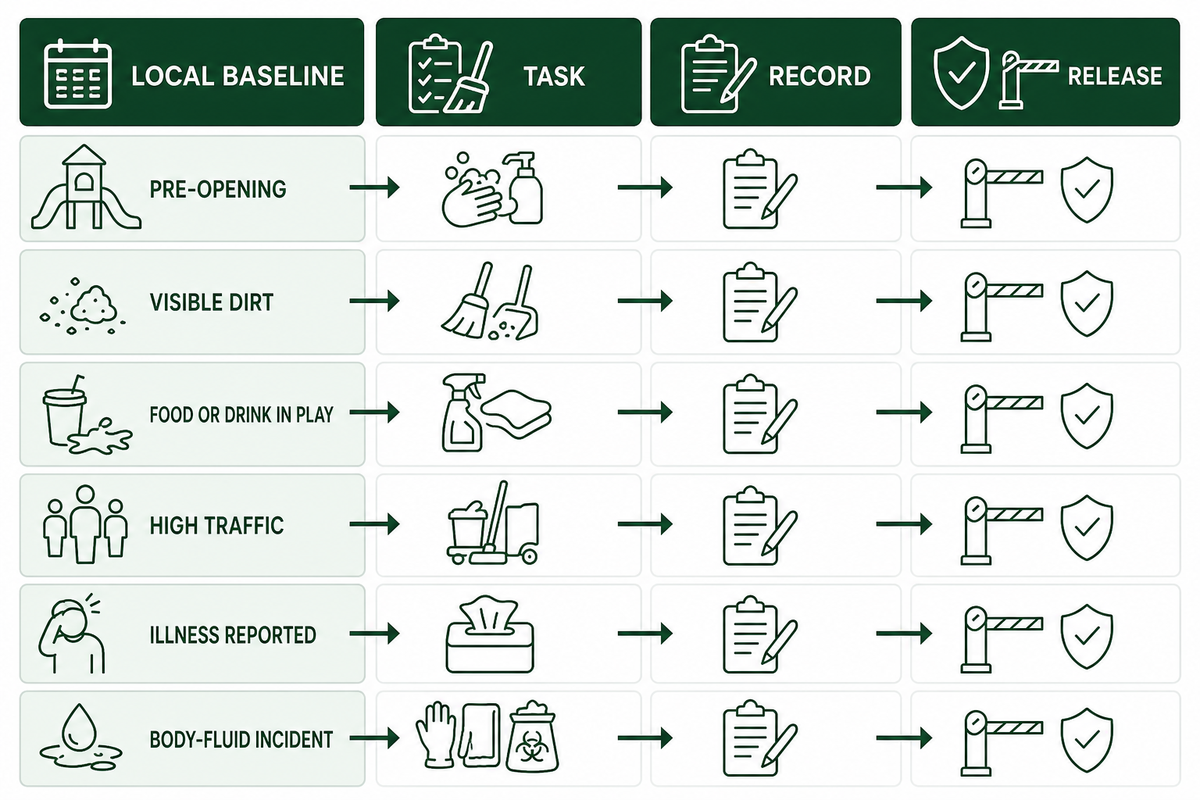
Direct answer: establish the baseline required for your jurisdiction and site, then add work when traffic, visible soil, food, spills, illness, or an incident change the risk. A clock and triggers belong in the same program.
Minnesota’s operator guidance says indoor play surfaces should be cleaned and sanitized daily or more often. Name that source if using it as a benchmark; don’t relabel it as a nationwide hourly, daily, or weekly mandate. Your own baseline may be different after local review.
Trigger-to-Task Matrix for a site SOP
Trigger
Immediate task
Record
Release evidence
Limitations
Pre-opening
Inspect debris, moisture, damage, and access
Opening check
Dry, accessible, no unresolved defect
Does not replace scheduled cleaning
Routine use check
Observe high-touch areas and behavior
Time and observer
No action trigger found
Visual review cannot prove pathogen absence
Visible dirt
Restrict access and clean immediately
Surface and soil
Soil removed; follow-on step complete
Visible removal is not disinfection
Food or drink in play
Remove food, isolate spill, clean affected path
Entry route and surfaces
No residue or slip condition
Assess food-contact implications separately
Mouthed loose item
Remove to a dirty-item container
Item class and batch
Approved cleaning/sanitizing method complete
Method depends on item and local program
High traffic
Increase observation and scheduled tasks
Traffic condition and change
Revised checks completed
No universal people-per-hour trigger
Daily close
Complete full scheduled surface routine
Product, method, staff, exceptions
Routine and defect checks signed
Local baseline can be more demanding
Scheduled deep access
Open maker-approved access points
Area, condition, defect
Panel restored and hazards cleared
Only trained staff access concealed zones
Illness reported
Apply employee/guest illness and cleaning plan
Report, exposure, decision owner
Manager confirms required response
Health authority may direct further action
Body-fluid incident
Close affected area and run incident SOP
Incident, extent, product, waste, food assessment
Incident and Reopen-5 records complete
No universal cleanup radius
Scenario 2 — a drink enters the play zone: staff close the wet path, remove the cup, keep dining tools out of the response, clean the spill from each contacted surface, complete any locally required follow-on step, check for slip risk, record the trigger, and release only the affected area.
Run the Clean-Separate-Verify Loop
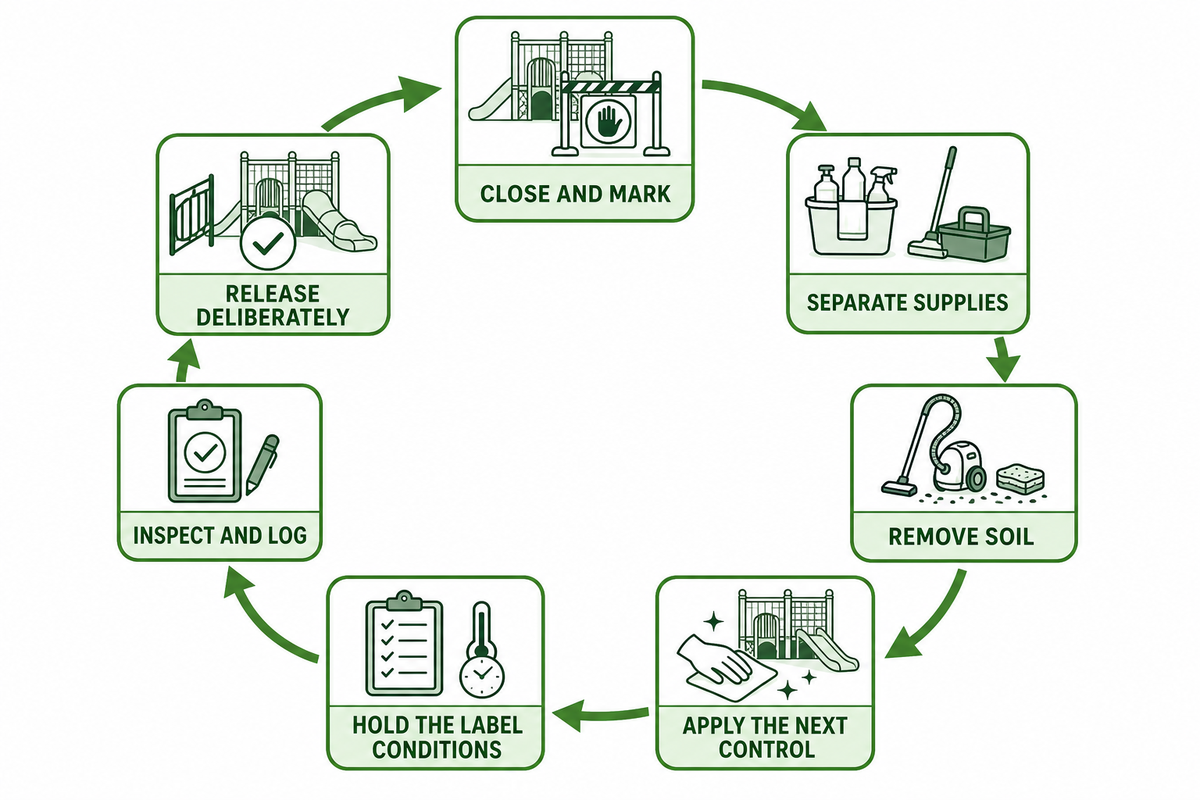
Direct answer: close the work zone, keep clean and dirty tools apart, remove debris, clean with friction, apply the approved follow-on product, honor contact time and rinse or drying directions, inspect, record, and release.
Close and mark — block access to the exact work area and name the release owner.
Separate supplies — bring zone-dedicated tools and keep unused items away from dirty returns.
Remove soil — collect debris, then clean the surface with the approved friction and rinse method.
Apply the next control — sanitize or disinfect only when the surface, trigger, local program, and label support it.
Hold the label conditions — maintain wet contact time and complete any rinse, drying, PPE, or ventilation direction.
Inspect and log — record work, defects, corrective action, and anything left closed.
Release deliberately — the designated manager confirms both hygiene and safety conditions before removing the barrier.
Color coding or a two-bucket method can make tool separation easier to audit, but it is an internal control, not a universal restaurant rule. Evidence that mops, cloths, and buckets can spread contamination comes from healthcare environmental-cleaning guidance; applying clean/dirty separation here is a conservative transfer-control choice with a different source setting.
Choose Chemicals by Label and Contact Time
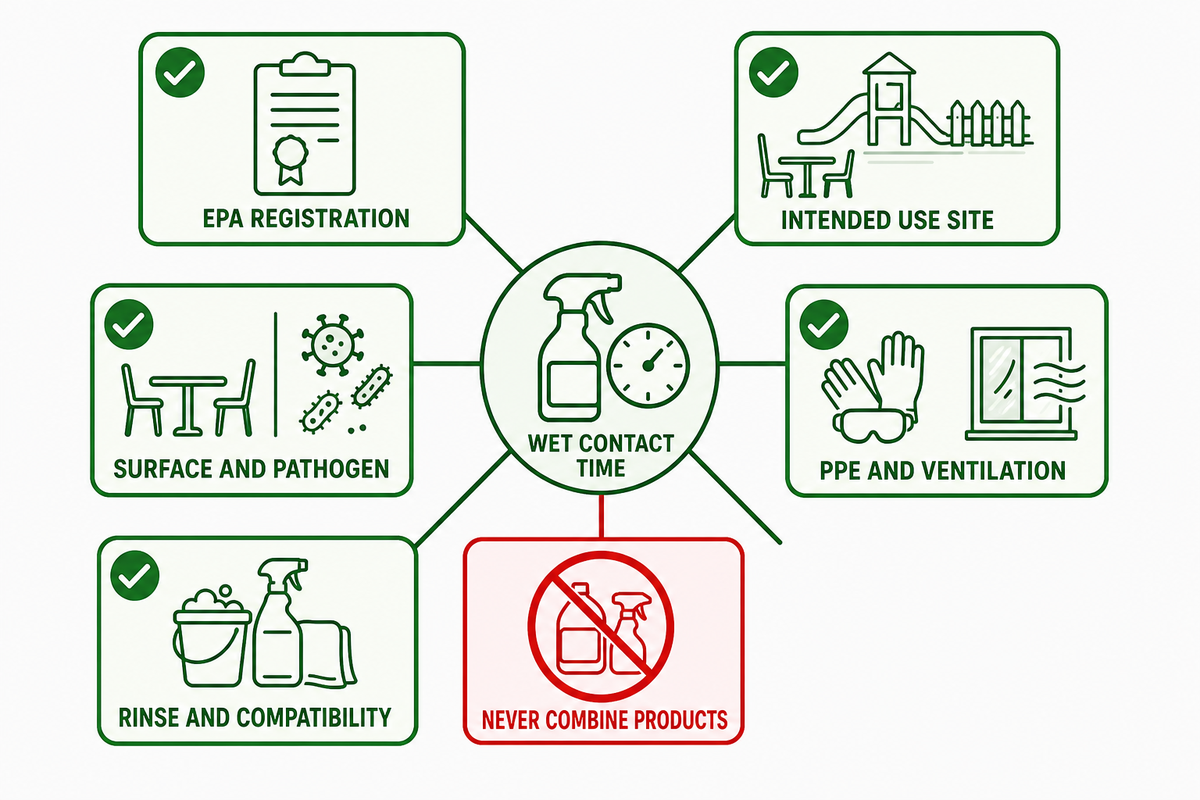
Direct answer: approve a disinfectant only after confirming its EPA registration, intended use site, surface, target pathogen, dilution, application method, wet contact time, PPE, ventilation, rinse, storage, and equipment compatibility. This turns the routine loop’s general method into a specific, label-bound decision.
The EPA’s selected registered disinfectants resource shows why product-specific labels matter: contact times and pathogen claims vary. “Hospital grade,” “natural,” “food safe,” or a pleasant smell doesn’t establish that a product is allowed for your play surface or method.
Keep children out of the application area; EPA designates children as a sensitive population, and children aren’t permitted to apply disinfectants.
Store chemicals locked and in the original labeled containers unless the label and workplace system allow a properly labeled working container.
Never combine products. Don’t apply a surface disinfectant directly to skin or food.
Don’t fog, mist, or use electrostatic application unless the label permits the method on the target surface and at the intended location.
Use a timer or recorded start/end control when the label requires a wet contact period; a quick spray-and-wipe may not meet it.
If the product can’t stay wet long enough without damaging the surface or causing an uncontrolled shutdown, it isn’t an operational fit. Reassess the chemical, surface method, component instructions, or replacement plan instead of silently cutting a corner on the label time.
Respond to Vomit, Diarrhea, and Other Body Fluids
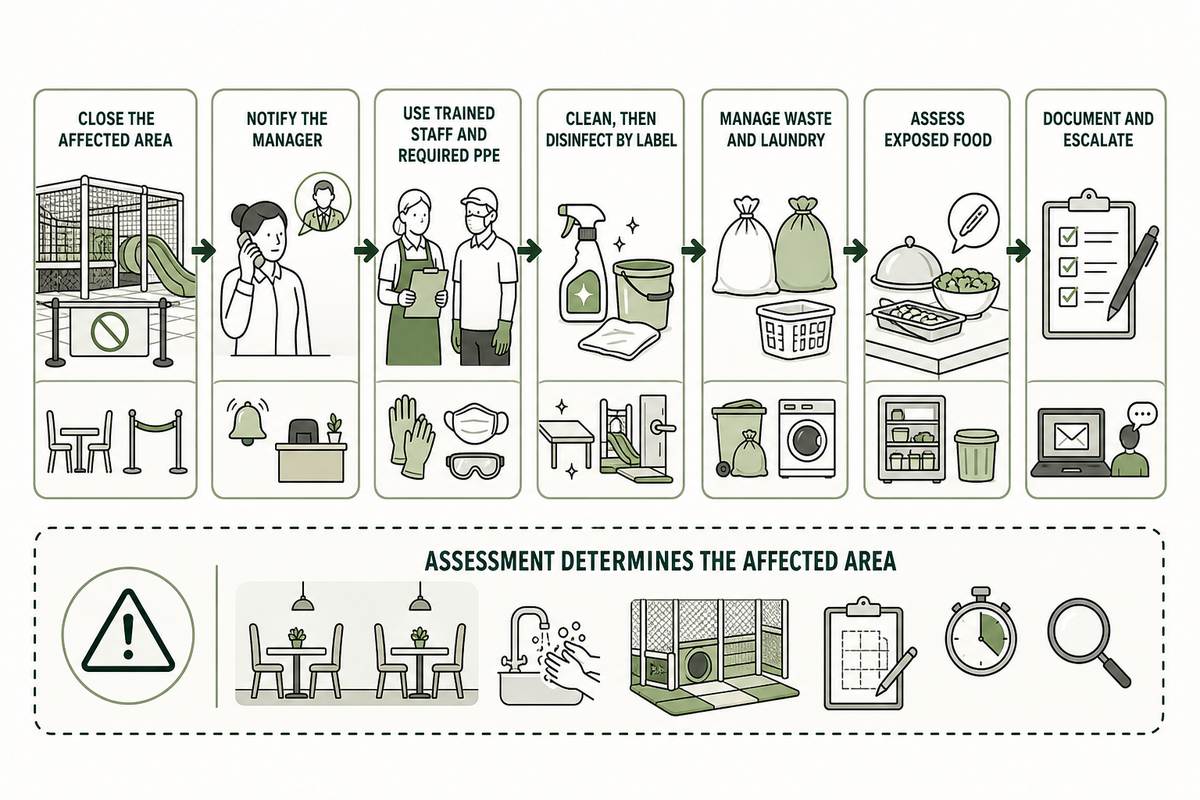
Direct answer: close the affected area immediately, keep guests away, notify the manager, use trained staff and required PPE, remove bulk material without spreading it, clean, complete the label-matched disinfection step, manage waste and laundry, wash hands, document, and assess exposed food. The same label controls still apply, but an incident changes the trigger, closure, and surface assessment.
CDC norovirus prevention guidance calls for immediate cleaning and disinfection of the entire affected area. It describes using an EPA-registered product against norovirus or a chlorine bleach solution in the stated 1,000–5,000 ppm range, followed by the current product and facility directions. Operators should verify the current page, label, surface compatibility, and local procedure before use.
Scenario 3 — vomiting near a play entrance: do not clean only the visible spot or trust the normal dining/play boundary. Close the affected play and nearby exposure area, stop food movement through it, discard or isolate exposed items under the food-safety plan, use the written incident kit and procedure, record who performed each step, and escalate to the health authority when required.
Do not invent a universal cleanup radius. The affected area depends on the event, droplets and traffic, nearby food and surfaces, local instructions, and what the manager can reliably isolate and assess.
Area release and employee return are different decisions. CDC advises food workers with norovirus illness to wait at least 48 hours after symptoms stop before preparing or handling food, while local employee-health rules can add duties. A cleaned play zone doesn’t shorten a sick employee’s exclusion period.
OSHA’s bloodborne-pathogen worker guidance has a conditional scope tied to occupational exposure to blood or other potentially infectious materials. Urine, feces, or vomit without blood isn’t automatically treated the same way under that standard, although other workplace duties and local procedures may still apply.
Train Staff and Build an Audit Trail
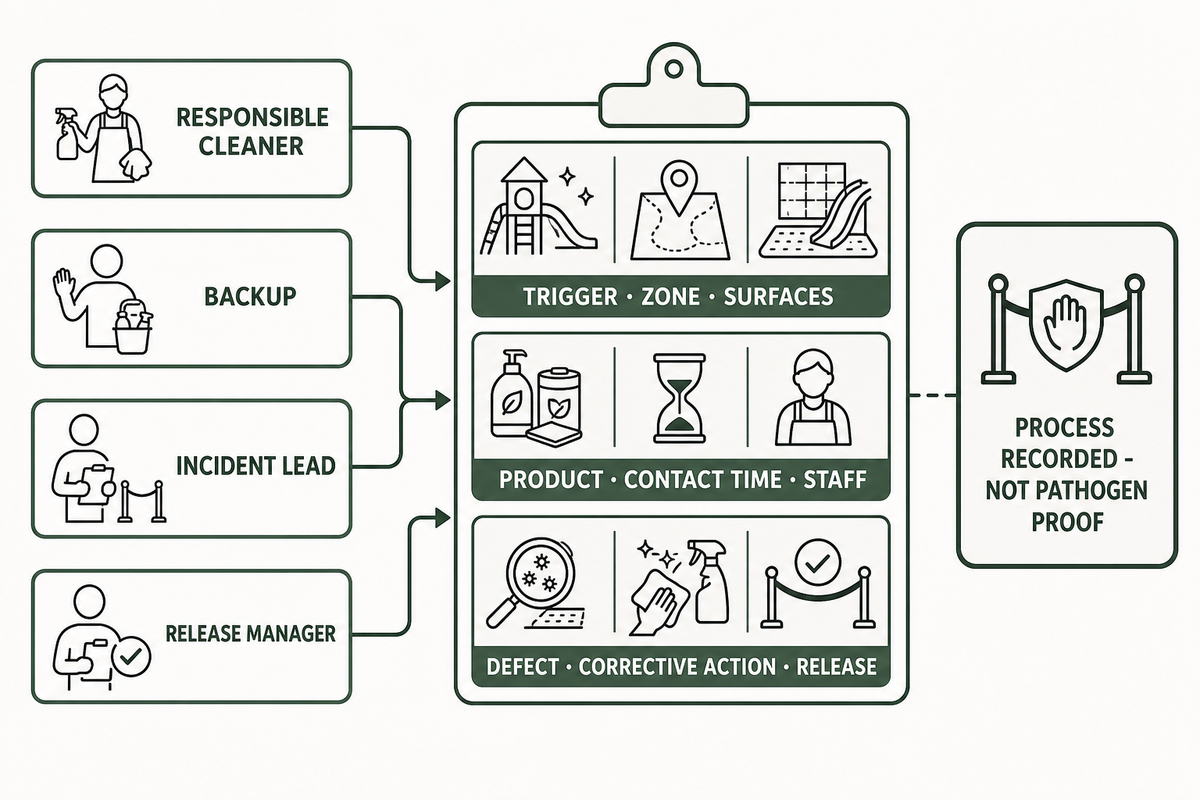
Direct answer: name a responsible cleaner, backup, incident lead, and release manager. Train them to read labels, prepare or verify dilution, maintain contact time, use PPE, protect food, identify damaged equipment, and escalate illness or an uncertain exposure. Because incident response spans people and surfaces, the record must show both exposure decisions and completed work.
A usable record captures date and time, trigger, closed zone, surfaces, product and EPA registration number, dilution or ready-to-use status, contact time, staff member, defect, corrective action, and release decision. It should also show when work was impossible, for example, a torn pad, inaccessible soil, depleted supply, or label/material conflict, and who kept the component closed.
Connect incident and maintenance records to the broader risk file. The playground insurance guide explains why owners should align evidence, responsibilities, and coverage discussions instead of treating a cleaning checklist as a complete risk program.
A signed sheet verifies that the defined process was recorded; it does not prove a surface is pathogen-free. Research in food-service operations has also shown that visual hygiene ratings did not reliably predict norovirus-positive surfaces. That finding supports honest limits, not a universal environmental-swabbing program. Testing decisions need risk, jurisdiction, and qualified-advisor input.
Keep Hygiene and Equipment Safety on Parallel Tracks
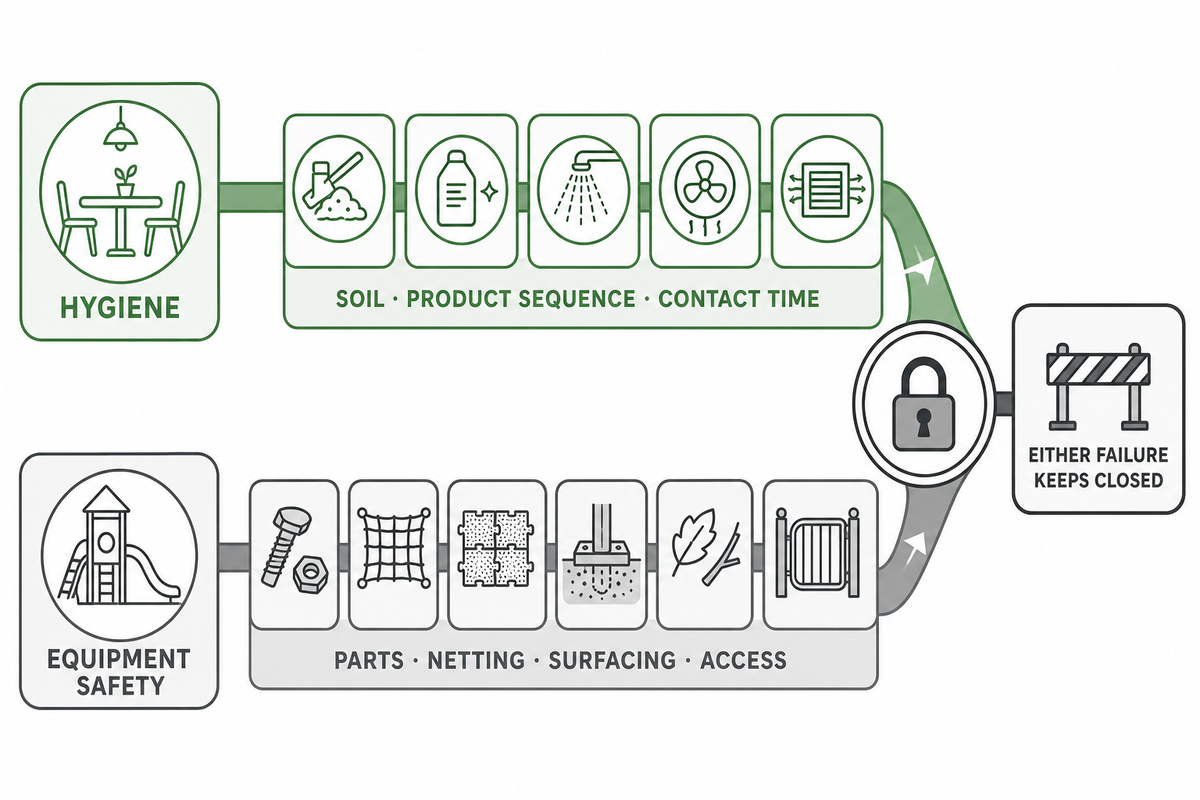
Direct answer: hygiene inspection addresses soil, germs, chemicals, and incidents; equipment inspection addresses broken or missing parts, netting, surfacing, anchoring, debris, and access. A failure in either track keeps the component closed. The audit log shows process completion, while the safety track decides whether the equipment itself can return to service.
The CPSC Public Playground Safety Handbook is a physical-safety reference, not a restaurant playground cleaning schedule. Use manufacturer maintenance instructions for the actual equipment and give staff a clear route for defects they cannot repair.
Two-track release check
Track
Check
Failure response
Hygiene
Soil removed; required product sequence, contact time, rinse, dry, and ventilation complete
Repeat the valid step or keep closed and escalate
Equipment safety
No loose, broken, missing, sharp, unstable, or inaccessible hazard left in service
Isolate, repair, replace, or obtain qualified review
For a commissioning or reopening project, use the play-zone handover checklist to agree cleaning access, approved chemicals, component care, defect routing, and record ownership before operations begin.
Use the Reopen-5 Gate
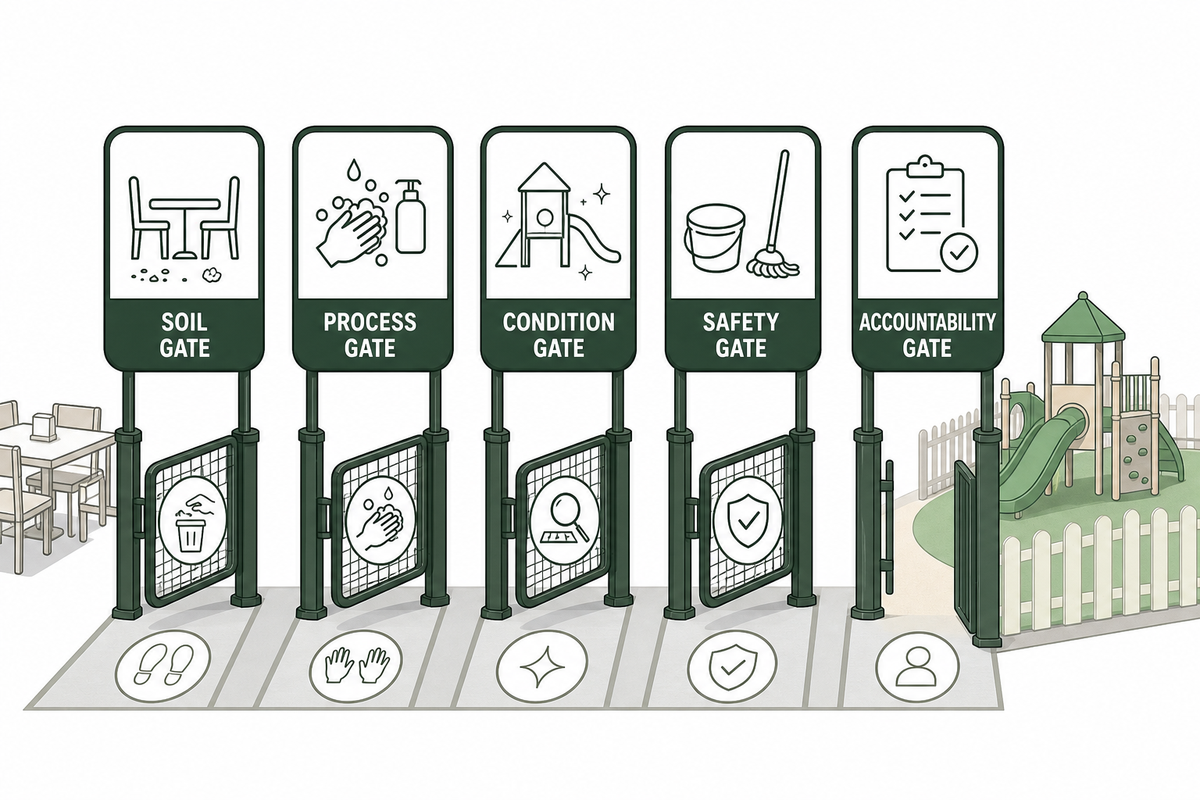
Direct answer: reopen only when soil and waste are removed, the required label-directed treatment is complete, rinse/dry/ventilation conditions are met, physical hazards are cleared or isolated, and a designated manager signs the release record.
Soil gate: visible material, disposable waste, and dirty tools have left the work area.
Process gate: cleaning and any required sanitizing or disinfection, including full wet contact time, are complete.
Condition gate: the surface meets label and manufacturer rinse, dry, ventilation, and compatibility conditions.
Safety gate: damage, debris, access, surfacing, and temporary slip or chemical hazards are cleared or isolated.
Accountability gate: the manager reviews the record, exceptions, and boundaries before removing the closure.
Reopen-5 is Dreamland’s source-bounded article framework, not a government-issued standard. It combines the completion evidence already required by the chosen procedure with a separate physical-safety check. It applies to the play area; employee exclusion and return-to-food-work remain under the employee-health program.
Key takeaway
A restaurant play area is ready only when the required hygiene process and the physical-safety inspection both pass, with a manager accountable for the recorded release.
Turn This Guide into a Site SOP
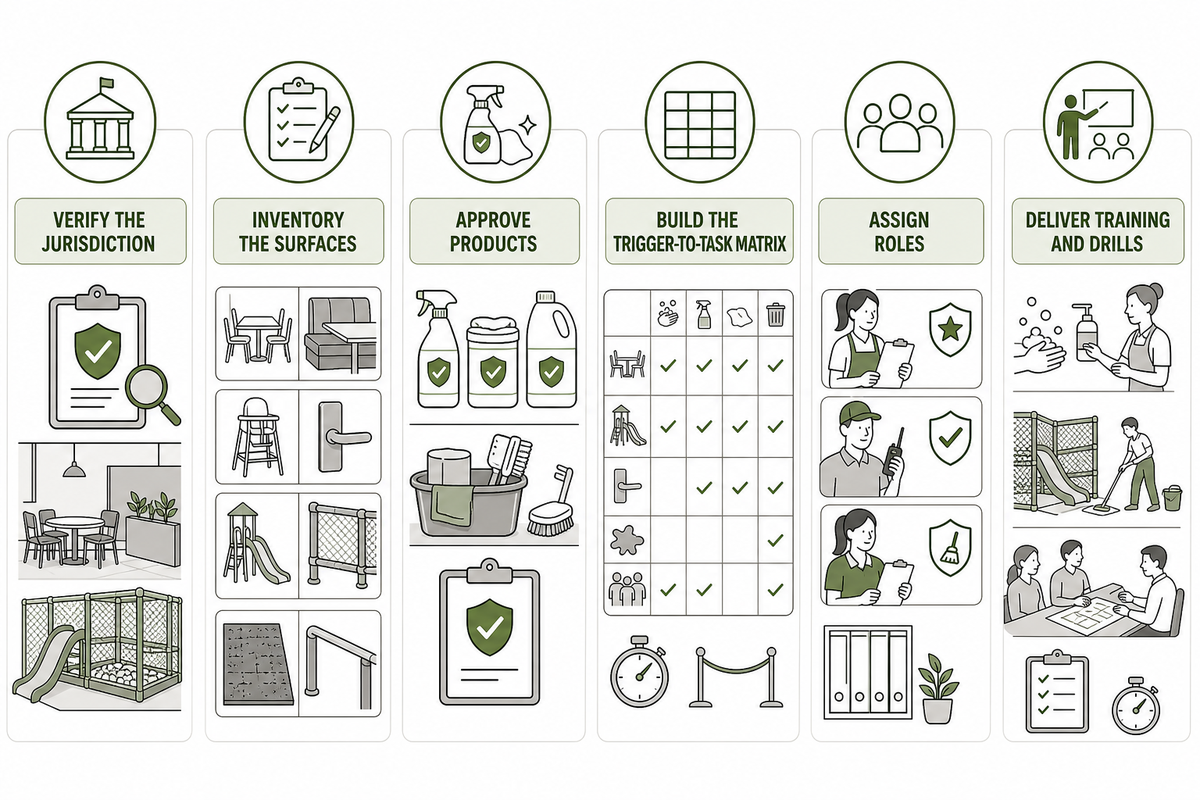
One-line reply: Verify the jurisdiction. Inventory the surfaces. Approve products.
Build the Trigger-to-Task Matrix. Assign roles. Deliver training and drills.
Audit the Reopen-5 records, then revise the program when chemicals, equipment, rules, or illness conditions change. With Reopen-5 defining the release record, implementation works backward through product approval, roles, and triggers.
Confirm the adopted food code, health-department instructions, employee-health rules, and reporting contacts.
Walk the structure with manufacturer care documents and complete the surface register.
Approve routine and incident products by label, material, access, contact time, and child-exposure controls.
Set the local baseline and add opening, in-use, soil, food, traffic, illness, and body-fluid triggers.
Assign routine, backup, incident, defect, and release ownership for every operating shift.
Run a tabletop incident drill, inspect the record for missing evidence, and correct the SOP before the next drill.
Use a proactive review after a component change, chemical substitution, label revision, incident, inspection finding, or local rule update.
How often should a restaurant playground be cleaned?
View answer
Do not rely on one universal interval. Inspect during use, act on visible soil, food, spills, illness, and damage immediately, and complete the documented local baseline. Minnesota’s food-business guidance says indoor play surfaces should be cleaned and sanitized daily or more often, but your adopted code, traffic, equipment instructions, and chemical labels can require a different program.
How long do germs stay on playground equipment?
View answer
There is no single reliable duration for every germ and surface. Survival changes with the organism, material, temperature, moisture, soil, sunlight, and cleaning history. Operators should not wait for a guessed survival period. Use the scheduled baseline, respond to visible contamination or illness triggers, and follow a current label-matched procedure for the affected surface and pathogen concern.
What are ASTM standards for playgrounds?
View answer
ASTM playground standards and CPSC guidance mainly address equipment design, use zones, surfacing, physical hazards, inspection, and maintenance. They do not supply a complete restaurant hygiene timetable or chemical SOP. Keep physical safety and hygiene as parallel controls, follow the equipment maker’s care instructions, and verify which standards and local rules apply to your specific installation.
Can hand sanitizer replace handwashing around a play area?
View answer
No. It does not remove dirt, and Minnesota’s guidance says hand sanitizer does not work well against norovirus. Direct guests and staff to soap-and-water handwashing.
Which disinfectant is safe for playground equipment?
View answer
Choose an EPA-registered, label-matched product, confirm material compatibility, and follow dilution, PPE, ventilation, contact-time, rinse, drying, and storage directions. Keep children away during application.
Related Operational Planning
Beyond the FAQ’s product-label and child-safety answers, these related guides cover the broader planning context outside this article’s hygiene ownership.
Dreamland Playground publishes practical planning guides for commercial indoor-play projects, including family entertainment centers, shopping malls, hotels, restaurants, churches, and other venue types.
Use these guides to frame the questions that should be resolved before concept selection: venue size, intended age groups, project location, attraction mix, operating priorities, timeline, and delivery constraints. Final recommendations should be based on the real site and applicable local requirements.
Start With The VenueFloor area, clear height, site location, intended audience, and target opening date create the working brief.
Clarify The ScopeConcept, equipment, production, shipping, installation, and operating inputs can vary from one project to another.
PROJECT / VENUE / TIMELINE
Prepare Your Project Brief
Venue TypesFEC · Mall · Hotel · Restaurant · Church
Start WithFloor area · Clear height · Age groups · Country