Get in touch with Dreamland Playground Company

Daycare Playground Equipment and Play Area Design
We design and manufacture daycare playground equipment for indoor rooms and outdoor yards, from one toddler soft play corner to a complete early childhood center. Every layout is drawn against your room, your age groups and the licensing rule your inspector will apply.
Costed quotation and a first layout within 24 hours
Full 3D design of your room in 3 working days
Production in 15 to 30 working days
We work from a DWG or PDF floor plan
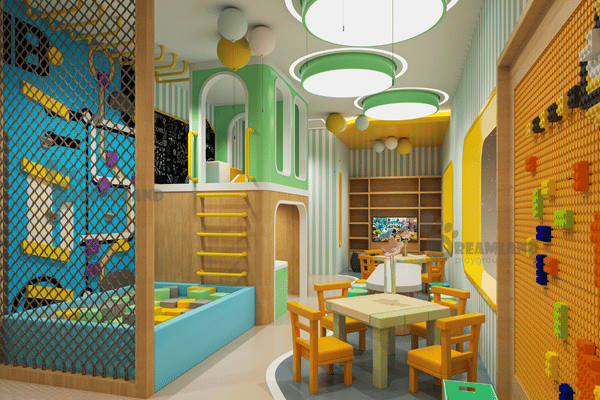
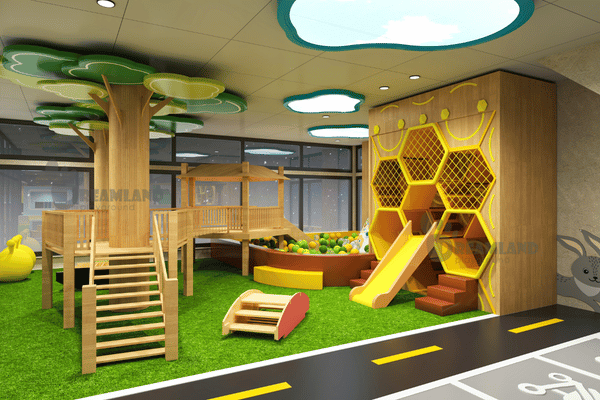
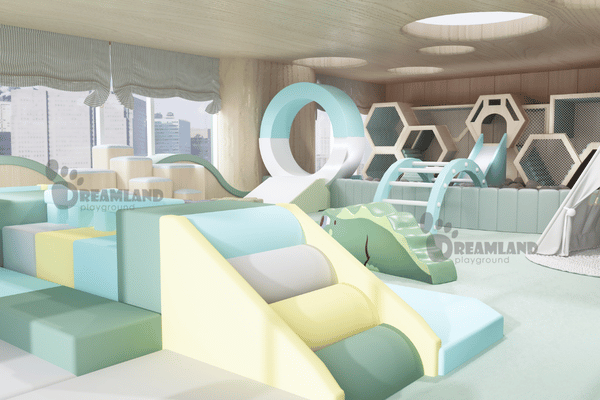
Play Structures We Build for Daycare and Preschool Rooms
We manufacture both the indoor playground equipment inside the classroom and the outdoor play structures in the yard. One drawing set covers both, so a daycare running an indoor room and an outdoor park area gets a single supplier, a single shipment and one installation drawing package.
SYS.01
Indoor Soft Play and Contained Structures
+ VIEW DATA
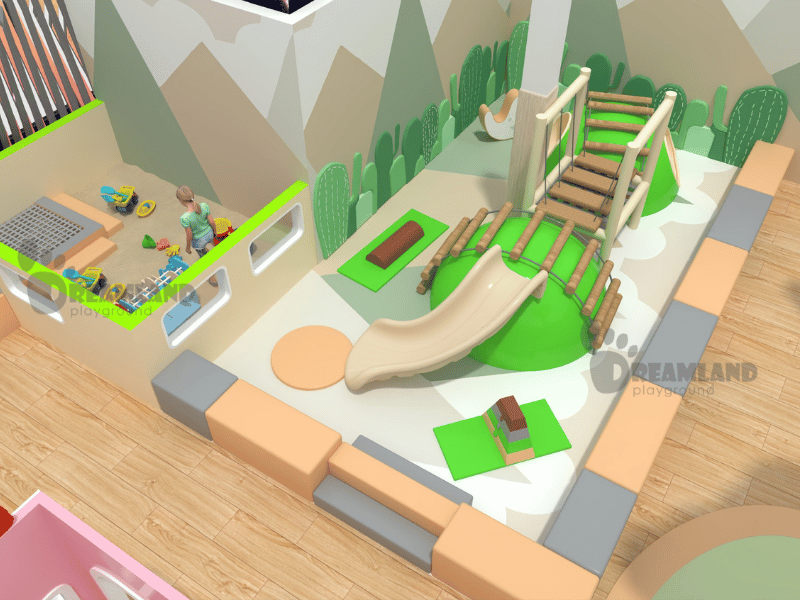
Soft blocks, ball pits, padded tunnels, low climber panels and tube slides: toddler playground equipment built to the clear ceiling height of your room rather than to a catalogue envelope. Entry points sit low enough for the youngest children to explore without a staff lift, which is what sets deck height in an infant room. This is the commercial indoor playground equipment most daycare directors shop for when the yard is small, or when weather moves play indoors for four months of the year.
SYS.02
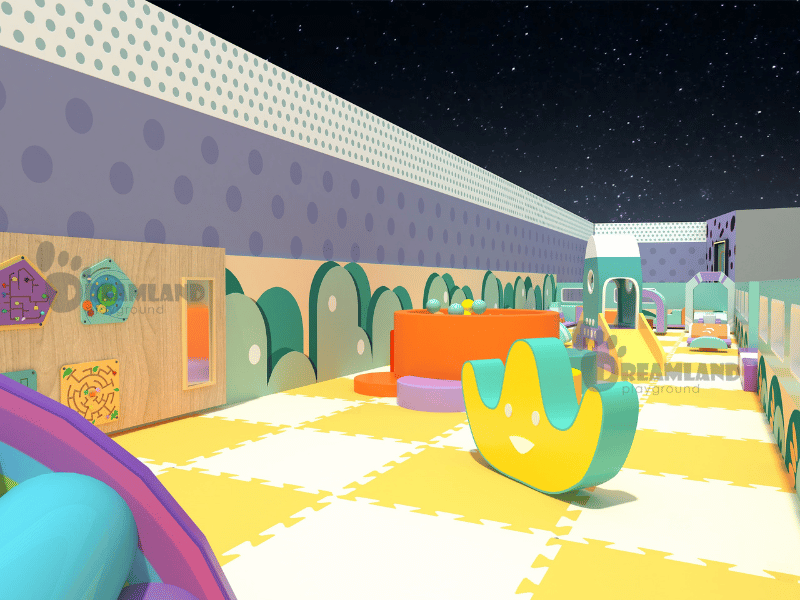
Outdoor Play Structures and Site Equipment
+ VIEW DATA
Decks, slides, jungle gym climbing frames, balance elements and shade structures for the yard, each drawn with its fall zone on the same plan so the surfaced area is sized before pricing.
SYS.03
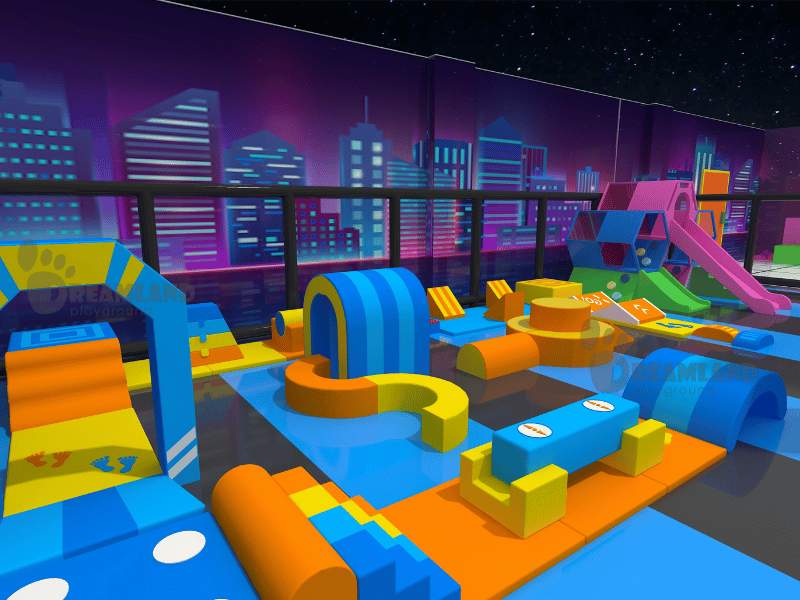
Larger Attractions and Themed Rooms
+ VIEW DATA
Beyond the daycare room we build indoor playground venues, family entertainment centers, trampoline parks, ninja courses, adventure parks, mall play areas, and installations for schools, hotels and resorts. A daycare operator planning a second revenue stream from public open-play sessions buys from the same plant and the same drawing office.
| Equipment | Age band it suits | What it develops |
|---|---|---|
| Soft play blocks, ramps and steps | 6-23 months | Gross motor skills, balance, first climbing |
| Contained ball pit | 6-23 months | Sensory input, cause and effect, shared play |
| Sensory wall panels | 6-23 months and 2-5 years | Fine motor skills, curiosity, creativity |
| Low platform playhouse | 2-5 years | Imaginative and cooperative play, language |
| Tube slide and open slide | 2-5 years | Motor planning, confidence, turn taking |
| Climber panels and ladders | 2-5 years | Upper-body strength, grip, climb technique |
| Role-play kitchen and shop units | 2-5 years | Language, negotiation, imaginative play |
| Jungle gym climbing frame | 5-12 years | Whole-body coordination, risk judgement |
| Ninja and agility elements | 5-12 years | Power, agility, persistence |
A room holding forty kids and a room holding twelve need a different solution, so nothing here is sold as a fixed package.
Materials and the Failure Modes They Have to Survive
Material choice on a daycare play area is settled by the daily inspection, not by the brochure. The national early care standard, Caring for Our Children Basics 6.2.5.1, tells an operator to check every play area each day for rust, chipped paint, peeling surfaces, splinters, rough spots and protruding nuts and bolts. Our specification answers that list item by item, because those findings are what take a structure out of service.
SPECIFICATION 01
Powder-Coated Steel
- Where we use itPosts, deck frames, climbing frames, guard rails
- Why it is specifiedCarries load at small section size, so a structure fits a low-ceiling classroom without losing headroom
- FinishPolyester powder coat over pre-treated steel, colour to your specification
RELATIVE PRICE $$$
SPECIFICATION 02
HDPE and PE Sheet
- Where we use itPanels, playhouse walls, roofs, decorative cut-outs
- Why it is specifiedColour runs through the sheet, so a scratch does not read as chipped paint at inspection
- FinishTextured or smooth face, machined edges radiused
RELATIVE PRICE $$$
SPECIFICATION 03
Rotomoulded LLDPE
- Where we use itSlide beds, tunnels, moulded roofs and themed elements
- Why it is specifiedOne-piece hollow mouldings have no seam and no fastener in the sliding surface
- FinishMoulded-in colour with an ultraviolet-stabilised outer layer
RELATIVE PRICE $$$$
SPECIFICATION 04
PVC-Coated Foam Soft Play
- Where we use itSoft blocks, padded walls, post padding, infant and toddler shapes
- Why it is specifiedWipe-clean skin over a foam core, welded rather than stitched, because stitched seams open under cleaning
- FinishHigh-frequency welded PVC skin, foam density selected by the element’s job
RELATIVE PRICE $$
SPECIFICATION 05
Fasteners and Hardware
- Where we use itEvery structural connection on indoor play equipment and outdoor frames
- Why it is specifiedRecessed and capped heads answer the protruding nuts and bolts line on the daily inspection list
- FinishStainless or hot-dip galvanised, with thread-locking on rotating joints
RELATIVE PRICE $$
Another Material
Send us the grade or the finish your specifier has written into the room package and we will confirm availability and price in the quotation. Wood-look composites, upholstery fabrics and branded colour matches are quoted the same way. Tell us at drawing stage which theme should inspire the panel set, because bespoke moulds are quoted with the structure and re-cutting one after approval is a new tooling charge.
Send Your Floor Plan for a QuoteTwo Material Questions We Will Not Answer With a Number
Fire performance of indoor soft play fabric
The requirement follows your building’s occupancy classification, which differs between states and between educational and assembly use. We supply the material specification with the drawing set so your code consultant checks it against the rule that applies to your building.
Disinfectant compatibility
Cleaning products vary too widely for a blanket claim. We state the cleaning method each surface is built for, and we will test a sample against the product you name.
COMPLIANCE & SAFETY
Surfacing and Finish Specifications
Surfacing is where daycare play areas fail inspection, and they fail after installation rather than at purchase. An Ohio licensing inspection report dated 30 January 2025 puts it in one line: the playground did not have adequate fall surface under and around equipment. ASTM F1292-22, which governs impact attenuation of playground surfacing, says so in its own scope.
“The critical fall height of a playground surfacing material determined under laboratory conditions does not account for important factors that have the potential to influence the actual performance of installed surfacing materials […] aging, moisture, maintenance, exposure to temperature extremes (for example, freezing), exposure to ultraviolet light, contamination with other materials, compaction, loss of thickness, shrinkage, submersion in water, and so forth.”
— ASTM F1292-22, scope clause 1.7
MATERIAL SPECIFICATIONS MATRIX
| Surface or finish | Where it is used | What governs it |
|---|---|---|
| Poured-in-place rubber | Fall zone under and around outdoor structures | ASTM F1292-22 impact attenuation, tested to a stated critical fall height |
| Rubber tile | Fall zones indoors and outdoors | ASTM F1292-22, with the installed depth carried through from the tested build-up |
| Artificial turf over a shock pad | Outdoor play areas and toddler yards | ASTM F1292-22 applies to the pad system, not to the turf pile |
| Loose fill such as engineered wood fibre | Outdoor fall zones on a budget | ASTM F1292-22, with depth maintained by the operator between inspections |
| EVA foam matting | Indoor soft play floors | Manufacturer specification; on its own it is not a tested fall surface for elevated equipment |
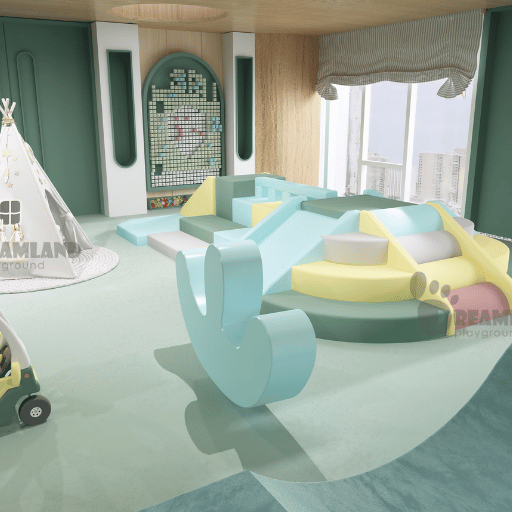
Why Certified Surfacing Still Fails an Inspection
A certificate describes the material as delivered, and an inspection measures the depth underfoot on the day, so a supplier’s test certificate is not a substitute for installed depth.
- ASTM itself. Clause 1.7 of F1292-22 puts compaction and loss of thickness outside what the laboratory number accounts for.
- National early care standard. Caring for Our Children Basics 6.2.3.1 calls for all indoor and outdoor climbing equipment to stand on shock-absorbing material covering more than the equipment’s own edges. Depth underfoot delivers that, and no certificate measures depth.
- Enforcement record. The Ohio citation above is what that instruction looks like when it is not met.
We draw the fall zone on the layout alongside the structure so the surfaced area is sized before the quotation goes out, and we state the depth the structure was drawn against. Choosing the surface after the equipment is ordered costs you a second surfacing order, because the fall zone is set by the deck height you already approved.
Equipment ships in its specified finish, edges radiused and hardware capped, so what your installer unpacks is already in the condition the inspection list expects.
Age Bands, Space Requirements and Delivery Specifications
Daycare rooms are mixed-age while the safety standards are age-split, so a single room can straddle two equipment populations governed by different rules. Every structure on the layout gets its age band fixed before anything is priced.
| Age band | Governing standard | Scope of that standard | What we place there |
|---|---|---|---|
| 6-23 months, infants and young toddlers | ASTM F2373-24 | Public use play equipment for 6 to 23 months, naming early care and education facilities and both indoor classrooms and outdoor playgrounds; excludes soft contained play at clause 1.5. | Soft blocks, low ramps, contained ball pit, sensory panels |
| 2-5 years, preschool | ASTM F1487-25 | Public playground equipment for ages 2 to 12. It excludes soft contained play and excludes children 6 to 24 months. | Low decks, tube and open slides, climber panels, playhouse units |
| 5-12 years, school age | ASTM F1487-25 | The same standard, with the equipment sized for the older half of the range. | Jungle gym frames, higher decks, longer slide runs, agility elements |
| Soft contained play, 2-12 years | ASTM F1918-21 | Soft contained play equipment, scoped from the 5th percentile 2 year old to the 95th percentile 12 year old. | Tube mazes, multi-level contained structures, padded interiors |
| Soft contained play under 2 | No ASTM equipment standard covers it | F1487-25 excludes soft contained play and 6 to 24 months, F2373-24 excludes soft contained play, F1918-21 starts at age 2. The gap is published in all three scopes. | Designed to the general framework of EN 1176-1 and to the licensing rule for your own room |
| Specification | What we hold |
|---|---|
| Design fee | Custom 3D design is free on our standard model library, and bespoke themed work is quoted before it starts. |
| Files we work from | A DWG or PDF floor plan. If you have no drawings, the room’s length, width and clear ceiling height are enough to start. |
| Quotation and first layout | Within 24 hours, costed and drawn against your floor plan |
| 3D design and approval | 3 working days, revised until you approve the drawing |
| Production window | 15 to 30 working days, starting at drawing approval, in our own plant |
| Minimum order | One play area. A single daycare room is a normal order, and individual items are supplied for a refit |
| Age bands we design to | 6-23 months, 2-5 years and 5-12 years, set per structure and marked on the layout |
| Standards the age bands map to | ASTM F2373-24, ASTM F1487-25, ASTM F1918-21 and EN 1176-1 |
| Safety design basis | Every structure we build is designed to the relevant EN and ASTM safety requirements for the product type and the destination market. |
| Payment terms | 30% T/T deposit with the balance paid before loading. L/C at sight for large orders. |
| Trade terms | EXW, FOB, CFR, CIF, DDU and DDP, so the point at which cost and risk pass to you is written into the quotation rather than discovered at the port |
| Warranty | One-year warranty from the date of purchase on every product |
| Documents with the shipment | Detailed installation drawings and the technical manuals ship with the equipment. |
Room Size and Children Served
Enter the length, width and clear ceiling height of the room and see the usable play area, the fall zone it has to give up, and how many kids the space supports at each of the licensed square-footage bands.
Open the room size calculatorAge Band and Standard Selector
Pick the ages in your room and the equipment type, then read off which standard governs it, what that standard excludes, and where the under-2 soft contained play gap lands on your plan.
Open the standards selectorPricing, Landed Cost and Lead Times
Cost follows the number of children the room holds, the age bands inside it, structure height, the steel-to-soft-play mix, and the surfacing area the fall zones demand. There is no price list for a custom play area, so your figure comes back as a written quotation against your own floor plan.
What Moves Your Price
| Driver | Effect on cost | How to reduce it |
|---|---|---|
| Play area footprint and children served | Largest single driver, because it sets both structure volume and surfaced area | Zone the room by session rather than building for peak occupancy in every corner |
| Number of age bands in one room | Each additional band adds separated equipment and its own fall zone | Share a structure across adjacent bands where the standards allow, and separate by timetable |
| Structure height and deck count | Height drives both steel and the critical fall height the surface must answer | Trade one high deck for two low ones, which lowers the surfacing specification with it |
| Soft play volume against steel structure | Soft play is cheaper per cubic metre but consumes floor area quickly | Use soft play for the infant and toddler zones and steel where children climb |
| Surfacing type and fall zone area | Poured-in-place costs several times what loose fill costs over the same area | Keep fall zones from overlapping walkways so the surfaced area stays contained |
| Customisation depth | Bespoke moulds and themed sculpting carry tooling | Start from a standard model and customise colour, graphics and panel cut-outs |
| Existing fall surfacing | A compliant floor already down removes the largest non-equipment line item | Send its type and depth with the floor plan so it is not re-specified |
| Container fill | Freight is charged on volume, so a part-filled container carries the same base cost | Order the outdoor structure and the indoor room on one shipment |
What the Market Publishes
| Published figure | Source | When observed |
|---|---|---|
| $5,199 to $128,185 per listed product | Playground Outfitters | Published listing, August 2026 |
| $16,476 to $28,236 for daycare packages | Little Tikes Commercial | Published listing, August 2026 |
| $53,328 to $78,234 for freestanding packages | GameTime | Published listing, August 2026 |
| $18,000 to $34,500 basic, $35,000 to $85,000 standard | Adventure Play Systems | Published range for faith centers, daycares and schools |
| About $1,000 per child | Play & Park | Published planning figure |
| $120,300 total: products $83,000, installation $18,000, surfacing $10,500, freight $8,800 | KOMPAN kindergarten project | 2022 United States pricing |
A 60% equipment, 20% surfacing, 10% amenities, 10% installation split circulates in vendor budgeting guides for this trade. Recomputed from the itemised KOMPAN project above it comes out at equipment 69%, installation 15%, surfacing 8.7% and freight 7.3%. Reading a low equipment quote as a low project cost is the trap here, and the trade-off lands in the surfacing and installation lines, so price your room from line items against your own drawing rather than from the ratio, and the daycare playground cost per square foot arithmetic is on its own page.
Landed Cost on an Imported Play Area
Buying direct removes a distributor margin and puts a freight and customs chain in its place. Exporters in this trade publish a landed cost of 25% to 45% above the factory quote, covering ocean freight, duty, clearance and ground delivery. Treat that as a vendor figure: it predates the tariff changes below, and the duty component alone has swung by tens of points since.
- The base rate is settled. US Customs classified children’s playground equipment from China under HTS 9506.99.6080 in ruling N300929 of 30 October 2018, and the current schedule still shows 4% ad valorem.
- What sits on top of that base has changed twice in 2026 alone. Three Chapter 99 additions applied to Chinese-origin goods in this subheading as late as October 2025, worth 37.5 points between them; Executive Order 14389 of 20 February 2026 then ended the emergency-powers duties supplying most of that, and a 10% global surcharge introduced the same day expired by statute on 24 July 2026.
- Section 301 duties came through both changes, because Executive Order 14389 excluded them by name, and further Section 301 action has been reported since. Budget the duty line from a rate your customs broker confirms against your own entry date, not from any all-in percentage published anywhere, ours included.
Buying from the manufacturer rather than a trading agent is published in this trade as a 10% to 30% saving. That one is an exporter figure too, and it carries the same weight as the band above rather than more.
Open the landed cost calculator →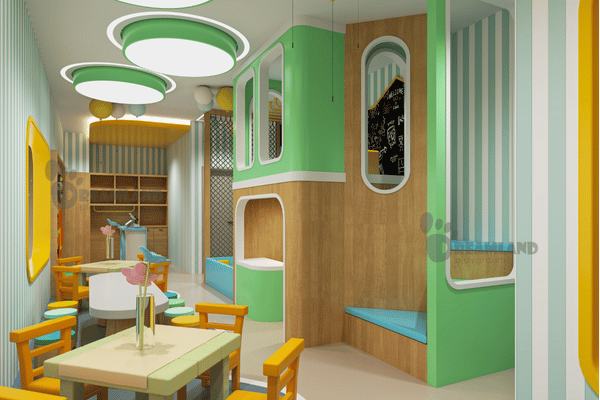
Space Per Child and the Multipurpose Room Trap
Pennsylvania requires outdoor or indoor play space measured at 65 square feet per child, with 40 square feet per infant and 50 square feet per young or older toddler. The same rule states that play space may not be used at the same time for another business, commercial, social or other purpose unrelated to the child care being offered.
A multipurpose room does not count toward the play space requirement if it is doing another job in the same session.
Your state’s number will differ from Pennsylvania’s, but its structure rarely does: a square-footage floor plus a dedicated-use condition. We size the layout against your own agency’s figure, which is why we ask for your state before the first drawing.
Total Project Timeline
| Stage | Time | What it covers |
|---|---|---|
| From order to ready for shipment | 3 to 6 weeks plus your approval time | The 15 to 30 working day production window, after the quotation and 3D steps in the specification table |
| Ocean freight and clearance | 3 to 6 weeks at sea, 1 to 3 weeks in customs | Published import-route timeline, outside our production window |
| Whole project, small | 10 to 14 weeks | Design start to installed, on the published import-route timeline |
| Whole project, large | 14 to 20 weeks | Same basis, several hundred square metres |
Freight, customs clearance and ground delivery sit outside the production window, so our quotation covers the whole chain rather than the production figure alone.
COMPLIANCE & PROTOCOL
Safety Standards, Certification Scope and Inspection
The certification seal a buyer is shown often does not cover the structure being bought. What decides an inspection is which standard governs the structure in your room and what that standard leaves out, because the gap is where an operator gets caught.
| Standard | Ages covered | Equipment type | Key exclusions | Market |
|---|---|---|---|---|
| ASTM F1487-25 | 2 to 12 | Public playground equipment | Soft contained play, children 6 to 24 months, home equipment | United States |
| ASTM F2373-24 | 6 to 23 months | Public use play equipment for infants and toddlers, naming early care and education facilities and indoor classroom settings | Soft contained play, at clause 1.5 | United States |
| ASTM F1918-21 | 2 to 12 | Soft contained play equipment | Public playground equipment, home use, sports, amusement rides, water play, toys | United States |
| ASTM F1292-22 | Not age banded | Impact attenuation of surfacing within the use zone | Applies to dry materials under laboratory conditions, as set out in its own scope | United States |
| EN 1176-1:2017+A1:2023 | All children, no age banding | Permanently installed public playground equipment and surfacing | Toys under EN 71, adventure playgrounds other than commercially sourced equipment, electricity and water play | Europe |
| CPSC Publication 325 | Not a standard | Public playground safety handbook, guidance only | Carries no conformance clause of its own | United States |
The Gap Nobody Publishes
Soft contained play for children under 2 sits outside all three ASTM equipment standards at once: F1487-25 excludes soft contained play and 6 to 24 months, F2373-24 excludes soft contained play, and F1918-21 starts at the 5th percentile 2 year old.
That combination is exactly the padded infant room a daycare buys first, so anyone claiming an ASTM conformance mark for an under-2 soft play structure is describing something the three scopes do not offer.
We design those elements to the general EN 1176-1 framework and to your own licensing rule, and we say so on the drawing rather than in a footnote.
What an IPEMA Seal Covers
The certification program published by IPEMA covers a defined list, and the list is shorter than most buyers assume.
- Its program covers ASTM F1487-25, with clauses 7.1.1, 10, 11.2, 11.3, 13.1.1, 13.1.2, 13.2 and 13.3 excluded, together with CSA Z614:20 Update No. 1, ASTM F1292-22, F3351-19e1, F2075-20 and F3012-22.
- There is no IPEMA program for ASTM F1918 and none for ASTM F2373, so a soft contained play structure or an infant and toddler unit cannot carry that seal for those standards.
- Those exclusions are individual subsections, so a seal can reference F1487-25 while specific requirements inside it were never validated.
- The seal also says nothing about how the equipment was assembled on your site, which is the half an inspector can see.
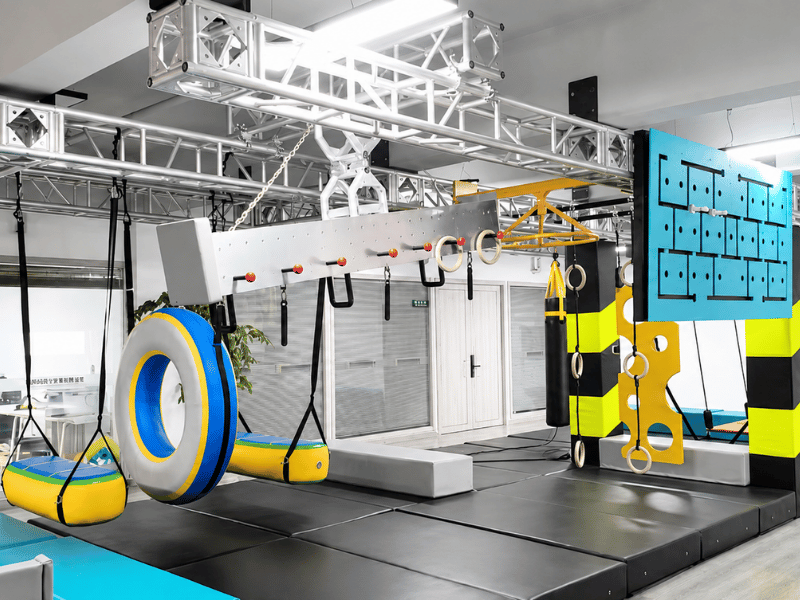
What the Inspector Actually Checks
Daycare playground requirements are written in two places at once: your state licensing regulation and the standard the equipment was built to. Caring for Our Children Basics 6.2.5.1, the national early care standard hosted by the Administration for Children and Families, sets out a daily inspection that is entirely about condition rather than paperwork.
- Missing or broken parts, protruding nuts and bolts, visible cracks, handhold stability, rust, chipped paint, peeling surfaces, sharp edges, splinters and rough spots
- Stability of large equipment such as playhouses even where it is not anchored
- Wear and deterioration, and vandalism or trash
Separately, clause 6.2.3.1 requires climbing equipment to stand on shock-absorbing material covering more than the equipment’s own footprint
Behind it sit 45 C.F.R. §98.41(a)(1)(v), requiring state rules on building and premises safety including identification of and protection from hazards, and Head Start §1302.47(b)(1), requiring facilities designed to prevent child injury and kept safe by ongoing preventative maintenance.
How Every Order Is Checked
- Drawing review against the age register and the clear dimensions of your room, before production is released.
- First-article check on structural components against the approved drawing, by our own quality control team.
- Component check against the packing list, so every part on the drawing is in the container before it is sealed.
- Detailed installation drawings and the technical manuals ship with the equipment, so the crew on site builds from the same drawing we produced against.
Book a factory visit at our Wenzhou plant
if you would rather see the quality control process than read about it.
How We Work
STEP 01 Send your room
A DWG or PDF floor plan, or the length, width and clear ceiling height, with the ages using the space.
STEP 02 Layout and quotation
Costed quotation and first layout, fall zones already drawn on the plan.
STEP 03 3D design
Full 3D of your room, revised until you approve it, free on our standard model library.
STEP 04 Production
In our own plant with our own production team, starting at drawing approval.
STEP 05 We carry the drawing
Anything not matching the approved drawing is remade before it ships, against the criteria set at first-article check.
STEP 06 Shipping and installation
Quoted separately: build from our drawings with your own crew, or have our technicians on site.
CORPORATE PROFILE & CAPABILITIES
Who We Are and Who We Build For
The Entity Behind the Quotation
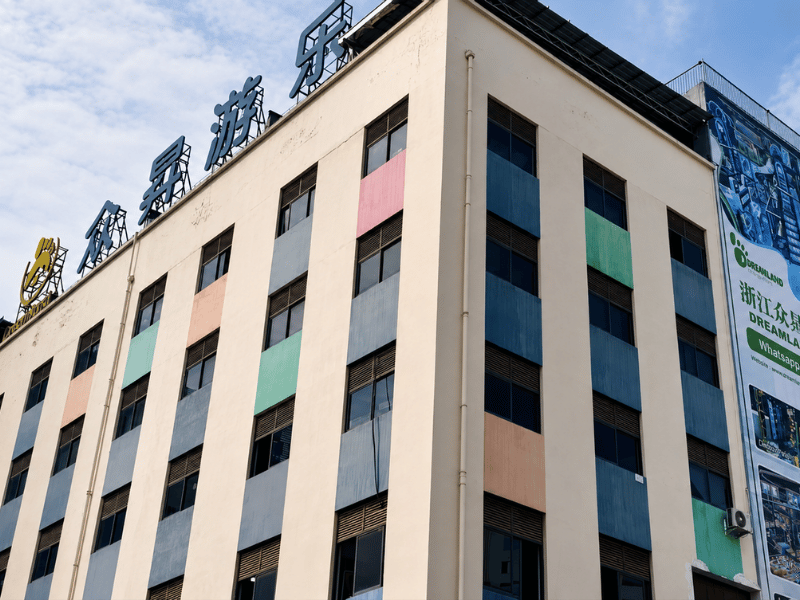
- Zhejiang Dreamland Co., Ltd, trading as DreamlandPlus
- Manufacturing facilities located at Xiaojing’ao Industrial Zone, Xiaojing Community, Qiaoxia Town, Yongjia County, Wenzhou City, Zhejiang Province, China
- Clients in more than 50 countries
- Our own production team and our own quality control process, rather than a brokered supply chain
- A factory visit at our Wenzhou plant, by appointment
- One-year warranty from the date of purchase on every product
Book a visit to the Wenzhou plant
and check the entity above against the building it operates from.
Sites We Build For
Daycare and Child Care Centers
Indoor rooms, infant and toddler zones and outdoor yards, designed to the licensing rule of the state the center operates in.
Preschools and Early Childhood Programs
Classroom-scale play equipment for 2-5 years, sized to the clear ceiling and to the sightlines that let one member of staff encourage free movement between zones from a single standing position.
Faith Centers and Community Halls
Rooms that carry a play area alongside other uses, where the dedicated-use condition in the licensing rule decides the layout.
Entertainment Venues, Hotels and Resorts
Larger indoor playground builds, trampoline parks and adventure park elements for operators running paid open-play sessions.
Related Guides
DOC.01
Age-Based Zone Design
How to split one mixed-age room into zones that satisfy two different equipment standards without having to buy two of everything.
DOC.02Daycare Licensing Requirements
What a licensing inspector actually checks on a play area, which rules are federal, and which square-footage figure your own state applies.
DOC.03Preschool Sensory Play Design
Designing sensory walls and tactile panels that survive daily cleaning and still build fine motor skills and creativity.
DOC.04Daycare Soft Play Setup
Setting up a contained soft play room for infants and toddlers, including the under-2 standards gap and how to document it.
Daycare Play Area Design Engineering Tools
T.01
Room Size and Children Served Calculator
Calculate usable play area and maximum child capacity based on your room dimensions and local licensing rules.
Launch Tool T.02Age Band and Standards Selector
Identify governing safety standards, equipment types, and critical exclusions by selecting your target age groups.
Launch Tool T.03Landed Cost Calculator
Estimate total project import costs including equipment, freight, duties, and local logistics to your site.
Launch Tool T.04Daycare Cost Calculator
Project your overall indoor playground investment based on footprint, structure height, and safety surfacing.
Launch Tool
SYSTEM / REQUIREMENT
Send Your Room and Get a Layout Back
A floor plan, the ages using the space and your state are enough for a first layout and a costed quotation within 24 hours. If you have no drawings, the room’s length, width and clear ceiling height will do.
A costed quotation and a first layout come back within 24 hours, and a factory visit at our Wenzhou plant is available by appointment.
Daycare Play Area Questions We Are Asked Most
FAQ / KNOWLEDGE BASEYes, and in most licensing frameworks indoor play space counts toward the required play area exactly as outdoor space does. Pennsylvania measures either at 65 square feet per child, so an indoor playground is licensed play area rather than a bonus amenity, with a dedicated-use condition attached: the space cannot be doing another job at the same time.
Published figures run from about $16,476 for a daycare package to $120,300 for an itemised kindergarten project including installation, surfacing and freight. Play & Park publishes about $1,000 per child as a sanity check before a drawing exists. Your own number turns on footprint, age bands, structure height and fall surfacing area.
For a licensed child care center the controlling document is your state licensing regulation rather than a playground permit; it sets space per child, dedicated use and inspection duties. Building work on the room follows local building and fire code for the occupancy classification, a separate approval. Drawings and material specifications go out for both.
At age five you buy against ASTM F1487-25, which covers public playground equipment for ages 2 to 12, so indoor playsets built for home use are the wrong category however sturdy they look. A deck at climbing height with a tube slide, a climber panel and a role-play unit underneath covers gross motor, imaginative and social play in one footprint, and keeping the fall height low enough for your existing surfacing avoids a floor replacement.
The quotation covers design, production, packing and the trade term you select, and installation drawings and technical manuals ship with the equipment. Installation support is quoted separately, so you can build from our drawings with your own crew or bring our technicians on site. Surfacing is its own line item because the layout sets the fall zone area.
There is a one-year warranty from the date of purchase on every product, and anything measuring outside the approved drawing is remade against the acceptance criteria set at first-article check. Because the installation drawings ship with the equipment, a discrepancy is settled against the drawing on site rather than by email.