Get in touch with Dreamland Playground Company

Indoor Playground Franchise Guide: Costs, ROI and Brands Compared (2026)
An indoor playground franchise runs $482,000 to $2,500,000 in total investment, and that span is two brands’ separate ranges rather than a sector figure. Not one of the eight franchisors checked publishes its initial franchise fee. That complete number lives in the Franchise Disclosure Document, which four US states publish free.
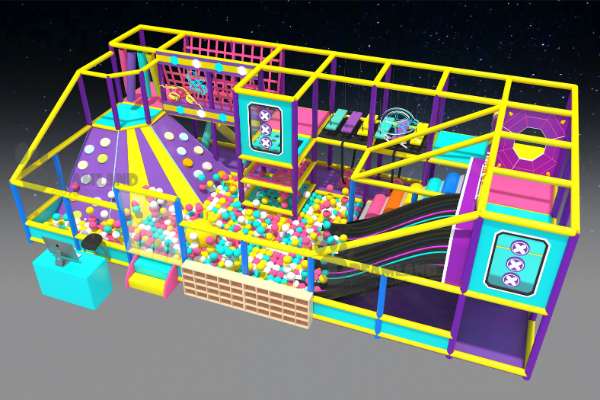
Send a floor plan or a rough sketch and our design team returns a layout concept and a written quote within 24 hours.
Get a Free Layout Concept and Quote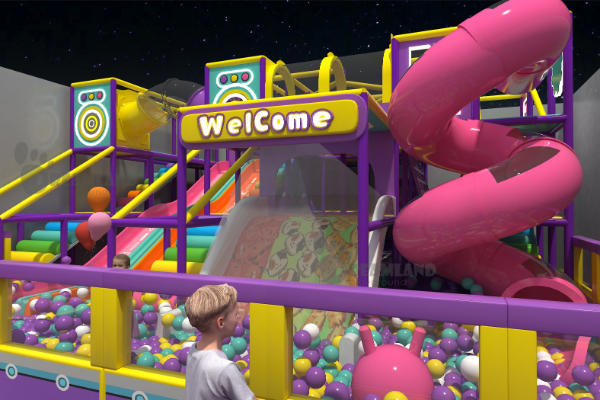
Every published number this guide verified
Total investment $600,000–$2,500,000 (Luv 2 Play); $482,000–$759,000 (Play Street Museum)
Ongoing fees 6% royalty plus 3% brand fund (Luv 2 Play)
Average unit revenue $360,309 a year, Item 19 (Romp n’ Roll)
Qualification threshold $1,500,000 net worth, $750,000 liquid (Urban Air)
Fee Transparency Not one of the eight publishes an initial franchise fee
Franchise Brands and Disclosure Data
- Eight brands checked on their own franchise sites
- ///
- Zero publish an initial franchise fee
- ///
- Four states publish the full disclosure free
- ///
- Royalty math carried out to ten years
- ///
Indoor Playground Franchise Investment at a Glance
Six numbers decide whether an indoor play franchise works for you. Public sources supply two; the other four are disclosed only inside the Franchise Disclosure Document, which a franchisor must hand you at least fourteen days before you sign or pay anything.
Initial franchise fee — one-time licence payment, Item 5.
Total initial investment — every cost from signing to opening day, Item 7.
Royalty — running percentage of your revenue, Item 6.
Brand or advertising fund — a second running percentage, also Item 6.
Financial performance — revenue, sometimes profit, for existing locations, Item 19.
Outlet turnover — three years of openings, closures, transfers and terminations, Item 20.
Total investment published
$482,000–$759,000 and $600,000–$2,500,000, the only two ranges publishedInitial franchise fee published
None of the seven brands with a reachable pageRoyalty published
6% of gross revenue, one brandBrand fund published
3% of gross revenue, one brandUnit revenue published
$360,309 a year, one brand, Item 19Free disclosure access
Four state registries, no account requiredREGULATORY DISCLOSURE NOTE
Four of those six sit on no website for a regulatory reason rather than an evasive one: US franchise law puts the disclosure obligation in a document handed to a qualified prospect, never on a marketing page. Buyers who budget from the two public numbers discover the gap weeks into a sales process.
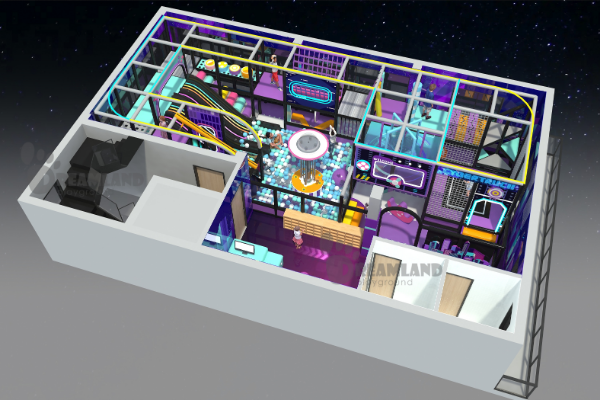
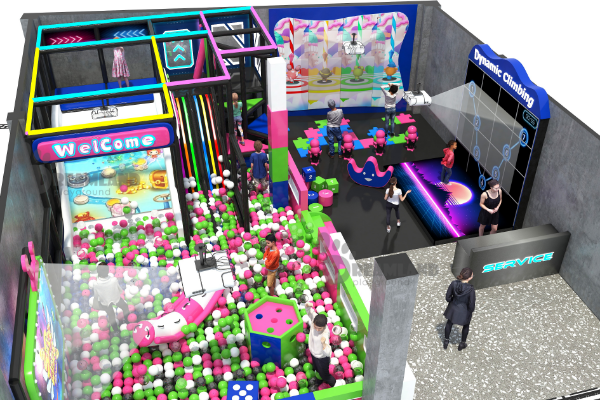
How to read thirty blank cells
What the brand publishes
One number, usually net worth
What it actually tells you
A capital filter, not a cost estimate
What the brand publishes
Two numbers, a low-to-high range
What it actually tells you
Its smallest and largest formats; your site lands inside that range on square footage and local build cost
What the brand publishes
A revenue figure under Item 19
What it actually tells you
Top line across reporting outlets, silent on rent, payroll, debt service and owner earnings
“Just tell me the franchise fee.”
It is the line least likely to decide the outcome. At any revenue above $200,000 a year, $35,000 at a combined 9% costs you more by year four than $60,000 at 5%, so ask for the fee and the revenue share together.
Named Indoor Playground Franchise Brands Compared
Eight indoor play and family entertainment brands were checked on their own franchise pages in August 2026. Seven returned a readable page; one did not respond. Everything below is what each brand shows you before you fill in a contact form.
| Brand | Total investment | Franchise fee | Royalty | Brand fund | Other figures on the page |
|---|---|---|---|---|---|
| Luv 2 Play | $600,000 – $2,500,000 | Not published | 6% | 3% | Not published |
| Play Street Museum | $482,000 – $759,000 | Not published | Not published | Not published | Not published |
| Romp n’ Roll | Not published | Not published | Not published | Not published | $360,309 average unit revenue, Item 19 |
| Urban Air Adventure Park | Not published | Not published | Not published | Not published | $1,500,000 net worth and $750,000 liquid required |
| We Rock the Spectrum | Not published | Not published | Not published | Not published | 213 destinations across 35 states and 8 countries |
| Little Diggers | Not published | Not published | Not published | Not published | Footprint from around 1,000 sq ft |
| Launch Entertainment | Not published | Not published | Not published | Not published | Not published |
| Ninja Nation | Franchise page returned no content when checked | ||||
Franchise vs Independent Indoor Playground
The choice is not brand versus no brand. It is whether you buy a proven operating system with a permanent revenue share attached, or build your own system and keep every dollar of margin. US franchise sales run under the Federal Trade Commission’s Franchise Rule, which governs what must be disclosed before you sign, not what support arrives afterwards.
| Decision area | Franchise route | Independent route |
|---|---|---|
| Upfront licence cost | Initial franchise fee, Item 5, paid before you open | None |
| Ongoing revenue share | Royalty plus brand fund, for the life of the agreement | None |
| Equipment sourcing | Often restricted to approved suppliers at approved prices | Open tender; you pick the manufacturer and negotiate directly |
| Floor plan and theme | Prescribed by the brand standard | Designed around your building, market and budget |
| Opening playbook | Supplied: training, launch marketing, operating manuals | You build it, or hire consultants to build it |
| Territory protection | Contractual, worth exactly what Item 12 says | None, and none needed |
| Exit | Transfer subject to franchisor approval and transfer fees | Sell to any buyer on any terms |
| Where your risk sits | Execution risk shared; the revenue share never falls | All execution risk yours; cost base under your control |
| Format | Site constraint that binds first | Capital level |
|---|---|---|
| Toddler and preschool soft play | Floor area, from around 1,000 sq ft | Lowest |
| Family entertainment centre | Kitchen, licensing and amusements stacked on the play area | High |
| Trampoline and adventure park | Ceiling height and structural loading, not floor area | Highest |
| Sensory-inclusive play | Staffing model and equipment specification | Mid |
| Mall and hotel play area | Landlord fit-out rules and opening hours | Mid |
Four situations where the franchise route wins
Financing is your binding constraint.
A filed disclosure document with an Item 19 gives a lender operating numbers to underwrite.
You will not run it daily.
Manuals, staff training and marketing calendars are what a hired manager executes from.
Your catchment already knows the brand.
Launch traffic arrives without you buying it, which is worth a royalty.
You want a defined path, not a design project.
Prescribed formats remove hundreds of theming, layout and pricing decisions.
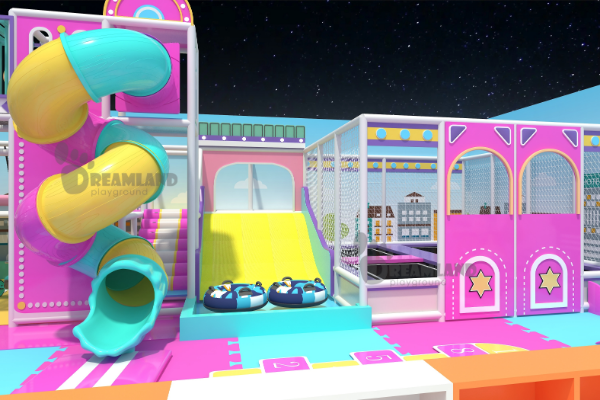
“Going independent means figuring everything out alone.”
That was true when suppliers only sold boxes. An independent build now buys space planning, floor plan design, 3D design and installation support from the manufacturer as a one-time cost; what a franchise still adds is the brand name, launch marketing and the operations manual.
Cost Line
What Drives It
Published Figure Available
Initial franchise fee
Brand licence, territory, opening support
None of the eight brands publishes it
Real estate and deposits
Square footage, ceiling height, local lease rates
Site specific, unpublished
Build-out and fit-out
Floor levelling, HVAC, electrical, fire systems, restrooms
Site specific, unpublished
Play equipment
Structure volume, level count, ninja courses, trampoline area
Quotable from a floor plan; unpublished by brands
Furniture, party rooms and cafe
Whether the format includes food service
Site specific, unpublished
Point of sale, booking and signage
Brand-mandated systems in a franchise
Unpublished
Insurance, licences and permits
Jurisdiction and format
Unpublished
Opening working capital
Payroll and marketing until revenue stabilises
Unpublished
SYSTEM.TOTAL_ESTIMATES
Total, low end
Smallest published format
$482,000 (Play Street Museum)
Total, high end
Largest published format
$2,500,000 (Luv 2 Play)
Ongoing Fees and the Ten-Year Cost of a Royalty
The initial fee is paid once and is easy to reason about. Royalties compound, and that is the number prospects consistently under-model. One brand publishes both rates: a 6% royalty plus a 3% brand fund, so 9% of gross revenue leaves the business before rent, payroll or loan repayments.
| Years open | Cumulative revenue | Royalty at 6% | Brand fund 3% | Combined outflow |
|---|---|---|---|---|
| 0 yr | $0 | $0 | $0 | $0 |
| 0 yrs | $0 | $0 | $0 | $0 |
| 0 yrs | $0 | $0 | $0 | $0 |
| 0 yrs | $0 | $0 | $0 | $0 |
| 0 yrs | $0 | $0 | $0 | $0 |
| 0 yrs | $0 | $0 | $0 | $0 |
Two published inputs from two different brands: the 6% and 3% rates from Luv 2 Play, applied to the $360,309 Item 19 average from Romp n’ Roll, held flat. Treat it as arithmetic, not a forecast. That revenue figure carries no disclosure year on the brand’s live page and an older indexed copy showed $410,255, which is why you read the current disclosure document rather than a summary.
What that total is worth comparing against_
Across ten years the running fees reach $324,278 — two-thirds of the entire low-end investment of $482,000, and paid whether the location is profitable or not.
One franchisee complaint in the FTC franchise issue spotlight describes additional fees rising 3% → 5% → 7% → 10% → 14%, charged on top of the royalty.
Booking, point of sale and reporting platforms are frequently mandated and separately billed; one documented complaint describes a $75 monthly charge on top of the royalty.
Where purchasing is restricted, complaints describe approved-vendor pricing running 15% to 30% above open-market retail, including an $80,000 gap on a single equipment package.
Complaints describe a 4.5% advertising fee with no accounting provided, and a 2% brand fund with no reporting to contributors. Item 11 is where that reporting obligation is, or is not, written down.
Ceasing to trade does not necessarily end the obligation; some contracts run royalties until the term expires or a settlement completes.
Early termination can require a lump sum calculated from the royalties the franchisor expected to receive. Item 17 holds the termination and transfer terms.
Payback Timeline and the Numbers That Drive It
No brand in this review publishes a payback period. What can be built is the arithmetic, with every assumption visible so you can substitute your own figures.
The payback formula, with the unknown marked
Annual revenue: the one published figure is $360,309, an undated Item 19 average from a single brand
Fees: 9% of revenue, or $32,428 a year at that level
Operating margin before fees: you supply this — it turns on rent, payroll and party mix at your site
Annual cash: revenue × margin, minus fees
Payback in years: total investment ÷ annual cash
| Operating margin | Annual cash | Payback ($482k) | Payback ($600k) | Payback ($2.5M) |
|---|---|---|---|---|
| 10% | $3,603 | Over 100 years | Over 100 years | Over 100 years |
| 15% | $21,618 | 22.3 years | 27.8 years | Over 100 years |
| 20% | $39,634 | 12.2 years | 15.1 years | 63.1 years |
| 25% | $57,649 | 8.4 years | 10.4 years | 43.4 years |
| 30% | $75,665 | 6.4 years | 7.9 years | 33.0 years |
Model, not a forecast. Revenue held flat at the single published Item 19 average; investment figures from two different brands; debt service, owner salary and tax excluded.
Five-year survival: the clock your payback races
| Years after opening | Arts, entertainment & recreation | All private sector | Difference |
|---|---|---|---|
| 1 year | 81.3% | 80.9% | +0.4 pts |
| 2 years | 77.6% | 72.3% | +5.3 pts |
| 3 years | 70.3% | 63.6% | +6.7 pts |
| 4 years | 67.2% | 57.2% | +10.0 pts |
| 5 years | 57.1% | 51.4% | +5.7 pts |
Bureau of Labor Statistics, Business Employment Dynamics, establishment survival, NAICS 71 against total private. This sector beats the average every year, and roughly four in ten still close by year five — franchised and independent alike. Any payback longer than five years is racing that curve.
⚠ RISK.ANALYSIS
Does the franchise badge lower your risk?
The Federal Trade Commission examined 66,291 Small Business Administration loans: franchised borrowers defaulted at 3.9%, non-franchised at 3.5%. Those two borrower populations are not identical, so this does not settle the question — but it does undercut the claim that a franchise agreement removes business risk.
What the model is telling you
SYS.ACT
Every acceptable payback needs both an operating margin at or above 20% and an investment at the bottom of the published range. A large-format build against the one published revenue figure does not pay back inside a normal lease term.
SYS.ACT
Revenue is the lever, not cost. Halving equipment spend moves payback less than a 30% revenue lift does; parties, memberships and repeat weekday traffic are where that lift comes from.
SYS.ACT
Never accept a payback claim without the margin assumption underneath it. Our indoor playground profit margin data sets out what that assumption runs at by operating model and venue size.
Substitute your own rent, revenue and margin in the break-even model, then request a quote so the equipment line becomes a number instead of an assumption.
Working With Dreamland Playground
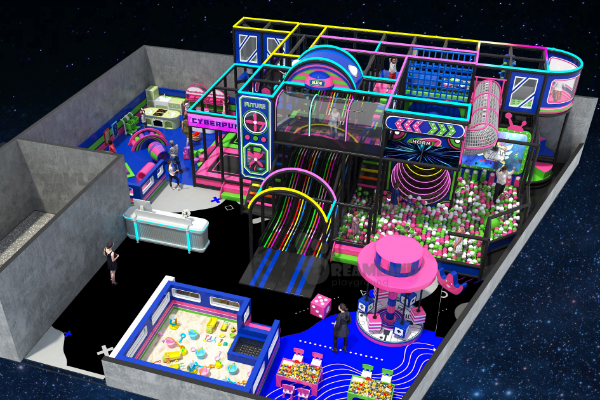
Dreamland Playground does not sell franchises. We are a manufacturer and project partner for playground operators, with no licence fee, royalty or territory agreement anywhere in what we do. Our work runs from the first idea to the final installation, covering space planning, floor plan design, 3D design, production, shipping and installation support, for operators in more than 50 countries.
Send space plan
— a floor plan, survey drawing or dimensioned sketch, plus the target age group.
Receive layout
— our own design team returns a layout concept and a written quote within 24 hours.
Approve 3D design
— you see structure, circulation and sightlines before anything is produced.
Enter production
— our own production team manufactures the structure under our quality control process.
Confirm shipping
— we ship FOB and coordinate the loading plan against your site access.
Build w/ support
— every project ships with an installation manual, and we support your build.
SYSTEM.CRITICAL
Before we draw anything we ask for three things: the ceiling height, the column grid and the target age group. A layout that ignores any one of those gets rebuilt on site, and rebuilding on site is the most expensive way to discover a design problem.
Production lead time
Standard projects 30-45 days; larger or more complex builds 45-60 days.
Payment and shipping
30% deposit, balance before shipping, FOB. Terms confirmed in writing on the quote.
Minimum order
One complete project. We do not sell single components separately.
Safety requirements
Products can be designed to relevant EN and ASTM requirements depending on product type and market — EN 1176 for Europe, ASTM F1918 for US soft contained play.
Age-appropriate design
Structure height, net aperture, platform spacing and slide geometry follow the target age group. A six-to-twelve layout is not a toddler layout scaled down.
Sample room check
Structures are assembled in our sample room before shipping, so a fit problem is caught in our building rather than yours.
Dreamland Playground Team
“Equipment has to come from the franchisor, that’s the deal.”
Item 8 settles that rather than assumption. That restriction buys a brand-consistent fit-out signed off by the franchisor and costs you the ability to tender the largest single line in your budget — and play equipment sits outside the restricted list more often than buyers expect.
Franchise & Investment Evaluation Tools
Professional assessment utilities for indoor playground operators and investors.
Franchise Investment & Operations
Explore professional insights tailored for facility operators and investors. These resources provide strategic financial breakdowns and operational comparisons to support your commercial project planning.
Franchise Cost Breakdown
Analyze the essential capital requirements, ongoing expenses, and potential hidden fees associated with establishing an indoor playground. This breakdown helps operators structure an accurate financial model.
Read ArticleFranchise vs Independent
Compare the operational autonomy of an independent facility against the structured support of a franchise system. Evaluate which approach aligns optimally with your commercial development goals.
Read ArticleStart Your Indoor Playground Project
Whichever route you choose, the equipment line can be priced today, and one floor plan is enough to start.
Layout concept and written quote within 24 hours.
Get a Free Layout Concept and QuoteWhat to send with your enquiry
- Your floor plan or dimensions — survey drawing, architect's plan, or a measured sketch
- Ceiling height and column positions, the two constraints that decide what fits
- The target age group: toddlers, school age, teenagers, or mixed
- Destination market, so design starts against the right safety requirements
- Opening date, so production and shipping schedule backwards from it
Indoor Playground Franchise FAQ
Crucial data and direct answers to help you navigate investment choices, space requirements, and equipment planning.
GET PROJECT CONSULTATIONHow much does an indoor playground franchise cost?
Two brands publish a total investment range: Luv 2 Play at $600,000 to $2,500,000 and Play Street Museum at $482,000 to $759,000. None of the eight publishes an initial franchise fee, and the complete breakdown is disclosed in Item 7.
What is inside a Franchise Disclosure Document?
A standard 23-item document a franchisor must give a prospect before any signature or payment. Items carrying money are Item 5 (franchise fee), Item 6 (recurring fees), Item 7 (total investment), Item 19 (financial performance) and Item 20 (outlet turnover).
Where can I read a Franchise Disclosure Document for free?
California, Indiana, Minnesota and Wisconsin operate public franchise registries that return filed documents without an account or a fee. Brands only appear in a state registry where they registered to sell franchises.
What royalty do indoor play franchises charge?
One brand publishes its rate: 6% royalty plus a 3% brand fund. Against the single published Item 19 average of $360,309, that 9% is $32,428 a year and $324,278 over ten years.
Is a franchise lower risk than an independent build?
A Federal Trade Commission review of 66,291 Small Business Administration loans found franchised borrowers defaulting at 3.9% against 3.5% for non-franchised borrowers. On that dataset the franchise badge did not reduce lending risk, though the two populations are not directly comparable.
What size space does an indoor play area need?
Format decides it. Toddler concepts operate from around 1,000 sq ft, while family entertainment centres and trampoline parks need larger floor areas and greater ceiling height, which is usually the harder constraint.
How long does custom playground equipment take to produce?
Standard projects run 30-45 days in production and larger or more complex builds run 45-60 days. We confirm the production window in writing on the quote so it schedules against your fit-out programme.
Does DreamlandPlus sell franchises?
No. We do not sell franchises, licences or territories, and there is no franchise fee or royalty to pay us. We manufacture the equipment and support the project, whether you are opening an independent centre or a location under someone else's brand.