Get in touch with Dreamland Playground Company

The Mall FEC Revenue Model is a planning worksheet that helps a mall owner, investor, or operator separate the income lines of a family entertainment center before design and lease decisions become fixed. For a mall project, that means treating admissions, parties, memberships, food and beverage, retail, game cards, and space capacity as separate inputs instead of one blended sales number.
This article is for early planning. It can help you build a cleaner mall entertainment center revenue model, prepare better questions for a design partner, and avoid the common mistake of turning mall entertainment center revenue into a single-location profit promise.
Build the model before the attraction mix is locked. Once the floor plan, lease area, party rooms, food counter, storage, and arcade footprint are fixed, the operator has fewer ways to correct a weak revenue mix. Early modeling gives the team a chance to ask whether the design supports the intended ticket products, whether party rooms can turn at the planned pace, whether memberships will help quiet periods, and whether add-ons can be sold without slowing guest flow.
A useful worksheet also makes disagreement visible. Leasing teams may focus on rent and destination value. Operators may focus on ticket sales and staffing. Parents may care about safety, cleanliness, visibility, and age fit. Investors may care about cash timing and sensitivity to weak demand. Putting these views into separate rows keeps the mall entertainment center revenue discussion grounded in decisions the team can actually test.
Scope limitation
This is a revenue planning model, not a profit, accounting, tax, lease, valuation, financing, or legal model. Investors should separately test fixed costs, variable costs, rent, common-area charges, labor, insurance, maintenance, startup costs, funding needs, break-even point, and accounting treatment before making a financial decision.
Quick Answer: What a Mall FEC Revenue Model Should Include
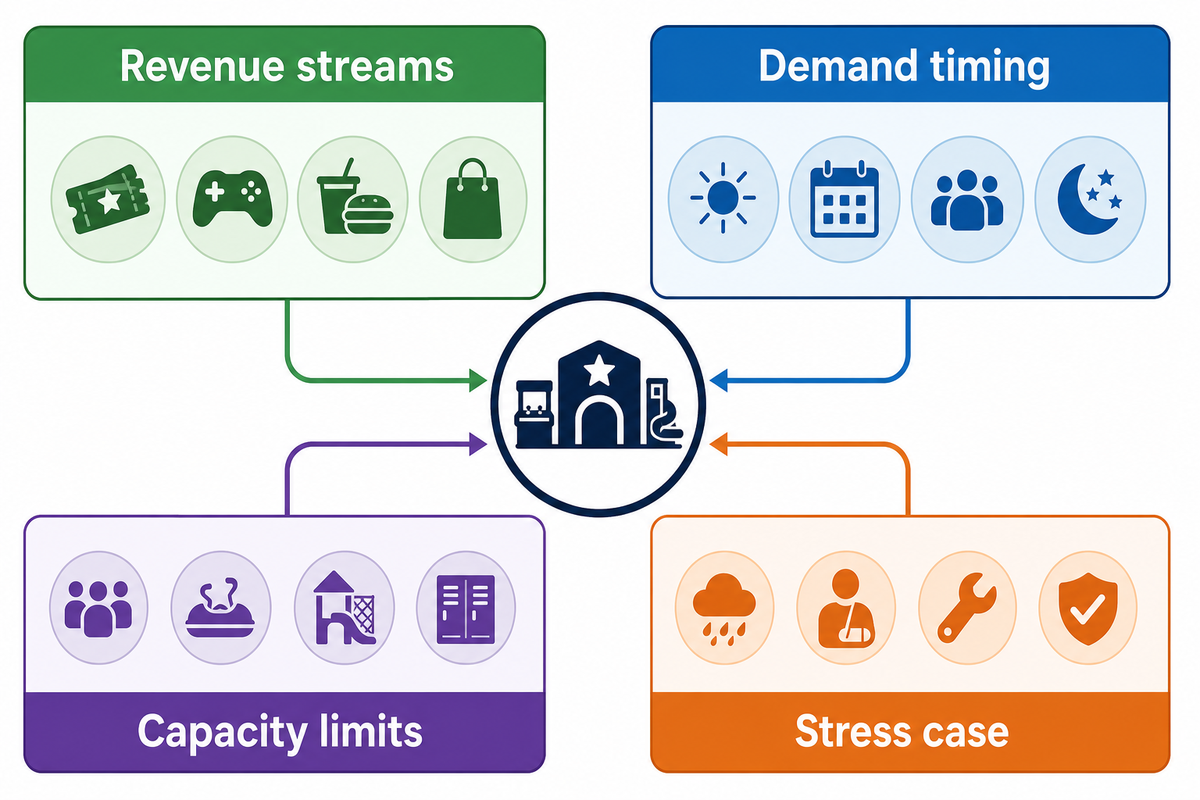
Your mall FEC revenue model should include ticket and admission income, party and group sales, recurring membership cash flow, food and beverage, retail items, game-card or attraction upcharges, and ancillary products. It should also show capacity limits, mall operating hours, target age groups, demand risk, labor pressure, lease pressure, and cash timing caveats.
IAAPA describes its entertainment center benchmark work as covering attractions, admissions, staffing, guest behavior, revenue generation, and expense management. That framing is useful because a family entertainment center isn’t only an attraction mix. It’s an operating system with sales channels, guest flow, staff capacity, party rooms, and local repeat demand.
Market research can add context, but it shouldn’t carry the model. Mordor Intelligence estimates a large and growing family entertainment center market, yet a 2024 family entertainment center market report, global family entertainment center market figures, market share, compound annual growth rate, forecast period, market size and forecast, entertainment center market trends, key growth drivers, fastest-growing revenue labels, FEC market summaries, strategic market framing, competitive landscape notes, or any other market analysis can’t prove that one mall project will convert local foot traffic into sustainable revenue. Useful questions are narrower: “Which revenue lines can this specific venue earn, at what capacity, and under what stress case?”
| Input | Why it matters | Boundary to keep |
|---|---|---|
| Admissions | Shows walk-in and time-slot demand. | Do not assume every mall visitor becomes a paid guest. |
| Parties | Turns rooms and staff into scheduled blocks. | Room turns and host labor cap the volume. |
| Memberships | May add recurring cash flow and repeat visits. | Peak crowding can reduce higher-yield sales. |
| Add-ons | Captures food, retail, lockers, socks, photos, and game upgrades. | Use attach-rate assumptions, not margin promises. |
Why Malls Evaluate FECs Differently From Standard Retail Tenants
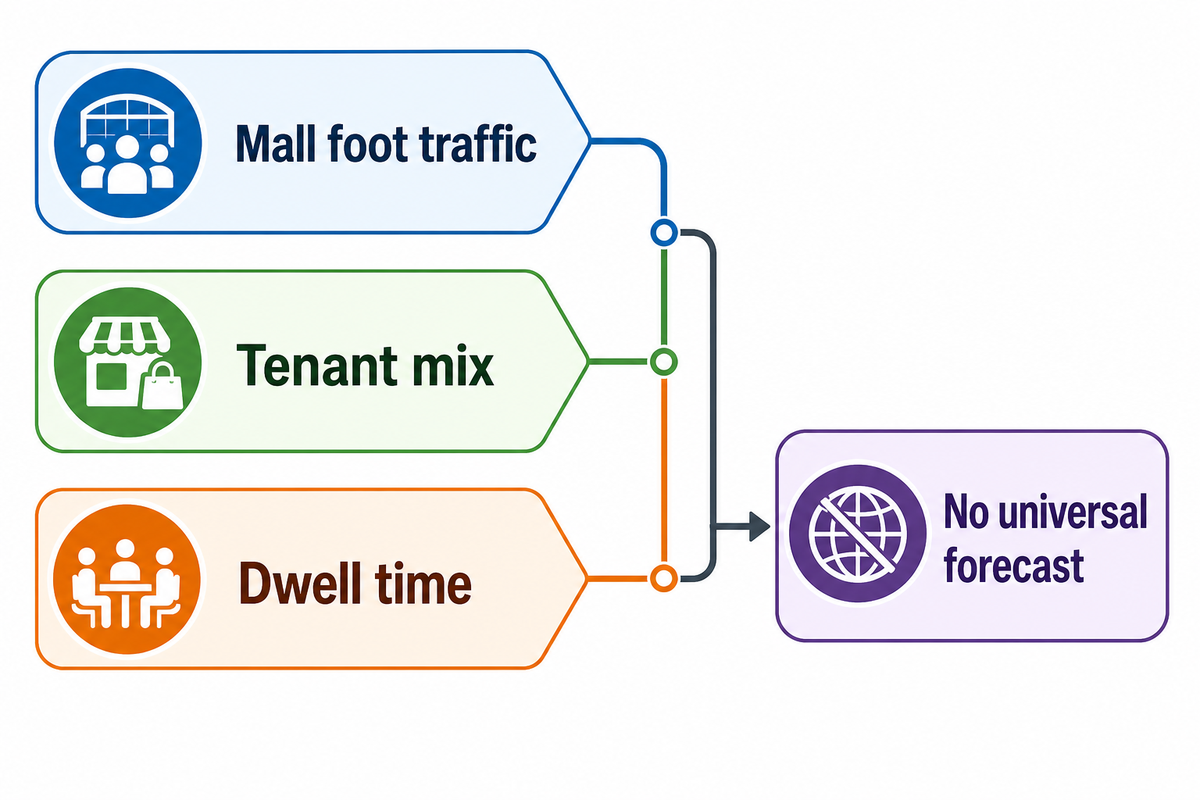
Standard retail tenants are often judged by rent, sales per area, brand fit, and leasing durability. A mall family entertainment center adds another layer. It may support visits, dwell time, family engagement, and cross-shopping, but it also brings noise, queueing, safety planning, cleaning, staffing, insurance, and peak-period crowd control.
ICSC has reported retailtainment examples where landlords discussed tenant mix, visit lift, dwell time, and retailers clustering near entertainment venues. Those are reported examples, not a universal forecast. For that reason, a mall entertainment center revenue model should show two views: what the operator may earn and what the mall may gain from stronger destination value.
That second view matters during leasing talks. If the FEC is expected to act as an experience anchor, the model should be clear about peak hours, weekday weakness, school-holiday demand, parent waiting time, party room booking patterns, and how families move from play to food, retail, or nearby stores. Mall foot traffic is helpful only when the project turns the right visitors into paying guests.
Planning rule
Treat retailtainment momentum as context. Don’t place reported landlord uplift figures directly into a mall FEC revenue model unless your lease, mall data, traffic counts, and conversion assumptions can support them.
The Mall FEC 5-Line Revenue Stack
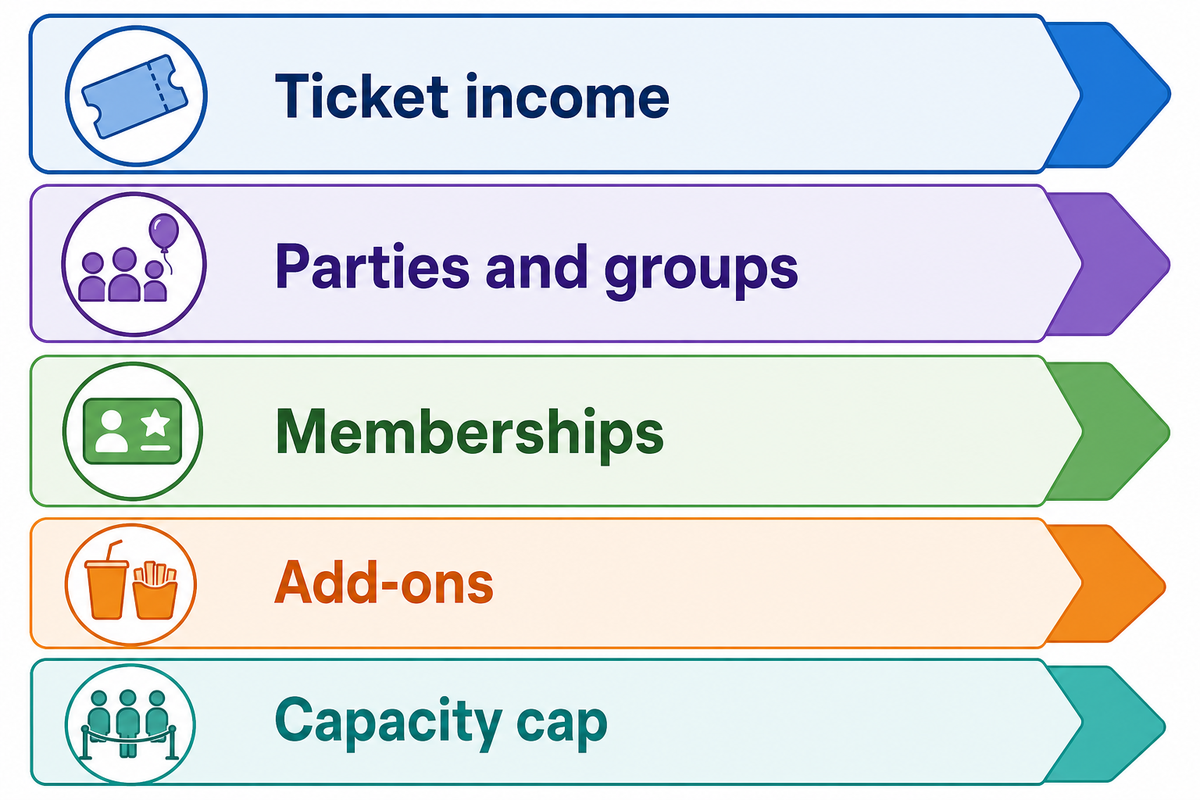
This Mall FEC 5-Line Revenue Stack is a planning worksheet. It separates operating revenue lines so the operator can test each one. It doesn’t prove profit, replace a family entertainment center business plan, or remove the need for cost, lease, and accounting review.
| Revenue line | Main driver | Planning question | Risk to test |
|---|---|---|---|
| Walk-in tickets | Mall traffic and conversion | How many visitors buy entry? | Low conversion on quiet weekdays |
| Timed slots and bundles | Peak-period control | Can the venue price peak demand without blocking families? | Capacity sold too cheaply at peak |
| Parties and groups | Room turns and hosts | How many scheduled blocks are realistic? | Food service or labor bottlenecks |
| Memberships | Repeat visits and renewal rules | Do members fill low periods or crowd peak hours? | High use with weak add-on spend |
| Add-ons and upcharges | Attach rate per guest | Which add-ons are easy to sell and operate? | Complex menu with low adoption |
This stack also help avoid one of the weakest claims in many FEC profitability articles: a single blended revenue assumption. Ticket products, party packages, memberships, and food service have different demand patterns. They shouldn’t be forced into one average sales-per-guest figure too early.
For example, a high average ticket value may hide low party-room use. Strong membership counts may hide peak-hour crowding. Busy arcades may hide weak birthday sales. Crowded weekends may hide the fact that weekdays can’t cover fixed staffing and rent pressure. The 5-Line Revenue Stack keeps each driver visible so the operator can decide whether the next fix is pricing, scheduling, layout, product mix, or sales process.
That stack is also a design conversation tool. If party sales are expected to carry a major part of the model, room access, food staging, storage, check-in, and cleanup paths need more attention. If admissions carry the model, entrance visibility, queue flow, price display, and age-zone clarity matter more. If memberships carry the model, the design must handle repeat users without making first-time guests feel crowded.
Ticket Income: Walk-Ins, Time Slots, Bundles, and Peak Periods
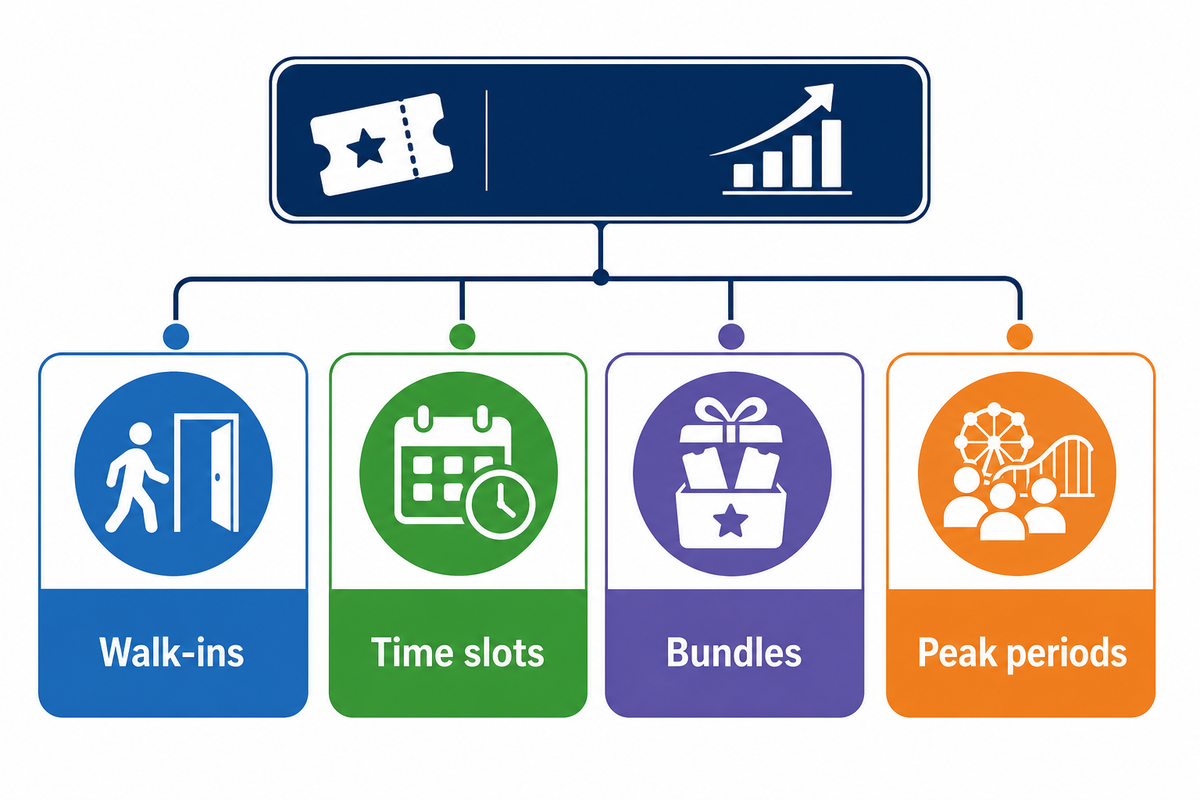
Ticket income is usually the most visible revenue stream because it connects directly to admissions. For a mall FEC, the operator should separate walk-in admission, booked time slots, family bundles, off-peak offers, school-day promotions, and attraction-specific upcharges. Trampoline zones, soft play areas, arcades, ninja courses, and laser tag rooms may not all share the same ticket logic.
Start the ticket worksheet with a simple formula:
Ticket revenue input
Paid admissions = mall visitor traffic x FEC visibility factor x visitor-to-guest conversion x average ticket value
Each variable should be editable. Venues beside a cinema or food court may have strong visibility, but the conversion rate may still fall if the entrance is hidden, the play zone looks too young for the target age group, the queue is unclear, or parents can’t see the activity mix quickly. Indoor entertainment revenue is often less about one perfect price and more about matching the ticket product to the mall’s traffic rhythm.
Party and Group Sales: Scheduled Revenue Blocks
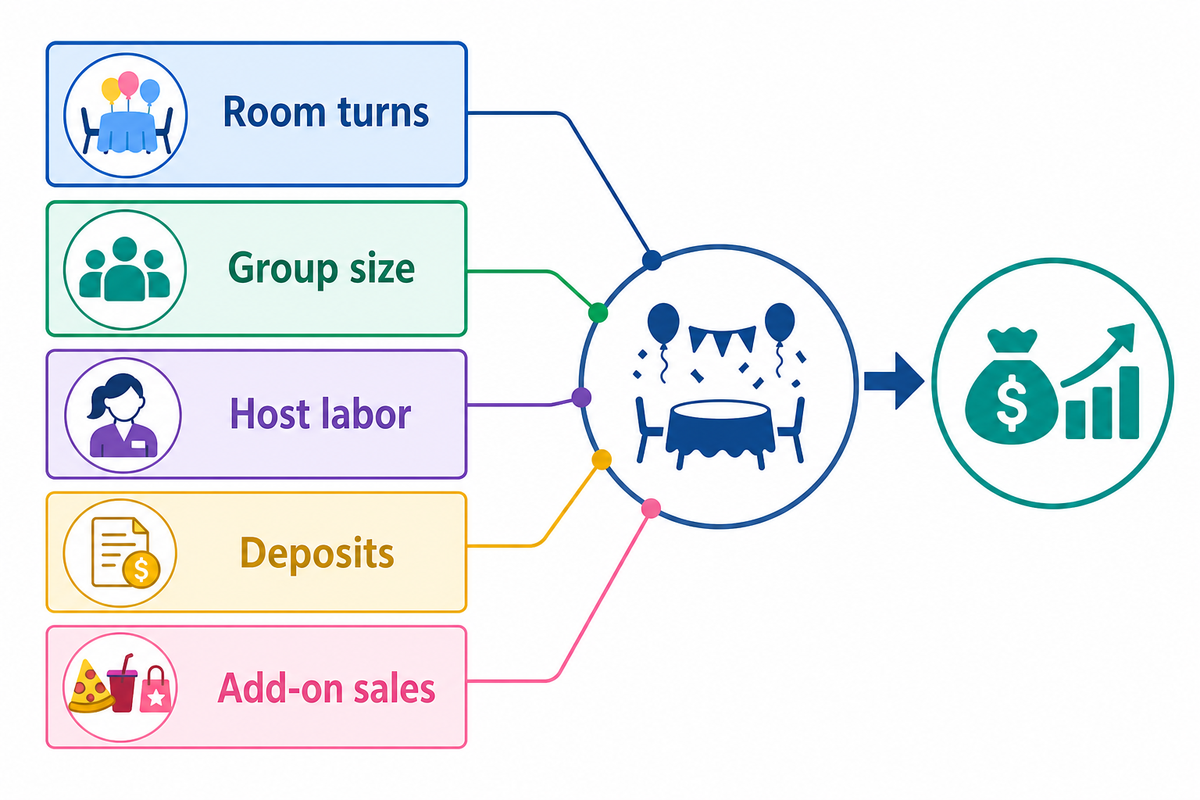
Party and group sales are different from ordinary admissions because they reserve capacity before the guest arrives. Birthday party packages may include entry, host labor, room time, food service, socks, gifts, photos, tokens, or arcade cards. School groups or corporate bookings may need a different check-in flow, safety briefing, and staffing plan.
How do birthday parties change FEC revenue?
Birthday parties change FEC revenue by turning open capacity into booked time blocks. Test room turns, group size, food service, host labor, cleaning time, deposits, and add-on sales together, because a full party calendar can still underperform if each block is priced or staffed poorly.
| Party input | Control question | Model risk |
|---|---|---|
| Room count | How many parties can run at once? | Overlapping guest flow |
| Room turn time | How long for setup, party, and cleanup? | Too many theoretical turns |
| Host staffing | How many hosts per party? | Labor pressure |
| Food package | Is food produced on site or ordered in? | Food delays hurt schedule |
| Deposit policy | What secures the booking? | No-show or late cancellation |
| Weekday group offers | Can quiet hours become group blocks? | Discounting without added volume |
Membership Income: Recurring Visits Without Overloading Capacity
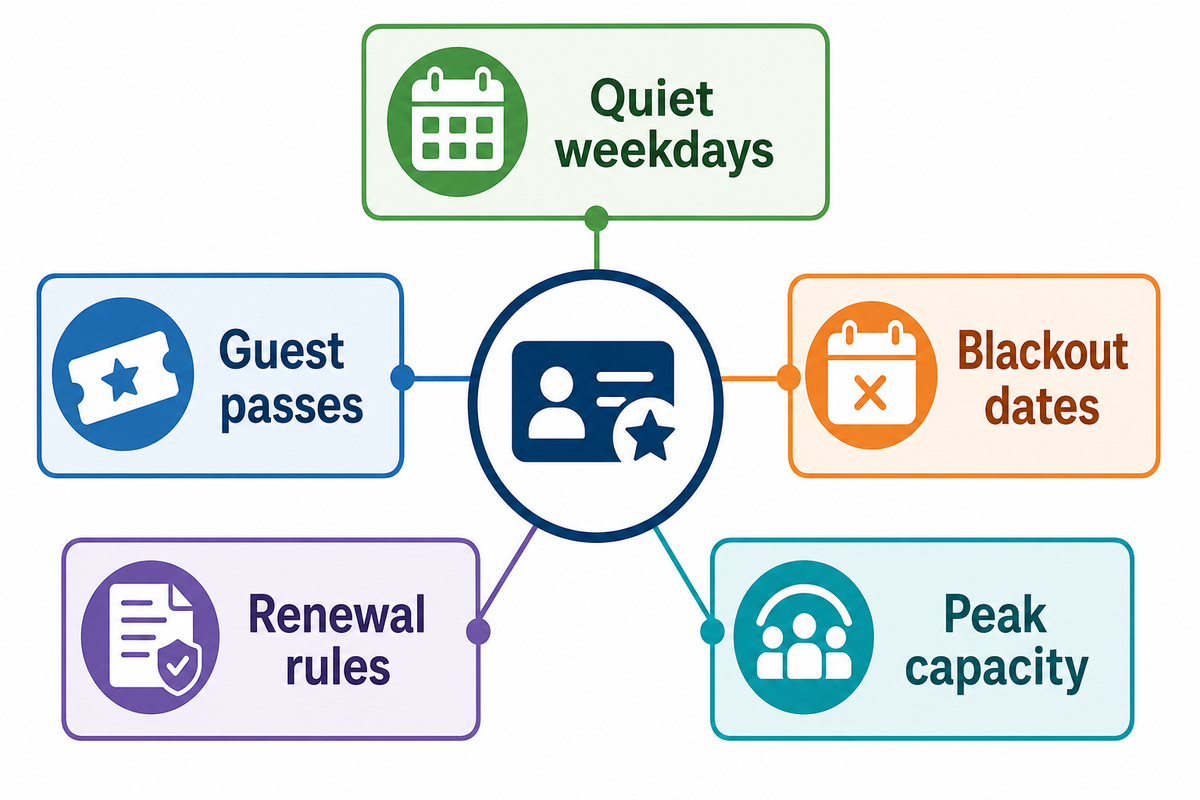
Membership income may support repeat visits and recurring cash flow, but it isn’t automatically better than one-time tickets and a commercial membership-software source isn’t independent proof of higher yield. Modern family entertainment centers should model member benefits, renewal rules, blocked dates, guest passes, birthday discounts, add-on spending, and cancellation terms. The goal is to test whether memberships fill low-use periods without turning peak hours into a crowded low-yield product.
Are memberships better than one-time tickets for a mall FEC?
Memberships are better only when the operator controls utilization. If members visit during quiet weekday periods, buy food and beverage, bring guests, and renew without crowding peak hours, they can support repeat cash flow. If members mainly arrive on weekends, use capacity heavily, and avoid add-ons, the same program can reduce ticket yield and party availability. Model blackout dates, monthly limits, guest passes, cancellation rules, and add-on behavior before treating membership income as stronger than tickets.
| Control | Ticket line | Party line | Membership line |
|---|---|---|---|
| Peak-hour cap | Protect walk-in yield | Reserve party traffic lanes | Block or limit peak use |
| Weekday offer | Lower-price time slot | School or group package | Member-only quiet hour |
| Food attach goal | Combo ticket | Party package food | Monthly snack credit |
| Guest policy | Family bundle | Sibling add-on | Limited guest pass |
| Booking priority | Paid slot first | Party calendar first | Priority only off peak |
| Cancellation rule | Not applicable | Deposit terms | Renewal and pause rules |
| Age group fit | Age-based ticket | Party age package | Benefits by age band |
| Capacity trigger | Stop new entries | Protect reserved block | Limit member entry |
| Review owner | Front desk manager | Party coordinator | Operations manager |
Add-On Revenue: Food, Retail, Socks, Lockers, Photos, and Game Cards
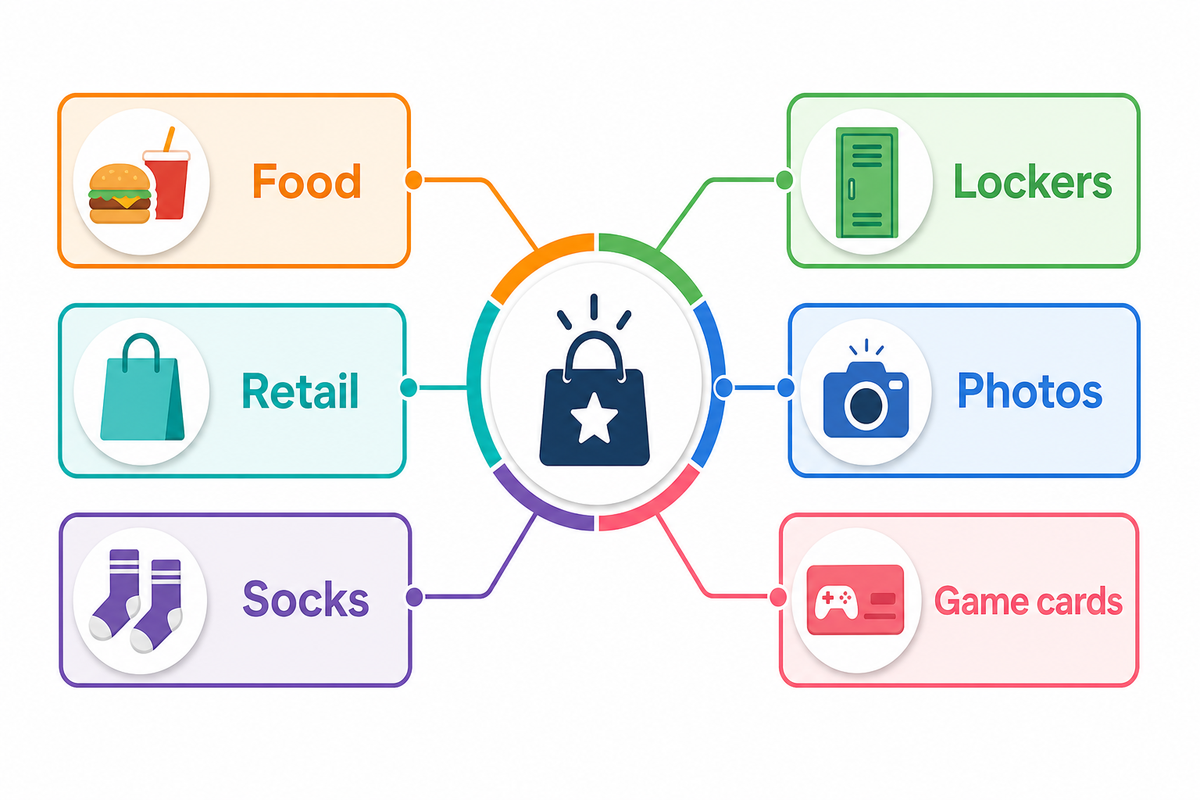
Add-on revenue should be modeled as attach rate and per-capita spend, not as a guaranteed margin. Food and beverage, socks, lockers, water bottles, souvenirs, photo products, arcade games, VR or immersive entertainment, and game-card upgrades can add direct revenue. They can also add training, storage, cleaning, shrinkage, service delays, and payment-system complexity.
For each add-on, the model should ask four questions: who buys it, when they buy it, how staff sell it, and what operational burden it creates. Sock requirements may be easy to model. Cafe service may need more space, equipment, food safety procedures, inventory control, and staff scheduling. Arcade games may improve entertainment choices, but card systems and redemption inventory need management.
Attach-rate formula
Add-on revenue = paid guests x attach rate x average add-on value. Keep attach rate separate for food, retail, lockers, photos, and game cards so one strong add-on doesn’t hide a weak one.
Capacity, Safety, and Accessibility: The Revenue Ceiling Many Models Miss
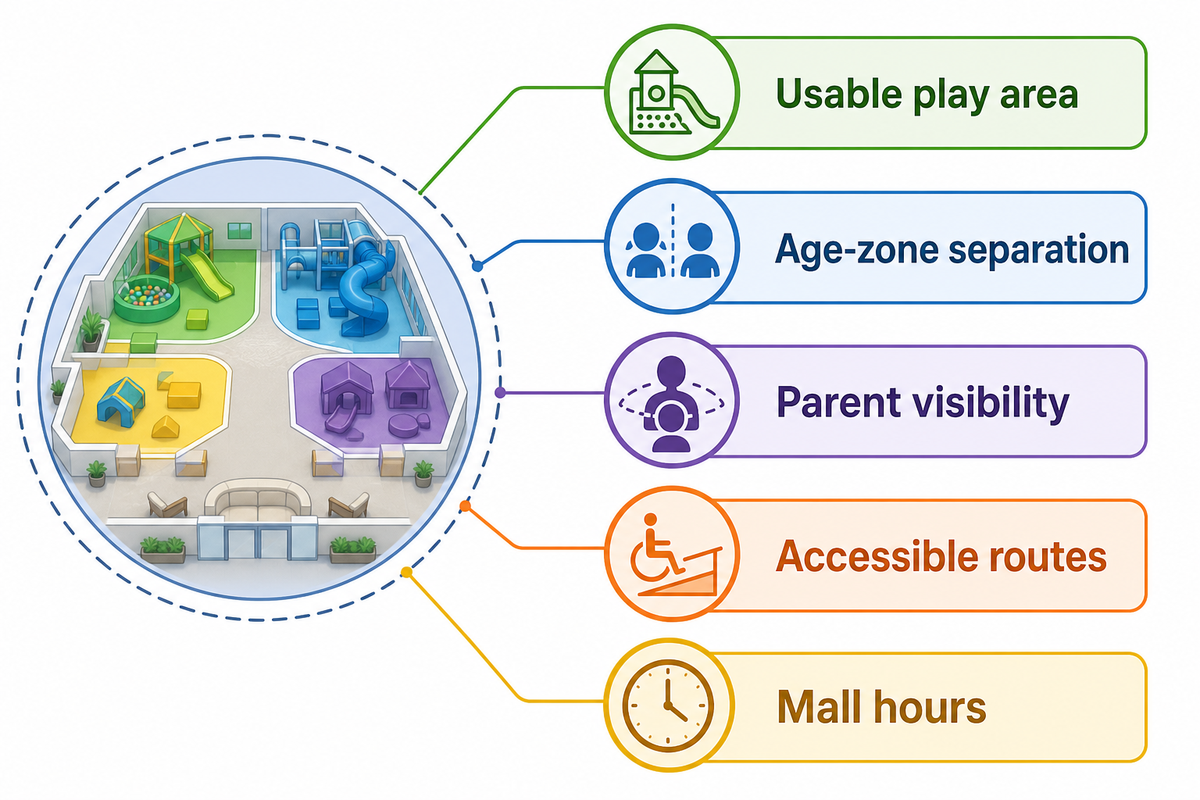
Even strong-looking mall entertainment center revenue forecasts can fail when the layout is tested. Usable area, age separation, sight lines, supervision, queueing, accessible routes, emergency access, cleaning paths, storage, safety standards, and mall operating hours all affect how many paying guests can safely use the space.
U.S. Department of Justice material describes the 2010 ADA Standards as minimum scoping and technical requirements for accessible and usable public accommodations and commercial facilities. Federal Register material on CPSC playground handbook updates also reinforces that play environments require safety and design review. These sources should be used as planning constraints, not as a universal revenue deduction formula.
What limits revenue in an indoor playground or mall FEC?
Revenue can be limited by usable play area, attraction mix, age-zone separation, parent visibility, staff coverage, queue length, party-room flow, accessible routes, safety rules, mall hours, and opening hours. Treat these as practical ceilings before raising ticket or membership assumptions.
This is where design and revenue planning should meet. A toddler area, ninja course, trampoline court, arcade, and party suite can all be revenue-positive in the right layout. In the wrong layout, they can block sight lines, increase supervision demand, reduce accessible paths, or create queue conflict. Local codes, mall rules, fire-safety review, ADA obligations, and equipment standards should be checked by qualified professionals before final capacity assumptions are used.
Base, Stretch, and Stress Cases for a Mall FEC Revenue Model
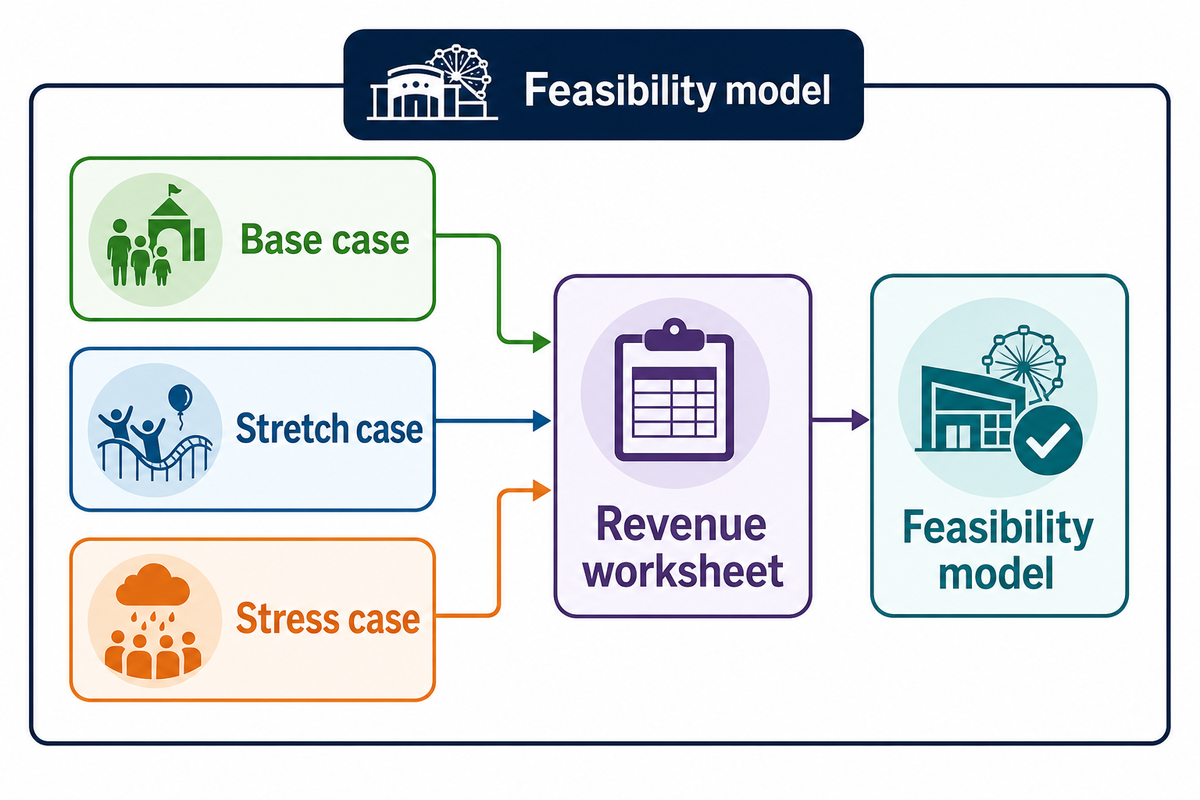
A serious model should not have only one forecast. Use base, stretch, and stress cases so the team can see what happens when demand is lower, conversion is weaker, labor is tighter, rent is higher, memberships crowd peak hours, or prepaid cash does not equal recognized revenue. SBA business-planning guidance separates revenue streams from cost structure, startup costs, financial projections, and break-even analysis, which supports this boundary.
Use local units before using money. Sample values below are placeholders for the buyer’s worksheet, not market benchmarks. Replace them with lease drawings, booking-system data, staff schedules, local pricing, and qualified safety review before using the model.
| Model input type | Base placeholder | Stress placeholder | Why it matters |
|---|---|---|---|
| Usable play area | 300 m² | 240 m² | Capacity may fall after paths and support areas are reserved. |
| Session length | 90 min | 60 min | Shorter play time can change ticket value and cleaning rhythm. |
| Party block | 120 min | 150 min | Longer room use reduces daily turns. |
| Reset time | 30 min | 45 min | Food cleanup and host turnover can cap party sales. |
| Trading week | 7 days | 5 days | Mall hours and holidays affect usable selling time. |
| Open hours | 10 hours | 8 hours | Staffing and mall rules can reduce the daily selling window. |
| Booking window | 30 days | 14 days | Short notice lowers party planning certainty. |
| Membership term | 1 month | 12 months | Longer terms change cash timing and visit load. |
| Peak capacity trigger | 80% | 90% | High utilization may feel crowded before the theoretical limit. |
| Downtime allowance | 2 hours | 1 day | Inspection, maintenance, or cleaning can remove sellable capacity. |
| Assumption row | Base case | Stretch case | Stress case |
|---|---|---|---|
| Mall traffic | Observed average | Holiday or event lift | Weak weekday demand |
| Visitor conversion | Visible entrance converts a modest share | Strong signage and mix lift conversion | Traffic passes without buying |
| Average ticket value | Core admission plus common bundle | Peak package mix improves value | Discounting lowers average value |
| Party bookings | Steady weekend rooms | Weekday groups add turns | Room turns underused |
| Membership count | Members fill quiet periods | Members bring guests and add-ons | Members crowd peak periods |
| Add-on attach rate | Food, socks, and game cards sell at planned levels | Bundle design lifts add-ons | Guests buy entry only |
| Demand underuse | Some off-peak idle time | Programming fills weak slots | Capacity exists but demand does not arrive |
| Labor and operating pressure | Staffing fits planned volume | Productivity improves with scheduling | Labor cost rises faster than revenue |
| Lease and rent sensitivity | Rent fits base sales | Sales absorb percentage rent | Rent and common charges strain cash flow |
| Cash vs recognized revenue | Deposits and memberships tracked separately | System reports redemption cleanly | Prepaid cash timing needs accountant review |
Placeholder formulas can keep the model practical without inventing dollar claims:
Monthly operating revenue worksheet
Monthly revenue = admissions + party and group sales + membership cash collected + add-ons + game or attraction upcharges. Then review cost, lease, tax, accounting, and financing items in separate worksheets.
What stays outside this revenue worksheet?
Several important items should sit beside the revenue worksheet, not inside it as casual assumptions. Labor planning should test front desk, party hosts, attraction supervision, cleaning, maintenance, and manager coverage. The financial model should separately test rent, common-area charges, insurance, financing, startup costs, depreciation, tax treatment, and working capital. Lease counsel, accountants, and local safety reviewers should confirm those assumptions before an investor treats revenue as profit or uses the worksheet for funding decisions.
Accounting and tax review should also remain separate. A deposit for a birthday party, a prepaid game card, or a membership payment may produce cash before the service is delivered. That does not mean the operator can treat every dollar as recognized revenue in the same period. The model can flag the issue, but an accountant and the operator’s management system should confirm how deposits, deferred items, refunds, breakage, and membership terms are handled.
This separation is not a weakness. It is what keeps the article useful for buyers who want to brief a design and equipment partner without pretending that revenue planning is the same as feasibility analysis. Revenue worksheets tell the team where income may come from. Feasibility models decide whether the whole project works after costs, lease terms, taxes, funding, and risk are included.
KPI Ownership After Opening
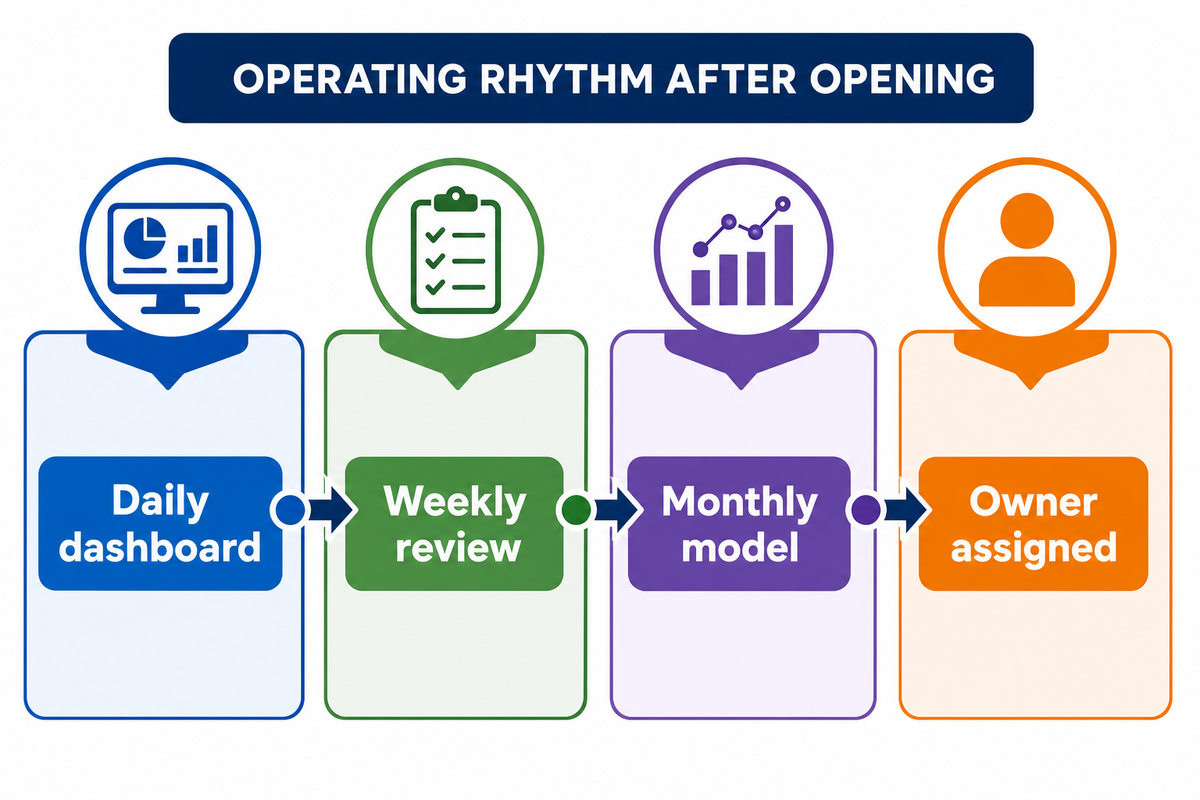
A model is useful only if the operator can compare it with real operation data after opening. KPI ownership should be assigned before launch, because admissions, party sales, memberships, food service, safety, and maintenance sit with different people. Strong revenue models become management tools, not one-time investor slides.
| KPI | Owner | Review cadence | What it reveals |
|---|---|---|---|
| Visitor-to-guest conversion | Front desk manager | Daily and weekly | Whether mall traffic becomes direct revenue |
| Ticket average value | Operations manager | Weekly | Whether bundles work |
| Party room turns | Party coordinator | Weekly | Whether scheduled capacity is underused |
| Member visits by daypart | Membership owner | Weekly | Whether memberships help or crowd peak hours |
| Add-on attach rate | Retail or cafe lead | Weekly | Whether food, retail, and game cards fit guests |
| Labor per paid guest | General manager | Weekly | Whether cost pressure is rising |
| Rent and common-charge review | Owner or finance lead | Monthly | Whether lease pressure is changing the model |
| Deferred or prepaid income review | Accountant and system admin | Monthly | Whether cash collected matches revenue treatment |
| Incident and downtime log | Safety lead | Daily with monthly review | Whether safety or maintenance is reducing capacity |
The cash-versus-revenue row is intentionally limited. Deposits, prepaid game credits, unredeemed passes, and memberships can affect cash timing and recognized revenue. Confirm the treatment with an accountant and with the point-of-sale, booking, or card system used by the venue.
How Dreamland Uses the Model in Mall Entertainment Zone Planning
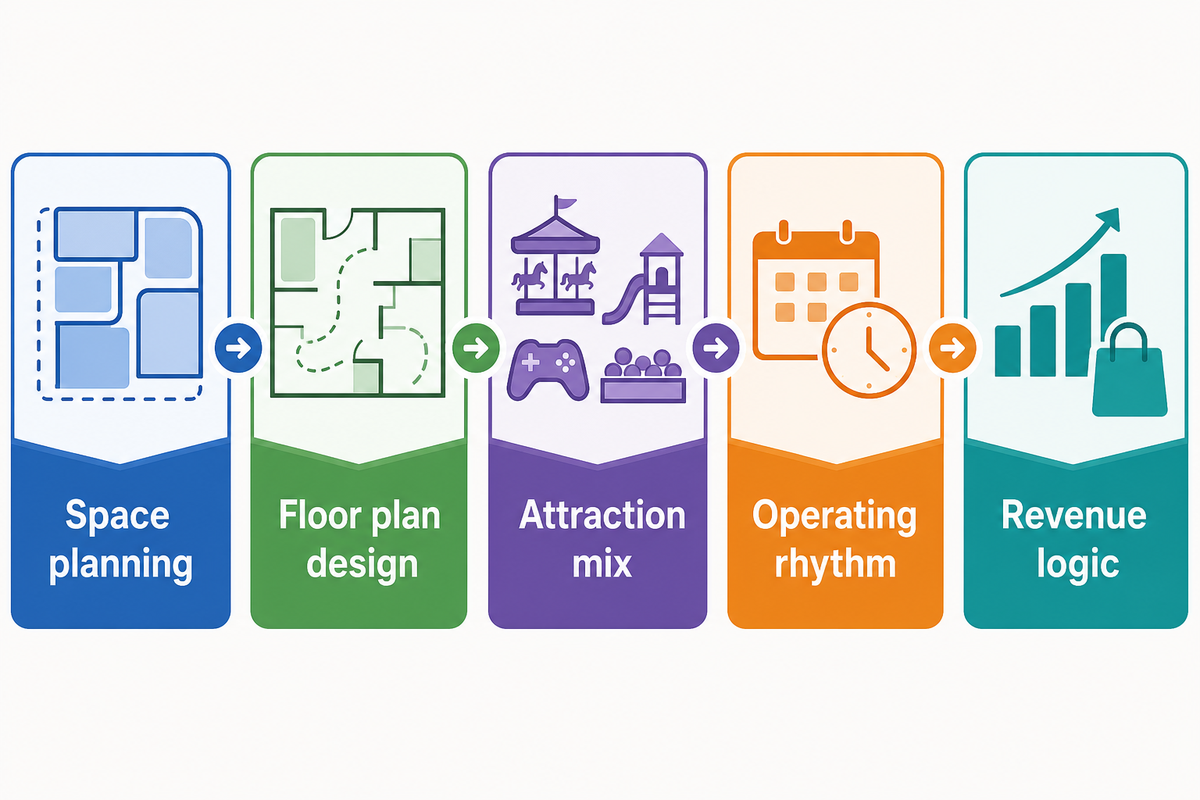
Dreamland Playground is a playground equipment manufacturer and project solution provider in China. Its work covers indoor playgrounds, family entertainment centers, trampoline parks, ninja courses, adventure parks, shopping mall play areas, schools, hotels, resorts, and outdoor play spaces. For a mall project, the revenue worksheet should become a design brief for children’s entertainment, diverse entertainment options, entertainment experiences, experiential entertainment, and accessible entertainment options, not a promise of financial return.
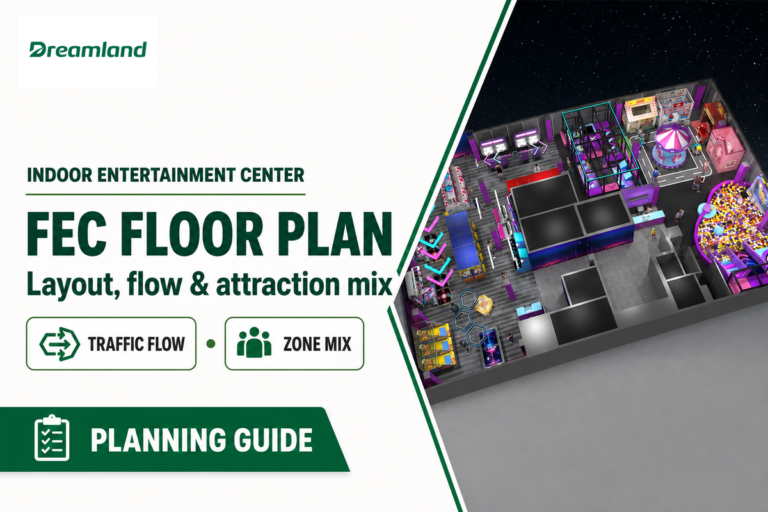
Before requesting a concept, prepare the usable area, ceiling height, target age groups, expected attraction mix, party-room plan, local market, theme direction, budget range, safety requirements, shipping expectations, installation support needs, and after-sales plan. Dreamland can then connect those inputs to layout, floor plan design, 3D design, entertainment infrastructure, equipment production, packaging, shipping, and installation support.
The more precise the worksheet is, the easier it is to make the concept practical. A mall venue is not a small theme park; it is year-round out-of-home entertainment inside a retail building. Planning should read demand for family entertainment, demand for indoor entertainment, demand for family entertainment centers, entertainment center industry patterns, family entertainment center industry language, entertainment preferences, and entertainment trends as directional signals only. If the target audience is mainly children under 8, the plan may need stronger parent sight lines, toddler-safe zoning, softer play features, and birthday room flow. If the target is mixed-age family engagement, the design may need arcade games, challenge courses, trampoline or ninja elements, and seating that keeps parents close to spending points. If the mall wants a stronger anchor effect, entrance treatment, photo moments, and clear circulation become part of the revenue source and revenue growth discussion while staying grounded in layout, capacity, and what is genuinely appealing to families.
Dreamland shouldn’t be asked to guarantee mall entertainment center revenue. A stronger request is more concrete: “Here’s our space, target age group, expected ticket products, party plan, membership idea, add-on goals, and stress-case concern. Which layout and attraction mix can support this operating model safely and attractively?” That question lets the equipment and design discussion stay tied to the buyer’s business goals without crossing into financial advice.
For a broader planning context, review Dreamland’s mall entertainment zone page and prepare your site data before discussing equipment scope.
Ready to turn the worksheet into a layout brief?
Share your mall space, age mix, target capacity, attraction ideas, and budget range with Dreamland Playground.
FAQ
How much does it cost to start a family fun center?
Useful budget planning should not give one universal number. Cost depends on floor area, lease condition, attraction mix, safety scope, party rooms, food service, theming, shipping, installation support, and approvals. First define those assumptions, then request a budget range tied to them.
Do family fun centers make money?
Profit is possible, but it depends on traffic conversion, rent, labor, ticket price, repeat visits, party bookings, membership utilization, add-on attach rate, maintenance, safe capacity, and financing structure. A mall location may provide foot traffic, but that does not replace a conservative operating model. Test base, stretch, and stress cases, then compare revenue assumptions with fixed costs, variable costs, lease exposure, and cash timing before treating any admission, party, or membership forecast as reliable.
What is a FEC business?
A family entertainment center, or FEC, is a location-based entertainment venue built around indoor play, arcade games, trampoline areas, soft play, ninja or adventure elements, party rooms, and services for families with children. A mall FEC usually combines admission, parties, memberships, food, retail, and repeat visits.
What revenue stream should a mall FEC build first?
Start with the revenue stream that matches the space and target age group. A small soft-play area may begin with admissions and parties because the layout is simple and parent supervision is close. A larger family entertainment center with arcade games, party rooms, trampoline or ninja attractions, and food service may need tickets, groups, memberships, and game-card products from the start. The first version should match what the venue can operate safely, consistently, and visibly from the mall corridor.
Are memberships better than one-time tickets?
Memberships are better when they fill underused periods and lead to add-on spending. They are weaker when they crowd weekends, reduce party-room availability, or train guests to visit without buying extras. Compare utilization, blackout dates, cancellation rules, and guest-pass behavior before deciding.
What should a mall owner ask before approving an FEC tenant?
Ask for the attraction mix, target age groups, projected admission products, party-room plan, membership policy, food and retail scope, staffing model, safety and accessibility review path, queueing plan, maintenance plan, insurance assumptions, lease sensitivity, and stress case. Mall teams should also ask how the venue handles school holidays, weekday softness, parent waiting time, cleaning, noise, and emergency access. The goal is to understand both the operator’s revenue logic and the operational demands placed on the property.
References & Sources
- 2025 IAAPA Benchmark Series: Entertainment Centers – IAAPA.
- Family Entertainment Center Market Size & Share Analysis – Mordor Intelligence.
- Retailtainment Is Having a Moment. Will the Momentum Last? – ICSC.
- 2010 ADA Standards for Accessible Design – U.S. Department of Justice.
- Notice of Availability: Public Playground Safety Handbook Update – Federal Register / CPSC.
- Calculate your startup costs – U.S. Small Business Administration.