Get in touch with Dreamland Playground Company

Indoor Playground Safety Standards
- Quotation within 24 hours
- Custom 3D design in 3 working days
- Production in 15 to 30 working days
We design and manufacture indoor soft contained play structures, and we apply indoor playground safety standards by equipment class and destination market before drawings are issued. Which standard actually governs a build depends on both, and getting that routing wrong is the expensive part. This page sets out those routes, the building code that applies to the structure itself, and the documents you receive.
We work from a CAD floor plan (DWG) or a PDF plan; if you have no drawings, the room’s length, width and clear ceiling height are enough to start.
-
Quotation
Returned within 24 hours, reviewed by an engineer.
-
Design
Custom 3D design in 3 working days, free on our standard model library.
-
Production
15 to 30 working days, confirmed with your quotation.
-
Design standard
Designed to the relevant EN and ASTM safety requirements for the product type and the destination market.
-
With the order
Installation drawings and technical manuals ship with the equipment, and we arrange freight.
-
Installation
Quoted separately — your own crew, or our technicians on site.
Which Standard Applies to Your Equipment and Market
Do not specify one standard for the whole room. Unlike ASTM F1918-21, ASTM F1487-25 explicitly excludes soft contained play equipment; that class routes to F1918-21 because the standards are maintained by separate ASTM subcommittees, F15.29 and F15.36. Treating the two as interchangeable is the mistake that creates a specification risk; slides, decks, toddler equipment, trampolines and aerial courses may require different documents in the same venue.
| Equipment class | Governing standard (current edition) | Market |
|---|---|---|
| Soft contained play structure (indoor) | ASTM F1918-21 | United States |
| Conventional play equipment — slides, climbers, decks | ASTM F1487-25 | United States |
| Equipment for children 6 months through 23 months | ASTM F2373-24 | United States |
| Commercial trampoline court | ASTM F2970-25 | United States |
| Aerial adventure and ninja course | ASTM F2959-25b | United States |
| Impact-attenuating surface | ASTM F1292-22 · EN 1177 | US · EU |
| Fully enclosed play equipment (indoor) | EN 1176-10:2023 | European Union |
| Any of the above, sold into the EU | EN 1176 series + Regulation (EU) 2023/988 | European Union |
| Outdoor public playground | CSA Z614:20 (R2025) | Canada |
| Indoor play structure, as a structure | 2024 International Building Code, Section 424 | United States, where adopted |
The standard selector applies the same routing logic to one specific piece of equipment.
Standards Edition Currency
Every designation below carries its edition. A specification written against a superseded edition is one your supplier can satisfy while still shipping to an obsolete requirement.
| Designation | Current edition | Covers |
|---|---|---|
| ASTM F1918 | F1918-21 | Soft contained play equipment |
| ASTM F1487 | F1487-25 | Playground equipment for public use |
| ASTM F1292 | F1292-22 | Impact attenuation of surfacing materials |
| ASTM F2373 | F2373-24 | Public-use play equipment for ages 6–23 months |
| ASTM F2970 | F2970-25 | Trampoline courts |
| ASTM F2959 | F2959-25b | Aerial adventure courses |
| EN 1176-10 | EN 1176-10:2023 | Fully enclosed play equipment |
| CSA Z614 | Z614:20 (R2025) | Children’s playground equipment and surfacing |
| International Building Code | 2024 IBC, Section 424 | Indoor play structures as building elements |
ASTM F1918 — Soft Contained Play Equipment
F1918-21 covers soft contained play equipment for users from the 5th percentile 2-year-old to the 95th percentile 12-year-old.
It includes fire-safety and evacuation requirements and excludes public playground equipment, home playgrounds, sports equipment, amusement rides, water attractions and toys.
Those exclusions run in both directions: F1487 compliance for a neighboring slide or deck does not establish F1918 compliance for the enclosed structure.
ASTM F1487 — Playground Equipment for Public Use
F1487-25 governs conventional public-use equipment such as slides, climbers, decks and platforms. One room can therefore require both F1487-25 and F1918-21 for different equipment classes.
ASTM F2373 — Play Equipment for Children 6 Months Through 23 Months
F2373-24 covers public-use equipment for children 6 through 23 months and excludes soft contained play equipment. Its reach, grip and step criteria require a dedicated toddler zone rather than a scaled-down 2-to-12 layout.
EN 1176, EN 1177 and Selling Into the European Union
- EN 1176-10:2023 covers fully enclosed play equipment for children up to 14 years old, including indoor installations.
- Its 2023 edition adds spinning-pole and bouncing-element provisions, specifies a 60 mm (2.36 in) minimum ball diameter and places fire safety and evacuation in Clause 4.2.
- Regulation (EU) 2023/988 has applied since 13 December 2024; Article 16 requires a responsible economic operator established in the European Union.
- Article 9 requires technical documentation retention for 10 years, product identification and instructions in a language consumers in the destination Member State can understand.
- Article 20 requires accident notification through the Safety Business Gateway without undue delay.
Accessibility Sits Outside the Equipment Standard
ASTM F1487 and F1918 do not govern accessibility. In the United States, ADA Sections 240 and 1008 provide the separate scoping and technical criteria.
| Provision | Requirement |
|---|---|
| Elevated play components on an accessible route | At least 50% |
| Play areas with 20 or more elevated components | Ramps connect a minimum of 25%; transfer systems may connect up to 25% |
| Play areas with fewer than 20 elevated components | A transfer system may serve the required 50% |
| Transfer platform size | 610 mm (24 in) wide minimum × 355 mm (14 in) deep minimum |
| Transfer step height | 205 mm (8 in) maximum |
| Entry point or seat transfer height | 280 mm (11 in) minimum to 610 mm (24 in) maximum |
Where both ramps and transfer systems are available, the accessible route should use the ramp. Fix the route and transfer points before the floor plan is frozen because later changes affect deck connections, circulation space and component counts.
Material, Flammability and Building Code Requirements
Indoor play materials must satisfy the adopted building code for the structure and the applicable product-safety law for chemical content.
Building Code Fire Criteria — 2024 IBC Section 424
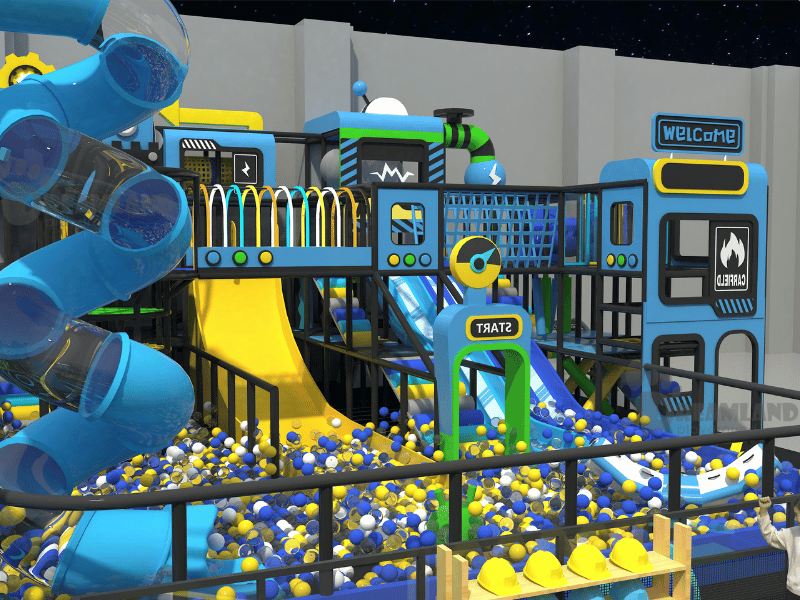
2024 IBC Section 424 applies when the structure exceeds 10 ft (3048 mm) in height or 150 sq ft (14 m2) in area. Section 424.2 then requires noncombustible materials or qualifying combustible materials.
“Play structures installed inside all occupancies covered by this code that exceed 10 feet (3048 mm) in height or 150 square feet (14 m2) in area shall comply with Sections 424.2 through 424.5.”
- Foam plastics: maximum heat release rate 100 kW under UL 1975 or NFPA 289 with the 20 kW ignition source.
- Rigid plastic components: peak heat release rate no more than 400 kW/m2 under ASTM E1354.
- Ball pool balls: maximum heat release rate 100 kW.
- Foam coverings: fabric, coating or film must meet NFPA 701 Test Method 1 or 2.
Section 424 also requires NFPA 701 textiles and films, a Class I floor finish beneath the structure, and IBC Table 803.13 flame-spread performance for structures over 600 sq ft (56 m2) or 10 ft (3048 mm).
Confirm the adopted code edition. The 2024 IBC is not automatically law everywhere. The Section 424 screener checks both trigger thresholds against your structure.
Chemical Requirements Under US Federal Law
16 CFR Part 1307 limits DEHP, DBP, BBP, DINP, DIBP, DPENP, DHEXP and DCHP to 0.1% in children’s toys and child-care articles. The restriction reaches plasticized components and other materials that may contain phthalates.
| Abbreviation | Chemical name |
|---|---|
| DEHP | di-(2-ethylhexyl) phthalate |
| DBP | dibutyl phthalate |
| BBP | benzyl butyl phthalate |
| DINP | diisononyl phthalate |
| DIBP | diisobutyl phthalate |
| DPENP | di-n-pentyl phthalate |
| DHEXP | di-n-hexyl phthalate |
| DCHP | dicyclohexyl phthalate |
The rule reaches each plasticized component and any other material that may contain a listed phthalate. Request component-level test scope rather than a general material declaration.
Fire compliance does not prove chemical compliance. EN 1176-10:2023 Clause 4.2.1 covers material flammability; US phthalate limits come from 16 CFR Part 1307, while European chemical restrictions sit outside the playground series.
Under ASTM F1292-22, compliant surfacing is not promised to prevent every injury. Its laboratory result also omits aging and site exposure, so procurement needs both the critical fall height rating and an installed-surface performance result.
Within ASTM, subcommittee F08.63 considered lowering the Head Injury Criterion threshold but halted that proposal pending injury-correlation data. The same subcommittee has work underway on requirements specific to indoor surfacing, so record the edition and test method rather than accept an unqualified claim that a surface is “ASTM compliant.”
Impact-Attenuating Surfacing and Critical Fall Height
Specify the playground surface against equipment fall height, not equipment type. Under ASTM F1292-22, impact attenuation is measured using g-max and the Head Injury Criterion.
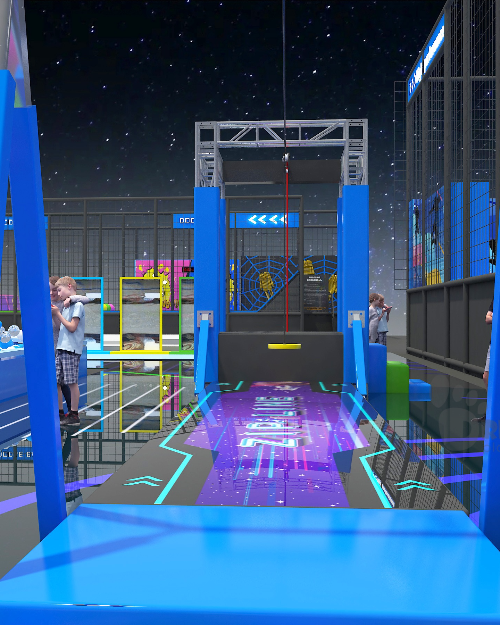
- Laboratory testing establishes critical fall height.
- Installed-surface testing checks actual site performance.
- Its scope serves F1148, F1487, F1918, CSA Z614 and SS457 equipment.
F1292-22 EXCEPTION
Open the Fall Height Checker
A laboratory rating is not a site result. F1292-22 says critical fall height does not account for aging, moisture, maintenance, freezing, ultraviolet exposure, contamination, compaction, thickness loss, shrinkage or submersion. Require an installed-surface test.
Indoor Surfacing Versus Outdoor Loose Fill
Outdoor loose fill can reduce material cost but is difficult to contain and maintain on a finished indoor floor. Indoor venues therefore use bonded systems, tiles or mat assemblies matched to the required fall height.
- Outdoor stationary equipment uses a zone extending 6 feet in all directions around playground equipment.
- An outdoor swing use zone extends to twice the height of the pivot, front and back.
- Indoor surfacing follows the enclosure, entrances, exits and measured fall heights.
- Outdoor loose-fill guidance can call for around 12 inches of mulch or wood chips; that depth does not transfer to a finished indoor floor; indoor systems are specified by tested assembly and installed thickness.
Dimensional and Entrapment Criteria
Use the source column to place each dimension in the purchase specification and drawing review.
| Criterion | Value (metric) | Value (imperial) | Source |
|---|---|---|---|
| Section 424 trigger — structure height | 3048 mm | 10 ft | 2024 IBC 424.1 |
| Section 424 trigger — structure area | 14 m2 | 150 sq ft | 2024 IBC 424.1 |
| Maximum play structure area without special investigation | 56 m2 | 600 sq ft | 2024 IBC 424.5 |
| Minimum horizontal separation between play structures | 6090 mm | 20 ft | 2024 IBC 424.4 |
| Foam plastic maximum heat release rate | 100 kW | 100 kW | 2024 IBC 424.2 |
| Rigid plastic peak rate of heat release | 400 kW/m2 | 400 kW/m2 | 2024 IBC 424.2 |
| Transfer platform width, minimum | 610 mm | 24 in | ADA Standards 1008.4 |
| Transfer platform depth, minimum | 355 mm | 14 in | ADA Standards 1008.4 |
| Transfer step height, maximum | 205 mm | 8 in | ADA Standards 1008.4 |
| Entry point or seat transfer height range | 280–610 mm | 11–24 in | ADA Standards 1008.4 |
| Handrail gripping surface height range | 510–710 mm | 20–28 in | ADA Standards 1008.4 |
| Ball pool minimum ball diameter | 60 mm | 2.36 in | EN 1176-10:2023 |
Age-Appropriate Equipment and Age Zoning
Separate users aged 6–23 months under ASTM F2373-24 from the conventional 2–5 and 5–12 groups. Mixing bands defeats the reach, grip and step criteria built for each group.
Zoning must be physical. ASTM F1918-21 spans the 5th percentile 2-year-old through the 95th percentile 12-year-old; signs do not substitute for a physically distinct toddler zone.
Clearances, Separation and Area Limits
- Structures over 600 sq ft (56 m2) need a fire-safety investigation accepted by the building official.
- Keep 20 ft (6090 mm) between play structures and 5 ft (1524 mm) from walls, partitions and egress elements.
- Provide the approved fire detection and suppression required for other structures in the same occupancy.
- Assess openings, ladder rungs and deck-to-panel gaps with the specified head, neck, partial-body and limb-entrapment probes.
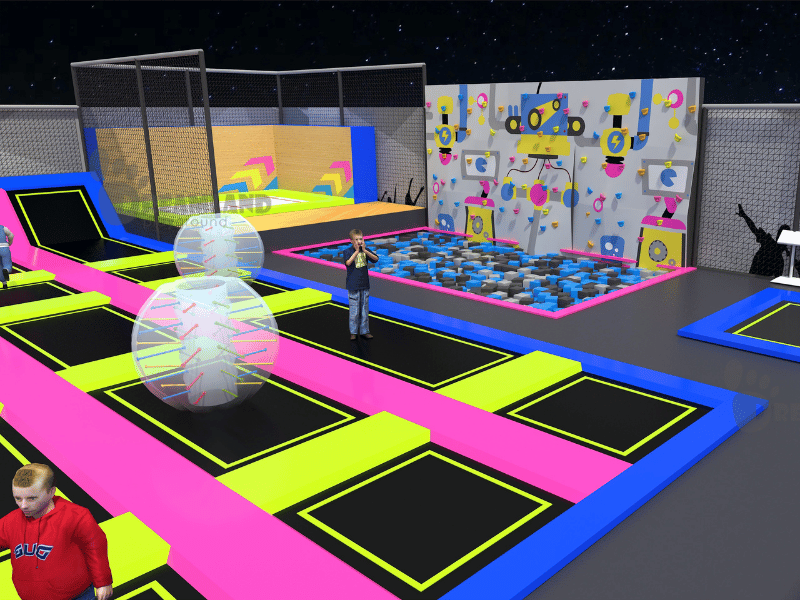
Pricing, Lead Time and Installation Scope
Price follows the floor area, the structure height, the number of activities and the finishing specification. A quotation is returned within 24 hours, and it is reviewed by an engineer before it goes out.
01
Design and lead time
- Custom 3D design delivered in 3 working days.
- Free custom 3D design on our standard model library; a design fee is agreed up front only for complex bespoke concepts.
- Production runs at 15 to 30 working days, confirmed with your quotation.
02
Order size and inputs
- Most orders cover one play area — a single room is a normal order, and individual items and replacement parts are quoted separately.
- We work from a CAD floor plan (DWG) or a PDF plan.
- If you have no drawings, the room’s length, width and clear ceiling height are enough to start.
03
Payment and shipping terms
- 30% T/T deposit with the balance paid before loading.
- L/C at sight for large orders.
- We ship EXW, FOB, CFR, CIF, DDU and DDP.
04
Installation scope
- Installation support is quoted separately — install from our drawings with your own crew, or have our technicians on site.
- Detailed installation drawings and the technical manuals ship with the equipment.
- We arrange freight to your sea port or your door.
Send your floor plan or drawing with the destination market, and the quotation comes back with the detailed standards routing attached.
Compliance Documentation, Quality Control and Inspection Cadence
Resolve these documents and responsibilities before manufacture.
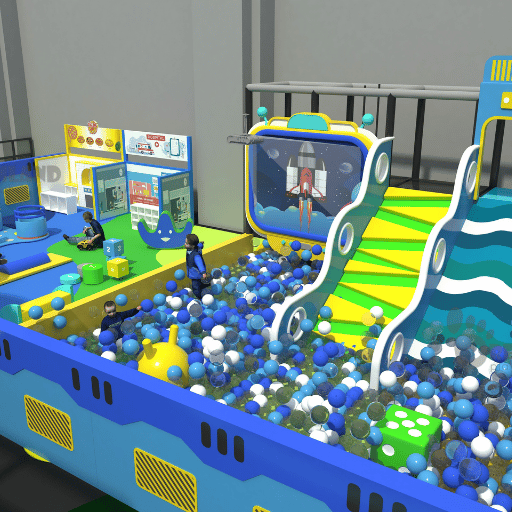
Compliance Checklist Before You Sign Off
- Standard and edition: record one for every equipment class, not one for the room.
- Destination market: record the European Union, United States, Canada or other jurisdiction; European Union delivery also needs the responsible economic operator and language plan.
- Building code: confirm the locally adopted edition and evaluate both Section 424 thresholds.
- Surfacing: tie the tested system and installed thickness to fall height, then require an installed-surface test rather than relying only on the laboratory rating.
- Layout: freeze age zones and the accessibility route on the floor plan before manufacture.
- Delivery documents: list installation drawings, technical manuals, test reports and the named inspection owner.
Ask the scoped question: which standard and edition governs this equipment class in this market? A general request for “safety certification” can return a certificate for another class.
Daily, Monthly and Annual Inspection Schedule
Set inspection frequency from risk assessment and manufacturer guidance. Indoor exposure and use can justify a schedule different from an outdoor playground.
High-use venues can require daily visual checks even when the baseline routine interval is weekly. The risk assessment should record the reason for the chosen interval and the event that triggers an extra inspection, such as a repair, impact incident or added component.
| Level | Interval | Purpose |
|---|---|---|
| Routine visual | Weekly, or daily at high use | Potential hazards arising from use, wear and vandalism — netting, stitching, surface damage, foreign objects in a ball pool |
| Operational | Quarterly | Stability, wear of moving parts, anchorage, fixing integrity |
| Annual main | Annually | Overall structural condition, corrosion or rot, and the effect of any repair or added component |
The EN 1176-7 pattern covers installation, inspection, maintenance and operation. Increase frequency when use exceeds the design assumptions.
- Keep each inspection record at least until the next inspection.
- Assign every finding to an owner and record the corrective action.
- Supervision and posted safety rules do not replace equipment maintenance or prevent injuries on their own.
Voluntary Standards, Guidelines and What Is Actually Enforceable
The Consumer Product Safety Commission (CPSC) describes its Public Playground Safety Handbook and the ASTM documents it cites as voluntary guidance. State or local codes, legislation and regulations may adopt or reference them, so confirm enforceability with the authority having jurisdiction.
A recommendation in a voluntary document becomes contractually binding when the purchase specification names it, and it can become legally enforceable when a jurisdiction adopts or references it. Record the source of each obligation—law, adopted code, contract, insurer condition or operator policy—so the approval team knows who can change it.
How We Work: From Floor Plan to Installed Play Area
01
Brief
send a DWG/PDF floor plan or room length, width and clear height.
02
Routing
we map each equipment class, market and building-code threshold before drawing.
03
Design
custom 3D design in 3 working days; complex bespoke concepts carry an agreed fee.
04
Quotation
engineer-reviewed pricing within 24 hours, with the 15–30-working-day production window.
05
Delivery
equipment, installation drawings and technical manuals ship together; freight is arranged.
06
Installation
use your crew and our drawings, or add separately quoted on-site technicians.
Raise the compliance risk during routing if a layout decision crosses a Section 424 threshold or places a component in another standard’s scope; deck positions, exits and surfacing can then still be revised without remanufacture.
Where This Equipment Is Not the Right Fit
Outdoor public playgrounds
Soft contained structures assume a controlled indoor environment. Outdoor municipal sites route to ASTM F1487-25 or CSA Z614:20 (R2025), with outdoor use zones and weather exposure.
Rooms below the working clear height
Where platforms, netting and deck headroom do not fit, use a single-level layout rather than compressing vertical clearances around a multi-level tower.
Trampoline courts and aerial courses
Specify these separately under ASTM F2970-25 and ASTM F2959-25b; they carry their own structural, operational and inspection requirements.
Venues serving one narrow age band
For users aged 6–23 months only, specify ASTM F2373-24 toddler equipment instead of scaling down a structure designed for the 2-to-12 range.
Confirm certification scope before specification. Operators, insurers or landlords may require a named third-party scheme, and each scheme covers only defined equipment classes.
SYSTEM / ENGINEERING TOOLS
Safety Standards Engineering Tools
Select a tool below to calculate surfacing requirements, check building code triggers, or route to the correct standard.
Fall Height Checker
Calculate the required impact-attenuating surfacing thickness based on equipment height.
Section 424 Screener
Evaluate your play structure against the 2024 IBC thresholds for noncombustible materials.
Standard Selector
Determine the applicable safety standards and test methods for your specific market and equipment.
Send Your Floor Plan for a Quotation
Send a floor plan and the destination market, and you get the standards routing together with the price. If the layout has a compliance problem, it is better found now than at inspection.
A quotation is returned within 24 hours and is reviewed by an engineer. Custom 3D design follows in 3 working days, and production runs at 15 to 30 working days.
Frequently Asked Questions
ASTM F1918-21 covers soft contained play equipment. ASTM F1487-25 covers conventional public-use equipment such as slides, climbers and decks, and explicitly excludes the soft contained class.
EN 1176 is a European multi-part series; Part 10 covers fully enclosed play equipment. ASTM routes that class out of F1487 and into F1918-21. A two-market design must resolve both systems at drawing stage.
ASTM F1292-22 measures surfacing with g-max and the Head Injury Criterion. Use its laboratory critical-fall-height result to select a system, then verify the installed surface because aging, moisture, compaction and thickness loss are site conditions.
Set frequency from risk and manufacturer guidance. A practical EN 1176-7 pattern is routine visual inspection weekly or daily at high use, operational inspection quarterly and a main inspection annually.
Where the ADA applies, Sections 240 and 1008 govern play-area accessibility. At least 50% of elevated components need an accessible route; with 20 or more, ramps must connect at least 25%.
2024 IBC Section 424 applies where adopted when a structure exceeds 10 ft (3048 mm) in height or 150 sq ft (14 m2) in area. It adds material, separation, area, detection and suppression requirements.
The Consumer Product Safety Commission says there is no equipment-specific playground certificate. Products classified as children’s products or toys may require a Children’s Product Certificate, and local authorities may adopt voluntary standards into enforceable rules.
Send a DWG/PDF floor plan or the room length, width and clear height, plus destination market and age bands. We return an engineer-reviewed quotation within 24 hours; installation drawings and technical manuals ship with the equipment.
CSA Z614:20 (R2025) is the Canadian standard for children’s playground equipment and surfacing, applying to outdoor public playgrounds in Canada. Like ASTM F1487, its scope excludes soft contained play equipment that has controlled public access, so a Canadian indoor venue routes its soft contained structure elsewhere.
A commercial trampoline court routes to ASTM F2970-25, and an aerial adventure or ninja course routes to ASTM F2959-25b. Neither is covered by the soft contained play standard, so a venue combining all three is specified against three documents.
Permits are set by the local building department rather than by any equipment standard, and they follow the occupancy classification of the venue. Where a play structure crosses the Section 424 thresholds of 10 feet (3048 mm) or 150 square feet (14 m2), the structure itself enters plan review.