Get in touch with Dreamland Playground Company

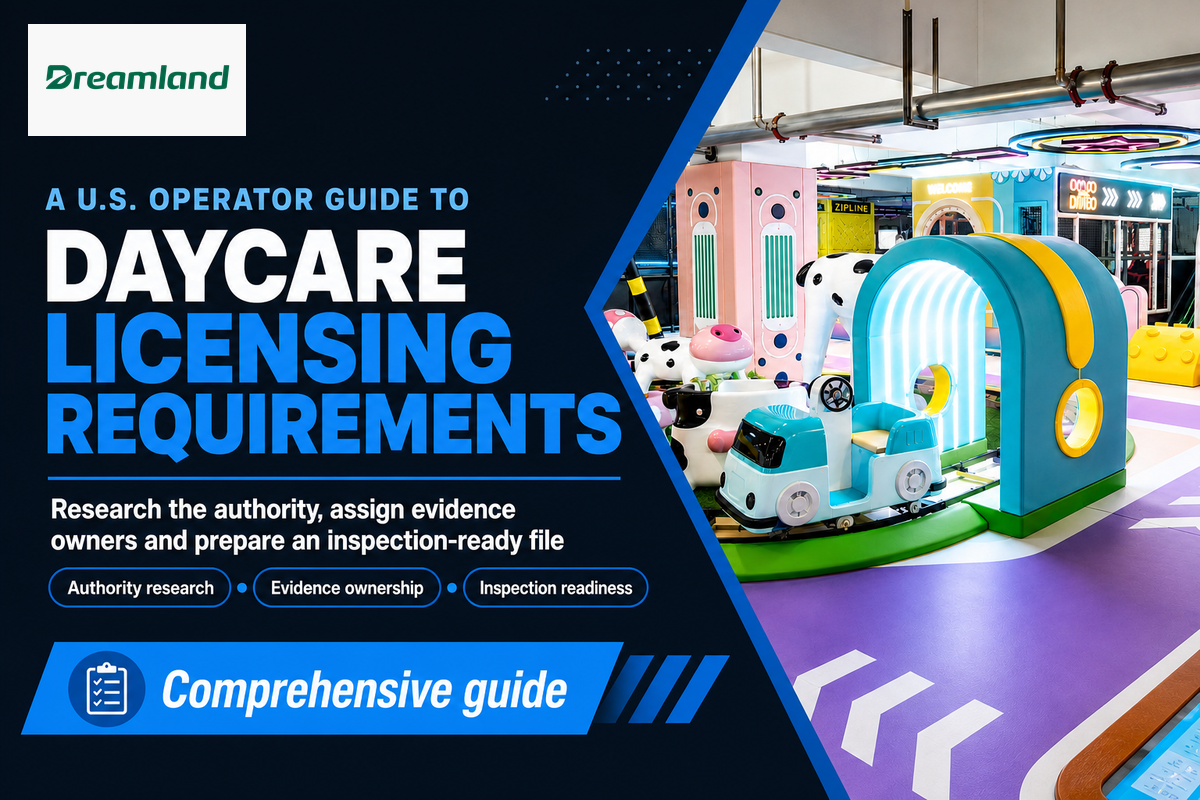
JURISDICTION · EVIDENCE OWNERS · INSPECTION READINESS
Daycare licensing requirements are not one national checklist. Start by confirming the governing jurisdiction, program type, legal operating status, funding or federal-program overlays, and local premises approvals. Then turn every current rule into named evidence with an owner, due date, and recheck trigger.
Revised: September 2026 Market: US Educational information, not legal advice
A licensing application can look complete while still being unusable. The missing item may sit outside the application packet: a local fire sign-off, a background-check result, a room capacity decision, an accessibility review, or a playground record that nobody owns. This guide shows operators how to build a traceable approval file instead of copying a checklist from another state.
The short answer
Identify who regulates the exact program, ask that authority which source controls, map each requirement to a room, role, document, and owner, and keep dated proof through inspection and correction. A product standard, consultant summary, or supplier document may support the file, but none grants a child-care license.
“Although child care licensing does not guarantee quality, it does set minimum health and safety requirements for child care programs.”
U.S. Department of Health and Human Services, ChildCare.gov
Key takeaway
A daycare approval file is ready only when each applicable rule has a current source, a named owner, matching site evidence, and a documented closeout path.
Identify the Controlling Regime Before You Build a Checklist
Answer first: begin with the authority, not a search result. Record the state or territory, county and city, facility address, provider type, ages served, operating hours, legal entity, funding streams, and whether the site is on tribal or military land. Those facts decide which licensing and program branches belong in the file.
Use the National Database of Child Care Licensing Regulations as a starting point. It says licensing is administered by state and territory governments, but additional requirements may sit in statutes, administrative codes, or other local, state, and federal laws. Treat the database as a map to source material, not proof that the search is finished.
Ask the licensing office to confirm the facility category, or provider type, that matches the planned operation. A center, family child care home, group home, school-age program, drop-in service, camp, preschool, or legally exempt arrangement may follow different rules even at the same address. Save the response, contact name, date, and source link in the project file.
The jurisdiction card
- Place: state or territory, city, county, tribal jurisdiction, military installation, and exact parcel.
- Program: facility type, ages, schedule, capacity concept, and services offered.
- Status: licensed, registered, certified, approved, license-required, or legally exempt, using the authority’s own terms.
- Overlays: Head Start, Child Care and Development Fund subsidy, public-school operation, or military child care.
- Contacts: licensing specialist and separate planning, building, fire, health, and accessibility owners.
Verify Legal Operating Status Without Guessing From Enrollment
Answer first: don’t conclude a program is licensed or exempt just because a number worked in another state. With the licensing specialist and authority contacts named on the jurisdiction card, test the actual operating status: exemptions often depend on the provider’s relationship to the children, the program setting, service duration, sponsor, funding stream, or program type. Ask the appropriate agency for a written determination and keep all records on which your request was based.
For example, California describes license-exempt or license-required arrangements by relationships to children, number of families, location (home or non-residence), and duration of care for under 24 hours. Those categories do not create a nationwide childcare standard. They also show why the search question “How many children can I watch without a license?” is incomplete without jurisdiction and operating facts.
Do
- Describe the actual care arrangement.
- Ask the governing agency for its classification.
- Save the determination and assumptions.
- Recheck when enrollment or services change.
Don’t
- Copy a child-count answer from another state.
- Use “small program” as a legal category.
- Treat subsidy eligibility as a license.
- Assume an exemption removes every other duty.
Even when the local authority says the business can legally operate without a child-care license, other duties may remain. These can include screening for subsidized care, business licensing, zoning, fire and food rules, building-occupancy limits, operating agreements, contract conditions, and civil-rights requirements. The authority’s written decision should state what it decided and should not be stretched beyond that issue.
Use a Source Hierarchy and Record the Effective Date
Design first: assemble the file from controlling text and agency guidance, then use summaries only to identify questions. For each rule, record the source title, section, facility type, effective date, revision date, agency contact, and retrieval date. When two sources conflict, pause the design decision and ask which source controls.
The federal licensing database is particularly useful because its state profiles and regulation search help locate agency contacts and documents. Its About page also date-stamps different data sets. That disclosure is a reminder that a clean-looking comparison table may combine material from different years.
- Identify the authority — confirm the agency and program classification for the exact site.
- Open the controlling text — save the statute, regulation, code, agency instruction, or written determination.
- Capture the locator — record the section, page, table, effective date, and retrieval date.
- Resolve conflicts — send a bounded question with both citations to the responsible office.
- Freeze the decision — link the authority response to the room, role, or document it controls.
- Set a recheck — use a calendar date and event triggers, not a memory-based reminder.
Keep superseded copies. An inspector, architect, insurer, or funding reviewer may need to understand why a design decision was reasonable when made. Label the old copy “superseded,” record its replacement, and avoid silently overwriting the only evidence that informed an earlier approval.
Agency-Language Crosswalk
Search vocabulary is not legal classification. Agencies use different names for similar offices, provider categories, funding programs, and review steps. Use the phrases below to find licensing information, then copy the exact term and definition from the authority that controls your site. Do not treat two labels in the same row as legally interchangeable.
| Research branch | Terms you may encounter | What to verify |
|---|---|---|
| Agency | regional office; licensing staff; department of social services; department of children; department of early childhood; children and families | Which office issues the decision, and which office only provides technical assistance? |
| License status | licensed child care; child care licensure; registered or licensed; license or registration; become licensed; open a child care program | What legal status is available, required, pending, or prohibited for this address? |
| Provider category | type of child care; care facilities; child care facilities; child care provider; exempt child care; exempt providers; legally exempt child care | Which definition matches the operator, setting, schedule, and children served? |
| Program label | day care; early care; early care and education; early childhood; family day care; family child care home license; preschool program; day camp | Does the label change the regulator, exemption test, age scope, or operating conditions? |
| Rule set | child care licensing requirements; licensing standards; state regulations; federal and state requirements; health and safety standards; training requirements | Which source controls, what is its effective date, and are stricter local terms incorporated? |
| Funding | child care assistance program; block grant; child care services | Does funding add eligibility, monitoring, reporting, or provider requirements? |
| People and checks | child care staff members; child abuse and neglect; sex offender; central registry; online orientation | Who must clear each check, complete orientation, and renew training? |
| Service scope | care for children; children ages; services provided; mildly ill children; children with special health needs; safety of children | Do age, health, transportation, food, or other services create a separate approval branch? |
| Oversight | unannounced visits; onsite monitoring; continued operation; quality rating and improvement system; quality system; rating system | Which activities are licensing enforcement, funding oversight, or voluntary quality review? |
Check Federal, Tribal, Funding, and Military Forks
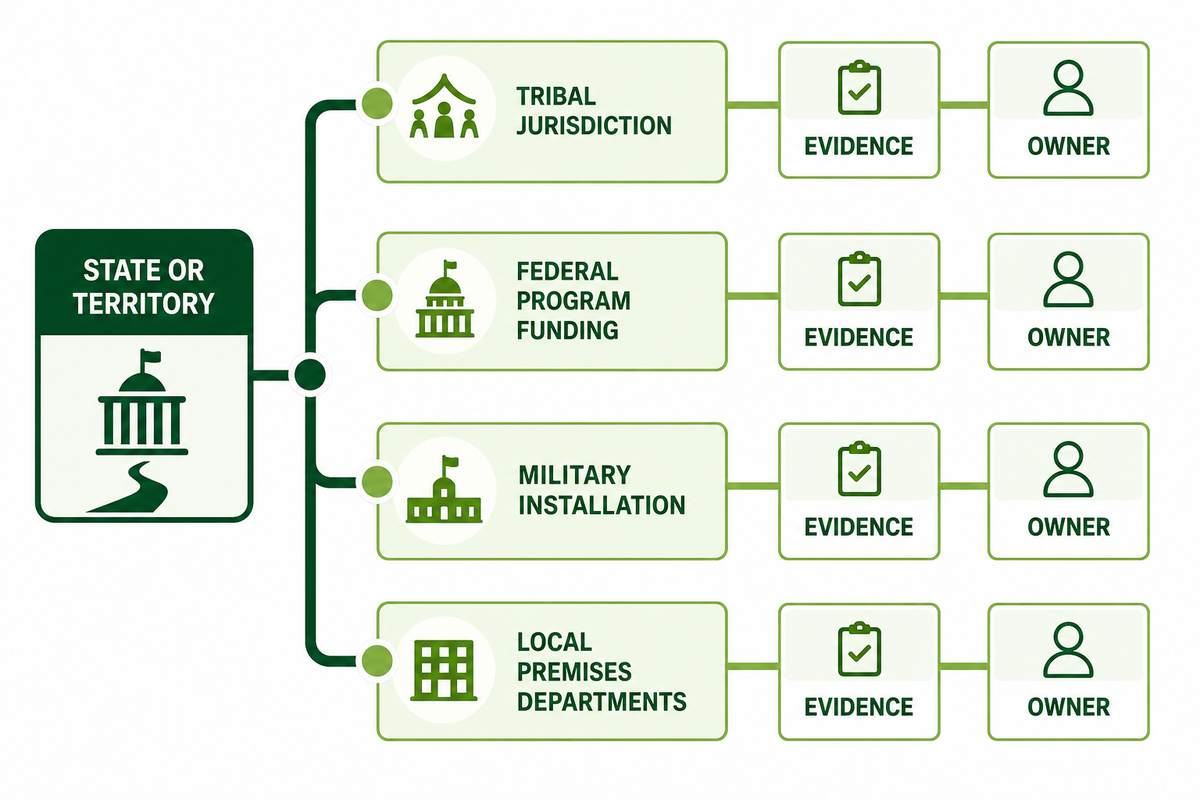
Answer first: state licensing is usually the starting branch, not always the final one. Ask whether the program is Head Start, receives Child Care and Development Fund support, operates under a tribe, is run by a public entity, or is a military child development center. Each “yes” can add another source, inspector, or reporting duty.
| Fork | Question to ask | Evidence to retain |
|---|---|---|
| State or territory | Which facility type and legal status apply? | Agency classification and current rules |
| Local government | Which land-use, building, fire, health, or food approvals are prerequisites? | Department sign-offs and conditions |
| Tribal authority | Which tribal and federal funding rules apply? | Written jurisdiction and lead-agency determination |
| Head Start | Which center-based or other program option applies? | Applicable 45 CFR program records |
| Child Care and Development Fund | Is the provider serving subsidized children? | Lead-agency requirements, inspection, and check records |
| Military child care | Is the operation a covered military center or family home site? | Department of Defense rules, inspection, and complaint records |
For Head Start center-based programs, 45 CFR 1302.21 contains program-specific ratios and group-size maximums. It also says a program must follow more stringent state or local licensing requirements. That’s a direct example of why “there are no federal numbers” is too broad.
For covered providers in the Child Care and Development Fund system, 45 CFR 98.42 includes inspection provisions and reporting of serious injuries or deaths to a designated state, territorial, or tribal entity. Confirm the exact lead-agency implementation before building a reporting workflow.
Military child development centers follow another branch. 10 U.S.C. § 1794 requires inspections at least four times a year, each unannounced. Don’t apply that cadence to a civilian center unless a source governing that center says so.
Build Role-Specific Proof for Staff, Checks, and Training
Answer first: create one role-specific eligibility row for every person. After the military center, funding, and other program branches are identified, licensing rules may assign different duties to the licensee, director, caregiver, teacher, assistant, substitute, volunteer, contractor, and household member. Record each person’s age where relevant, qualifications, experience, training, background-check status, medical records where required, permitted role, and supervision limits instead of grouping everyone under a generic “child-care workforce” label.
Before hirefederal licensed-program check request point
Every 5 yearsminimum repeat interval described by ChildCare.gov
Up to 45 daysfederal processing ceiling in 45 CFR 98.43
ChildCare.gov’s staff background-check page states that licensed child-care programs must request staff background checks before hiring and at least once every five years. For the Child Care and Development Fund branch, 45 CFR 98.43 includes database components, prior-state lookbacks, and a 45-day processing ceiling. Use the applicable source and local process, not these numbers in isolation.
Track each person’s progress with fields such as “not started,” “requested,” “pending,” “eligible,” “expires,” and “role cleared.” Keep private personnel details on a need-to-know basis, while giving the operating team and inspector enough evidence to confirm who may work and in which role.
Never Copy Another State’s Ratio or Group-Size Number
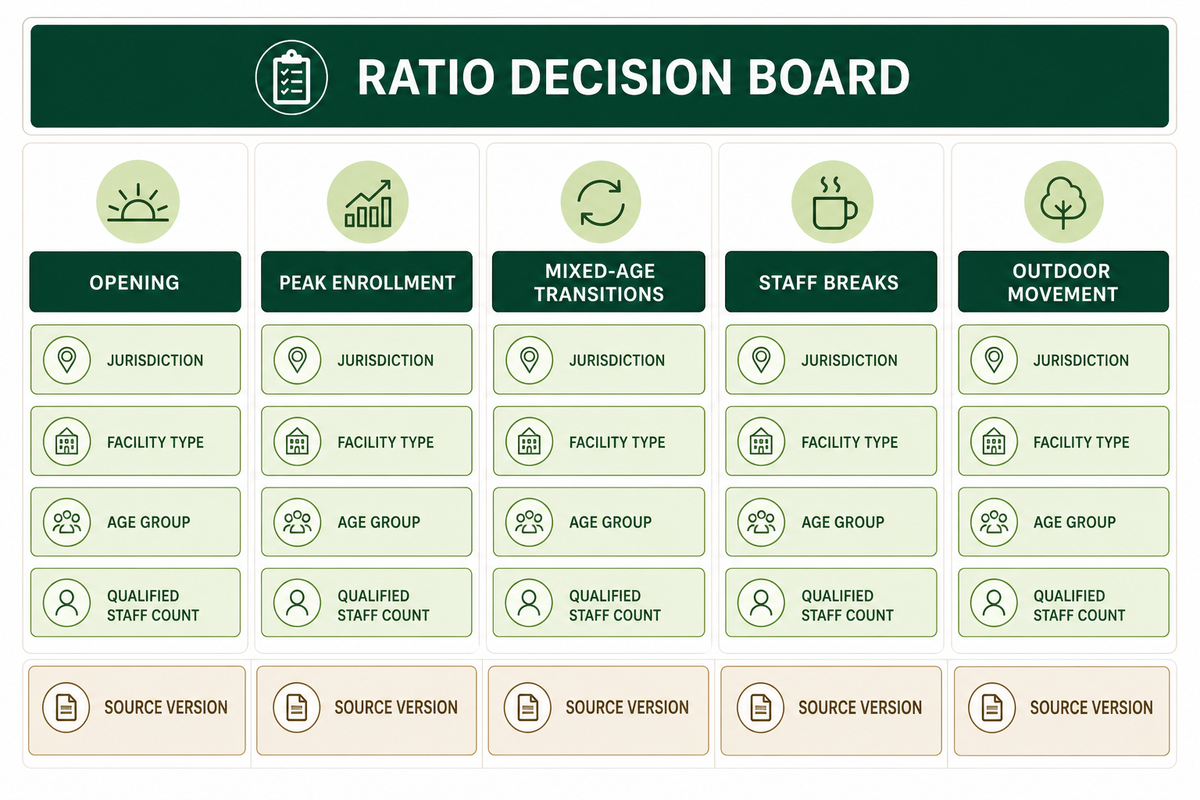
Answer first: a ratio is valid only when its jurisdiction, facility type, program overlay, child age, mixed-age method, activity, time of day, staff qualification, and effective date match your operation. The role-specific evidence row tells the operating team which adults can count. Record ratio, group size, and room capacity as separate controls because one compliant number does not prove the other two.
Use a small scenario set before accepting the staffing plan: opening hour, peak enrollment, mixed-age transition, outdoor time, meals, naps, restroom assistance, staff breaks, and an absence. Ask which adults count in each scenario and what qualification or location condition controls that count. Keep the authority response with the staffing schedule.
Head Start shows how quickly context changes a number. Under 45 CFR 1302.21, a class serving children under 36 months has one set of teacher and group-size conditions, while classes serving mostly three-year-olds or four- and five-year-olds have others. The section also preserves stricter state or local licensing provisions.
Write the denominator: “one staff member per X children” is incomplete unless the file identifies which staff count, which children count, the room or activity, the age rule, and the exception conditions.
Clear Premises, Fire, Health, and Accessibility Gates Before Procurement
Answer first: don’t make an irreversible lease or equipment decision until the responsible departments have documented the intended child-care use. Once staff, ratio, and group-size controls are mapped, the next risk is a delayed license, an unusable room, or a redesign after procurement. Licensing, planning, building, fire, health, food-service, sanitation, transportation, environmental, and accessibility decisions can be separately owned, yet one may be a prerequisite for another.
Stamford’s child-care permitting guide identifies multiple local departments in its pre-application process. That list is an example from Stamford, not a national department checklist. Its purpose is procedural: determine all site reviewers early and record their requirements against the same floor plan revision.
Ohio provides a better dependency example. Ohio Revised Code 5104.05, effective January 1, 2025, considers building, fire, and food-service approvals in the license-issuance process. Local approvals can be separately obtained and still serve as state-license prerequisites.
Accessibility begins with operator and facility facts. The U.S. Department of Justice explains that privately run child-care centers generally fall under Title III, while government-provided services generally fall under Title II; religious-entity control changes the analysis. Use the Department of Justice child-care guidance to frame questions, then obtain project-specific advice from qualified professionals.
Before you’re locked in on a property, the pre-lease feasibility checklist can help organize questions about commercial site selection. It doesn’t replace licensing, professional design, code official, or legal review.
Separate Playground Authority Decisions From Supplier Inputs
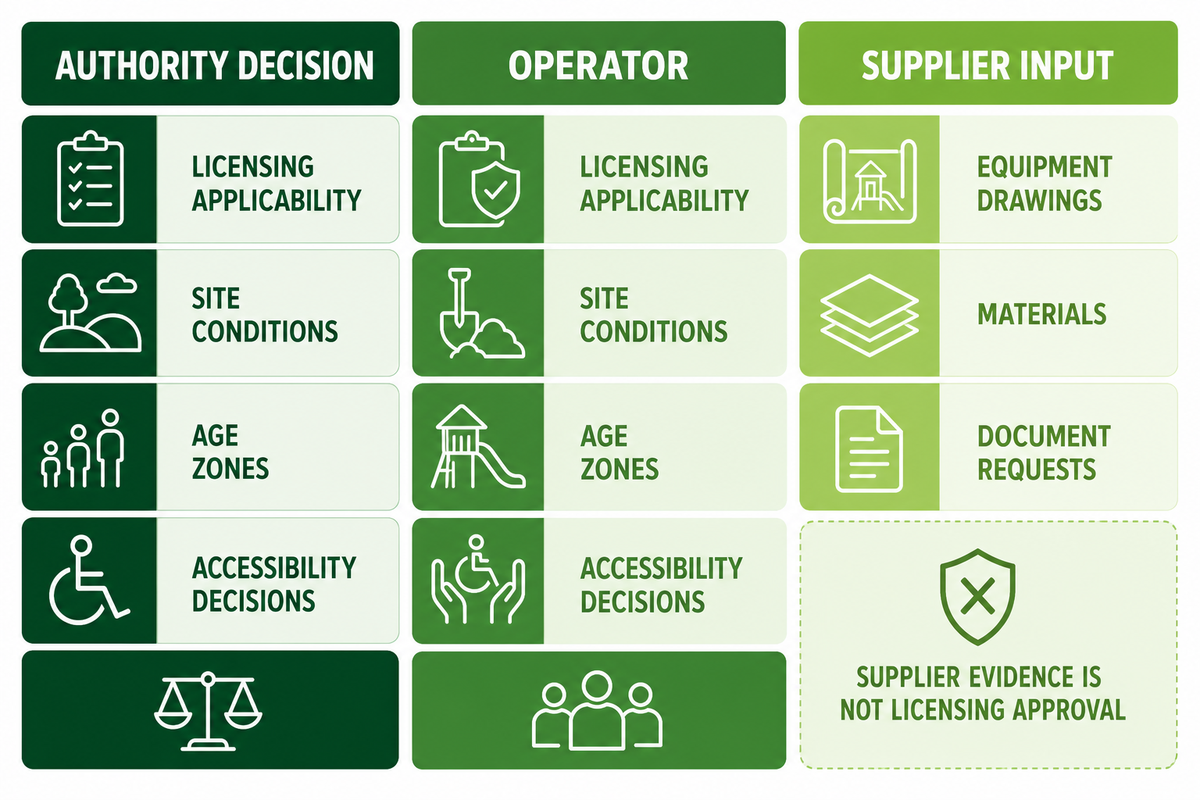
Answer first: a playground safety reference or manufacturer declaration is not a licensing approval. The determining authority decides which licensing, building, accessibility, and local code provisions apply. Designers and product suppliers provide bounded evidence about layout, equipment, materials, installation, use zones, surfacing, inspection, and upkeep for that decision.
For playground references, the U.S. Consumer Product Safety Commission issues a Public Playground Safety Handbook, while the U.S. Access Board describes accessible routes, play features, and surfacing in its play-area guide. Both are useful references, but neither is a license nor a manufacturer certification.
A state rule can create a specific bridge. Washington’s WAC 110-300-0165 addresses playground equipment, surfacing, and provider hazard mitigation. Use it only as a Washington example. Another state may adopt different editions, terminology, inspection methods, or authority decisions.
Playground Approval Responsibility Split
This sheet prevents a common handoff failure: an operator sends an authority question to a supplier, or leaves a supplier evidence request with the regulator. Assign one decision owner and one evidence owner for every line.
| Decision or evidence lane | Decision owner | Evidence owner | Closeout proof |
|---|---|---|---|
| Licensing applicability | Licensing authority | Operator | Written classification |
| Use and occupancy | Local code officials | Owner and design team | Approved plan or permit |
| Accessibility scope | Covered operator and authority | Qualified design team | Reviewed accessibility package |
| Age and user range | Operator and authority | Supplier | Approved age-zone schedule |
| Equipment configuration | Operator and design team | Supplier | Revision-controlled drawings |
| Use zones and clearances | Design team and authority | Supplier | Dimensioned layout review |
| Surfacing system | Design team and authority | Supplier and installer | Product and installation records |
| Installed condition | Operator and required inspector | Installer | Punch list and acceptance record |
| Continuing inspection and maintenance | Operator | Trained staff and service providers | Logs, repairs, and reinspection |
Once the authority boundary is defined, move commercial configuration, scope definition, documentation requests, and pricing quotes into a separate project brief. This guide remains anchored in license research, evidence ownership, and inspection readiness.
Turn Rules Into a Rule-to-Room Register
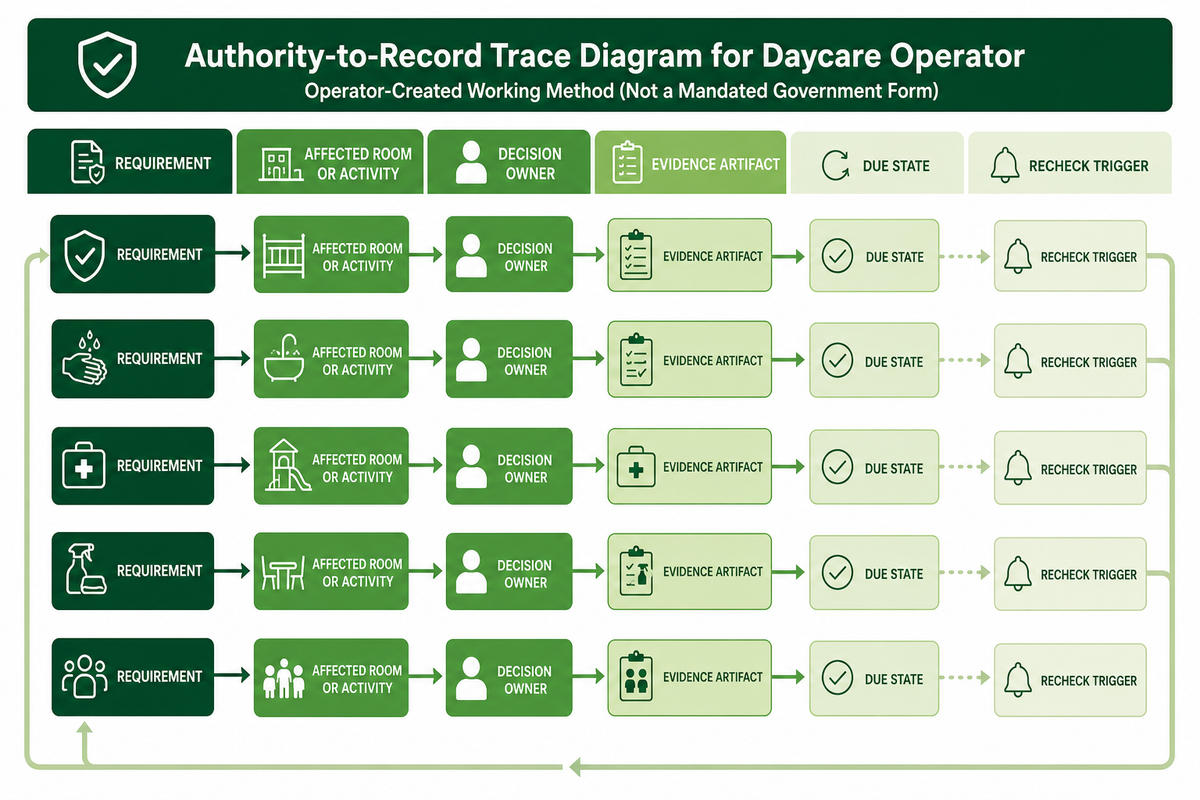
Answer first: a saved regulation is not yet an operating control. Carry the licensing research, evidence ownership, and inspection-readiness boundary into rows: convert every applicable citation into a row that names the affected room, role, policy, or record; the required evidence; its owner; the approving party; the source version; and the current status. This register becomes the spine of the approval file.
Authority-to-Record Trace: Rule-to-Room Register
Use one row for each decision-sized requirement. Split a long section when different owners must act. Keep links to drawings and records rather than pasting uncontrolled copies into email threads.
| Evidence category | What to record | Acceptance question |
|---|---|---|
| Requirement ID | Stable internal row number | Can every comment point to one row? |
| Authority and citation | Agency, title, section, page or table | Is this the controlling source? |
| Scope | Program type, age, activity, and exceptions | Do our facts match the source? |
| Effective date | Effective, revision, and retrieval dates | Was this current at the decision date? |
| Affected item | Room, route, person, policy, or record | Is the requirement tied to a real object? |
| Evidence needed | Drawing, approval, certificate, log, or observation | What proves the row is satisfied? |
| Action owner | Named person, not a department alone | Who produces or repairs the evidence? |
| Decision owner | Authority, professional, operator, or funder | Who accepts the evidence? |
| Status and dependency | Open, submitted, conditional, accepted, superseded | What work must wait? |
| Recheck trigger | Date plus enrollment, design, staffing, or rule change | What makes this decision stale? |
A simple status vocabulary keeps meetings honest: unresearched, source found, applicability confirmed, evidence in progress, submitted, accepted with conditions, closed, and superseded. “Done” is too vague when a document can be complete but not accepted.
Close Gaps With an Inspection Delta Log
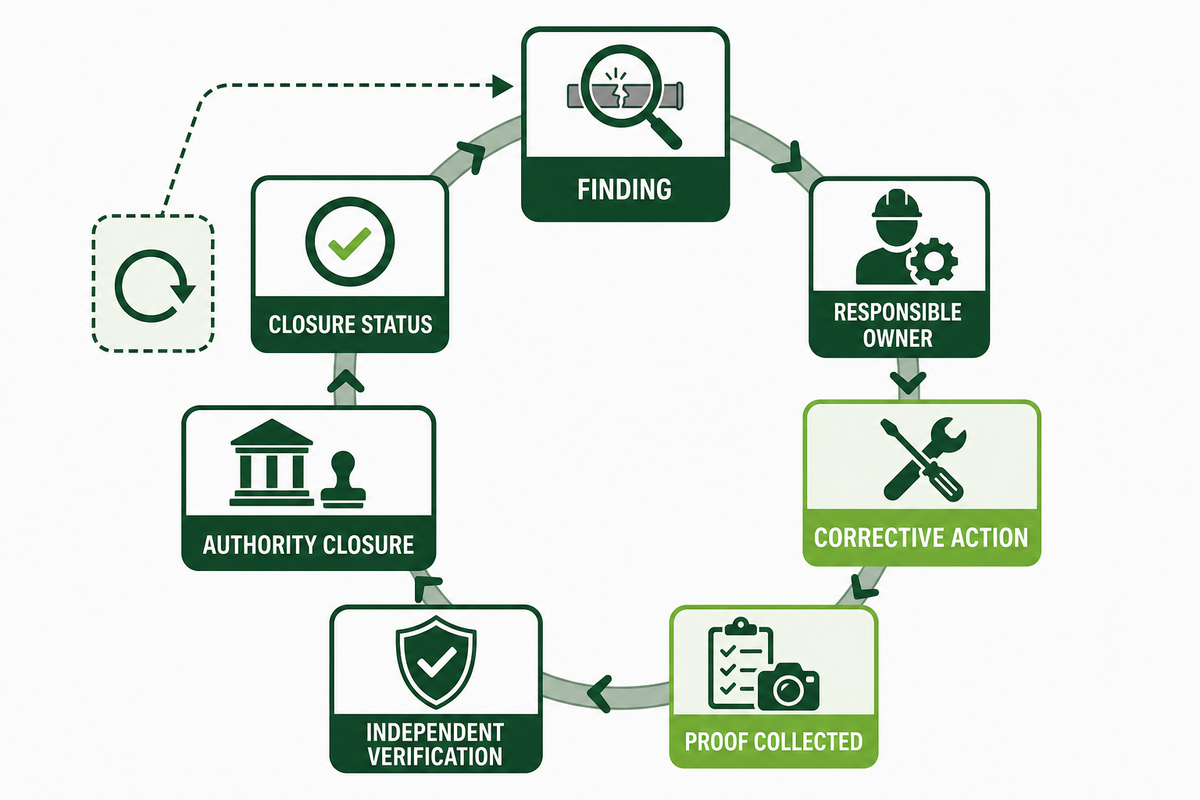
Answer first: treat every pre-inspection finding, authority comment, failed record check, field deviation, and inspection deficiency as a controlled delta. Each Rule-to-Room row with an open status now becomes an inspection closeout item. Give it an owner, severity basis, due date, interim protection, corrective action, replacement evidence, verifier, and closure date. A verbal fix without replacement proof is still open.
Texas’s child-care inspection handbook explains that inspectors may identify deficiencies during operation walk-throughs or record reviews. The handbook, revision 25-2 and effective July 1, 2025, describes inspectors observing operations, reviewing records, citing deficiencies, documenting scope and severity, and considering risk. It also assigns the operation responsibility for corrective plans and prevention; inspectors do not manage the operation.
A Department of Health and Human Services Office of Inspector General audit found physical-condition noncompliance at all four reviewed Florida providers despite required inspections. Although the sample is narrow and older, it supports a durable operating lesson: passing through an inspection cycle does not remove the provider’s responsibility to maintain ongoing compliance with applicable state licensing requirements.
Inspection Finding Closure Dossier
| Field | Required entry | Closure test |
|---|---|---|
| Delta ID | Stable number linked to the source visit | No duplicate or lost finding |
| Finding | Observable condition, not a vague label | A second person can locate it |
| Rule or acceptance basis | Citation, plan note, or authority comment | Applicability is confirmed |
| Risk and interim action | Authority severity plus temporary protection | Interim condition is documented |
| Owner | Named accountable person | Owner accepts the due date |
| Corrective action | Specific repair, record, training, or decision | Root cause is addressed |
| Replacement evidence | Photo, drawing, log, receipt, or approval | Evidence matches the corrected condition |
| Independent recheck | Verifier, method, date, and result | Original finding no longer exists |
| Authority closure | Submission, response, conditions, and close date | The party that raised it accepts closure |
Preserve both the finding and the fix. If the center replaces the original photo or drawing, it loses the before-and-after trail. Link the delta to the Rule-to-Room Register so the corrected evidence becomes the current record while the closed issue remains auditable.
Recheck the File When the Program or Rules Change
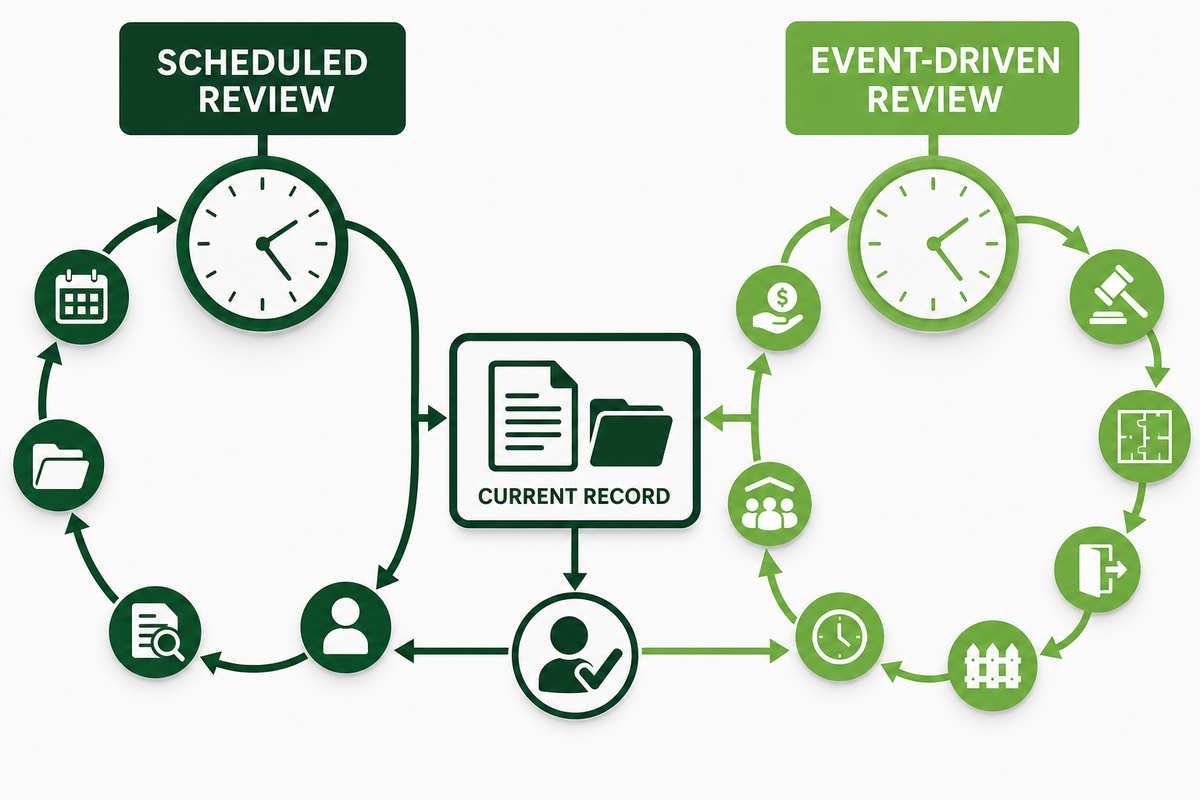
Answer first: use two clocks, a scheduled review and an event-driven review. Once a finding is closed, keep its fix in the current record and set the next trigger. A calendar check catches routine updates; event triggers catch changes in ownership, address, room use, capacity, age mix, staffing, funding, services, equipment, construction, incidents, or authority guidance. Record who watches each trigger and what gets frozen during review.
Current reform work shows why a copied rulebook ages badly. Minnesota enacted revised child-care licensing standards in May 2026, with an effective date of July 1, 2027; current requirements remain in effect until then. Separately, the state’s modernization project says the Weighted Risk System may not be implemented earlier than January 1, 2027. Operators need the adopted rule and effective date, not a proposal summary.
Use change control on the operating side too. A new room, remodeled exit, moved fence, different age zone, new transportation service, food preparation change, or revised playground layout can invalidate an earlier approval. Ask the licensing specialist which changes need prior notice, revised drawings, a new inspection, or an amended license.
Minimum version-control rule
Every controlled document should show an owner, revision, effective date, approval status, and the superseded version. If a floor plan changes, check the room register, capacity basis, fire review, accessibility review, and playground boundary sheet against that revision.
Prepare an Authority-Ready Brief Before Asking for Quotes
Answer first: send suppliers only the design facts the authority and project team have bounded. Include approved or provisional room dimensions, clear heights, entrances and routes, columns, utilities, age zones, supervision concept, accessibility decisions, required standards or guidance, documentation deliverables, installation boundary, and acceptance process. Mark every unresolved item.
A clean supplier brief prevents two opposite errors. One asks a manufacturer to make legal decisions outside its role. The other withholds site and authority conditions, then expects the equipment package to fit an approval it never received. Use revision numbers so supplier drawings and authority submissions refer to the same plan.
Supplier evidence request
- Project, room, age-zone, and drawing revision identifiers
- Equipment and material schedule with bounded standard references
- Dimensioned layout, use zones, routes, access points, and service clearances
- Installation responsibilities, field tolerances, inspection points, and punch-list method
- Operation, inspection, cleaning, maintenance, repair, and replacement instructions
- Document index showing issuer, date, revision, scope, and applicable configuration
Dreamland Playground is a China-based playground equipment manufacturer and project solution provider. Based on the company information supplied for this article, its team can support space planning, floor plans, three-dimensional design, production, shipping, installation support, and after-sales service. Projects are tailored to the site, target ages, market, theme, budget, and business needs.
Dreamland reports an in-house production team and quality-control process. It also states that products can be designed to relevant EN and ASTM safety requirements, depending on the product type and target market. Treat these as first-party capability statements—not licensing approval, third-party certification, or a product-specific applicability decision. Ask for revision-controlled evidence that matches the quoted configuration, then send it to the authority and qualified professionals for review.
Turn the approved boundary into a playground brief
Share the room revision, age groups, authority comments, accessibility decisions, evidence list, and installation boundary. Dreamland Playground can then discuss a project-specific configuration without taking over the authority’s role.
Frequently Asked Questions
Answer first: most daycare licensing questions cannot be answered safely without a state, program type, address, age group, and operating model. The answers below show the decision path, not universal thresholds. Confirm current requirements with the licensing agency and the local departments that control the planned site.
What qualifications are needed for a childcare license?
Requirements depend on jurisdiction, facility type, and role. Separate director qualifications, caregiver qualifications, experience, orientation, background checks, health and safety training, first aid, continuing education, and on-site supervision. Confirm whether each item belongs to the licensee, director, lead teacher, assistant, substitute, volunteer, contractor, or household member. Ask the licensing office for the current role-specific source, allowed alternatives, proof format, and renewal rule. Map every item to a named person, current status, issue date, expiration date, and the room or shift that depends on it.
How many children can you watch without a daycare license?
There is no safe nationwide number. Submit the actual state, provider relationship to each child, number of families, home or commercial setting, schedule, sponsorship, payment source, and services to the responsible agency. Retain its written classification and the facts reviewed. Recheck if enrollment, hours, location, funding, or services change because an earlier exemption decision may no longer fit.
Can a daycare open before the license is issued?
Do not assume that an application, inspection, provisional document, payment, or passed department review authorizes care. Ask the licensing agency what written authorization is required before serving children and whether zoning, building, fire, health, food-service, or other approvals must be complete first. Keep the issued authorization, effective date, approved address, capacity, age scope, and operating conditions in the opening file. Train staff to distinguish “submitted,” “conditionally accepted,” and “authorized to operate.”
Does licensed playground equipment guarantee daycare approval?
No. Equipment evidence can support a review, but the authority decides licensing and site approval.
How often are daycare inspections required?
The controlling cadence depends on the program. Federal funding or military rules can add distinct branches, and state rules can go further. Confirm pre-licensure, routine, unannounced, complaint, follow-up, renewal, and change-triggered inspections with the competent agency. Record the source and do not transfer one program’s frequency to another.
What records should be ready for a daycare inspection?
Build the list from the current inspection scope. Evidence lanes can include legal status, staff eligibility, training, attendance, supervision, ratios, health and safety policies, emergency plans, incident records, premises approvals, equipment inspections, maintenance, and prior corrective actions. Index each record by source requirement, person or room, owner, date, and status. Run a mock retrieval: an independent reviewer should be able to request a rule and receive the current proof without searching personal inboxes. The local source still controls the final list.
Related Dreamland Planning Guides
Use these resources after the licensing authority boundary is defined. They cover site, design, safety, operations, and insurance planning; none replaces a government determination, licensed professional, inspector, attorney, or insurer.
- commercial daycare playground configuration and quotation
- verify the applicable playground standards pathway
- screen the site before signing a lease
- prepare insurer evidence and coverage questions
- control the post-acceptance operating file
References & Sources
Sources below were checked during research in September 2026. Regulations and agency guidance can change; verify the current text and applicability before making licensing, staffing, lease, design, or procurement decisions.
- ChildCare.gov: Child Care Licensing
- National Database of Child Care Licensing Regulations: About
- ChildCare.gov: Staff Background Checks
- 45 CFR 98.42: Enforcement of Licensing and Health and Safety Requirements
- 45 CFR 98.43: Criminal Background Checks
- 45 CFR 1302.21: Head Start Center-Based Option
- 10 U.S.C. § 1794: Military Child Care Safety and Inspections
- U.S. Department of Justice: Child Care Centers and the ADA
- U.S. Access Board: Guide to Play Areas
- U.S. Consumer Product Safety Commission: Public Playground Safety Handbook
- Texas HHS: Inspecting Child-Care Operations
- City of Stamford: Child Care Permitting Guide
- Washington WAC 110-300-0165: Safety of Outdoor Play Space and Equipment
- Ohio Revised Code § 5104.05
- Minnesota DCYF: Revised Child Care Licensing Standards
- Minnesota DCYF: Child Care Regulation Modernization Project
- HHS Office of Inspector General: Florida Childcare Centers Audit