Get in touch with Dreamland Playground Company

Updated November 2026 · Reviewed by the Dreamland Playground (Zhejiang Dreamland Co., Ltd) technical team
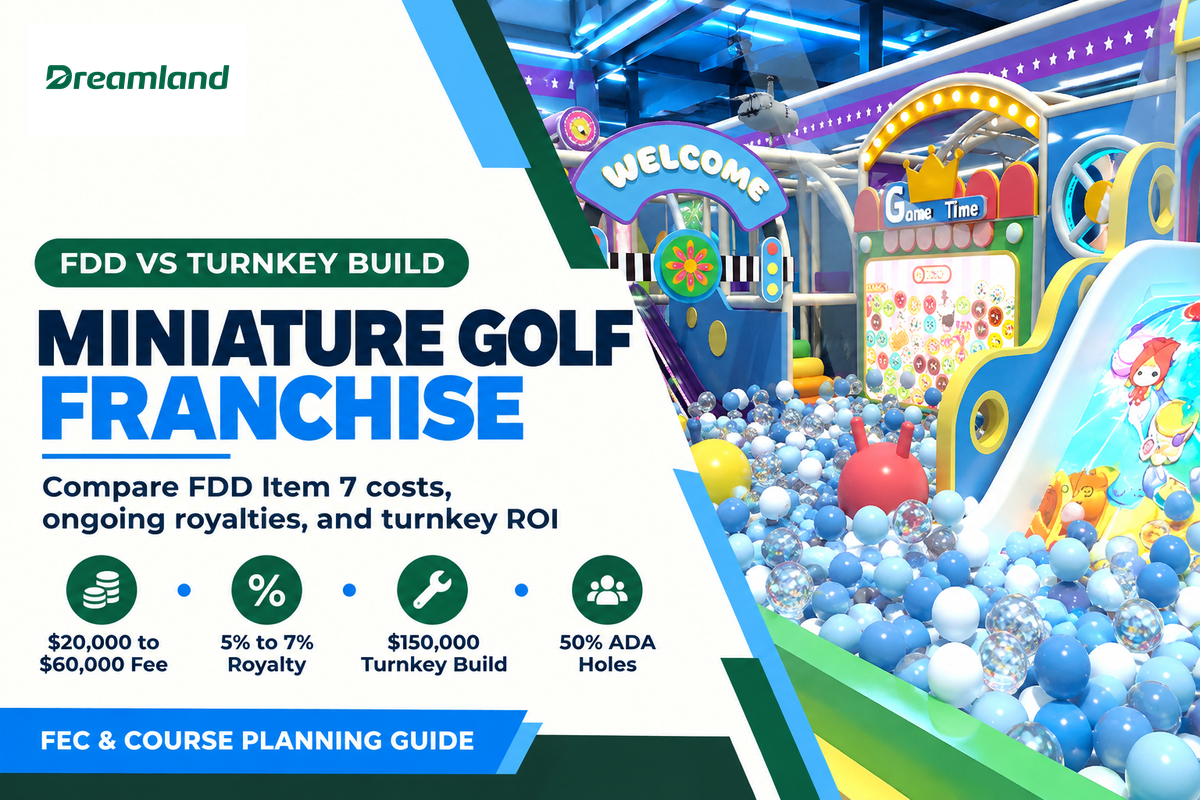
According to 2025 FDD filings, Putt-Putt Golf Only lists $420,000 to $975,000 in Item 7 initial investment. Monster Mini Golf lists $885,235 to $1,535,235, while a full Putt-Putt Fun Center miniature golf franchise reaches $5,380,000. Disclosed FDD schedules list $20,000 to $60,000 in upfront franchise fee charges plus 5% to 7% ongoing gross royalties and 1% to 2% marketing fees. By contrast, Adventure Golf Services publishes independent 18-hole commercial mini golf course buildout pricing of $150,000 to $500,000+ with zero ongoing royalties.
Quick Specs: Miniature Golf Franchise vs. Independent Turnkey Build
| Active U.S. FDD Franchise Systems | Monster Mini Golf (indoor glow FEC) and Putt-Putt Fun Center (3 tiers) |
| Corporate-Only Social Putting Chains | PopStroke (Tiger Woods & TaylorMade backed) and Puttshack |
| FDD Item 5 Upfront Franchise Fee | $20,000 to $50,000 (Putt-Putt tiers) · $60,000 (Monster Mini Golf 2025 FDD) |
| FDD Item 6 Ongoing Royalty & Ad Fund | 5% royalty + 1% marketing (Putt-Putt) · 7% royalty + 2% marketing (Monster Mini Golf) |
| FDD Item 7 Total Initial Investment | $420,000 to $975,000 (36-hole golf only) · $885,235 to $1,535,235 (indoor glow FEC) |
| Independent 18-Hole Course Build Cost | $150,000 to $200,000 (Modular Advantage panels) · $150,000 to $500,000+ (custom build) |
| 2010 ADA Standards Compliance | At least 50% accessible holes (consecutive sequence, 1 permitted break ending at final hole) |
Which Miniature Golf Franchise Opportunities Actually Exist (And Which Chains Do Not Franchise)?
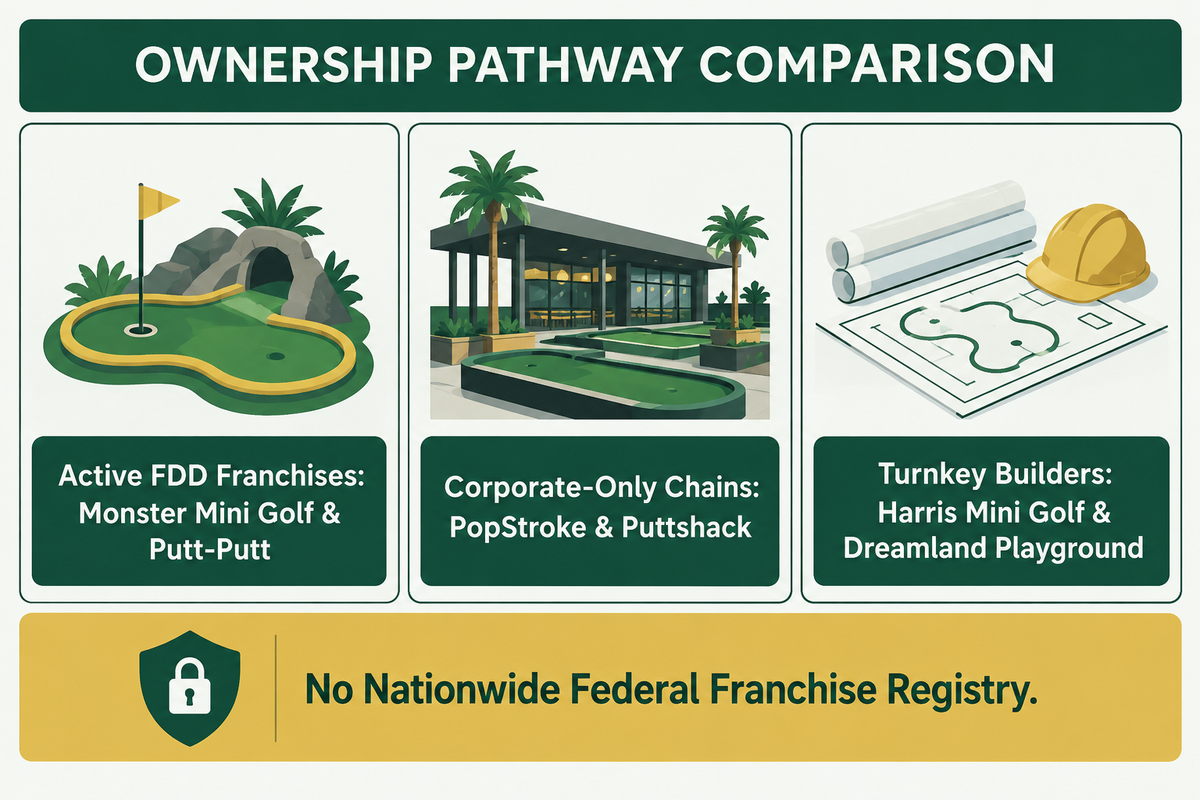
In our reviewed 2025 disclosures, Monster Mini Golf and Putt-Putt Fun Center actively sell unit franchises under a federal Franchise Disclosure Document (FDD). National chains like PopStroke and Puttshack expand via corporate venues and institutional joint ventures. Independent buyers instead hire turnkey builders like Harris Miniature Golf Courses or Dreamland Playground.
The federal franchise disclosure framework doesn’t provide a nationwide federal registry of franchise brands. Prospective buyers must request each brand’s FDD or verify state franchise filings directly. Putt-Putt Fun Center operates 29 locations across the U.S. after more than 70 years in the family entertainment business.
What about other recognizable names such as Pirate’s Cove Adventure Golf, Puttery, or Swingers? In our reviewed disclosures, Pirate’s Cove Adventure Golf, Puttery, and Swingers don’t publish open single-unit FDD investment tables for individual retail applicants. Meanwhile, Harris Miniature Golf Courses (Harris Mini Golf) builds custom independent courses and offers The Putt Club brand partnership.
| Brand / Builder Name | Model Category & Tier | Single-Unit FDD Disclosed? | Disclosed Footprint / Scope | Primary Revenue Driver |
|---|---|---|---|---|
| Monster Mini Golf | Indoor Glow FEC Franchise | Yes (Active 2025 FDD) | 9,000 to 20,000+ sq ft | 18-hole blacklight golf, redemption arcade, party rooms |
| Putt-Putt Golf Only | Outdoor Putting Franchise (Tier 1) | Yes (Active FDD, 29 U.S. sites) | Two 18-hole courses (36 holes total) | 36-hole competition putting admissions and group events |
| Putt-Putt Golf and Games / Fun Center | Multi-Attraction FEC Franchise (Tiers 2 & 3) | Yes (Active FDD) | 3,500–4,000 sq ft or 10,000 sq ft building | 36-hole putting, arcade games, go-karts, bumper boats |
| Harris Miniature Golf / The Putt Club | Turnkey Course Builder & Partner Model | Turnkey builder (non-FDD) | Custom indoor or outdoor course layout | Custom mini golf courses paired with food and entertainment |
| PopStroke | Corporate / Institutional JV | No individual unit FDD | Two 18-hole courses + dining patio + playground | 36-hole synthetic turf putting, 98% scratch kitchen, bar |
| Puttshack | Corporate Tech-Putting Chain | No individual unit FDD | 25,000 sq ft average venue (20 locations) | Auto-scored 9-hole courses, upscale dining, cocktail bar |
| Pirate’s Cove / Puttery / Swingers | Legacy Chain & Urban Social Putting | No public FDD cost table in reviewed records | Resort outdoor or urban indoor hospitality venues | Destination adventure golf or adult cocktail putting |
| Independent Turnkey FEC (Dreamland Playground) | Factory-Direct Custom Buildout | No franchise fees or royalties | 30+ modular indoor attraction configurations up to 50,000 sq ft | Custom mini golf paired with indoor soft playground and arcade |
Does PopStroke or Puttshack Offer a Miniature Golf Franchise?
Neither PopStroke nor Puttshack sells traditional single-unit franchises to individual entrepreneurs under a standard Franchise Disclosure Document (FDD). Both corporations expand through development of corporate-owned real estate, private equity, and joint ventures with institutional landlords. Individual operators must select an active FDD franchise or build an independent brand.
According to FSR Magazine’s 2025 feature on PopStroke’s expansion, PopStroke grew from 9 locations at the start of 2024 to 17 locations by year-end. Each PopStroke venue features two 18-hole putting courses, a dining patio with a 98% scratch kitchen, and an enclosed playground. The brand is backed by founder Greg Bartoli, Tiger Woods, and TaylorMade.
Similarly, Dataintelo’s 2025 Global Mini Golf Market Report notes that Puttshack operates 20 locations averaging 25,000 square feet. Those venues generate $11 million to $12 million in annual revenue with a 25% store-level margin. Because these corporate venues require institutional capital, individual business owners evaluate Monster Mini Golf, Putt-Putt, or turnkey course builders.
How Much Does a Miniature Golf Franchise Cost Under FDD Item 5, Item 6, and Item 7?
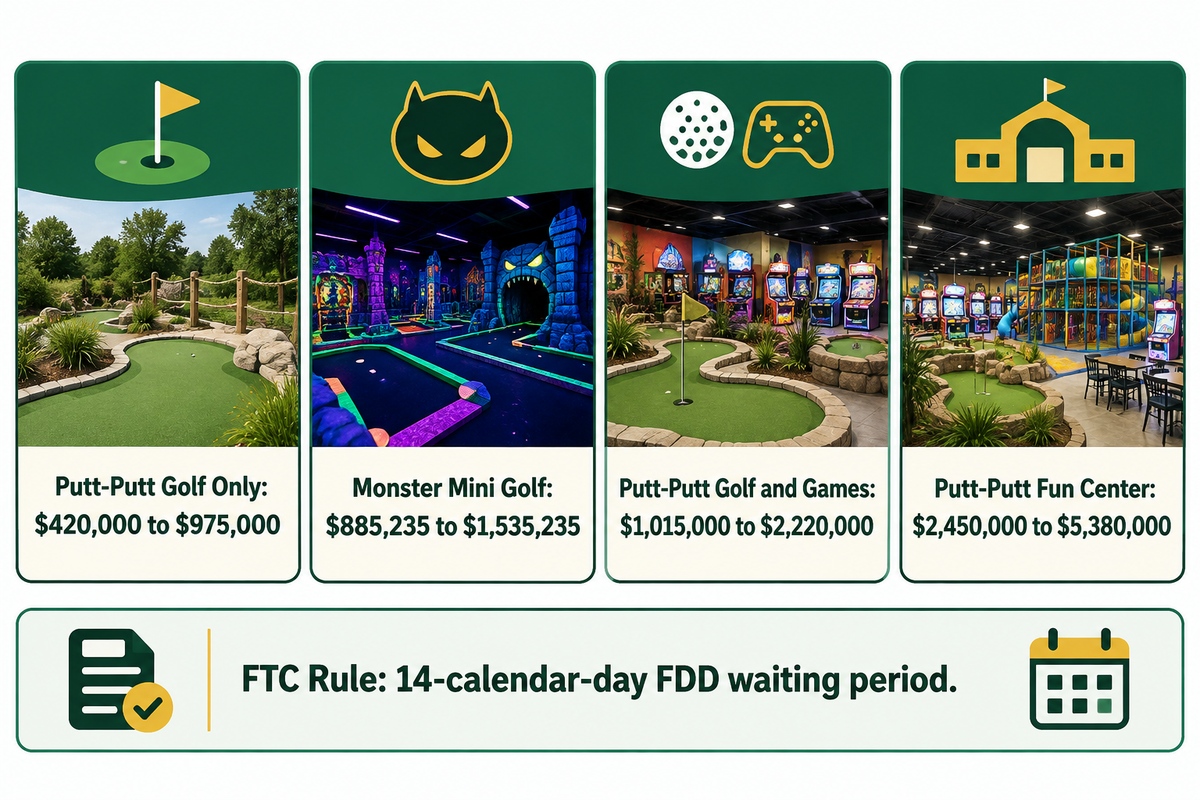
According to 2025 FDD disclosures, Putt-Putt Golf Only requires $420,000 to $975,000 in initial investment (excluding real estate and building construction costs). Monster Mini Golf requires $885,235 to $1,535,235, and a full Putt-Putt Fun Center requires $2,450,000 to $5,380,000 (excluding land and building shell). Upfront Item 5 franchise fees span $20,000 to $60,000, while ongoing Item 6 deductions take 6% to 9% of gross sales.
Covered franchise sales under the FTC Franchise Rule (16 CFR Part 436) require a 14-calendar-day waiting period. The franchisor must provide the buyer with the 23-item FDD before the buyer signs a binding agreement or pays money to the franchisor or an affiliate. Before meeting with a accountant or lender, buyers should separate one-time start-up costs in Item 5 and Item 7 from ongoing revenue deductions in Item 6.
| Franchise Tier & Format | Item 5 Initial Franchise Fee | Item 7 Total Initial Investment | Liquid Cash & Net Worth Required | Item 6 Royalty + Marketing Fee |
|---|---|---|---|---|
| Putt-Putt Golf Only (36 Holes) | $20,000 | $420,000 to $975,000 | $200,000 liquid · $1,000,000 net worth | 5% royalty + 1% marketing fee |
| Monster Mini Golf (2025 FDD Indoor Glow) | $60,000 | $885,235 to $1,535,235 (or $891,500–$1,563,500 in prior FDD summaries) | $210,000 liquid · $500,000+ net worth | 7% royalty + 2% marketing fee |
| Putt-Putt Golf and Games (3,500–4,000 sq ft) | $30,000 | $1,015,000 to $2,220,000 | $300,000 liquid · $2,000,000 net worth | 5% royalty + 1% marketing fee |
| Putt-Putt Fun Center (10,000 sq ft FEC) | $50,000 | $2,450,000 to $5,380,000 | $500,000+ liquid · $2,000,000+ net worth | 5% royalty + 1% marketing fee |
The widest variable in Item 7 is leasehold improvement and tenant buildout expense. If a retail box needs upgraded HVAC, fire sprinklers, multi-stall restrooms, or a combination of these, construction budgets move toward the upper end of Item 7. Operators can model their capital reserves by using our 5-Year Indoor entertainment Financial Projection Model prior to signing a lease.
Qualified U.S. buyers often use SBA Standard 7(a) loans. That program provides up to $5 million in total financing. SBA 7(a) loans carry an 85% maximum government guaranty for loans up to $150,000 and a 75% maximum guaranty for loans above $150,000. Loan maturity reaches up to 10 years for equipment and working capital and 25 years for real estate.
BMI Leisure applies a modeled 14%–18% EBITDA margin to Monster Mini Golf’s $1,044,449 Item 19 average unit volume. That calculation yields $146,223–$188,001 in modeled annual EBITDA before interest, taxes, depreciation, and amortization. That figure represents store-level EBITDA rather than a guaranteed net profit promise from the franchisor.
Monster Mini Golf vs. Putt-Putt Fun Center: How Do the Two Active Franchise Formats Compare?
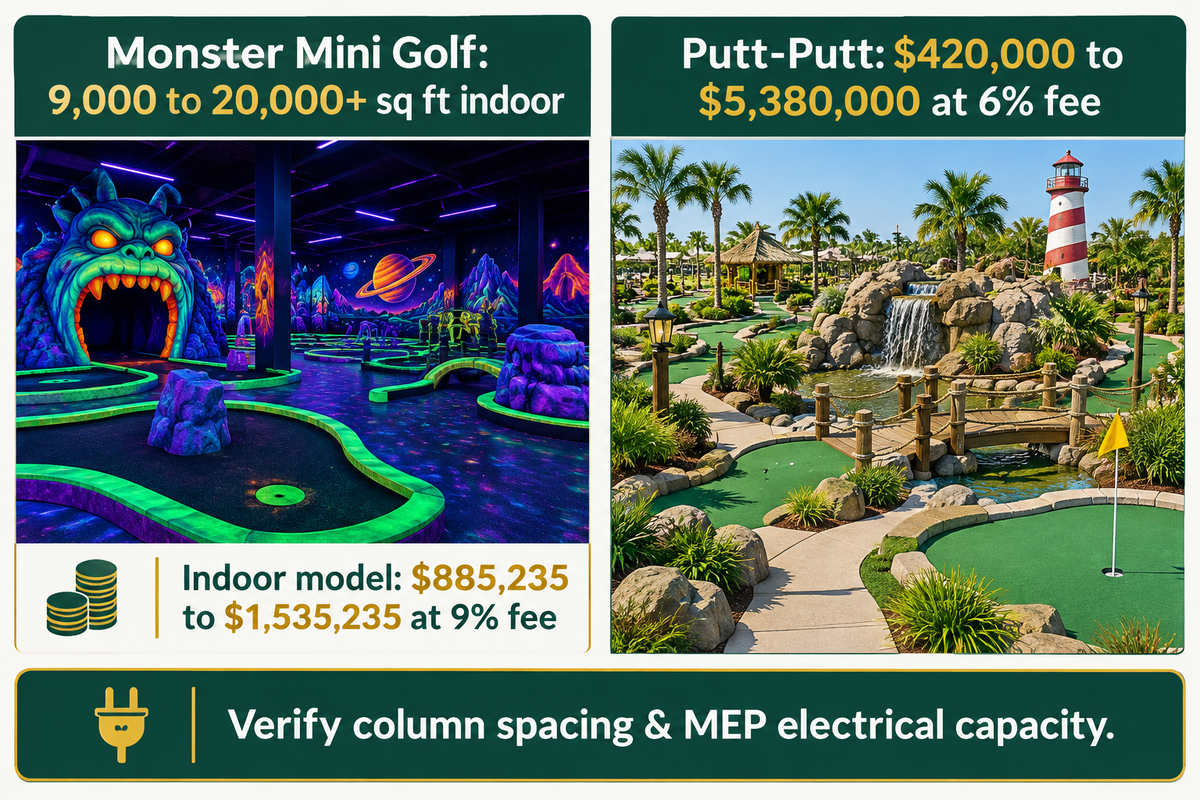
According to 2025 FDD filings, Monster Mini Golf targets 9,000 to 20,000+ sq ft indoor spaces. It requires $885,235 to $1,535,235 in total investment and a 9% combined fee. Putt-Putt Fun Center offers three formats from $420,000 for 36-hole golf courses to $5,380,000 for a full center at a 6% combined fee.
Monster Mini Golf should be considered by operators seeking climate-controlled indoor retail space in markets with winter freezes. Putt-Putt Fun Center provides outdoor and hybrid formats in Southern and Sunbelt markets. Monster Mini Golf converts retail boxes into immersive, glow-in-the-dark venues featuring 18 holes, animatronic props, arcade games, and private event rooms. Indoor operation protects attendance from weather.
Conversely, Putt-Putt Fun Center emphasizes par-2 competition putting holes alongside scalable attractions. Operators in warm markets can launch the entry-level 36-hole Putt-Putt Golf Only model for $420,000 to $975,000, or scale into a 10,000-square-foot indoor/outdoor entertainment venue. Buyers comparing entertainment franchises can also review bowling franchise FDD fee and buildout benchmarks to compare capital intensity across anchor attractions.
⚠️ Important Real Estate Envelope Check
Make sure to verify structural column spacing and electrical panel capacity with your MEP engineer for the arcade cabinets before signing a multi-year retail lease for an indoor blacklight course.
Miniature Golf Franchise vs. Independent Turnkey Build: 5-Year Royalty and Cash-Flow Math
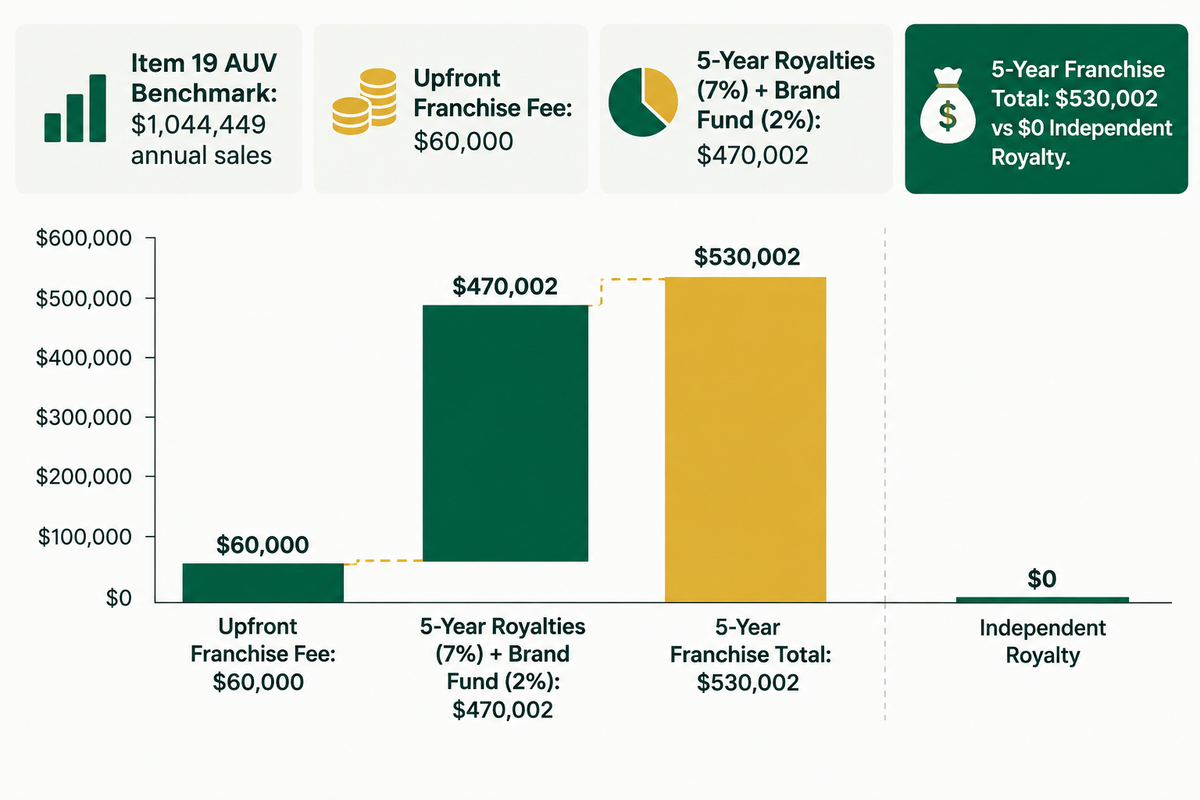
At Monster Mini Golf’s $1,044,449 FDD Item 19 average unit volume, five-year franchise deductions reach $530,002. That total includes the $60,000 upfront fee, $365,557 in 7% royalties, and $104,445 in 2% brand fund fees. At $700,000 in annual revenue, 5-year franchise charges total $375,000, whereas an independent turnkey operator pays $0 in ongoing royalties.
To see the effects of ongoing fees on your return on investment, see the 5-Year Royalty-to-Turnkey Crossover Ledger that follows. Miniature golf depends on Google Maps proximity and is supported by school fundraisers and weekend birthday bookings. When a franchise charges 6% to 9% of gross sales every month, those fees are calculated before deducting store rent, payroll, and debt service.
Selected five-year costs: 5-Year Royalty-to-Turnkey Crossover Ledger at $1,044,449 in annual gross revenue:
| Cost item | Option A: Indoor Franchise (Monster Mini Golf 2025 FDD Model) | Option B: Independent Turnkey FEC Buildout |
|---|---|---|
| Purchase price | $60,000 upfront FDD Item 5 franchise fee (part of $885,235–$1,535,235 Item 7 total) | $0 franchise fee + $150,000 to $300,000 standard 18-hole course buildout |
| Installation & commissioning | Included inside $885,235 to $1,535,235 total FDD Item 7 initial investment | $300,000 to $1,500,000+ total themed multi-attraction venue buildout |
| Energy (5-yr) | Site-specific HVAC, blacklight UV LED lighting, and arcade power load | Site-specific indoor LED lighting, HVAC, and attraction power load |
| Franchise royalties, brand marketing fees, and maintenance allowances (5-yr) | Routine turf/prop upkeep plus $470,002 in 5-year royalties (7% = $365,557) and marketing fees (2% = $104,445) | Routine turf, putter, golf balls, and prop upkeep; $0 franchise royalties or brand fund fees |
| Downtime risk (5-yr) | Subject to franchisor-approved prop suppliers and FDD renewal terms | Direct factory-supplied modular obstacle replacement with zero territorial restrictions |
Payback example: At $1,044,449 in annual sales, a Monster Mini Golf franchisee pays $60,000 upfront plus $94,000.41 per year in 9% ongoing fees. Over five years, those charges total $530,002. At equal annual sales of $1,044,449, an independent venue spending $50,000 per year on local marketing saves $220,002 in five-year ongoing fees, or $280,002 including the $60,000 upfront fee. Even at a conservative $700,000 annual revenue level, 5-year franchise charges equal $60,000 + ($700,000 × 0.09 × 5) = $375,000, or $125,000 net of $250,000 in five-year local marketing spend.
The $530,002 five-year franchise figure tracks cumulative fee and royalty outflow over 60 months. The $150,000 to $500,000+ turnkey course price, on the other hand, covers course design and construction equipment only. Shell construction, buildout, tenant improvements, and working capital are budgeted separately. Operators can review our indoor playground franchise vs. independent financial comparison and FEC revenue per square foot benchmarks for in depth cash flow modeling.
How Much Gross Revenue and Profit Margin Does a Mini Golf Venue Generate?
According to Monster Mini Golf’s 2025 FDD Item 19 disclosure, reporting franchise units achieved an average unit volume (AUV) of $1,044,449 in annual gross revenue. Using BMI Leisure’s assumed store-level EBITDA margin of 14% to 18%, annual revenue of $1,044,449 produces $146,223 to $188,001 in modeled annual EBITDA before interest, taxes, depreciation, and amortization.
BMI Leisure cites a 7.7 to 9.7 year payback for that model. Simple pre-tax payback against the $885,235 to $1,535,235 investment range spans 4.7 to 10.5 years. Owner cash flow also reflects loan principal payments, capital expenditure reserves, and local tax obligations.
Are Miniature Golf Businesses Profitable?
Yes, commercial venues achieve strong store profitability when operators control occupancy and payroll overhead. In Dave & Buster’s FY2025 Form 10-K, amusement revenue represented 62.9% of sales with an 8.1% direct cost (91.9% gross margin complement). Food and beverage represented 37.1% of sales with a 24.8% direct cost (75.2% complement).
Deducting store payroll (25.5%), other store operating expenses (34.5%), and depreciation and amortization (13.3%) leaves a 12.4% store margin. Corporate G&A and pre-opening expenses then reduce Dave & Buster’s consolidated operating margin to 4.1%. Controlling fixed rent, staff payroll, and ongoing royalty deductions is what keeps small-footprint golf businesses profitable for independent business owners.
Commercial Mini Golf Course Construction Costs: 9-Hole vs. 18-Hole Turnkey Buildout Breakdown
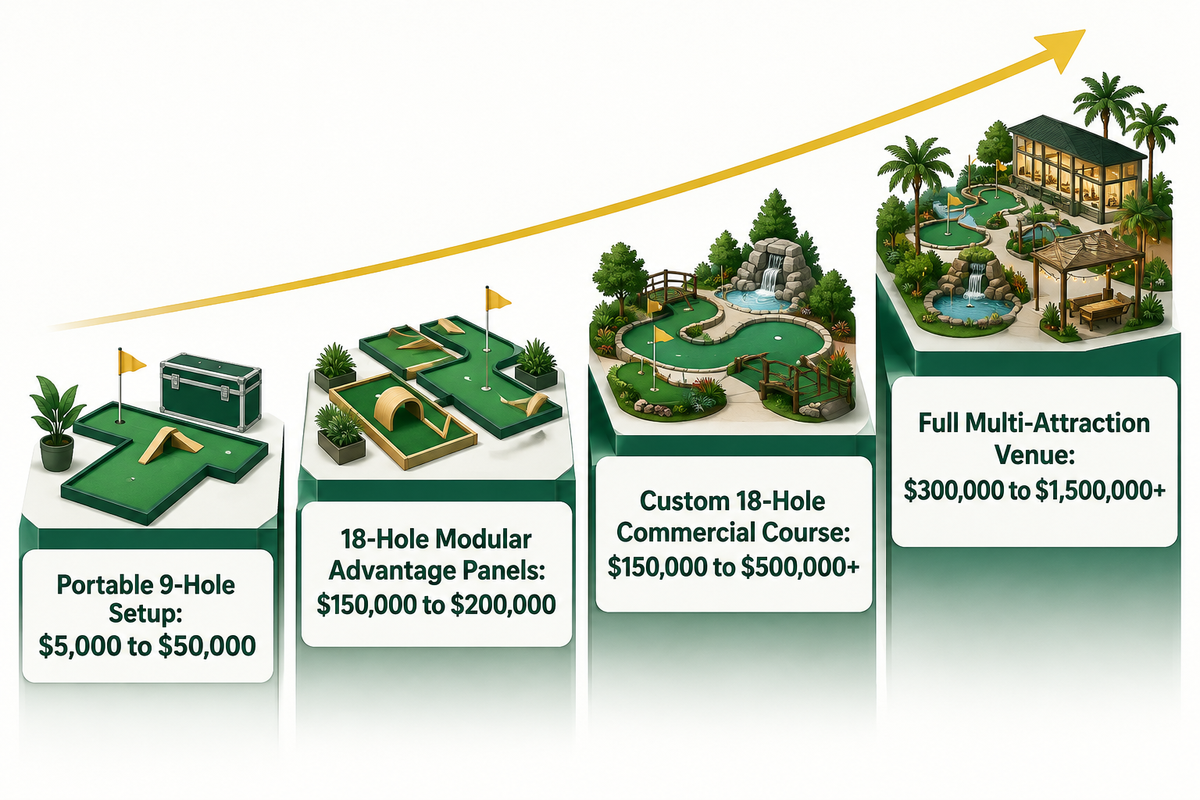
According to Adventure Golf Services and Roller Software benchmarks, a custom 18-hole commercial miniature golf course costs $150,000 to $500,000+ ($8,300 to $27,500+ per hole). An 18-hole Modular Advantage panel course costs $150,000 to $200,000. Portable 9-hole setups cost $5,000 to $50,000, and full multi-attraction venues require $300,000 to $1,500,000+.
The 18-Hole Turnkey Capex Allocation Matrix is used to avoid unexpected change orders from contractors. It separates course fabrication and site civil engineering. The matrix organizes the costs of course construction into eight capital categories and ends with a total budget row.
| Cost Category & Component Scope | Tier 1: Portable / Modular 9-Hole Setup | Tier 2: Modular / Standard 18-Hole Course | Tier 3: Custom 18-Hole Adventure Course / FEC |
|---|---|---|---|
| 1. Course Design, CAD & ADA Grading Plans | Pre-engineered 9-hole modular templates | 3D layout routing and ADA Section 239/1007 plan | Custom topographic civil, drainage, and thematic engineering |
| 2. Sub-Base Slab / Concrete Contouring | Rests directly on existing flat floor or patio | Interlocking high-density polyethylene (HDPE) panel system | Excavation, subgrade base, and contoured concrete fairways |
| 3. Commercial Putting Turf & Curbing | Pre-cut modular turf mats and composite border rails | Commercial putting turf or UV-reactive glow carpet | UV-stabilized outdoor drainage turf and masonry edging |
| 4. Themed Obstacles, Props & Animatronics | Detachable geometric hazards and numbered hole flags | 3D fiberglass props, blacklight murals, and interactive hazards | Optional artificial rockwork, bridges, and custom sculptures |
| 5. Water Features, Streams & Filtration | Dry portable operation (no plumbing required) | Dry indoor layout or faux LED water effects | Optional recirculating streams, waterfalls, ponds, and pumps |
| 6. Blacklight UV / Outdoor LED Lighting & Sound | Uses existing ambient room or patio lighting | Blacklight UV LED fixtures and zoned audio speakers | Weatherproof pathway bollards, floodlights, and landscape audio |
| 7. Putters, Golf Balls, Scorecards & POS Kiosk | Starter set of rubber-headed putters and golf balls | Glow putters, UV golf balls, scorecards, and POS counter | Multi-length putters, floating balls, and check-in clubhouse |
| 8. Freight, Rigging & On-Site Crew Installation | Palletized freight for rapid in-house assembly | Factory panel shipping and professional assembly crew | Multi-week on-site shaping, turf seaming, and scenic finishing |
| 9. Published Total Course Build Budget Range | $5,000 to $50,000 (Roller Software benchmark) | $150,000 to $200,000 (AGS Modular) · $100,000 to $300,000 (Roller standard 18-hole) | $150,000 to $500,000+ (AGS custom 18-hole) · $300,000 to $1,500,000+ (Roller full venue) |
How Much Does It Cost to Build a 9-Hole vs. 18-Hole Mini Golf Course?
According to Roller Software and Adventure Golf Services published pricing, a portable or modular 9-hole mini golf course costs $5,000 to $50,000. An 18-hole Modular Advantage panel course costs $150,000 to $200,000, while a standard 18-hole build costs $100,000 to $300,000. Custom-built 18-hole courses cost $150,000 to $500,000+.
Why do per-hole construction quotes vary from $2,500 per hole up to $27,500+ per hole? The price gap reflects sub-base engineering and obstacle complexity. Modular panel systems bolt together over a flat concrete slab and can be relocated if a lease ends. Outdoor adventure golf construction includes site preparation and drainage. Freezing climates require frost-protected structural foundations, while artificial rockwork and recirculating water features are optional.
In commercial FEC layouts, pairing a 9-hole or 18-hole indoor putting course with a soft playground and redemption arcade broadens family appeal. Parents prefer bundled birthday bookings to a single round of mini-golf.
FEC Layout Engineering Team, Dreamland Playground (Zhejiang Dreamland Co., Ltd)
Indoor Glow-in-the-Dark vs. Outdoor Adventure Courses: Climate, Rent, and Attraction Mix Trade-Offs
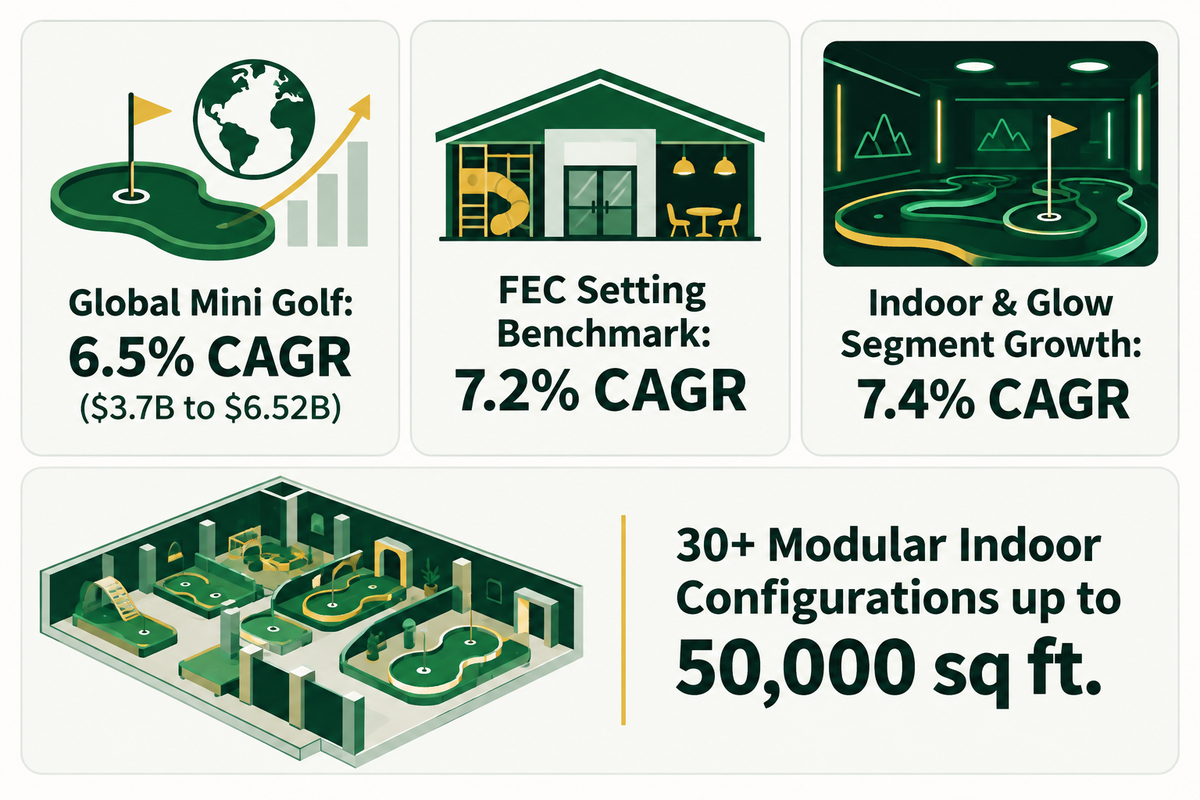
Indoor glow-in-the-dark courses can operate year-round in leased retail boxes. According to Dataintelo’s 2025–2034 market report, the indoor and glow segment is projected to grow at a 7.4% CAGR. That pace exceeds the 6.5% global mini golf CAGR, while family entertainment center settings grow at 7.2% CAGR.
Dataintelo’s 2025–2034 market analysis values the global mini golf market at $3.7 billion in 2025 and projects $6.52 billion by 2034. Meanwhile, BMI Leisure reports the global FEC market at $32.62 billion to $34.4 billion in 2025 ($34.57 billion in 2026), growing at 6.4% to 6.75% CAGR.
Use the following 4-Factor Format and Attraction Mix Selector to align your climate, building envelope, and capital budget with the correct venue format. Dreamland Playground’s commercial catalog covers 30+ modular indoor attraction configurations from 50,000 sq ft full-scale FECs down to compact mall entertainment zones. Operators can review our guide on FEC floor plan design and multi-attraction zoning. We also offer customized layout solutions to guide foot traffic.
| Decision Factor / Site Condition | Standalone Outdoor 18/36-Hole Course | Indoor Blacklight Golf + Arcade Franchise | Multi-Attraction Hybrid FEC (Golf + Indoor Playground) |
|---|---|---|---|
| 1. Annual Weather Operating Window | Seasonal outdoor operation, with the operating window shaped by local weather and tourism demand | Year-round climate-controlled operation in 4-season or high-heat suburban markets | Year-round indoor operation supporting weekday and weekend family attendance |
| 2. Disclosed Footprint Benchmarks | 36-hole outdoor course (Putt-Putt Golf Only) or two 18-hole courses (PopStroke) | 5,992 sq ft (18-hole Glowgolf mall venue) to 9,000–20,000+ sq ft (Monster Mini Golf) | 10,000 sq ft building (Putt-Putt Fun Center) up to 50,000 sq ft multi-zone FEC |
| 3. Primary Repeat-Visit & Party Anchor | Evening walk-ins, tournament play, and outdoor group events | 18-hole blacklight golf, redemption arcade games, VR simulators, party rooms | Soft indoor playground + 9/18-hole family mini golf + dedicated party rooms |
| 4. Published Capital Budget Tier | $150,000 to $500,000+ (AGS custom 18-hole build) or $420,000 to $975,000 (Putt-Putt Golf Only) | $885,235 to $1,535,235 total FDD Item 7 investment (Monster Mini Golf) | $300,000 to $1,500,000+ (Roller independent multi-attraction) or $2.45M–$5.38M (Putt-Putt FEC) |
Adding a commercial indoor playground or redemption arcade balances weekly utilization. Teens and adults enjoy playing mini golf on Friday nights and weekends. Parents with young children visit indoor playground zones on weekday mornings.
Does Adding a Bar, Food Service, or Auto-Scoring Technology Pay Back the Extra Buildout?
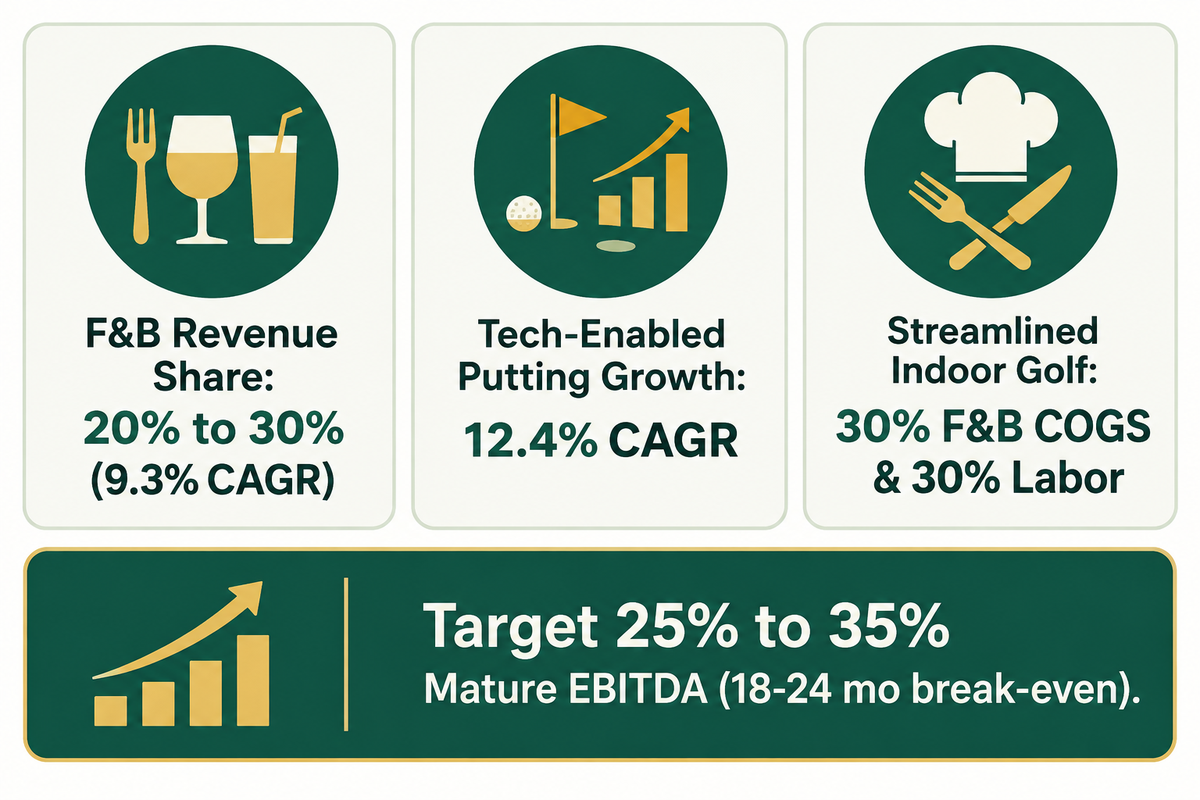
Favor streamlined food and beverage (F&B) over a full-service kitchen to limit buildout and labor costs. According to Dataintelo’s 2025 market report, mini golf F&B streams grow at a 9.3% CAGR and tech-enabled putting grows at a 12.4% CAGR. In GolfBays’ commercial indoor golf benchmarks, F&B contributes 20% to 30% of venue revenue.
How do miniature golf franchises and venues make money across their revenue streams? Monster Mini Golf and Putt-Putt generate core revenue from per-round golf admissions, arcade game play, and birthday party bookings. Adult social putting chains add full bar and restaurant tabs. Each local operator sets per-guest ticket pricing and party package tiers for its market. Note that the 20% to 30% F&B share reflects GolfBays’ commercial indoor golf benchmark rather than a franchise FDD.
While adult eatertainment concepts generate high top-line sales, they also carry high fixed occupancy and hospitality overhead. Dataintelo’s industry performance data highlights this overhead risk. Urban operator Swingers saw annual revenue drop from GBP 43.3 million to GBP 36.4 million before closing its City of London venue in March 2025.
By contrast, GolfBays reports a 30% F&B ingredient cost and 30% staff labor share for streamlined indoor golf venues. Those venues target 25% to 35% mature EBITDA margins and break-even within 18 to 24 months. Operators can also pair a putting course with golf simulator bays, see our commercial golf simulator business payback analysis for bay-level financial modeling.
| F&B and Technology Tier | Operational & Equipment Scope | Published Direct Cost Benchmark | Published Labor / Margin Benchmark | Target Demographics & Audience |
|---|---|---|---|---|
| Tier 1: Pre-Packaged Snack Bar + Party Rooms | Reach-in coolers, bottled drinks, snack counter, and private party rooms | Dave & Buster’s FY2025 amusement direct cost benchmark: 8.1% of amusement revenue | 14% to 18% modeled store EBITDA margin (BMI Leisure / Monster Mini Golf benchmark) | Suburban families, kids birthday parties, school and camp groups |
| Tier 2: Streamlined Bar & Café + Golf Bays | Canned/draft beverages, simple café menu, putting green, and simulator bays | GolfBays indoor golf benchmark: 30% F&B COGS (70% gross margin on F&B) | 30% staff labor share; 25% to 35% mature EBITDA margin (GolfBays benchmark) | Daytime families plus evening casual adult leagues and corporate groups |
| Tier 3: Full Scratch Kitchen + Auto-Scored Social Putting | 98% scratch kitchen (PopStroke) or proprietary ball-tracking courses (Puttshack) | Dave & Buster’s FY2025 F&B direct cost benchmark: 24.8% of F&B revenue | 25.5% store operating payroll (Dave & Buster’s 10-K); 25% venue margin (Puttshack) | High-density urban nightlife districts and corporate hospitality events |
Site Selection, Square Footage per Hole, and ADA Section 239 / 1007 Compliance Rules
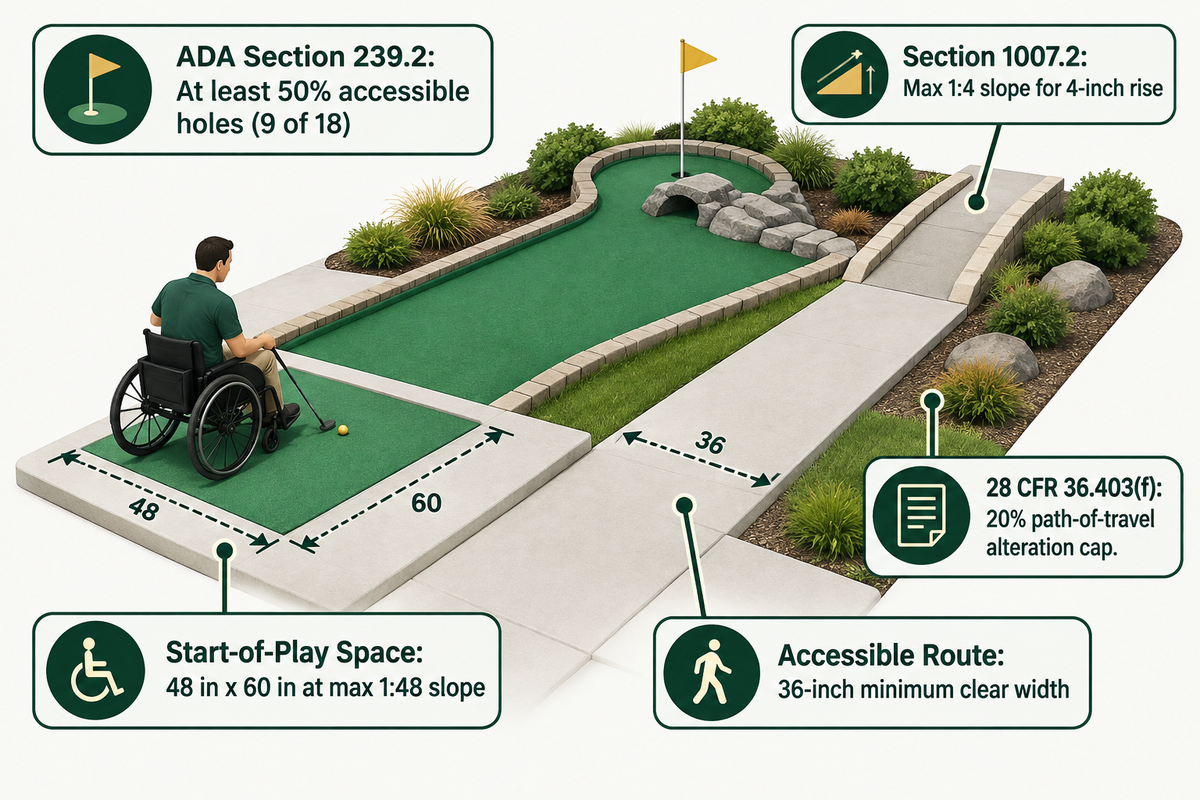
Under the 2010 ADA Standards (Sections 239 and 1007), new and altered miniature golf courses must make at least 50% of holes accessible (9 of 18 holes). Accessible holes must form a consecutive sequence, with one break permitted if the sequence ends at the final hole. Accessible routes generally require a 36-inch minimum clear width, and each accessible hole requires a 48-inch by 60-inch start-of-play space sloped no steeper than 1:48.
Non-compliant curbing or steep turf transitions can stall local inspections and put operators at risk for federal accessibility claims when running a mini golf course. Careful planning, in the architectural design phase, helps to ensure your setup meets the federal dimensional rules prior to the placement of concrete or modular panels.
Section 239.3 permits one break in the consecutive sequence of accessible holes. That exception applies only when the final accessible hole is the last hole of the course. In addition, the accessible route must not require players to pass back through other holes to exit.
Section 1007.2 permits a maximum 1:4 slope for a playing-surface rise of up to 4 inches. Ordinary accessible walking surfaces allow a 1:20 maximum slope under Section 403, while ramps allow a 1:12 maximum slope under Section 405. When altering an existing building for a new attraction, 28 CFR § 36.403(f) caps mandatory path-of-travel upgrades at 20% of the primary alteration cost. Separate children’s play areas must comply with 2010 ADA Standards Sections 240 and 1008.
How Much Space Is Needed for a 9-Hole or 18-Hole Miniature Golf Course?
In published brand disclosures, an 18-hole indoor Glowgolf mall venue occupies 5,992 square feet, while Monster Mini Golf venues span 9,000 to 20,000+ square feet. Putt-Putt buildings span 3,500 to 4,000 square feet for Golf and Games or 10,000 square feet for a Fun Center, and Puttshack venues average 25,000 square feet.
Rather than use a single, fixed floor area per hole or ceiling height, architects size each room around obstacle height and the clearances specified in ADA section 1007. Table 6 summarizes those published venue footprints and dimensional rules.
| Engineering & Regulatory Parameter | Compact / Mall Course Benchmark | Indoor Glow FEC Benchmark | Multi-Attraction FEC Benchmark | Statutory Code / Published Source |
|---|---|---|---|---|
| Published Venue Footprint Examples | 3,500–4,000 sq ft building (Putt-Putt Golf & Games); 5,992 sq ft (18-hole Glowgolf mall venue) | 9,000 to 20,000+ sq ft total venue (Monster Mini Golf 2025 FDD) | 10,000 sq ft (Putt-Putt Fun Center); 25,000 sq ft (Puttshack); up to 50,000 sq ft (Dreamland FEC) | Brand FDD filings, AGS case study, and Dataintelo report |
| Minimum Accessible Holes | At least 50% (minimum 5 of 9 holes) | At least 50% (minimum 9 of 18 holes) | At least 50% (minimum 9 of 18 holes) | 2010 ADA Standards Section 239.2 sets the 50% minimum; Section 239.3 requires consecutive holes, with 1 permitted break ending at the course’s final hole (Hole 9 or Hole 18) |
| Accessible Route & Start-of-Play Space | 36 in (915 mm) route · 48 in × 60 in tee space | 36 in (915 mm) route · 48 in × 60 in tee space | 36 in (915 mm) route · 48 in × 60 in tee space | Section 1007.2 & 1007.3.1 (max 1:48 tee slope; 1:4 max slope for 4 in playing-surface rise) |
| Golf Club Reach Range & Curb Gap | Max 36 in (915 mm) reach from accessible route | Max 36 in (915 mm) reach · 1 in × 4 in curb pass-throughs | Max 36 in (915 mm) reach · 60 in (1525 mm) turning space | Section 1007.3.2 & Access Board miniature golf guide |
Pre-Lease & Builder RFQ Checklist: How to Vet Franchise FDDs and Turnkey Equipment Suppliers
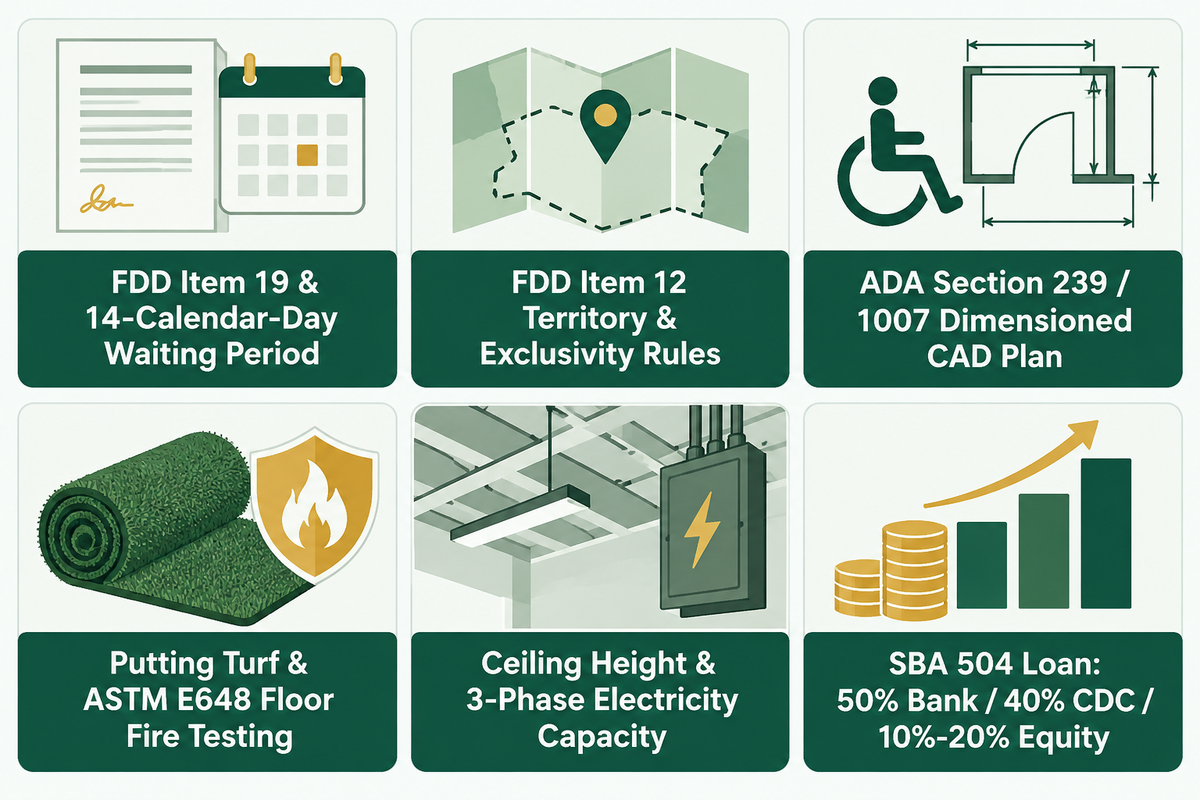
For franchise purchases, the FDD is due at least 14 calendar days before signing or payment. It discloses any Item 19 earnings claims and Item 12 territory rules. Independent equipment buyers instead review ADA Section 239/1007 geometry, turf and fire-testing specs, building power load, and SBA loan terms.
Whether you plan to invest in a mini golf business franchise or partner with a manufacturer to grow your business, pre-lease diligence protects your capital. Buyers financing real estate or long-life fixed equipment often use an SBA 504 CDC loan. The program provides up to $5.0 million ($5.5 million for eligible energy or manufacturing projects) under a 50% bank, 40% CDC, and 10% borrower equity split.
Under 13 CFR 120.910(a), a startup company open less than two years or a single-purpose amusement building must contribute 15% borrower equity (20% if both apply). SBA 504 funds can’t be used for working capital or equipment with a useful life less than 10 years. The six checklist rows below cover FDD disclosures, territory rules, ADA Section 1007 geometry, turf specs, building power, and SBA loan terms when you get started with a miniature golf business:
RFQ checklist — copy these into your quote request:
| Parameter | Recommended range | Why it matters | How to verify |
|---|---|---|---|
| 1. FDD Item 19 & 14-Day Waiting Period | ≥14 calendar days pre-sale FDD delivery; review any Item 19 AUV ($1,044,449 Monster Mini Golf) | When Item 19 reports average unit revenue, it identifies the reporting population and the number and percentage of outlets attaining that average; franchisors may provide no Item 19 claim | Audit FDD Item 19 tables and interview current franchisees listed in Item 20 |
| 2. Territory Rights Disclosure (Item 12) | Written Item 12 territory definition and any exclusivity conditions | Clarifies whether the franchisor grants an exclusive territory or reserves alternative channels | Verify the exact territory map and conditions in FDD Item 12 before signing |
| 3. ADA Section 239 / 1007 Route Geometry | ≥50% accessible holes (consecutive sequence, 1 break allowed ending at final hole); 36 in route; 48 in × 60 in tee at ≤1:48 slope | Federal Title III accessibility obligations apply separately from local occupancy approval; a municipal Certificate of Occupancy does not establish Title III compliance | Require dimensioned CAD drawings showing 36 in routes, 60 in turning spaces, and curb cuts |
| 4. Putting Turf & Floor-System Fire Testing | Commercial putting turf specifications and ASTM E648 radiant panel test reports for indoor floor systems | Turf face weight measures fiber mass per unit area; backing adhesion and installation affect delamination resistance, while ASTM E648 measures critical radiant flux of the tested floor system | Request manufacturer backing warranty, ASTM E648 lab reports (indoor), and ASTM F1487 docs (if adding a playground) |
| 5. Multi-Attraction Structural & Power Load | Site-specific clear ceiling height and 3-phase electricity capacity for arcades and HVAC | Supports adding redemption arcade games, VR bays, or multi-level soft play structures | Have a licensed MEP engineer inspect the base-building electrical panel and slab load |
| 6. SBA 7(a) / 504 Equity & Loan Rules | SBA 504: 50% bank / 40% CDC / 10% borrower equity (15%–20% for new or special-purpose properties); ≥10-yr equipment life | SBA 504 excludes working capital; for franchise equipment purchases, both franchise eligibility and equipment useful-life rules must be met separately | Confirm SBA loan program rules with your lender and budget separate working capital |
Dreamland Playground’s engineering team customizes 9-hole or 18-hole mini golf course designs and integrates them with indoor playgrounds and trampoline zones. That partnership helps local businesses create a differentiated, lucrative entertainment destination without paying 6% to 9% of gross sales in ongoing franchise fees.
Frequently Asked Questions (FAQ)
Q: How much does it cost to open a miniature golf franchise?
According to 2025 FDD filings, opening a miniature golf franchise will cost $420,000 to $1,535,235 for a standard venue. A full Putt-Putt Fun Center reaches up to $5,380,000.
Putt-Putt Golf Only (36 holes) requires a $20,000 initial franchise fee and $420,000 to $975,000 in total investment. Monster Mini Golf requires a $60,000 franchise fee and $885,235 to $1,535,235 in total capital. By comparison, Adventure Golf Services reports that an independent 18-hole commercial course costs typically $150,000 to $500,000+ for course design and construction with zero ongoing royalty fees.
Q: Are miniature golf franchises profitable for first-time owners?
Well-located venues achieve modeled store-level EBITDA margins of 14% to 18% (or 25% to 35% in streamlined indoor golf venues) when paired with arcades, party rooms, or beverage service.
Using Monster Mini Golf’s reported $1,044,449 average unit volume and BMI Leisure’s assumed 14%–18% EBITDA margin gives modeled annual EBITDA of $146,223–$188,001, before interest, taxes, depreciation, and amortization. At $1,044,449 in annual sales, Monster Mini Golf’s 9% combined fee totals $94,000 per year, while Putt-Putt’s 6% fee equals $62,667. An independent venue avoids these franchise charges but pays for its own marketing, systems, and operating support.
Q: What is the franchise fee and royalty rate for Putt-Putt and Monster Mini Golf?
Putt-Putt charges a $20,000 to $50,000 upfront franchise fee with a 5% royalty and 1% marketing fee. Monster Mini Golf charges $60,000 upfront with a 7% royalty and 2% marketing fee.
Putt-Putt’s initial fee is $20,000 for Golf Only, $30,000 for Golf and Games, and $50,000 for a full Putt-Putt Fun Center, plus 6% total ongoing gross deductions. Monster Mini Golf’s 9% combined royalty and brand fund deduction equals $94,000.41 per year on a $1,044,449 average revenue store.
Q: Can you franchise a PopStroke or Puttshack location?
No, they don’t sell franchises as individual units under their standard Franchise Disclosure Documents (FDDs).
Both chains expand through corporate-owned venues and institutional real estate joint ventures, with Puttshack operating 25,000-square-foot venues and PopStroke operating 36-hole dining complexes.
Q: Should I buy a mini golf franchise or build an independent course with a commercial FEC supplier?
Choose a franchise if you want a pre-packaged brand playbook and vendor list. Choose an independent turnkey venue for custom multi-attraction zoning and $375,000 to $530,002 in avoided 5-year franchise charges.
A franchise offers wall graphics, POS displays and an FDD disclosure record. However, miniature golf is a local destination business where families book birthday parties based on Google Maps reviews, indoor playground variety, and facility cleanliness rather than a national logo. In the modeled revenue scenarios, avoided upfront franchise fees, royalties, and brand fund charges total $375,000 to $530,002 over five years before replacement marketing costs. Building an independent venue with Dreamland Playground lets you combine an 18-hole glow-in-the-dark course with custom soft play structures, ninja courses, or golf simulators tailored to your building envelope.
Q: How long does it take to build and open an 18-hole miniature golf venue?
Modular indoor courses assemble on-site in 2 to 4 weeks after room prep, while outdoor concrete courses require 8 to 16 weeks of field construction.
Indoor, modular HDPE or blacklight courses can be quickly constructed on-site after completion of tenant improvements and electrical work. Outdoor, poured-concrete adventure courses require municipal zoning permits, site excavation, drainage grading, and weather-dependent field construction. Field construction is weather dependent.
About This Financial & Engineering Analysis
This guide synthesizes 2024–2025 FDD Item 5, Item 6, Item 7, and Item 19 disclosures alongside 2010 ADA Standards Sections 239 and 1007. Edited and approved by the Dreamland Playground (Zhejiang Dreamland Co., Ltd) Tech team.
Planning a Custom Indoor Mini Golf & Multi-Attraction FEC?
Send us your building CAD floor plan or target square footage. Our engineering team will design a custom 9-hole or 18-hole mini golf layout integrated with commercial indoor playgrounds, redemption arcades, and party zones—with zero franchise royalties. There will be zero franchise royalty fees.
References & Sources
- 16 CFR Part 436, Disclosure Requirements and Prohibitions Concerning Franchising (FTC Franchise Rule) U.S. Federal Trade Commission / National Archives eCFR
- ADA Guide for Miniature Golf Courses (2010 ADA Standards Sections 239 & 1007) U.S. Access Board
- 2010 ADA Standards for Accessible Design & 28 CFR Part 36 Subpart D (§ 36.403 Path of Travel) U.S. Department of Justice Civil Rights Division
- SBA Standard 7(a) and 504 Certified Development Company Loan Program Guidelines (13 CFR Part 120) U.S. Small Business Administration
- PopStroke’s Journey to 200 Locations Is Rooted in Connection (2024–2025 Footprint & Kitchen Model) FSR Magazine
- Global Mini Golf Market Report 2025–2034 (Indoor Glow, Tech-Enabled Putting & FEC Growth Benchmarks) Dataintelo Market Research