Get in touch with Dreamland Playground Company

Waterpark stories tie a familiar tale to your rides, attractions and even the smallest details of your visit. Everything from tropical islands and mountain adventures to pirate harbours and ocean worlds can be used. Select the story that suits your guests and your location then plan out a layout and attraction mix guests will love.
A hotel splash area and a destination water park can share a pirate theme while needing very different facilities. The hotel may need a compact family base beside gentle play; the destination may need several places where groups can split up and meet again. This difference should inform the first conceptual sketch.
Waterpark themes work most effectively when the story supports the guest day. Consider the theme space, family involvement and support areas prior to choosing signature rides. The concept of a visible path and a comfortable regroup point should be incorporated from the beginning.
- A memorable story can support both gentle play and high-thrill attractions.
- Seating, shade and food stops allow the entire group to benefit from the park.
- Examine included work and subsequent maintenance and the appearance.
- Make the identity open enough to embrace a future attraction.
What Makes a Waterpark Theme Work?
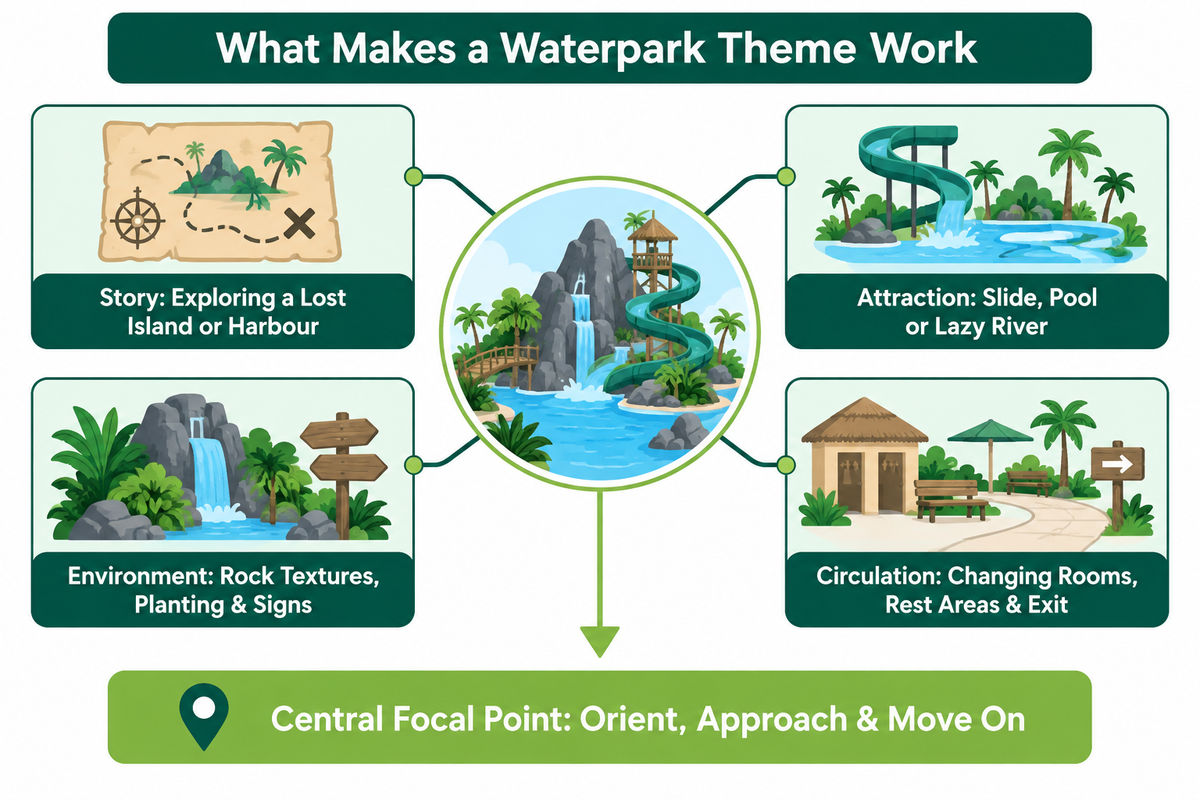
A theme is a good way for guests to place themselves in the story and for designers to justify what they chose. A story on a harbour could link a lookout tower, a sheltered quay and a river journey. Using the same colour scheme and naming those places makes them familiar, but the layout demonstrates how guests access and occupy them.
The study by Milman, Tasci and Wei associated perceived crowding with a poorer experience of navigating a theme park. Use that finding to review circulation alongside the story.
Separate the story from the equipment schedule. “Exploring a lost island” is a story. A slide, pool or lazy river is an attraction. Rock textures, planting and signs indicate the environment.
Circulation connects those attractions to changing rooms, rest areas and the exit. A convincing concept brings these choices together.
In water park terminology, what is a themed central attraction?
A themed central attraction is a prominent ride or play feature that expresses the park’s story and gives the setting a recognizable focal point. It could be a ship-shaped splash structure or a mountain-framed slide tower. Its location should help guests orient themselves, with space around it for approaching, waiting and moving onward.
The point can be subtle: within a small resort, a special water-play feature that the family sits around to watch can have more impact than a huge landform at the rear of the site.
Waterpark Theme Ideas: Eight Directions to Explore
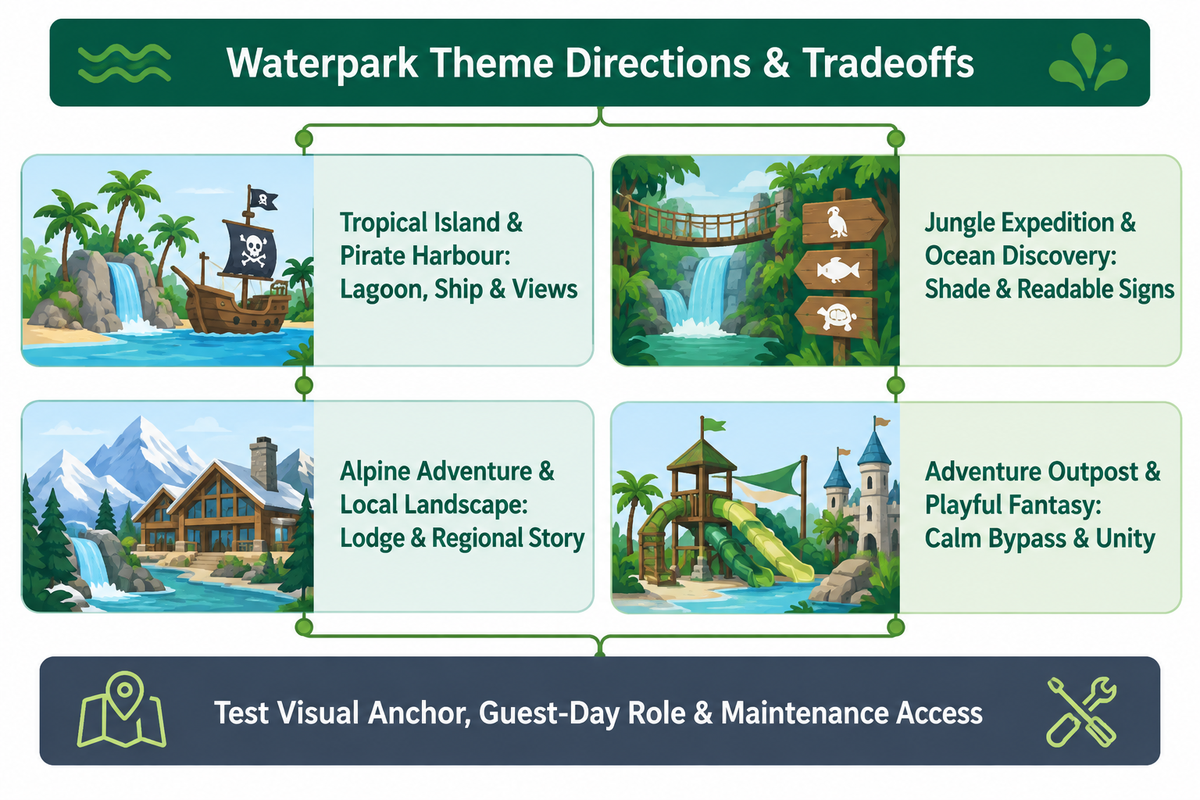
Tropical, pirate, jungle and ocean themes offer familiar starting points; Alpine, local-landscape, adventure and playful-fantasy concepts offer other ways to shape the setting. Shortlist by the guest experience you want to offer. This comparison rephrases each creative concept as a visual anchor, a functional purpose and a design tradeoff.
| Direction | Story and visual anchor | Guest-day opportunity | Tradeoff to resolve |
|---|---|---|---|
| Tropical island | A lagoon, lookout and beach-side village | Connect active water play with a relaxed resort setting | Make the arrival identity distinctive rather than relying on palm graphics alone |
| Pirate harbour | A ship silhouette, dock and treasure trail | Give children an easy-to-understand exploration story | Position scenic sails and hulls around the necessary views and routes |
| Jungle expedition | A research camp, canopy patterns and a creek | Link discovery play with shaded gathering spaces | Choose planting and scenic finishes the maintenance team can reach |
| Ocean discovery | A reef, research station or underwater-inspired gateway | Develop playful discovery cues for younger guests | Keep signs easy to read against busy marine graphics |
| Alpine adventure | A mountain lodge and playful snow-to-water story | Create a strong contrast with warm-weather swimming | Carry the story through gathering spaces, rather than buying a mountain façade alone |
| Local landscape | A regional river, coastline or geological setting | Give a destination a connection to its surroundings | Develop imagery with local knowledge and appropriate cultural input |
| Adventure outpost | An explorer’s base with distinct expedition zones | Organize shared challenges and more energetic attractions | Give cautious guests a clear route around the highest-intensity experiences |
| Playful fantasy | Original creatures, oversized objects and a splash wonderland | Build a recognizable world around interactive play | Use a consistent design language so new additions feel related |
Disney’s Typhoon Lagoon uses a tropical setting transformed by a legendary storm; Blizzard Beach tells a melted Alpine ski-resort story. Both of them incorporate similar common attraction classifications, such as the slides and lazy river. Those factors demonstrate how varied stories can give context to the classic water park experience.
Create unique names and branding for your project.
For a compact tropical or pirate resort serving younger families, start the concept with gentle exploration, shared water play and a nearby family base. A destination serving older children can give a family ride and a thrill attraction more prominence, with a calmer route alongside. An Alpine concept can locate the lodge as the regrouping point; a local-river concept can tie everything in the resort along a distinct journey.
Fit those roles to the available site and opening budget before choosing a large pool, slide tower or scenic structure.
For a resort with a dry play area, consider using a connecting story to link the two environments. A guide to resort playground themes explores that companion part of the guest experience.
Match the Concept to the Site and the Guest
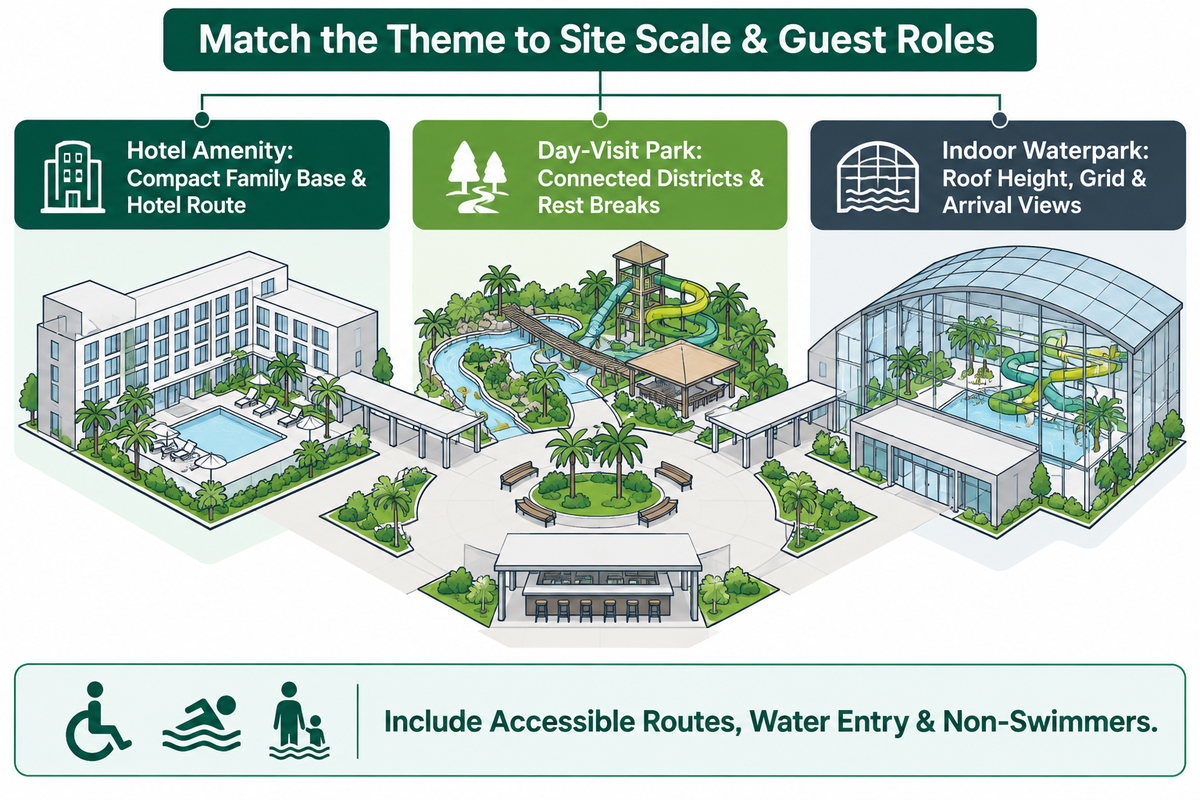
Scale the story to how the facility is interacted with; a hotel amenity is part of the guest’s stay; a day-visit park is a set of events with breaks in-between to extend it; an indoor waterpark fits its visual world around the building, arrival points and available views.
Example: a family resort courtyard. Imagine parents arriving after breakfast with a younger child and an older sibling. The younger child wants to explore gentle splash play; the older child wants a more active experience. One adult remains close to the family’s belongings, while the other joins the children. A compact harbour story could put a recognizable meeting point beside the family base, with the livelier attraction beyond it. A huge ship across the middle of the courtyard would consume valuable gathering space. The more useful concept gives the group a place to settle, a clear view of the next activity and an obvious route back to the hotel.
A small splash park could express an entire ocean narrative through interactive forms, paving graphics and a uniformly shaded “research base”. A destination park can generate a few connected districts. When choosing an indoor site, consider the roof height and structural grid during the early concept stage.
Distinguish guests who come to swim from companions who mainly want to stay with the group.
Include disabled guests as participants in the concept. The U.S. Access Board’s aquatic guide distinguishes accessible routes and means of entering different aquatic facilities. The project team should plan participation and supporting spaces together under the requirements that apply locally.
Turn the Theme into a Waterpark Layout
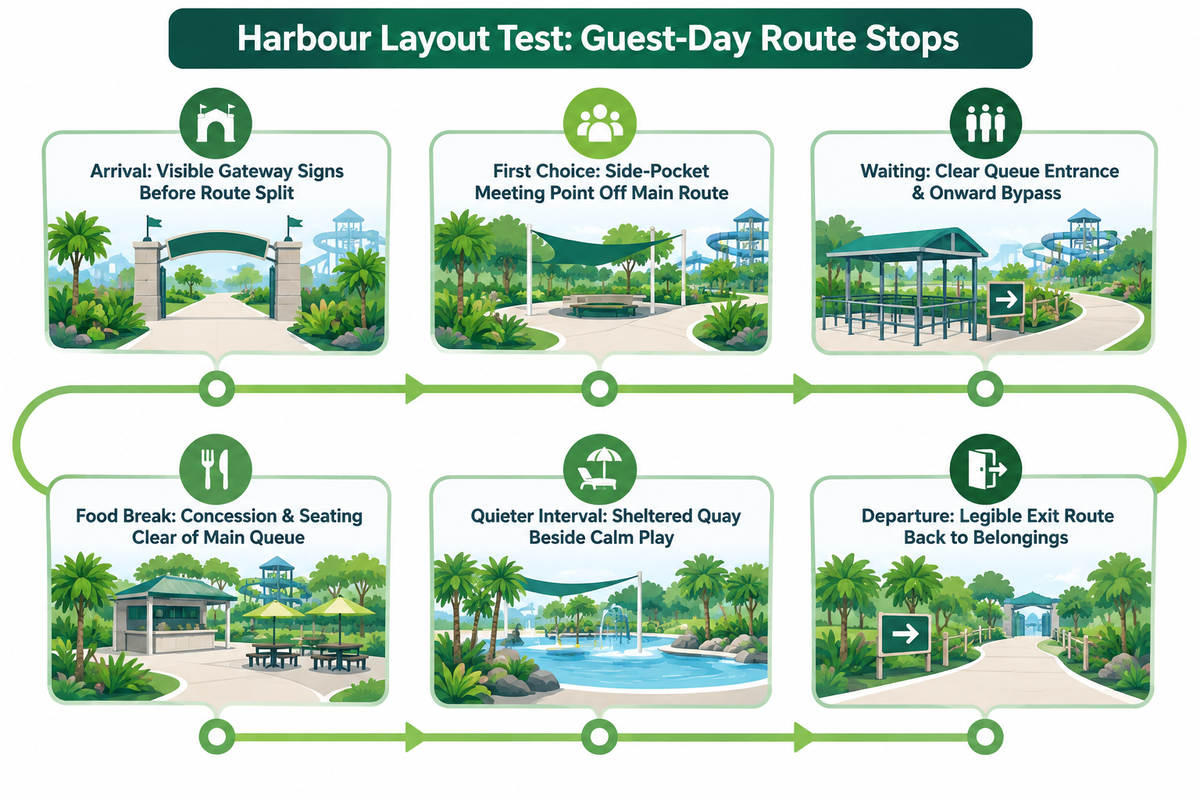
Begin the layout with arrival, choice points and places to regroup. Mark the main route in a way guests can latch onto, then link each attraction to a supportive space. Queue shade, a family base and clear paths back from the water deserve room before the scenic details fill the drawing.
One Story, Two Guest Days is a simple concept test: trace different visitors through the same setting and note what each needs at every stop. Choose your own harbour concept here for this example. The family will want to do things together but will choose to split up; the repeat visitor wants to get to a favourite ride fast and take a different route if busy.
| Stop | Mixed-participation family | Repeat visitor | Decision on the concept plan |
|---|---|---|---|
| Arrival | Find changing facilities and a family base | Move toward a familiar attraction | Keep the harbour gateway’s signs visible before the route splits |
| First choice | Split between gentle play and an active ride | Choose between the slide and river | Place a named meeting point outside the main through-route |
| Waiting | Accompany a child or wait nearby | Check the queue and consider another activity | Show both the queue entrance and the onward route around it |
| Food break | Regroup without carrying everything across the park | Buy a drink before returning to play | Connect the concession and seating without crossing the principal queue |
| Quieter interval | Read, rest or accompany a cautious swimmer | Choose a calmer experience | Give the sheltered quay a useful location beside suitable activities |
| Departure | Return to belongings, change and leave together | Leave by a familiar route | Keep the exit leg legible when attractions and groups are busy |
In the family trace, a parent leaves the younger child’s activity with the accompanying adult, then walks toward the older child’s slide. The return loop passes a food queue before reaching the same meeting point beside the main route.
And if that queue occupies the meeting space, the family’s day breaks down at an ordinary moment. Moving the meeting point into a side pocket, while keeping its harbour landmark visible, changes the drawing without changing the story – the operator and the specialist team can talk queues, circulation and staffing on the same plan.
Popularity and movement comfort are separate questions. Milman, Tasci and Wei’s theme-park study found different relationships for perceived popularity and perceived crowding. Survey data (N=477) indicates that perceived crowding has a negative effect on internal access, while perceived popularity has positive effects on internal access, outdoor entertainment and retail. For this concept review, assess the appeal of the destination and the experience of moving through it separately.
Build the Attraction Mix Around the Guest Day
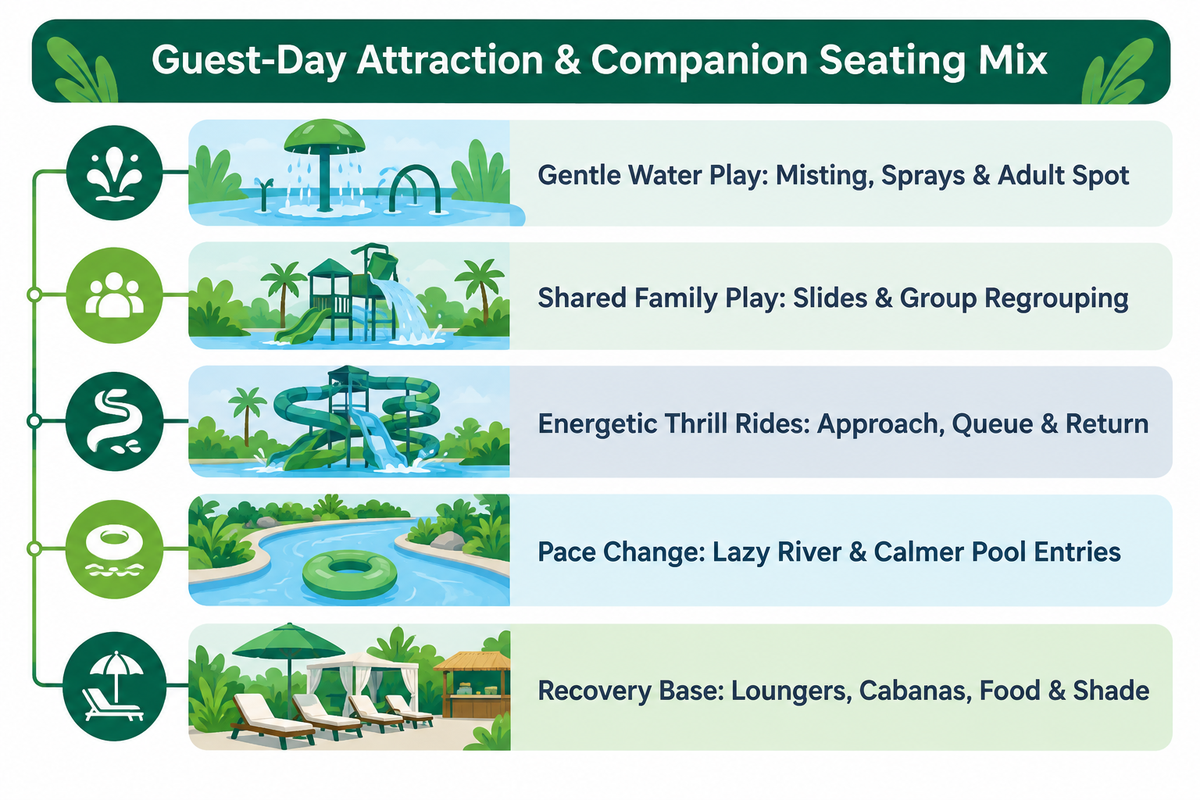
Center the attraction combo on participation, group experience, excitement and recovery time. A family waterpark can combine gentle water play, activities people enjoy together and a more energetic ride. The story gives those experiences a common identity; the guest profile and the site determine which roles need the most space.
Which attractions should a family waterpark include?
A splash structure, family slide and quieter pool can provide appealing choices for younger children, shared family play and guests who want a calmer visit. Include thrill rides where the target audience and operating plan support them. A wave pool or water coaster is a project choice rather than an automatic requirement.
- Misting and small sprays for water play provide children with an area to explore. Give accompanying adults a practical place to be.
- Family water slides or communal play build an experience that can be shared afterward. Plan where groups form and regroup.
- Race slides, bigger waterslides or water coasters could excite their audiences. Include their approach, queue and return route in the comparison.
- A lazy river or a calmer pool changes the pace. Its entry points and surrounds remain a challenge to be addressed.
- Loungers, a cabana, food and comfortable gathering areas accommodate companions and breaks.
Michael Hays of American Resort Management described that last role in a Recreation Management interview:
“Waterslides will drive a family to the waterpark. A lack of seating may deter them from returning.”
That operator’s experience is a handy prompt for a review of a ride-heavy proposal: pop the non-rider in the group into the drawing, and follow their day as well.
Make the Story Visible Beyond the Slides
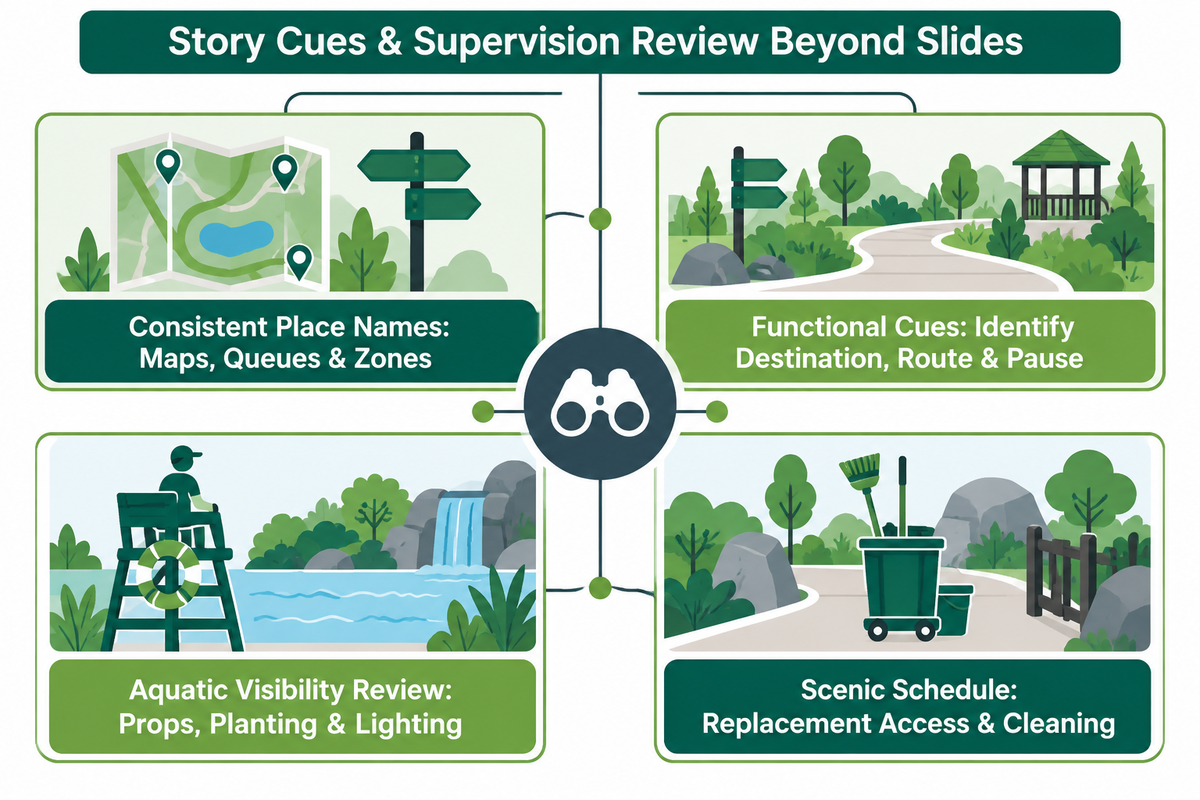
Progress the story from arrival, through waiting and less busy environments to be encountered during the visit. A harbour might include a familiar entry marker, a shaded quay for meeting or some basic dock graphics. Give each detail a job: Identify a destination, describe a route, add interest to a pause.
Follow the same place names for maps, queue entrance and meeting points. A “Coral Cove” name tag can lead to a specific zone that guests can return to. Food outlets and drinking points can share the visual language without turning every practical instruction into a puzzle.
Scenic design also needs an operational review. The Royal Life Saving Society UK guidance describes equipment, lighting and pool layout as influences on visual supervision. Position large scenic forms, planting and lighting within the aquatic team’s review before the concept design is approved.
For a jungle environment, a striking canopy design just above a gathering area might tell the story more succinctly than thick props lining all the edges. Keep replacement access and cleaning responsibilities in the scenic schedule.
Budget for the Theme Through Its Working Life
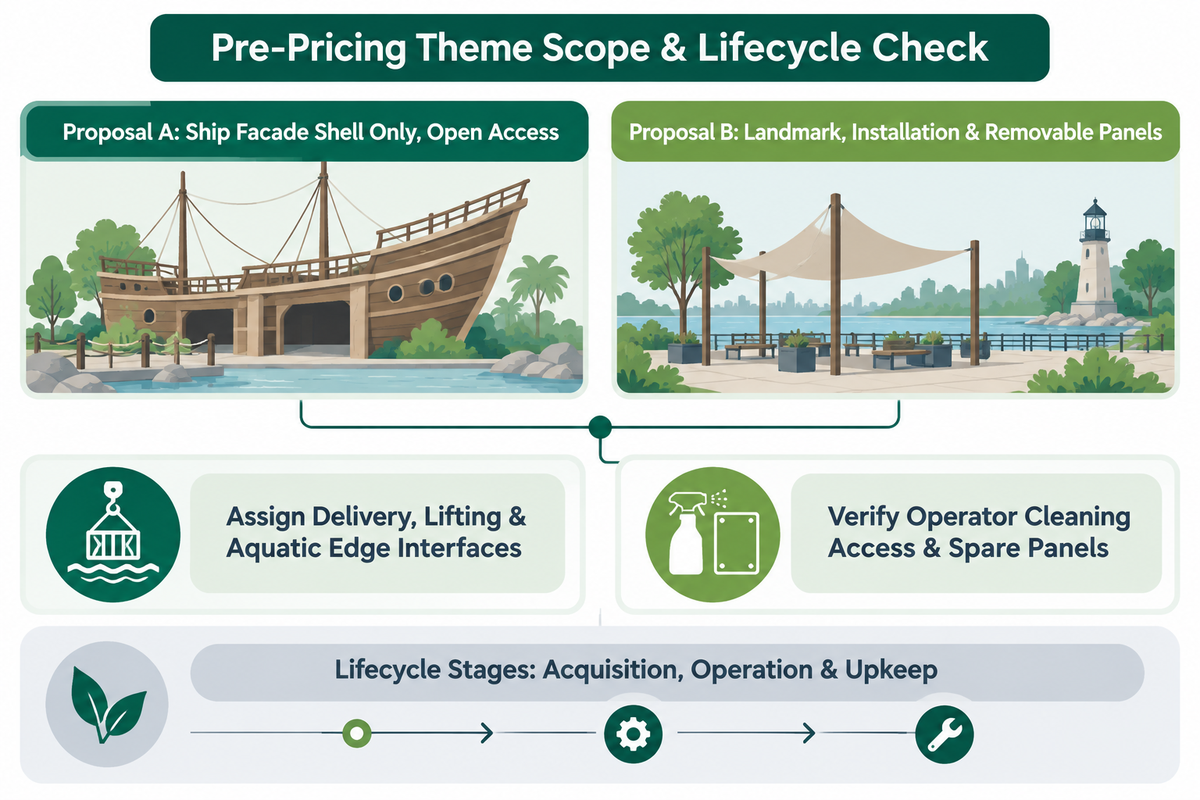
Compare theme proposals by what they include on opening day and what the operator will look after later. Separate visual design, fabrication and installation from aquatic systems and site work. The finance review should also include access for maintenance, replacement responsibilities and the cost of working around an operating park.
Western Australia’s Life Cycle Cost Guidelines incorporates acquisition, operation, maintenance and disposal as stages of owning an asset. For a theme brief, use that principle to compare a scenic object’s purchase with the work required to keep it useful.
Example: two harbour proposals. One bidder offers a large ship façade; another offers a smaller landmark and a gathering spot for families. The first presentation looks more dramatic, but the sale covers fabricated scenic pieces only.
The second includes installation details and replacement access for its removable panels. Procurement cannot compare their headline prices yet. The owner wants a recognizable story, finance wants the full cost exposure, and the operator wants to maintain the setting without dismantling unrelated work.
Returning the same scope schedule to both bidders reveals where each offer needs an addition, an exclusion or a named responsible party.
| Scope item | Proposal A: large ship façade | Proposal B: harbour gathering area | Owner’s next decision |
|---|---|---|---|
| Creative design | Ship artwork and exterior views | Landmark, signs and gathering-area views | Set the required guest-facing scenes |
| Layout coordination | Façade location shown | Seating and sign locations shown | Require both to use the coordinated site plan |
| Fabrication | Large scenic shell | Smaller landmark and removable panels | Compare item schedules and finish specifications |
| Installation | Scenic pieces supplied only | Installation details included | Assign delivery, lifting and fixing work |
| Aquatic interface | Open item around adjacent water play | Review item at the gathering-area edge | Give interfaces to the qualified aquatic designer |
| Cleaning access | Rear access unresolved | Removable panel approach shown | Have the operator review access before acceptance |
| Replacement | Large assembly approach | Individual panel approach | Request the actual replacement sequence and available parts |
| Later phase | New connection to façade unresolved | Space for an additional sign/activity identified | Price future access and construction conditions separately |
| Acceptance package | Finish sample offered | Finish sample and panel schedule offered | Agree drawings, samples, manuals and responsibility records |
Drew Horn, a cost consultant writing for the International Association of Amusement Parks and Attractions, discusses how theming level and construction conditions affect budgets. Review the theming ambition and priced scope together in the same session.
Choose a Theme That Can Grow with the Park
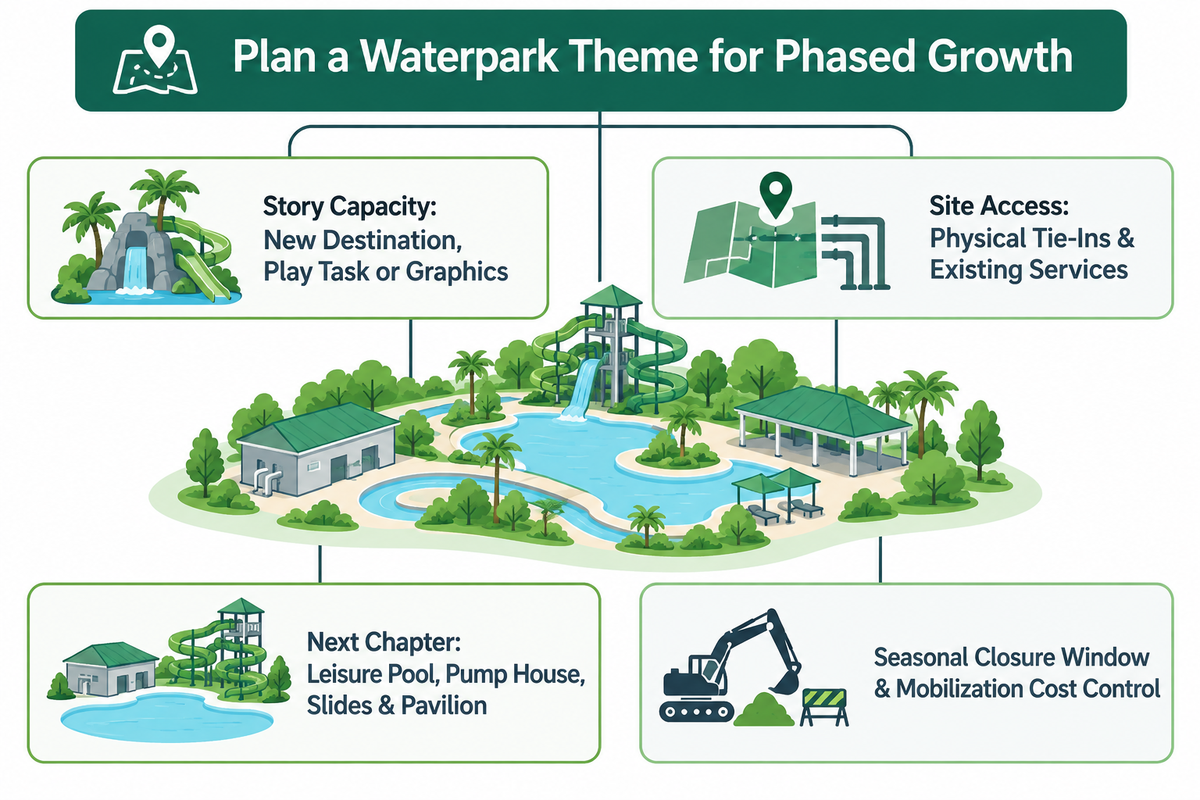
Select a story that can accommodate additional action and still exist in its familiar location. For instance, an exploration harbor might add a second destination, a new play task or updated graphics. Leave both a story location and a physical location open for alteration, then assess how future work will get to the site and link to current services.
The City of Englewood’s Pirates Cove renovation plan combines a leisure pool, a pump house, new slides and an event pavilion. It’s a concrete reminder that a park’s next chapter can involve guest amenities and infrastructure together.
For a waterpark season pass audience, changing an activity or adding a fresh reason to explore may suit the story. The operator still needs a practical programme for the period when the park is closed for the season. Phased work, limited access and repeated construction mobilizations can increase costs, even when the creative identity is easy to extend.
Prepare a Brief Designers Can Price
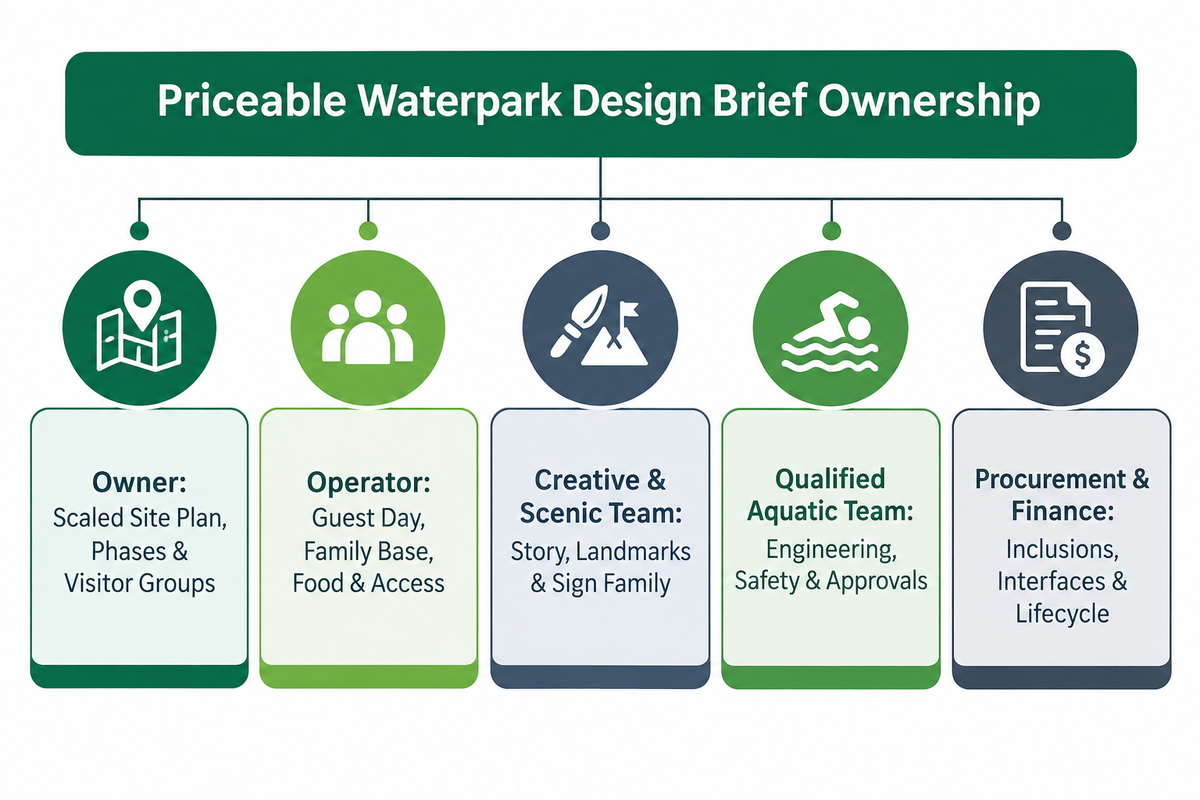
Provide designers with a site plan, guest profile and brief summary of your theme with the attraction functions and support areas you would like included. Clearly spell out the ownership of each design task. A useful brief gives bidders the same opening scope and identifies the decisions that must be resolved before detailed pricing.
- Owner: provide the scaled plan, the setting (indoor/outdoor), project phases and type of visitors.
- Operator: describe the guest day, family-base needs, food stops, maintenance access and the activities that must stay open during later work. Be sure to include the ticket model in the operating brief.
- Creative and scenic team: develop the original story, recognizable landmarks, sign family and itemized scenic work.
- Qualified aquatic and local project team: review of attraction engineering, accessibility, water safety, supervision visibility and any approvals.
- Procurement and finance teams should verify priced inclusions, interfaces, delivery obligations, and the opening and lifecycle budgets.
Maintain the jurisdictional requirements inside of that specialist review. For instance, the U.S. Centers for Disease Control and Prevention states:
“The MAHC is not a federal law.”
Local adoption and the project’s location determine how that guidance relates to the work. Keep technical requirements with the qualified teams rather than treating a theme drawing as an engineering approval.
Dreamland supports playground projects with space planning, floor plan and 3D design, manufacturing and installation support. We provide you with our playground project services when designing the dry play areas of your leisure development.
Frequently Asked Questions
What are some cool themes for theme parks?
For a waterpark, useful starting points include tropical islands, pirate harbours, jungle expeditions, ocean discovery, Alpine adventure and local landscapes. Choose the setting that gives your guests appealing things to do throughout the day. A playful fantasy world can suit interactive family play, while a regional river story can connect a resort to its surroundings.
What are some catchy names for water parks?
Creative starting points include Harbour Splash, Reef Run, Cloud Cove and Cascade Camp. A useful name is easy to say, fits the story and can extend to signs and attraction names. Treat these as naming ideas; before adopting one, complete the brand and name-clearance work for the markets where the park will operate.
What are some good slogans for a water park?
Try a promise guests can recognize in the experience: “Make a Splash, Find Your Adventure” for an exploration concept, “Drift into Adventure” for a river-led setting, or “A Little Escape, A Lot of Play” for a family resort. Keep the wording specific to your park. The slogan should describe the day you intend to deliver.
What are some creative ideas for a theme park?
Try connected harbour expeditions, a reef-research play area or a local river story. Carry the idea into recognizable meeting places and interactive activities as well as the rides.
What are some unique water parks?
Disney’s Typhoon Lagoon and Blizzard Beach offer contrasting story examples: a tropical paradise shaped by a legendary storm and an Alpine ski-resort setting transformed by a melt. Their distinction comes from the setting and story around familiar aquatic experiences. One invites an island escape; the other uses the playful contrast between snow imagery and swimming. Use them as inspiration for connecting a narrative across a park. For your own project, develop the arrival scene, gathering places and attraction names together around an original identity that fits the location.
Can a small resort use more than one theme?
Yes. Use related zones within one main story, such as a harbour, reef and explorer’s camp. Shared signs and colours keep the compact guest journey connected.
What should we know to build a water park?
Start with the intended market, site, operating model and project budget, then develop the attraction and guest-space brief with qualified designers. Include aquatic engineering, approvals, access, supervision and maintenance responsibilities early. Give the team the site’s boundaries, existing buildings and service information, together with the visitor groups and project stages. Separate the scenic schedule from the aquatic and civil work so each interface has an owner. The theme organizes the visitor experience; the development plan also coordinates the systems, people and support facilities needed to deliver that day.
Bring a clearer play-space brief to your next design discussion.
Share your site plan, target guests and preferred theme direction with Dreamland’s playground project team.
Named park and municipal project examples retain their respective operators’ ownership. Aquatic engineering and operating requirements belong with the qualified project teams for the site.
References & Sources
- Recreation Management: Making Waves, Joe Bush, October 2025 named operator and practitioner interviews.
- Milman, Tasci and Wei: Crowded and popular, 2020 general theme-park research; observational associations.
- U.S. Access Board: Swimming Pools, Wading Pools, and Spas aquatic access categories.
- Royal Life Saving Society UK: Lifeguard Zone Visibility Test – Association guidance on factors affecting visibility.
- Western Australian Government: Life Cycle Cost Guidelines recreation facility asset-cost principles.
- IAAPA: Avoiding Busted Budgets, Drew Horn contributor perspective from a commercial cost consultant.
- City of Englewood: Pirates Cove Renovations published renovation scope.
- CDC: About the Model Aquatic Health Code (MAHC) – information on what the MAHC is, what’s in the code, and the adoption process.