Get in touch with Dreamland Playground Company

Indoor playground franchise vs independent ownership is a decision about systems, control, and long-term cash, not only startup cost. A franchise can give a buyer a brand, operating playbook, training, and supplier rules. An independent indoor playground gives the owner more control over theme, equipment, pricing, suppliers, and local marketing, but the owner must build the missing systems before opening.
Quick Answer
Choose a franchise when you value a known brand, training system, opening checklist, vendor rules, and operating playbook enough to pay franchise fees and recurring charges. Choose an independent indoor playground when you want control over theme, equipment, local positioning, suppliers, and long-term margin, and when you can replace the franchisor’s support with a serious launch plan.
Franchise vs Independent Indoor Playground: What You Are Really Choosing
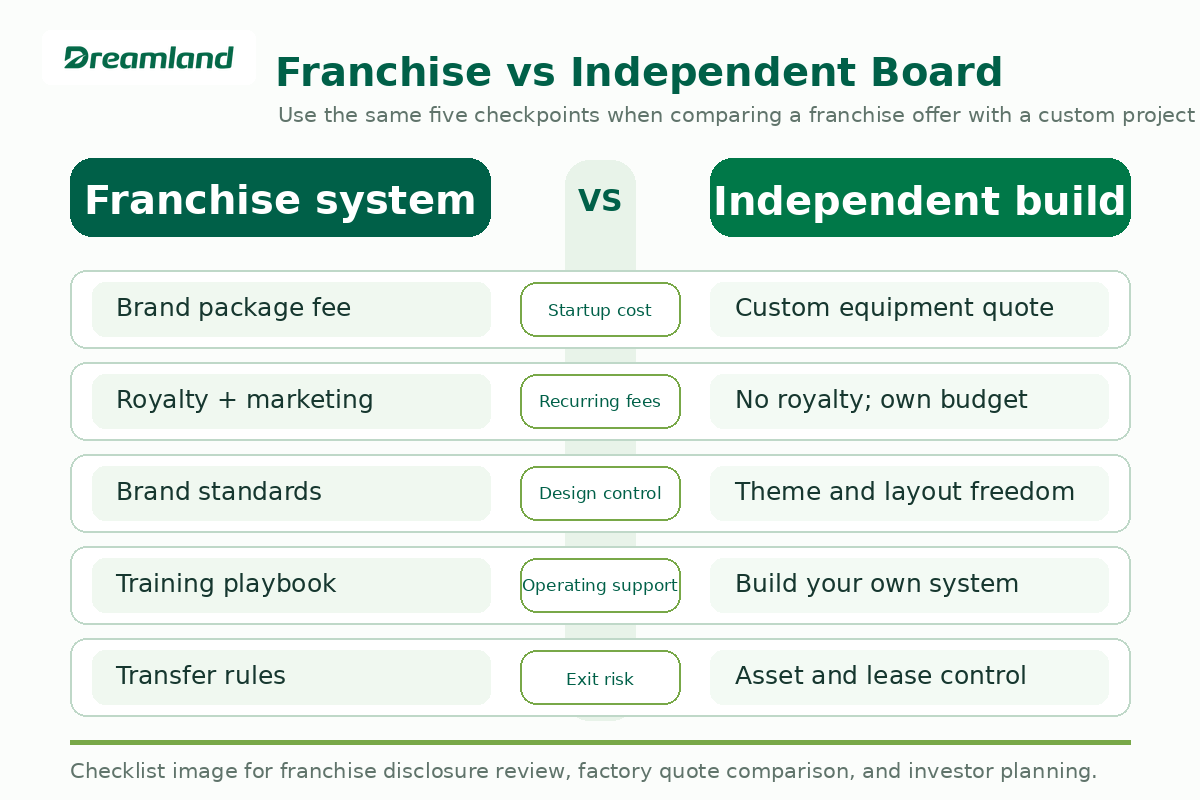
A franchise path buys a business system. Independent ownership buys control, but control has a labor bill before the lease is signed. Ask whether the franchisor’s brand, training, vendor rules, manuals, and opening support justify the fees and contract limits attached to them.
For an indoor playground investor, that choice affects five areas: startup cost, recurring fees, design control, operating support, and exit risk. A franchise may reduce uncertainty during launch. It can also limit what equipment you buy, what theme you build, how you price parties, and how you leave the system if the local market doesn’t work.
An independent indoor playground gives more room to fit the local market. Owners can build a toddler-focused play cafe, a larger family entertainment center, a mall play area, or a themed soft play venue around the site’s exact floor plan. Control still has a price: someone must create or buy the systems that a franchisor would normally provide.
Dreamland Playground’s role is different from a franchise brand. In its public franchise-guide positioning, Dreamland presents itself as a manufacturer and project partner rather than a franchisor selling territory rights or royalty-based agreements. It supports project planning, floor plan design, 3D design, equipment production, shipping, installation support, and after-sales service, so buyers can compare a franchise proposal against a factory-direct independent project.
Dreamland Playground works from project details such as space, age group, market, theme, budget, safety requirements, and business goals. That makes the independent path more structured. The indoor playground business plan still needs the owner’s local operations, permits, staffing, insurance, and marketing.
The Money Difference: Upfront Cost Is Not the Only Cost
Franchise cost comparisons often start with the franchise fee, but that’s only one line. A better comparison adds total initial investment to the recurring fee load that follows opening day, because two proposals can look similar while one carries long-term gross-revenue charges.
Official franchise pages checked for this article show how wide the ranges can be. Luv 2 Play lists an overall investment from $600,000 to $2,500,000, plus a 6% royalty and a 3% advertising fund. Play Street Museum’s FAQ lists $482,741 to $759,920 in one cost section and $304,650 to $761,140 in another, plus $150,000 liquid capital and $700,000 net worth requirements. Because the same official page shows two ranges and placeholder fee fields, treat it as a cautionary example and request the current disclosure document before using the number in a budget.
Treat those as brand-specific public examples, not as a promise about your project. A franchise disclosure document, local lease, landlord work, fire review, accessibility work, equipment scope, safety flooring, freight, installation, insurance, payroll, and working capital can change the real budget.
SBA startup guidance at U.S. Small Business Administration tells new businesses to separate one-time startup expenses from ongoing monthly expenses. Planning categories include equipment, licenses and permits, insurance, salaries, marketing, market research, rent and utilities, inventory, and professional services.
Five-Year Royalty Drag Worksheet
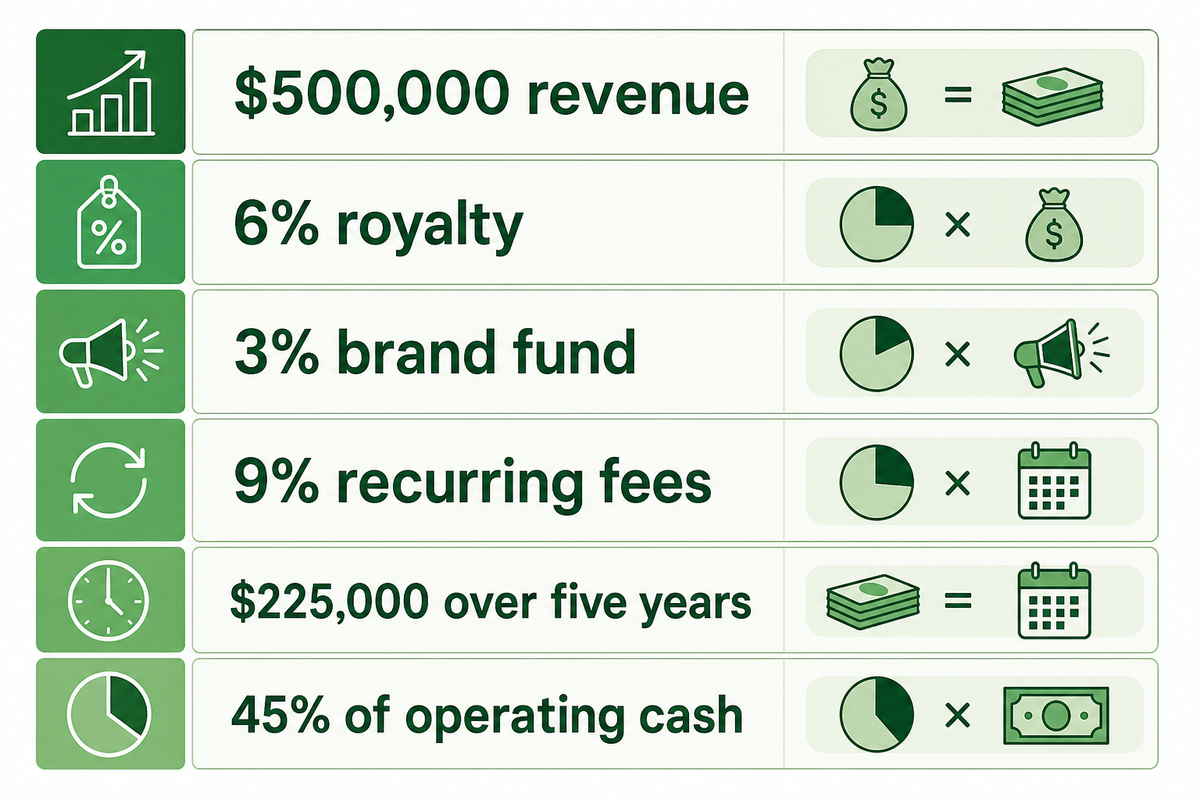
Below is an arithmetic example, not a forecast. The math stands on visible assumptions: about $500,000 annual revenue and a 9% combined recurring fee equals about $45,000 per year. Replace every value with your own numbers; Dreamland’s indoor playground break-even model and franchise royalty load calculator are planning aids, not evidence that any revenue level is typical.
| Input | Example value | Why it matters |
|---|---|---|
| Rough annual revenue assumption | about $500,000 | Gross-revenue fees are charged before profit is known. |
| Royalty | 6% | At $500,000 revenue, royalty equals $30,000 per year. |
| Brand fund | 3% | At $500,000 revenue, brand fund equals $15,000 per year. |
| Estimated recurring percentage fee | roughly 9% | In this rough example, recurring percentage fees equal about $45,000 per year. |
| Estimated five flat years | about $225,000 | Using the same rough assumptions, five flat years at unchanged revenue and fee rates total about $225,000 before fixed fees. |
| Local marketing replacement | owner-set budget | Independent projects still need launch demand, ads, partnerships, birthday-party outreach, and repeat-visit offers. |
| Working-capital reserve | owner-set reserve | Rent, payroll, insurance, utilities, cleaning, maintenance, and slow ramp-up months still need cash coverage. |
| Sensitivity check | same assumptions | Run the worksheet again with lower revenue, higher rent, and delayed party bookings before signing either path. |
| Estimated operating margin before fees | around 20% | In that rough scenario, a $45,000 fee load would consume around 45% of about $100,000 operating cash before debt, tax, and owner salary. |
Finance capsule: Gross-revenue fees matter because they aren’t tied to profit. In the same rough example, a 9% combined fee on $500,000 revenue equals about $45,000 each year, even before debt service, taxes, or owner salary are considered.
FDD and Contract Control: What a Franchise Buyer Must Read First
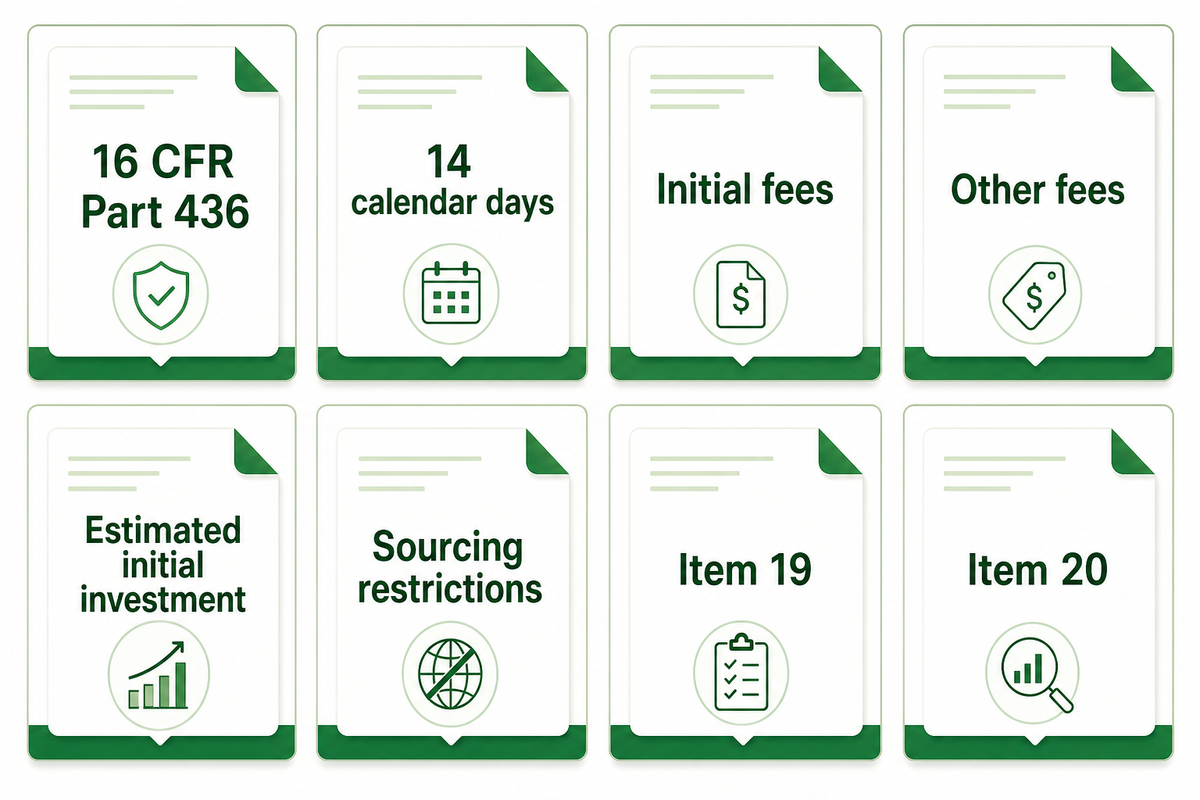
Franchise disclosure is the buyer’s first serious test. Sales pages can summarize a brand. Disclosure documents show fees, obligations, sourcing rules, performance representation limits, contracts, outlets, and exit language, turning the sales promise into obligations the owner must fund and follow.
Under 16 CFR Part 436, a franchisor must provide disclosures at least 14 calendar days before the buyer signs a binding agreement or makes a payment. Federal disclosure categories also cover initial fees, other fees, estimated initial investment, restrictions on sources of products and services, obligations, financial performance representations, outlet information, financial statements, and contracts.
That matters because the franchise-vs-independent choice often turns on small contract details. Restricted sourcing can change replacement-part cost. Territory language can affect expansion. Item 19 may show only selected financial performance information. Item 20 outlet data can show openings, closures, transfers, and terminations that deserve a closer look.
Preparation Note
Use Dreamland’s FDD red flag checklist to prepare questions, then ask a franchise attorney or qualified advisor before signing. Dreamland frames the checklist as a preparation aid, not legal advice.
Contract capsule: A franchise disclosure document should be read before any fee is paid. Start with the current FDD, not a sales deck, because contract language controls fees, sourcing, support, territory, and exit terms.
Control vs Support: What the Franchise Playbook Gives and Takes
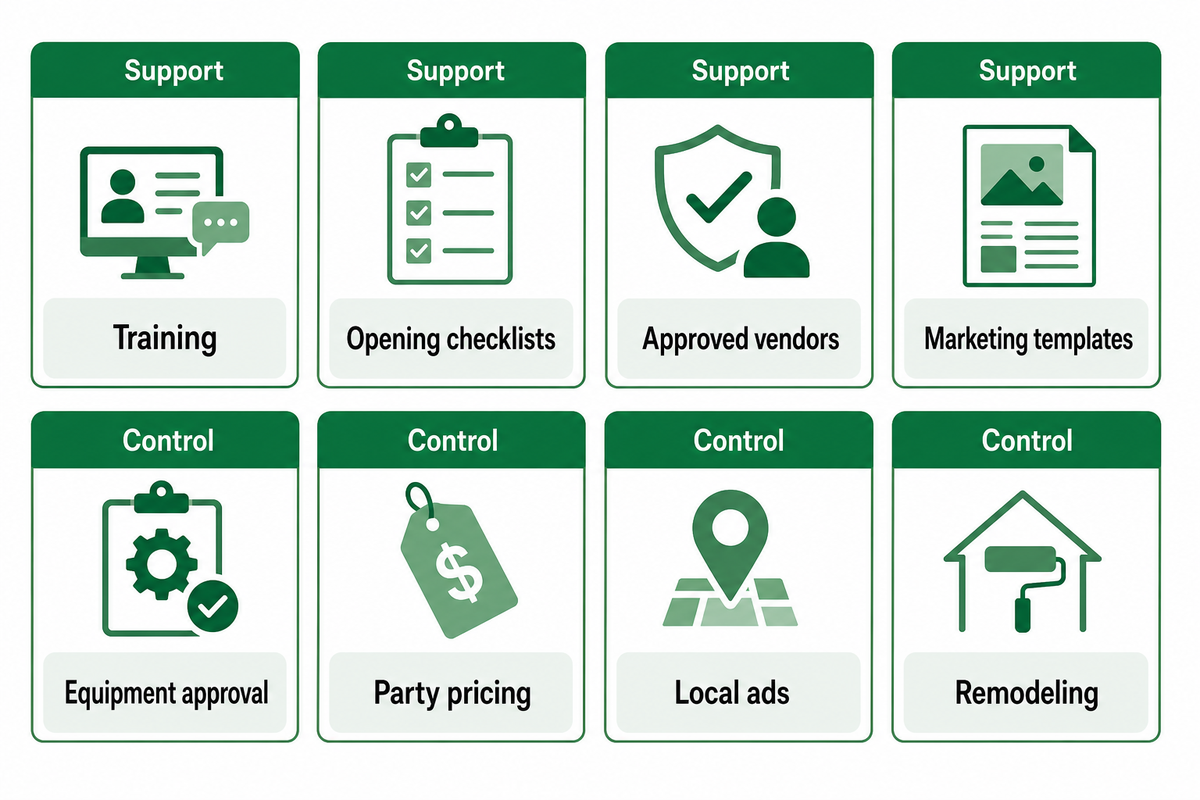
Franchise playbooks can help first-time operators move faster. Training, opening checklists, standard operating procedures, approved vendors, marketing templates, and brand rules can reduce the number of decisions an owner must make alone, especially when the owner lacks a tested venue operating system.
Brand playbooks can limit local decisions. A franchise owner may need approval for equipment changes, supplier selection, party pricing, cafe menu, membership offers, signage, birthday packages, local ads, and remodeling. These limits may be acceptable if the brand brings enough demand and support. They become costly when the local market needs a different format.
Independent owners control the concept. Site planning can follow the real lease, parent seating, party rooms, toddler zone, trampoline area, ninja course, cafe, traffic flow, cleaning route, and expected age mix. That control is valuable only when the owner can handle the work behind it.
Dreamland can reduce the equipment and project-planning burden for independent buyers. A buyer can send a floor plan or sketch, photos, ceiling height, target age group, theme, budget range, country, standards target, and timeline. Dreamland can then support layout planning, 3D design, production, shipping, and installation support.
Operations capsule: Franchise support is valuable when it replaces real work the owner can’t do yet. Independent control is valuable when the owner has a local marketing plan, staff training plan, site plan, and supplier proof before opening.
Hidden Bottleneck Map: Where Each Path Usually Breaks
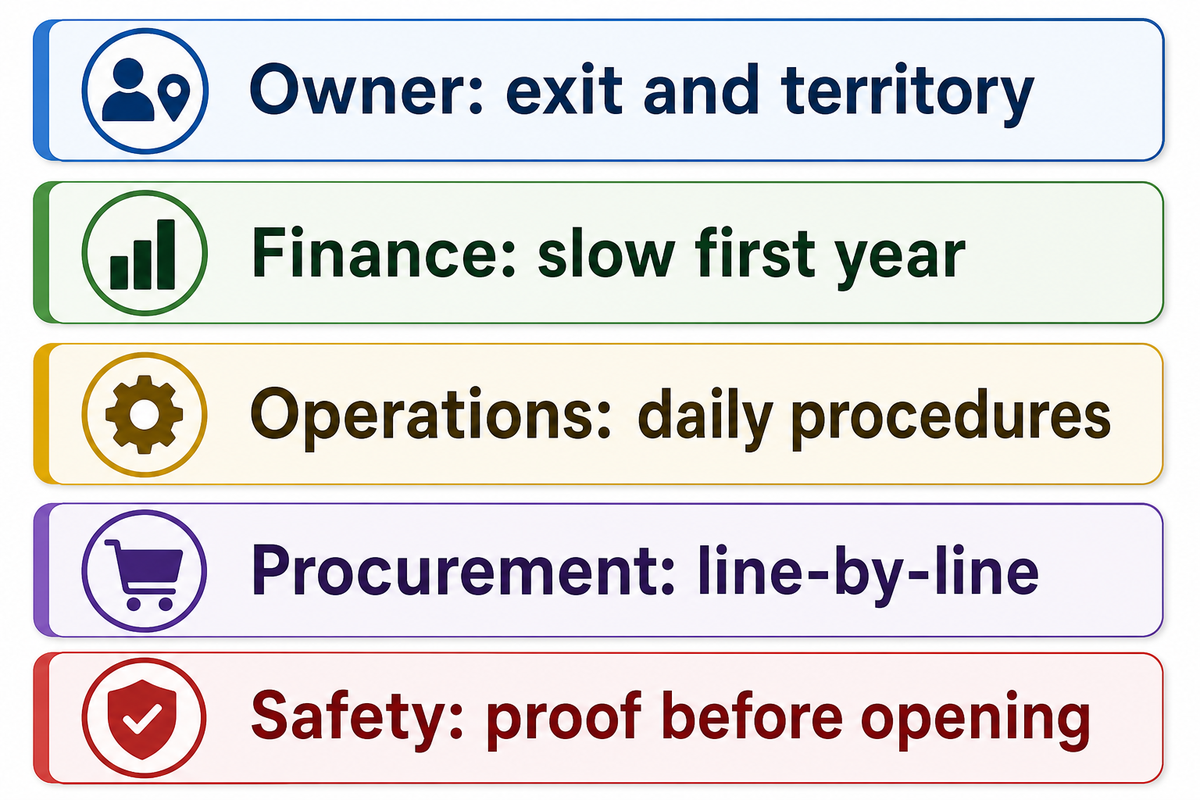
Many franchise-or-independent decisions fail at a hidden bottleneck. Owners often compare the visible price and miss the role that will carry the risk after opening. The practical question is who can control that bottleneck after grand opening, not which proposal sounds easier.
9-Point Bottleneck Map
| Buyer role / risk type | Franchise bottleneck | Independent bottleneck | Decision test |
|---|---|---|---|
| Owner | contract exit, territory, brand approval | full accountability for concept and local demand | Can you live with the risk you cannot delegate? |
| Finance | royalty, brand fund, fixed monthly fees | working capital and launch cash | Which model survives a slow first year? |
| Operations | brand playbook and reporting rules | staff procedures, cleaning, parties, scheduling | Who will run daily procedures? |
| Procurement | approved supplier rules and replacement parts | supplier qualification and scope comparison | Can you compare equipment line by line? |
| Safety/quality | brand standard plus local rules | standards file and inspection readiness | Who owns proof before opening? |
| Marketing | brand campaigns may not fit local parents | owner must build local demand from zero | Who owns birthday-party and membership demand? |
| Landlord/buildout | brand format may reject awkward space | custom layout must solve columns, ceiling, and flow | Does the real lease fit the model? |
| Staffing/training | training may be standardized but limited | owner must document every local procedure | Can new staff run the venue without the founder? |
| Exit/expansion | transfer, renewal, and territory language | asset resale and owner-controlled second site | Which path gives a cleaner downside plan? |
When operations are the buyer’s weak point, a franchise can be the better choice. When local execution is strong and equipment planning is the gap, an independent project can be the better choice. Use the bottleneck map to stop one path from looking safer only because its risk is better hidden.
Bottleneck capsule: Franchise concentrates risk in contracts and recurring fees. Independent ownership concentrates risk in execution. Ask which risk your team can manage.
Safety, Accessibility, and Commercial-Use Proof Apply to Both Paths
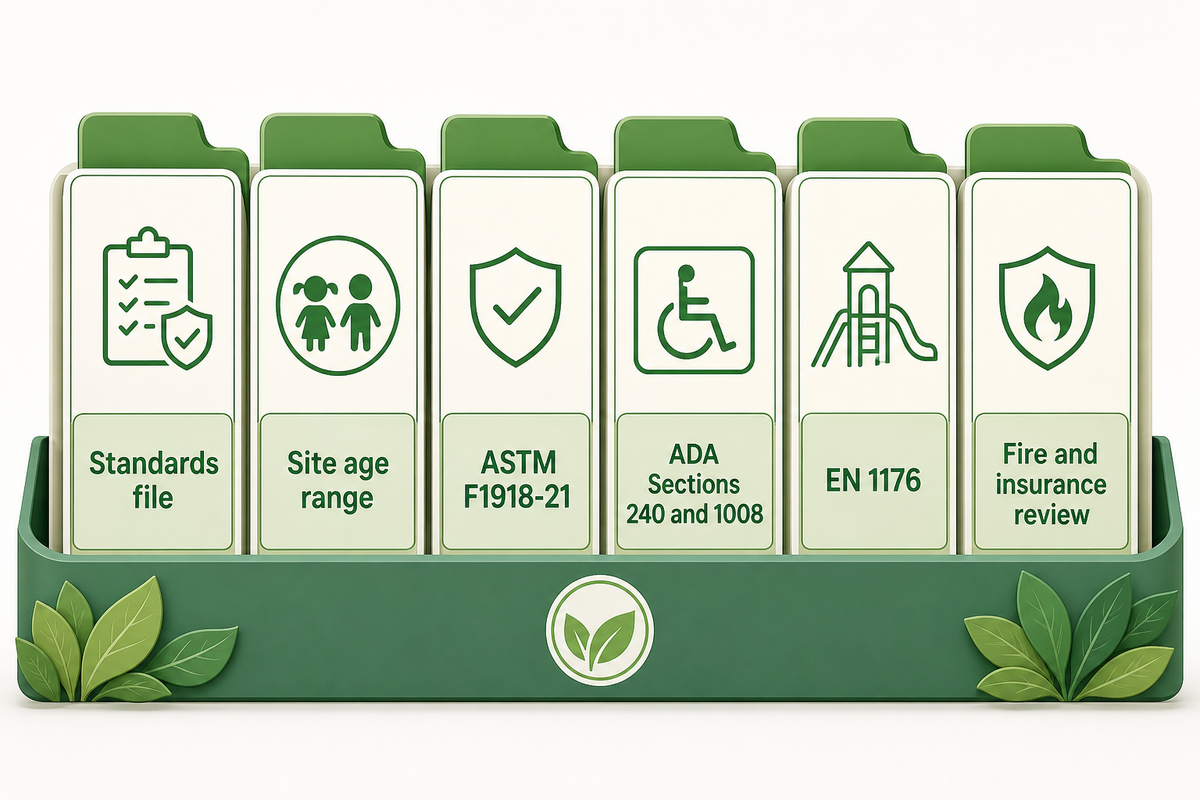
Franchise brands don’t replace local safety, accessibility, fire, building, insurance, and inspection work. Independent suppliers don’t replace it either. Commercial indoor playground projects need a standards file that matches the product type and target market, with documented confirmation for the site, age range, and authority.
For U.S. soft-contained play equipment, ASTM F1918-21 is the public standard page to check. Its public scope covers soft contained play equipment, lists a user range from the 5th percentile 2-year-old to the 95th percentile 12-year-old, and excludes public playground equipment, home playground equipment, sports equipment, amusement rides, water-related attractions, toys, and juvenile products.
ADA.gov’s recreation guidance points to play areas in Sections 240 and 1008. It states that children with disabilities must be able to participate in play without barriers and that play structures, including soft play environments, should be accessible.
For European projects or projects sold into markets that use European references, EN 1176 may also matter. Dreamland’s product planning can account for relevant EN and ASTM requirements depending on product type and target market, but the buyer still needs local confirmation from the project team, inspector, insurer, or authority having jurisdiction.
Safety capsule: ASTM F1918-21 and ADA play-area guidance solve different parts of the project. One frames soft-contained play equipment; the other frames accessible play participation. Both paths still need local review.
The FDD-to-Factory Quote Matrix
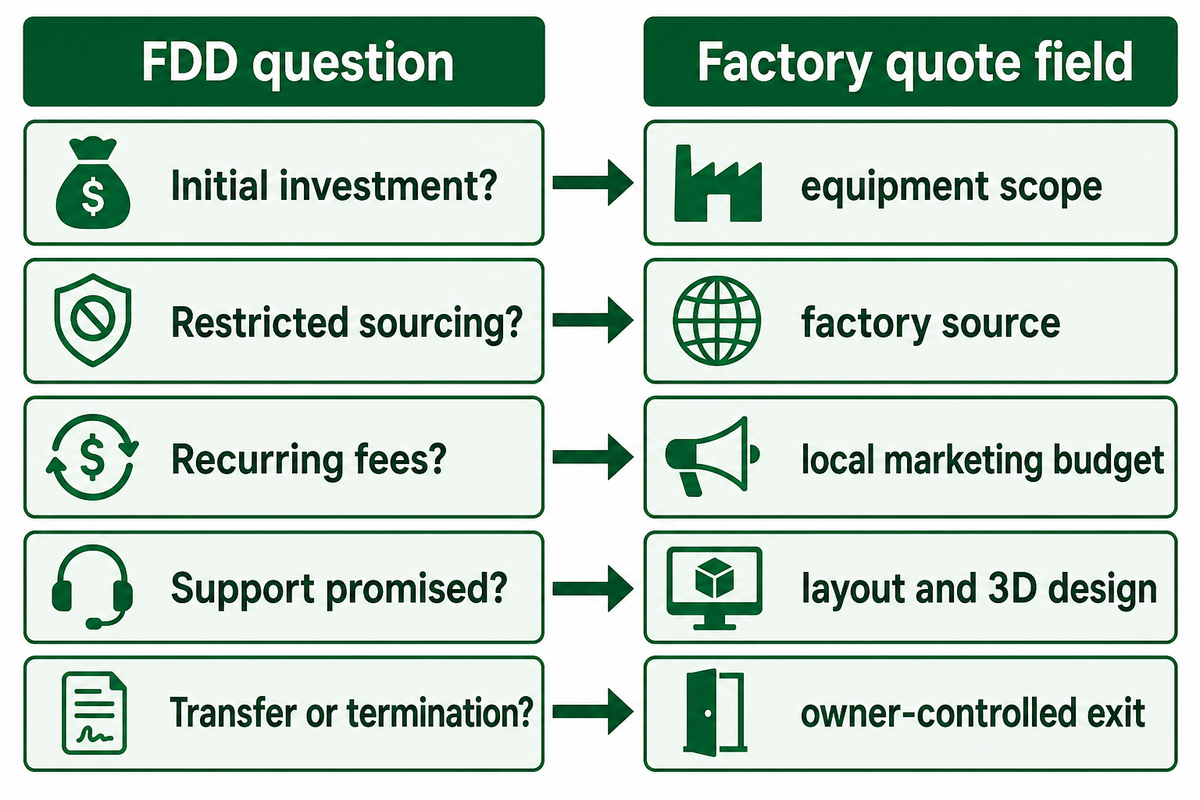
Compare a franchise proposal and an independent equipment quote only after both use matched assumptions before signing. Use the matrix below to turn FDD questions into factory quote fields; otherwise, the buyer compares a contract bundle with a partial equipment list.
| Franchise question | Why it matters | Independent quote field |
|---|---|---|
| What is included in initial investment? | Prevents fee-only comparison | equipment scope, safety flooring, freight, installation, spare parts |
| What sourcing is restricted? | Affects price and replacement speed | factory source, material options, part list, service path |
| What recurring fees apply? | Changes cash after opening | royalty-free model plus local marketing budget |
| What support is promised? | Tests the value of the fees | layout, 3D design, production, shipping, installation support |
| What happens on transfer or termination? | Defines downside risk | asset resale, lease assignment, owner-controlled exit plan |
Matrix discipline also protects independent buyers from an unfair comparison. Factory equipment quotes aren’t full business budgets. Place the quote beside a lease budget, working-capital reserve, permits, insurance, staff plan, marketing plan, and local code review.
Quote capsule: A franchise proposal and a factory quote become comparable only after both show equipment scope, freight, installation, support, recurring fees, local buildout, and working capital.
When a Franchise Is the Better Choice
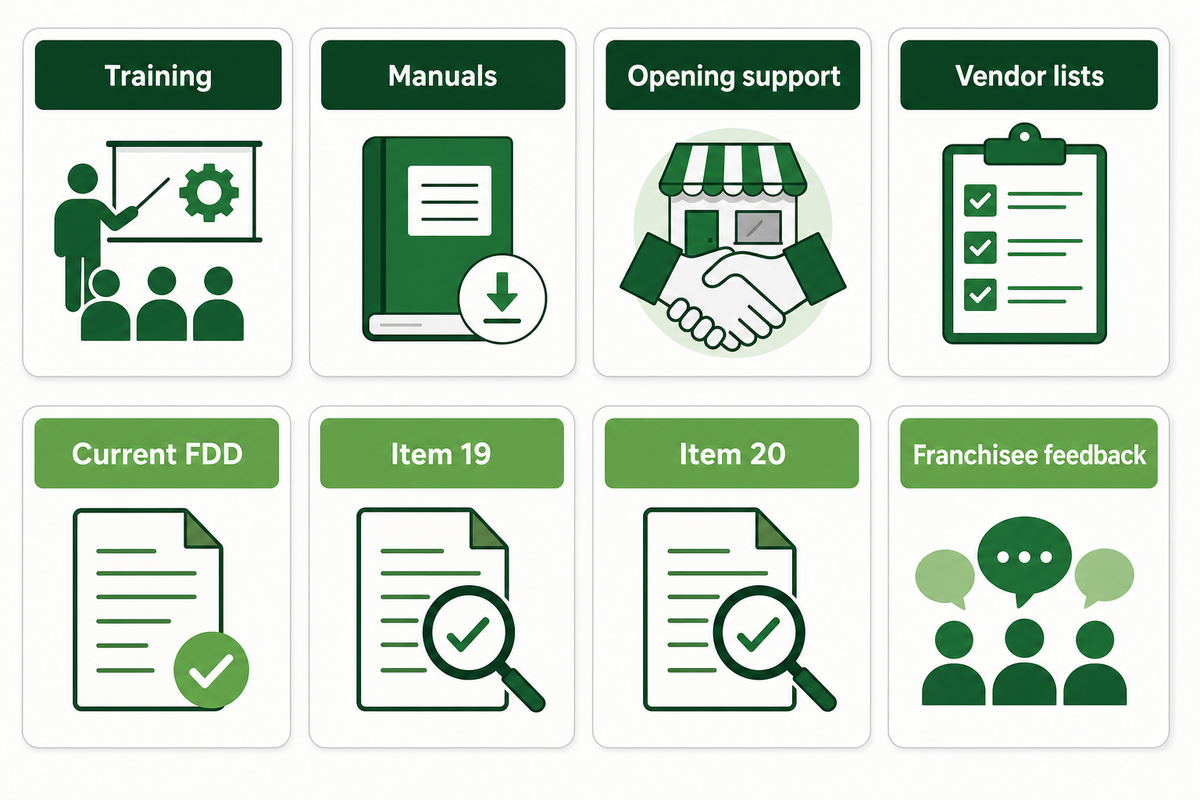
Franchise ownership often fits buyers who value a proven operating system more than creative freedom, especially when the founder has limited venue experience. New operators may need training, manuals, opening support, vendor lists, marketing templates, and a brand story that landlords and lenders can understand.
Part-time founders may also prefer a franchise during early planning. The operating burden remains heavy, but the franchisor’s checklist can reduce blank-page decisions. Buyers should still test whether actual brand support justifies the fee load.
Before paying, franchise-leaning buyers should verify four items: current FDD, Item 19 financial performance representation, Item 20 outlet history, and former franchisee feedback. Brand stories can sound attractive while contract limits, liquidated damages, or a narrow territory make the local project hard to run.
Franchise-fit capsule: A franchise fits best when the playbook materially lowers your execution risk. If brand support doesn’t create more value than the royalty, brand fund, fixed fees, and contract limits, the safer-looking path may be expensive.
When an Independent Indoor Playground Is the Better Choice
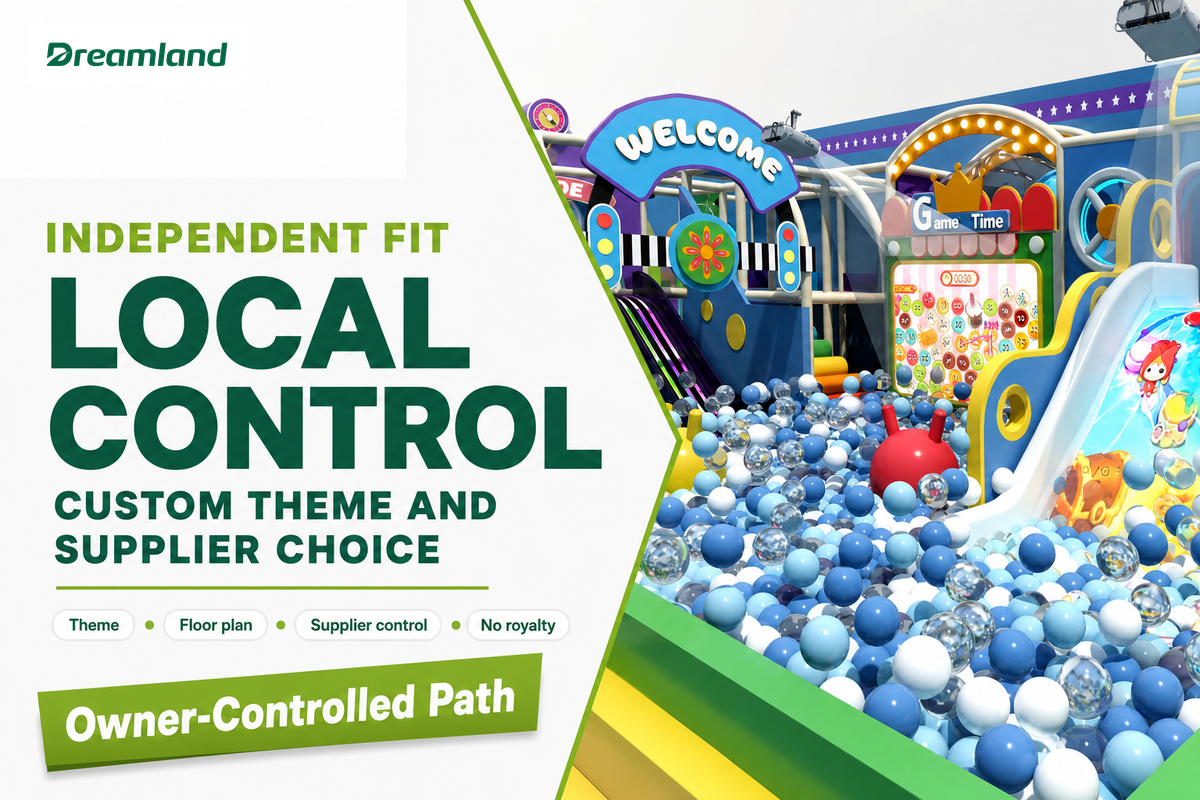
An independent indoor playground is often the better choice when the buyer wants local positioning and supplier control. That may include a custom theme, unusual floor plan, smaller play cafe, larger family entertainment center, mall-specific layout, resort project, school play area, or hybrid attraction mix.
Independent ownership can protect long-term cash because there’s no franchisor royalty or brand fund. That doesn’t make it automatically cheaper. Owners still need marketing, staff training, safety proof, inspections, insurance, maintenance, cleaning, replacement parts, and working capital.
Dreamland can make the independent path more concrete by turning a site into a layout and equipment plan. A buyer can request a floor plan concept, 3D design, equipment quote, production plan, shipping plan, and installation support before signing a lease or comparing franchise terms. The same file should note site selection constraints, commercial soft contained play equipment scope, birthday party rooms, membership revenue assumptions, payback period targets, and any franchise liquidated damages language that could affect the exit plan.
Independent-fit capsule: Independent ownership fits buyers who can build local demand and operating discipline. Control is the reward. Responsibility for every missing franchise system is the cost.
How to Compare Both Quotes Before You Sign Anything
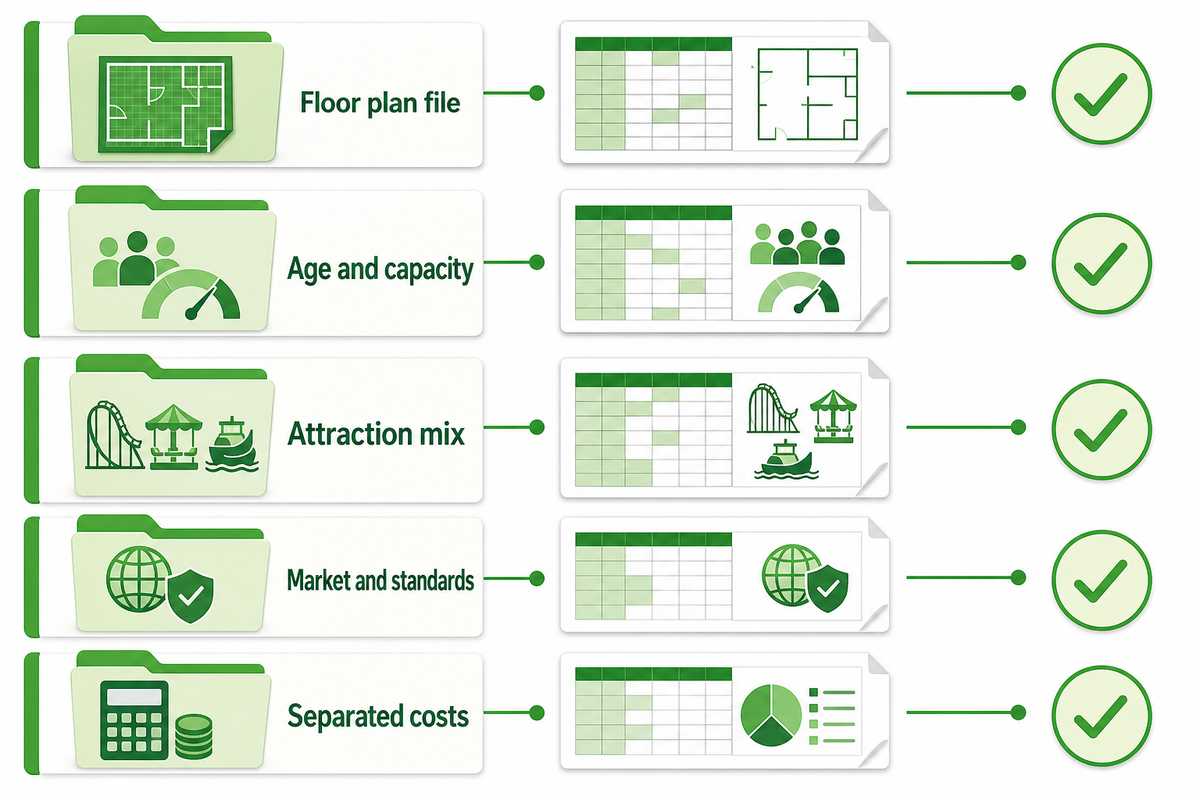
Before choosing a franchise or independent indoor playground, force both proposals into one worksheet. Match floor area, ceiling height, target age group, expected capacity, theme level, equipment scope, party-room plan, cafe plan, safety flooring, freight, installation method, standards target, and opening timeline.
- ✔Send floor plan, dimensions, ceiling height, column locations, entry/exit points, and photos or video.
- ✔Define target age group, expected capacity, birthday party rooms, membership revenue assumptions, cafe model, and parent seating.
- ✔Choose the attraction mix: soft play, toddler zone, trampoline, ninja course, ball pool, slides, climbing, or adventure elements.
- ✔State the country, local market, standard target, budget range, installation method, and target opening date.
- ✔Ask each proposal to separate equipment, safety flooring, freight, installation, spare parts, design support, training, recurring fees, and working capital.
One messy but common case is a landlord-ready shell with low rent, awkward columns, a short ceiling section, and a strong weekend birthday market; a franchise may reject the layout while an independent project can still work if the equipment plan, traffic flow, party rooms, and inspection path fit the real site.
Buyers see the real difference faster when both paths share the same assumptions, because a franchise proposal that includes brand training, required vendors, software, opening support, royalties, and transfer language can’t be judged against a factory equipment quote that excludes rent, staff, insurance, launch marketing, freight, installation, and working capital. Franchise may win on system and support. Independent ownership may win on control, sourcing, and recurring cash. Your weak point decides which advantage matters more.
Get a Factory-Direct Benchmark Before You Commit
Dreamland Playground can review your space, age target, theme, budget, and market, then prepare a layout concept and equipment quote so you can compare an independent build with a franchise proposal.
Frequently Asked Questions
Is an indoor playground franchise better than independent ownership?
Choose a franchise when brand support lowers execution risk more than fees reduce cash; choose independent ownership when local control and royalty-free margins matter more.
Independent wins when you can build demand, staff procedures, safety proof, supplier control, and local marketing yourself. A franchise can be better when the brand playbook, training, vendor system, and opening support lower execution risk more than royalties and contract limits reduce flexibility. Compare the owner role you can actually manage, not only the logo on the proposal.
Is an independent indoor playground cheaper than a franchise?
An independent build can avoid franchise royalties and brand-fund payments, but it is cheaper only when the owner budgets systems, marketing, staff, and working capital well.
Owners still need equipment, safety flooring, freight, installation, rent deposits, permits, insurance, staff, marketing, working capital, and local operating systems. Compare both paths from the same site and capacity assumptions, then test whether the franchise fee load buys support you would otherwise have to build, document, or hire before opening.
What does a franchise fee cover?
Franchise fees usually buy entry into the system, initial training, brand rights, and launch support for opening; they do not cover the full venue budget or working capital.
Check the current FDD for exactly what the fee covers and what remains separate: buildout, equipment, safety flooring, freight, installation, opening inventory, insurance, staff, marketing, software, and working capital. Ask whether any part of the fee is refundable, whether training travel is extra, whether approved vendors are mandatory, and which launch services continue after opening day.
Can I open an indoor playground without a franchise?
Yes, but the independent path still needs a business system before opening, including site planning, safety proof, staffing, marketing, maintenance planning, insurance, and working capital.
Build a floor plan, equipment quote, safety and accessibility file, staff procedures, cleaning schedule, party process, maintenance plan, local marketing plan, insurance path, and working-capital reserve. A factory or project partner can help with layout and equipment, but the owner still needs the business system.
What FDD items should I check first?
Start with fees, investment estimate, sourcing restrictions, obligations, financial performance, outlet history, territory, transfer terms, termination language, and the signed contracts before paying any fee.
Read initial fees, other fees, estimated initial investment, restrictions on sources, obligations, Item 19, Item 20, contracts, termination, transfer, territory, and former franchisee contact options before paying. Then ask a qualified advisor to review the items that affect your lease, sourcing, downside risk, and exit options.
What standards matter for commercial indoor playground equipment?
ASTM F1918, ADA play-area guidance, EN 1176, and local fire/building rules may all matter depending on market, product type, inspector expectations, insurer requirements, and opening documentation.
Soft-contained play projects in the U.S. should check ASTM F1918-21 and accessibility requirements. European or export projects may need EN 1176 references. Local inspection and insurance requirements still control the opening process, so keep a standards file beside the equipment quote rather than treating it as a sales afterthought.
How can Dreamland Playground help compare both options?
Dreamland can create an independent project benchmark from your site, age target, theme, budget, market, safety target, shipping needs, installation method, and franchise comparison assumptions.
Dreamland can support space planning, floor plan design, 3D design, equipment production, shipping, installation support, and after-sales service, so you can compare a factory-direct project with a franchise proposal. Send the same assumptions you would use for a franchise review: floor plan, ceiling height, target ages, capacity, country, theme, budget, standards target, timeline, shipping needs, and installation method. That lets the Dreamland team build a quote benchmark rather than a generic equipment list. Use that benchmark beside the FDD, lease budget, opening cash reserve, staff plan, and local code review, then decide whether the franchise playbook is worth the recurring fee load.
About This Comparison
Dreamland Playground designs and manufactures indoor playground and family entertainment center projects for buyers in more than 50 countries. This comparison reflects public franchise disclosure rules, official franchise example pages, and Dreamland’s stated project workflow from layout planning through production, shipping, installation support, and after-sales service.
References & Sources
- 16 CFR Part 436 – Franchise disclosure requirements – eCFR
- Calculate your startup costs – U.S. Small Business Administration
- Spotlight on Accessible Recreation Spaces – ADA.gov
- ASTM F1918-21 public standard page – ASTM
- Franchise Opportunity – Luv 2 Play official page
- Franchising FAQ – Play Street Museum Franchise official page
- Indoor Playground Franchise Guide – Dreamland Playground