Get in touch with Dreamland Playground Company

Writing a bank-ready business plan for escape room venues (updated November 2026) starts with egress and commercial lease math. Loan officers skipping puzzle lore and reviewing U.S. Small Business Administration 7(a) loan terms up to $5 million focus on credit. Credit teams gauge whether the cash flow survives a three-to-six-month buildout.
A business plan for escape room venues is an eight-section underwriting document proving lease viability, fire-code egress compliance, and monthly debt coverage. Standalone 3-to-5 room venues typically lease 2,000–5,000 sq ft of commercial space and model private-group bookings rather than full-seat capacity.
Key Takeaways for Founders and Underwriters
- 78% of US escape rooms sell always-private sessions: Unsold seats inside a booked group vanish permanently. Eight-player sellout spreadsheets fail bank scrutiny.
- 3 to 5 rooms require 2,000–5,000 sq ft of commercial space: Published commercial buildout budgets span $82,300 on the bare-bones low end to $424,800 for full contractor builds with sprinkler work.
- Special-amusement fire rules depend on local code: Obscured exit paths trigger NFPA 101 life-safety scrutiny regardless of group size, while adopted IBC editions govern local puzzle-room exemptions.
- SBA 7(a) lenders discount custom drywall collateral: Commercial banks typically screen startup pro formas near 1.15x to 1.25x debt service coverage and require founder equity plus collateral recovery plans.
- Hybrid active-play zones solve single-play decay: Pairing puzzle rooms with a $50,000–$200,000 commercial indoor play zone lifts family repeat visits inside compact entertainment centers.
What Lenders and Landlords Actually Check First in an Escape Room Business Plan
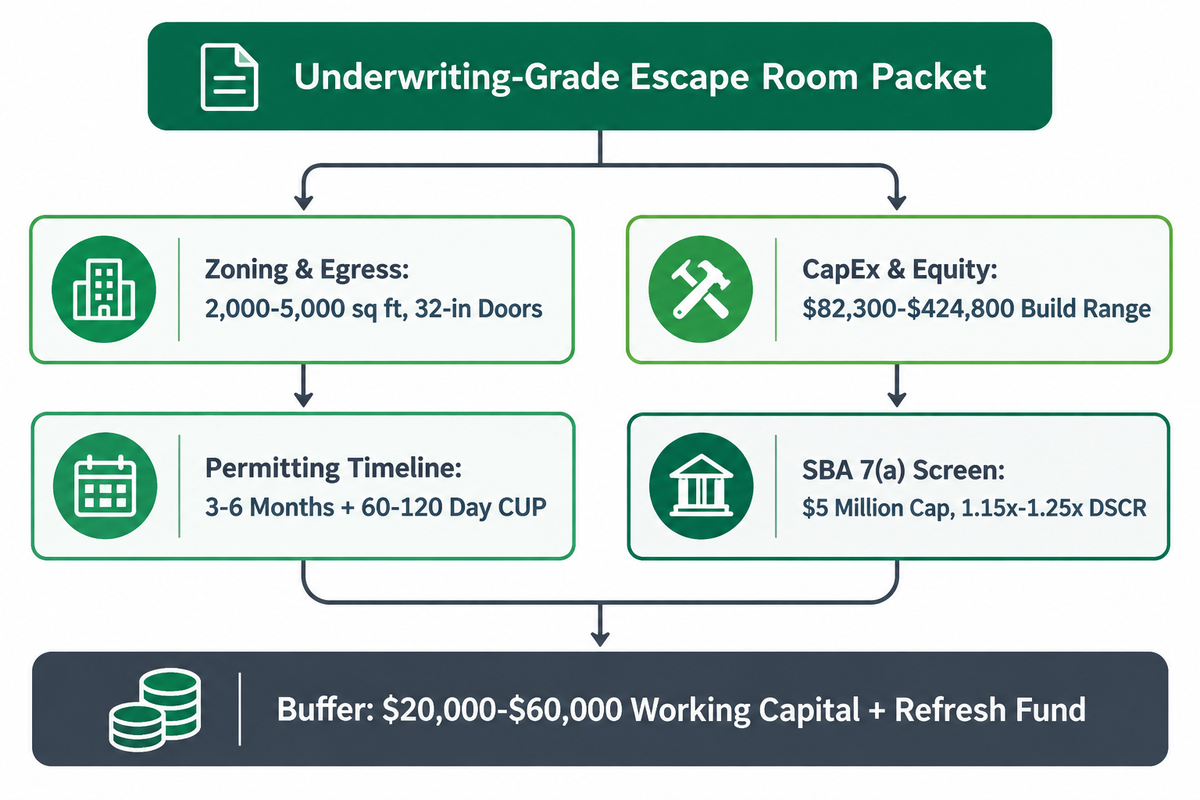
Commercial landlords and bank underwriters review zoning, fire-marshal egress drawings, weekday usage, and collateral recovery on the first two pages. Published commercial tenant permitting schedules show raw-space plan review and construction taking 3-6 months, with conditional-use hearings extending the process an additional 60-120 days.
Founders with no prior experience in the industry, starting an escape room business, tend to rely on their proposal as if it were an ultimate guide to storyline twists and prop sketches. Credit committees continually reject standard A.I. business plan drafts that don’t include dead-rent cash burn during municipal plan review. Every business owner opening an escape room business needs an eight-part packet, ordered around the core areas of real estate risk and debt service.
When the proposed project incorporates puzzle rooms with active attractions, clients should align their proposal with a proven business plan structure for a multi-attraction FEC. Export your pro forma and CAD test fit as a clean PDF packet. Your landlord and outside investor can then verify contractor quotes side by side.
Retail landlords are cautious when leasing to entertainment tenants that build full height partition walls next to quiet medical or office suites. Lobby crowd noise and evening parking loads trigger an immediate push back from the property manager. Providing pre-application fire marshal comments and off-peak parking counts helps prevent costly leases from being rejected.
| Plan Section | Primary Reviewer | Benchmark Metric or Threshold | Frequent Rejection Trigger |
|---|---|---|---|
| 1. Executive Summary | Bank Officer & Landlord | Single-page summary of CapEx, founder equity, and opening timeline | Leading with fiction lore instead of capital sources |
| 2. Local Catchment Audit | SBA Lender | 15–25 minute drive-time ring & rival slot sellout count | Citing global billion-dollar forecasts without local proof |
| 3. Venue Blueprint & Mix | Equity Investor | Royalty-free independent model vs. franchise or hybrid play mix | No plan for repeat local visitors after theme completion |
| 4. Site & Fire-Code Plan | Landlord & Fire Marshal | 2,000–5,000 sq ft; 32-in clear doors; 60–120 day CUP check | Unverified as-is retail lease lacking occupancy pre-check |
| 5. Itemized CapEx Schedule | SBA Construction Desk | $82,300–$424,800 build range; $2–$5/sq ft flame treatment | Omitting sprinkler drops and HVAC splits for closed rooms |
| 6. Room-Turn Revenue Math | Credit Underwriter | 78% private-booking share; $150 average booking spend | Assuming full-seat public sellouts on Monday afternoons |
| 7. Three-Year Pro Forma | SBA 7(a) Credit Team | $5 million loan cap; 1.15x–1.25x bank DSCR screen | No $20,000–$60,000 working-capital buffer for permitting lag |
| 8. Staffing & Refresh Reserve | Operator & Lender | Dedicated monthly cash-flow sinking fund; $300–$800/yr music license | Withdrawing all year-one cash with no 18–36 mo retheme budget |
Market Analysis in 2026: Stable US Venue Counts, Consolidation, and Catchment Sizing
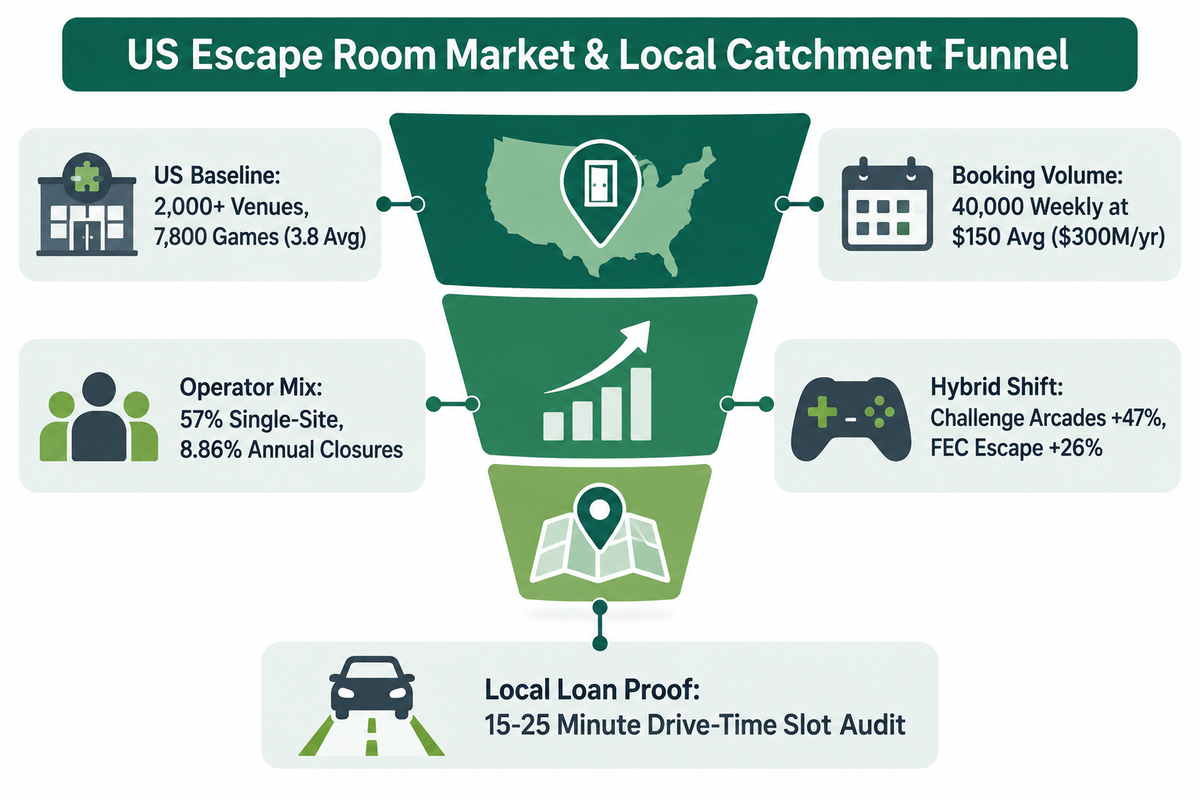
The December 2025 US escape room industry census counted just over 2,000 permanent escape room facilities across the United States. Those locations operated approximately 7,800 escape rooms, averaging 3.8 individual games per facility, while directory tracking added fewer than 200 new facilities in 2025.
2,000+ venuespermanent US escape room facilities
3.8 gamesaverage themes per US facility
57% sharesingle-facility US operator companies
Are escape rooms still popular enough to justify a new venue in 2026?
Yes, the logs from 2025 US booking-platform tracking indicate that around 40,000 weekly US bookings occur at an average group spend of $150. That level of volume equates to roughly $300M in US ticket sales annually, predominantly driven by automated scenic immersion and corporate buyouts.
The US escape room industry outgrew its 2014 infancy more than a decade ago. Currently, approximately 1,450 companies operate across U.S. locations; single-facility companies own 57% of facilities, and the industry logs an 8.86% annual facility closure rate. Multi-unit companies have been acquiring single facility companies in the broader escape room market.
Take the census boundary into account when developing your new business forecast. The directory count covers permanent physical venues and excludes standalone online escape products and pure VR arcades. Non-traditional directory formats grew from 4% of US venues in 2024 to 6% in 2025. Challenge arcades increased by 47% and were located at 71 venues, and family entertainment centers with escape rooms increased by 26% and were located at 35 venues.
National venue counts never prove local demand when you are preparing a bank loan. To determine local availability, loan officers require a 15-25 minute drive-time audit logging competitors and how many rooms each competitor operates. Local availability is measured by logging open evening booking slots on Thursdays and Saturdays. AI review tagging tools also identify local user reviews that contain complaints about broken locks or cramped lobbies.
Choosing Your Revenue Blueprint: Independent Boutique vs. Franchise vs. Hybrid Entertainment Hub
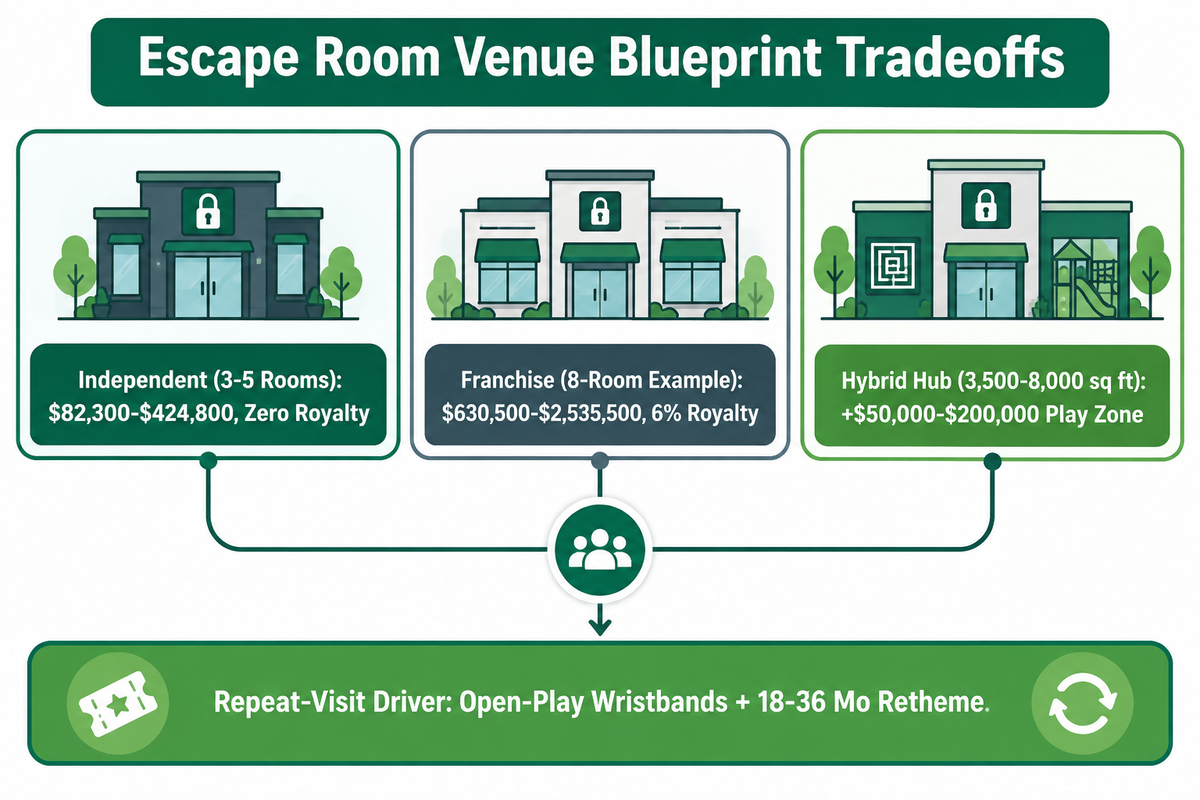
Independent operators don’t pay franchise royalties or national ad fees and can customize game themes. Licensed franchises supply tested blueprints under a 14-day federal disclosure rule in exchange for upfront fees and ongoing gross-revenue royalties. Hybrid entertainment hubs add a $50,000-$200,000 commercial indoor play zone, documented in commercial soft-contained playground cost guides.
Local population density and capital reserves should determine whether this type of business is independent, franchised, or hybrid. Opening your own escape room as an independent escape room lets an escape room owner build a distinct local escape room brand. Buying an escape room franchise supplies pre-engineered manuals. However, published 2026 Escapology FDD investment disclosures cite $630,500–$2,535,500 for an 8-room build, including a $45,000 initial fee and 6% royalty.
As stated in 16 CFR Part 436, FTC rules, franchisors must deliver the Franchise Disclosure Document at least 14 calendar days before signing or payment. Founders often assume hybrid venues need oversized regional mall shells, but 3,500 to 8,000 sq ft of a dual-zone venue can easily fit into a suburban strip center. Bringing together puzzle rooms with autonomous redemption gaming improves your value proposition for parents and corporate planners; see our arcade business plan revenue and cash-control model.
AI camera-tracked challenge cells and active play zones lift same-visit family dwell time. Once local enthusiasts finish standalone escape themes, they rarely return until a new room opens. Side attractions monetize siblings and monthly weekend visits; however, escape rooms still require scheduled theme refreshes.
| Decision Dimension | Independent Boutique (3–5 Rooms) | Licensed Escape Room Franchise | Mobile Trailer / Pop-Up Unit | Mid-Size Hybrid Escape + Play/Arcade Hub |
|---|---|---|---|---|
| Typical Gross Floor Area | 2,000–5,000 sq ft leased commercial shell | Multi-room footprint set by brand manual | Towable event trailer footprint | 3,500–8,000 sq ft dual-zone commercial shell |
| Verified CapEx Anchor | $82,300 low to $424,800 high benchmark | $630,500–$2,535,500 (Escapology 8-room FDD example) | Varies by trailer chassis and generator spec | Escape buildout + $50,000–$200,000 play/activity zone |
| Ongoing Royalty & Ad Fees | No franchise royalty or brand ad fund | Gross-revenue royalty (e.g., 6% in Escapology FDD) | No royalty unless licensed territory | No royalty on custom escape & play zones |
| Primary Regulatory Gate | Municipal occupancy & fire-code review | FTC 16 CFR Part 436 14-day FDD rule + local permits | DOT trailer registration & municipal event permits | Dual-zone building, fire & play-safety review |
| Theme Exclusivity Control | Custom in-house IP or written vendor radius lock | Protected territory; mandatory brand catalog | Short-cycle festival and corporate throughput games | Custom escape rooms + branded active play |
| Walk-In Family Monetization | Low (relies on pre-booked 60-min slots) | Low to moderate (pre-booked slots dominate) | High at fairs, campuses, and corporate lots | High (open-play wristbands & arcade cards) |
| Repeat-Visit Frequency | Single play per theme until 18–36 mo retheme | Single play per theme; national corporate leads | Event-driven seasonal B2B bookings | Repeat family play visits plus scheduled room rotation |
| Best Catchment Fit | Downtown dining districts & college towns | Suburban lifestyle centers with higher rent budgets | Corporate parks, schools, and seasonal markets | Family suburbs within a 15–25 minute drive ring |
Site Selection, Square Footage, and Fire-Marshal Traps Before You Sign a Commercial Lease
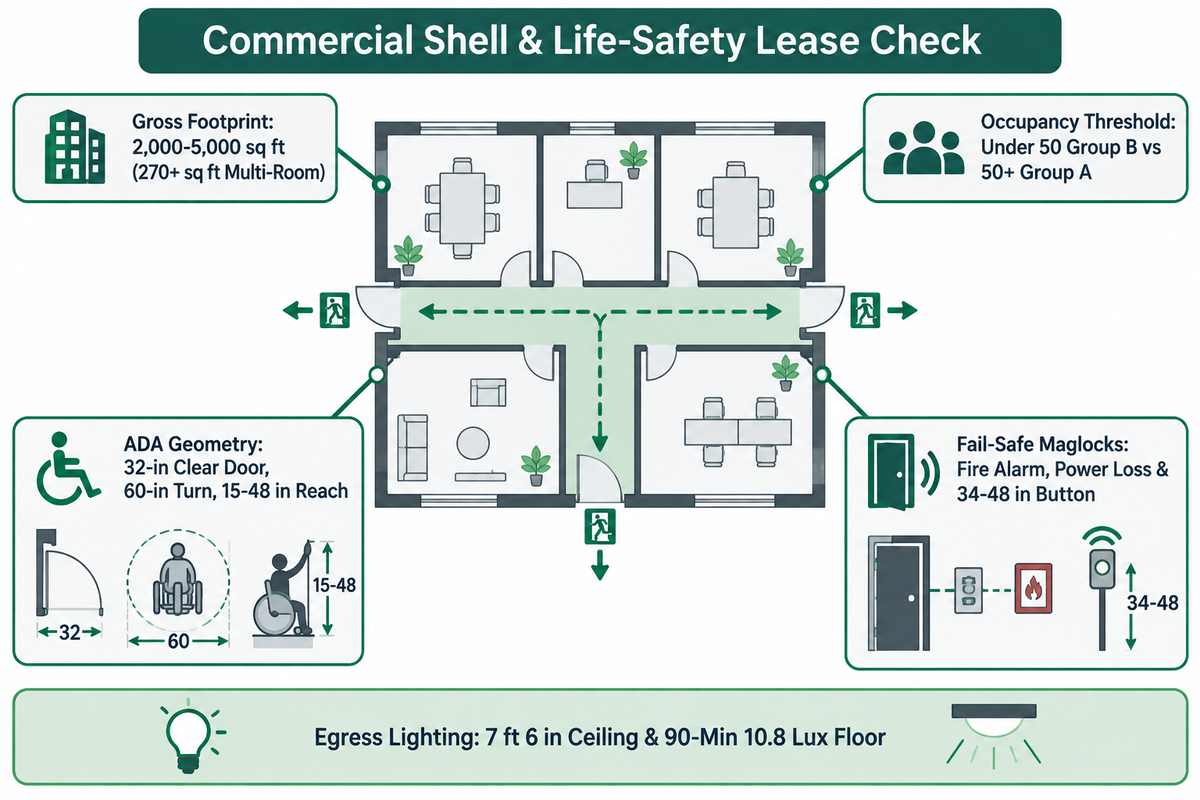
Single-unit escape room venues consisting of 3-5 rooms require 2,000-5,000 sq. ft. of commercial tenant space. Site plans must provide code-compliant egress corridors, 32-inch clear door openings, and at least 7 ft 6 in of clear egress ceiling height. Confusing exit paths, even for small groups, require special-amusement review under NFPA 101 Life Safety Code.
“No minimum occupant load threshold needs to be met for a space to be classified as a special amusement building.”
How much space do you actually need for a 3-to-5 room escape room business?
Plan for 2,000 to 5,000 sq. ft. of gross commercial space for 3 to 5 puzzle rooms. Keep multi-room games at or above 270 sq. ft. (25 sq. m) alongside a lobby, control, workshop, accessible restroom, and code-compliant corridors. Ensure that your building official has no issues with the height and occupancy of the rooms prior to executing a lease.
The most stringent regulation hurdle when you set up an escape room in existing retail space is occupancy classification. IBC Section 411 code analysis states that special amusement areas under 50 occupants are subject to Group B business occupancy rules as well as Sections 411.1 to 411.6. An occupant load of 50 or more triggers Group A assembly requirements.
In the 2024 IBC Section 411.1, Exception 2 text states that a puzzle room with an unlocked egress that’s readily identifiable and always available is exempt from Section 411 requirements. Other jurisdictions that have older code editions or local amendments in force apply more stringent special amusement controls.
Door-lock and accessibility specs belong directly in your construction budget. Required egress doors must allow free exit from the occupied side without keys or combinations, keeping mechanical padlocks strictly on interior puzzle props. Exit doors need 32 inches of clear width (36 inches nominal) under 2010 ADA Standards, while alterations weigh technical feasibility and the 20% path-of-travel cap. Provide a 60-inch wheelchair turning circle and mount interactive clues 15–48 inches high. Where local authorities approve electromagnetic locks under IBC Section 1010.1.9.8 and NFPA 101, wire fail-safe release to fire alarm, power loss, 34-to-48-inch exit buttons, and 90-minute 10.8 lux floor lighting.
Cross-check multi-zone clearances against commercial play and attraction safety standards. Match landlord indemnity clauses with our commercial entertainment venue liability insurance guide.
Do
- Insert a 60-to-120-day permitting contingency in your lease letter of intent.
- Provide free egress or use AHJ-approved fail-safe maglocks wired to fire alarm and power loss.
- Negotiate construction rent abatement to protect cash reserves during 3–6 month permitting.
- Specify full-height acoustic drywall between loud puzzle chambers and neighboring suites.
Don’t
- Never sign an as-is retail lease without prior sprinkler and 50-occupant verification.
- Never install mechanical padlocks or fail-secure hardware on required egress doors.
- Never allocate the entire leased shell to game rooms with zero reset workshop or egress corridor space.
- Avoid mounting essential puzzle clues above 48 inches forward reach where seated players cannot reach.
Startup Cost Breakdown: Leasehold Build-Out, Gen-2 Automation, and Cash Reserves
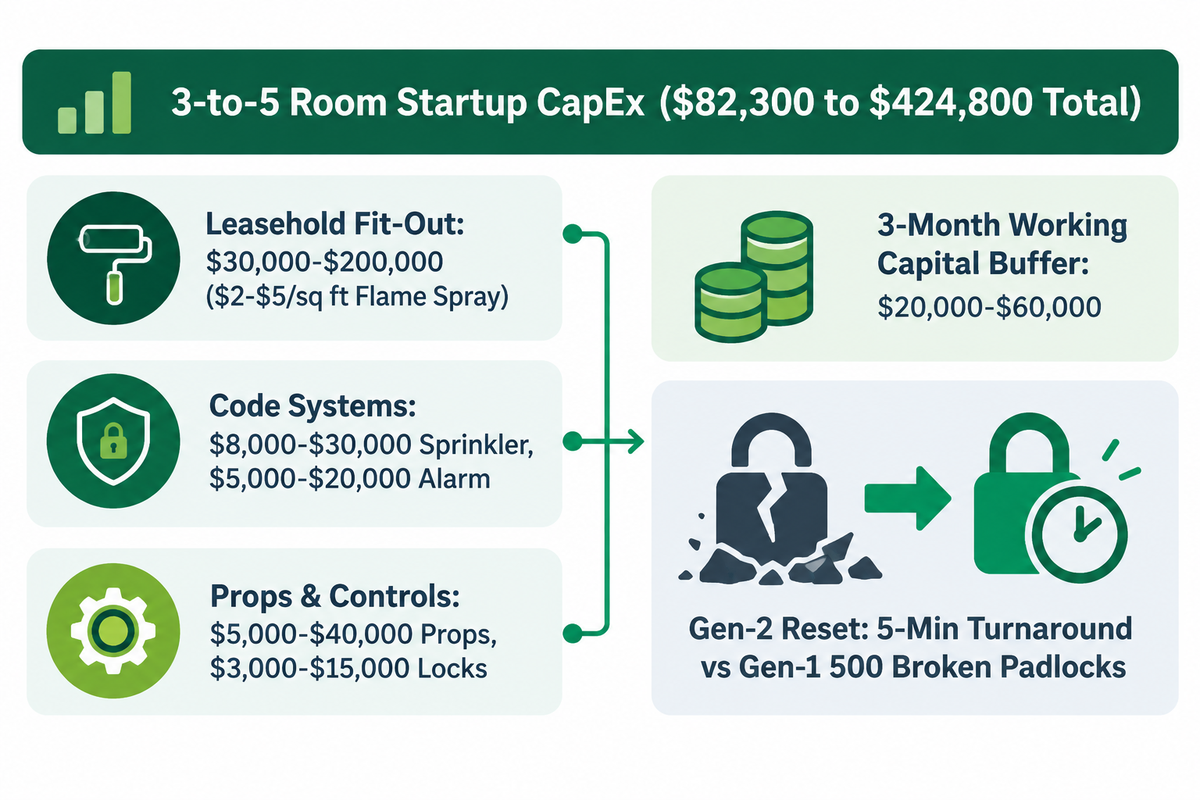
The 2026 commercial escape room cost schedules show standalone 3-5 room budgets across 2,000-5,000 sq ft run $82,300 on the low end and $424,800 on the high end for a high-spec build out. Expect to pay $2-$5 per sq ft for professional fire retardant spray treatment on foams and fabrics.
Founders launching a new escape room routinely underestimate mechanical, electrical, and plumbing trades. Designing and building floor-to-ceiling partition walls turns one open retail bay into enclosed rooms requiring smoke detection and HVAC balancing. When Section 411 applies, automatic fire sprinklers ($8,000–$30,000), fire alarms ($5,000–$20,000), and fail-safe electromagnetic locks ($3,000–$15,000) become mandatory code expenses.
Second-generation office suites with existing corridors and ADA restrooms provide a path for cost effective startups to preserve personal savings. Game-master stations also integrate AI monitoring software that offers audio hints and tracks room sensors.
| Budget Category | Low Benchmark | High Benchmark | Underwriting Scope & Code Notes |
|---|---|---|---|
| 1. Leasehold Improvements (Walls, Doors, Lobby) | $30,000 | $200,000 | 32-in clear doors, egress corridors, themed walls, $2–$5/sq ft flame spray |
| 2. Fire Sprinkler System Installation | $8,000 | $30,000 | Mandatory full-space sprinkler coverage where IBC Section 411 applies |
| 3. Fire Alarm & Room Smoke Detection | $5,000 | $20,000 | NFPA 72 alarm panel relay restoring full lighting and 90-min 10.8 lux egress light |
| 4. Electromagnetic Locks & Alarm Integration | $3,000 | $15,000 | Fail-safe maglocks wired to FACP plus 34–48 in push-to-exit buttons |
| 5. Game Master Monitoring Station | $2,000 | $10,000 | Live multi-room cameras, intercoms, remote release, and AI timer cues |
| 6. Puzzle Electronics, Props & Set Pieces | $5,000 | $40,000 | Per-room low-voltage sensors, microcontrollers, and scenic prop assemblies |
| 7. Building, Electrical, Alarm & Sprinkler Permits | $2,000 | $12,000 | Allow 3–6 months for permitting, with a CUP potentially adding 60–120 days |
| 8. Architect / Engineer Stamped Drawings | $3,000 | $20,000 | Stamped egress, occupant-load, electrical, and ADA compliance plans |
| 9. State / Local Business & Amusement Licenses | $200 | $2,000 | Municipal business and local entertainment or assembly venue filings |
| 10. Commercial General Liability Insurance | $2,000 | $6,000 | Annual $1M/$2M CGL coverage ($2,000–$5,000/yr typical for small venues) |
| 11. Music Licensing — ASCAP + BMI (Annual) | $600 | $1,800 | Combined PRO licenses ($300–$800/yr per PRO); consumer Spotify is unlawful |
| 12. LLC Formation, Signage & Entity Setup | $500 | $3,000 | State entity filing plus municipal exterior and illuminated sign permits |
| 13. Booking Software, POS & Waiver System | $1,000 | $5,000 | Online private-slot checkout, digital waivers, and lobby check-in tablets |
| 14. Working Capital (3 Months Operating) | $20,000 | $60,000 | Three-month cash buffer covering dead rent, payroll, and re-inspection lag |
| Total Verified Startup Envelope | $82,300 | $424,800 | Sum of all 14 commercial buildout, permitting, and 3-month reserve items |
Hardware durability directly shapes five-year maintenance cash flow. An independent Melbourne operator logged 500 broken padlocks across 20 months and 10,000 players (2,000 games) in first-generation rooms. Meanwhile, 2026 automated-reset room benchmarks show self-resetting puzzle hardware cuts room turnover from 15 minutes to 5 minutes.
Gen-1 Mechanical Padlock Rooms
- Lower initial prop spend using combination locks and paper clues.
- High hardware wear, logging 500 broken padlocks across 10,000 players.
- 15-minute manual resets that cap Saturday peak slot turns.
- Lower ticket pricing power among corporate and enthusiast groups.
Gen-2 Sensor-Automated Rooms
- Higher upfront wiring cost for RFID sensors, microcontrollers, and maglocks.
- Automated reset systems cut room turnaround to 5 minutes between bookings.
- AI audio and lighting triggers help game masters monitor rooms reliably.
- Supports $150 private group bookings and higher weekend throughput.
Unit Economics and The Room-Turn Yield Ceiling: Pricing, Occupancy, and Corporate Weekdays
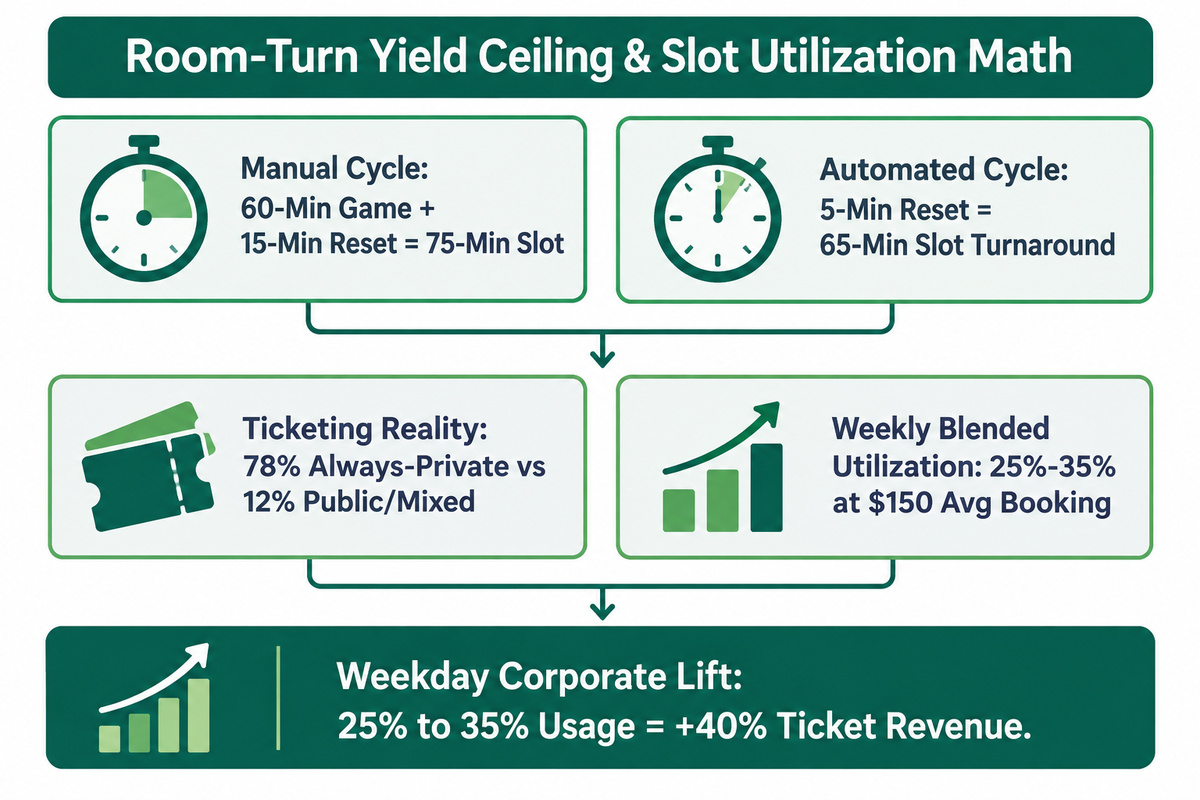
The December 2025 US escape room census reported an average booking spend of $150 across approximately 40,000 weekly sessions. In the US, 78% of escape rooms offer always-private bookings and 12% offer public or mixed tickets. A realistic business plan model suggests blended weekly slot utilization of 25%-35% as opposed to full-seat capacity.
The Room-Turn Yield Ceiling is the maximum potential revenue a venue can achieve given the constraints of game duration, the time required to reset a game, and the size of the private group that limits the number of sessions a venue can run in a day. A 60-minute escape game paired with 15 minutes for waivers, briefing, photos, and manual reset runs on a 75-minute cycle.
Why do single-room sellout projections fail in real escape room operations?
Single-room sellout projections fail because 78% of US escape rooms use always-private ticketing. Seats disappear once five players reserve an eight person room, leaving no seats for that hour. Meanwhile, weekday afternoon slots stay quiet outside corporate buyouts even when Saturday prime hours book solid.
Bank underwriters estimate total weekly available slots from Monday through Sunday, while 50%-65% occupancy figures reflect prime hours only on the weekends. How many players join each private escape room game sets your ticket yield, so tiered per-person pricing rewards larger groups without discounting peak Saturdays.
Worked Example (Slot Yield Formula Using Verified US Benchmarks): Divide your weekly operating schedule into 75-minute cycles (60-minute game plus 15-minute manual reset; or 65-minute cycles with 5-minute automated reset). Multiply your total weekly room slots across all rooms by the 25%–35% blended weekly utilization benchmark, then multiply booked sessions by the $150 US average private booking spend. Increasing usage from 25% to 35% results in a 40% increase in ticket revenue without additional space or base rent.
Lenders require slot forecasts that don’t rely on Tuesday walk-ins. Busy downtown operators sometimes build two identical rooms of a flagship escape room experience to double Saturday capacity. Many venues also use AI dynamic pricing tools to price off-peak, Wednesday corporate blocks.
Three-Year Financial Projections, Break-Even Math, and SBA 7(a) Loan Underwriting
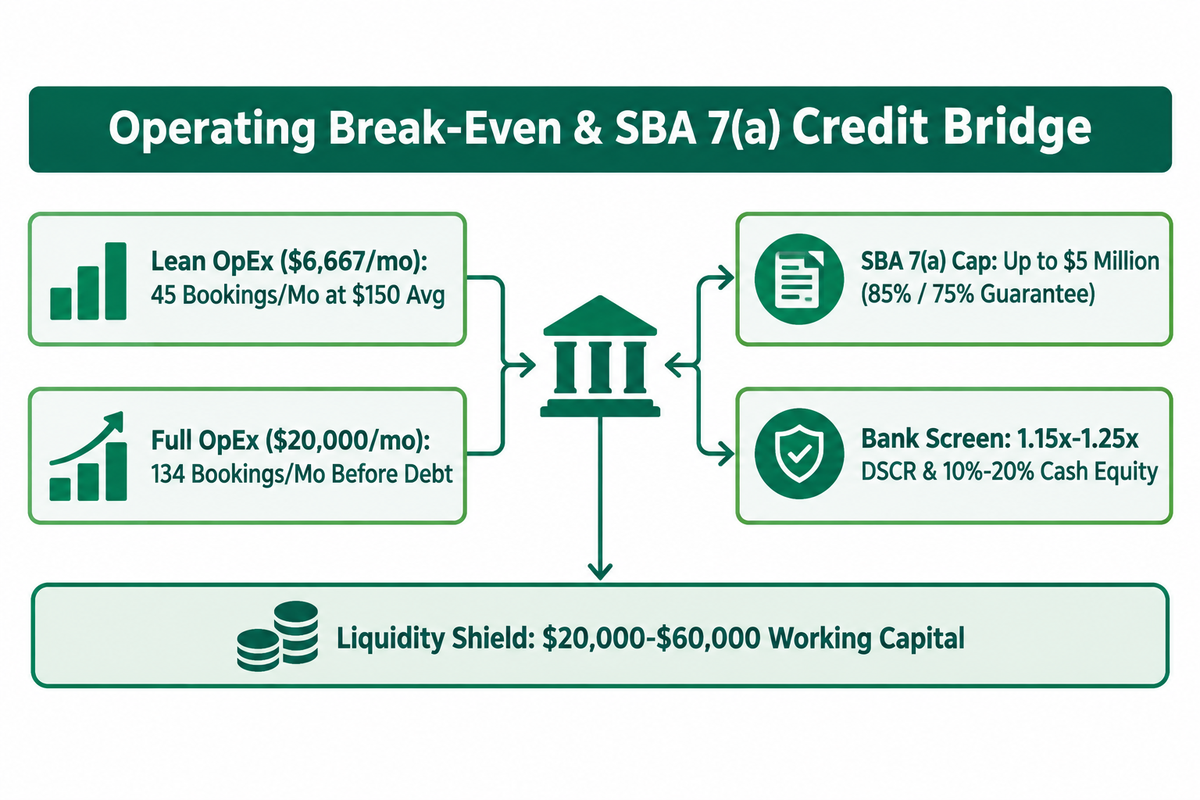
Published U.S. SBA 7(a) loan terms allow for up to $5 million, repaid via monthly principal and interest installments from operating cash flow. For startup pro formas, commercial banks assess a debt service coverage ratio of 1.15x to 1.25x with 10%–20% founder cash equity.
Keep the rules for SBA federal programs and bank credit screens for commercial loans distinct in your loan narrative. Federal SBA rules cap loans at $5 million (85% guarantee up to $150,000; 75% above $150,000) and fund leasehold improvements, equipment, and working capital. Banks discount the liquidation value of custom drywall leasehold improvements. Borrowers without real estate often pledge other collateral, including movable commercial attraction assets.
Every entrepreneur running a business with fixed retail rent must account for variable session fees separately from the monthly overhead. Small commercial escape room liability insurance typically runs $2,000–$5,000 per year ($2,000–$6,000 across the full commercial benchmark range). Game-master payroll must match real operating hours, so audit AI spreadsheet assumptions line by line. Credit officers also run AI cash-flow stress tests on winter weekday liquidity.
Worked Example (Operating Break-Even & Bank DSCR Formula): Using the published $20,000–$60,000 three-month working-capital benchmark, a 3-to-5 room venue carries roughly $6,667 to $20,000 in monthly operating expenses before loan payments. At the $150 US average private booking spend, covering $6,667 in lean monthly operating costs requires 45 paid bookings per month, while a $20,000 monthly operating structure requires 134 paid bookings before debt service. To pass a bank’s 1.25x debt service coverage screen, net monthly operating income after rent, payroll, insurance, and utilities must equal at least 1.25 times your quoted monthly SBA 7(a) loan payment.
Maintain working capital before you start construction. Budget $20,000-$60,000 for three months of operating working capital so municipal permitting or fire-inspection delays never exhaust loan reserves before opening day.
Multi-Attraction Floor Splits and Vendor Strategy: DIY vs. Turnkey vs. Integrated Zone Builders
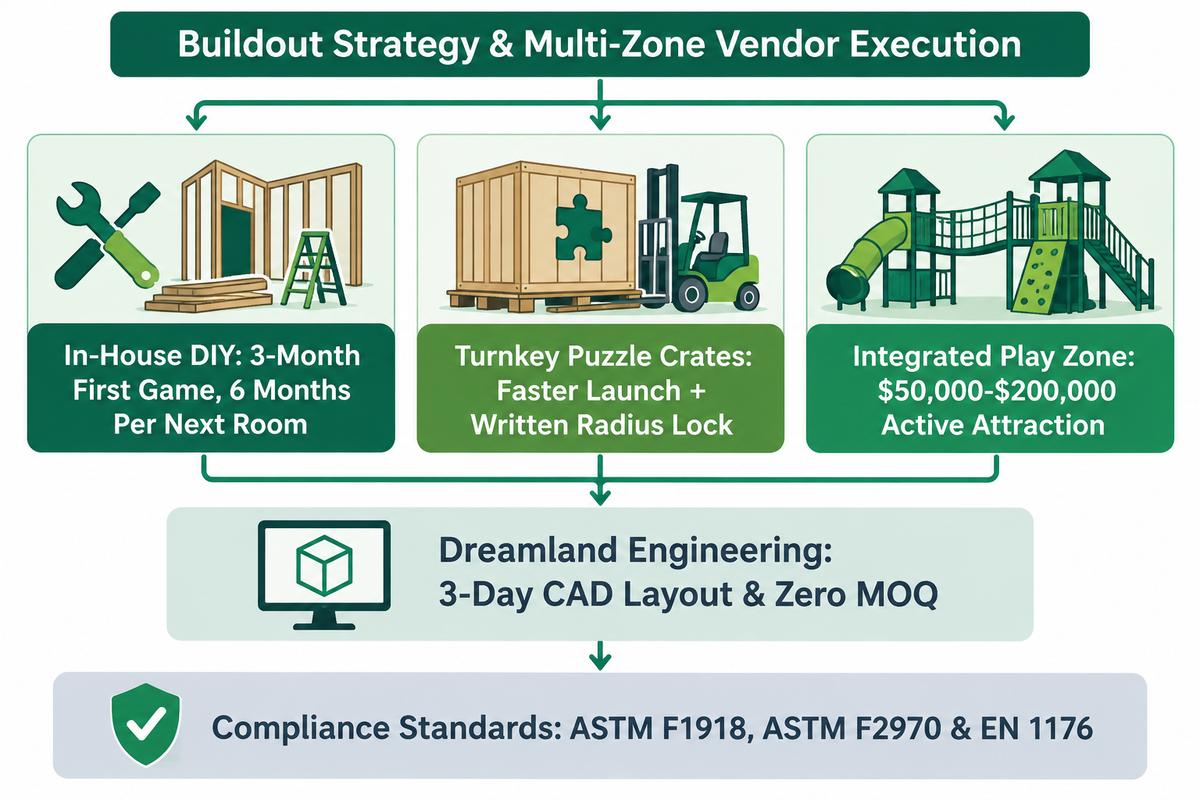
Build escape rooms in-house only when internal fabrication skills cover a 3-month build on game one and 6 months per subsequent room without exhausting rent reserves. Partner with an integrated manufacturer when adding a $50,000–$200,000 commercial indoor play zone.
Choose DIY, turnkey or integrated construction, based on the available rent-free build out window and your internal skill set. An independent operator in Melbourne took 3 months to build a first game, and 6 months for each subsequent room. A turnkey approach compresses the timeline to opening a business, while a custom, in-house approach retains the business’ proprietary storyline intellectual property. AI layout pre-checks and modular fabrication avoid burning six months of full retail rent.
When buying pre-made puzzle crates, lock intellectual property territory rights in writing so nearby rivals can’t install the same game. Commercial soft-play zones add $50,000–$200,000 to a multi-attraction buildout budget under published commercial indoor play cost benchmarks. Study our family entertainment center space planning guide and play cafe business plan space and capacity math to align venue and games.
At Zhejiang Dreamland Co., Ltd, Dreamland Playground’s Wenzhou factory and 3-day floor-plan team handles metalworking, CNC routing, printing, sewing, and pre-assembly under one roof. Our commercial play areas operate in more than 50 countries. Share your ceiling height, target age bands, and opening date to get a custom CAD layout and quote in 3 working days with zero minimum order quantity. Depending on your selected attraction zones, Dreamland Playground engineers soft-contained play structures to ASTM F1918, trampoline courts to ASTM F2970, and European installations to EN 1176.
Operations, Game-Master Staffing, and Budgeting the 18-to-36-Month Theme Refresh
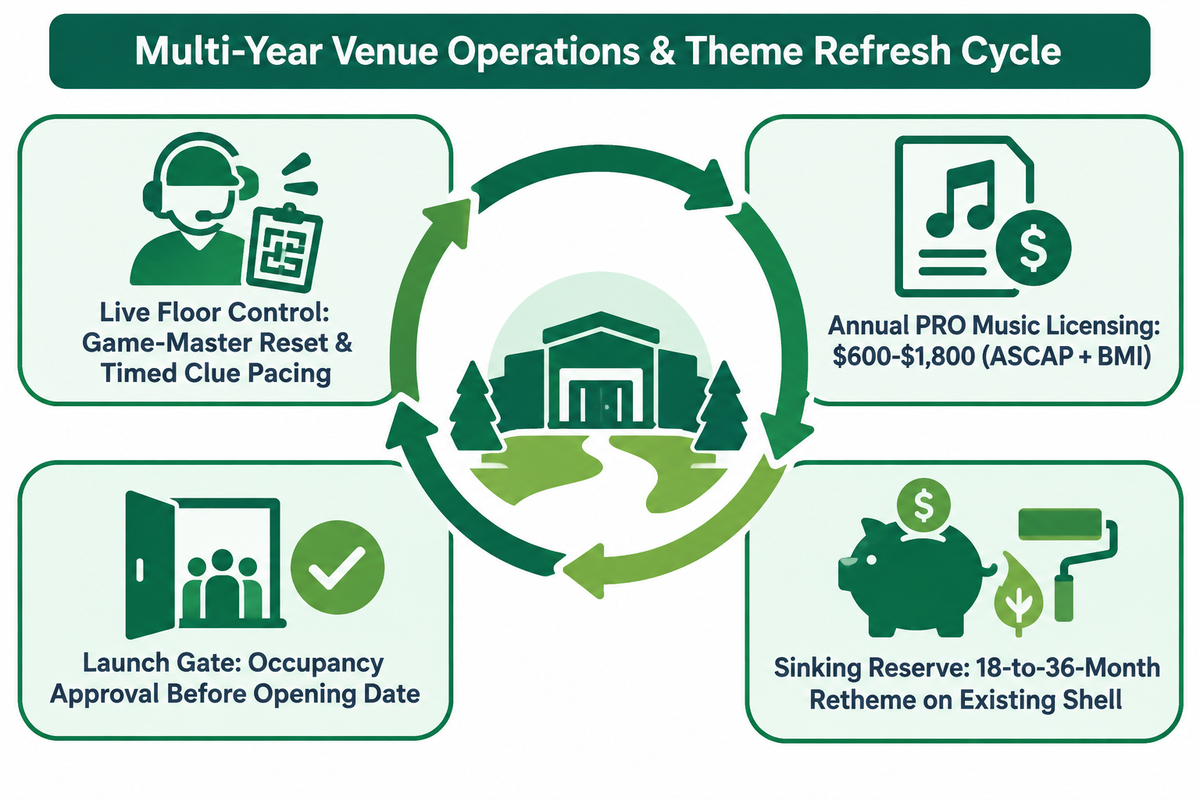
Multi-year escape room business plans assign trained game masters to monitor every occupied room and budget $300–$800 yearly per PRO ($600–$1,800 combined ASCAP and BMI) for music licensing. Sound operators also fund a monthly cash-flow sinking reserve for 18-to-36-month room theme rotation.
Suburban venues suffer year-two revenue drops if owners withdraw all year-one profits without funding room rotation. The approved infrastructure from the first permit remains in place and is reused for scenic and sensor retheming. Retheming interior props must keep unobstructed exit paths and emergency lighting intact under NFPA 101 special-amusement safety rules. An exact budget for an experience depends on the automation of the props.
Day to day floor execution protects customer satisfaction. Written reset checklists govern floor execution. Structured staff training keeps live clue pacing consistent. Train staff to pace progressive clues with the aid of a timer and log player feedback. Poor clue management can contribute to frustrated player groups and negative reviews.
Build your escape room marketing plan around confirmed permitting milestones. Don’t play the public’s expectation game with promised opening dates before occupancy sign-off. Claim your Google Maps profile early to support local search visibility for corporate team building. Once occupancy approval clears, match staffing and run unpaid beta playtests.
Frequently Asked Questions
How many people fail escape rooms, and what escape rate should operators target?
Industry estimates suggest that about 30% of player groups complete escape rooms. At a completion rate near 30% in 60-minute sessions, most groups will not finish before time expires. Successful multi-room venues calibrate puzzle difficulty around that 30% benchmark so experienced enthusiasts feel genuinely challenged. To ensure the challenges remain enjoyable to players, game staff monitor group progress and provide clues as needed. This results in a positive player experience and stronger player reviews.
How much does it cost to open a 3-to-5 room escape room venue?
Opening a standalone 3-to-5 room escape room inside a 2,000–5,000 sq ft commercial shell requires $82,300 on the bare-bones low end to $424,800 for a full contractor buildout. Leasehold improvements alone span $30,000 to $200,000 depending on raw-space framing and acoustic partitions. Where special-amusement fire rules apply, founders must also budget $8,000–$30,000 for sprinklers, $5,000–$20,000 for fire alarms, $3,000–$15,000 for fail-safe locks, and $20,000–$60,000 in three-month working capital.
Can you get an SBA 7(a) loan with an escape room business plan?
Yes, eligible for-profit founders can apply for U.S. SBA 7(a) loans of up to $5 million, with monthly principal and interest payments. Participating banks often request that founders provide 10-20% of the funding as cash equity, and require a debt service coverage ratio of 1.15-1.25. Since banks heavily discount custom drywall partitions in liquidation value, borrowers without real estate often pledge outside collateral or movable commercial attraction equipment.
Do fire codes allow locked doors inside an escape room?
No, mechanical padlocks or key-operated locks may never block required exit doors. Egress doors must allow free exit from inside, and any code-approved electromagnetic lock must release automatically upon power loss, fire alarm, or exit-button press.
How often should an escape room business plan budget for changing room themes, and what does a retheme cost?
Suburban venues serving local residents typically rotate puzzle themes every 18 to 36 months, whereas tourist districts run flagship games longer. Tourist areas have longer runs because out-of-town visitors bring steady demand, while neighborhood operators fund monthly reserves for prop updates. Existing walls, sprinklers, and wiring reduce the cost to refresh the venue.
Is buying an existing escape room safer than building one from scratch?
Buying an operating escape room is only a good investment when verified tax returns, transferable leases, and current fire approvals justify the price. Acquiring a room skips the 3-6 month buildout, but US directories listed a closure rate of 8.86% and unpermitted rooms risk retrofit orders.
Planning a Hybrid Escape Room or Multi-Zone Entertainment Venue?
Send your CAD shell dimensions, ceiling height, target age mix, and target opening date to Zhejiang Dreamland Co., Ltd (Dreamland Playground). Our Wenzhou engineering team delivers a custom multi-attraction floor layout and itemized factory quote within 3 working days with zero minimum order quantity.
Request Your 3-Day Floor Plan & Quote
Contact Our Engineering Team
References & Sources
- 7(a) Loans Program Terms & Maximum Loan Amounts U.S. Small Business Administration (SBA)
- How to Start an Escape Room: Commercial Permitting, Egress & Startup Cost Guide StartPermit
- US Escape Room Industry Report (December 2025) Room Escape Artist
- Commercial Soft-Contained Indoor Playgrounds Budget & Planning Guide Playground Professionals
- NFPA 101 Life Safety Code Analysis: Escape Rooms & Special Amusement Buildings National Fire Protection Association (NFPA)
- Code Update: International Building Code Section 411 Escape Room Egress Requirements iDigHardware
- 2010 ADA Standards for Accessible Design U.S. Department of Justice Civil Rights Division
- How to Start an Escape Room Business (Escapology FDD Investment Summary) BMI Leisure
- Escape Room Industry & Automated Reset Trends (2026) ER Workshop