Get in touch with Dreamland Playground Company

Updated November 2026 · Technical Operations & Recurring Revenue Guide
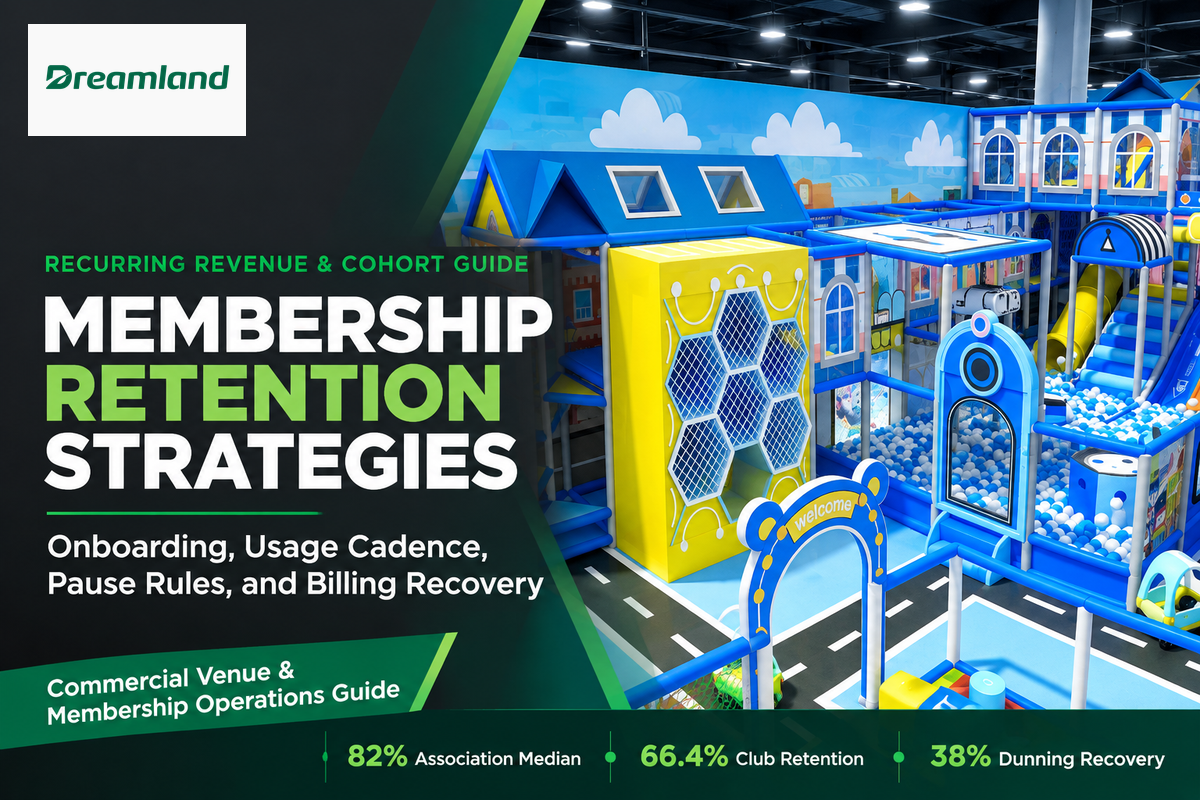
Membership retention strategies refer to operational systems across onboarding, member engagement, billing recovery, and renewal timing that keep subscribers active past term one. Annual retention averaged 66.4% across global clubs in the Health & Fitness Association 2025 benchmarking report. U.S. associations were recorded to have an 82% median renewal rate by Marketing General Inc.’s 2026 survey (via Membership.quest).
Treating retention as a last-month email blast results in lost recurring dues. Sequence Consulting data published by the American Society of Association Executives (ASAE) puts a new member’s first-year renewal odds at 50%. Year-two renewal jumps to 80%. Separating early habit gaps, mid-term silence, and failed card charges lets teams fix cancellations at the root.
Quick Specs: Core Retention Benchmarks & Operational Thresholds
| Operational Dimension | Verified Benchmark / Rule | Source & Scope |
|---|---|---|
| Period Cohort Retention Formula | ((End Count – New Members) / Start Count) × 100 | Member365 standard cohort accounting formula |
| Association Median Renewal Rate | 82% overall (90% trade vs. 82% individual bodies) | MGI 2026 & 2024 reports via Membership.quest |
| Fitness & Club Annual Retention | 66.4% mean retention; 23.6% median EBITDA margin | HFA 2025 Benchmarking Report (175 operators, 27 countries) |
| Critical Activation Window | First 90 days; 40%–65% club dropout in first 6 months | ASAE & Gjestvang et al. (2023, NIH PMC10244985) |
| Subscription Pause Recovery | 3 out of 4 return; zero billed MRR while paused | Recurly 2026 Churn Report & Subscription Pause Docs |
| Failed Payment Recovery Rate | 38% average recovery; up to 8 retries over 2 weeks | Stripe Billing Revenue Recovery Documentation |
| Auto-Renewal Statutory Baseline | 16 CFR Part 425 (pre-2024 rule); CA CARL up to $2,500/violation | Federal Register 91 FR 6507 (Feb 2026) & Orrick (July 2025) |
Why Member Retention Matters: Cohort Math, Churn Rate, and Retention Formulas
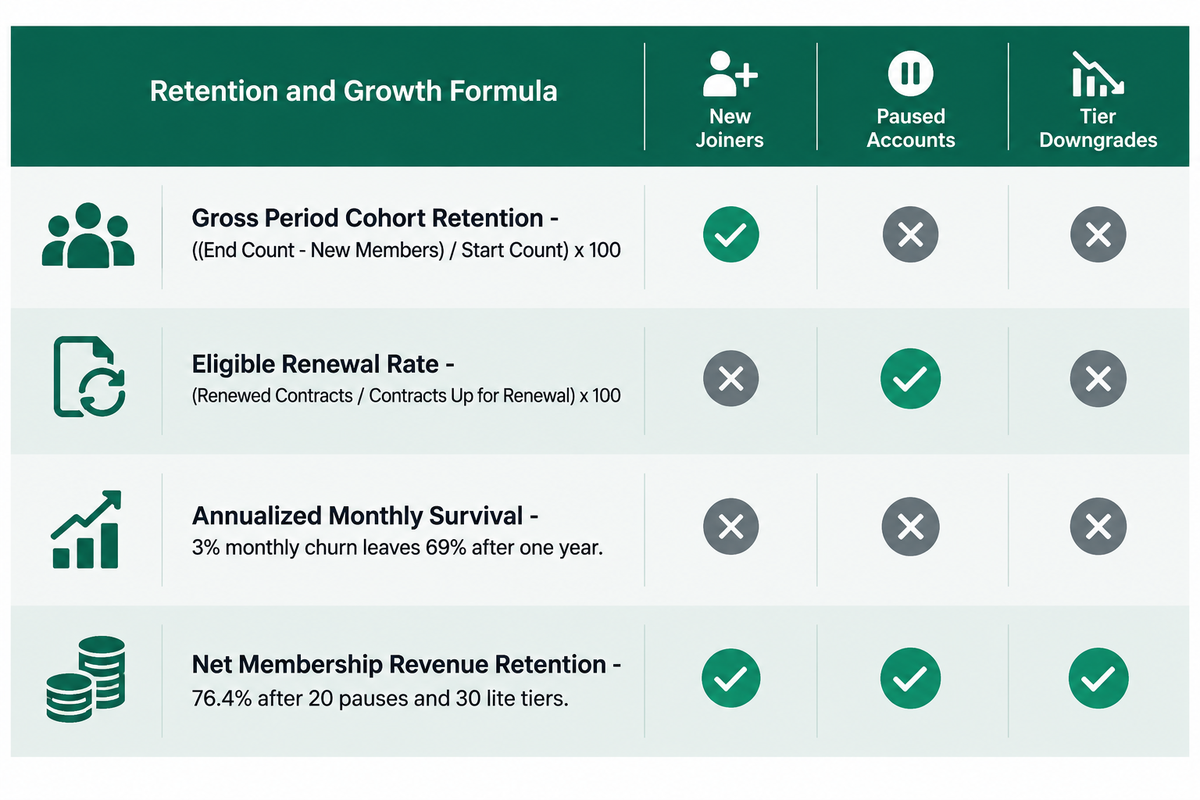
Tracking gross cohort member retention shows starting subscribers who are still active at the end of a period, and is calculated by ((End Count – New Members) / Start Count) x 100, per Member365. Lumping new members in headcount camouflages early member churn. Track member survival separately on recurring monthly plans, since a 3% monthly churn rate results in 69% member survival after twelve months.
82%U.S. association median renewal rate (MGI 2026)
66.4%global club annual retention mean (HFA 2025)
69%12-month survival at 3% monthly churn
Member retention is important because recurring dues cover fixed facility, staff, and program overhead without repeating ad spend. Marketing General Inc.’s 2024 segmented report (cited by Membership.quest) recorded a 90% median renewal rate across 177 trade associations. Individual membership bodies recorded an 82% median renewal rate across 195 groups. First-year renewal diverged wider still at 85% for employer-paid trade associations versus 64% for individual joiners.
Monthly consumer clubs face harsh compounding math. Membership.quest notes that a 3% monthly loss equates to a retention rate of 0.97 to the twelfth power, or 69% retained after one year. Median tenure at that pace is 23 months, whereas a 5% monthly churn rate leaves 54%. At a 5% monthly loss, the retention rate is 54% after a year. Operators should review recurring revenue economics and SBA break-even visit thresholds against rental and payroll expenses to understand why existing member costs stay far lower than the costs of replacing half your member base every year.
| Metric Name | Exact Calculation Formula | What It Captures | Blind Spot If Used Alone |
|---|---|---|---|
| Gross Period Cohort Retention | ((End Count – New Members) / Start Count) × 100 | Share of starting members still active at period end | Treats full-rate and downgraded tiers identically |
| Eligible Renewal Rate | (Renewed Contracts / Contracts Up for Renewal) × 100 | Decision conversion at annual or term anniversary | Excludes mid-term cancellations and monthly plans |
| Annualized Monthly Survival | (1 – Monthly Churn Rate)^12 × 100 | True 12-month survival on recurring monthly billing | Assumes uniform churn across early and mature months |
| Net Membership Revenue Retention | ((Starting Dues – Churned/Paused/Downgraded Dues + Upgrades) / Starting Dues) × 100 | Collected recurring cash flow after pauses and tier shifts | Price hikes can mask falling active household headcount |
Suppose a club starts January with 500 members paying $25 monthly ($12,500 starting dues); the example below contrasts Gross Cohort Retention Rate, Eligible Renewal Rate, and Net Membership Revenue Retention. Adding 100 joiners while ending December at 520 accounts yields 4% apparent membership growth, yet Gross Cohort Retention Rate is ((520 – 100) / 500) × 100 = 84% because 80 starting members quit. If 420 of 450 term-eligible accounts renewed, Eligible Renewal Rate is 93.3%; with 20 retained accounts on unbilled pauses and 30 on a $10 lite tier, collected dues drop to (370 × $25) + (30 × $10) = $9,550, or 76.4% Net Membership Revenue Retention.
Treat MGI’s association median and HFA’s club average as voluntary-survey reference points with varied definitions, and track your own cohort growth rate quarter over quarter against them.
Core Membership Retention Strategies Mapped to the Member Lifecycle
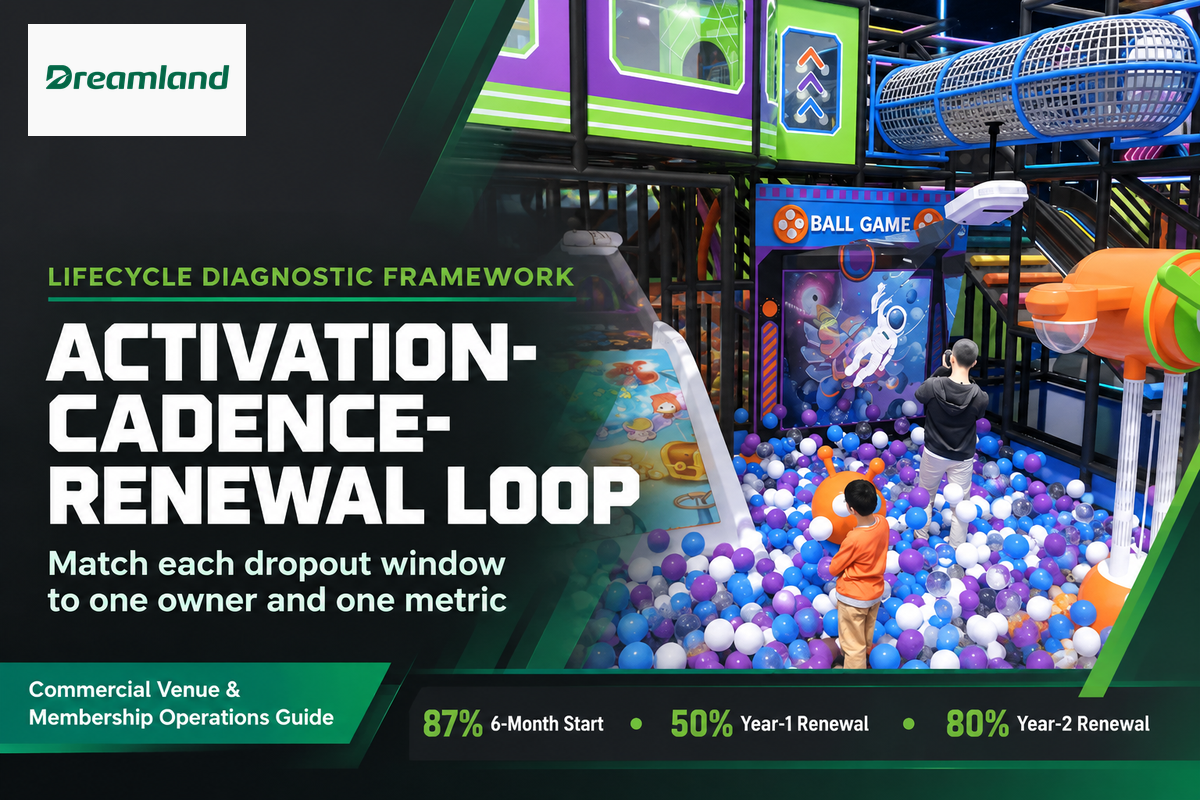
Deploy membership retention strategies by matching each lever to the exact window where dropouts peak: first-quarter activation, mid-year usage, or pre-renewal billing. Propello Cloud’s 2025/2026 report shows 78% of groups prioritize retention, yet only 27% overall (41% of large bodies) document a formal plan. Fix onboarding first whenever first-half attrition spikes.
Copying a random checklist wastes staff hours when renewal emails target people who mentally quit months ago. VantaInsights club benchmarks show nearly half of lost joiners exit within six months. Members who go through a defined start program retain at about 87% in the sixth month. ASAE’s Sequence Consulting research shows members who log three or more high-value interactions renew their membership at rates approaching 100%.
The Activation-Cadence-Renewal Loop: Matching Churn Windows to Fixes
We’ve structured proven membership retention strategies around the Activation-Cadence-Renewal Loop. Each dropout window has one operational owner and one leading metric. Begin with auditing your last 100 cancellations, broken down by tenure buckets. Then deploy the matching lever below to improve member retention step by step.
| Lifecycle Stage & Window | Observed Churn Symptom | Primary Retention Lever | Trigger / Target Metric | Operational Owner |
|---|---|---|---|---|
| 1. Day 1–14 Setup | Zero portal login or pass scan after payment | Pre-exit second-visit booking & wallet pass setup | ≥1 core benefit used within 14 days | Front Desk / Onboarding |
| 2. Day 15–45 Habit Bridge | Initial signup excitement fades after first visit | Goal check-in & peer group or buddy introduction | ≥2 visits/week or 2 logged actions/month | Member Success Lead |
| 3. Day 46–90 Anchor | Member uses only one entry perk and stalls | Day-60 two-question pulse survey & secondary perk tour | 3 distinct touchpoints completed by Day 90 | Community Manager |
| 4. Month 4–6 Slump | Attendance interval doubles vs. member baseline | Visit-Velocity Drop Trigger & six-month loyalty perk | Zero-activity gap kept under 90 days | CRM / Floor Operations |
| 5. Month 7–9 Mid-Term | Newsletter fatigue or child outgrowing toddler zone | Role/age-band tier transition & referral guest passes | ≥33.54% email open & active tier utilization | Marketing & Programming |
| 6. Seasonal / Travel Gap | Summer vacation or busy-season cancellation request | Capped pause option with scheduled auto-resume date | 3 out of 4 paused accounts return; zero pause MRR | Billing & Retention Ops |
| 7. Pre-Renewal Window | Surprise auto-renewal dispute or price-shock exit | Statutory advance notice + personalized usage summary | 15–45 day annual notice; 7–30 day price notice | Membership Operations |
| 8. Recurring Billing Cycle | Expired card or soft decline causes passive lapse | Account updater + up to 8 smart retries in 2 weeks | 38% failed-payment recovery; <1.25% involuntary churn | Finance / Billing System |
| 9. Post-Cancel Win-Back | Former member leaves cleanly due to temporary constraint | Frictionless online cancel + seasonal win-back invite | Nearly 1 in 4 new signups from prior subscribers | Lifecycle Marketing |
Focusing retention efforts on one broken stage stops staff burnout. Teams boost retention when habit formation and billing hygiene are sustained as daily infrastructure. Save discounts then stay a rare exception rather than the default way to retain members.
New Member Onboarding: Reducing First-90-Day Churn Through Early Habit Anchors
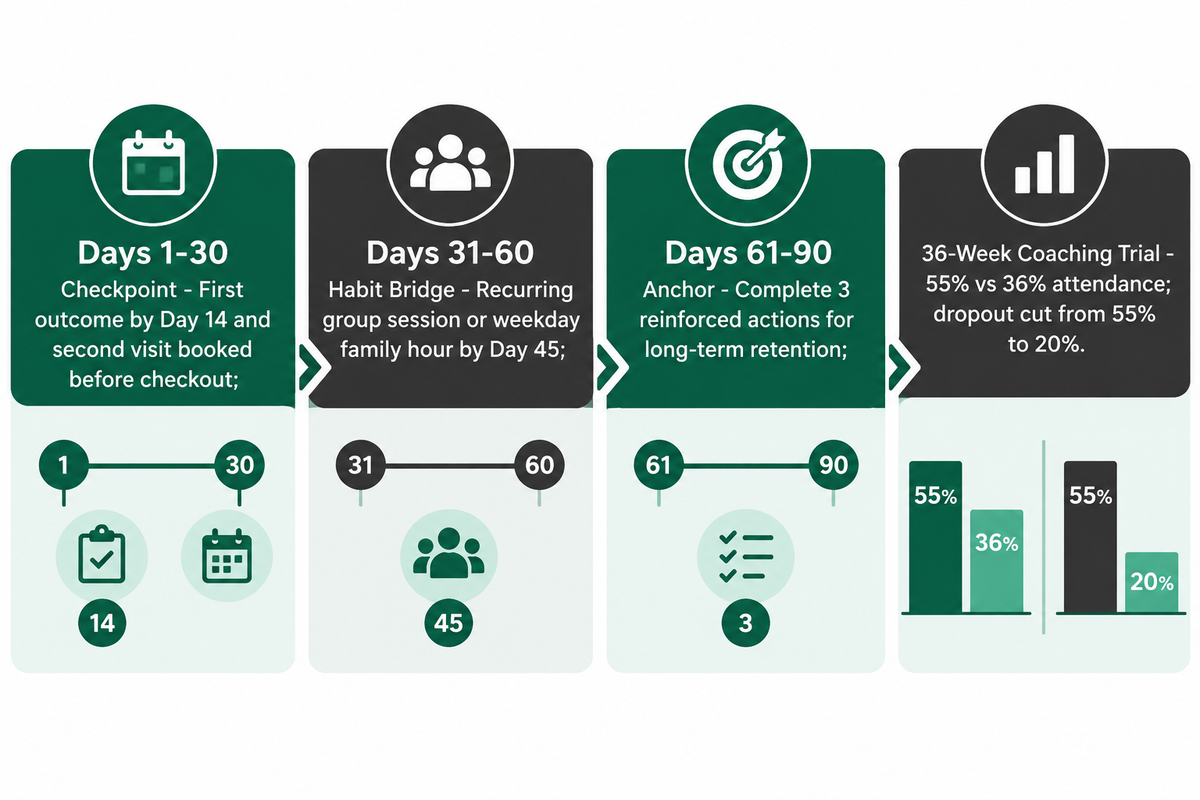
Effective new member onboarding anchors repeat visits in the first 90 days by booking session two before Day 1 ends, the first fix the lifecycle diagnostic above points to. Club research by Gjestvang et al. (2023, NIH PMC10244985) logs 40%–65% dropout inside six months. Replace passive welcome emails with booked routines whenever initial-quarter active use falls under 50%.
“The distribution of regular exercise attendance (≥2 sessions/week at the gym) at three, six, and 12 months were as follows: 51.8, 37.6, and 37.4%. About 17% reported regular exercise attendance at all time-points.”
Look closely at that cohort of 250 novice club joiners. Formal enrollment stayed at 86.6% at year end only because annual contracts blocked mid-year cancellation. Regular twice-weekly attendance fell to 37.4% by month twelve, and only about 17% attended regularly across all follow-up points. Once binding contracts end or monthly billing applies, inactive sleepers cancel right away. In the same paper’s cited 36-week trial (Annesi, 2003), structured goal-setting and relapse-prevention coaching lifted attendance to 55% versus 36% in controls, while dropout fell from 55% down to 20%.
⚠️ Common Mistake: Mistaking Welcome Emails for an Onboarding Process
Sending five automated welcome emails in week one without confirming a live login or second visit leaves joiners stranded when week-two motivation dips. Retention guidance from ASAE warns that you have 90 days to honor the membership promise before members lose interest.
How Do You Structure a 30-60-90 Day Member Onboarding Sequence?
Structure a 30-60-90 day onboarding process around three checkpoints: first-outcome completion by Day 14, routine repetition by Day 45, and secondary-perk adoption by Day 90. Pause upsell blasts during the first quarter. Trigger a personal staff call if there are no logins or visits within 14 days.
For days 1-30, provide mobile credentials immediately and arrange the second visit or peer introduction before checkout closes. For days 31-60, integrate the joiner to a recurring group session or weekday family hour. Building social enjoyment into their experience with your organization helps avoid relying on solo willpower. For days 61-90, look for the completion of three reinforced actions to enable long-term membership retention.
Year-Round Member Experience, Membership Tiers, and Referral Loops
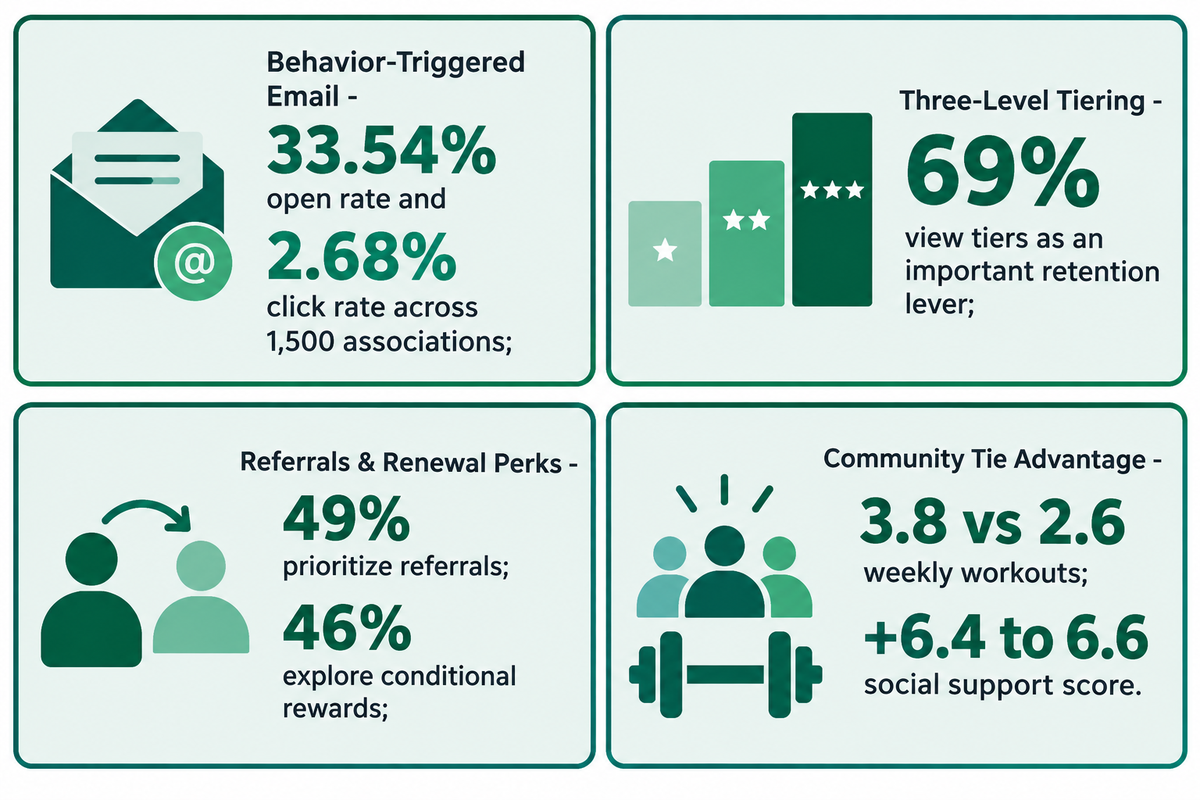
Year-round member experience after onboarding requires segmented email communications, clear membership tiers, and peer referrals instead of pre-renewal discounts. Higher Logic’s 2025-2026 study of 1,500 associations with 2 billion emails logged a 33.54% open rate and 2.68% click rate. Behavior-triggered lists outperform mass blasts when activity slows after month 3.
A nine-month silence with a 30-day reappearance before invoicing conditions subscribers to question their dues. Tie your newsletter and targeted communications to real member activity. Trade bodies deliver exclusive content, benchmarking toolkits, networking opportunities, and regional roundtables between annual conferences. These steady offers aid sponsorship sign-offs by association leaders.
Tiered pricing stops all-or-nothing exits when household budgets or company seats tighten. Propello Cloud’s 2025/2026 survey found 69% of organizations view tiers as an important retention lever. Another 49% prioritized member referral programs, and 46% explored conditional renewal rewards. Offering three clear levels of membership, such as off-peak weekday passes, standard access, and VIP household membership levels, lets price-sensitive accounts step down inside your member community.
Coupons are less effective than social ties to increase visit frequency. Gjestvang et al’s 2023 study of 232 club members showed boutique community clubs averaged 3.8 weekly workouts, while multipurpose clubs averaged 2.8 workouts and fitness-only clubs averaged 2.6 workouts. Boutique members also scored 6.4 to 6.6 points higher on family-and-friend social support. Guest passes and group memberships, or the combination of member benefits and sense of community, increase social ties and support among members.
How To Market a Membership Without Margin-Eroding Discounts?
Refrain from cutting member dues by employing creative bundling of zero-marginal-cost benefits such as early booking windows and loyalty program credits. Restrict discounts on annual member fees to the paid-in-full version of the fee. Current members who refer a friend for membership should receive a guest pass to bring that friend to the facility.
Permanent couponing attracts deal-chasers who quit at first renewal, according to 2025 membership marketing data and the latest membership marketing benchmark report. Boutique members also scored 6.4 to 6.6 points higher on family-and-friend social support. To engage and retain members over the long haul, focus on member-only events and tiered perks. But remember: not everyone wants to pay full price for the membership.
Spotting Disengagement Early With Member Surveys and Member Feedback
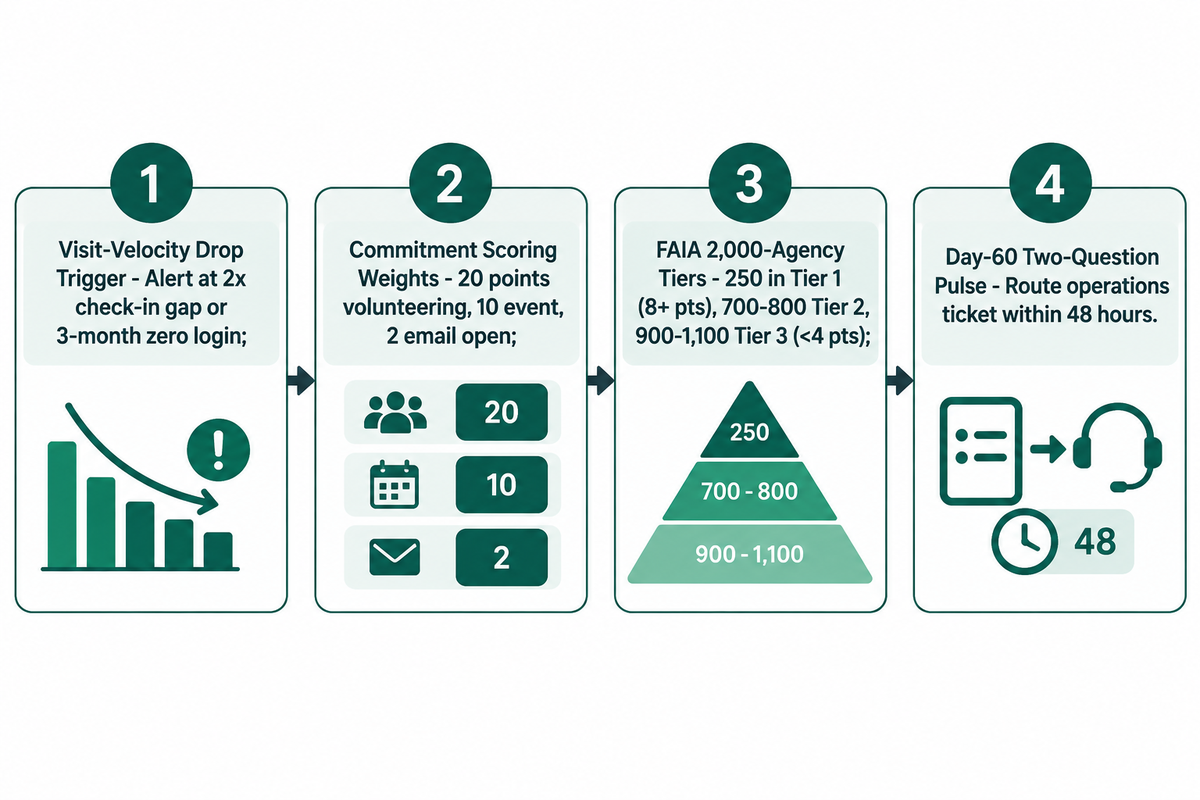
Catch silent disengagement two to three months before billing by combining rolling attendance alerts with two-question micro-surveys instead of annual forms. Associations Now’s March 2026 churn guide defines three to six months of zero usage as ghost-member risk. Monthly portals should trigger automated outreach once an account hits a three-month login gap.
Polite members who enjoy the services of the association tend to give high satisfaction survey scores before ending their membership. Therefore, satisfaction survey scores can miss quiet attrition.
Configuring the Visit-Velocity Drop Trigger Before Renewal Billing
Set up the Visit-Velocity Drop Trigger in your CRM, association management system, or venue POS before habits die. Trigger human outreach whenever a member’s check-in gap stretches to twice their prior 60-day baseline, or crosses a quarter-long zero-login threshold. Weight member engagement patterns by the depth of commitment: for example, Associations Now’s 2026 model shows scoring 20 points for volunteering, 10 for attending an event, and 2 for opening an email.
Real engagement scoring reveals how big the silent tier gets. In a separate association rubric reported by Associations Now on the Florida Association of Insurance Agents (FAIA), scoring roughly 2,000 agency members uncovered three distinct bands. On FAIA’s own point scale, which is separate from the 20/10/2 activity weights above, about 250 agencies landed in Tier 1 (8+ points), 700 to 800 in Tier 2 (4 to under 8 points), and 900 to 1,100 in Tier 3 below 4 points. Spotting that silent half early let staff focus phone outreach and re-engage high-risk accounts months before billing.
How Do You Know What To Ask in Your Member Surveys?
Make requests for focused information at Day 60 and during the exit interview at cancellation, avoiding long annual forms. Ask which expected goal remains unmet and which single obstacle blocked visits this month.
Short member surveys turn raw member feedback into fast routing rules matched to member needs. If a Day-60 survey flags Saturday check-in lines or portal login errors, route a ticket to operations within 48 hours to resolve members’ needs. If lapsed members cite seasonal travel or a tight budget at exit, automatically route to a pause or lite tier.
Membership Renewal Mechanics: Pause Options vs. Discounts vs. Annual Prepay
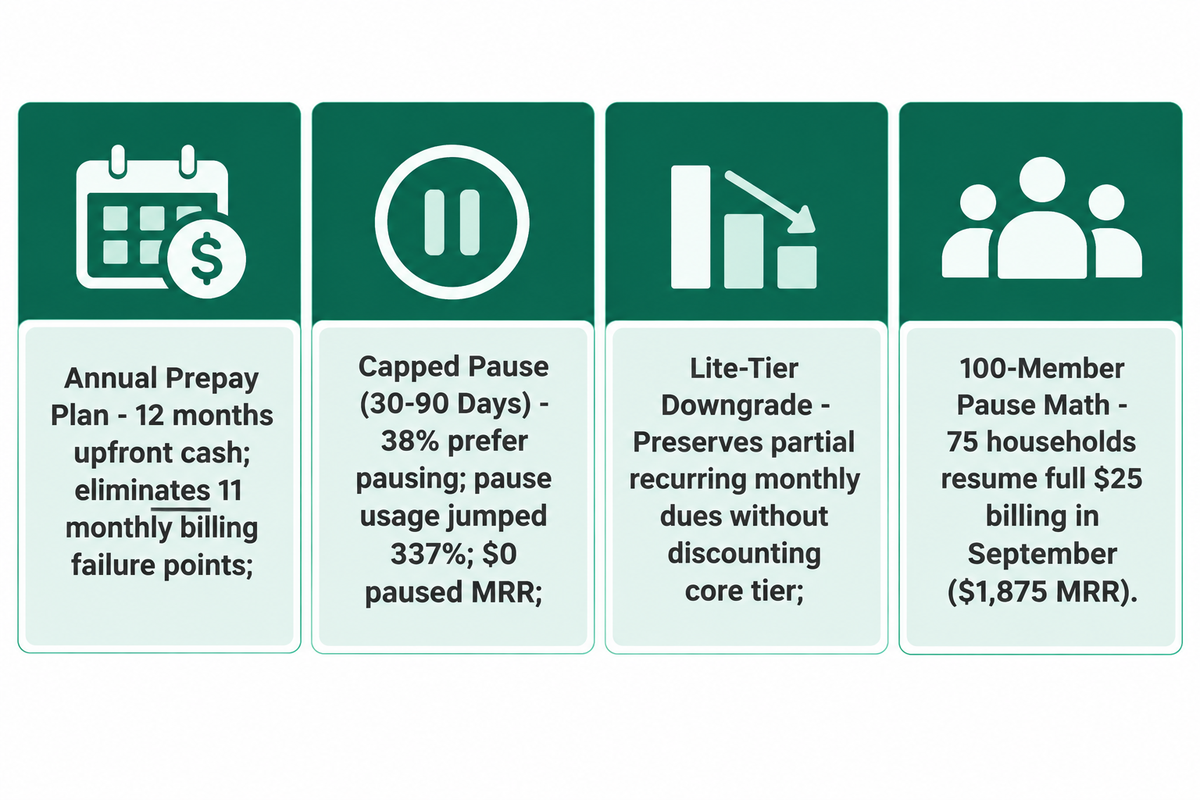
Prepaid annual plans lock in 12 months of upfront cash from committed joiners. Annual prepay plans secure twelve months of upfront cash from committed joiners, while capped 30-to-90-day pause options retain more recurring revenue than reactive discounts during temporary travel or schedule gaps. Recurly’s July 2026 Churn Report found that 38% of consumers prefer pausing to cancelling, pause usage jumped 337%, and 3 out of 4 paused subscribers return.
Accurate accounting distinguishes healthy membership renewal policies from those with bloated dashboards. Recurly Subscriptions documentation indicates that paused accounts generate no invoices and contribute $0 to monthly recurring revenue (MRR) while frozen. However, analysis dashboards will show those accounts as being active and associated promo codes will continue to expire. Operators aiming for a break-even membership pricing model should limit the time for which accounts can be paused and track paying MRR separately from paused headcount.
| Renewal Lever | Best-Fit Churn Cause | Immediate MRR & Fee Impact | Recommended Guardrail |
|---|---|---|---|
| Annual Prepay Plan | High-intent joiners & corporate budgets seeking predictable billing | 12 months upfront cash; eliminates 11 monthly billing failure points | Send renewal reminders 15–45 days before auto-renewal |
| Capped Pause (30–90 Days) | Summer travel, school exams, medical recovery, or seasonal hiatus | Zero billed MRR during pause; preserves full membership fee on resume | Limit to 1–2 billing cycles/year with disclosed auto-resume date |
| Lite-Tier Downgrade | Budget squeeze or lower visit frequency (e.g., weekday-only use) | Preserves partial recurring monthly dues without discounting core tier | Remove peak Saturday or premium perks so tier value stays distinct |
Suppose 100 monthly members paying a $25 membership fee click cancel before a two-month summer trip. Permanent 60% save coupons cut ongoing dues to $10 even after routines normalize. A capped two-month pause collects zero cash in July and August instead, then at Recurly’s 3-out-of-4 (75%) return rate, 75 households automatically resume full $25 billing in September ($1,875 monthly revenue) while protecting your standard membership model.
Clean exits also feed future rejoin pipelines. Recurly’s 2026 data shows that nearly 1 in 4 new subscriptions is from a previously canceled customer. Clear renewal reminders and easy cancellations keep customers likely to renew, while a fair pause rule improves retention and produces higher retention than cancellations.
Stopping Involuntary Churn From Failed Recurring Payments
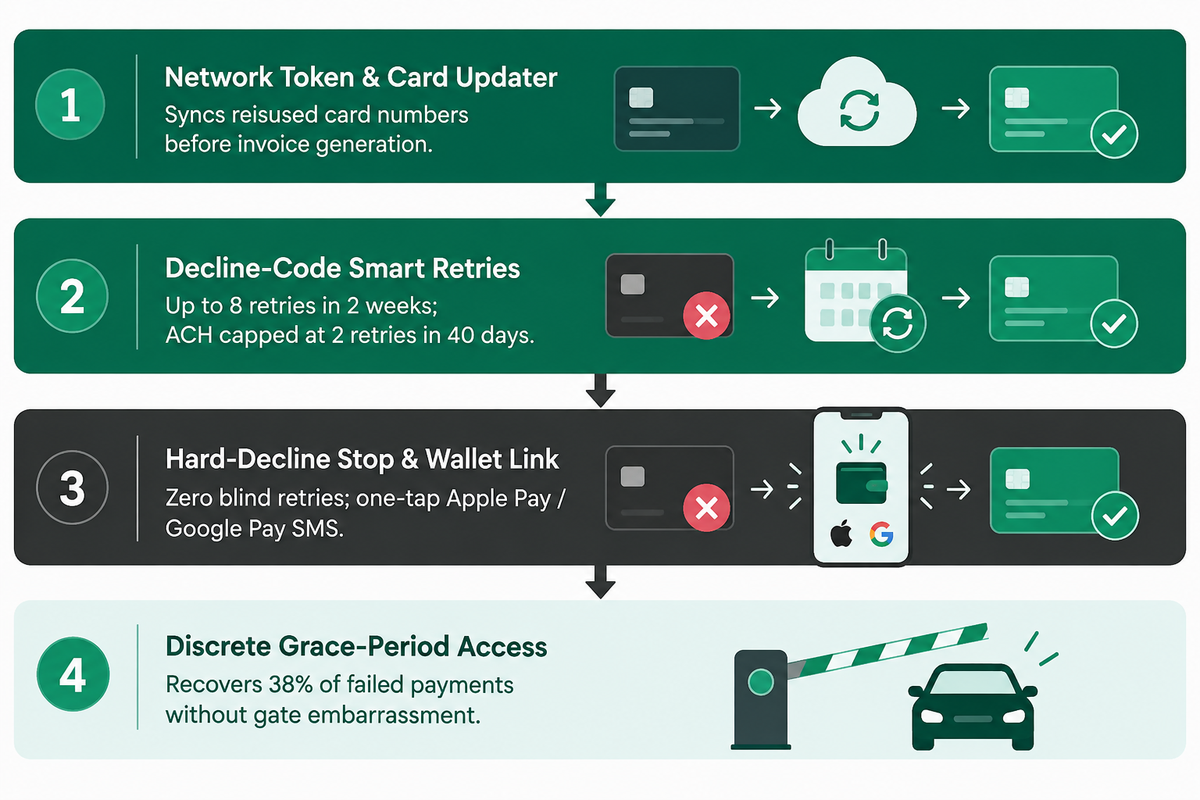
To lower your involuntary churn rate from recurring charges, use a combination of network card updaters, smart retries based on decline codes, and pay via a mobile wallet to accept the payment in the browser. Recurly’s July 2026 benchmarks record a 3.60% median monthly billing-period churn rate (2.34% voluntary, 1.25% involuntary). Stripe Billing documentation reports Smart Retries, failed-payment emails, and card updaters recover 38% of failed payments on average.
Subscription price tiers strongly influence passive card loss. In Recurly’s benchmark dataset, involuntary churn sits at 1.30% per billing period at $10–$25 monthly revenue per customer (4.29% total churn). In that bracket, consumer debit cards more commonly hit payday balance timing and card reissuance. Above $250 monthly ARPC, involuntary churn drops 87% to 0.18% (3.07% total churn).
| Recovery Layer | Technical Mechanism | Documented Rule / Retry Cap | Member Experience Benefit |
|---|---|---|---|
| 1. Network Token & Card Updater | Syncs reissued card numbers and expiry dates directly with card networks | Runs silently before invoice generation | Prevents routine expiry failures with zero member effort |
| 2. Decline-Code Smart Retries | Times soft-decline reattempts around payday and issuer approval windows | Stripe default: up to 8 retries within 2 weeks; ACH capped at 2 retries in 40 days | Recovers temporary balance shortfalls without spamming alerts |
| 3. Hard-Decline Stop & Wallet Link | Halts retries on lost_card, stolen_card, or revocation_of_authorization codes | Zero blind retries on hard declines until payment method updates | Sends one-tap Apple Pay / Google Pay update link via SMS or email |
| 4. Discrete Grace-Period Access | Buffers active gate or portal access during the two-week smart-retry window | Resolves billing privately on mobile before arrival | Eliminates embarrassing front-desk card rejection in front of guests |
How Can Organizations Prevent Involuntary Membership Lapses?
Organizations prevent involuntary lapses by turning on automatic card updaters, separating soft declines from hard declines, and texting one-tap wallet links during a short grace window. Never let gate turnstiles announce a declined card aloud while a family waits in line.
When you automate billing recovery, Stripe’s documented logic halts retries on hard decline codes like stolen cards. This Stripe logic protects merchant approval rates while spacing retries for soft declines up to eight across two weeks. Private SMS payment links keep an accidental card lapse from becoming an embarrassed voluntary cancellation.
Applying Member Retention Strategies in Physical Venues, Clubs, and FECs
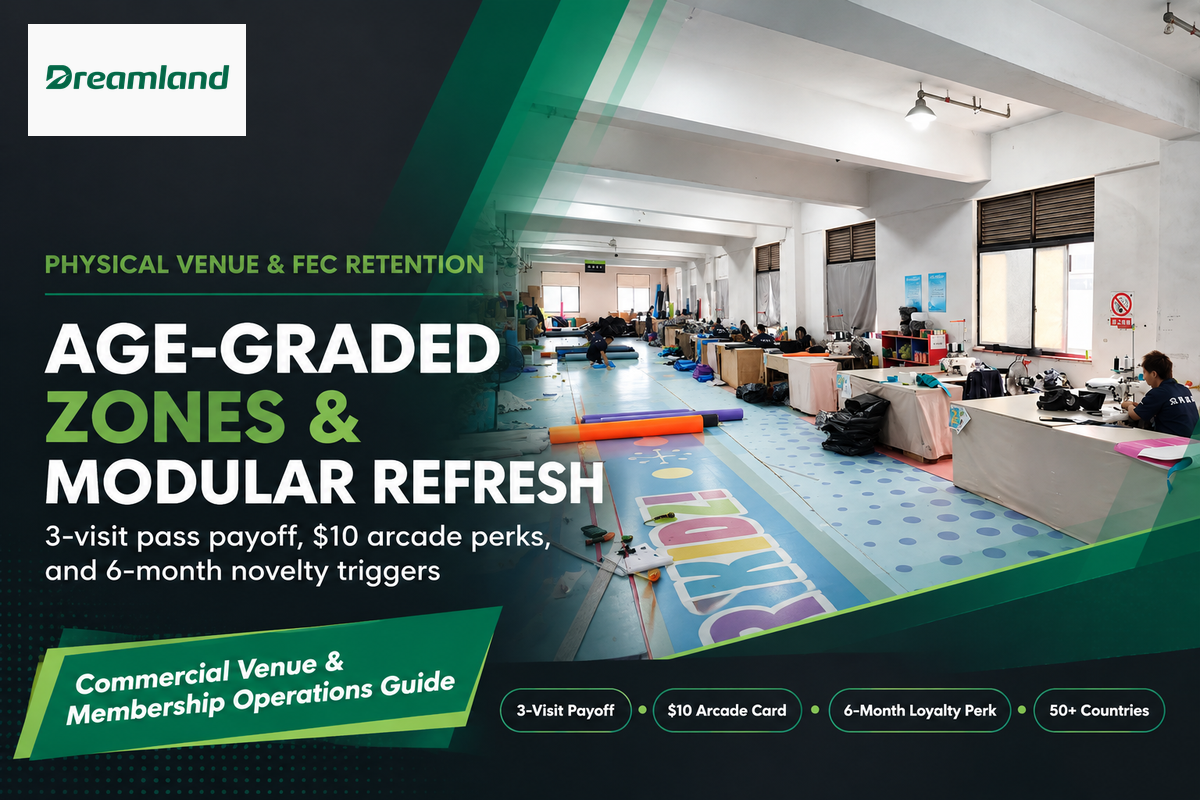
Physical clubs, indoor playgrounds, and family entertainment centers offer frictionless recurring billing with perks, weekday passes, and age-graded zones. 6-month loyalty rewards help retain customers. Across 41,556 U.S. fitness and recreation centers employing 708,273 staff (2023 Census CBP via VantaInsights), Saturday overcrowding erodes pass value unless perks shift visits to weekdays to help alleviate overcrowding.
“She says the passes pay for themselves after roughly three visits, but the perks start right away.”
In that IAAPA Funworld feature on passholder retention, Adventureland manager Jeanine Gentile prices season passes to pay off around visit three. Adventureland passholders also receive a $10 arcade card on preseason validation day, plus bring-a-friend discount tickets. In addition, RPM Raceway founder Andrew Farage bundles two races and a $5 arcade card on the first day. Operators of location-based entertainment venues can bind these types of bonuses to cashless arcade card reload systems and a 90-day family entertainment center marketing plan.
Physical venues also hit a novelty wall around month six. In Club Solutions Magazine, Club Automation VP Nick Thornton recommends tracking attendance by tenure and triggering a loyalty perk right at six months. In Dreamland Playground’s 7-stage turnkey indoor play and FEC design projects across 50+ countries, age-band zones move children from under-2 soft play to preschool role-play and 10+ adventure zones. Modular replaceable padding and printed panels refresh the floor so growing siblings keep renewing inside one household membership program, though peak weekend floor capacity and natural child age-out still bound physical venue visit frequency.
Membership Software Selection, Auto-Renewal Rules, and 2026 Retention Shifts
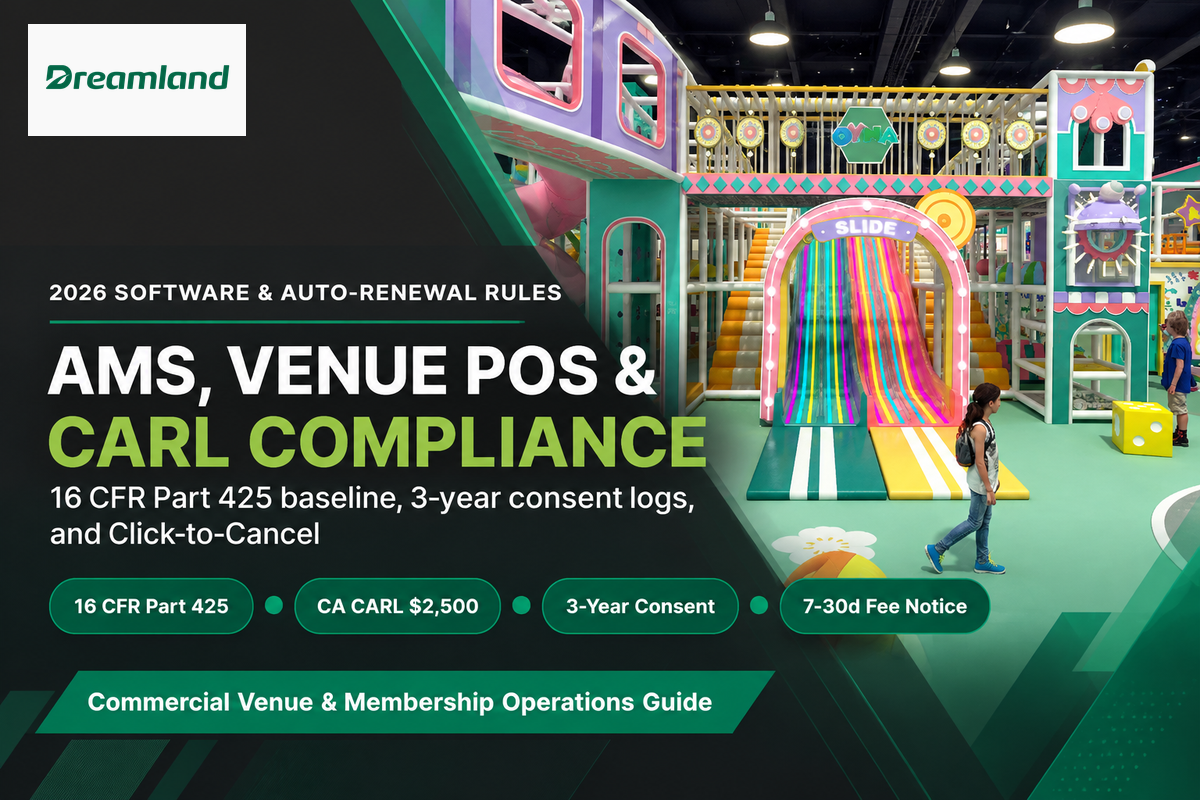
Match 2026 membership software to check-in format and auto-renewal rules: association management software (such as WildApricot or Fonteva) fits chapter rosters, while ticketed venue POS platforms fit waiver-linked family gate scans. Although the Eighth Circuit vacated the FTC’s 2024 Click-to-Cancel rule, after which the FTC restored its prior rule (91 FR 6507, February 12, 2026), California’s Automatic Renewal Law still carries penalties of up to $2,500 per violation.
Legal shifts make cancellation dark patterns a severe liability in 2026. Following the 2025 Eighth Circuit ruling, the FTC restored its pre-2024 rule (16 CFR Part 425). On March 13, 2026, the FTC opened a new rulemaking notice (FTC Docket FTC-2026-0265) concerning recurring billing obstacles. Other state enforcement actions have remained ongoing. Per Orrick’s July 2025 Legal Update, the amended California law (effective July 1, 2025, for B2C contracts) requires operators to retain affirmative consent for a period of not less than 3 years. Operators must also send annual reminders on monthly plans, give 7-to-30-day fee-change notices, and place a “Click to Cancel” button beside online save offers.
Software budgets reflect those compliance and access priorities. Propello Cloud’s 2025/2026 report notes 64% of organizations prioritize system integration and 56% target mobile-first delivery. Association professionals evaluating management software (like WildApricot, Fonteva, or Neon One) verify committee scoring and chapter dues splits. Indoor play venues instead test dedicated POS, digital-waiver, and Stripe or Recurly billing integrations; see our guide to indoor playground POS and membership software checks for gate hardware criteria.
| Requirement / Compliance Dimension | Association Management Software (AMS) | Ticketed Venue & Club POS | 2026 Verification Standard |
|---|---|---|---|
| 1. Primary Account Structure | Corporate rosters, trade chapters, CEU credits | Household profiles, child ages, signed digital waivers | Confirm multi-seat or dependent pass linking |
| 2. Check-In & Access Speed | Portal login & event badge QR check-in | Sub-second barcode/NFC gate & wristband scan | Test Saturday queue scan latency with live waivers |
| 3. Engagement Scoring Engine | 20/10/2 point weights across committees & emails | Rolling visit-interval & arcade/cafe spend tracking | Automate alerts at 2× baseline visit gap or 90 days |
| 4. Failed-Payment Dunning | Invoice reminders & automated ACH/card retries | Network card updater + SMS mobile wallet pay link | Verify hard-decline stop on lost/stolen card codes |
| 5. Pause & MRR Accounting | Dues hardship deferral or retired/student tier | Self-serve 30–90 day freeze with auto-resume date | Separate zero-invoice paused accounts from paying MRR |
| 6. Affirmative Consent Logs | Recorded opt-in on B2C individual dues checkout | Timestamped parent auto-renewal checkbox at signup | Retain consent records ≥3 years (CA CARL baseline) |
| 7. Statutory Renewal Notices | Automated 15–45 day pre-renewal email reminders | Annual notice (even on monthly plans) + 7–30d fee alerts | Audit automated reminder logs by member state |
| 8. Online Cancellation Flow | Self-serve portal cancel for online B2C joiners | Direct “Click to Cancel” button beside pause/save offer | Remove mandatory phone-call barriers for online signups |
| 9. Federal Rule Monitoring | B2B corporate dues exempt under CA CARL; FTC rule applies to covered plans | Consumer family passes governed by state ARLs & 16 CFR 425 | Track FTC ANPRM Docket FTC-2026-0265 updates |
Compliant 2026 Auto-Renewal Setup
- Displays a direct Click to Cancel button beside any online pause or lite-tier save offer
- Retains affirmative consumer auto-renewal consent logs for at least 3 years
- Sends 7-to-30-day advance notices before any recurring fee change takes effect
High-Risk Practices That Trigger Penalties
- Forcing online joiners into phone-only or in-person cancellation queues
- Treating the 2025 Eighth Circuit FTC ruling as an exemption from active state laws
- Blending unbilled paused accounts into reported monthly recurring revenue totals
Dreamland Playground helps plan spaces for indoor playgrounds and provides custom manufacturing and installation of indoor playground equipment. We do not build membership software, provide financing, run marketing agencies, or issue legal or safety certifications.
Frequently Asked Questions About Membership Retention Strategies
Q: How do you do customer retention in a membership model?
Book every new subscriber’s second visit or portal milestone before Day 1 ends.
Follow that early habit anchor with rolling visit-interval alerts, automatic card updaters, and pre-renewal usage summaries so silent sleepers receive personal outreach early. Offer a capped pause window ahead of billing day instead of permanent save discounts that erode recurring margin across your active member base.
Q: What is a good membership retention rate?
U.S. associations report an 82% median annual renewal rate in MGI benchmarks, and global fitness and recreational clubs average 66.4% annual retention.
Indoor play centers, monthly consumer clubs, and family birthday party venues often see higher natural member turnover because of local household moves, school calendars, and seasonal youth sports schedules.
Q: What is an example of retention in a recurring membership program?
When a visit interval doubles at an indoor play venue, they text a weekday guest pass.
They welcome the parent and child back during open Tuesday morning capacity, which restores their weekly play habit well before billing day arrives and preserves full recurring monthly membership dues across active family play accounts.
Q: Should retention strategies differ for corporate versus individual or family members?
Yes: corporate trade memberships renew at a 90% median.
Employer-paid rosters renew when multiple staff seats stay active before annual company budget review, whereas individual and family passes depend on fast gate scans, multi-age zones, and smooth recurring card billing.
Q: When do membership retention strategies fail to reduce cancellations?
Retention campaigns fail because operators send extra newsletters or blanket coupons instead of fixing Saturday’s check-in queue, worn play zones or failed recurring card attempts.
Gjestvang et al.’s club cohort study found that members’ satisfaction scores had zero correlation with regular twice-weekly club attendance. Even worse, frequent save discounts teach active subscribers to threaten to cancel their membership each billing cycle and ignore seasonal travel and soft debit card declines that are recovered by automatic reattempts.
Q: How can organizations track member retention across cohorts?
Group subscribers strictly by enrollment month rather than blending headcount.
Compute ((End Count – New Members) / Start Count) x 100 at Day 30, Month 3, Month 6, and Month 12, and always report unbilled paused accounts separate from paid revenue.
Q: Are membership retention strategies worth the cost compared with new member acquisition?
Yes, provided budget funds low-cost structural fixes first: automatic card updaters, smart payment retries, Day-1 next-visit booking, and Day-60 pulse outreach before paid loyalty perks.
Per Stripe Billing, pairing smart reattempts with automatic card updaters rescues 38% of failed recurring charges without manual staff follow-up. Meanwhile, ASAE research shows renewal probability jumps from 50% in year one to 80% in year two, compounding lifetime contribution margin without repaying paid media acquisition fees.
Key takeaway
Early first-quarter habit anchors, 8-retry failed-payment recovery, and capped pauses move cohorts from ASAE’s 50% first-year renewal baseline toward 80% year-two retention without permanent discounts.
Planning an Indoor Playground or Family Entertainment Center Built for Repeat Visits?
Floor zoning, clear age separation, and modular attraction refreshes decide whether local families keep renewing past six months. Send our engineering team your project city, CAD floor plan, clear ceiling height, target age mix, equipment budget, and target opening window for a custom 3D layout.
About This Analysis
Our team has compiled 2025-2026 renewal benchmarks for associations, NIH PubMed Central club cohort studies, payment recovery rules, and US auto-renewal laws alongside Dreamland Playground’s 7-stage indoor playground layout and manufacturing work across 50+ countries. Reviewed by the Dreamland Playground technical team.
References & Sources
- HFA Releases 2025 Fitness Industry Benchmarking Report Health & Fitness Association (HFA)
- Three Keys to Solving the Member Retention Puzzle American Society of Association Executives (ASAE)
- How Do Fitness Club Members Differentiate in Background Characteristics, Exercise Motivation, and Social Support? A Cross-Sectional Study U.S. National Library of Medicine, National Institutes of Health (NIH PMC10244985)
- What Makes Individuals Stick to Their Exercise Regime? A One-Year Follow-Up Study Among Novice Exercisers in a Fitness Club Setting U.S. National Library of Medicine, National Institutes of Health (NIH PMC8194699)
- How to Identify and Prevent Member Churn Before It Happens Associations Now (ASAE)
- To Increase Member Retention, Rate and Score Engagement Associations Now (ASAE)
- Friends for Life International Association of Amusement Parks and Attractions (IAAPA Funworld)
- Four Strategies to Boost Member Retention Club Solutions Magazine
- Revision of the Negative Option Rule (91 FR 6507, Feb. 12, 2026) Office of the Federal Register & Federal Trade Commission
- Negative Option Rule (16 CFR Part 425; ANPRM Docket FTC-2026-0265) Federal Trade Commission (FTC)