Get in touch with Dreamland Playground Company

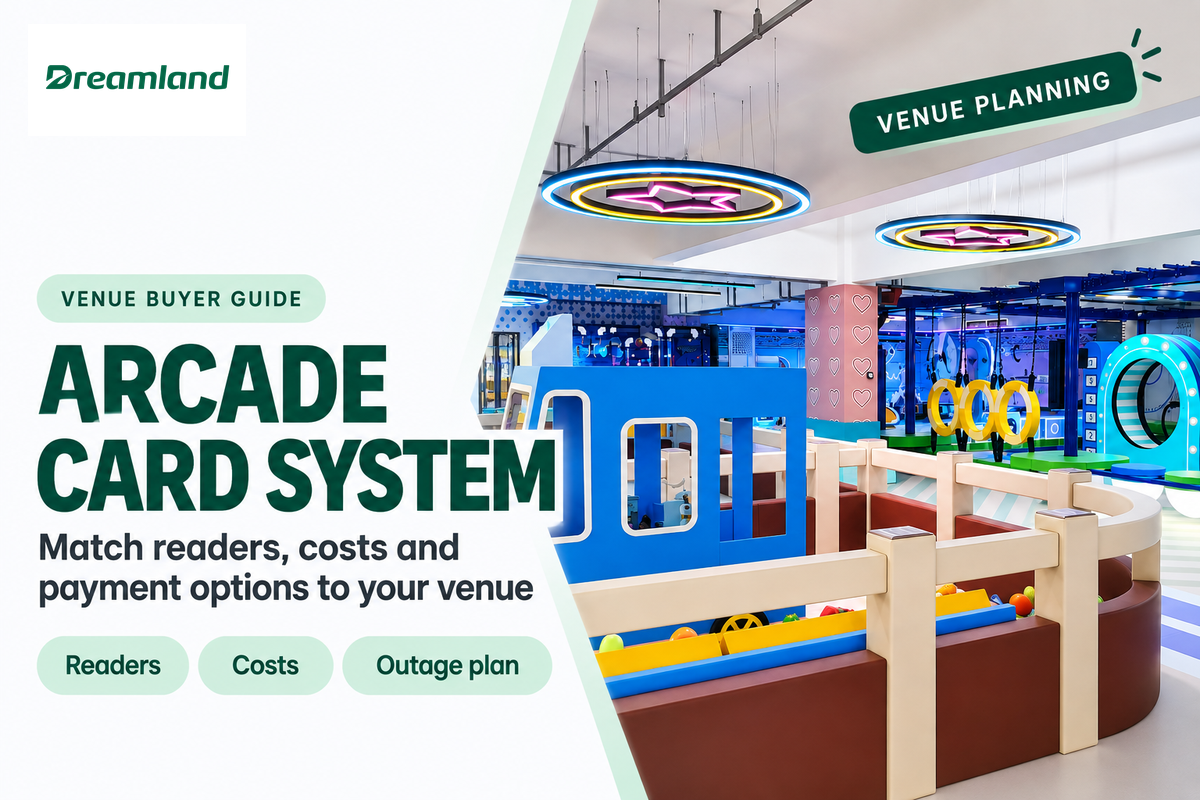
An arcade card system connects a guest’s play balance to the games, reloads and reporting tools in your venue. Guests add value, tap or swipe to play, and collect tickets from the game to redeem a prize (if available). The buying decision starts with the whole operating loop: payment in, game started, value deducted, tickets recorded and a report that balances at closing.
When an owner plans a family entertainment center (FEC), the bigger oversight is deciding on game readers before figuring out arcade operations. The arcade’s staffing and support plan should cover a failed reload as well as normal play. Your family entertainment center plan should establish the game mix, guest journey and staffing model before the payment hardware is specified.
Quick answer: Choose an arcade card system by matching its payment methods and game interfaces to your venue. Compare complete costs over the same contract term, run a representative cabinet pilot, and reconcile play balances and tickets before rollout. A lower reader price can still produce a higher operating bill.
What an arcade card system does
A cashless arcade system manages the connection between guest value and game access. Its usual building blocks are game cards or digital credentials, an arcade card reader at each connected game, a reload point and management software. Self-service kiosks can issue cards and reloads, and take payments, all without an attended point of sale. The management system determines how pricing, promotions, refunds and tickets for guest redemption reach the operator’s reports.
How does an arcade card work?
A guest loads value onto an account, presents a card or supported digital credential, and receives a game start after the system approves the play. Games in the arcade give tickets to guests for prizes (if offered) through a configured interface. The arcade game card identifies the guest’s entitlement; where the balances are held depends on the selected platform.
Embed’s description of its cashless system connects readers, kiosks and point of sale to central software. It explains how account balances are stored centrally, as opposed to being stored on the media. That architecture makes account recovery and reporting part of the purchase, alongside the visible hardware. It should not be assumed for every competing product.
Distinguish purchased play, promotional credit and ticket balances in operating rules. A bonus may have a different redemption policy than paid play. Tickets are normally redeemed to purchase prizes. Exceptions can be intentionally configured by the venue. Combining those balances into one field makes refunds and promotion costs harder to explain.
Consider a parent buying a party package with admission and game credit. The package purchased at the front desk has to be clearly recorded and recognized by the game readers. The front desk needs a clear way to issue the package, the game floor needs to recognize it, and the redemption counter needs the correct ticket balance. A reader that starts a game successfully has completed only one step in that visit.
RFID game cards, swipe cards and direct bank-card payments
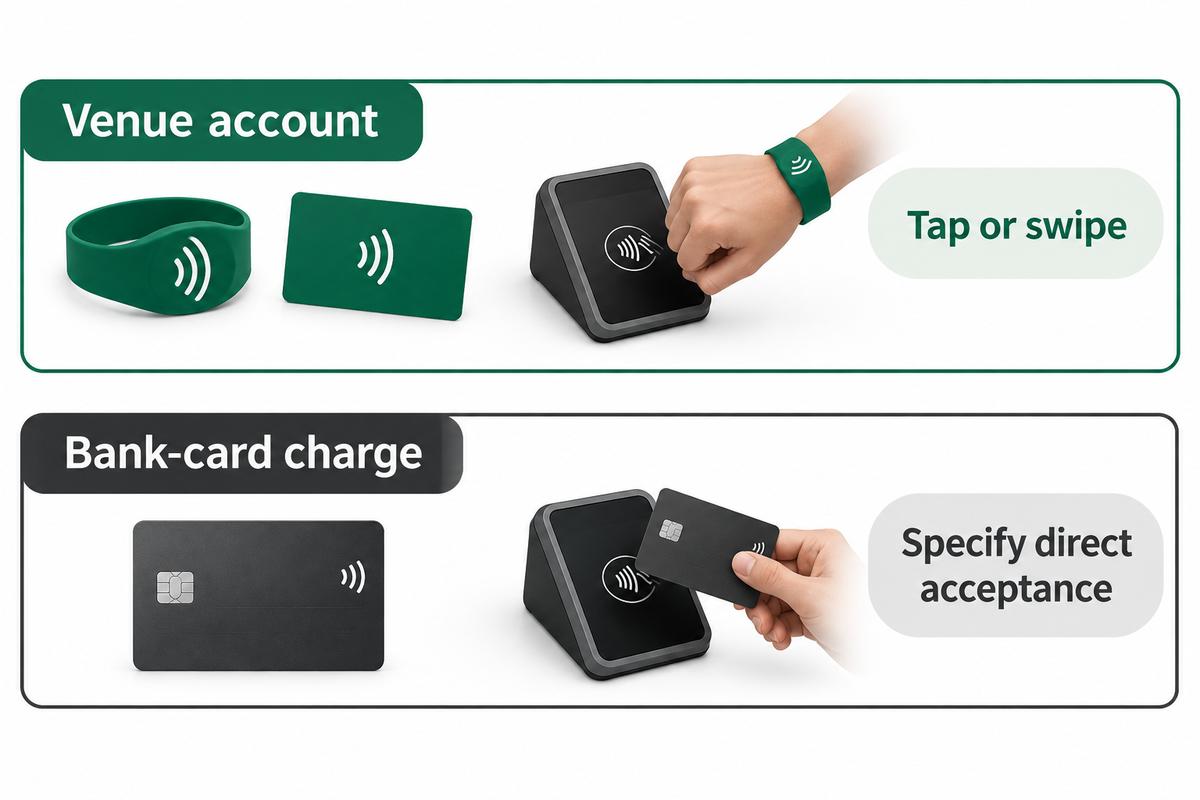
RFID game cards or magnetic swipe cards identify a venue account. Direct bank-card acceptance charges a payment card via a payment service. The reader may support one, some, or all of the arrangements. Select the payment path first, as it affects reloads, transaction fees, guest support, and the payment provider’s obligations.
With RFID card readers, guests tap a card or wristband. A swipe arrangement requires the card to pass through a magnetic reader. Neither action tells you if the transaction spends venue credit or takes money out of a bank account. The phrase “arcade debit” can describe debiting a game balance.
Cantaloupe Play names stored-value Play Card transactions and credit, debit and mobile wallet payments, for Engage Lite readers. Its kiosk takes cash and electronic payments. Cashless play on the floor can therefore coexist with guests paying cash to buy or reload a game card.
Among the smartTOUCH play methods listed by Embed are game cards, RFID wearables and Mobile Wallet. Those options are particularly useful for repeat visitors, but direct bank-card payment at the game must be specified separately in a supplier proposal. A phone displaying a venue credential and a phone making a bank-card payment can look similar to a guest while producing different accounting events.
The PCI Security Standards Council explains the remaining merchant duties and obligations in the move to outsource payment processing.
“However, this does not remove the merchant’s responsibility to ensure account data is properly protected by the third party.”
Identify the provider’s scope and written shared responsibilities, and state ongoing compliance checks in the supplier handoff. A small game room accepting payments at one counter has a different support arrangement from a large amusement park with direct payment terminals spread across attractions. Define the POS (point-of-sale) connection and responsibility for account support at each staffed location.
Which card readers fit existing arcade machines?
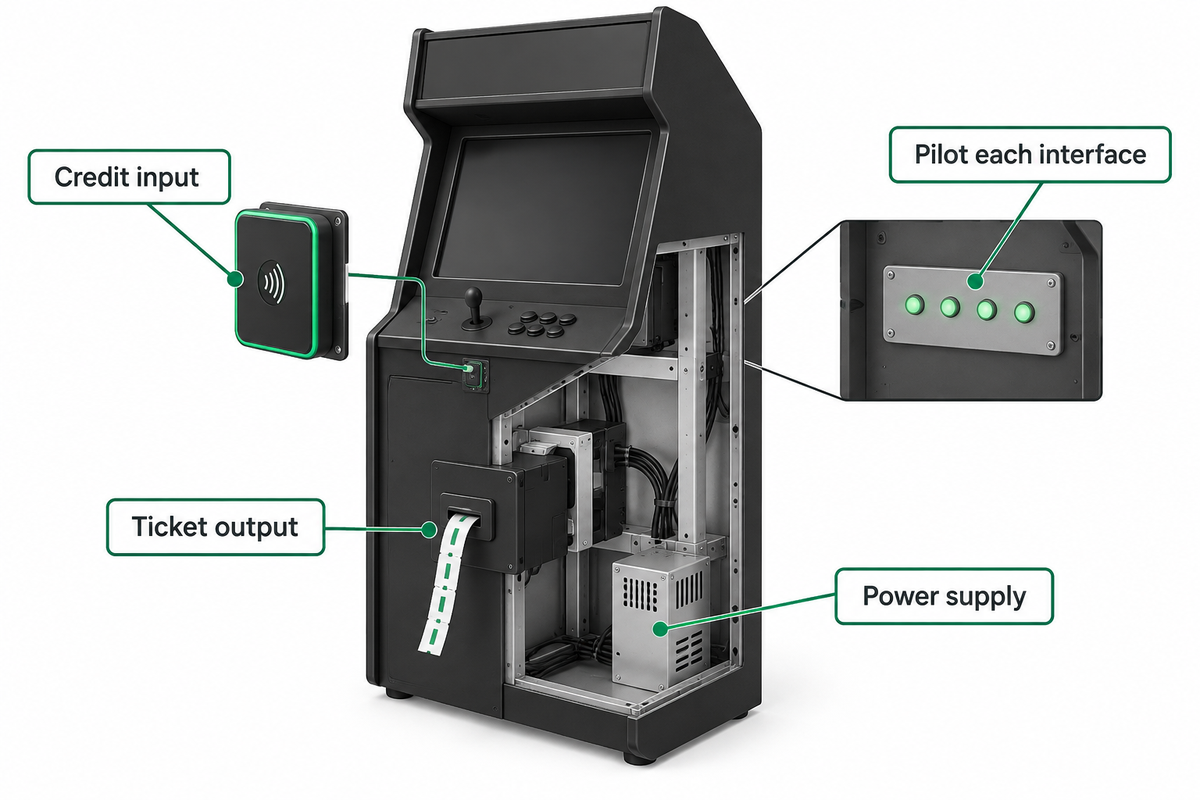
Choose readers that match the actual game machine’s credit input, ticket output and installation requirements. Build a cabinet inventory before placing a bulk order. Log model and board revision, power supply, payment interface and redemption mode. An arcade machine’s appearance or age is not a dependable compatibility specification.
Cantaloupe lists serial and pulse protocols for Engage Lite. Amusement Connect describes keyboard emulation for certain PC-based games and serial ticket payout among SmartMech features. These are different integration routes. An installer must match the route to each cabinet, including any adapter or firmware requirement. Specify compatible interfaces before choosing the RFID readers; tap-to-play is the guest action, not the cabinet wiring requirement.
Embed’s smartTOUCH specifications include installer testing and paper-ticket, e-ticket or dual operation. For a redemption game, validate both the game start and the ticket recorded. For a classic coin-operated cabinet, inspect whether existing coin acceptance stays active and how both payment paths appear in reporting.
A mixed room may have a video cabinet, a ticket game, and a PC simulator. A successful pulse-input installation on the video cabinet has little to do with the simulator’s keyboard control or the ticket game payout. Pilot one representative of each of the family of interfaces before purchase of the remaining readers. Keep original arcade wiring documented, so a failed pilot can be reversed without guessing which connection was changed. The technician should also demonstrate a denied play and a refund, while the operations lead checks the on-screen price. This is where an arcade game installation becomes a working guest service from a box of fitted electronics.
The 9-Check Play-to-Ledger Test
This protocol should be followed jointly by the installer, operations lead and finance owner. Agree on the expected outcome before each test. These tests are proposed acceptance methods, not claims that any listed vendor has passed these tests.
| Check | Action | Acceptance record |
|---|---|---|
| 1. Cabinet identity | Match model, PCB revision, interface and supply to the installation sheet. | Exact cabinet and reader configuration recorded. |
| 2. Paid play | Start a game at its configured price. | One start and the agreed debit; rejected taps create no charge. |
| 3. Bonus order | Play with both purchased and promotional value. | The agreed balance priority and restrictions are followed. |
| 4. Ticket path | Complete a redemption play and any paper/e-ticket conversion. | Game payout and guest ticket balance reconcile. |
| 5. Internet loss | Disconnect the venue’s internet connection during the pilot. | Permitted play and payment behavior match the agreed outage mode. |
| 6. Local dependency loss | Separately interrupt reader connectivity and the required local server or hub. | Each failure has its own recorded result and staff response. |
| 7. Concurrent use and recovery | Use one test account at two readers, then restore connectivity and retry a transaction. | No unauthorized extra spend or duplicate debit; every accepted play reconciles. |
| 8. Migration | Import a controlled account set at a fixed cutoff. | Each account’s paid, bonus and ticket fields match, followed by totals. |
| 9. Closing report | Process a refund and compare the game, reload and financial exports. | Every difference has a traceable transaction and responsible owner. |
What an arcade card system costs
Price a complete installation and its recurring services over an agreed term. Embed, Amusement Connect and Cantaloupe separately quote their wider system configurations. A reader’s quote can’t substitute for a venue-level operating budget.
How much does an arcade card system typically cost?
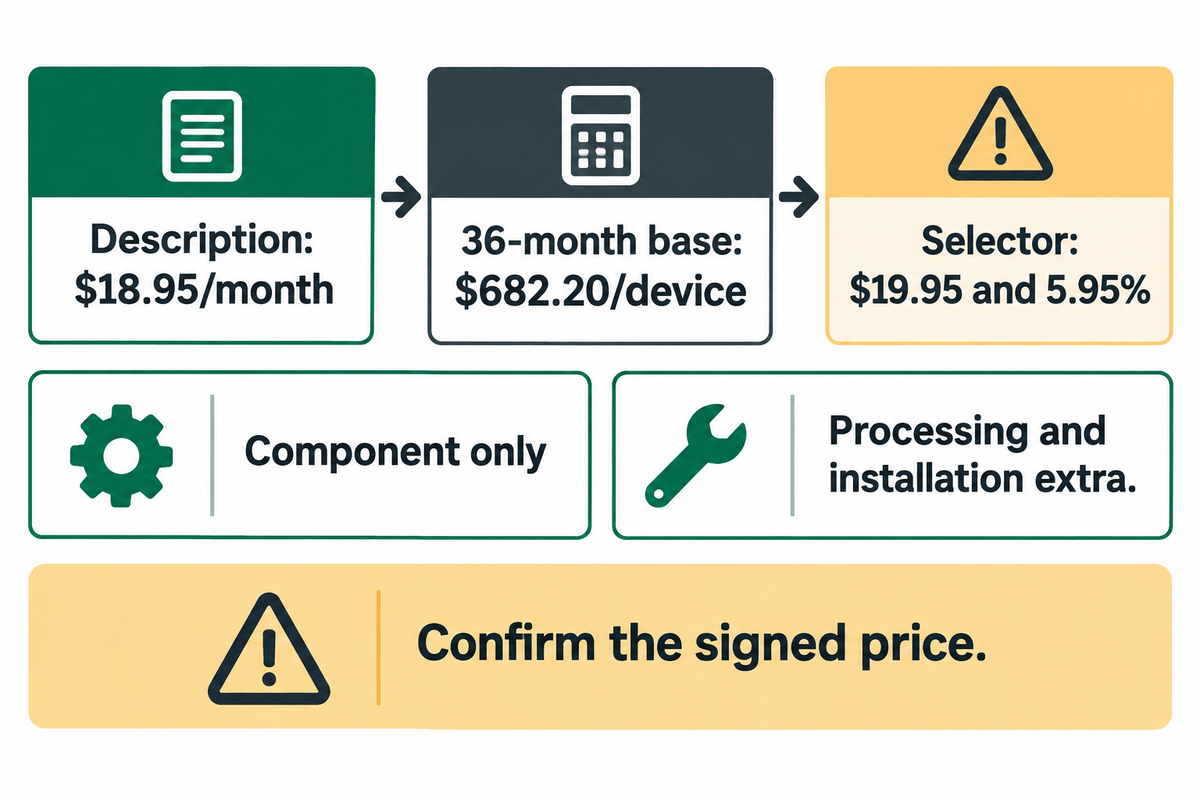
Obtain a complete venue quote for a stored-value card installation. The scope of the quote would include the hardware, reload equipment and the software. For a public component-price anchor, Cantaloupe’s Engage Pulse with Power Supply rental offer shows $0 upfront and an $18.95 monthly subscription in its description with a 36-month per-device commitment. This direct payment reader offer is different from a complete stored-value arcade installation.
Comparable-Quote Ledger
Use the signed monthly fee and contract term to calculate committed cost before comparing proposals. The Cantaloupe One Engage Pulse offer, reviewed October 26, 2026, supplies the inputs for the example below. Its description states $18.95 per month; its carrier selector displays “$19.95 and 5.95%.” Resolve that price and processing-fee difference in the written proposal before ordering.
Worked model: Use the $18.95/mo subscription and a 36-month device term to calculate the recurring base. The fleet scenario assumes 24 devices. Processing, installation and any different signed price are outside this subtotal.
| Comparable field | One device | 24-device scenario |
|---|---|---|
| Advertised upfront device payment | $0 | $0 |
| Monthly subscription base | $18.95 | $18.95 × 24 = $454.80 |
| 36-month subscription base | $18.95 × 36 = $682.20 | $454.80 × 36 = $16,372.80 |
| Termination after 18 billed months | 18 × $18.95 = $341.10 remaining | 24 × $341.10 = $8,186.40 remaining |
| Processing, installation and venue software | Add the contracted scope | Use the same scope for each proposal |
| Card issuing, reload and redemption equipment | Specify separately where required | Include every required venue component |
The published early-termination formula is the monthly service fee multiplied by the remaining device-commitment months. Ending after 18 billed months therefore leaves another 18 months in this model: $341.10 per device. The paid and remaining subscription base totals $682.20, even though the operating period was shorter. The owner needs to determine if the expected operating horizon justifies this commitment.
Processing requires another calculation: percentage fee × processed dollars, plus fixed fee × chargeable bank transactions. The U.S. Government Accountability Office’s payment-card analysis separates transaction volume, dollar value, and fee categories. Its data for federal entities aren’t arcade prices.
For example, 1,200 game starts could be funded by 120 reload transactions, or could produce 1,200 direct bank transactions if each is charged individually. Before any provider batching, there would be 1,200 chargeable events if each play is charged separately. For every chargeable event, there’s a corresponding bank transaction. Apply the actual percentage and fixed-fee schedule to those events; count bank transactions rather than game starts.
When creating your venue financial projections, compare the complete scope; bundled pricing is allowed if its terms are clear. To increase revenue, reduced waiting must translate into additional paid visits or plays. The additional contribution must cover the subscription, processing, staffing and equipment costs before it becomes profit.
How to shortlist arcade cashless system suppliers
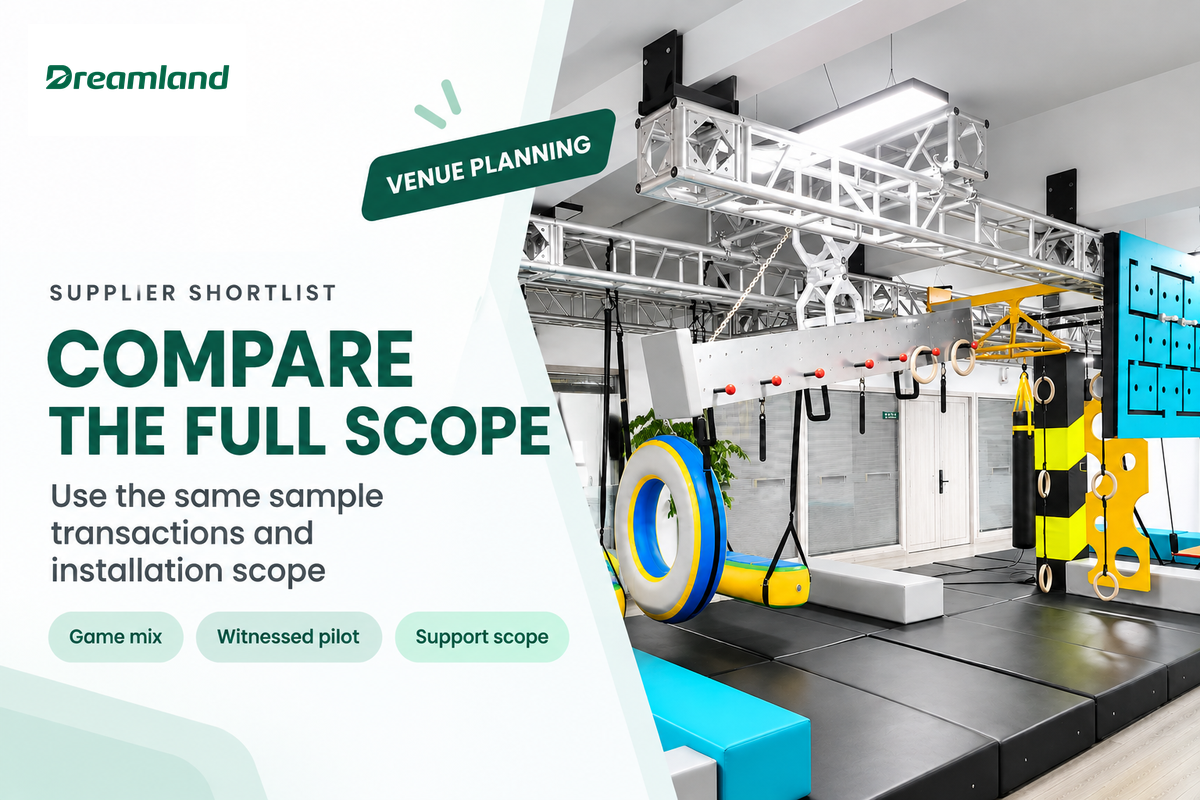
Shortlist suppliers around your operating requirements, then compare a witnessed pilot and a complete proposal. Embed, Semnox’s Parafait, Amusement Connect and Cantaloupe offer different routes through the arcade payment problem. Compare cashless solutions by their delivered functionality. Choose the appropriate product family based on your game mix, country and support requirements.
For a small unattended game arcade, card issuing, remote support and the cost of the central equipment can dominate the decision. A staffed entertainment center may give more weight to party packages, point-of-sale integration and prize inventory. A multi-site operator needs clear rules for account sharing, location ownership of revenue and support escalation.
RePlay’s September 2026 Amusement Connect report contains essential SE and SmartMech readers on the same platform and a mobile option. This raises a buying question: can entry-level and high-end units co-exist as the venue expands? Keep the answer tied to the quoted product family.
The cabinet inventory, countries and currencies, guest payment methods, ticket and time-play rules, software functions, outage behavior, reader spares, export format, support hours and exit costs must all be combined into a single RFQ. Include the nine acceptance checks and name who signs each result. This will help clarify “customizable.”
State what settings your team can customize and what requires supplier support.
A clear comparison of suppliers ends with the same sample transactions and installation scope for all. An original arcade retained for its coin-operated collection needs a different retrofit plan from an indoor venue opening with entirely new games.
What still works when the network fails?
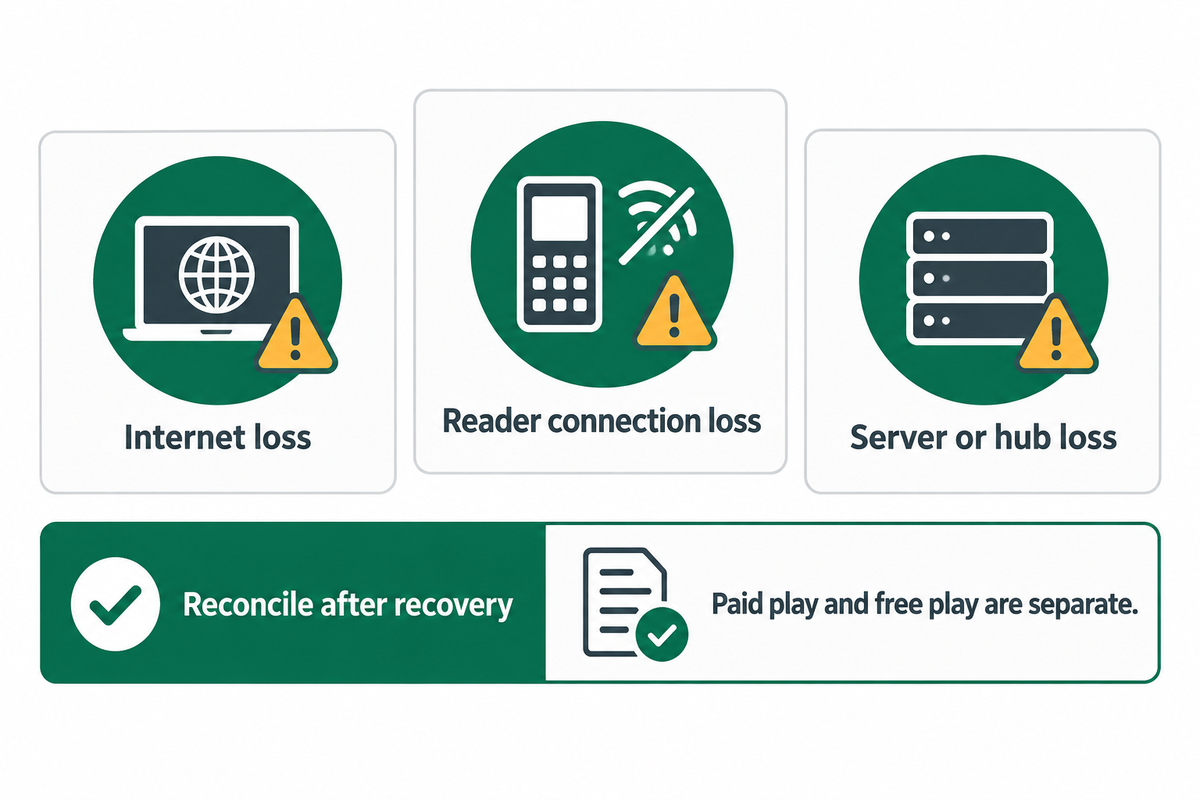
Some systems offer a fallback that keeps games available during an outage, but paid play, free play and bank-payment authorization are separate functions. Choose the outage policy deliberately. Test loss of the Internet, the reader’s local connection, and any server or kiosk hub that play normally depends on.
Amusement Connect’s SmartMech page describes a feature for offline mode that enables free play and states that on return of the network, synchronization of credits and tickets is automatic; it directs users to support for firmware upgrades and offline cards. The vendor has stated the features; a paid-debit policy still belongs in the commissioning agreement.
It’s important on a busy day like Saturday. Let’s say the internet link goes down while the venue’s internal network stays up. The staff may still have an operating path that goes down if the local wireless connection fails, for example. In these cases, you should write down the results for each interruption instead of calling the entire card reader system “offline capable.”
At restoration, check accepted plays, denied plays, balance changes and ticket awards. Test a repeated tap and a pending transaction before reopening every game. Reliability includes the staff response as well as reader connectivity. If an account holds 15 paid credits and a play costs 10, two concurrent accepted paid plays would exceed that starting balance. The acceptance test should record the intended outcome and then demonstrate it on the proposed configuration.
The Federal Reserve’s 2024 offline-payment analysis distinguishes hybrid services that reconnect for authorization and settlement from fully offline designs. For bank payments, record whether the provider permits deferred authorization, how much exposure is allowed and how declined or duplicated transactions are handled. A game credit balance and a bank settlement are represented by different ledgers. Staff also needs a clear free play authority, a guest communication script and a recovery owner. Keep that response in the venue operations guide.
Move old balances without losing credits or tickets
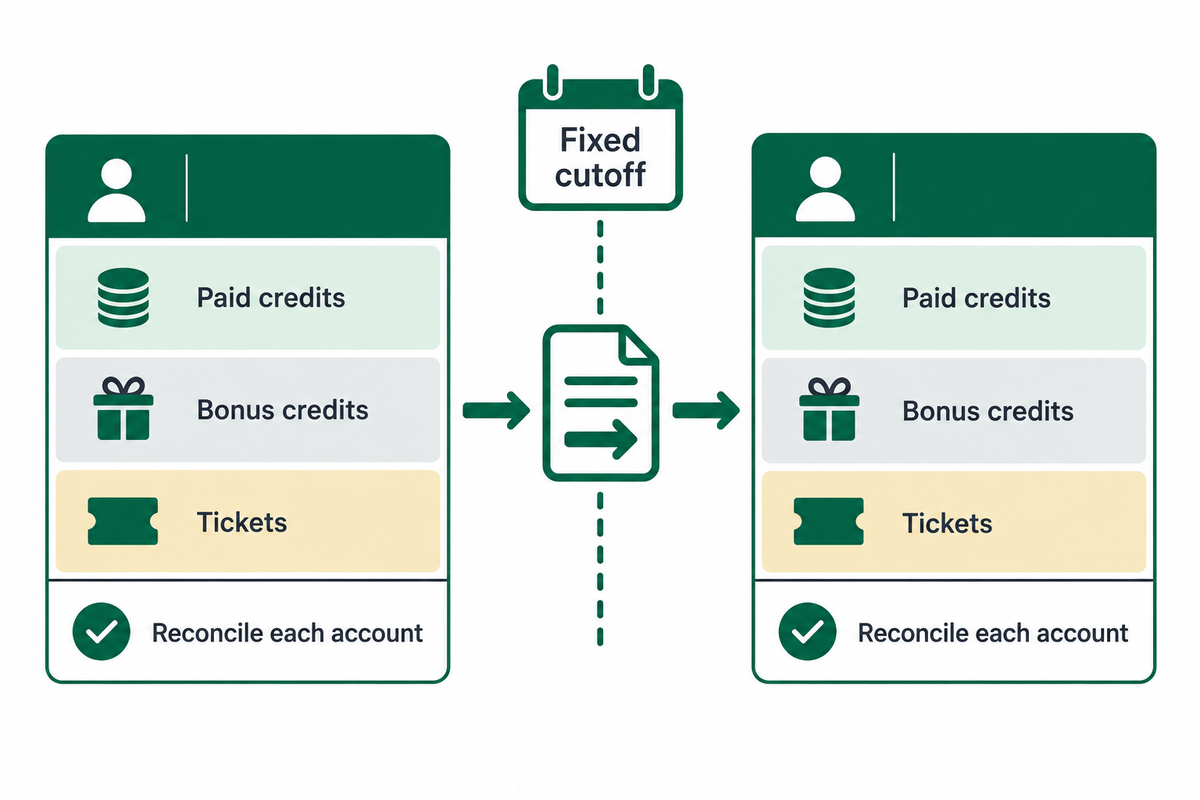
Before going live with a new system, migrate balances with a fixed cutoff. Reconcile accounts on an individual basis. Preserve purchased credit, bonus value and tickets as distinct fields. Maintain the original export, record controlled changes during cutover, and compare account records before comparing venue totals.
A matching total can hide two guests receiving each other’s balances. Start with a test set containing an ordinary paid account, a bonus account, a high-ticket account and a refund. Map old account ids to new ones. When physical media can’t be reused, connect the new credential to the migrated account and don’t consider card appearance as portability.
Worked account example: At the cutoff, a guest had 100 paid credits, 20 bonus credits and 800 tickets. Under the agreed paid-first rule, one 10-credit play awarding 40 tickets should leave 90 paid credits, 20 bonus credits and 840 tickets. If a 20-credit reload occurs after the snapshot, either freeze that activity or include it in a controlled delta. Importing the old snapshot wouldn’t show the reload.
Operations should retain a read-only copy of the old records while finance signs off the import. Record failures by account and reason, resolve them, then rerun the affected checks. Staff should have a straightforward balance-recovery process and a way to locate the old account. The migration date also belongs in the wider opening and operating plan, where training, signage and the launch schedule are coordinated. This includes staff training and communications.
Plan the card system around the whole venue
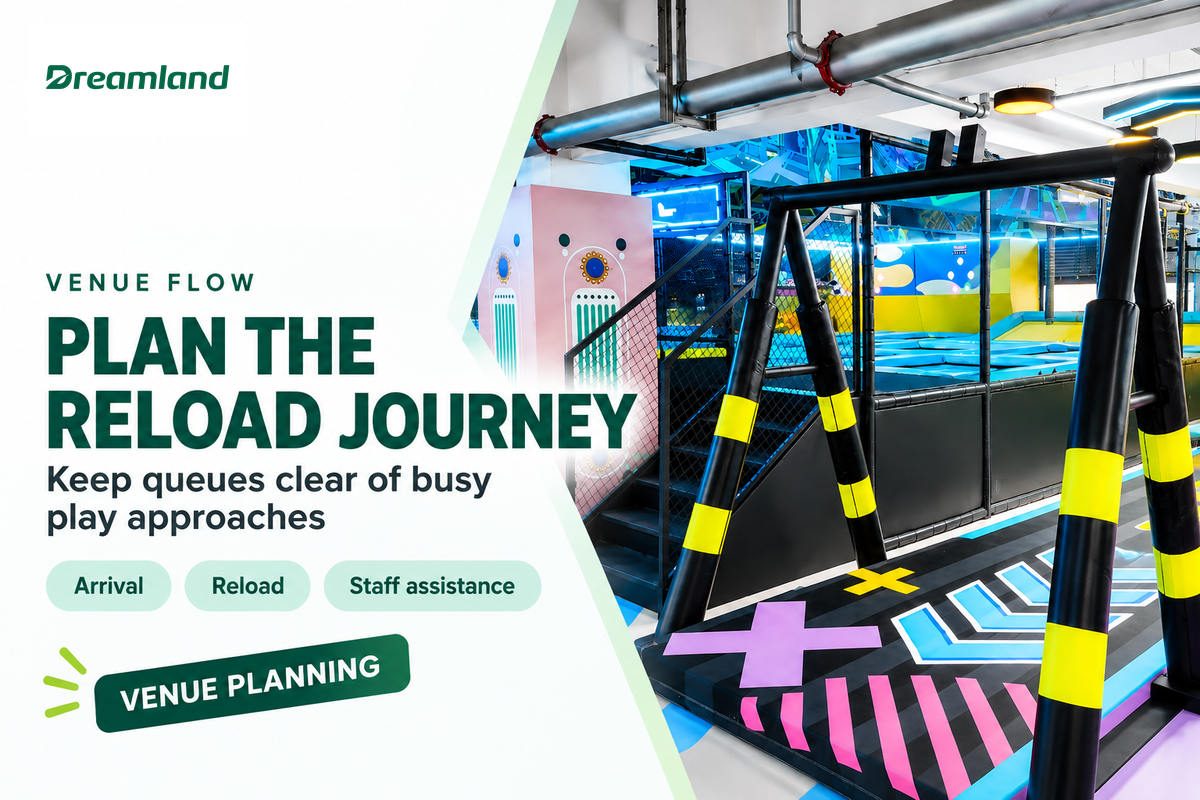
Consider queues, staff assistance, and accessible approaches before finalizing equipment placement. Decide how the arcade connects with admissions, parties and other attractions before finalizing equipment locations. Good arcade gaming flow keeps reload queues away from busy play approaches. Payment hardware should fit the operating plan and the physical layout.
An entrance kiosk can help guests, but may create a second queue at admissions. A deep reload point can shorten the repeat trips guests make inside the arcade. Signs and staff visibility are key for this to be effective. A coin jam and an account-service outage require two different responses, so the arcade desk must be able to support both. Draw both journeys on the family entertainment center floor plan, including a parent supervising children and a guest needing assistance.
Implementing accessible controls also requires accessible placement. Department of Justice’s 2010 accessibility standards address operable parts and reach ranges; the site designer should include those requirements in the installed arrangement. A suitable reader mounting position, clear approach and readable LCD are part of guest use, alongside the electrical installation. The guest experience suffers if a technically functional reader is difficult to reach or its balance display cannot be read from the approach.
Hidden bottleneck map
| Bottleneck | Visible consequence | Action before rollout | Owner |
|---|---|---|---|
| Card issuing or reload queue | Guests leave games to wait at the counter. | Walk the arrival and repeat-reload routes; stage help and signage. | Operations |
| One unsupported cabinet interface | A popular game stays out of the connected floor. | Resolve its adapter, power and ticket path in the pilot. | Installer/procurement |
| Uncontrolled migration window | New transactions fall outside the imported snapshot. | Freeze activity or reconcile a dated delta per account. | Finance |
| No outage decision owner | Staff improvise free play, refunds and restart order. | Assign fallback authority and a tested recovery sequence. | Venue manager |
For the DreamlandPlus projects, incorporate this payment system brief as part of the overall venue design discussion. Begin with the floor plan and game list to consider guest flow and the placement of equipment and the payment system supplier’s installation requirements.
What mobile wallets and hybrid payments change
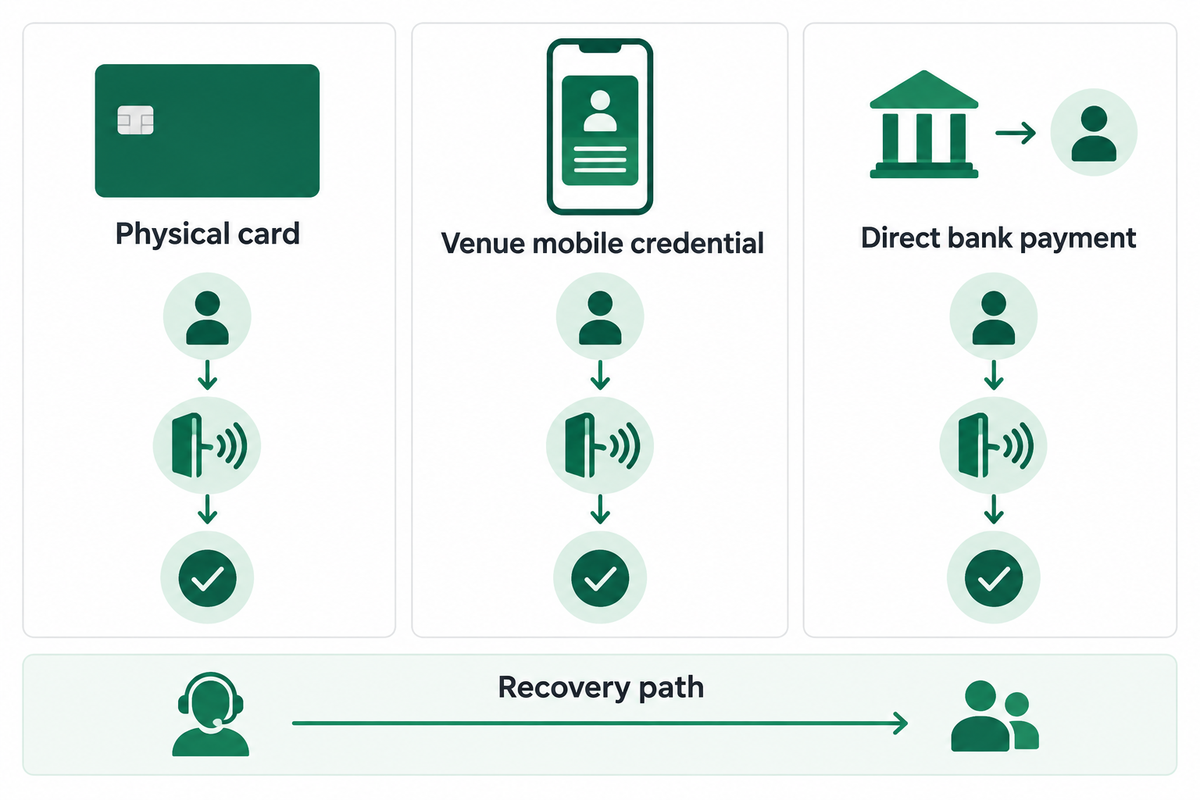
Purchasing and using mobile wallet and hybrid payment systems doesn’t eliminate the need for ticket accounting, card recovery, and an outage policy. Compare the exact functions available now and the path for upgrading existing readers, rather than purchasing a forecast of future features.
Physical cards remain useful for children, groups and visitors without a suitable phone. A digital credential can help a repeat guest reload before reaching the counter. Semnox’s Parafait describes its SmartFun app alongside its POS and kiosk options; keep that app route distinct from direct bank-card acceptance. Test the full mobile journey with gaming, including a failed reload and the path to staff assistance. Bank card payment can work for a casual visitor; a stored value account can work for a venue promotion and multiple starts from one purchase. These options can work together.
For a venue with multiple attractions, or for waterparks, check the guest journey with staffed points, phones and wristbands. Local options, like WeChat, require an explicitly supported partnership; a mobile wallet logo doesn’t represent acceptance in different countries. A QR code should lead to the intended payment or account flow with a clear recovery path if the phone loses service.
The next step is concrete. Send the cabinet list, expected payment flows and a Comparable-Quote Ledger to the shortlisted suppliers. Run the 9-Check Play-to-Ledger Test on the proposed configuration. Discuss your venue plan with DreamlandPlus, when you’re ready to align the arcade with the rest of the entertainment center.
FAQ
Can arcade cards be used at different venues?
Generally, only within the locations supported by the same operator’s account network. A card issued by a different arcade isn’t automatically interchangeable. Even when brands are shared, account structures may differ. For multi-site projects, state which locations accept the credential and how paid value, bonuses, tickets and refunds are split among the locations.
Can I check or reload an arcade card balance online?
Yes, when the location’s platform offers that account service. Use the operator’s official website or app and follow its registration process. Online reloads and balance inquiries are different functions, so a location may offer one and not the other. Lost-card recovery may also require a registered account or purchase record; keep the card details and receipt until the balance is spent.
Why is my arcade card system not working?
Check whether the problem affects one game, one card or the whole floor. One game suggests a reader, connection or cabinet interface; one card suggests an account or media issue. A floor-wide problem calls for the venue’s network and server checks. In this case, follow the operator’s support process. Avoid repeated paid taps while a transaction is being processed.
Is an arcade card system free?
No. An operator pays for some combination of hardware, software, installation, support and payment services. A guest receiving a card for free is different from a venue receiving a free system. Look at the entire offer.
How do unlimited-play arcade cards work?
Unlimited-play cards apply a time or access rule to the games included in a package. Redemption games, instant-prize machines and premium attractions can have different rules from video games. Set the included categories, session duration and any cooldown before selling the offer. Then test an included game, an excluded game, an expired session and ticket treatment. The same package name should represent the same thing in the booking system, reader and guest’s receipt.
References & Sources
- PCI Security Standards Council: merchant duties when payment processing is outsourced.
- U.S. Government Accountability Office, GAO-25-107298: payment-card fees.
- U.S. Department of Justice: 2010 ADA Standards for Accessible Design, sections 205, 308 and 309
- RePlay: Amusement Connect cover story, September 2026.
Product examples are attributed in the text to their respective suppliers. Product and source review: October 2026.