Get in touch with Dreamland Playground Company

An indoor playground for church use will need a working ministry plan before it needs a piece of equipment. A pastor may want families to linger after worship; a facilities manager may need the same hall ready for other church activities. Start with how you intend to serve your community and who can keep each promised session running.
An indoor playground for church use is a play space serving ministry sessions, family gatherings or community opening hours. Plan the programme, room, adult responsibilities and ongoing workload together. Equipment and local building review must fit those choices.
Before the board approves a layout
- Adult-accompanied play can still require a hosting team.
- A shared room needs a named person to return it to its next user.
- Opening funds and future operating funds need separate allocations.
- A supplier drawing, a building approval and a programme policy answer different questions.
Church playgrounds can accommodate different uses. The planning process connects those uses to board decisions: purpose, room, equipment, operation, cost, reviews, supplier brief and opening rehearsal. Examples and schedules are illustrative; they aren’t completed Dreamland projects or operating requirements.
Decide what the playground must do for your ministry
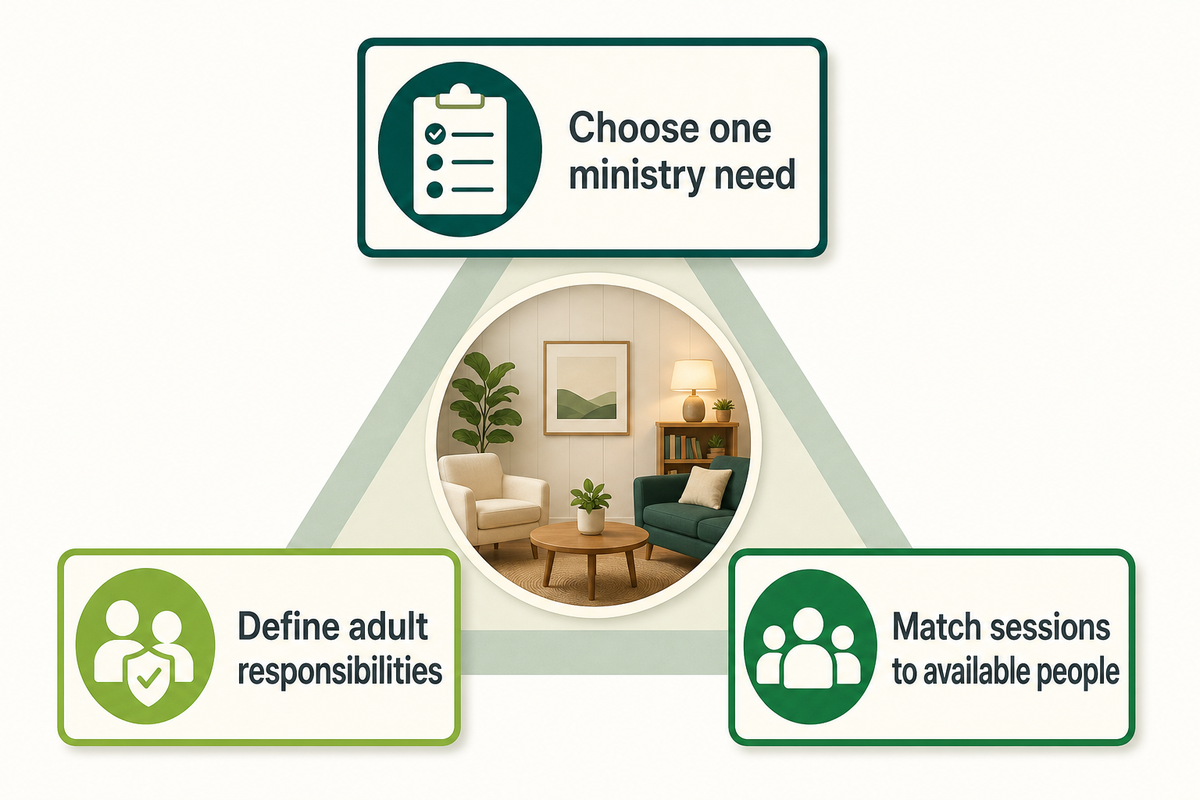
Choose the playground’s main purpose and adult-responsibility model before discussing attractions. A children’s ministry session, a parent-accompanied weekday visit and an outside provider’s programme can use the same play area while needing different teams and agreements. Determining the operator helps the church leadership decide what the church is actually committing to support.
Focus on one need, for example, providing space for children to play while caregivers meet, or an indoor activity for local families. A broad wish to create a safe, family-friendly space still leaves opening hours, staffing and the next room user undecided. Determining everyday arrangements is essential for a welcoming environment.
For example, the published FAQs for Lakeland Park state that children must be accompanied by an adult and the park doesn’t provide childcare. The FAQs describe Park Rangers and volunteer Park Guides. In this example, the responsibility of having an adult present and the responsibility of hosting the venue are distinct. Neither describes your program’s licensing status.
Imagine a small congregation considering a Saturday family gathering. The church’s community team wants conversation and fellowship among young families, while the volunteer coordinator can reliably cover one morning each month. A weekly public opening would exceed that commitment. The board chooses the monthly gathering for its initial design, assigns a host and asks how to create a space for the kind of play families would use. If someone comes to church for the first time through the gathering, the host describes what activities are available. If “helps children learn” or “cognitive development” appears in the ministry brief, the programme leader defines the activities and feedback that would test those goals. No equipment purchase promises those outcomes.
Do indoor playgrounds help attract new families?
A church play space can give local families a reason to visit, but doesn’t establish they’ll join the congregation. Record the need you want to meet, listen to visitors and compare what you actually delivered against your plan. A board evaluating playgrounds for churches should ask what they can actually sustain before projecting attendance growth.
Choose a room that works before and after Sunday services
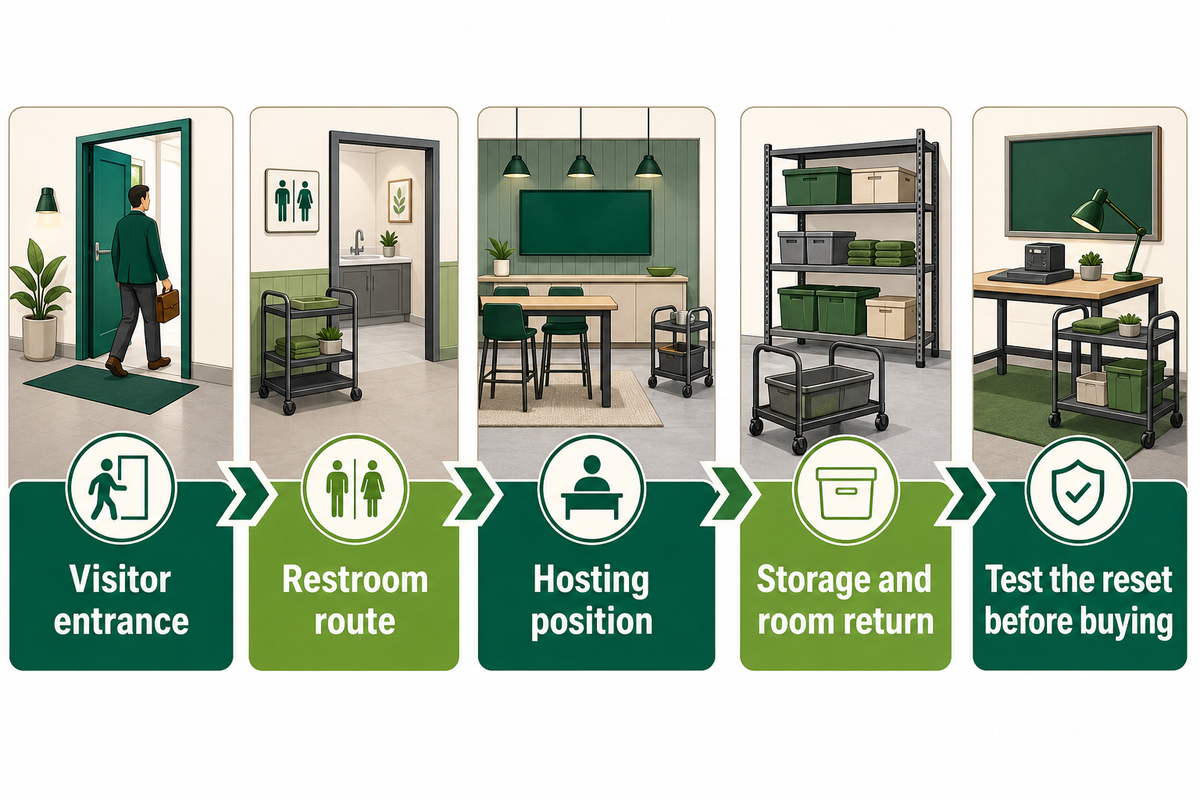
To select a room, consider its function throughout the week including what happens immediately before and after play. Available space includes arrival, waiting, storage and routes through the building. The footprint of the equipment alone doesn’t show if a shared church room can return to teaching, meeting or worship in time.
Perform the walk beginning from the entrance a visitor will actually use. Identify doors, columns, low ceiling services and path to the restrooms. Ask a volunteer to stand in the proposed hosting position while another person follows the children’s route. Consider how the room will cater for participation and sensory needs; a quiet corner can’t guarantee an entrance is accessible.
Sharing classrooms is a known planning challenge. In a historical Church Executive article by architects Allison Parrott and Paul Lodholz, using movable furniture and providing storage address Sunday and day school use. The article offers practitioner context, not a current building rule or a study of every church.
Imagine a meeting taking place in the fellowship hall at 12:30 p.m. The planning team thinks play stops at noon and tests a hypothetical 20-minute reset. Families are still collecting bags while volunteers move suitable portable equipment to storage. A trolley can’t pass the waiting area because it blocks the path. The facilities lead changes the sequence to first finish visitor departure, next clear the path, and finally, reset the hall. If that sequence takes longer than the booking allows, the team changes the session or equipment proposal before buying.
Once the room’s uses are agreed, use the existing guide to selecting the best layout for the agreed room to explore configurations. Keep the measured room and weekly calendar together when choosing the right layout; do not substitute a generic area-per-child rule for the equipment, building and programme reviews.
Compare portable soft play, a fixed structure and outdoor play
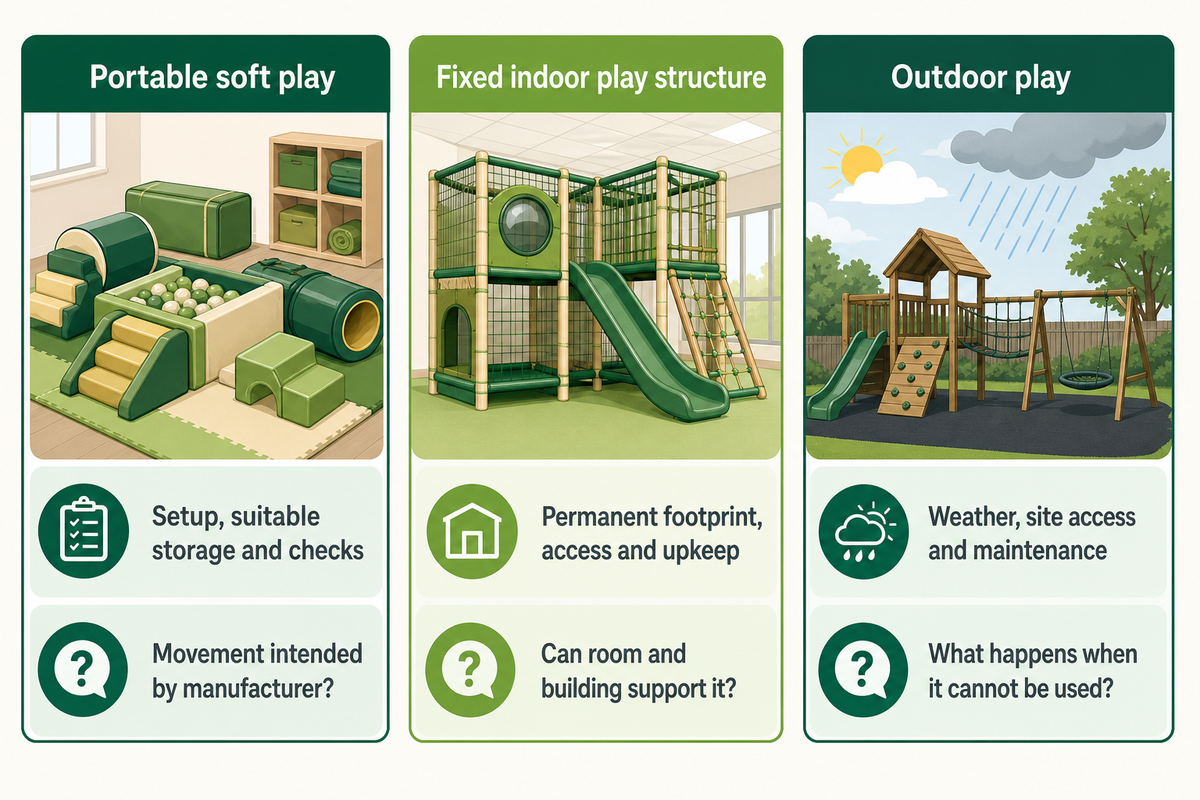
An equipment approach should be considered in relation to the work it creates and the space it occupies, then checked for product and building feasibility. Portable soft play can suit a changing room when the products permit that use. A fixed structure requires a dedicated space. Outdoor play introduces weather and site conditions and is a location choice, not a fixed equipment synonym.
| Approach | Operating commitment | Decision that can block it |
|---|---|---|
| Portable soft play | Setup, suitable storage and checks for each arrangement | Who handles it, and is repeated movement intended by the manufacturer? |
| Fixed indoor play structure | Permanent footprint, equipment access and upkeep | Can the room and building support the proposed installation? |
| Outdoor play | Weather decisions, site access and outdoor maintenance | How will the programme operate when that area cannot be used? |
User group and setting must be defined for commercial playground equipment for churches. Compare commercial-grade playgrounds designed for these uses against an agreed room commitment. A household playset, an infant product and a soft contained system aren’t interchangeable just because they’re all designed for children. The Consumer Product Safety Commission’s soft contained checklist, for example, includes netting, cargo webbing and floor surfacing checks. Those components create work that’s more than just putting away toys.
Assess different age ranges and activity speeds without inventing a single age split for all play systems. Older children may seek climbing routes, and the youngest members may need a different setting. For infant and toddler decisions, refer to church nursery soft play planning as opposed to adapting an older child format. Interactive panels and age-appropriate play equipment still require product specific use instructions.
A church considering affordable church playground equipment should price the room commitment that fits its agreed uses. Choose playgrounds that fit the room’s agreed uses. A fixed structure that displaces a valued hall activity may be a poor choice even when its purchase price is affordable. A portable option also needs an achievable handling routine. Selecting the right playground equipment addresses this tradeoff with the operating team.
Build a weekly operating plan before you approve a layout
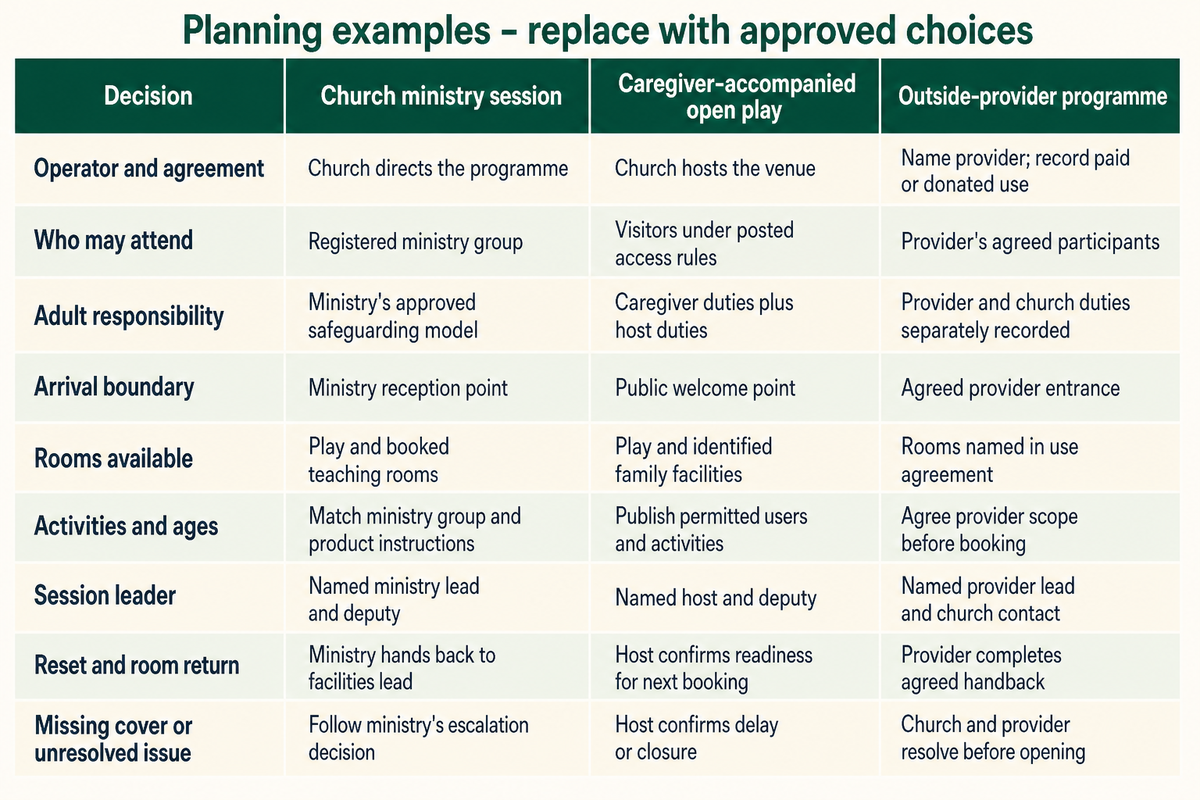
Each session must be defined as its own operating agreement, with an identified operator, definition of adult responsibilities, and a room return owner. A weekly calendar records when play happens; it does not explain who accepts responsibility when the next team arrives. The same indoor playground can change access rules for Sunday ministry from weekday community use.
Flexible examples of published church choices are available. Preston Trail’s playground page requires adult supervision, describes closure before Sunday services and doesn’t allow for private reservations. Lakeland Park publishes public opening hours and party options. Neither model is a requirement for another church; they help identify decisions that a generic “open to families” sign leaves unanswered.
Sunday-to-Weekday Session Switchboard
Use the example below to describe your church’s choices, and substitute these examples with the church approved choices. The “outside provider” example captures the operator and use agreement, rather than defining the agreement with respect to the law. Control of the program, paid rent, and donated space, may be important, regardless of the day on the calendar.
| Decision | Church ministry session | Caregiver-accompanied open play | Outside-provider programme |
|---|---|---|---|
| Operator and agreement | Church directs the programme | Church hosts the venue | Name provider; record paid or donated use |
| Who may attend | Registered ministry group | Visitors under posted access rules | Provider’s agreed participants |
| Adult responsibility | Ministry’s approved safeguarding model | Caregiver duties plus host duties | Provider and church duties separately recorded |
| Arrival boundary | Ministry reception point | Public welcome point | Agreed provider entrance |
| Rooms available | Play and booked teaching rooms | Play and identified family facilities | Rooms named in use agreement |
| Activities and ages | Match ministry group and product instructions | Publish permitted users and activities | Agree provider scope before booking |
| Session leader | Named ministry lead and deputy | Named host and deputy | Named provider lead and church contact |
| Reset and room return | Ministry hands back to facilities lead | Host confirms readiness for next booking | Provider completes agreed handback |
| Missing cover or unresolved issue | Follow ministry’s escalation decision | Host confirms delay or closure | Church and provider resolve before opening |
In a fictional Sunday programme, play ends at 11:30 a.m., room handback is booked for 11:45 a.m. and the next ministry starts at noon. The 15-minute handback interval is a planning assumption to test, not a cleaning or safety requirement. During rehearsal, the ministry lead discovers nobody owns the change of door access. The facilities lead accepts that task and the next ministry confirms the room state. On Wednesday, a different host opens accompanied play from 10 a.m. to noon and closes access afterwards. Both sessions use the same equipment, but their teams and access boundaries are recorded separately.
Can indoor playgrounds be used outside regular service hours?
Indoor playgrounds can be used outside of service hours with the church’s approval of the programme, access, supervision model and supporting resources. Public church pages provide multiple options instead of one to copy. Before announcing weekday sessions, complete the operator and room-return decisions so visitors do not arrive expecting a service the team cannot provide.
Separate the opening budget from the cost of staying open
Approve the initial project scope and continuing operating allocation separately, even if funds are raised for both with the same campaign. Creating affordable playgrounds for churches goes beyond comparing equipment prices. The board needs to decide how to fund the ongoing costs of cleaning and repairs and of hosting events, and provision for equipment replacement after the opening event. Cancellation of bookings affects use provided.
The Department of Energy’s life-cycle-cost training shows the differences in the costs for the purchase and the ownership of an item. Its examples concern energy products and federal purchasing, not church playground prices. A good accounting question is to consider what ongoing costs your programme creates.
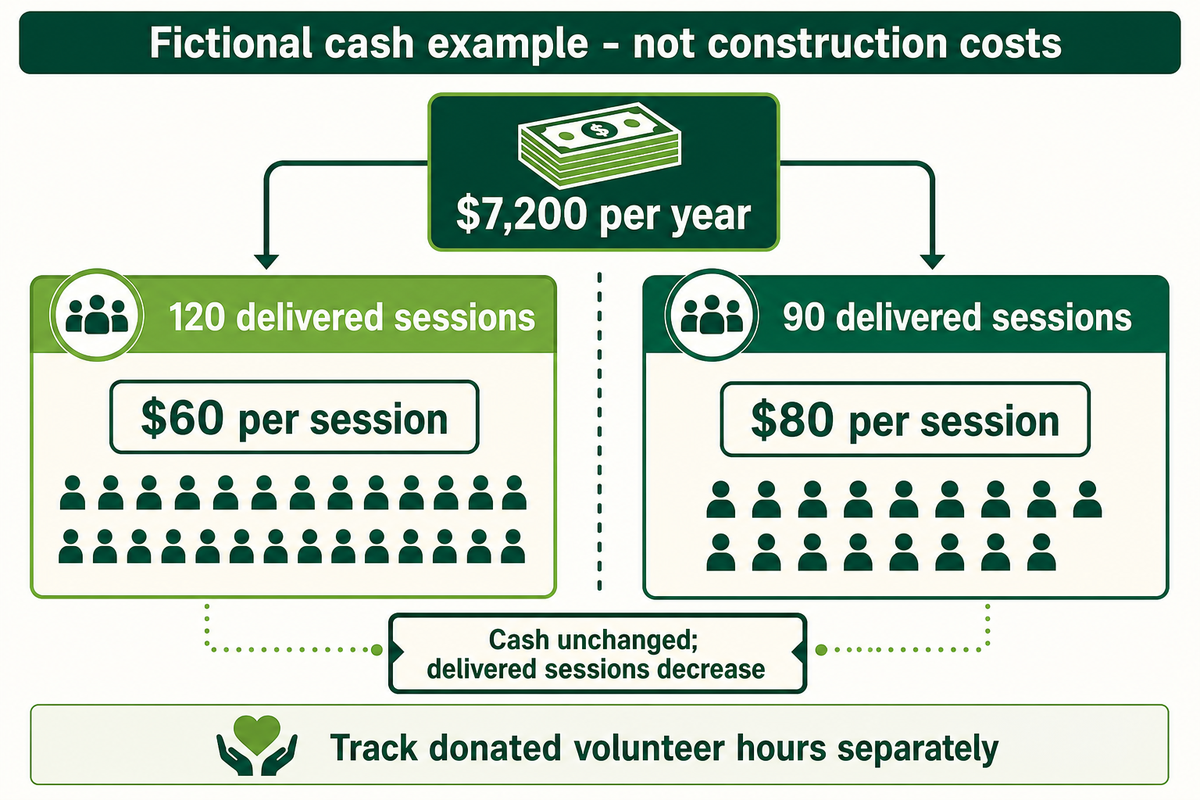
Suppose a church allocates a fictional $7,200 per year for its play programme and plans 120 delivered sessions per year . With this amount and a plan of 120 delivered sessions, $7,200 works out at $60 per session. If staff gaps reduce delivery to 90 sessions per year and the cash total remains unchanged, the result is $7,200 ÷ 90 = $80 per session . The lower session count changes the cost of each delivered opening. These inputs are made up to demonstrate the calculation; they do not estimate your church’s costs or the value of its ministry.
Make the cash amount and donated volunteer hours clear. Recalculate the $7,200 and the session count when you have to cover paid staff or repair and utility bills. An upfront campaign can include future operating reserves; the distinction is what the money has been allocated to support. Count delivered sessions rather than sessions cancelled.
Is a playground worth the investment for smaller churches?
A smaller church can evaluate the investment by matching an identified family need with funded sessions and available people. Use the operating allocation and room commitment together; the equipment price alone won’t indicate sustainability of the program. Starting with a manageable schedule also leaves the board a concrete proposal to review before committing more space.
Equipment, scope, quotes and funding routes are described in the existing guide to creating affordable playgrounds for churches. A playground for your church can be affordable to buy while exceeding the available weekly team commitment. Present that commitment alongside the capital request instead of promising a return from visitor numbers.
Ask the right people about equipment, building approval and insurance
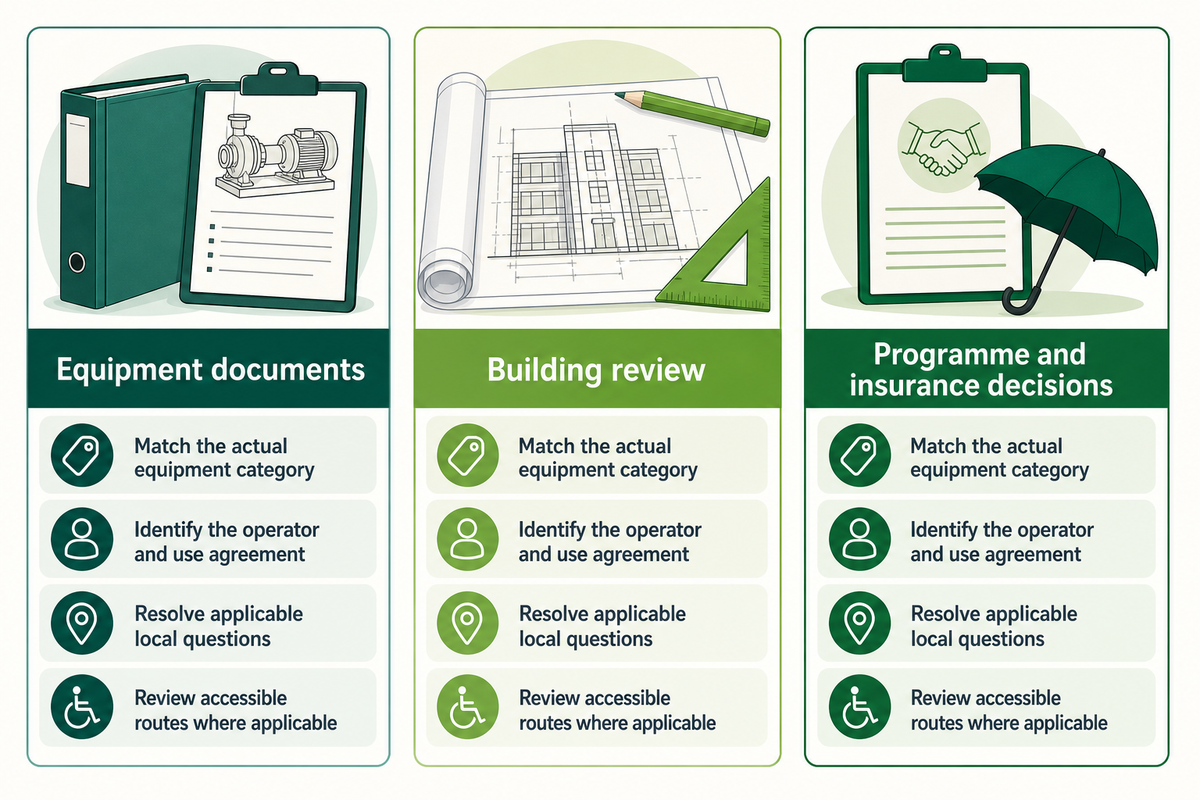
Separate the equipment documents from building and program/insurance decisions. A supplier can help explain its proposed playground equipment and provide related documentation. Local professionals and authorities can assess the building and operating requirements. Church leadership and the insurance company can address the proposed use and concerns. A general statement about safety standards can’t address all concerns.
Public Scope of ASTM F1918-21 addresses soft-contained play equipment and excludes others. It doesn’t include a complete accessibility assessment and doesn’t cover all play equipment. Match the proposed indoor playground equipment to the correct product category; request documents for that equipment and destination rather than relying on a logo in a brochure.
Building feasibility should be reviewed prior to selecting church playground equipment. In a 2025 Tucson commercial permit review, the fire reviewer requested play-structure information and building separation details. That is a local example of the questions a project may raise, not a nationwide church threshold. You should ask your own reviewer about the proposed structure, exits, ceiling services and materials.
Department of Justice guidance, III-1.5200, distinguishes religious-controlled activities, nonreligious paying tenants and donated-space arrangements. Apart from that, ChildCare.gov states licensing and exemptions vary from state to state and territory to territory. Caregiver presence alone isn’t a nationwide exemption test. Resolve the relevant local questions, including whether guidance for daycares applies, and identify who’s responsible for providing the program.
As with any inclusive play experiences, review the physical routes available and the activities individuals can participate in. The Access Board’s soft-contained entry provisions address accessible routes where applicable. A sensory-friendly session is not evidence of physical compliance. Review the entry and participation requirements with the project team, but don’t assume the same obligations found in federal requirements for every church arrangement.
Do
- Identify the actual equipment and proposed use.
- Record the operator and room-use agreement.
- Ask the relevant reviewer for site-specific decisions.
Don’t
- Apply a household product label to a commercial installation.
- Treat an equipment report as approval for the building.
- Infer every operating obligation from religious ownership.
Use church playground responsibilities and insurance questions for the specialist discussion. This planning guide doesn’t provide a legal opinion, a staffing ratio or a complete safeguarding policy. The unresolved items are to be referred to those who are authorised to make the decisions.
Prepare a church project brief for the design team
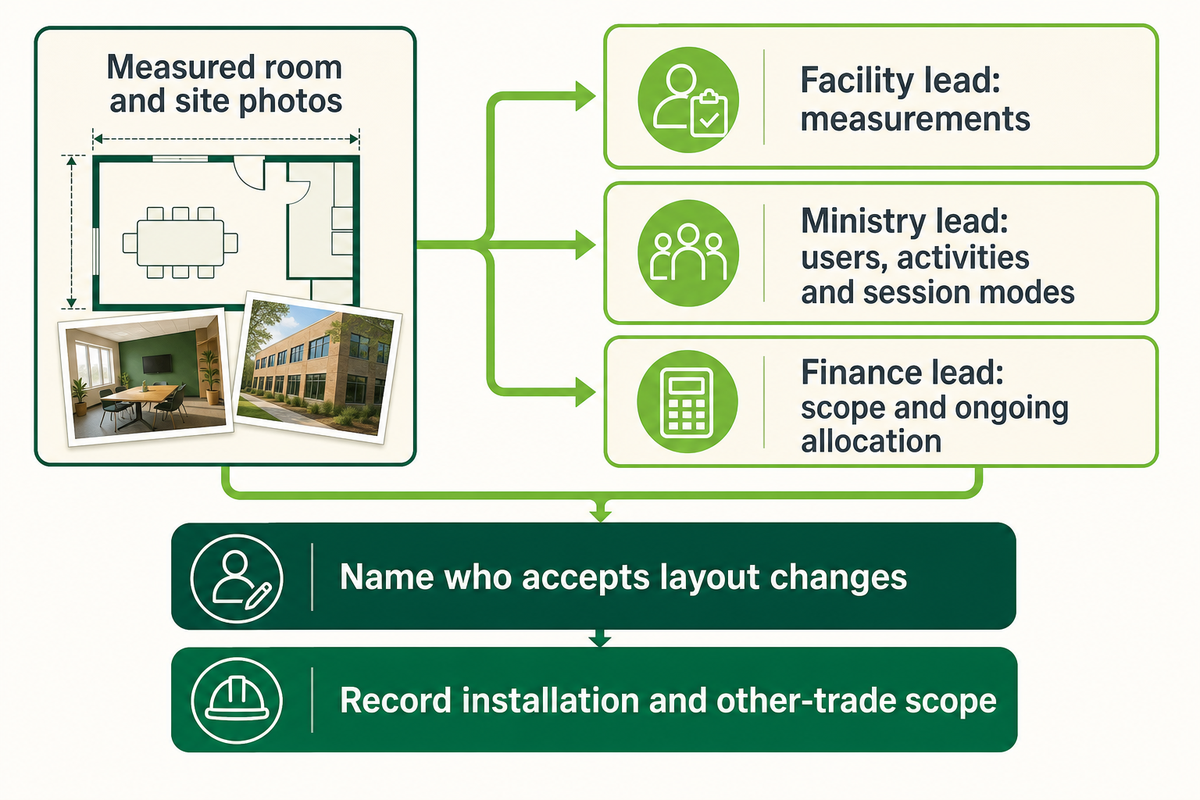
Send the supplier a brief that relates measured room information to approved ministry decisions and their owners. A drawing becomes more useful when it depicts which programme has priority and which decisions are still open. The church’s facilities, ministry and finance leads should agree what the initial proposal must preserve before reviewing additional attractions.
Begin with the measured floor plan, clear height, columns, doors and ceiling services. Attach site photos. The Facility lead confirms measurements. The Ministry lead identifies age groups, activity and session modes. The Finance lead confirms the project scope and ongoing allocation. Name the person who accepts layout changes, so a later request does not quietly remove another ministry’s space.
When reviewing playground equipment for churches and religious organizations, include intended frequency of use, suitable storage, and maintenance access. The installer must have the site and handling arrangements. The purchase and installation of playground equipment requires written clarity on professional installation, safety surfacing and the work of other trades.
A brief for faith-based organizations and worship centers might say: the fellowship hall has to be available for teaching after play, caregivers have to stay during public sessions, and the facilities manager has to approve the reset procedure. These statements help guide a proposal for thoughtfully designed play. Asking for a larger structure or themed picture isn’t as helpful.
Dreamland Playground’s public service description covers planning, design, production, shipping, installation support and after-sales. For custom church playground design and equipment, provide the agreed brief and request a quote against that scope.
Test opening-day routines before inviting the community
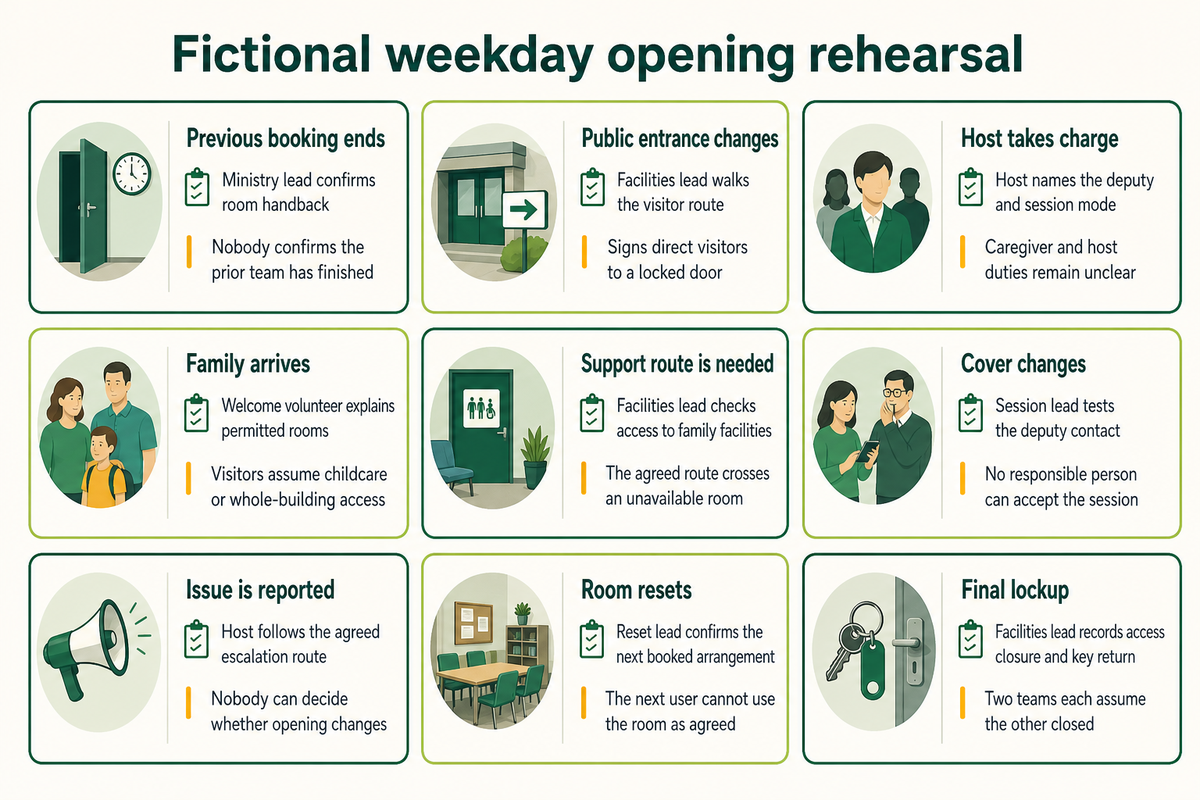
Rehearse the room and team transitions before public opening with the people who will be running it. Preston Trail specifies a weekday visitor entrance while other doors stay locked, a published example of why the opening team needs to confirm the public route for its intended session. Using the example of the session host: can the host explain what’s about to happen; is the right entrance opening; does the next user of the room receive the room in the state they expect? This rehearsal exposes unresolved operating decisions; it does not replace equipment inspection, safeguarding, childcare procedures or professional approval.
Opening Rehearsal: Arrival to Final Lockup
In the completed example below, a weekday caregiver-accompanied session follows a ministry booking. Each observation has an owner and a visible failure condition. Replace the example roles with actual names. Nursery collection, allergy information and personal-care procedures remain within the church’s established specialist policies.
| Switch point | Example owner and test | Unresolved if… |
|---|---|---|
| Previous booking ends | Ministry lead confirms room handback | Nobody confirms the prior team has finished |
| Public entrance changes | Facilities lead walks the visitor route | Signs direct visitors to a locked door |
| Host takes charge | Host names the deputy and session mode | Caregiver and host duties remain unclear |
| Family arrives | Welcome volunteer explains permitted rooms | Visitors assume childcare or whole-building access |
| Support route is needed | Facilities lead checks access to family facilities | The agreed route crosses an unavailable room |
| Cover changes | Session lead tests the deputy contact | No responsible person can accept the session |
| Issue is reported | Host follows the agreed escalation route | Nobody can decide whether opening changes |
| Room resets | Reset lead confirms the next booked arrangement | The next user cannot use the room as agreed |
| Final lockup | Facilities lead records access closure and key return | Two teams each assume the other closed |
Add one disruption to the rehearsal: the deputy is off-duty, the previous booking runs over, or the public entrance is inaccessible. Ask the session leader to explain the agreed response. If that person needs an unmade decision from the board, resolve it before advertising the opening. Well-designed equipment supports the session; an unanswered operating question still needs an owner.
What published church play programmes can teach your team
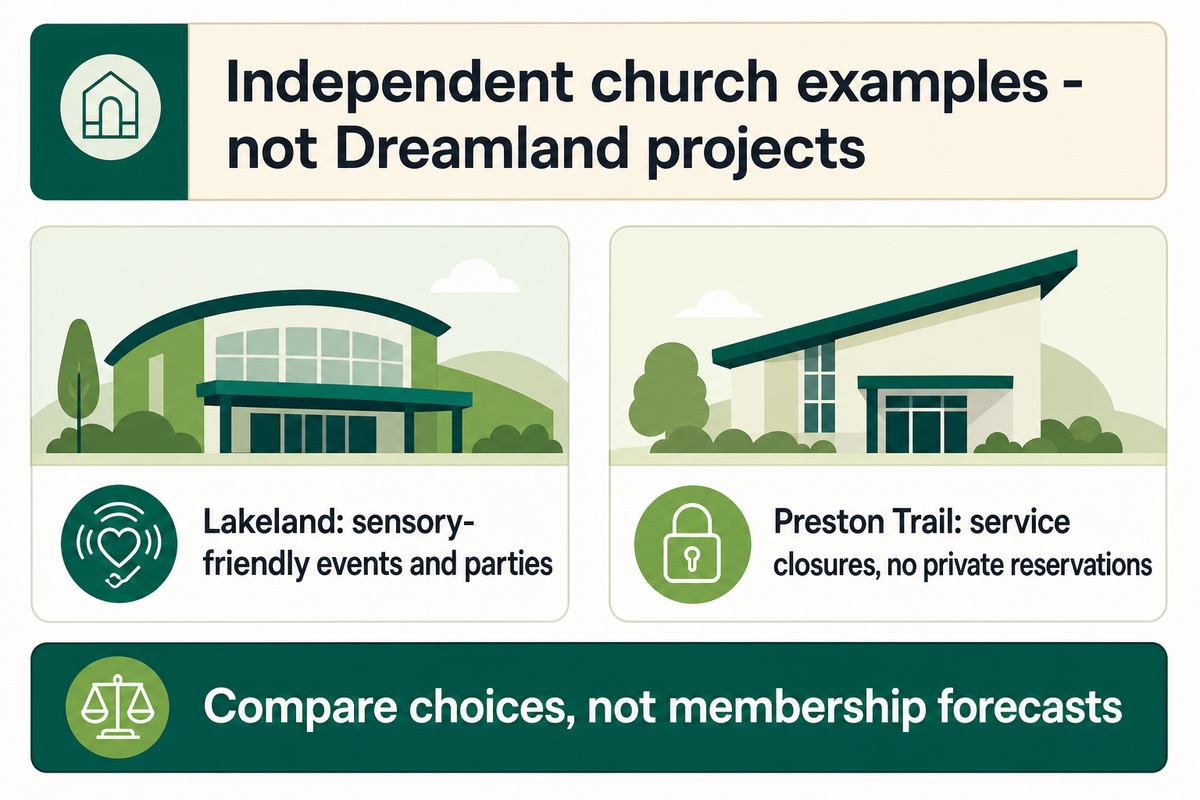
Compare published church programmes to illustrate choices, but each congregation still needs to make their own determination. Sensory-friendly sessions or public hours and party policies, for example, show what a church has decided to offer. They don’t show when the project was initiated, how much it cost, or if it resulted in membership increase.
Lakeland and Preston Trail, reviewed in October 2026, provide models for differing emphases: sensory-friendly events and parties at Lakeland; service-related closures and no private reservations at Preston Trail. A board can use the differences to ask whether its own priority is regular open play, scheduled ministry, family events or another service.
In a September 2026 article, Catalyst Construction’s Natalie Jonas, identified as its Director of Sales and Marketing, spoke about playground decisions based on community need. The contractor has a vested interest in the church building market. Its qualification is useful; its reported visitor figures don’t allow a church-wide forecast.
“Every congregation and every community is different.”
Ask which neighbourhood need the church can serve and what feedback will help review it. Creating spaces where children can engage, stay active and develop skills may be a ministry aim. Treat physical and cognitive goals as programme intentions to evaluate, rather than benefits guaranteed by the presence of a playground.
Key takeaway
A church playground plan needs an operator, a sustainable session commitment and an agreed room-return process. Choose equipment after those decisions and the site review, then rehearse the transition with the opening team.
Frequently asked questions
Are church playgrounds open to the public?
Read answer
Some church playgrounds publish community hours; others limit play to ministry activities or selected events. Lakeland Park and Preston Trail both describe public access with their own rules. Check the church’s current page before visiting. A church planning public hours should decide the permitted rooms, adult responsibilities and hosting team before announcing access. Public availability doesn’t by itself determine childcare licensing or other obligations.
How can a church plan playground supervision with volunteers?
Read answer
Define responsibilities for the intended session before assigning people. A hosting volunteer in caregiver-accompanied play has a different role from a ministry team accepting children into a church programme. Name the session leader, arrange cover and walk the actual room from the proposed positions. Follow the church’s safeguarding and equipment procedures. Where a programme needs specialist staffing or licensing review, resolve that separately; no single volunteer ratio applies to every church setting. A rehearsal should reveal whether the team knows who makes the opening decision when someone is absent. Give volunteers a chance to question the proposed roles before committing to a timetable. A named deputy who’s unavailable during the session can’t provide the planned cover. When an outside provider uses the room, identify its team and the church contact separately; don’t count an assumed church volunteer as part of the provider’s staffing. Keep the agreed responsibilities accessible to the people actually opening that session.
Can a church indoor playground be built in phases?
Read answer
A phased proposal can be considered when each opening stage works within the agreed room and programme arrangements. Ask the designer and relevant reviewers what later additions would require, and preserve necessary circulation and access in the initial scope. Don’t assume a fixed structure can simply accept extra levels later. The board should agree the first stage’s operating commitment and funding before treating expansion as part of the opening promise.
Are indoor playgrounds suitable for all age groups?
Read answer
Match equipment to its intended users and follow the product instructions. Infant care and toddler soft play may need a separate setting. Review movement speeds, support needs and physical access before specifying the mix; one structure isn’t automatically suitable for every age.
What do you need to start an indoor playground?
Read answer
Start with a ministry purpose, a measured room, an agreed operating model and funded project scope. Prepare the design brief and resolve the relevant product, building and programme reviews. Rehearse the room and team transition before opening, with named people responsible for the promised sessions.
How much does it cost to build an indoor playground?
Read answer
Request a project-specific quotation against the measured room and agreed equipment, site-work and installation scope. Keep the ongoing operating allocation separate. The session-cost example uses fictional dollar inputs and doesn’t estimate construction costs. Compare proposals with the church’s budget guide.
Bring the ministry plan to your design conversation
Share your measured room, target users, weekly programme and unresolved questions. Dreamland can discuss a custom equipment proposal around that brief.
Editorial scope: This guide uses public church policies and official guidance, and clearly labeled hypothetical examples. The mentioned churches are independent and not identified Dreamland customers. Church-specific professional review is needed for the proposed equipment, building and operating arrangement.
References & Sources
- Lakeland Park: public hours, staffing and programme FAQ.
- Preston Trail: community hours and playground rules.
- Church Executive: Engaging children’s ministry spaces.
- CPSC: Soft Contained Play Equipment Safety Checklist.
- ASTM F1918-21: public scope and status.
- DOE: Take Five, Life Cycle Costs for Acquisition.
- DOJ: Title III Technical Assistance Manual, III-1.5200.
- ChildCare.gov: child-care licensing and exemptions.
- Access Board: accessible routes to soft contained play structures.
- Tucson: commercial permit review, September 2025.
- Catalyst Construction: church play and community need, September 2026.