Get in touch with Dreamland Playground Company


Quick Specs
- Best for: nursery ministry leaders, children’s ministry leaders, and building committees planning or refreshing a church nursery for infants and toddlers
- Decision tools: an equipment-standard decision tree, a daily inspection checklist, and the 4-Factor Nursery Readiness Matrix scoring grid
- Use this guide when: you’ve a room, a rough headcount of babies and toddlers, and questions about which safety standard, ratio, and cleaning routine actually apply to a church nursery
This Church Nursery Play Guide is the practical reference church staff and volunteer coordinators use to match play equipment, room layout, and supervision ratios to nationally recognized safety standards. A church nursery serves the age group with the lowest margin for error: infants and toddlers, who can’t yet tell a caregiver what hurts and explore everything with their hands and mouths. This guide covers the equipment, room layout, volunteer ratios, hygiene standards, and daily inspection routine needed to keep a nursery ministry space safe, plus the check-in and allergy-handoff system essential for keeping track of every child in the room. It complements your church’s broader Sunday school, preschool, and children’s ministry programming, but the job of a true nursery — serving kids too young for a classroom — isn’t casual babysitting; it blends everyday physical safety with real nurture and spiritual care, so the church’s youngest members grow up in an environment every parent can trust.
The Cliff’s Notes: use ASTM F1918 for soft-contained play apparatus designed for ages 2-12, request other manufacturer certification against general CPSC juvenile-product/toy-safety specifications (as nothing under age 2 is either 1918 or 2373), budget roughly 35 square feet per child as a common daycare-licensing reference point, not a binding church rule (nurseries generally are not licensed, but fire/sanitation/background checks still might be), keep supervision ratios no wider than Head Start’s 1:4 outdoor floor for children under three, look over the room daily for loose/missing components/exposed hardware, and know the distinction between cleaning, sanitizing and disinfecting.
What this guide covers: this practical church nursery checklist compiles federal and industry church nursery guidelines on equipment standards, room layout and sqft planning, volunteer readiness, infant-vs-toddler equipment selection, surfacing materials, hygiene protocol, daily inspection, check-in/allergy systems, spiritual nurturing alongside physical safety, a readiness scoring tool, current planning-data trends, and budget/procurement. It isn’t legal, licensing, or building-code advice — confirm your state’s childcare-licensing exemption status and your denomination’s own safety policy before finalizing plans.
Which ASTM Standard Actually Applies to Your Nursery
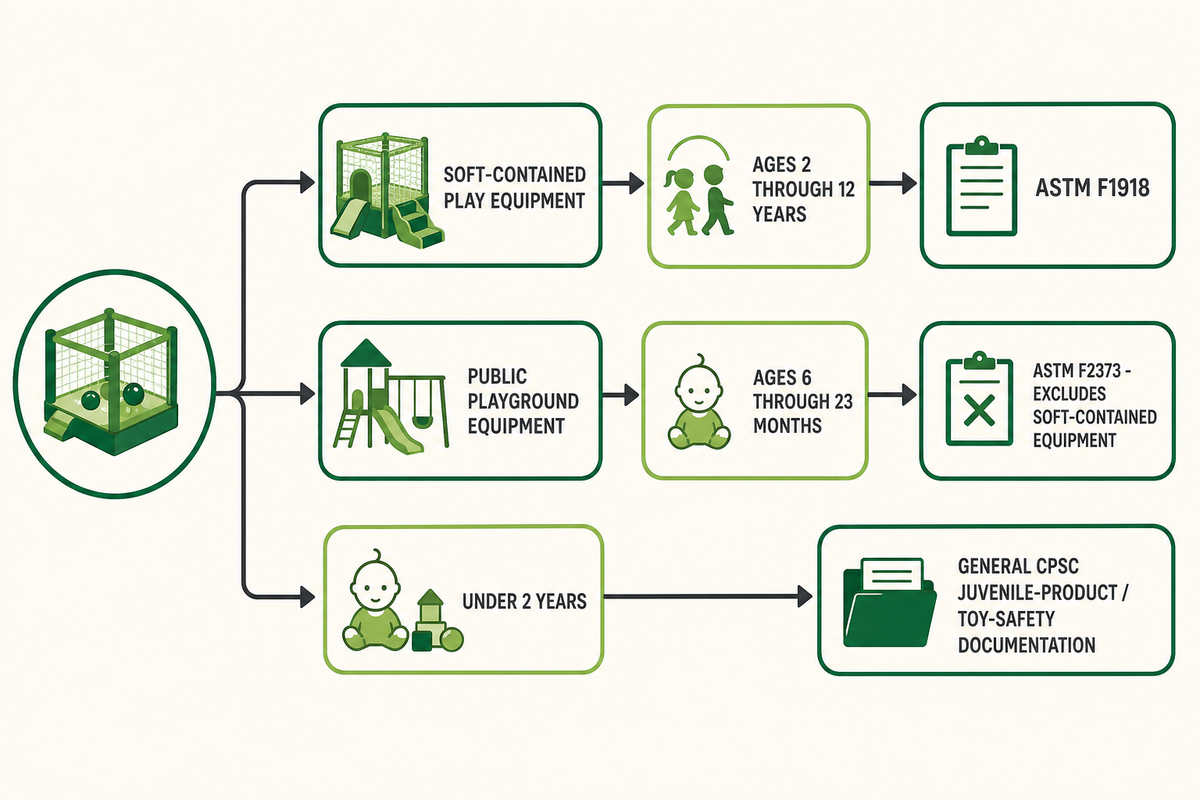
Soft-contained play equipment for the 5th-percentile 2-year-old through the 95th-percentile 12-year-old falls under ASTM F1918. Public-use equipment for children 6 through 23 months falls under ASTM F2373, though F2373’s own Section 1.5 excludes soft-contained equipment from its scope — a similar scope exclusion commonly attributed to ASTM F1487, the default standard for public playgrounds. Equipment for children under 2 sits in a gap: no dedicated play-equipment standard, so it’s governed instead by general CPSC juvenile-product and toy-safety rules.
Many church nursery guidance sources either skip equipment standards entirely or cite the wrong one, in part because the standard names sound interchangeable to a committee that isn’t reading past the title. The distinction matters in practice, not just on paper — based directly on the scope sections of the standards themselves, not third-hand repetition, the next section walks through exactly where that under-2 coverage gap comes from and what to ask a vendor about it.
Line those three scopes up and a real gap appears: soft-contained equipment built for children under 2 isn’t covered by F1918 (starts at 2) or by F2373 (excludes soft-contained equipment outright). CPSC’s own guidance acknowledges this — staff have historically flagged that public and home playground equipment standards were sometimes applied to childcare situations “where they may not have been appropriate,” and CPSC is supporting F2373’s own voluntary-standard development specifically because that gap exists. The industry is aware of the hole, too: a proposed new ASTM work item built on F2373 aims to add toddler-specific play equipment requirements to the standards landscape, though it explicitly still excludes soft-contained equipment from its own draft scope. Until that gap closes, equipment intended for true infants and young toddlers under 2 is governed by general CPSC juvenile-product and toy-safety requirements, not a dedicated play-equipment performance spec — ask any vendor which framework their under-2 equipment is actually built to, rather than assuming an F1918 certification covers your whole room.
It’s a common assumption that ASTM F2373 covers this equipment — it does not, and that mix-up is not always caught before equipment ships. It’s a real procurement risk: a sales sheet that name-drops the wrong standard can pass an inexperienced committee’s paperwork review while leaving the room out of compliance with the standard that actually governs it. Cross-check any vendor’s certification directly against the standard’s own scope language — ASTM F1918’s published scope and F2373’s exclusion clause are both public documents, not something a buyer has to take a sales rep’s word for. Dreamland Playground sources its soft-contained pieces against the standard that actually applies to them, precisely because this mix-up is common enough in the industry to be worth a committee double-checking before a purchase order goes out.
Room Layout: Zoning a Nursery So One Volunteer Can See Everything
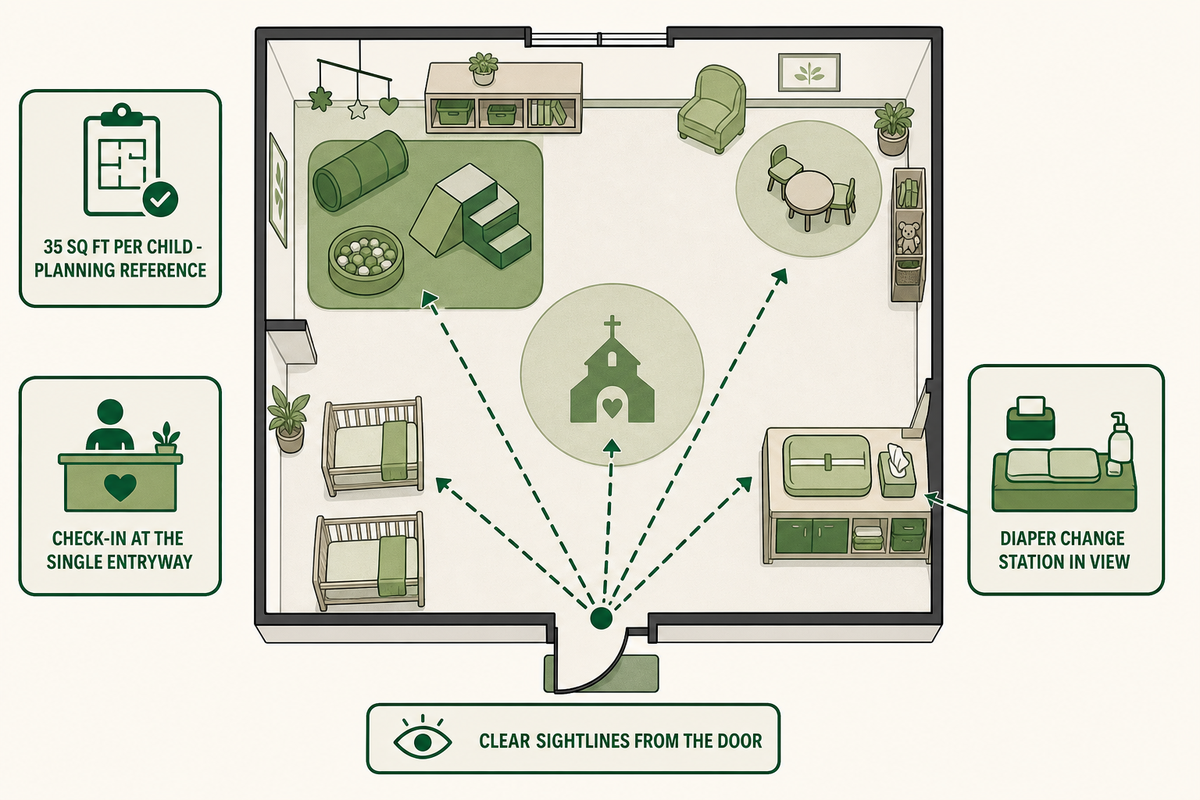
The “35 sq.ft. per child” stipulation appears time and time again during a church nursery Google search. This number comes from the Iowa state daycare licensing standard (which requires “35 square feet of usable floor space per child” in a licensed facility), although most open play areas offered at church-sponsored nurseries aren’t certified daycares, so by definition, the church nursery doesn’t necessarily need to meet this requirement to offer volunteer Sunday morning open play. By the same token, the exemption is by no means unconditional: fire code, sanitation requirements, and volunteer background-check rules can still apply even when the sqft licensing figure itself doesn’t. Consequently, although the ‘35 sq. ft’ number isn’t a binding rule for a church nursery — it serves, at least, as helpful guidance.
Reference figures for a church nursery space fall anywhere from the mid-20s to 50 sqft per child; that varies by the source: Is that referencing licensed daycare licensing requirements? General space-planning advice? Or, of course, an unlicensed portable or makeshift temporary space — which is why confusing those with strict policy guidelines for your facility is such a common issue. Children’s ministry site planning research reinforces the reasons a square-foot measurement can’t alone resolve it: informal children’s ministry and church-provided care exist in many forms, isn’t consistently regulated by the same licensing and standards, and isn’t well understood by the public in the way that a state-licensed facility is. Structure the space so that a person standing on the threshold has a view of any corner without being able to patrol a “walk,” keeping sightlines from the door into the furthest reach of a play area clear of stacks of shelving or drapery dividers, with the person “on duty” behind the check-in at the single entryway, and keeping the nursery volunteer diaper change station in view. When a room is easy to monitor, check-in and check-out also move faster, keeping social time in the lobby moving more freely instead of forming long lines at the entrance. If your facility includes a much larger space adjacent to your church “Worship Center,” our church play area design guide covers this same zoning and sight-line logic — what that guide names the Doorway-to-Play-Line Rule — at a bigger scale.
Published guidance quotes three different church-nursery square-footage figures — 25-30 sqft per child, 35 sqft per child, and 50 sqft per child — and copying just one of them is not always an apples-to-apples comparison for your specific room. Only the 35 sqft figure carries a live citation back to a government source, Iowa’s own daycare licensing rule, which is exactly why it shows up most often in published guidance even though it technically applies to certified daycares rather than church nurseries.
Treating the loosest of these three figures as a green light for the smallest possible room is a common mistake: fire code occupancy limits and background-check requirements still apply regardless of which square-footage number a committee lands on, and a room sized purely to the minimum leaves no slack for a bigger-than-expected Sunday.
The Nursery Ministry Volunteer Readiness Checklist
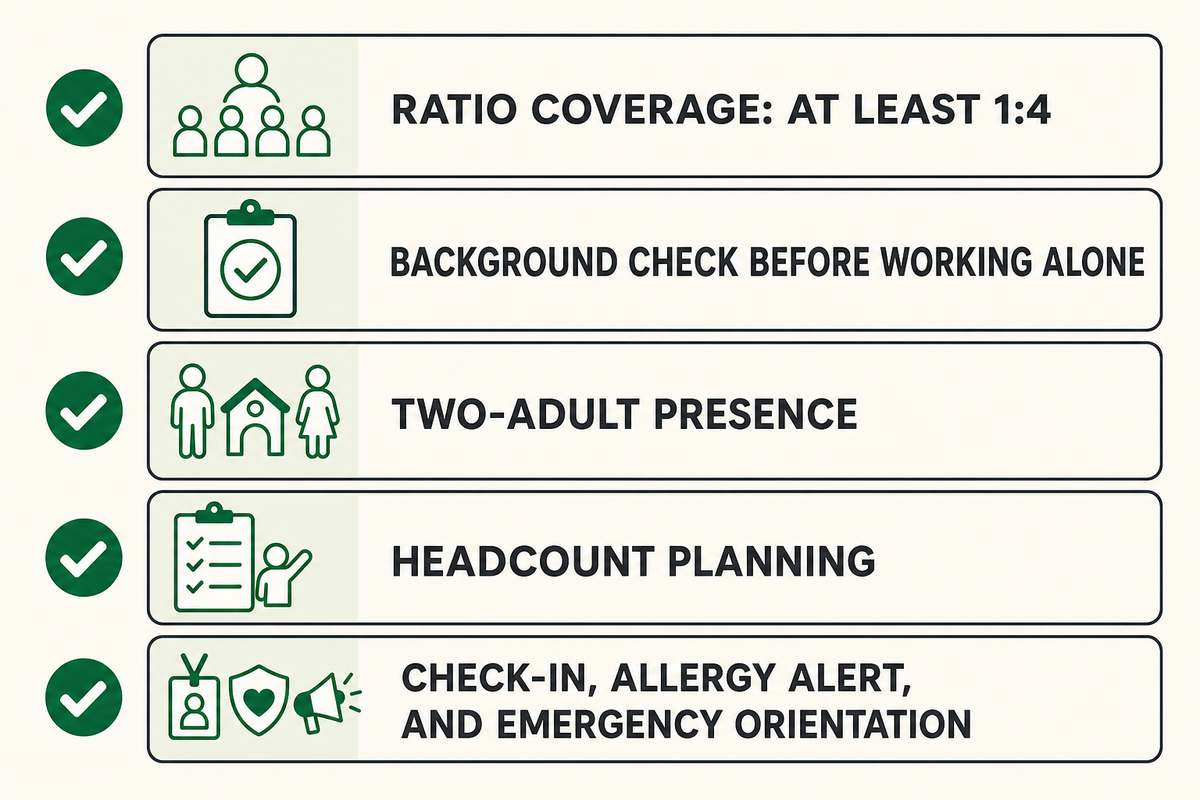
The Federal Head Start program establishes guidelines for the infants and toddlers within its youngest offerings. Early Head Start and Migrant and Seasonal Head Start, the segments of the program for 0 to-3-year-olds, each adhere to a 1:4 adult-to-children ratio as part of their active supervision requirements for outdoor play and child safety protocols. Consider this minimum ratio a helpful, federally recommended guideline floor for your church’s infants and toddlers program, not a strict state requirement: a common and preventable mistake is applying the same general ratio equally to our youngest ones in their dedicated room as to our 4-and-5-year-olds’ space, rather than giving the children under 3 the closer ratio they need from a caregiver who can’t rely on verbal redirection alone. Getting the ratio and training right gives volunteers the confidence to care for babies and toddlers knowing every child in the room is safe and well cared for.
Before a nursery volunteer — sometimes called a church nursery worker — works a shift, a readiness checklist tied to a short written job description should cover:
- Ratio coverage: at least a 1:4 ratio of volunteers scheduled in the youngest section, tighter if your own safety policy sets a stricter number for infants specifically.
- Background check completed before volunteers work alone, not after their first shift, with paperwork on file that insurers look for — see our playground insurance guide for how coverage and documentation connect.
- Two-adult presence: at all times, ensure there are at least two responsible adults in a room with a child (including well-trained volunteers and staff). Children must not be left alone with a single adult at any point.
- Headcount planning: roughly guessing how many kids might show up enables you to provide proper staffing — Portable Church’s kids-ministry guidance suggests adding roughly 2% of a congregation’s size for every birth year as an initial estimate of the number of young children requiring nursery time on a Sunday morning.
- Orientation to the check-in system, allergy-alert protocol, and emergency escalation steps covered later in this guide.
Volunteering in the nursery is often a congregation’s first hands-on introduction to children’s ministry, which is exactly why this checklist matters — it’s the difference between a volunteer who feels ready and one who’s just been handed a room full of babies.
General children’s-ministry guidance commonly repeats a flat ratio across every age band, but that is not necessarily the tighter, ministry-specific number your infant room actually needs, because Head Start’s own active-supervision guidance sets the federal 1:4 floor specifically for children under three, not for a mixed-age room next door.
Closed-door classrooms with no window, one unidentified volunteer alone in a room, an unenforced check-in system, and no way to reach parents during service are four separate safety mistakes a children’s-ministry leader flagged after visiting several different churches as a parent — not from one bad Sunday, but a pattern she saw repeat across churches. Her own conclusion:
these are things we cannot get wrong as children’s ministry leaders, regardless of budget or volunteer count.
Equipment That Belongs in an Infant Room vs. a Toddler Room
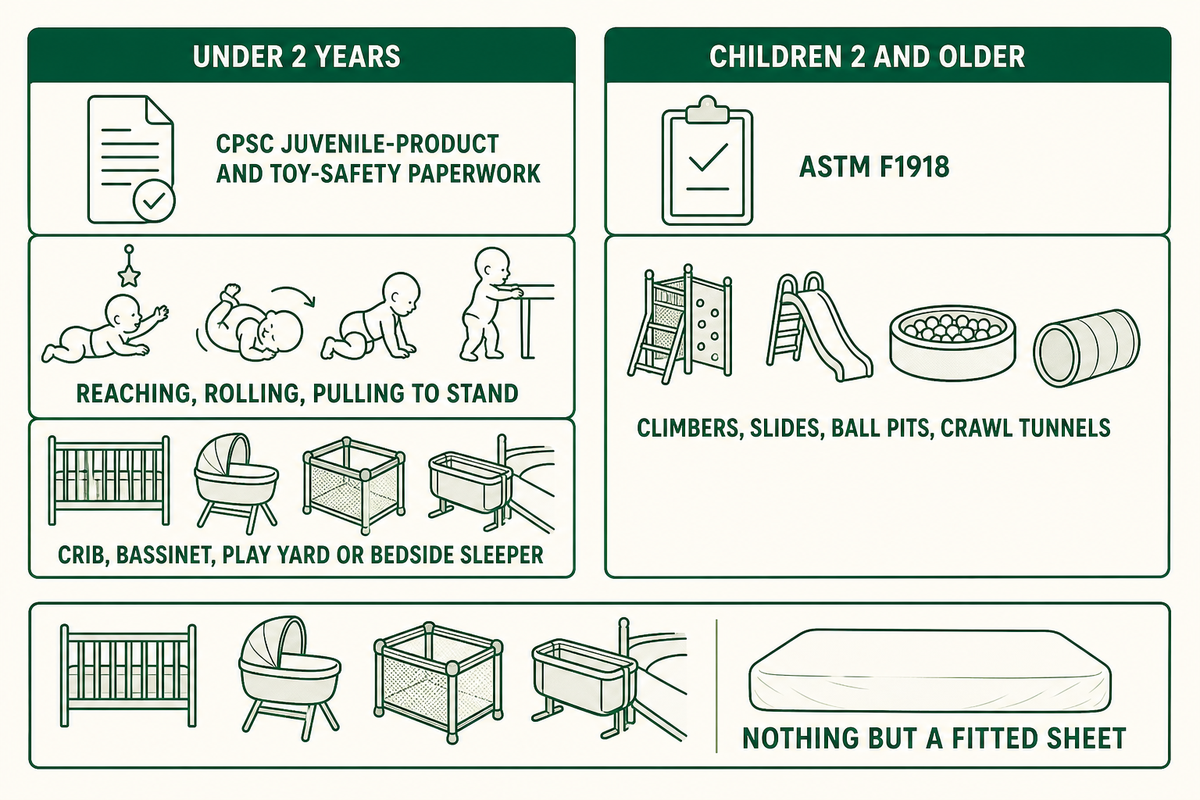
Use the same age line the standards themselves draw. For a toddler room serving children 2 and older, soft-contained play equipment (climbers, slides, ball pits, crawl tunnels) should be built to ASTM F1918. For a room serving true infants under 2, don’t ask a vendor for an F1918 certificate — ask what CPSC juvenile-product and toy-safety paperwork backs that specific piece, since neither F1918 nor F2373 was written to cover it. Equipment for this youngest band should support early motor skills — reaching, rolling, pulling to stand — rather than the climbing-and-sliding equipment built for the 2-and-older room next door. Adding a dedicated low-light corner with a rocking chair can help create a soothing environment for a fussy baby without pulling a volunteer’s attention off the rest of the room.
Any nursery that also serves true infants needs a sleep policy, separate from the play-equipment question entirely. CPSC’s recommendation for creating a safer sleep environment is direct: offer products designed solely for sleep — a crib, bassinet, play yard or bedside sleeper — that meet current CPSC requirements, and keep that sleep space bare — nothing but a fitted sheet, with no bumpers, pillows, blankets, or even weighted swaddles. Always place an infant down to sleep on their back.
They should also never be left unsupervised in anything inclined at an angle steeper than 10° — rockers, gliders, soothers, and swings all qualify — as sleep environments, since young infants can’t yet lift their own heads away from a blocked airway. If your nursery also has a crib or a designated sleep area, this sleep policy needs to be folded into the same checklist you use for play-equipment policy, rather than treated as a seemingly optional extra.
One common assumption is that a single vendor catalog covers both ends of the age range, but the paperwork trail is not always as complete as a glossy brochure makes it look: neither ASTM F1918 nor F2373 was written for under-2 soft-contained equipment, so a buyer has to ask for the actual CPSC voluntary standard for under-2 equipment by name, not just a general safety certificate. Dreamland Playground asks its factory to document which CPSC juvenile-product requirements a given infant-room piece is built to, because mixing true infants into a room built around 2-and-older climbers is one of the most common equipment-planning mistakes a new committee makes — confirming age-fit before a purchase order goes out is far cheaper than a reorder six months into a new nursery build.
Surfacing and Soft-Play Material Choices
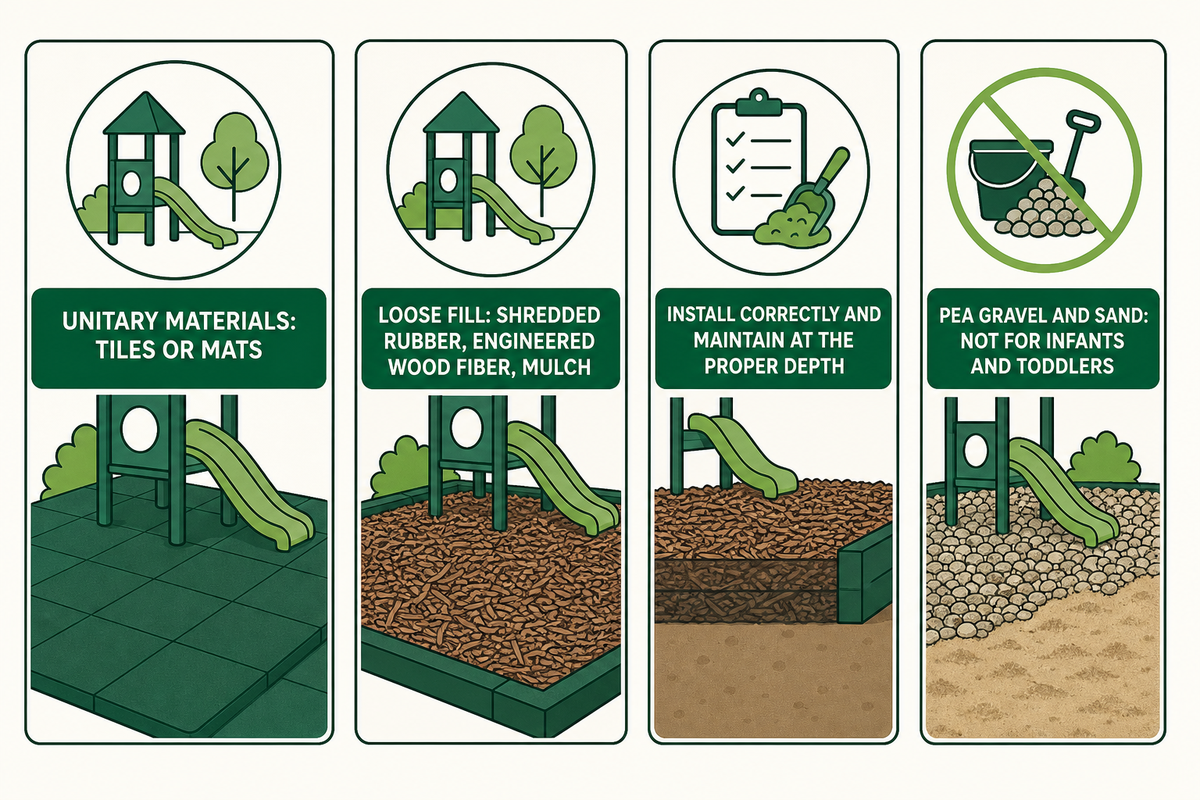
Federal guidelines that address the impact of outdoor and indoor playing surface for the infants and toddlers identify two approved categories of playing surfaces: unitary materials that can interlock with one another like tiles or mats, or loose fill that could be an engineered wood fiber with mulch, or shredded rubber. Both types can work for playing, but they come with a different maintenance commitment: you need to make sure the loose fill surface is properly placed, maintain it, and top it off to maintain the cushion necessary for the impact of falling – a task for the volunteer or facilities team on site. Unitary surfacing systems often don’t need that added ongoing upkeep, which makes them a much more feasible choice for a nursery with no full-time facilities team maintaining the building.
One age-specific exclusion is worth building into any nursery plan regardless of which surface type you choose elsewhere in the building: pea gravel and sand are explicitly called out as not appropriate protective surfaces for infants and toddlers, even though they’re acceptable for other age groups in some settings. In the field, the maintenance-wear pattern is predictable — loose-fill surfaces near a nursery’s most-used play zone compress and thin out faster than the edges, which is exactly the kind of gap a daily inspection (next section) is built to catch before it becomes a real fall-cushioning problem. Whatever material you choose, confirm it’s non-toxic and free of small detachable parts that could become a choking hazard once a toddler starts exploring with their hands and mouth.
For committees comparing the most durable flooring options for high-traffic nurseries, the tradeoff is not always about upfront price — it’s about which surface actually holds up under a Sunday-morning crowd without turning into a maintenance job. Federal play-area guidance lists unitary materials (tiles or mats) and loose fill (shredded rubber, engineered wood fiber, mulch) as equally acceptable protective surfaces on paper — but that same guidance flags loose fill as carrying an ongoing obligation unitary surfacing doesn’t: it “must be installed correctly and maintained at the proper depth” to keep cushioning falls, which is a recurring facilities task a volunteer-run nursery has to own indefinitely, not a one-time install decision. Dreamland Playground sources unitary surfacing for exactly this reason on nursery projects with no dedicated facilities staff to keep re-checking loose-fill depth.
Hygiene Protocol: Cleaning, Sanitizing, and Disinfecting
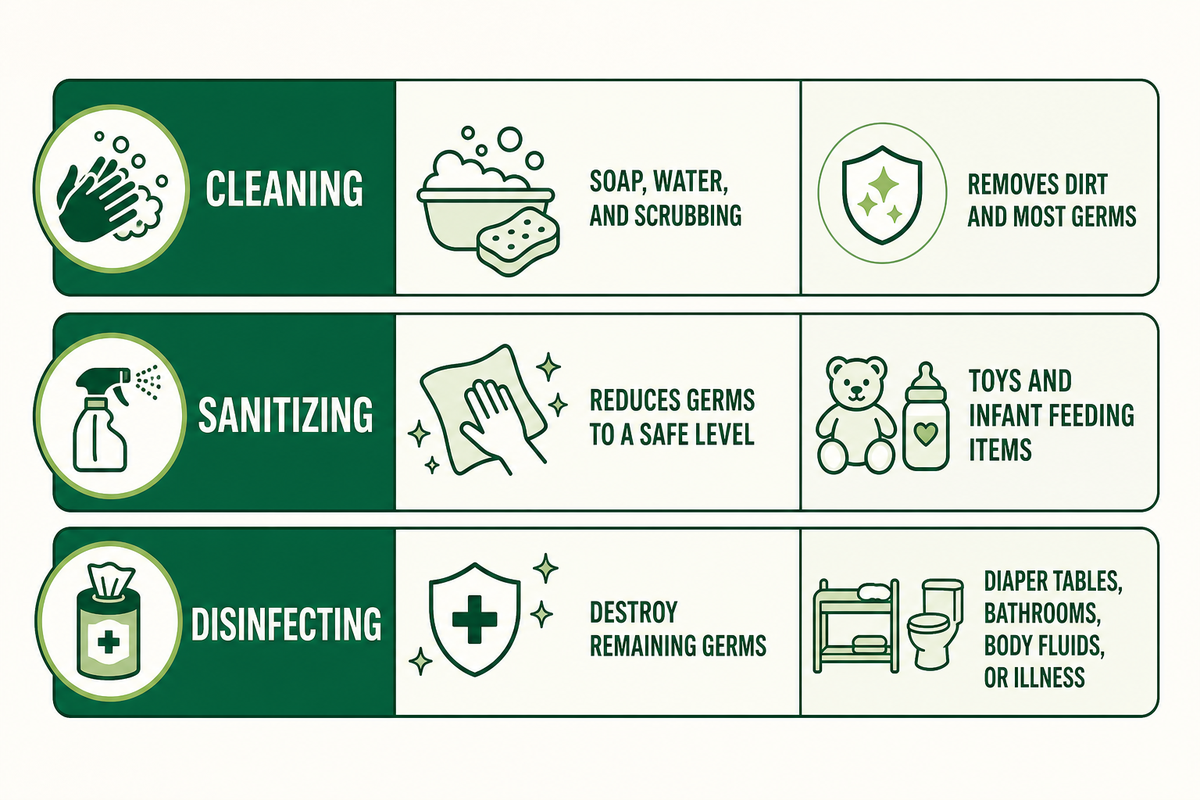
CDC’s long-standing guidance for early care and education settings treats cleaning, sanitizing, and disinfecting as three different jobs for three different situations — not one three-step routine you repeat after every single service. Cleaning (soap, water, and scrubbing) removes dirt and most germs from a surface, and should happen daily or after any meal or activity — and it always comes first, since dirt on a surface makes it harder for chemicals to actually kill anything. Sanitizing reduces germs to a safe level and is specifically for anything that touches a child’s mouth: toys, infant feeding items, and play surfaces a toddler is likely to mouth. Disinfecting uses a stronger product to destroy remaining germs, and is reserved for specific situations — diaper-changing tables, bathrooms, and any surface or object that’s been in contact with body fluids or a child who’s sick.
Build your nursery’s cleaning schedule on that same three-tier structure rather than one blanket routine. Routine cleaning: wipe down high-touch surfaces, such as door handles, the front and sides of shelves, and the changing surface, between services. Sanitizing: sanitize toys and feeding items after each use with an EPA-registered sanitizer or a diluted bleach solution. Full disinfecting: reserve for situations involving a contamination incident, contact with bodily fluids, or when a child in the room has been ill. Pair that schedule with a simple handwashing routine for volunteers (and toddlers old enough to participate) — cleanliness in a nursery starts at the sink, not just the spray bottle. Keeping a tub of general-purpose cleaning wipes within reach at the door makes the between-service wipe-down quick enough that volunteers actually do it every time.
First-time nursery committees commonly assume a single spray bottle covers cleaning, sanitizing, and disinfecting all at once — it does not, and treating all three as one step is a preventable gap the CDC’s own early-care guidance specifically warns against, because dirt left on a surface makes even a strong disinfectant far less effective. Budgeting for three labeled bottles — soap and water, an EPA-registered sanitizer, and a stronger disinfectant — costs a few dollars more per month than one all-purpose spray, but it’s the difference between a checklist that looks compliant and a room that actually is. Dreamland Playground’s nursery play equipment is chosen in part for how easily it passes this three-tier test — smooth, sealed surfaces that a sanitizing wipe can actually reach into every seam. When comparing vendors for sanitizing supplies, a committee should ask for the EPA registration number up front, not take a label’s marketing claims at face value.
The Daily Inspection Routine That Keeps a Nursery Safe
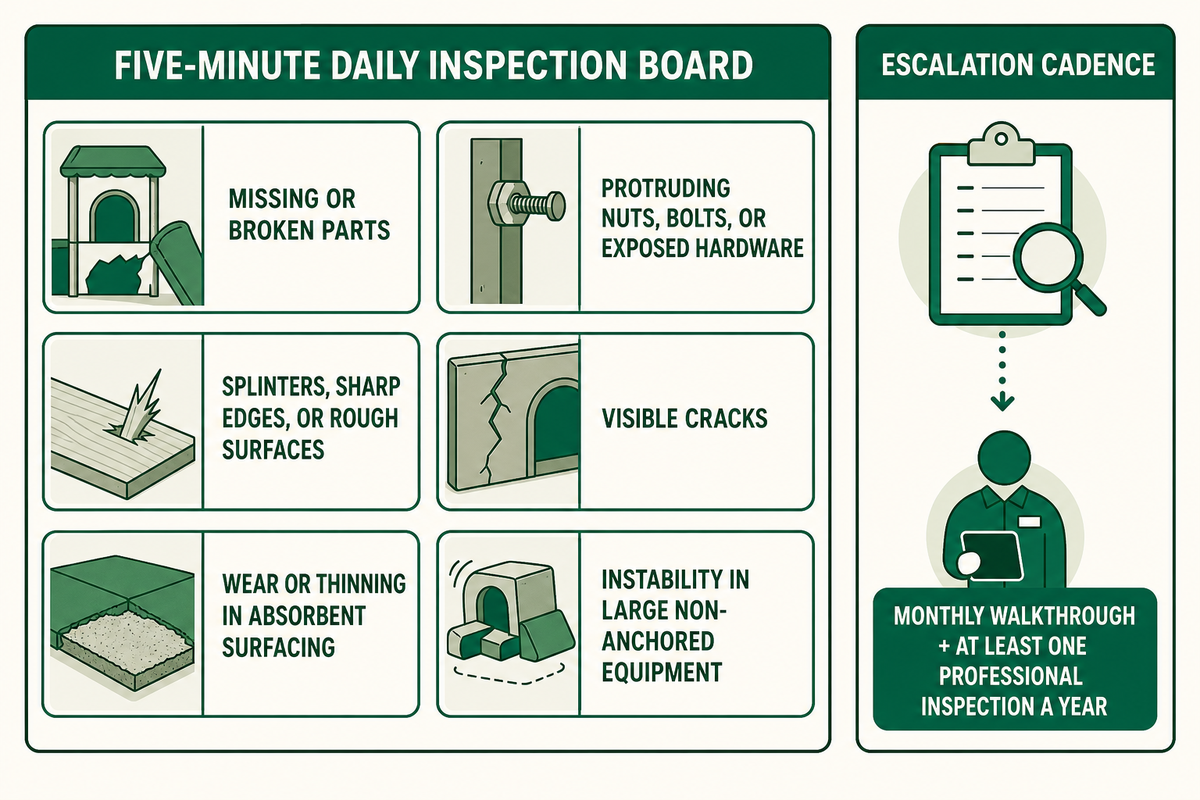
Federal childcare guidance recommends caregivers inspect indoor and outdoor play areas and toys every day, checking for: missing or broken parts; protruding nuts, bolts, or exposed hardware; rust or paint chips; splinters, sharp edges, or rough surfaces; loose railings, bars, or handholds; visible cracks in any pieces; instability in any large non-anchored equipment, such as a playhouse; wear or thinning in absorbent surfacing materials; leftover vandalism or trash; and surface temperature, to avoid burns or ice-related falls. Address anything that fails this list before kids ever play in the room.
This routine is nothing more than about 5 minutes long, not something requiring a facilities crew; one volunteer can go through the space before the doors open to note what areas need repair or addressing. This step often gets overlooked for some odd reason in published church nursery guidance; while many sources refer to “safety” in general terms, they often don’t provide an actionable checklist so kids can safely occupy your nursery.
Doing a daily walk-through is not necessarily the same thing as documenting one, and that distinction matters more than it sounds: federal childcare facility guidance expects this inspection to happen every single day the room is used, not just when something looks obviously wrong. Taping a one-page paper checklist inside a supply closet, initialed by whichever volunteer opens the room, turns a five-minute habit into something a committee can actually point to during an insurance review — rather than everyone simply trusting that someone probably checked. That daily habit is the floor, not the whole system: Head Start’s playground-safety guidance layers a longer monthly walkthrough and at least one professional inspection a year on top of the daily check, with a named person (and backup) responsible for catching what a five-minute glance might miss.
Check-In, Allergy Alerts, and Handoff Systems
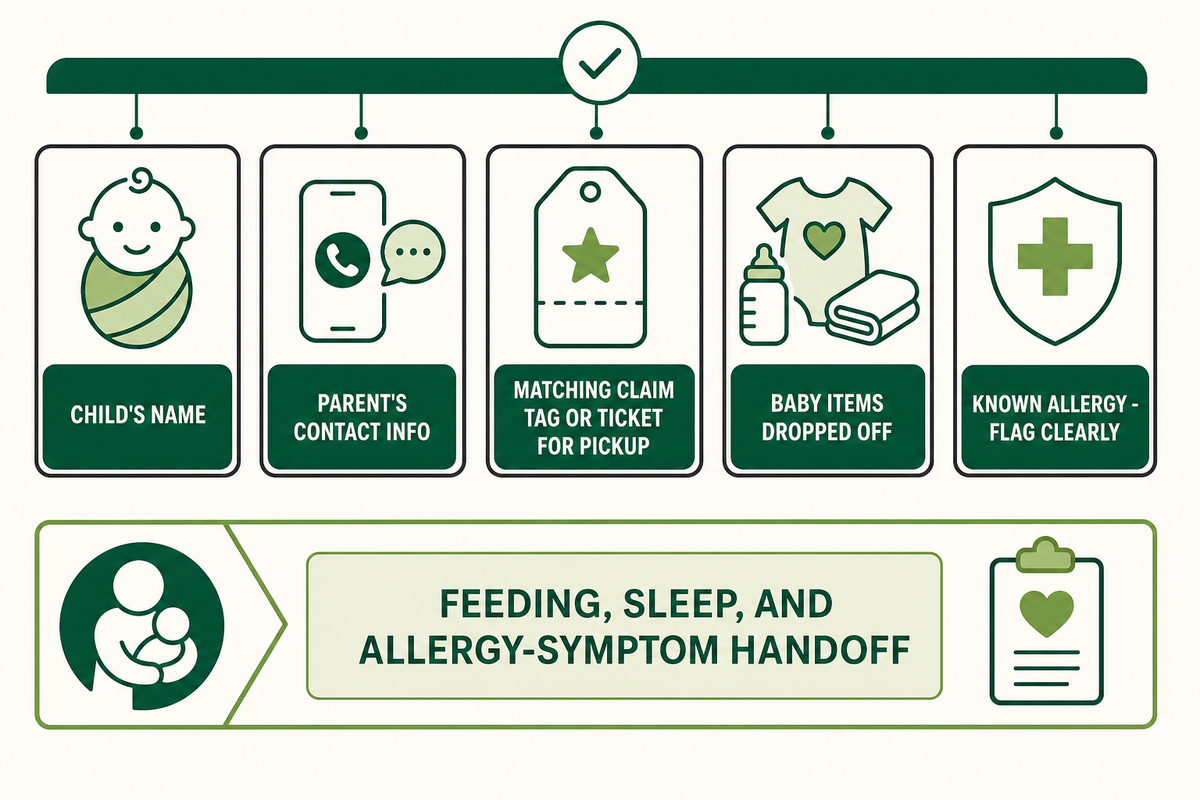
All check-in sheets should gather, at minimum: the child’s name, a parent’s contact info, a matching claim tag or ticket for pickup, a list of any baby items dropped off, and — most important — an emergency info section flagging any known allergy clearly, not buried in a notes field. A lot of intake forms let that allergy information get written down and then forgotten while the child is off playing, so the sheet alone isn’t the fix — the real gap most checklists skip is the escalation piece. It’s rare for a checklist to spell out who, specifically, on your volunteer team is authorized to give medication for a known allergy, and whether every volunteer — not just the shift lead — can actually recognize an allergic reaction and escalate it right away, rather than just knowing an allergy was listed somewhere on the intake paperwork. None of this replaces the two-adult and ratio rules from the checklist above, which still apply once check-in is done.
A handoff sheet with key info for each child coming into the nursery — feed or meal time, whether the child was just fed, how long they slept, and any allergy or allergy-related symptom — creates a direct link between your check-in volunteers and the volunteer responsible for the room. That handoff is where information most often gets lost when several people are working a busy check-in line handling dozens of forms.
Treating the handoff sheet as optional paperwork rather than a safety document is a common mistake: a baby who was already fed an hour ago and gets handed a bottle again by a volunteer who missed the note is exactly the kind of gap a committee should design the room layout to prevent, not something to fix after the fact. CPSC’s safe-sleep guidance is one more reason that sleep-time field isn’t decorative — a volunteer who doesn’t know a baby was just put down needs that information before making a placement decision. Dreamland Playground curates nursery layouts so the handoff station sits directly next to the entrance, keeping that sheet in the flow of foot traffic instead of buried at a back desk a busy check-in line never reaches.
The 4-Factor Nursery Readiness Matrix
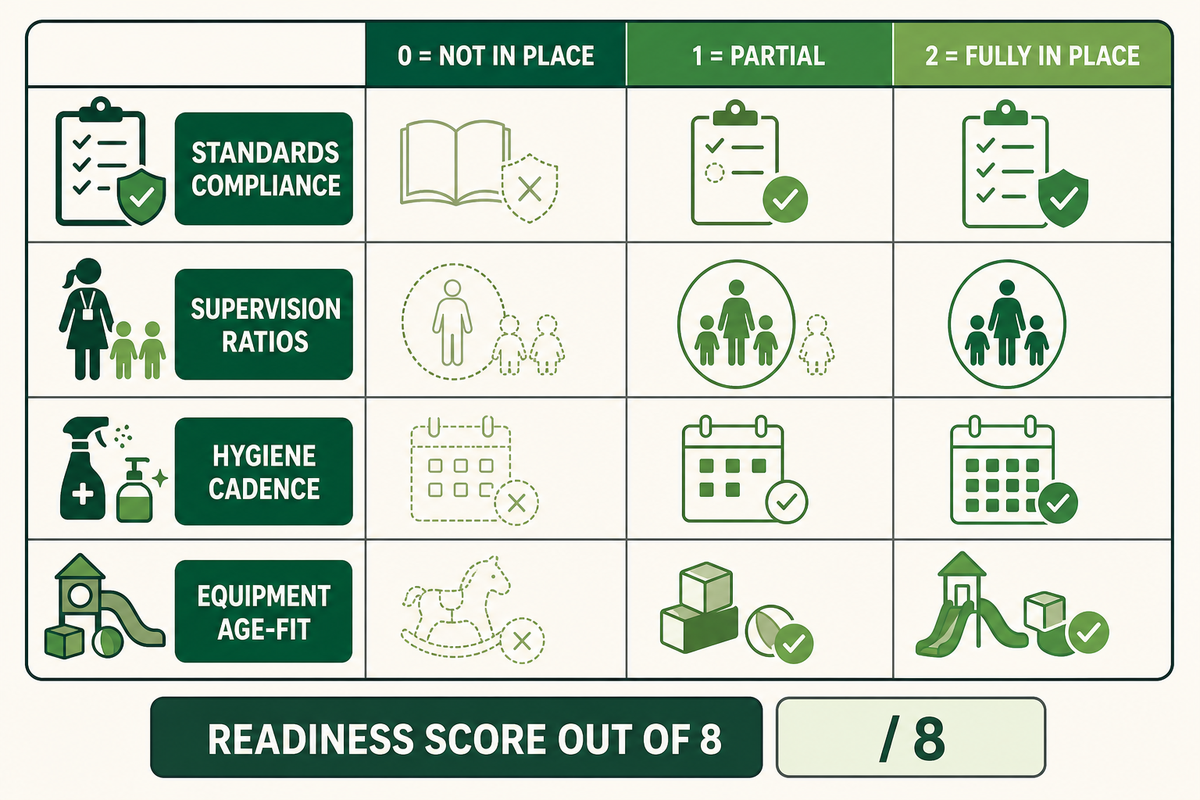
Standards compliance, supervision ratios, cleaning cadence, and age fit of equipment are very rarely measured on a simultaneous basis, making it difficult for a committee to answer a single yes/no question about your nursery: “Is my nursery room readiness good?” The 4-Factor Nursery Readiness Matrix below breaks all four areas down on a scale of 0-2 (0 = Not in place, 1 = Partially Complete, 2 = Complete) for a readiness score out of a total 8 the committee can assess.
Before the score is complete, consult the “Category and Type Quick Reference” table to see exactly which standard, hygiene type, or ratio corresponds to each zone/type of facility listed here, collapsing all the detail we’ve touched upon into a simple, quick reference you can check against each section.
One common assumption is that a subjective walkthrough tells a committee everything it needs to know, but an unscored checklist is not always as objective as it feels — two people walking the same room can reach different conclusions without a shared scoring reference, which is a real risk when the volunteer holding the clipboard changes from month to month. Independent space-planning research makes a related point about informal children’s care settings generally: they aren’t always regulated by the same standards and licenses a state-run facility is, which is exactly why an unscored walkthrough can miss things a formal inspection wouldn’t. Dreamland Playground provides this matrix specifically so a rotating volunteer committee gets the same score regardless of who’s holding the clipboard that week.
| Category | Type | Age Band | Governing Standard / Guidance | Where It Belongs |
|---|---|---|---|---|
| Play equipment | Soft-contained (climbers, slides, ball pits, crawl tunnels) | 2 through 12 years | ASTM F1918 | Toddler room |
| Play equipment | Public playground equipment | 2 through 12 years, general outdoor use | ASTM F1487 (excludes soft-contained equipment) | Outdoor playground, not a soft-play nursery |
| Play equipment | Public playground equipment | 6 through 23 months | ASTM F2373 (also excludes soft-contained equipment) | Outdoor toddler play area, not a soft-play nursery |
| Play equipment | Soft-contained equipment for the youngest band | Under 2 years | General CPSC juvenile-product / toy-safety documentation (no dedicated play-equipment spec yet) | Infant room |
| Sleep equipment | Crib, bassinet, play yard, or bedside sleeper | 0 to 12 months (true infants) | CPSC federal safe-sleep product requirements | Infant sleep corner |
| Surfacing | Unitary (tiles, mats) | All ages | HHS / Head Start play-area guidance | Any room; lower ongoing maintenance |
| Surfacing | Loose fill (shredded rubber, engineered wood fiber, mulch) | 2 years and older (excluded for infants/toddlers: pea gravel, sand) | HHS / Head Start play-area guidance | Toddler play zone; needs depth checks |
| Hygiene tier | Cleaning (soap and water) | All ages | CDC early-care-and-education hygiene guidance | Daily, high-touch surfaces |
| Hygiene tier | Sanitizing (weakened bleach or EPA-registered spray) | All ages | CDC early-care-and-education hygiene guidance | Mouth-contact toys and feeding items |
| Hygiene tier | Disinfecting (stronger EPA-registered product) | All ages | CDC early-care-and-education hygiene guidance | Diaper station; after body-fluid contact or illness |
| Staffing | Supervision ratio floor | 0 to 3 years (Early Head Start / MSHS outdoor play) | HeadStart.gov Active Supervision guidance, 1:4 | Nursery and toddler room staffing plan |
| Factor | 0 = Not in place | 1 = Partial | 2 = Fully in place |
|---|---|---|---|
| Standards compliance | No equipment standard identified | Some equipment matched to a standard, some unverified | All soft-contained equipment matched to F1918 (2yr+) or CPSC juvenile-product documentation (under 2) |
| Supervision ratios | No ratio target set | Ratio target set but not consistently staffed | Ratio consistently met, with a documented two-adult rule |
| Hygiene cadence | No written cleaning schedule | Cleaning happens but sanitizing/disinfecting steps aren’t distinguished | Written 3-tier cleaning/sanitizing/disinfecting schedule followed |
| Equipment age-fit | Equipment mixed across ages with no daily check | Age-appropriate equipment but no daily inspection routine | Age-banded equipment plus a running daily inspection checklist |
Worked example: a mid-size church with a shared nursery and toddler room scores itself. Standards compliance: 1 (the toddler soft-play system has F1918-spec documents on file, but the newer infant-area mats don’t) = 1 point. Supervision ratios: 2 (a written weekly schedule shows a 1:4 ratio with a standing two-adult rule) = 2 points. Hygiene cadence: 1 (toys get wiped down weekly, but there’s no separate sanitizing step and no written schedule for when it happens) = 1 point. Equipment age-fit: 1 (infant and toddler equipment are separated by a physical barrier, but there’s no daily inspection checklist for the pieces) = 1 point. Total: 5/8 — the room’s safety fundamentals are real but incomplete, and the two clearest next priorities are a written hygiene schedule and a daily inspection habit. That breakdown tells your team exactly where its two weakest points are in nursery-room management so far, and which two areas need the most immediate attention.
What the Data Says About Where Nursery Planning Is Headed
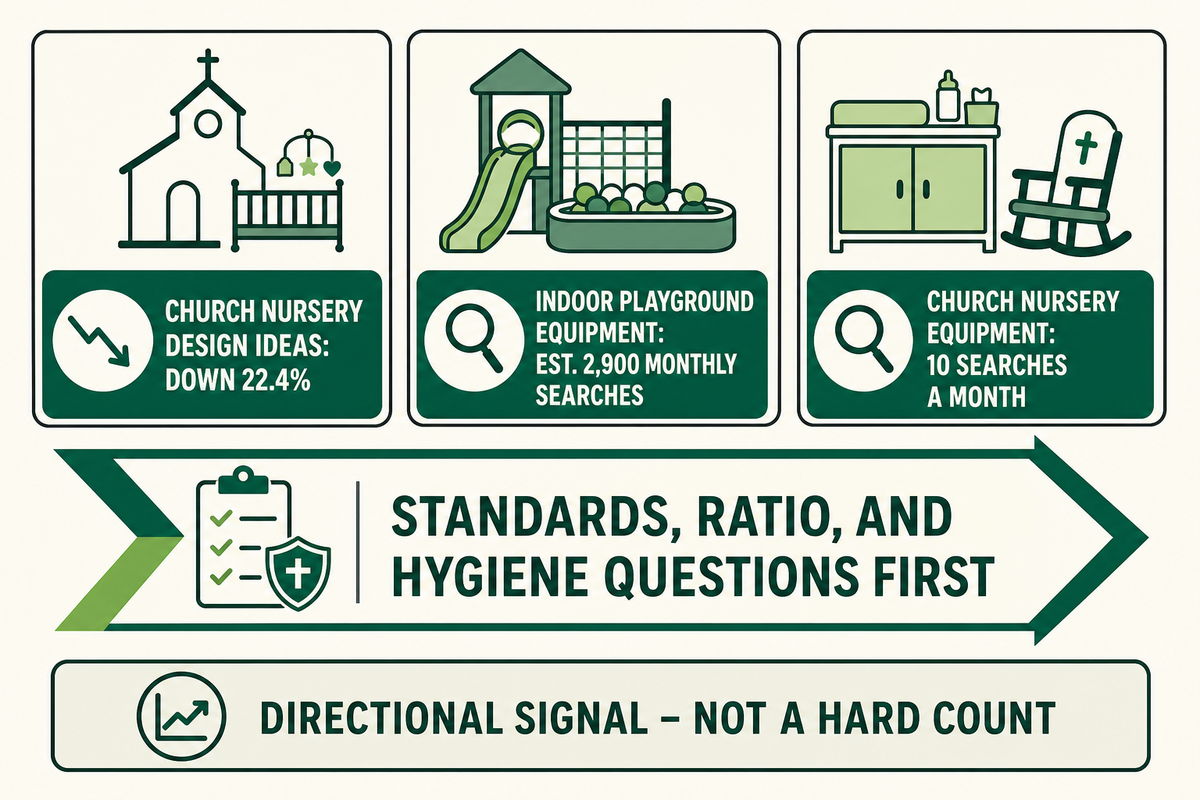
Search demand around “church nursery design ideas” has been declining, while the ranking content for that exact topic has been shifting toward compliance and logistics vocabulary — volunteer, checklist, ratios, cleaning — rather than decor inspiration. Two signals point the same direction: search interest in the decor-focused framing is cooling off, and the pages that already rank are increasingly answering practical planning questions instead of showing mood boards. For a planning committee, that has a direct implication: spend the research phase of your project on the standards, ratio, and hygiene questions this guide answers first, and treat paint colors and furniture style as the last decision on the list, not the first.
Design-trend content can still be useful and informative when incorporated thoughtfully; however, it’s no longer a headline element in kids’ room design, and current design coverage points toward natural design elements, biophilic materials, screen-free sensory stimulation, and softer textures in place of plastic for soft furnishings, replacing older bright primary-color schemes. While it’s fine to fold in these natural-design trends when budget allows, hygiene, ratio, and operational planning belong first on the list, well before aesthetic design.
Keyword-research tool data backs up that same pattern, not just anecdote: DataForSEO’s modeled search-volume figures show “church nursery design ideas” searches down 22.4% comparing the trailing 12 months against the prior 24-36 month window, while broader equipment-buyer terms like “indoor playground equipment” still pull an estimated 2,900 monthly searches nationally — a directional signal, not a hard count, but one consistent with committees still actively shopping for gear, just not for decor inspiration. A common assumption among churches new to this process is that a low-volume term like “church nursery equipment” (10 searches a month) means no one is researching this online; it doesn’t — it just means most committees are searching under broader indoor-play and soft-play-equipment terms instead of church-specific phrasing, which is not necessarily how a first-time planning team would think to search. For a committee doing this research today, that shift is not just an SEO curiosity: it means the vendor pages and guides worth reading are increasingly the ones written around compliance, ratios, and procurement — like this one — rather than the room-tour photo galleries that used to dominate the results. Dreamland Playground’s own church-specific pages are built around exactly this shift — compliance and procurement information up front, decor as a secondary consideration. That same shift shows up in adjacent industry commentary too, not just the raw numbers: nursery-design trend coverage for 2026 increasingly frames decor as a secondary consideration behind safety and function — a general home-nursery signal, not a church-specific one, but directionally consistent with what the search data already shows.
Budget and Procurement: What a Church-Ready Nursery Actually Costs
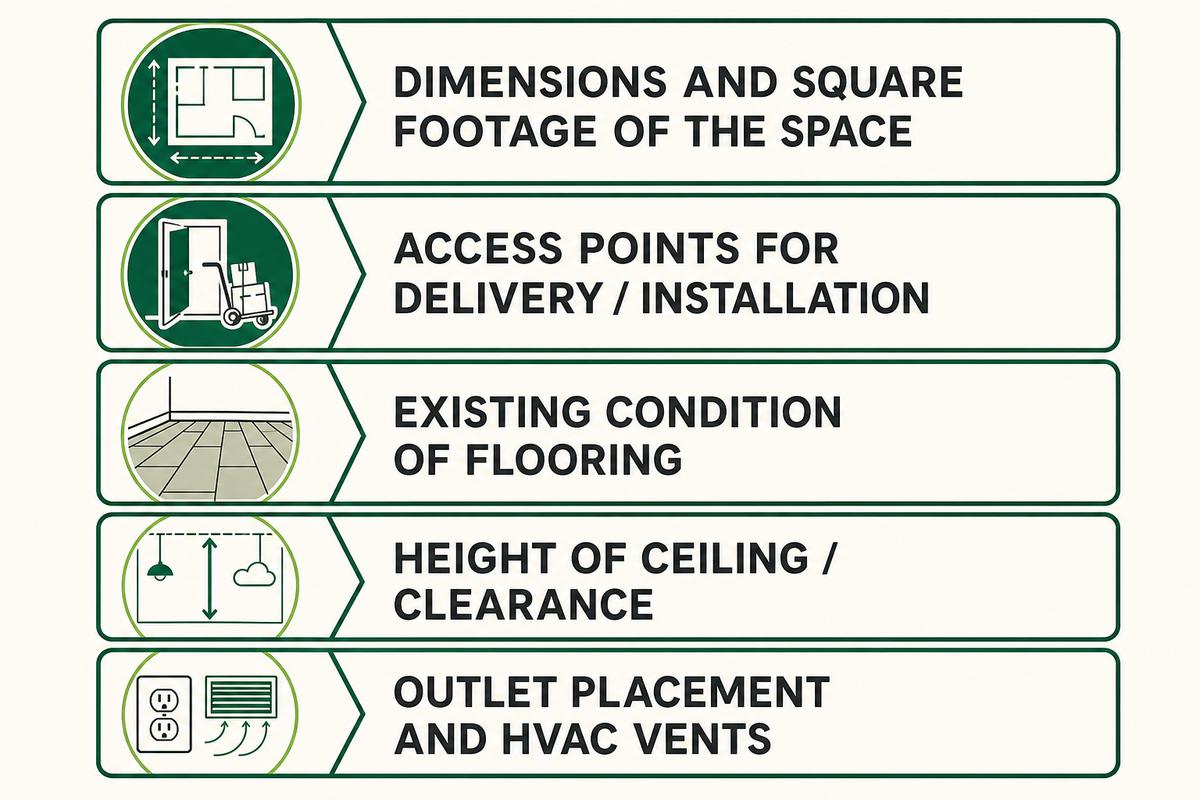
For the numerous ministry budgets competing at your church for funds, the nursery affair is one of the easier ones; safety and ratio compliance aren’t negotiable line-items, even in a lean year. Cost will be defined by the room size, number of pieces and method of installation. Treat any single quoted figure as a starting range rather than a fixed price, since room dimensions and access constraints move the final number. First-time committees commonly make the mistake of treating the first vendor quote as the market rate, which is a real risk because room dimensions, access constraints, and finish-out choices all move the number independently of each other — a second comparison quote often reveals a meaningful swing.
Gather a scope checklist containing: dimensions and square footage of the space available, access points for delivery/installation (door width, elevator access, stairs), existing condition of any flooring to be replaced or installed over, height of ceiling/clearance between room floor and ceiling for any lifts, and conditions such as outlet placement and HVAC vents which may determine the placement of various pieces of equipment — then send it to a vendor to receive a quote on all equipment you’ll consider purchasing.
Bringing that scope checklist to a supplier conversation — rather than a single budget number — reduces surprise, as both equipment and surface pricing vary with such room specifics that a fixed number can’t encompass. For a deeper line-item walkthrough of typical costs, see our church playground budget guide. You may also want a multi-purpose room throughout the week for when your Sunday-specific playground equipment setup can convert without significant overhaul (consider movable partitions and rolling storage).
A thematic paint palette is nice but ultimately the least important line item and best considered last on the list to ensure the room is sound for staffing and equipment. For a planning-range estimate tailored to your own nursery, see Dreamland Playground’s church nursery and playground planning support page.
Key takeaway
Match equipment to the standard actually written for it (F1918 for 2yr+ soft-contained equipment, CPSC juvenile-product documentation for under-2 gear), staff to a ratio no looser than the federal 1:4 floor, run a five-minute daily inspection, and treat cleaning/sanitizing/disinfecting as three separate jobs — then use the 4-Factor Nursery Readiness Matrix to see which of those systems still needs work.
Dreamland Playground supports nursery and play-area projects for congregations of every size, from space planning through production, shipping, and installation. When your committee is ready to turn this checklist into a room-specific plan, visit the church playground solutions page.
FAQ: Church Nursery Play Guide
What should a church nursery have?
A church nursery should have age-appropriate equipment matched to the right ASTM or CPSC standard, a written ratio target no looser than 1:4, a five-minute daily inspection routine, and a check-in and allergy-alert system that volunteers can see at a glance.
At minimum: soft-contained play equipment built to ASTM F1918 for children 2 and older (or CPSC juvenile-product documentation for equipment meant for children under 2), a staffing plan that holds a ratio no looser than the federal 1:4 outdoor-supervision floor, a five-minute daily inspection checklist, a written cleaning/sanitizing/disinfecting schedule, and a check-in sheet that captures allergy alerts clearly rather than burying them in a notes field.
What is the best layout for a nursery?
The best nursery layout keeps an unbroken sightline from the entrance to every play and sleep area, with the check-in desk at the single entry point and no tall shelving or curtain dividers blocking a volunteer’s view across the room.
Position the check-in desk at the single entry point, keep the diaper-changing station visible from the main play area, and avoid tall shelving or curtain dividers that break a volunteer’s sightline across the room. The goal is a layout where one volunteer standing near the door can see the entire room without walking a patrol route.
How much square footage is required per child in a church nursery?
Most church nurseries aren’t legally bound by a square-footage figure, but 35 sqft (about 3.25 m²) per child is a common planning reference drawn from state daycare-licensing rules, useful even though the room itself is usually license-exempt.
The 35-square-foot-per-child number that circulates widely is a state daycare-licensing benchmark, not a universal rule — churches running an unlicensed Sunday-morning nursery usually aren’t bound by it. That said, license-exempt doesn’t mean rule-free: fire code, sanitation, and background-check requirements can still apply even when the square-footage figure itself doesn’t. Use 35 sqft/child as your starting planning number, then confirm your own state’s rules if your church ever pursues formal daycare licensing.
What supplies do I need in a church nursery?
A church nursery needs diapering and wipe supplies, EPA-registered sanitizing spray for toys and feeding items, a first-aid kit, and a stocked check-in station, plus crib sheets for infant rooms and a step-stool and potty-training caddy for toddler rooms.
Beyond play equipment: a changing table with diapers and wipes stocked and restocked before each service, EPA-registered sanitizing spray for toys and feeding items, a basic first-aid kit, sign-in sheets or a digital check-in system, and clearly labeled storage so volunteers aren’t hunting for supplies mid-shift. If the room serves true infants, add crib or bassinet sheets and a safe-sleep policy to that list. If it serves toddlers who are potty training, add a small step-stool and a stocked potty-training caddy too.
What are the most durable flooring options for high-traffic nurseries?
Both unitary surfacing (interlocking tiles or mats) and loose fill (shredded rubber, engineered wood fiber) are acceptable under federal guidance, but loose fill carries an ongoing depth-maintenance obligation that unitary surfacing doesn’t, which matters most for a nursery without dedicated facilities staff.
Federal play-area guidance treats unitary materials (interlocking tiles or mats) and loose fill (shredded rubber, engineered wood fiber) as equally acceptable protective surfaces on paper, but loose fill must be installed correctly and maintained at the proper depth to keep cushioning falls — a recurring facilities task, not a one-time install decision. For a nursery with no dedicated facilities staff to keep re-checking that depth, that maintenance gap is usually the deciding factor, not price alone.
What are some ideas for a small church nursery?
Good ideas for a small church nursery include one flexible zone instead of a crowded mix of equipment, age-separated areas for infants and toddlers, a small calm-down corner, and a rolling storage cart that doubles as a light divider for midweek room-sharing.
In a small church setting, prioritize one well-chosen soft-play piece over a crowded mix of smaller items, set aside a small quiet area where a fussy or overstimulated toddler can calm down, keep infant and toddler areas physically separated even if that just means a low gate or floor marking, and use rolling storage carts that can double as a light room divider so the space stays flexible for non-nursery use during the week. Portable dividers work the same way for a room that also hosts a midweek Bible study or fellowship gathering — fold them away and the space reverts to general-purpose in minutes. Our church play area design ideas guide has more small-room layout ideas and photos.
What are the trends in nursery design for 2026?
Nursery design trends for 2026 include biophilic, nature-inspired materials, screen-free sensory play zones, and softer, less purely-plastic finishes — worth folding into a refresh as supporting texture, not the headline, since compliance and ratio planning matter more to most churches right now.
Current nursery design coverage points toward nature-inspired, biophilic materials, screen-free sensory play zones, and softer, less purely-plastic finishes. Worth folding into a refresh, but current search and content patterns suggest operational and compliance planning — ratios, standards, hygiene — is what churches are actually searching for more than decor inspiration right now. A hand-painted mural is a low-cost way to add that nature-inspired texture to an existing room without replacing any equipment. Our church play area design ideas guide has the fuller look at 2026 design trends.
What baby gear and check-in supplies should parents expect at a well-run church nursery?
At a well-run church nursery, parents can expect a labeled place to drop baby gear such as a diaper bag, bottle, or comfort item, and a quick nursery check-in process that captures food allergies clearly before you head into the worship service.
At nursery check-in, hand the volunteer your child’s labeled baby gear — diaper bag, bottle, comfort item — along with any food allergies or feeding notes for that day, then head back to the worship service. That two-minute handoff is what lets the room’s assigned volunteer focus on kids’ safety instead of piecing information together mid-shift.
How can a small church equip its nursery ministry on a limited budget?
A small church can equip its nursery ministry on a limited budget by prioritizing adequate supervision and one solid piece of equipment over a full wish list, then building out the room gradually through fellowship-hall donations and used-but-certified gear.
The ministries of your church don’t need a fully outfitted room to be safe on day one — equip the space gradually, starting with adequate supervision (a ratio that actually holds) and one age-appropriate soft-play piece, before adding extras. Many churches build out their nursery over time through fellowship-hall donations and used-but-certified equipment. For more ideas for safety beyond this checklist, see the Related Reading links below — the goal is a safe, loving environment, not a perfect inventory list in week one.
Source Comparison: What Each Cited Standard or Study Actually Establishes
| Source | What It Establishes | Value / Requirement | Where Covered |
|---|---|---|---|
| Iowa HHS daycare licensing rule | State square-footage benchmark for licensed daycare space | 35 sqft per child (usable play space) | Room Layout section |
| HeadStart.gov Active Supervision guidance | Federal supervision-ratio floor for children under 3 | 1:4 adult-to-child ratio (outdoor play) | Volunteer Readiness Checklist section |
| ASTM F1918 published scope | Soft-contained play equipment coverage | Ages 2 through 12 | ASTM Standard section |
| ASTM F2373 Section 1.5 | Public-use equipment coverage and exclusion | Ages 6-23 months; excludes soft-contained equipment | ASTM Standard section |
| ASTM F1487 scope description | Public playground equipment coverage and exclusion | General outdoor use; excludes soft-contained equipment | ASTM Standard section |
| CPSC Under-2 Playground Equipment guidance | Coverage gap for the youngest band | No dedicated play-equipment standard under 2; general CPSC juvenile-product rules apply | ASTM Standard section |
| CDC early-care hygiene guidance | Distinction between the three cleaning tiers | Cleaning, sanitizing, and disinfecting are three separate steps | Hygiene Protocol section |
| HHS/ACF CFOC 6.2.5.1 | Play-equipment inspection requirement | Documented daily inspection | Daily Inspection Routine section |
| CPSC Safe Sleep requirements | Federal infant sleep-product standard | Crib, bassinet, and play-yard products | Infant vs. Toddler Equipment section |
References & Sources
- ASTM F1918-21 standard scope (soft contained play equipment, ages 2-12)
- ASTM F2373-11r17 Section 1.5 (excludes soft contained play equipment)
- CPSC: Public Playground Equipment Voluntary Standards (ASTM F1487)
- CPSC: Playground Equipment for Children Under 2 Years of Age
- ASTM WK99117: proposed toddler play equipment work item
- Iowa HHS: 35 sqft/child childcare licensing standard
- American Planning Association: church/informal childcare regulation report
- HeadStart.gov: A Closer Look at Safety Considerations (ratio + surfacing guidance)
- CPSC: Safe Sleep — Cribs and Infant Products
- CDC: How To Clean and Disinfect Early Care and Education Settings
- HHS/ACF Child Care Technical Assistance Network: CFOC 6.2.5.1 Daily Inspection
- Portable Church: Kids Ministry Ratios
- Nestig: 2026 Nursery and Kids’ Room Design Trends