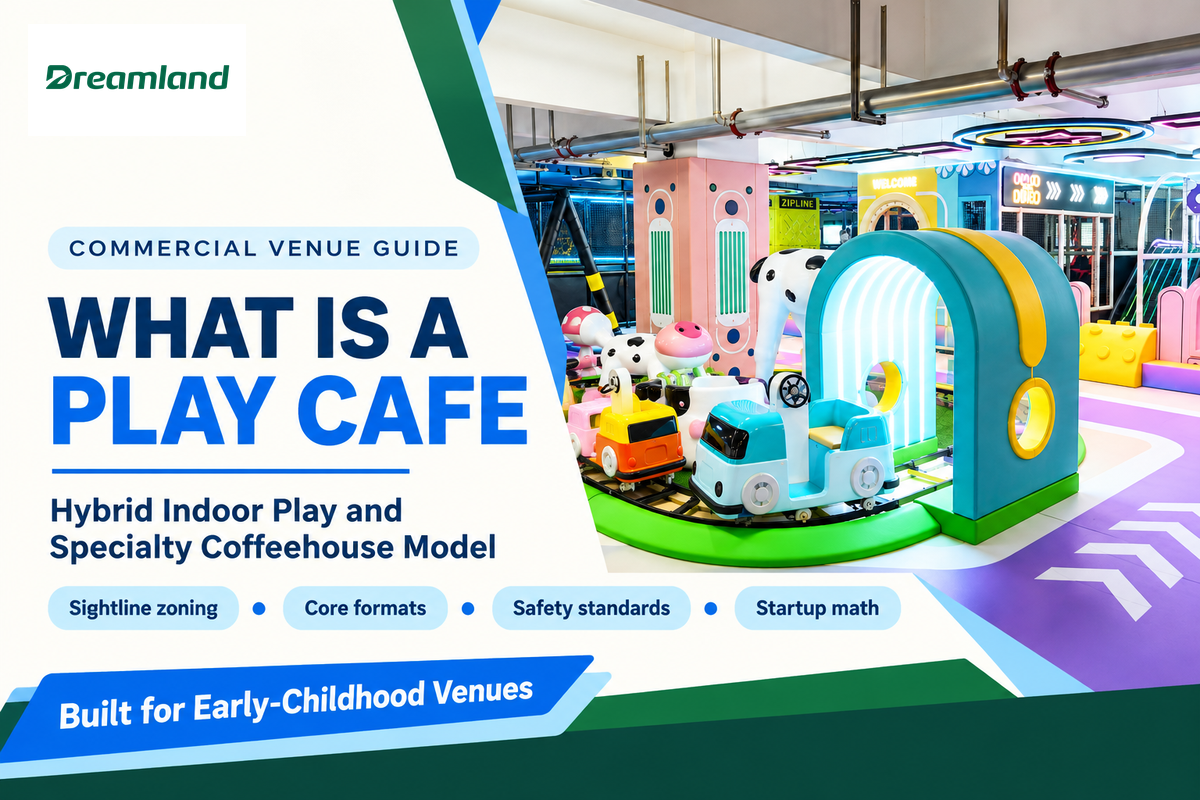
A play cafe is a hybrid commercial venue combining an indoor play area most often focused on babies, toddlers, and preschoolers with a specialty coffeehouse and light-food bar. When commercial investors ask what’s a play cafe, the working definition rests on parent-on-site supervision, clear sightlines, and dual revenue streams from play admissions and cafe orders.
Caregivers supervise their little ones while located on the perimeter, providing an opportunity for caregivers to purchase espresso drinks, snacks, memberships, and other items. Longer family stays make repeat visits predictable.
What Is a Play Cafe and How Does the Hybrid Model Work?
A commercial play cafe (often written play café) combines an indoor play space most commonly geared toward babies, toddlers, and preschoolers with a cafe counter for parents, nannies, and grandparents. The model creates a dual revenue stream from admissions and food service. An indoor play cafe splits its space for play and hospitality. While the hospitality area is for adults to order coffee and food, the play area is supervised by caregivers.
A commercial play cafe model features two revenue engines running in the same space. Play admissions generate revenue by charging for space on the floor, and food and drinks increase the average ticket price for a visit. A true indoor play area encourages calmness and comfort, and can develop a repeated visit habit, whereas a traditional coffeehouse relies on quick turnover to serve many customers. CPSC Publication 325 (July 2025) recommends separating infants and toddlers (6 to 23 months) from preschool-age children (2 to 5 years) in public play environments while keeping sightlines open across zones.
Wait times and seating comfort are the primary factors that motivate local families to return week after week. Business owners who treat play equipment as an afterthought may struggle to justify admission charges. Operators that treat the coffee bar as a basic vending counter miss steady beverage margins.
How does a play cafe work?
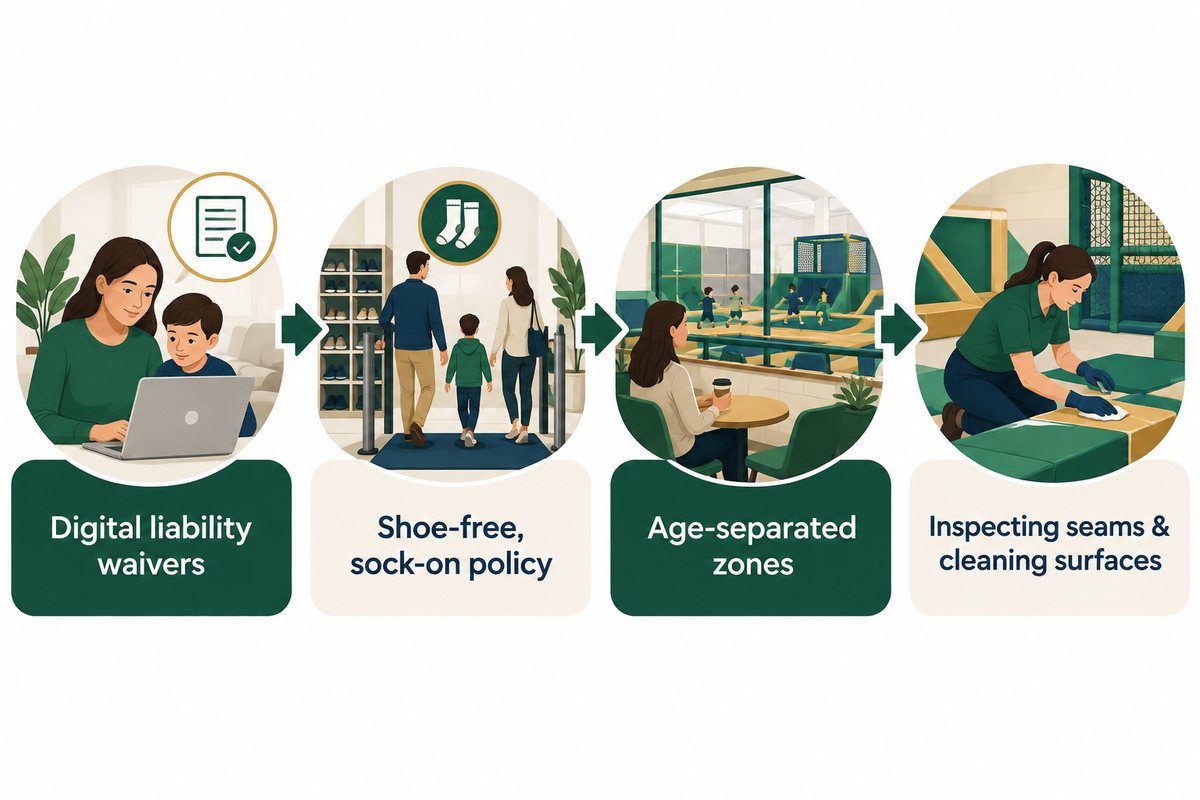
Guests book a timed session or walk in, digitally complete a liability waiver, remove their shoes in a gated lobby, and put on grip socks to enter the play floor. Adults sit along the perimeter to supervise their kids.
Daily guest flow follows a simple four-stage cycle:
Families complete their digital liability waivers and online session bookings from home. This reduces delays at the front desk during peak morning hours.
Front desk staff check liability waivers, issue wristbands or session stamps, and direct strollers to lobby parking to enforce the shoe-free, sock-on policy.
Caregivers order coffee and snacks from the cafe to enjoy in the seating area while closely supervising their kids in age-separated zones.
Staff reset the play areas by inspecting seams, removing loose props, and cleaning surfaces during breaks and before the next block of play.
Skeptical investors often assume a play cafe is simply a coffee shop with a toy bin. A toy corner lacks several features of a purpose-built venue, including impact flooring, waiver software, and paid admissions. Strong word-of-mouth across local parent networks motivates investment.
Play Cafe Formats: Soft Play, Role-Play Villages, Sensory, and Coworking Models
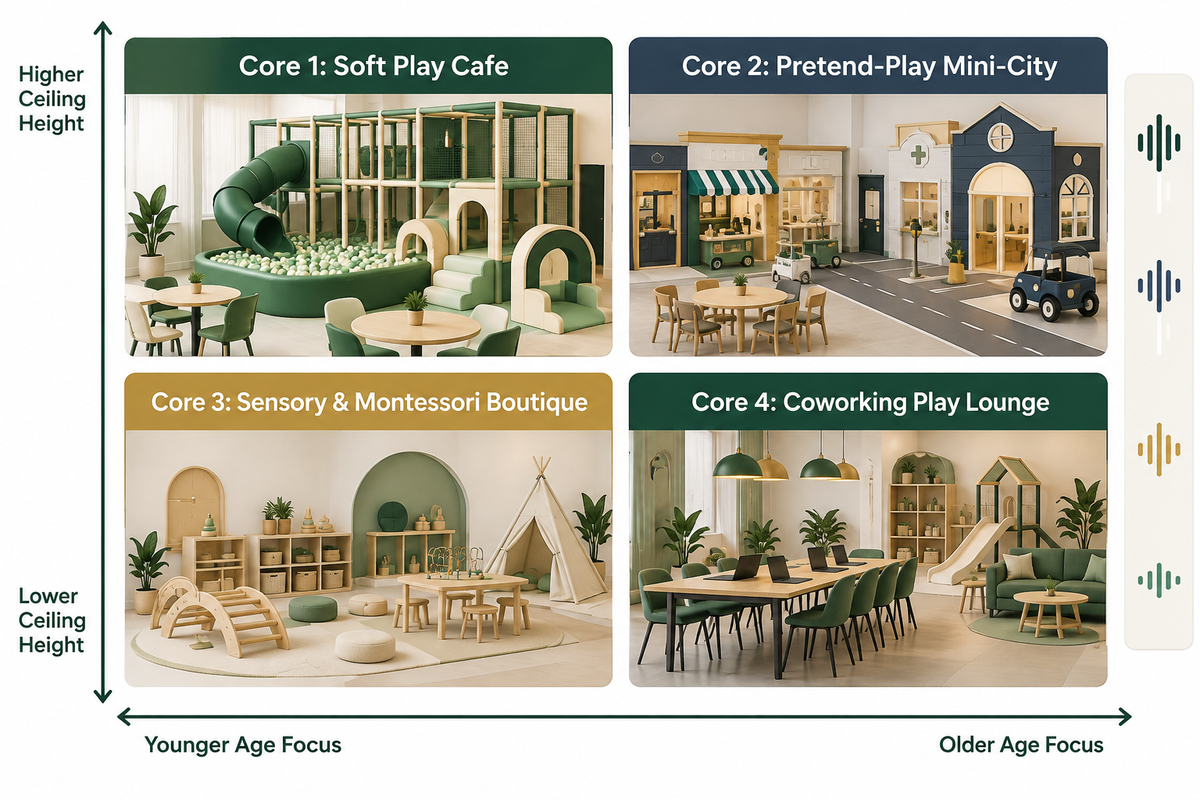
Commercial venues are built around four core concepts of play cafe, specifically soft play, role-play villages, sensory and Montessori studios, and coworking lounges, as well as five common hybrid variations shaped by suite size and food scope. The 4-Format Play Cafe Concept Matrix below compares the four core models (rows 1-4) and five commercial variations (rows 5-9) relative to their preliminary space and equipment needs.
Concept Format / Commercial Variation
Primary Age Focus
Suite Size Tier
Core Play Equipment
Acoustic Profile
Primary Repeat-Visit Driver
Core 1: Soft Play Cafe
0 to 6 years
Mid-Size Neighborhood Suite
Padded climbers, mini slides, ball pit, toddler mats
Low wooden ramps, tactile boards, sensory play tables
Low; calm neutral aesthetics
Caregiver-and-me classes + memberships
Core 4: Coworking Play Lounge
Infants & preschoolers
Mid-Size to Large Suite
Quiet sensory bays + glazed acoustic work pods
Controlled via glass partitions
Monthly coworking + remote-parent demand
Hybrid A: Soft Play + Role-Play
0 to 6 years (plus older siblings)
Mid-Size to Large Suite
Two-tier soft play frame + perimeter role-play booths
Moderate; physical zoning needed
Sibling versatility + weekend parties
Hybrid B: Full-Kitchen Family Bistro
0 to 6 years (older siblings welcome)
Large Full-Service Suite
Enclosed play structure + full commercial kitchen dining
High during lunch and dinner peaks
Full family meals + group celebrations
Hybrid C: Class-First Play Studio
Infants & toddlers
Small to Mid-Size Suite
Open class floor + compact toddler climber
Structured around class schedule
Weekday curriculum + pre-class playdate
Hybrid D: Retail-Anchored Play Place
0 to 6 years
Small to Mid-Size Suite
Compact soft play zone + boutique gift and toy retail
Moderate; front retail buffer
Gift shopping + neighborhood drop-in
Hybrid E: Franchise Play Center
0 to 6 years (varies by brand)
Mid-Size to Large Suite
Standardized branded soft play + cafe counter package
Moderate to high; higher capacity
Brand recognition + turnkey party rooms
Generally speaking, it’s best to let the space (i.e. available clear height, and neighborhood demographics) dictate the format, as opposed to personal preferences. If your suite is in the small boutique tier, has low ceilings, and receives strong weekday parent foot traffic, choose a Sensory & Montessori Boutique. Conversely, if you have a large suite and tall ceilings with demand for private birthday parties, consider a Soft Play + Role-Play hybrid. For enclosed soft play formats, the CPSC Soft Contained Play Equipment Safety Checklist outlines equipment and safe-use verification points aligned with ASTM F1918-21.
Modular design largely solves the risk of customer boredom with a fixed theme when deciding on which format to choose.
Play Cafe vs. Indoor Playground, Family Entertainment Center, Daycare, and Gaming Cafe
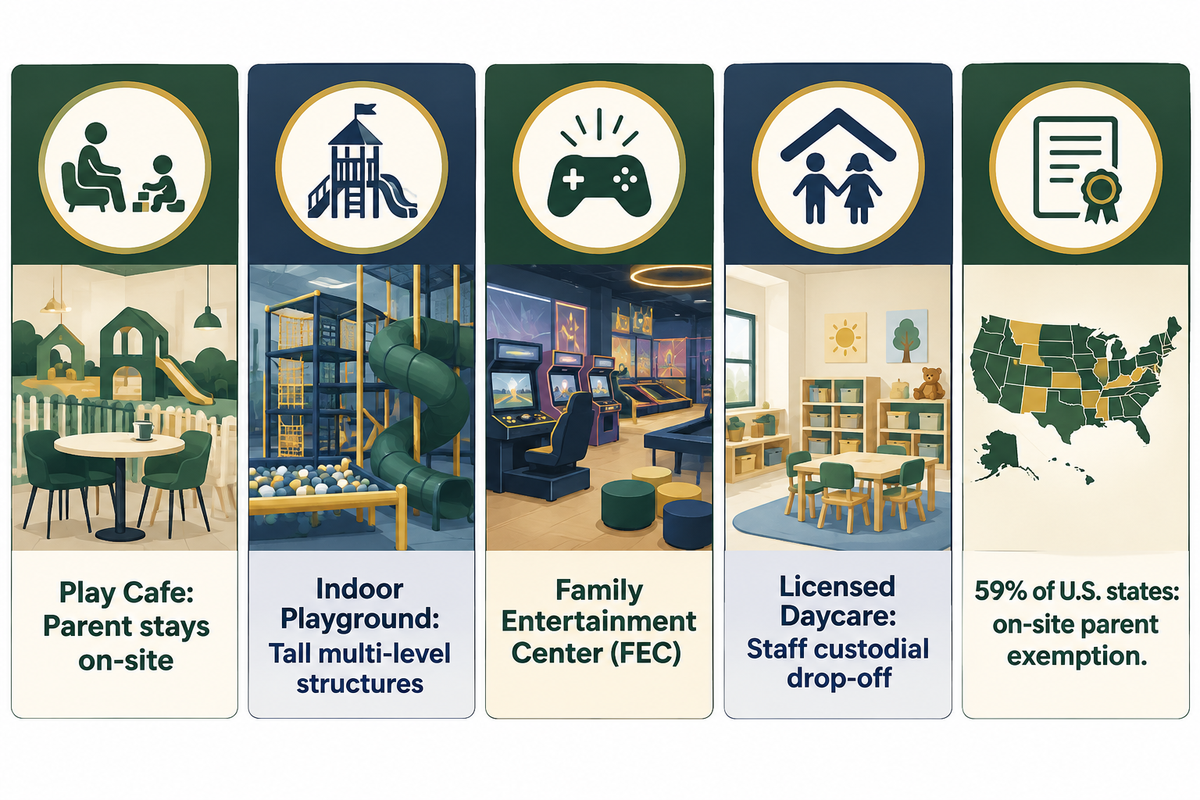
A play cafe is distinguished from an indoor playground, family entertainment center, licensed day care, and gaming cafe based on age focus, level of supervision, and hospitality depth. Typically, mixing up these categories leads to oversized leases, misaligned play equipment, or unanticipated child care center licensing issues.
PC/console stations or board-game libraries; no children’s play floor
Custodial supervision separates play cafes from licensed daycares. Federal guidance provided by ChildCare.gov means state licensing determines background checks, CPR training, ratio, and inspection requirements for regulated programs. These factors help distinguish operating models, while state licensing rules determine whether care is exempt from licensing or requires a license. The September 2024 federal ACF/OPRE review reported that 59% of U.S. states provide a childcare licensing exemption for facilities where parents remain on-site.
Notable variations among states in exemption requirements, session limits, and drop-off care definitions are governed by state statute. Providers need to check local regulations before including drop-off care or “parents’ night out” services. Offering custodial drop-off care beyond the parameters of the legal exemption causes providers to operate an unlicensed care program.
Outdoor play parks and large family entertainment centers (FECs) compete on physical thrill rides, arcades, or activities like miniature golf. Play cafes can give parents of young children a convenient location to gather while keeping crawling children separated from older active kids.
Play Cafe Floor Plan, Play Area Sizing, Sightlines, and Age Zoning
Commercial play cafe layouts balance suite footprint, caregiver sightlines, age separation, plaything spacing and ADA access routes. WellnessLiving’s planning guide groups venues into Small Boutique, Mid-Size Neighborhood, and Large Full-Service suites (detailed in the sizing matrix below), and former operator Michele Caruana ran a 2,500 sq ft (232 m²) mid-size venue.
How much space does a play cafe need?
The mid-size range (2,000–4,000 sq ft, according to WellnessLiving) allows space for separate age zones, cafe seating, stroller parking, a party room, and accessible ground-level routes. Smaller concepts, such as a sensory room, can work in the smaller suites, and full kitchen suites can work in the larger suites.
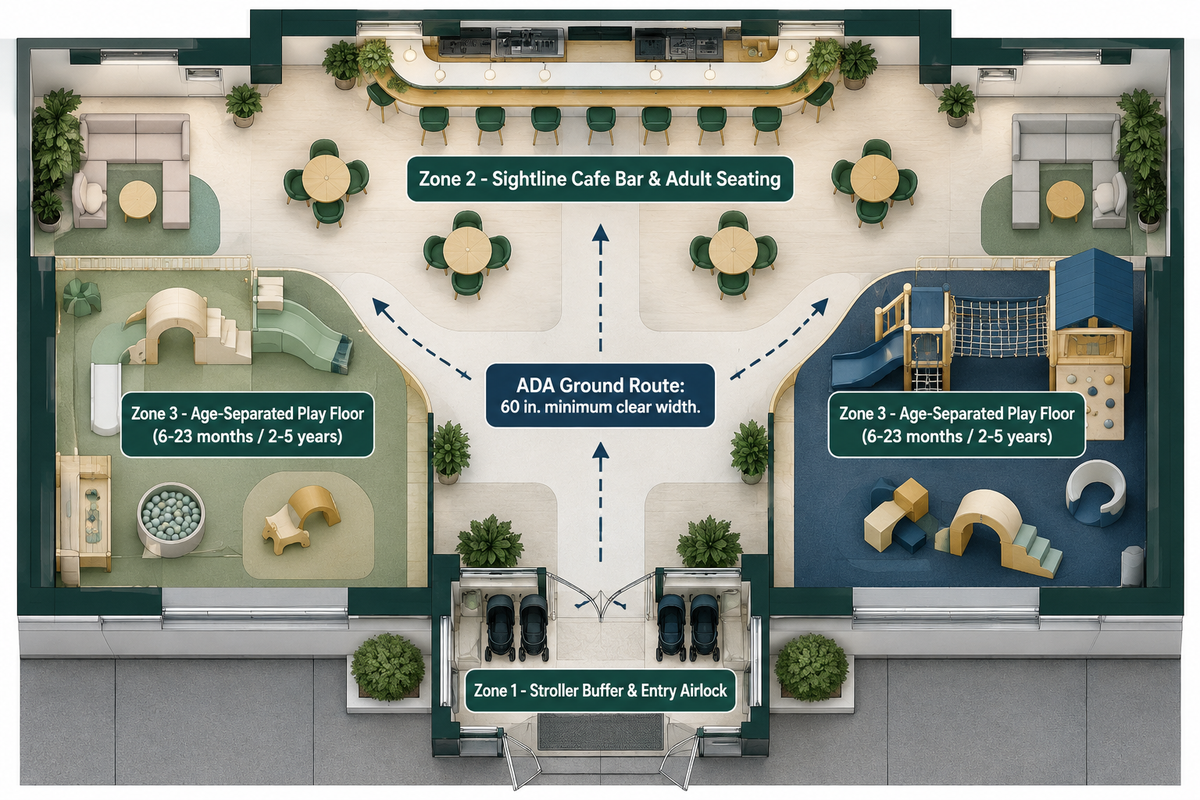
Prior to signing a lease, test fit any commercial floor plate against the 3-Zone Sightline & Flow Blueprint:
Zone 1 – Stroller Buffer & Entry Airlock: Install double safety gates between the street exit and play floor. Shoe cubbies, stroller parking, restrooms, and check-in desks should be placed off the padded floor to keep dirt outside.
Zone 2 – Sightline Cafe Bar & Adult Seating: Place the espresso pickup counter away from the play gate so hot drinks never cross toddler pathways. Arrange seating in either an L-shape or a U-shape facing the play floor for clear sightlines.
Zone 3 – Age-Separated Play Floor: Use low padded barriers to separate infant crawler bays from active preschool climber bays to create age-separated play areas. Keep party rooms separated by acoustic doors to help support the running of weekend events and open play.
Safety research proves why separation and spacing matter alongside structure height. The July 2025 CPSC Public Playground Safety Handbook (Publication 325, Section 1.6) defines three age bands: 6–23 months, 2–5 years, and 5–12 years. Section 2.2.5 also advises keeping older children’s areas visible from younger areas for adult supervision. A peer-reviewed outdoor playground injury study on NIH/PMC (Cazacu-Stratu et al.; PMC12302015) cites Suh et al. (2018), noting upper-limb fractures accounted for 72.5% of 1,458 hospitalized patients (ages 0–18, with playgrounds and ages 6–11 as common risk factors). In the same study, Smith et al. (2021) found that excessively short minimum spacing between playthings drives falls and collisions beyond equipment height alone.
Spatial / Design Parameter
Verified Standard or Benchmark
Metric Equivalent
Authoritative Source
Layout Application
Small Boutique Suite
1,000–2,000 sq ft
93–186 m²
WellnessLiving guide
Basic soft play or sensory studio + espresso bar
Mid-Size Neighborhood Suite
2,000–4,000 sq ft
186–372 m²
WellnessLiving; Caruana (2,500 sq ft)
Custom play zones, full cafe setup & party room
Large Full-Service Suite
4,000–8,000+ sq ft
372–743+ m²
WellnessLiving guide
Multi-zone playground, full kitchen & event space
Dedicated Indoor Play Floor
Largest floor share
Core revenue floor
3-Zone Sightline & Flow Blueprint
Preserves slide run-outs and inter-unit spacing
Infant / Crawler Band
6–23 months
Under 2 years
CPSC Publication 325 §1.6 (July 2025)
Separated low-height bay away from big climbers
Preschool Active Band
2–5 years
2 to 5 years
CPSC Publication 325 §1.6 & §2.2.5
Main play zone kept visible from toddler bay
ADA Ground Route Width (Ages 2+)
60 in. minimum clear width
1,525 mm
U.S. Access Board Ch. 10 (§1008.2.4)
Ground-level routes in new/altered play areas (ages 2+)
Small Play Area Route Exception
44 in. clear width (play area <1,000 sq ft)
1,120 mm (<93 m²)
U.S. Access Board Ch. 10 (§1008.2.4)
Requires turning space if route exceeds 30 ft (9.14 m)
ADA Slope & Vertical Clearance
1:16 max slope; 80 in. headroom
2,030 mm headroom
U.S. Access Board Ch. 10 (§1008.2.4)
Keeps ground routes free of overhead protrusions
Structural columns can create sightline blind spots even inside a generous lease. Walk the floor from seated chair height before signing lease terms. Review commercial indoor play floor plan design practices to align slide run-outs, restrooms, and acoustic baffles before trenching plumbing.
Commercial Play Cafe Equipment: Soft Play, Pretend Structures, and Vendor Selection
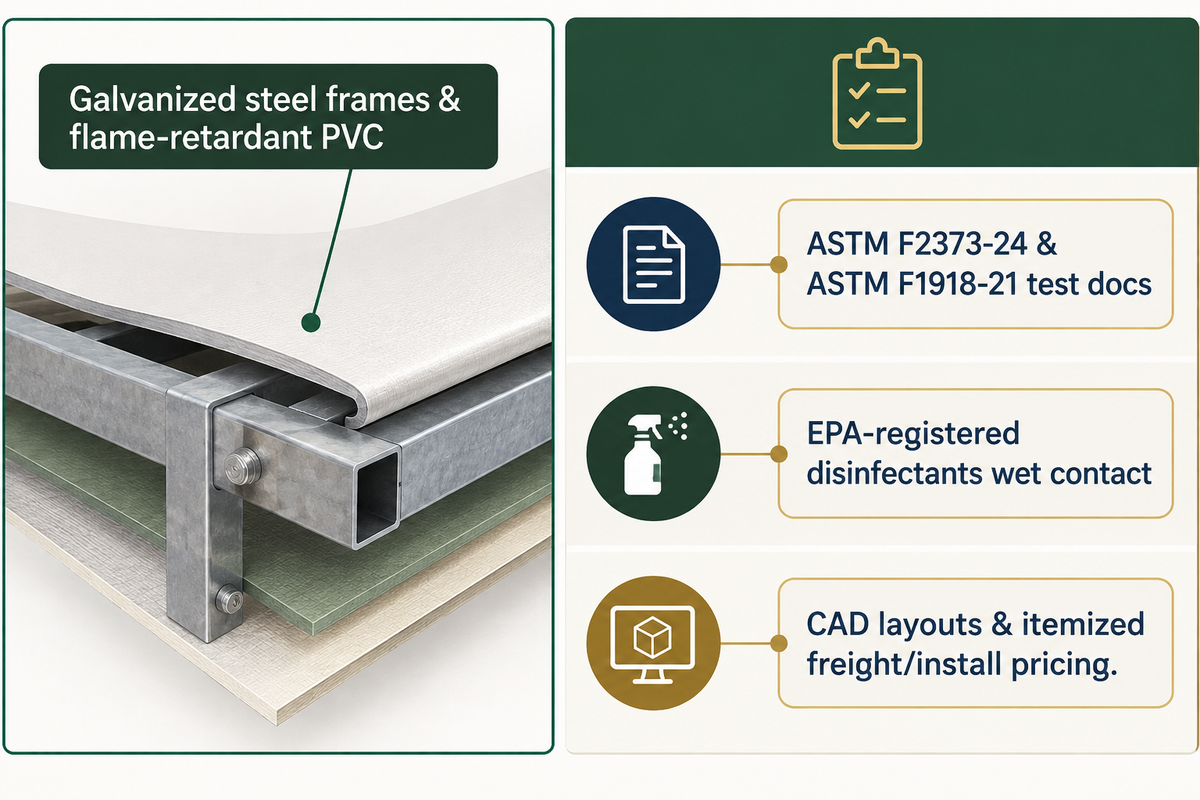
Commercial play equipment units use galvanized steel frames, high-density closed-cell foams, and flame-retardant PVC vinyls. Residential toys don’t have the same level of engineering as their commercial counterparts and may not be engineered to withstand the same daily usage level as public use toys. Therefore, they may not undergo the same rigorous commercial safety tests requested by insurance companies.
What are soft play areas?
Soft play areas cover both open padded floor zones (foam climbers, crawler mats, and low obstacles) and enclosed soft contained play structures. Enclosed frames use coated steel to construct play structures and pair them with vinyl padding, netting, and low slides. Commercial soft play removes exposed hard corners, allowing young children to climb, crawl, and slide with cushioned impact protection.
USPTO Design Patent USD1120181S1 (Climbing frame, granted March 2026) records an active ornamental design for a climbing frame in the indoor play category. Using a modular design allows individual elements of the play structure (e.g. slide liners, cushions, netting) to be replaced as needed instead of the entire structure.
There’s a division of duties in commercial projects between equipment suppliers and local licensed architects. Equipment suppliers can create play-area drawings, fabricate components per applicable age and equipment standards, ship crated hardware, and offer optional installation support; final compliance still depends on complete site installation and local inspection. Local licensed architects and general contractors handle building permits and clearances for fire sprinklers, HVAC and grease traps, as well as ADA compliant restrooms.
As a commercial manufacturer, Dreamland Playground’s commercial design and manufacturing scope covers space planning, custom 2D/3D floor layouts, commercial production, global shipping, and installation support for indoor play venues. Use this consolidated vendor RFQ checklist before paying any commercial playground equipment deposit:
Request written test documentation matched to each zone’s age band and equipment category. Common references include ASTM F2373-24 (6–23 month public climbers), ASTM F1918-21 (enclosed soft play, ages 2–12), ASTM F1487-25 (open structures, ages 2–12), and EN 1176-10:2023 in Europe.
Specify non-porous, wipe-clean PVC vinyl and sealed wood or laminate seams rated for daily cleaning and wet contact with EPA-registered disinfectants.
Separate itemized pricing for ocean/ground freight, customs duties, installation supervision, and replacement padding or netting kits.
Safety Standards, ADA Accessibility, Health Permits, and Sanitation Protocols
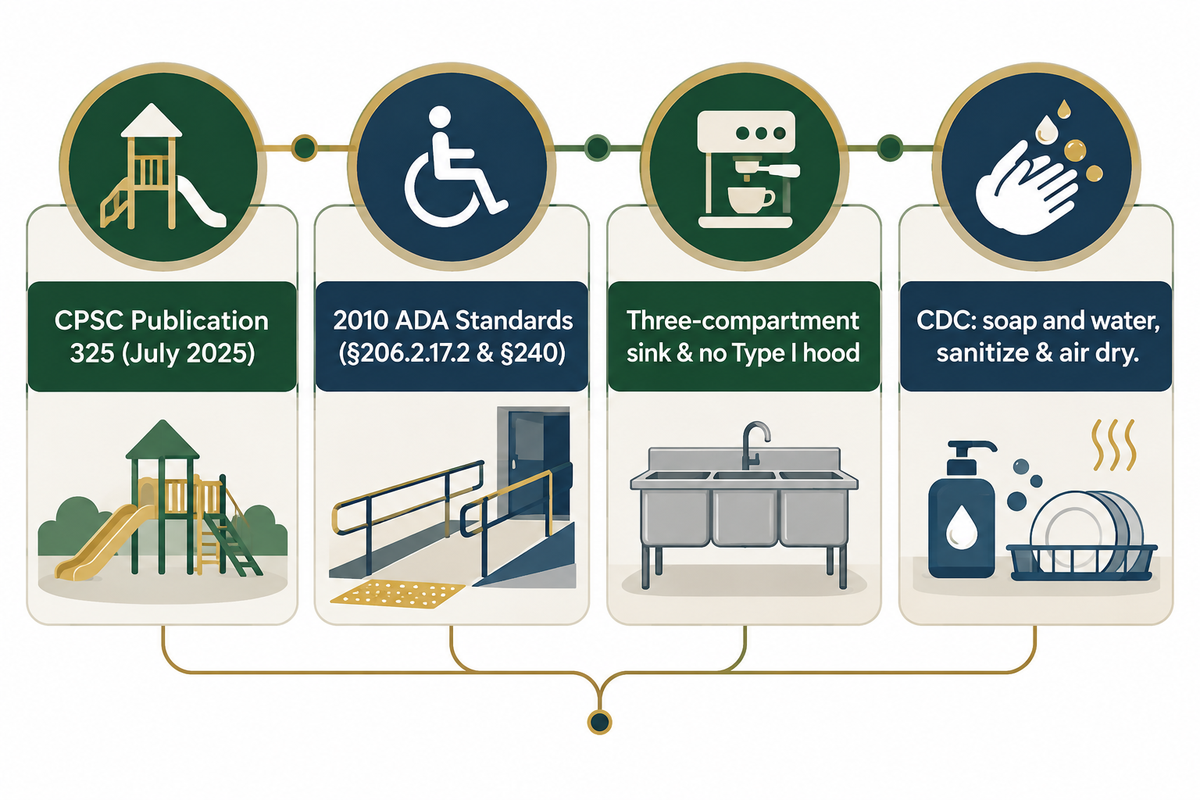
Commercial play cafes should follow applicable age-matched safety standards, federal ADA play-area standards, local health-department food requirements, and CDC sanitation guidance.
In August 2025, the U.S. Consumer Product Safety Commission published Federal Register 90 FR 38959 announcing final updates to its Public Playground Safety Handbook (Publication 325, July 2025). The notice cites over 190,000 estimated annual ER-treated playground injuries across home and public playgrounds (2021–2023 NEISS average). Publication 325 is a voluntary handbook rather than a federal statute, yet state and municipal codes often adopt it by reference. Several CPSC recommendations also sit stricter than voluntary ASTM clauses.
Each ASTM specification is unique to an equipment class and age range. The matrix below aligns nine safety, accessibility, and hygiene benchmarks with their play cafe scope.
Standard / Authority
Covered Age / Scope
Core Technical Provision
Play Cafe Application
ASTM F2373-24
6 through 23 months (5th–95th percentile)
Public-use infant/toddler play equipment (small parts, barriers, use zones)
Dedicated public-use toddler climbers and slides (distinct from soft contained frames and toys)
ASTM F1918-21
2 through 12 years (5th–95th percentile)
Soft contained play equipment (netting, padding, fire safety, evacuation)
Enclosed multi-level padded soft play structures
ASTM F1487-25
2 through 12 years
Open public-use playground structures, guardrails, suspended-element impact
Freestanding open commercial climbers and slides
EN 1176-10:2023
Commercial enclosed users (EU/global)
Fully enclosed play equipment structural and evacuation specs
European and international commercial soft play venues
ASTM F1292 (FR 90 FR 38959)
Equipment use zones
Impact attenuation of surfacing materials (absorbing lab test F3351 in 2025)
Impact-rated flooring under climbs and slide exits
ASTM F1951 (U.S. Access Board)
Accessible play routes
Wheelchair propulsion force below 1:14 ramp equivalent
Unitary rubber or tile paths connecting accessible components
2010 ADA Standards (§206.2.17.2 & §240)
New/altered play areas for ages 2+
Soft contained structures: ≥1 accessible entry if ≤3 entries; ≥2 accessible entries if ≥4 entries
Entry routing, transfer platforms, integrated ground components
CPSC SCPE Checklist
Soft contained play operators
Daily checks of netting and padding seams, age separation, no drawstrings
Opening safety inspection log and posted rules of play
CDC Early-Care Hygiene
Early care & play surfaces
Separate cleaning (soap/water), sanitizing, and disinfecting; full wet contact time + air drying
Toy rotation, mouth-contact surfaces, daily mat disinfection
Focus closely on pinch points around cafe tables and safety gate thresholds when using the U.S. Access Board Chapter 10 Play Areas Guide during layout review. The U.S. Access Board publishes ADA play area guidelines and doesn’t certify commercial products; therefore, local architects check final drawings against 2010 ADA Standards §§240.2.1, 240.2.2, and 1008.4.
Health-department food permits are directly tied to cooking equipment. Serving espresso, smoothies, and prepackaged pastries from the commissary usually requires a hand sink, three-compartment sink, mop sink, and commercial refrigeration without a Type I cooking exhaust hood. Adding a grill or fryer increases permitting timelines due to the addition of a grease trap and/or fire suppression hood.
How Play Cafes Make Money: Open Play, Drop-In Admissions, Memberships, Parties, and Cafe Mix
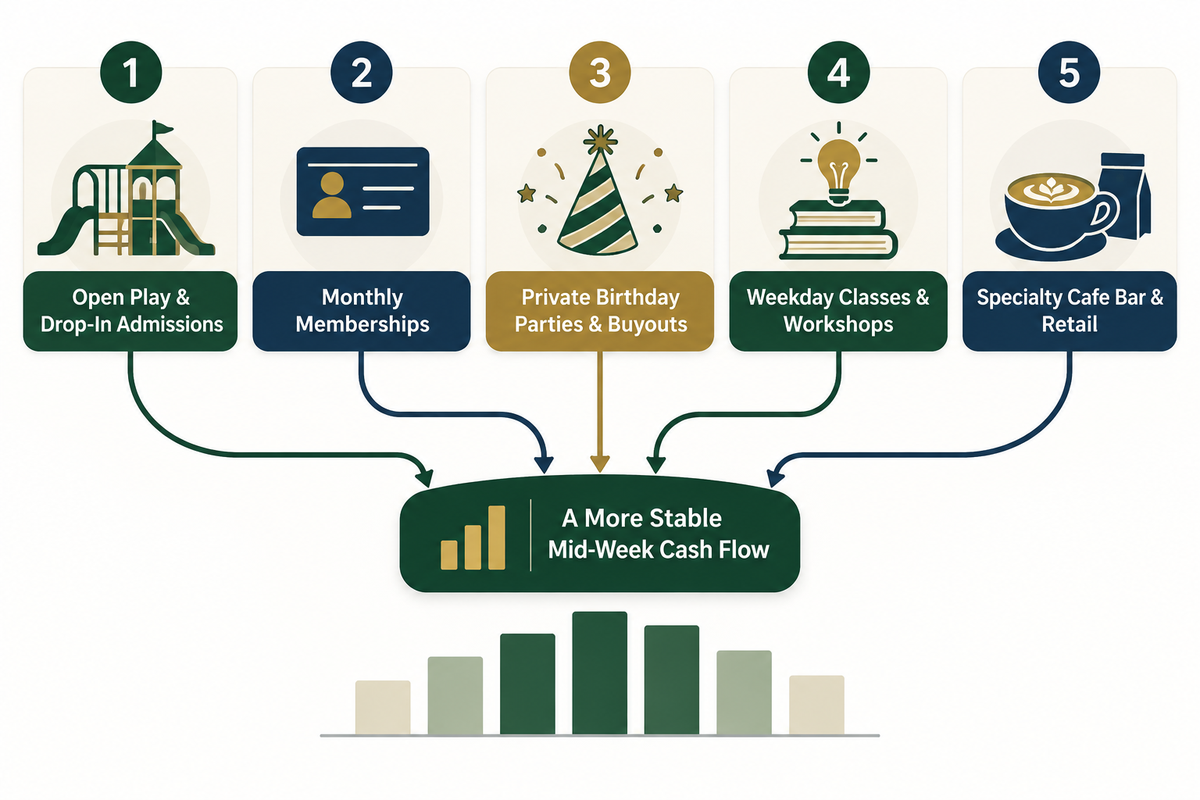
Because Tuesday through Thursday mornings are slower than weekends, many play cafes differentiate by diversifying beyond open play. Well-established venues typically structure revenue by utilizing the 5-Stream Play Cafe Revenue Mix. That mix comprises admissions for open play, memberships, private birthday parties, weekday classes, and specialized food and drinks.
Revenue Stream
Primary Demand Window
Role in Venue Cash Flow
Documented Operator Example
1. Open Play & Drop-In Admissions
Weekday mornings & weekends
Top-of-funnel trial & baseline daily traffic
Timed play passes or walk-in wristbands
2. Monthly Memberships
Year-round recurring billing
Predictable recurring revenue during slow weather weeks
Unlimited single-child monthly play passes paired with cafe and party discounts
3. Private Birthday Parties & Buyouts
Friday evenings, Saturdays & Sundays
High single-booking revenue block with advance deposits
Private party room blocks or full-venue buyouts with catering add-ons
4. Weekday Classes & Workshops
Tuesday–Thursday off-peak slots
Fills mid-week capacity without adding fixed rent
Bundled caregiver-and-me music or sensory classes paired with open play
5. Specialty Cafe Bar & Retail
All open hours
Lifts per-visit ticket value and parent dwell time
Specialty espresso, kid snack boxes, grip socks, and curated gifts
Executing hospitality has become a key differentiator amongst family entertainment venues. Trade publications in the IAAPA Funworld edition report how certain discerning families are evaluating the food offered at family entertainment centers as part of their entertainment choices.
“If 2026 has taught family entertainment centers and location-based entertainment venues anything, it is that ‘more’ isn’t necessarily better. Operators are now forced to look harder at experience, value, labor and revenue per square foot. F&B is no longer simply an amenity.”
Controlling capacity and completing cleaning resets requires implementation of timed play sessions. However, this creates surges at the front desk when check-ins and espresso orders collide. Former play cafe owner Michele Caruana highlighted why starting with a simple coffee and espresso menu avoids costly early menu mistakes.
“We started with a very simple coffee and espresso based menu and here’s the thing- I did make mistakes.”
Decoupling drink production from check-in reduces the surge. Pre-paid digital waivers route guests directly to a fast lane for wristbands while a barista works a side-offset pickup counter. Offsetting entrance time slots avoids a crowd in the lobby, and partnering with local bakeries to cater party food reduces the need for kitchen staff.
Startup Costs and Business Plan Basics to Open a Play Cafe
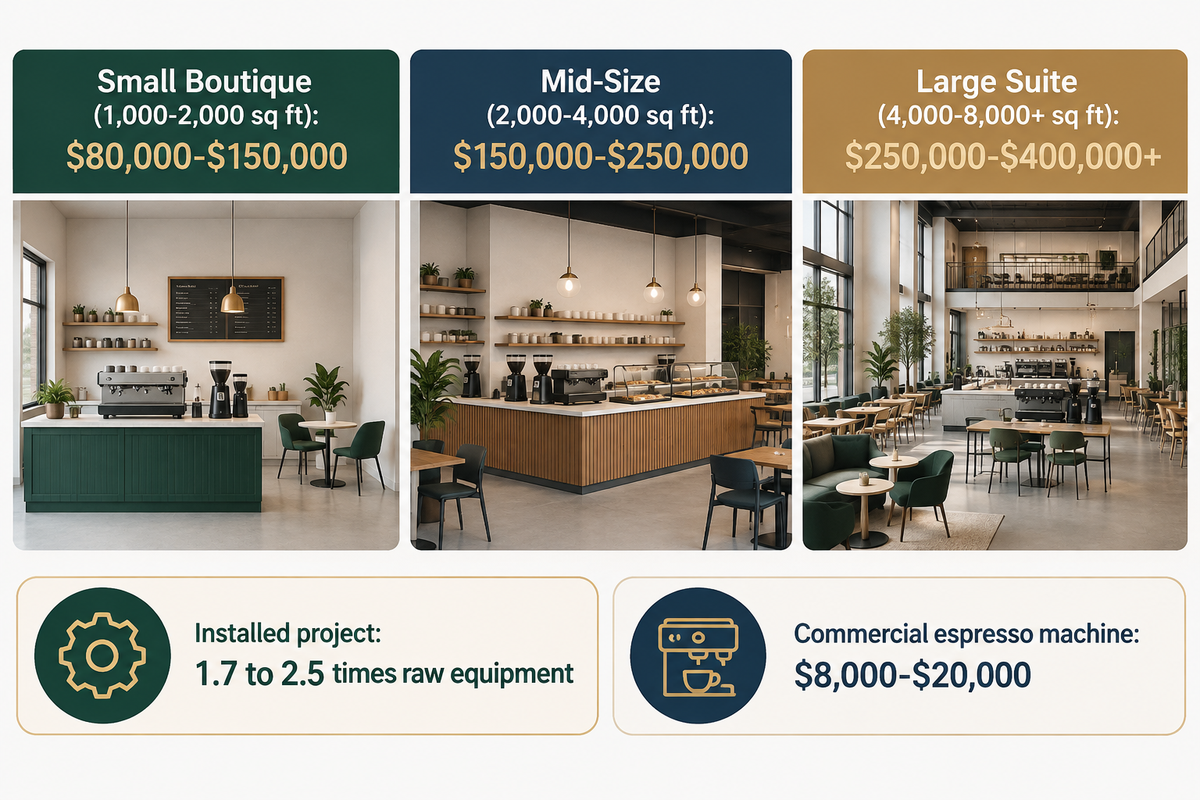
According to WellnessLiving’s planning guide, independent play cafe startup costs are placed between $80,000 and $400,000+, depending on suite size. Franchise pathways have separate brand fees, royalties, and capital thresholds (cost breakdown table below) as well as real independent operator benchmarks.
How much does it cost to start up a play cafe?
WellnessLiving gives a startup planning range of $80,000 to $400,000+, with capital needs varying by floor space, kitchen exhaust requirements, and the scope of play structures. As an illustrative vendor cost guide, commercial supplier AAA State of Play notes that completed play projects often reach 1.7 to 2.5 times the raw equipment price once surfacing, freight, and installation are added.
Catalog equipment quotes leave out major build-out lines. AAA State of Play reports that installed safety surfacing runs $15 to $35 per square foot, and professional installation adds 15% to 25% to base equipment price. The same cost guide budgets 8% to 12% of equipment value annually for maintenance. WellnessLiving adds $8,000 to $20,000 for a commercial espresso machine alone. Actual venue costs still shift with local tenant-improvement work, kitchen permitting, and custom equipment specifications.
Capital Cost Bucket
Small Boutique Suite (1,000–2,000 sq ft)
Mid-Size Neighborhood Suite (2,000–4,000 sq ft)
Large Full-Service Suite (4,000–8,000+ sq ft) or Franchise
Published Startup Ranges
$80,000–$150,000 (WellnessLiving)
$150,000–$250,000 (WellnessLiving); Michele Caruana reported about $200,000 for 2,500 sq ft
Membership/party booking software, permits, multi-month working capital
Operating reserve and, for franchise projects, a franchise fee; Franchise Gator lists a $90,000 minimum liquid-capital requirement for Cool Beans franchisees
Lenders underwrite custom indoor play equipment conservatively because bespoke structures hold low resale liquidation value if a lease closes. Hold multi-month operating cash reserves before opening rather than pouring every dollar into interior finishes. To start a play cafe with a lender-ready package, follow our dedicated play cafe business plan guide. You can also review line items in the indoor playground build-out cost guide and compare independent vs. franchise indoor play models.
Play Cafe Unit Economics: Break-Even Math, Profitability Drivers, and Worked Example
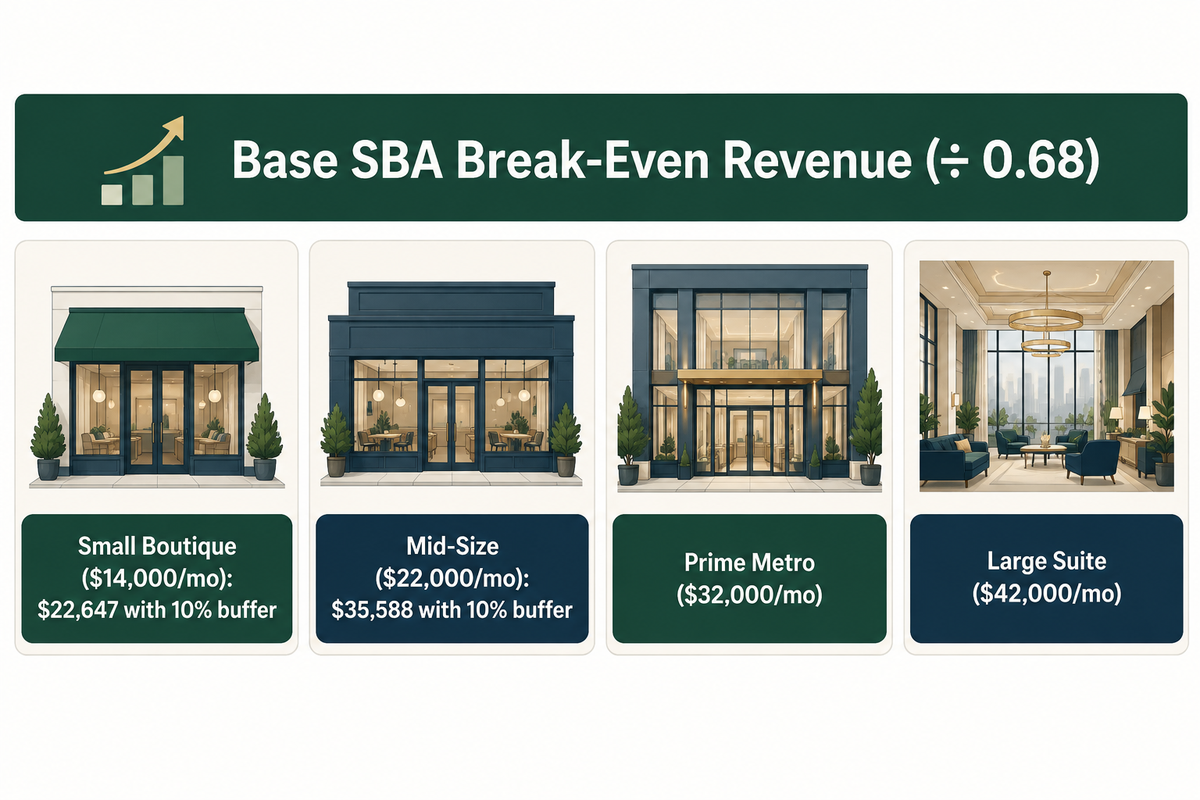
The success of a play cafe depends on its ability to control fixed costs and on weekday occupancy. Peaks on Saturdays are less important. Before signing a commercial lease, use the U.S. Small Business Administration (SBA) break-even formula to calculate the monthly revenue necessary to cover rent, payroll, insurance and utilities by dividing Fixed Costs by the Contribution Margin Ratio.
How profitable is a play cafe?
No audited national average profit margin exists for U.S. play cafes; a play cafe’s monthly net profit equals total contribution dollars from admissions, memberships, parties, classes, and cafe sales minus fixed overhead and owner pay. Actual profits depend on local rent, staffing, weekday usage, and weekend party sales.
Play cafes bundle admissions and parties with lower-margin retail and espresso sales. SBA guidance for multi-product businesses sums monthly sales and variable costs into a blended contribution margin ratio instead of using a single-item formula. Capacity units should be kept non-overlapping. A member play visit should not also be counted as a drop-in admission. Also, a private party buyout can replace admissions for that time period.
Worked Example: SBA Monthly Play Cafe Break-Even Sensitivity Table
Assumed inputs: Illustrative monthly worksheet scaling from a Small Boutique Suite up to a Large Full-Service Suite open 30 days/month. Hypothetical blended variable cost is 32% of gross sales (coffee, milk, bakery COGS, card fees, party supplies, socks), giving a 68% blended contribution margin ratio. Hypothetical non-overlapping sales inputs use $28 per paid walk-in family visit, $55/month per active member, and $400 per private party. Per SBA planning advice, a 10% contingency buffer covers unexpected costs.
Under these assumed inputs, a mid-size play cafe carrying $22,000 in monthly fixed overhead requires $35,588/month to clear break-even with a 10% SBA buffer. That target equals roughly 27 paid family visits per day plus 18 parties and 100 members.
For broader business-risk context separate from lease math, U.S. Bureau of Labor Statistics (BLS) establishment survival data on the 2013–2023 cohort show Year 1 brings the steepest drop (down 20.4 percentage points across the private sector). Five-year survival stood at 55.3% in Accommodation & Food Services and 52.9% in Arts, Entertainment & Recreation. Ten-year survival reached 38.2% in food services, 35.4% in recreation, and 34.7% across the total private sector. Explore deeper revenue levers in our indoor playground profitability benchmarks guide.
2026 Concept Shifts, Operational Pitfalls, and Why Play Cafes Fail
Neon drop-in rooms are being replaced with calming sensory interiors and acoustic treatment. Emergen Research (cited by WellnessLiving) projects the global family indoor entertainment market to expand from $26.7 billion in 2024 to $69.5 billion by 2034, led by recurring memberships. Former owner Michele Caruana’s 2026 play cafe trends point to experience-led play design, profit-driving cafes, flexible pricing, custom builds, and universal inclusive design.
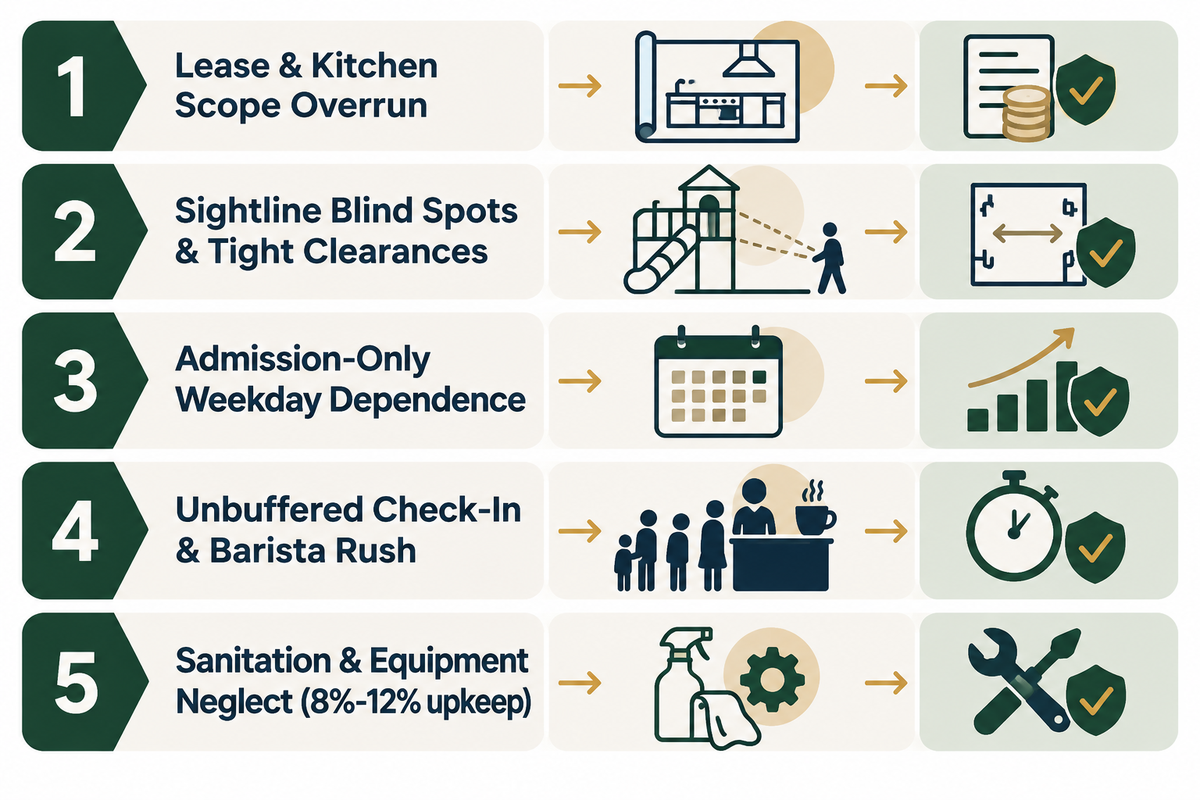
Well-funded play cafes still close early when founders prioritize Instagram decor over floor flow and lease discipline. The table below outlines five recurring pitfalls during launches, along with preventative measures.
Launch Pitfall
Root Failure Mechanism
Preventive Design / Financial Fix
1. Lease & Kitchen Scope Overrun
Signing retail space before verifying Type I hood, grease-trap, or occupancy permits drains launch cash.
Launch with a hoodless espresso and prepackaged snack bar; write permit contingencies into the lease.
2. Sightline Blind Spots & Tight Clearances
Columns, tall structures, or compressed plaything spacing raise collision risk (PMC12302015) and parent stress.
Check sightlines from seated eye height and preserve clearances between infant bays and active climbs.
3. Admission-Only Weekday Dependence
Busy weekends mask Tuesday–Thursday losses that fail to cover fixed monthly rent and payroll.
Pre-sell memberships, weekday caregiver classes, and weekend party packages before opening day.
4. Unbuffered Check-In & Barista Rush
Simultaneous timed-session arrivals clog both waiver checks and espresso ticket times (Caruana).
Enforce online pre-waivers, separate check-in from drink pickup, or stagger entry windows.
5. Sanitation & Equipment Neglect
Torn netting creates entanglement hazards flagged on the CPSC soft-contained safety checklist, while skipped cleaning routines fall short of CDC early-care hygiene steps and hurt word-of-mouth.
Log daily equipment inspections, run timed CDC-aligned sanitation resets, and reserve annual upkeep funds (AAA State of Play notes 8%–12% of equipment value).
Planning a Commercial Play Cafe Floor Plan or Equipment Package?
Commercial play cafes focus primarily on babies, toddlers, and preschoolers ages 0 to 6. Venues engage in strong age-separation practices to avoid conflicts between age groups using CPSC Publication 325 as a reference. Older kids past age 7 usually outgrow low-rise soft play structures and prefer larger indoor playgrounds or family entertainment centers.
Do parents have to stay with their kids at a play cafe?
Yes, parents or adult caregivers must stay inside the venue and actively supervise their children during the entire visit. Play cafes don’t operate as licensed drop-off daycares, running instead as non-custodial hospitality and recreation spaces for families. Leaving a child unattended breaks the venue’s safety policy because front-desk and cafe staff do not provide custodial supervision.
Is a play cafe the same as a gaming cafe or board game cafe?
No. A play cafe provides early childhood physical and imaginative play for young kids. Gaming cafes and board game cafes are for adults and teens and provide video gaming and tabletop gaming, respectively. Gaming cafes provide long, adult-sized tables and console lounges, while play cafes provide play structures and caregiver sightlines.
What is needed to open a play cafe?
Opening a play cafe requires six main ingredients: a business plan with working capital, a zoned commercial lease, permits and insurance, commercial play equipment, an espresso bar with POS/waiver software, and pre-launch memberships. First, stress-test your monthly fixed costs with the SBA break-even formula before signing a lease. Second, find a physical location that’s permitted and zoned for indoor recreation and food services and check that your location has ample parking and clear sightlines. Third, obtain the necessary municipal, health department, and insurance approvals. Fourth, purchase commercial play equipment and impact-attenuating surfacing. Fifth, set up two separate counters, one for check-in and one for espresso. Finally, pre-book events and sell memberships.
Should I open an independent play cafe or buy a franchise?
Choose an independent play cafe for lower upfront fees, no ongoing royalties, and full menu flexibility. A franchise only makes sense if standardized playbooks, vendor packages, and established brand recognition outweigh franchise fees, ongoing royalties, and strict territory limits.
How do you turn a retail space into a play cafe?
You must confirm zoning, fire code occupancy, accessibility, and plumbing capacity for espresso and wash sinks prior to signing the lease. Next, hire a local architect to submit tenant-improvement drawings, while your commercial play equipment supplier constructs a 3D layout around your column grid and ceiling height. In the meantime, you should source and install materials to create separate check-in and pick-up counters as well as impact surfaces, and both safety gates and acoustic baffles.
What sock and sanitation rules do play cafes typically follow?
Children and adults remove their shoes and wear grip socks as they enter the play area to protect hygiene and the padded vinyl. Food and drinks stay strictly in the cafe seating area, and staff, in accordance with CDC guidelines, clean, sanitize, and air-dry high-touch toys daily.
References & Sources
U.S. Consumer Product Safety Commission (CPSC), Notice of Availability: Public Playground Safety Handbook Update (Publication 325, July 2025), Federal Register 90 FR 38959, Docket No. CPSC-2024-0030 (Aug 13, 2025) Federal Register
U.S. Consumer Product Safety Commission (CPSC), Soft Contained Play Equipment Safety ChecklistCPSC Safety Guide
ASTM International, ASTM F1918-21: Standard Safety Performance Specification for Soft Contained Play Equipment (updated Sep 3, 2021) ASTM International
ASTM International, ASTM F2373-24: Standard Consumer Safety Performance Specification for Public Use Play Equipment for Children 6 Months through 23 Months (updated Jan 16, 2025) ASTM International
U.S. Access Board, Guide to the ADA Accessibility Standards, Chapter 10: Play Areas (§§206.2.17.2, 240, 1008)U.S. Access Board
U.S. Department of Health & Human Services, Child Care Licensing and Regulations & ACF/OPRE Licensing Requirements for Child Care Programs (Sept 2024)ChildCare.gov
Centers for Disease Control and Prevention (CDC), How To Clean and Disinfect Early Care and Education SettingsCDC Hygiene Guidance
National Institutes of Health / PubMed Central (PMC12302015), Angela Cazacu-Stratu, Daniela Ciobanu, and Svetlana Cociu, Understanding the risk from playgrounds to injuries for children in the Republic of Moldova (citing Suh et al. & Smith et al., 2021) NIH PubMed Central
U.S. Small Business Administration (SBA), Break-Even Point Calculator & Multi-Product Planning GuidanceU.S. Small Business Administration
U.S. Bureau of Labor Statistics (BLS), 34.7 Percent of Business Establishments Born in 2013 Were Still Operating in 2023, The Economics Daily (Jan 12, 2024) U.S. Bureau of Labor Statistics
USPTO Design Patent USD1120181S1, Climbing Frame (filed Nov 7, 2024; granted Mar 24, 2026) Google Patents / USPTO
AAA State of Play (commercial supplier cost guide, illustrative reference), How Much Does It Cost to Start an Indoor Playground?AAA State of Play
WellnessLiving, Your Guide to Opening a Play Cafe & Play Cafe Ideas That Attract Families (citing Emergen Research 2024–2034 projection) WellnessLiving
Michele Caruana (Play Cafe Academy), 2026 Play Cafe Trends & Why Having a Cafe Is Essential for Indoor Playground ProfitabilityPlay Cafe Academy
Methodology & Technical Review: Regulatory clauses, spatial dimensions, and startup cost benchmarks are from published U.S. federal guidance (CPSC, U.S. Access Board, CDC, SBA, BLS) and active ASTM/EN scopes. Commercial operator guides supply size-tier and build-out ranges. Final permitting is determined by local building, health, fire and childcare codes.
Dreamland Playground publishes practical planning guides for commercial indoor-play projects, including family entertainment centers, shopping malls, hotels, restaurants, churches, and other venue types.
Use these guides to frame the questions that should be resolved before concept selection: venue size, intended age groups, project location, attraction mix, operating priorities, timeline, and delivery constraints. Final recommendations should be based on the real site and applicable local requirements.
Start With The VenueFloor area, clear height, site location, intended audience, and target opening date create the working brief.
Clarify The ScopeConcept, equipment, production, shipping, installation, and operating inputs can vary from one project to another.
PROJECT / VENUE / TIMELINE
Prepare Your Project Brief
Venue TypesFEC · Mall · Hotel · Restaurant · Church
Start WithFloor area · Clear height · Age groups · Country