Get in touch with Dreamland Playground Company

U.S. municipal feasibility studies and hospitality benchmarks show wide capital tiers for developers asking “how much does it cost to build a water park” in 2026. According to DesignMyPlayground, commercial 3,000-square-foot splash pads run $210,000 to $345,000 flow-through or $645,000 to $1,035,000 recirculating. Hotel & Leisure Advisors (HLA) places outdoor commercial water parks at $1 million to $8 million per acre. Full-service indoor waterpark hotel resorts reach $300,000 to $600,000 per available room under the same HLA benchmark.
These overall costs vary widely across every water-park build. Starting a water park incorporates civil, earthwork, and water treatment with fiberglass water rides on the same parcel. Bare water park equipment costs cover hardware only, and don’t include grading, utility extensions, pump rooms, or permitting. Outdoor parks are typically cheaper to build per square foot compared to enclosed indoor facilities. Investors should consider verified public scopes of work to estimate design capital before committing capital.
Water Park Construction Cost by Project Size and Format
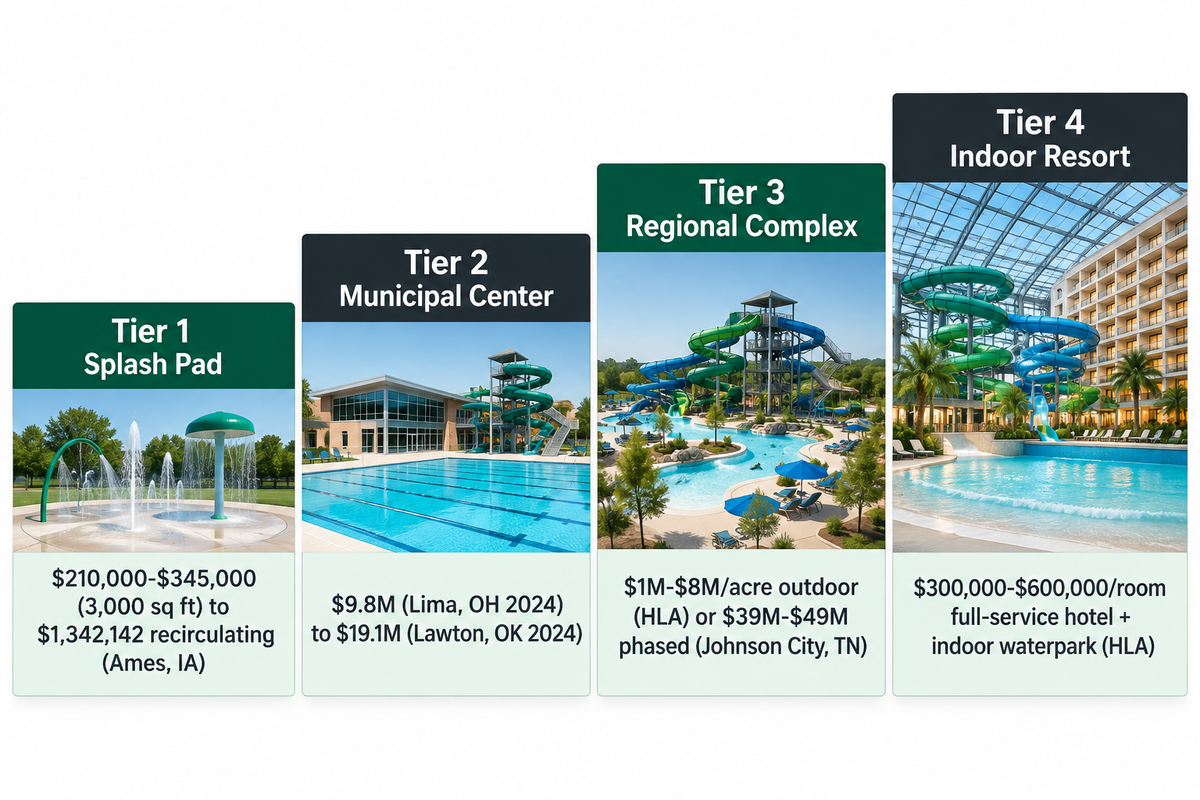
Recent public U.S. estimates span $489,856 to $1.34 million for municipal splash pads and $9.8 million to $19.1 million for community aquatic centers. Phased indoor-outdoor municipal complexes reach $39 million to $49 million. Since each reported estimate reflects a particular year, city, and construction scope, and public budgets often do not include land, financing or parking, buyers must verify line-item inclusions before comparing totals.
Sizing drives capital more than raw acreage. According to Aquatic Development Group (ADG), a water park logs daily attendance of 1.2 to 1.4 times its in-park capacity. Engineers size facilities around peak loads and guest turnover. Filtration rooms are sized for pool water volumes and local health codes.
Municipal budgets also diverge sharply because project scopes rarely match across cities. In Ohio, Lima’s 2024 community aquatic center overview priced an activity pool, family slide, tall slide, retractable-enclosure pool, and pool house at $9.8 million. In Oklahoma, Lawton’s July 2024 update listed $19.1 million on flat municipal land with nearby utilities, while funding parking and sidewalks under separate accounts. In March 2026, Water Technology, Inc. projected $39 million to $49 million across three phases for Johnson City, Tennessee. That phased plan broke into $30.09 million to $38.01 million indoor, $4.99 million to $6.30 million outdoor, and $4.09 million to $5.16 million for a splashpad.
Prior to engaging a master plan, align your funding and target land against the Four-Tier Aquatic CapEx Architecture below.
| Project Tier / Named Benchmark | Facility Format | Reported Budget or Rate | Source & Scope Conditions |
|---|---|---|---|
| Tier 1A: 3,000 sq ft Flow-Through Splash Pad | Single-pass splash pad | $210,000–$345,000 | DesignMyPlayground planning range; excludes bathhouse and land. |
| Tier 1B: Ames, IA 5,000 sq ft Flow-Through (2023) | Municipal drain-away pad | $489,856 | Ames, IA estimate (via DesignMyPlayground); $223,380 equipment/labor, $0 restroom line. |
| Tier 1C: Ames, IA 5,000 sq ft Recirculating (2023) | Recirculating splash pad | $1,342,142 | Ames, IA estimate; $485,000 equipment/labor plus $425,000 health-code restroom building. |
| Tier 1D: Ann Arbor, MI 6,000 sq ft Pad (2025) | Recirculating splash pad | $1.3 million | 2025 contract reported via DesignMyPlayground (100 by 60 ft play area). |
| Tier 2A: Lima, OH Community Aquatic Center (2024) | Hybrid outdoor + retractable pool | $9.8 million | City of Lima (2024 USD); activity pool, slides, play elements, retractable pool, pool house. |
| Tier 2B: Lawton, OK Aquatic Center (July 2024) | Municipal outdoor park | $19.1 million | City of Lawton update; flat site and nearby utilities, parking/sidewalks funded separately. |
| Tier 3A: Outdoor Waterpark per-Acre Rate | Commercial outdoor build | $1 million–$8 million/acre | Hotel & Leisure Advisors published per-acre construction benchmark. |
| Tier 3B: Johnson City, TN Phased Study (2026) | Indoor + outdoor + splashpad | $39 million–$49 million | WTI study: indoor $30.09M–$38.01M, outdoor $4.99M–$6.30M, splashpad $4.09M–$5.16M. |
| Tier 4: Full-Service Indoor Waterpark Hotel Resort | Indoor waterpark + hotel | $300,000–$600,000/room | Hotel & Leisure Advisors range inclusive of full-service hotel and indoor waterpark. |
Published supplier figures often reflect equipment-only export budgets rather than complete local construction bids. For example, international supplier CityPark Solutions lists $1 million to $2 million for small sites (500–2,000 m²) and $4 million to $6 million for medium sites (2,000–10,000 m²). U.S. turnkey contracts add local excavation, concrete basins, electrical switchgear, and state health approvals on top of hardware. Public studies also rarely separate equipment packages from civil earthwork across every size tier, so multi-trade bids remain essential.
What is the cheapest water park to build commercially?
Among the commercial formats documented in U.S. municipal studies, a single-pass flow-through splash pad carries the lowest upfront construction cost. DesignMyPlayground puts a 3,000-square-foot flow-through pad at $210,000 to $345,000. A recirculating splash pad of the same area runs $645,000 to $1,035,000 because underground holding tanks, pumps, and filter vaults add major mechanical scope.
The 2023 Ames, Iowa estimate cited by DesignMyPlayground illustrates how lower up-front capital can increase annual utility costs. Pricing the same 5,000-square-foot pad both ways showed $489,856 for flow-through water versus $1,342,142 for recirculation. Under state health regulations, a $425,000 restroom and shower building was added only for the recirculating option. However, modelled annual operating costs fell for recirculation versus flow-through, from $110,246 to $32,355. That modelled $77,891 annual saving gives the $852,286 extra construction spend a simple payback of roughly 10.9 years before financing or discounting.
Where Your Budget Goes: Hard Costs, Soft Costs, and Hidden Infrastructure
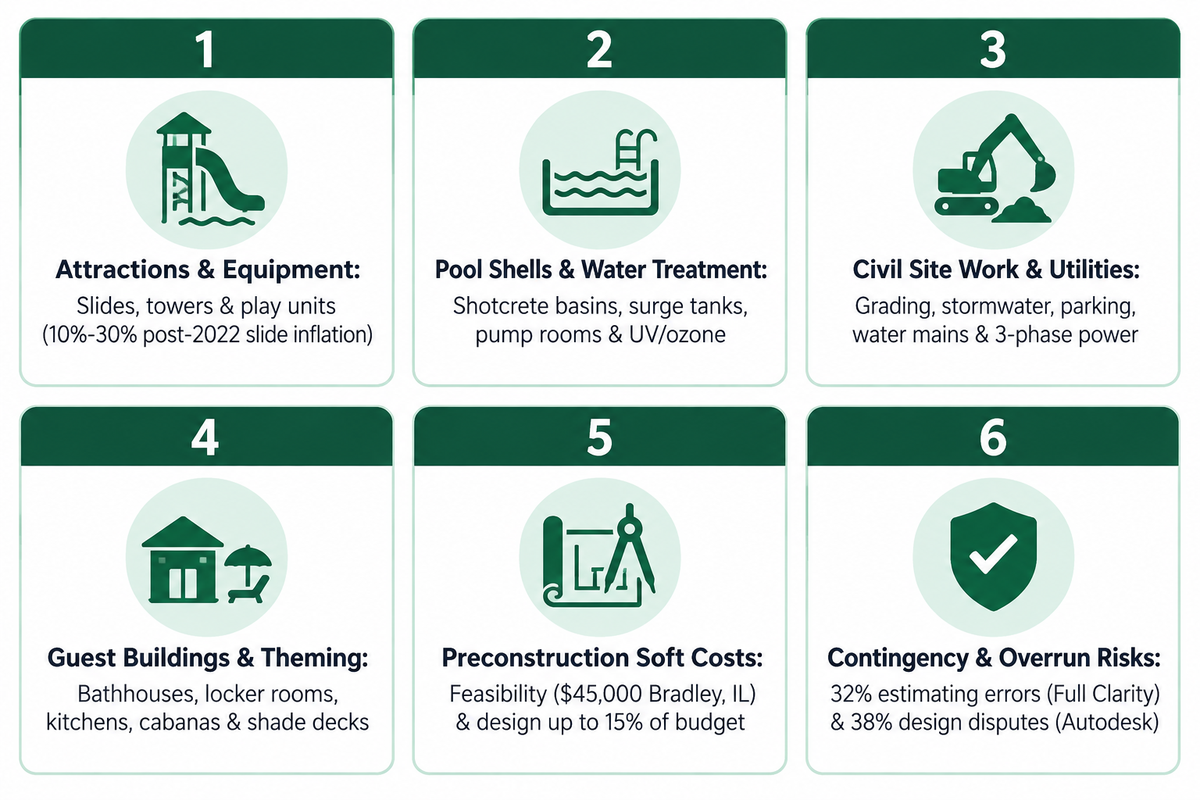
A realistic water park project breaks the capital budget into six separate baskets. Those baskets cover attractions, pool and filtration systems, site work, guest buildings and theming, preconstruction soft costs and contingency reserves. Budgeting based on a ride catalog leaves the major earthwork, concrete and utility scopes unfunded until contractor bids come in.
Hidden underground engineering swings budgets by seven figures even on flat land. ADG reports that engineering philosophy and mechanical criteria create upwards of $2 million in cost swings on parks of 10 acres or more. Construction inflation adds further pressure. JLL’s October 2026 Global Construction Costs Index places annual escalation at a 3% to 6% baseline after 25% to 30% five-year cumulative growth. Meanwhile, Cushman & Wakefield (September 2026) reported U.S. construction commodity prices up 13.3% year-over-year, including concrete up 6.4% and electrical machinery up 13.0%.
Use the six budget categories below to audit early proposals and identify omitted trades.
| Budget Bucket | Included Hard & Soft Scope | Primary Cost Variance Driver |
|---|---|---|
| 1. Attractions & Aquatic Equipment | Fiberglass slides, steel towers, interactive play structures, wave machines, shipping, and ride installation. | Custom thrill rides vs. stock towers; Goodlettsville TN (2023 study) logged 10%–30% post-2022 slide inflation. |
| 2. Pool Shells & Water Treatment | Shotcrete basins, surge tanks, pump rooms, sand/regenerative filters, UV/ozone sanitation, hydraulic piping. | Health-code turnover requirements, groundwater conditions, and underground engineering specifications. |
| 3. Civil Site Work & Utilities | Clearing, grading, stormwater detention, parking lots, fencing, water mains, sanitary sewer, three-phase power. | Hilly terrain, bedrock, high water tables, and off-site utility extension distances. |
| 4. Guest Buildings, Decks & Theming | Entry gate, bathhouses, locker rooms, kitchens, food and beverage kiosks, cabanas, shade decks, thematic rockwork. | Custom thematic facades and commercial kitchen MEP vs. pre-engineered utilitarian buildings. |
| 5. Preconstruction Soft Costs | Feasibility study ($45,000 in Bradley, IL per HLA), master planning, aquatic engineering, geotechnical surveys, permits. | Autodesk reports preconstruction and design services can reach up to 15% of construction budgets. |
| 6. Contingency & Owner Exclusions | Construction contingency plus separate owner lines for land costs, financing carry, POS/RFID gear, and pre-opening payroll. | Full Clarity links 32% of overruns to estimating errors; Autodesk links 38% of disputes to design errors. |
Cutting preconstruction engineering fees can be a costly mistake. Autodesk reports preconstruction and design costs can consume up to 15% of a project’s construction budget. Absent project documentation causes change orders during excavation and pipe installation. Maintain separate lines for land costs, loan interest, and first-season working capital alongside actual construction bids to retain the full capital budget for the lending evaluation.
Individual Water Park Attraction Costs: Slides, Wave Pools, Lazy Rivers, and Play Structures
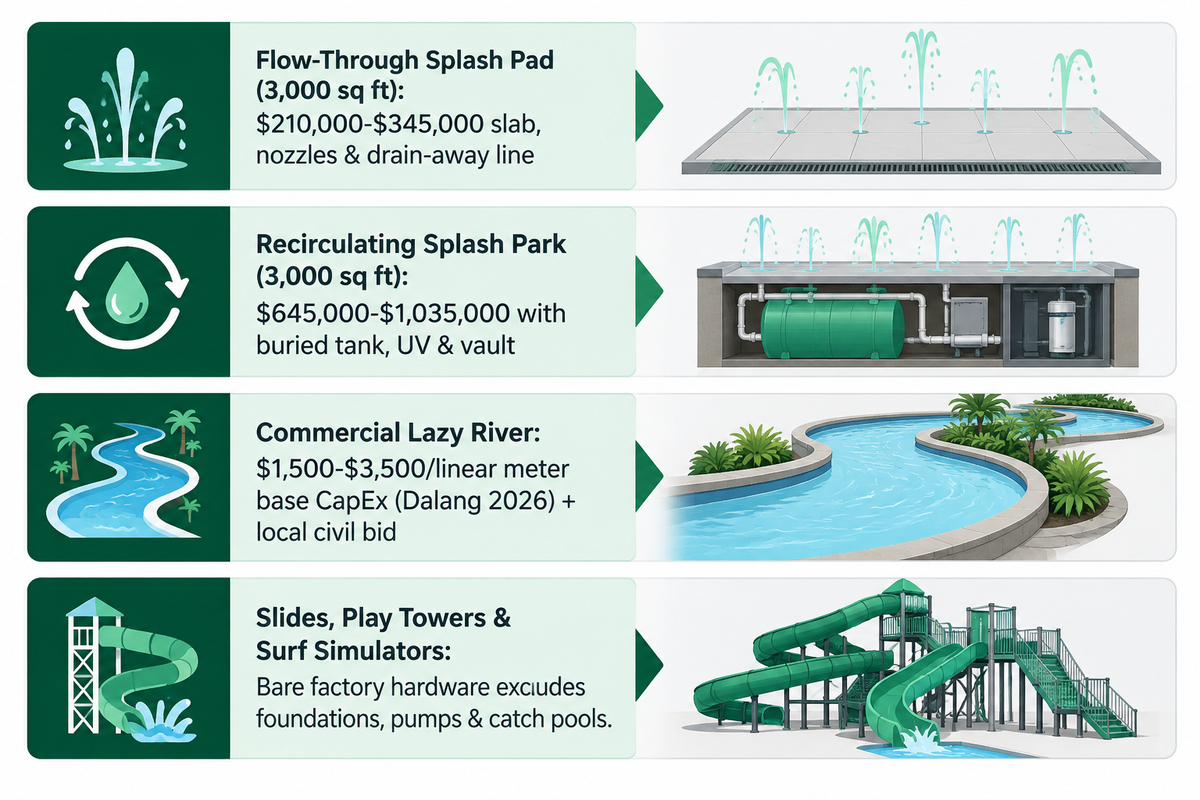
Each individual commercial water park attraction has two price levels: bare factory ride hardware and a fully-installed system. Bare factory slide quotes often don’t include tower foundations, catch pools, surge tanks, pump vaults, and deck concrete unless these are bundled into a design-build contract. In large water parks, installed costs for civil basins and mechanical rooms tend to dominate the overall cost and drive long-term success.
Published USPTO patent designs illustrate the specialized mechanical subsystems engineered for specific commercial water rides. Patent US4730355A describes a pneumatic wave generator built around pressurized air chambers and four-way valves. Patent US8561221B2 covers a deep-end wave-dampening structure, while US11273383B2 details custom surface drainage for a standing-wave ride. Public U.S. bid records rarely publish standalone installed prices for wave pools or multi-slide towers, because soil bearing, wind loads, and ride geometry require custom conceptual engineering quotes.
Review the Two-Track Attraction Scope Split matrix below to see what each attraction type requires regarding hardware and civil site work.
| Attraction Category | Equipment / Vendor Scope | Added Civil, Structural & MEP Scope | Published Benchmark / Scope Note |
|---|---|---|---|
| 1. Flow-Through Splash Pad | Spray nozzles, ground jets, manifold box, controller. | Slip-resistant concrete slab, potable supply line, storm/sanitary drain. | DesignMyPlayground lists $210,000–$345,000 for 3,000 sq ft (Ames, IA 5,000 sq ft: $489,856). |
| 2. Recirculating Splash Park | Spray features, buried holding tank, chemical controller, UV/filtration skid. | Mechanical vault, upgraded power, potential state-mandated bathhouse. | DesignMyPlayground lists $645,000–$1,035,000 for 3,000 sq ft (Ames, IA 5,000 sq ft: $1,342,142). |
| 3. Multi-Level Water Play Structure | FRP or steel decks, tipping bucket (e.g., 750-gal unit), kiddie slides, interactive sprays. | Zero-depth concrete catch basin, structural footings, dedicated pump/filter loop. | Site quote required; Wizard Works claims FRP lowers hardware cost vs. carbon steel. |
| 4. Commercial Lazy River | Propulsion pumps or jet manifolds, filtration skids, tubes, entry stairs. | Long shotcrete channel, pedestrian bridges, beach entry, surge tank, rockwork. | Dalang 2026 guide lists $1,500–$3,500 per linear meter base CapEx; local civil bid needed. |
| 5. Recreational Wave Pool | Pneumatic blowers, hydraulic wave valves, PLC controls, wave-stop sensors. | Reinforced concrete wave chambers, sloping beach basin, acoustic baffling, filtration plant. | Site quote required; major concrete and mechanical anchor in regional outdoor parks. |
| 6. Multi-Slide Fiberglass Tower | 3–5 fiberglass flumes, galvanized steel or FRP stair tower, dispatch controls, ride pumps. | Deep wind-load footings, shared runout troughs or plunge pool, perimeter decking, lighting. | Site quote required; grouping 3–5 slides on one tower lowers structural steel cost per ride. |
| 7. Family Raft & Funnel Slides | Wide-diameter fiberglass bowls/funnels, raft conveyor lifts, heavy steel support columns. | High-load foundation piers, oversized catch pool, three-phase conveyor power, queue deck. | Site quote required; multi-rider rafts deliver higher hourly throughput than single tubes. |
| 8. Water Coaster | Linear induction motors (hydromagnetic models) or uphill water jets (jet-propelled models), sensors, boats. | Dedicated electrical substation capacity, continuous concrete footings, specialized pump rooms. | Destination-tier capital investment; quote required for site power and propulsion type. |
| 9. Standing-Wave Surf Simulator | High-flow propulsion pumps, tensioned ride membrane, nozzle assembly, containment walls. | Reinforced pump pit, heavy three-phase electrical feed, spectator seating deck. | Compact footprint, low throughput compared with pools (quote required). |
From a throughput perspective, each ride or attraction adds significant capacity to a theme park, especially when compared to a surf machine. As OpenAire notes, a single lazy river fits hundreds of guests simultaneously, whereas a surf machine holds only two riders at once. On a busy Saturday, pairing high-capacity water play structures with a thrill slide ride can help manage guest wait times.
How much does it cost to build a lazy river pool?
The Dalang 2026 Water Park Lazy River Design Guide lists commercial lazy river base capital expenditure at $1,500 to $3,500 per linear meter. That converts to about $457 to $1,067 per linear foot (at 3.2808 ft/m) for base channel and equipment scope. In North American turnkey builds, installed totals rise higher once excavation, pedestrian bridges, surge tanks, filtration rooms, and theming are priced locally.
Channel width and depth drive up cost and determine where lazy river designs land in local bids. Wider channels require larger propulsion pumps and higher filtration flow rates than narrow resort loops. The cost of a commercial lazy river can quickly escalate if designs include pedestrian bridges or other water play features, especially zero-depth entries and spray arches. The cost for commercial lazy rivers should be assessed in an aquatic engineer’s conceptual estimate rather than multiplying bare per meter hardware costs.
Indoor vs. Outdoor Water Park Construction Cost and ROI Threshold
Building indoor aquatic centers is significantly more expensive than building outdoor aquatic centers. For indoor aquatic centers, developers must enclose every pool and water slide inside a tall, corrosion-resistant natatorium with continuous dehumidification HVAC. In Johnson City’s feasibility study, Phase 1 indoor aquatics reached $30.09 million to $38.01 million, versus $4.99 million to $6.30 million for separate Phase 2 outdoor components.
Comparing indoor and outdoor options requires looking at the unit building cost separately from the total project cost. Outdoor water parks can spread across lawns, pathways, and sun decks. Hotel & Leisure Advisors puts outdoor construction costs between $1 million and $8 million per acre. Indoor waterparks compress attractions to contain building volumes. Clear-span trusses, vapor barriers, and air-handling units to remove corrosive chloramines create steep extra costs, even on a smaller footprint. HLA puts development costs for resorts combining a full-service hotel with an indoor waterpark between $300,000 and $600,000 per available room. Because public municipal studies rarely price identical aquatic programs both outdoors and indoors, developers model enclosure premiums directly with structural engineers.
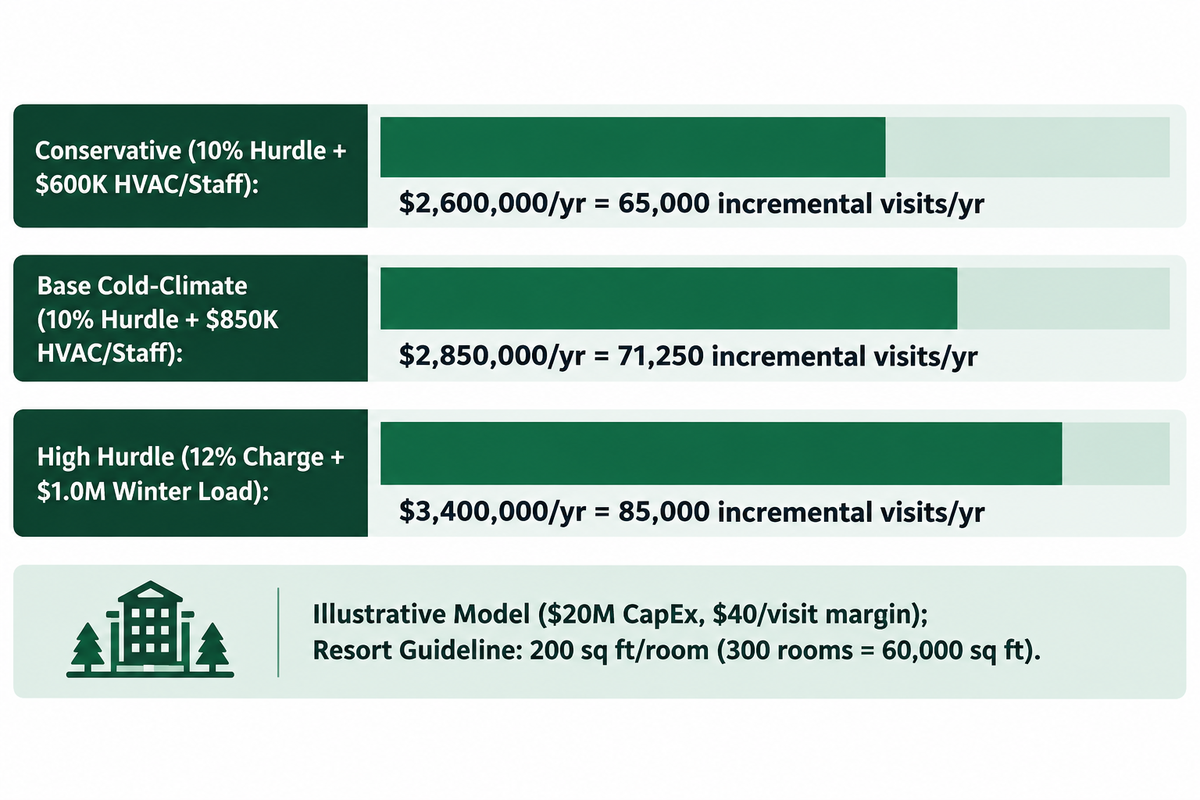
The enclosure premium can require revenue beyond day-pass ticket sales. ADG notes that indoor water park projects are often developed with a hotel bed base to help support the investment. Condo Hotel Center cites a hospitality guideline of 200 square feet of indoor waterpark per guest room for a 300-room resort. Under this guideline, a 300-room hotel would equate to approximately 60,000 square feet of indoor waterpark facility area. OpenAire also states that families are willing to drive 3 to 5 hours to a destination indoor waterpark resort.
Before committing to an enclosure, run the Indoor Enclosure Cash-Flow Inflection Test below. This sensitivity model uses illustrative assumed inputs rather than a contractor bid or industry average. Suppose enclosing a planned park adds $20 million in incremental building and HVAC CapEx (Johnson City’s indoor and outdoor phases cover different aquatic programs, so their total gap doesn’t isolate an enclosure premium). Next, apply a 10% annual capital-return hurdle ($2.0 million/year) or a 12% hurdle ($2.4 million/year). Add $600,000 to $1.0 million per year for extra heating, dehumidification power, and winter staffing.
| Assumed Scenario | Added Annual Capital Return Hurdle | Added Annual HVAC & Staffing OpEx | Minimum Added Annual Margin Required | Equivalent Incremental Visits (at $40 Assumed Margin/Visit) |
|---|---|---|---|---|
| Conservative Hurdle (10% Charge, Lower Utility Drag) | $2,000,000 | $600,000 | $2,600,000 | 65,000 incremental visits/year |
| Base Commercial Hurdle (10% Charge, Cold-Climate HVAC) | $2,000,000 | $850,000 | $2,850,000 | 71,250 incremental visits/year |
| Higher Capital-Return Hurdle (12% Charge, Heavy Winter Load) | $2,400,000 | $1,000,000 | $3,400,000 | 85,000 incremental visits/year |
Under these assumptions, the enclosure meets the return hurdle once it generates $2.6 million to $3.4 million in additional annual contribution margin, measured before the extra HVAC and staffing costs. The additional margin may come from increased admissions, ancillary spend, or linked hotel room nights. In warm climates with long outdoor seasons, open-air development usually yields better return on investment.
Land, Utilities, Water Treatment, and Safety Compliance Costs
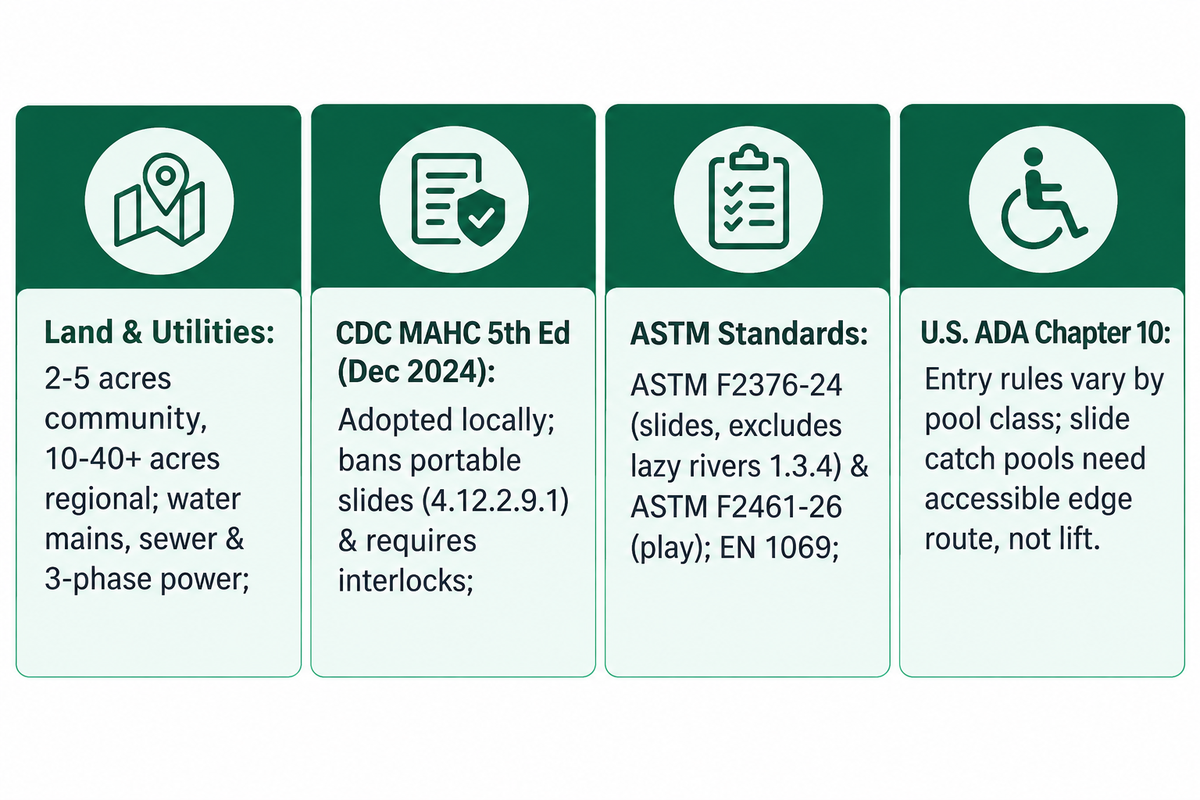
Following construction codes and regulatory compliance impacts whether civil engineering blows past budget or stays predictable. Constructing a water park can be a costly venture due to the expense of providing various utilities and services to remote rural land. Before a single slide tower goes up, low-cost rural acreage often hides millions in costs for off-site potable water mains, sanitary sewer lines for filter backwash, upgraded three-phase electrical service, and geotechnical soil stabilization.
Before closing on a piece of land, WhiteWater West advises verifying commercial zoning, height and noise bylaws, utility tie-ins, and environmental clearance. WhiteWater also recommends mapping competing entertainment venues within a 60-mile (100 km) radius. Terrain matters just as much. ADG notes that flat parcels trim earthwork bills, while rock, granite, or high groundwater inflate pool excavation and hydrostatic relief costs. Negotiating realistic parking ratios early also prevents wasting civil funds on oversized asphalt lots.
Aquatic safety codes carry direct hardware and layout costs, and developers must distinguish published standards, voluntary federal guidance, and binding local law.
- The CDC Model Aquatic Health Code (MAHC) 5th Edition was posted December 16, 2024 (Annex revised February 4, 2025). On its official overview page, the CDC states, “The MAHC is not a federal law.” Its rules apply legally only where a state, local, territorial, or tribal government adopts them. Where adopted, the 2024 MAHC 5th Edition defines single-pass splash pads and prohibits portable water slides under Section 4.12.2.9.1 because landing depth and clear spaces aren’t fixed. It also flags missing or bypassed chemical/flow interlock switches (Section 4.7.3.2.1.3) and free chlorine above 10 ppm with bathers present as critical failures.
- When specifying slides or aquatic play structures, verify the edition adopted by your local jurisdiction alongside active published standards. ASTM lists ASTM F2376-24 (updated June 14, 2024) as the active standard for water slide systems; its Scope Section 1.3.4 excludes in-ground, constant-elevation lazy rivers. ASTM lists ASTM F2461-26 (updated August 26, 2026) as the active standard for aquatic play equipment. Earlier code texts such as CDC MAHC editions cite ASTM F2376-17a and historical ASTM F2461-16e1, while European parks reference EN 1069 for water slides.
- Costs for U.S. ADA accessibility vary by attraction class. Under the U.S. Access Board Chapter 10 ADA guide, standard pools, wave pools, lazy rivers, and catch pools have different entry requirements. For water slide catch pools, an accessible means of pool entry, such as a pool lift, isn’t required. In such cases, designers must provide an accessible route to the pool edge.
Likewise, health department rules for systems that recirculate water can also expand requirements for bathhouses and showers beyond the water play deck. Simultaneously reviewing aquatic rules with our amusement and play safety standards overview helps mitigate redesigns and additional costs related to permitting.
Annual Operating Expenses, Profitability, and Payback Timeline
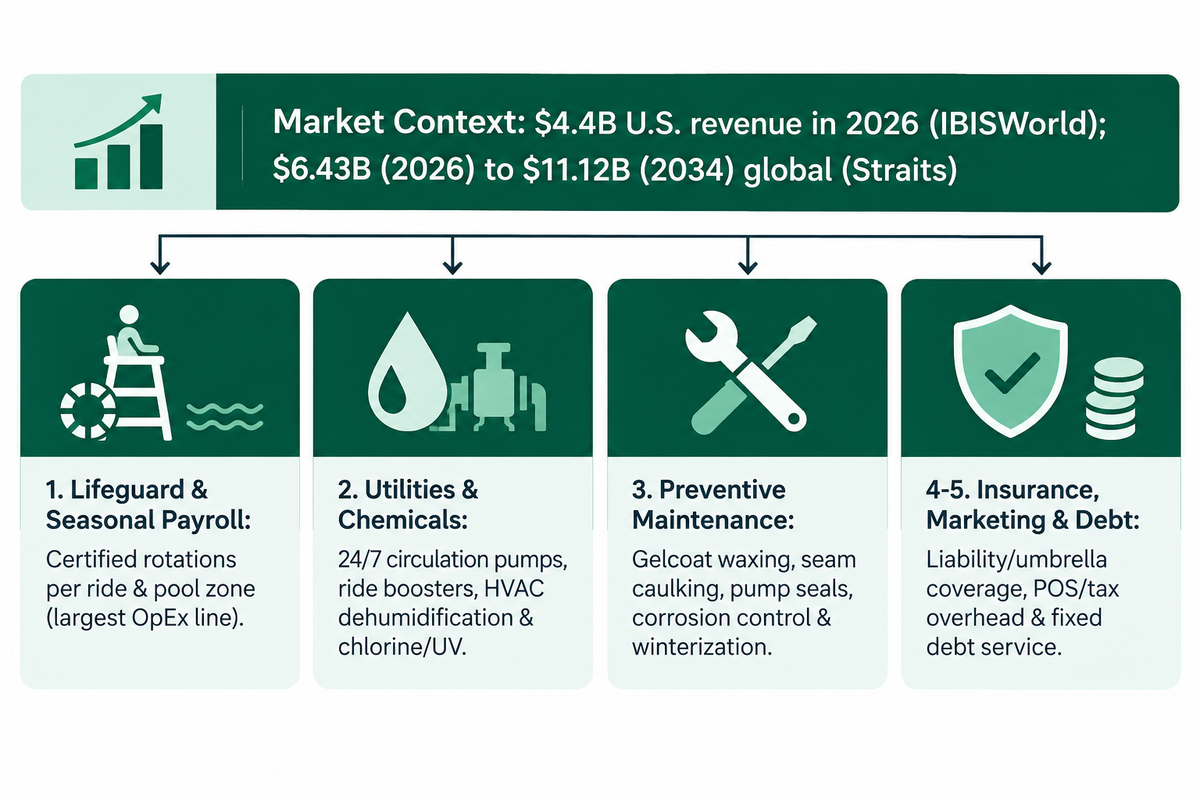
Operation of the water park requires substantial ongoing spending on certified lifeguards, water treatment, electricity, insurance, and seasonal maintenance. At the industry level, IBISWorld estimates U.S. water park revenue at $4.4 billion in 2026. Straits Research values the global market at $6.00 billion in 2025 and $6.43 billion in 2026, projecting $11.12 billion by 2034. Broad sector revenue doesn’t guarantee positive returns for an individual site.
Investors must separate operating earnings before interest, taxes, depreciation, and amortization (EBITDA) from net cash available after debt service and capital reserves. Municipal facilities work to different goals than private commercial parks. For example, a feasibility study for Northport, Alabama budgeted $612,000 in annual operating expenses against $571,000 in projected revenue for a 500-capacity municipal aquatic park. That public projection reflected an operating shortfall even before construction debt. For commercial operators, WhiteWater West warns that skipping routine slide waxing, buffing, and inspection triggers major repairs and unscheduled downtime.
“With a well-formulated and intuitive maintenance plan, we can prevent unnecessary expenditure and downtime to a large extent.”
| Operating Expense Bucket | Key Cost Drivers | Investor Risk & Margin Lever |
|---|---|---|
| 1. Lifeguard & Seasonal Payroll | Certified lifeguard rotations per ride dispatch and pool zone, admissions, food service, supervisors. | Largest operating line; local lifeguard shortages force reduced slide hours or wage spikes. |
| 2. Electricity, Water & Chemicals | 24/7 circulation pumps, ride booster jets, pool heating, indoor dehumidification HVAC, chlorine/UV sanitation. | High fixed load; variable speed pumping trims seasonal electrical draw. |
| 3. Preventive Maintenance & Repairs | Fiberglass gelcoat waxing and buffing, seam caulking, pump seals, corrosion control, winterization. | Deferred upkeep shortens fiberglass lifespan and causes peak-day ride closures. |
| 4. Commercial Insurance | Property, general liability, umbrella coverage, and workers’ compensation (WhiteWater checklist). | Aquatic injury exposure keeps premiums high; documented safety audits protect insurability. |
| 5. Marketing & Administration | Pre-season ticket campaigns, ticketing/POS fees, property taxes, and general overhead. | Debt principal and interest sit outside OpEx; weather delays shrink revenue while debt stays fixed. |
Parks are highly dependent on ancillary spending beyond gate admissions. Water park tickets draw whole families through the gate, while food and beverage, private cabanas, lockers, parking, and concession stands expand per-capita revenue. Ancillary spend and operating margins can be improved through well-placed shade cabanas and concession stands.
Do waterparks make money after debt service and seasonal downtime?
Yes, well-sited regional water parks and hotel-anchored indoor resorts can retain a net profit when operating earnings cover debt service and seasonal downtime, though no universal payback period applies across the industry. Because private commercial parks rarely publicly disclose audited annual operating budgets or debt schedules, capital recovery must be modeled site by site around financing terms, annual attendance, ancillary spending, and summer weather.
Project records contradict casual promises of rapid two- or three-year payback. Public municipal studies show small standalone parks struggling to cover operating expenses alone, and operator accounts from shuttered U.S. water parks repeatedly flag code-mandated lifeguard rosters and heavy utility bills as severe cash drains. Opening-year schedules add further risk: Lawton’s municipal update recorded rain delaying its launch from early July to early August 2025, erasing a peak summer month from Year-1 revenue. Commission an independent feasibility study from a World Waterpark Association (WWA) or IAAPA specialist to stress-test weather and debt-service scenarios before committing equity.
Water Park vs. Dry Indoor Entertainment Venue: Capital Efficiency for Investors
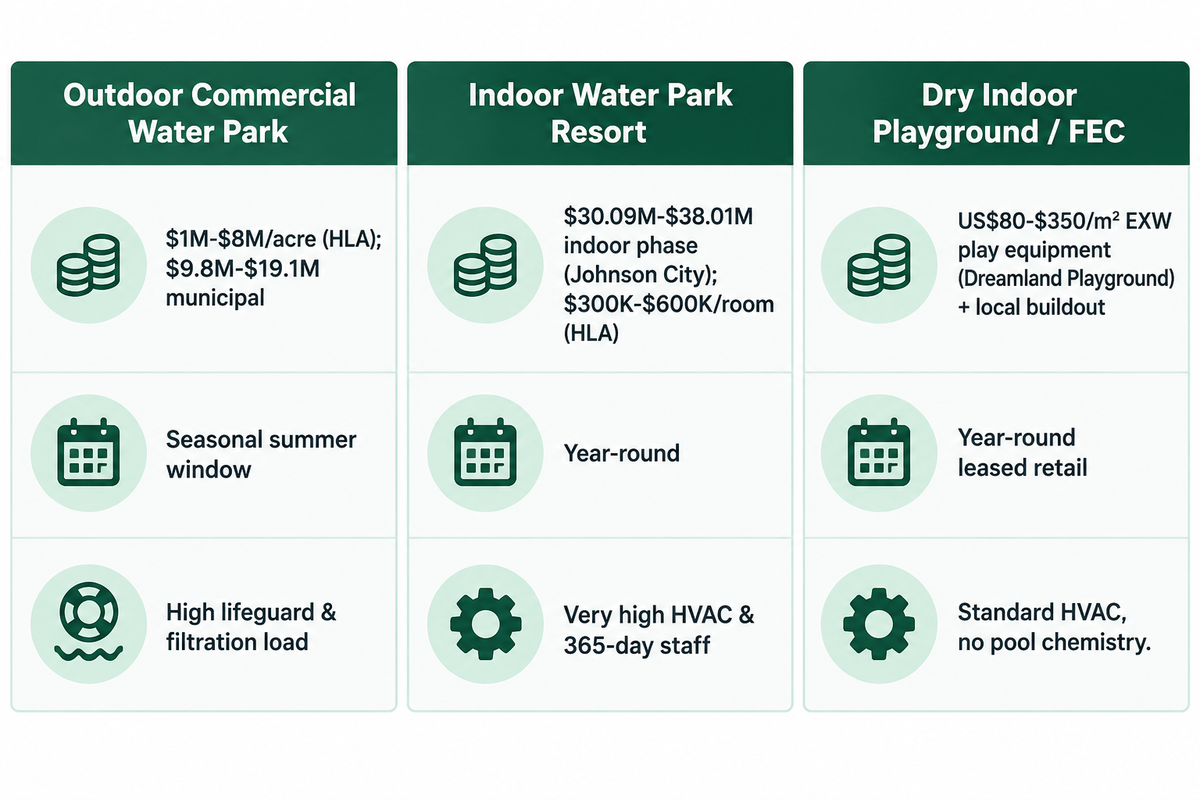
A community municipal aquatic park can cost between $9.8 million and $19.1 million before land costs are included. When capital is tighter or the local climate restricts outdoor swimming to a short summer, a dry indoor family entertainment center (FEC) offers year-round revenue without aquatic mechanical complexity.
Dry indoor play venues remove pool excavation, water treatment plants, chlorine corrosion, and certified lifeguard staffing. For direct equipment reference, Dreamland Playground publishes commercial indoor playground equipment pricing of US$80 to US$350 per square meter (ex-works play area scope). Standard production runs 15 to 30 working days, with engineer-reviewed quotes delivered in 3 working days. Because that price covers only dry play equipment, excluding leasehold fit-out, freight, and local work, investors compare complete local buildout bids across formats.
| Business Model | Published Cost Reference | Operating Season | Staffing & Mechanical Complexity |
|---|---|---|---|
| Outdoor Commercial Water Park | $1M–$8M/acre (HLA); $9.8M–$19.1M municipal comparisons with differing scopes (Lima, OH: community aquatic center with a retractable-enclosure pool; Lawton, OK) | Seasonal (weather-exposed summer window) | High: certified lifeguard rosters, commercial filtration, winterization. |
| Indoor Water Park Resort | $30.09M–$38.01M indoor phase (Johnson City); $300K–$600K/room with hotel (HLA) | Year-round (often paired with resort lodging or municipal funding) | Very high: natatorium dehumidification, chloramine corrosion control, 365-day lifeguards. |
| Dry Indoor Playground / FEC | Dry play equipment US$80–$350/m² EXW (Dreamland Playground) + local leasehold buildout | Year-round in leased retail/mall space | Moderate: standard commercial HVAC, floor monitors instead of lifeguards, no pool chemistry. |
| Dry Theme / Amusement Park | Multi-million to destination-scale mechanical ride CapEx (site bid required) | Seasonal or year-round by climate | Very high: heavy mechanical ride maintenance and strict ride inspection regimes. |
Operators consider dry amusement facilities along with water parks before locking land. Check out our indoor playground cost guide or compare real indoor playground profitability benchmarks. Or measure wet builds against the full theme park development cost guide. Hybrid business models, where a smaller outdoor splash pad combines with a year-round indoor FEC, capture summer traffic without the burden of an indoor natatorium mortgage.
Turnkey Water Park Builders, Equipment Manufacturers, and Construction Timeline
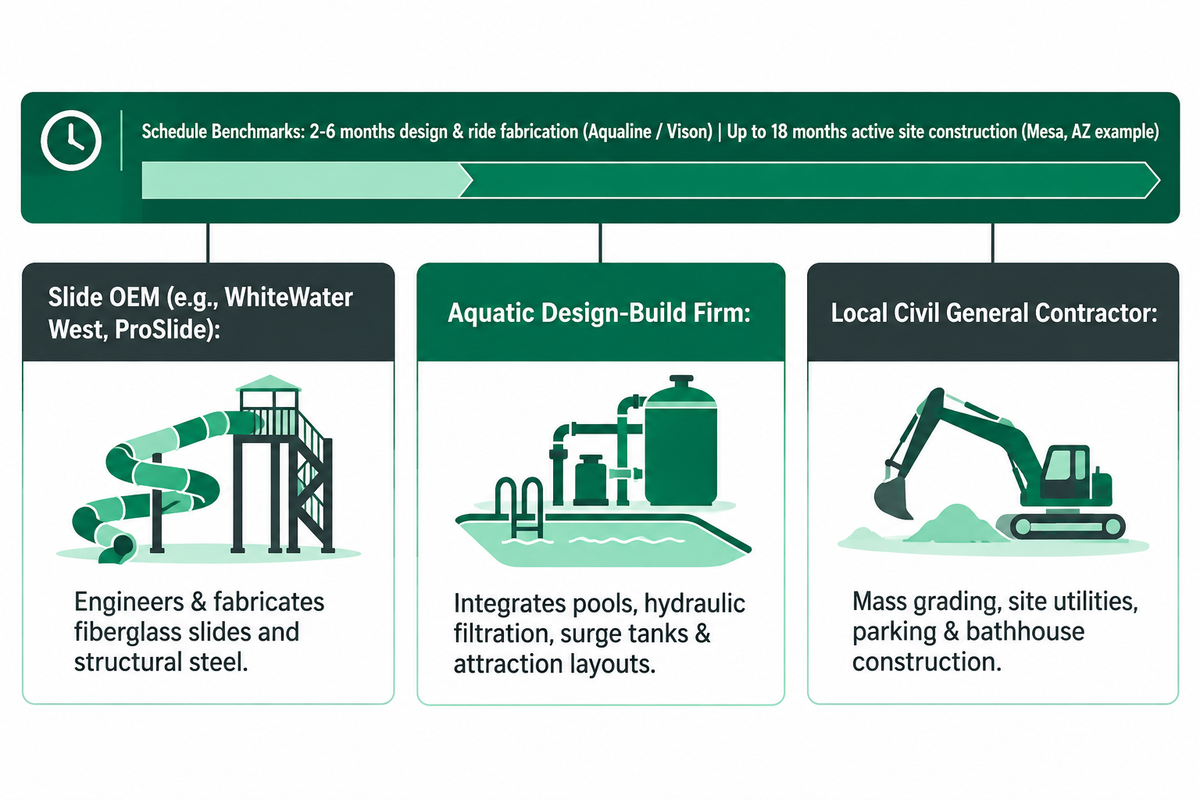
Building a new water park typically spans feasibility and master planning, engineering and permitting, concurrent civil construction and ride fabrication, and installation plus commissioning. Manufacturer guides from Aqualine and Vison Waterparks cite 2 to 6 months for initial design and ride fabrication, while ground-up municipal complexes like the aquatic center in Mesa, Arizona can take up to 18 months of active construction.
A typical procurement error in water park design is assuming a ride supplier’s slide package includes a turnkey design-build service for the entire park. In practice, a project may split responsibilities among three firms. Slide manufacturers, like WhiteWater West and ProSlide, build and engineer slides. Aquatic design-build firms integrate pools and attractions. Local civil general contractors perform mass grading and bathhouse construction. Clear scope boundaries help define what is and isn’t included in bids.
| Project Workstream | Park-Level Design-Build Firm | Slide & Ride OEM | Local Civil General Contractor |
|---|---|---|---|
| Market & Financial Feasibility Study | Coordinates with independent consultants (e.g., HLA, WTI). | Provides ride budgets only; not an independent lender study. | Not applicable. |
| Site Grading, Utilities & Parking | Provides interface specs; may self-perform or subcontract. | Usually excluded from ride equipment scope. | Primary responsible contractor. |
| Pool Shells, Surge Tanks & Filtration | Primary aquatic engineering and specialty construction scope. | Supplies ride pump specs; normally excludes concrete basins. | Builds surrounding decks and utility tie-ins. |
| Slide Manufacturing & Installation | Integrates ride foundations, plumbing, and commissioning. | Primary manufacturing and installation supervision scope. | Provides crane access and site staging. |
| Bathhouses, Kitchens & Entry Gate | Coordinates guest flow and capacity sizing. | Usually excluded from ride contract. | Primary vertical building contractor. |
Defining contract scope boundaries clearly in your RFP reduces scope-gap disputes between trades. Selecting your design team and lead builder early also limits conservative over-engineering. As ADG explains, engineers drawing plans without knowing the end builder often over-specify underground systems to hedge risk. Financing structures shape timelines too. Hotel & Leisure Advisors notes that developers combine traditional banks, hospitality investment bankers, developer equity, and government bonds or grants. An independent competitive analysis helps lenders assess projected attendance and revenue before financing closes.
How to Lower Water Park Construction Costs Without Cutting Guest Throughput
Value engineering can help reduce construction costs and lower energy costs for the life of the building. Careful value engineering also doesn’t compromise the capacity of the deck and pumps or guest experience. Cutting back core infrastructure, such as shrinking shade decks, removing backup pumps, or under-building restrooms, risks bottlenecks that discourage return visits and require costly retrofits.
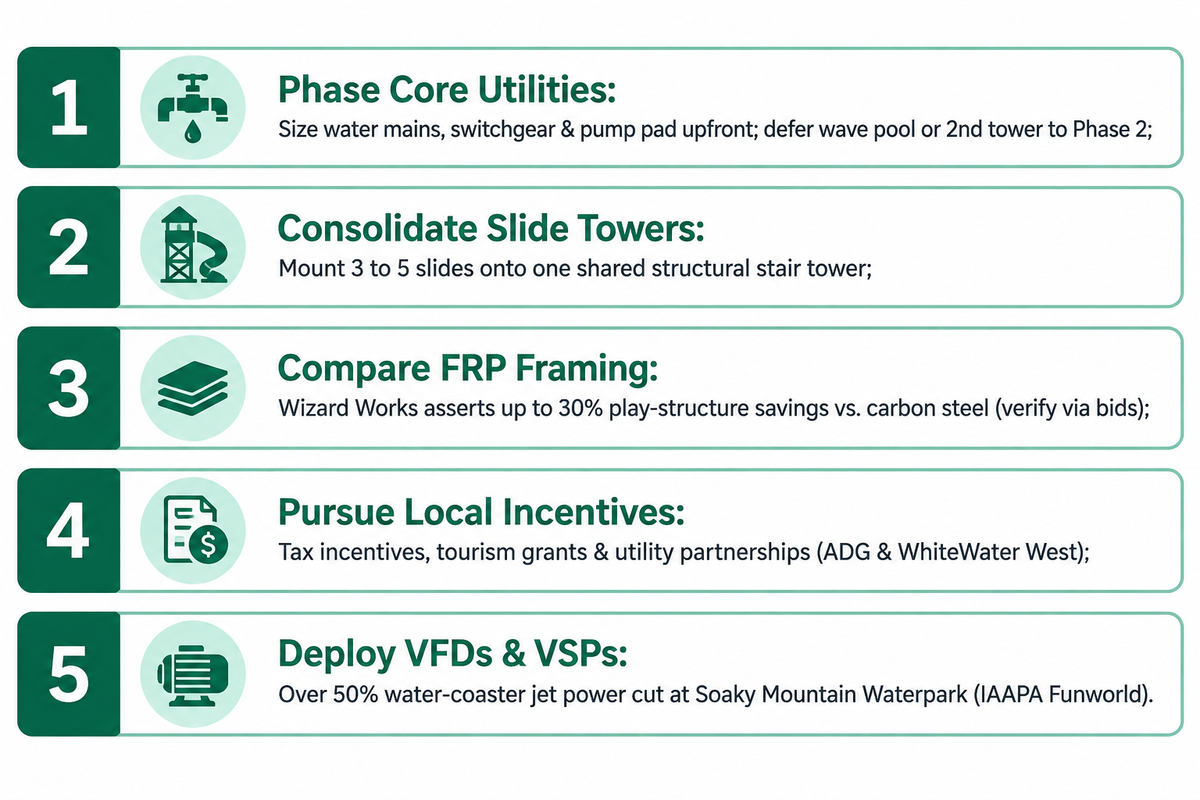
Rather than stripping infrastructure, we can implement the following five capital efficiency levers during master planning:
- Delay capital expenditures for less critical infrastructure. Size main water lines, electrical switchgear, and the pump pad for expansion, then defer a wave pool or second slide tower to Phase 2 once cash flow stabilizes.
- Consolidate three to five slides on the same structural stair tower.
- Consider corrosion-resistant framing materials for use in high-chlorine air. Vendor Wizard Works Design Group asserts that replacing carbon steel frames with Fiberglass Reinforced Pultrusion (FRP) and modular plumbing reduces its play structure costs by up to 30% versus steel. Owners should verify the vendor claim by requesting side-by-side competitive bids.
- Pursue incentives to offset site work and utility costs. Both ADG and WhiteWater West identify local tax incentives, tourism grants, and infrastructure partnerships as potential options to alleviate steep land costs.
- Use variable frequency drives (VFDs) and variable speed pumps (VSPs) to lower energy costs. An IAAPA Funworld report documented WhiteWater’s VFD-controlled Smart Blast jets at Soaky Mountain Waterpark in Sevierville, Tennessee cutting water-coaster jet power consumption by more than 50%.
Variable speed pumping reduces water loss and power costs. As Dan Thomas, Director of Product Development at ProSlide, told IAAPA Funworld:
“Operating at lower speeds reduces stress on pump components, extending their lifespan and reducing maintenance needs.”
Avoid overcrowding your footprint while chasing a unique design. As OpenAire advises, packing too many rides into tight spaces damages deck yield, sightlines, and guest flow; more attractions isn’t always better. If you’re weighing phased aquatic builds against dry venues, read our family entertainment center planning guide. It explains how to model guest throughput, zoning, and capital staging before hiring architects.
Frequently Asked Questions About Water Park Construction Costs
How much land do you need to build a water park?
A municipal splash pad fits on under half an acre, while small community aquatic centers require roughly 2 to 5 acres, including surface parking. Regional outdoor parks often require 5 to 10 acres for the core aquatic footprint, expanding to 10 to 40+ acres to accommodate large wave pools, stormwater retention basins, and peak-day surface parking. By comparison, indoor waterparks can occupy roughly 30,000 to 100,000+ square feet, with hotel-linked waterparks often sized to provide around 200 square feet per attached hotel room.
What stages control the water park development schedule from concept to opening?
How long a commercial water park can take to build depends closely on the scope of the project. Ride suppliers report that early layout design and fiberglass production alone take 2 to 6 months. Ground-up municipal aquatic facilities run up to 18 months for active site construction after permits are approved. Local zoning hearings and state environmental, health and safety approvals set the critical path. Queues for custom fabrication and facility construction also affect project timing. Equipment and utility tie-ins early in the project reduce the risk of missing peak summer openings.
How do you own and finance a water park as a first-time developer?
Commission an independent, municipal market and financial feasibility study from an aquatic hospitality specialist to get started. For example, Bradley, IL contracted its municipal feasibility study for $45,000 (reported by Hotel & Leisure Advisors) before seeking project funding. According to Hotel & Leisure Advisors, completed developments integrate commercial bank debt, hospitality investment banking, developer equity and municipal bonds or incentives. It’s important to note that commercial lenders will look to third-party attendance and cash-flow projections.
What is a Category 6 water park?
Category 6 is the branded six-slide waterpark aboard Royal Caribbean’s cruise ship Icon of the Seas, not a municipal construction cost tier or ASTM rating.
How does renting out an entire water park compare with building one?
U.S. venues quote private after-hours water park buyouts individually rather than through public flat price lists, while renting an entire commercial water park for a corporate event avoids multi-million-dollar construction capital. Summer Fun Water Park sets a three-hour minimum starting at 6:30 p.m. and prices each buyout based on headcount, lifeguard staffing, cabanas, and concessions.
What hidden costs most often cause water park construction budgets to overrun?
There are five recurring drivers for budget overruns. These are off-site utility extensions, unanticipated rock or groundwater, health-code bathhouse mandates, mid-build material inflation, and incomplete construction drawings. Undeveloped parcels often require long potable water, sanitary sewer, and three-phase electrical tie-ins. Pool excavation costs can rise with poor soil bearing capacity or high water tables. Unexpected state health code mandates may also impact the design. There are a number of items that contribute to mid-project inflation and change orders. These include gaps in the construction documents, and inflation in the cost of steel, electrical items and other trade items.
Planning a Leisure Venue on a Practical Capital Budget?
Before sinking capital into a multi-million dollar aquatic build, consider your catchment radius and climate. Evaluate your capital stack and compare it to year-round indoor entertainment formats. Take a look at our family entertainment center planning guide or our indoor playground cost guide to help you analyze dry indoor equipment and compare it to water park commercial budgets.
References & Sources
- City of Johnson City, TN & Water Technology, Inc. Final Johnson City Aquatics Feasibility Study (March 2026)
- City of Lima, Ohio The Lima Community Aquatic Center Financing & Cost Overview (2024).
- City of Lawton, Oklahoma Lawton Aquatic Center Official Project Updates (2024–2025).
- City of Goodlettsville, Tennessee Goodlettsville Indoor Aquatics Feasibility Report (2023).
- City of Northport, Alabama Feasibility Study for Multi-Sport Complex & Aquatic Park.
- Centers for Disease Control and Prevention (CDC) About the 2024 Model Aquatic Health Code (5th Edition); MAHC Legal Status Overview.
- From ASTM International, ASTM F2376-24 Standard Practice for Water Slide Systems and ASTM F2461-26 Standard Practice for Aquatic Play Equipment.
- U.S. Access Board ADA Accessibility Standards Chapter 10: Swimming Pools, Wading Pools, and Spas
- Hotel & Leisure Advisors (David J. Sangree, MAI, CPA, ISHC) – Waterpark Financing Fundamentals; Bradley Water Park Feasibility Study Report
- Aquatic Development Group (ADG) An Inside Look into the Real Cost of Building a Waterpark (2025).
- WhiteWater West – So, You Want to Build a Water Park?
- WhiteWater West Common Park Maintenance Mistakes.
- IAAPA Funworld Benefits of Transforming Water Parks with Variable Water Pump Systems.
- JLL Global Construction Costs Index (October 2026).
- Cushman & Wakefield – U.S. Construction Cost Pressures Report (September 15, 2026).
- DesignMyPlayground – Splash Pad Cost: Flow-Through vs. Recirculating (incl. 2023 Ames, IA Municipal Estimate).
- OpenAire – Designing a Winning Indoor Waterpark.
- Autodesk 6 Causes of Construction Cost Overruns & How to Prevent Them.
- USPTO Public Patents – US4730355A (Pneumatic Wave Generator); US8561221B2 (Wave Pool Dampening); US11273383B2 (Standing Wave Water Ride).
- IBISWorld & Straits Research Water Parks in the US Industry Analysis (2026); Global Water Parks Market Report.
Transparency & Scope Note: Design guides, hospitality benchmarks, and municipal budgets reflect specific locations, scopes, and dates rather than site-specific contractor bids. During the preconstruction phase, confirm zoning, health-department rules and utility costs.
Reviewed by the Dreamland Playground Co.,Limited technical team.