Get in touch with Dreamland Playground Company

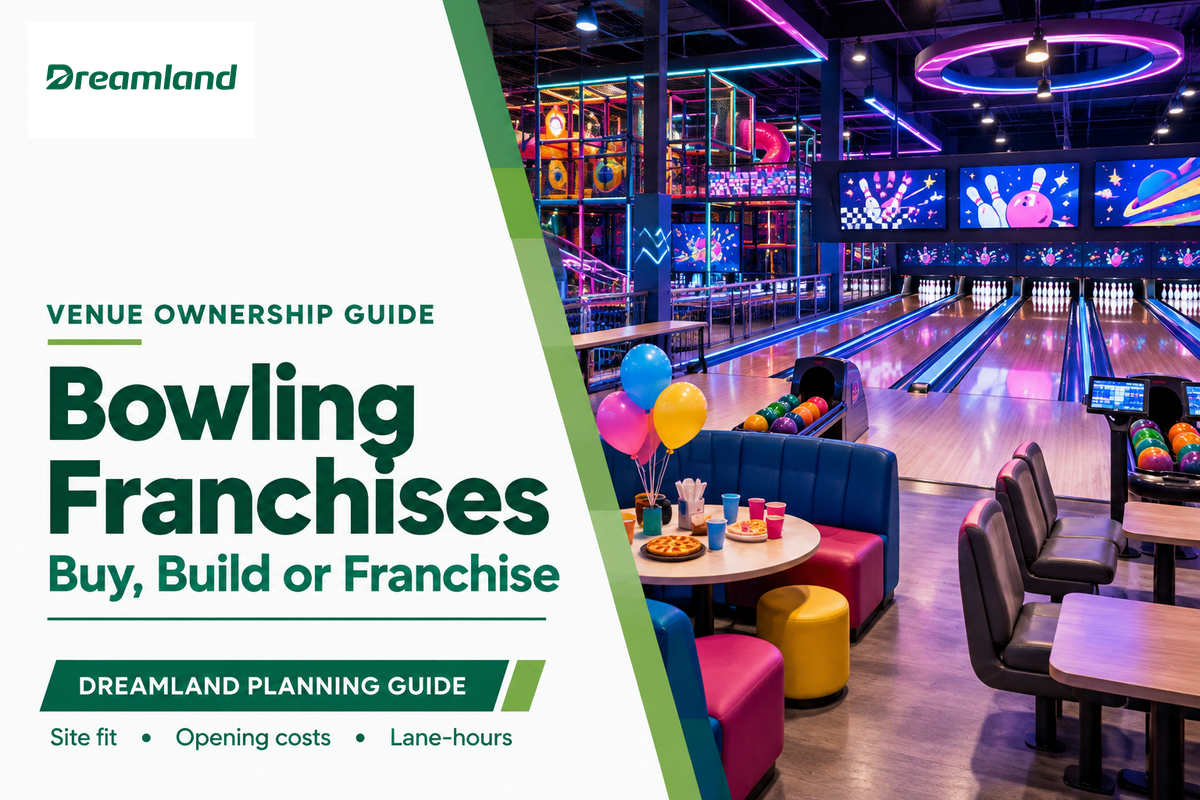
Consider the business you wish to operate. An investor who wants to serve local bowlers will have different considerations from one building an entertainment complex around group events. A league-oriented alley with traditional bowling lanes, a dining-led entertainment venue and a family entertainment center with a few lanes each have different implications for the building and the staff. When comparing bowling franchises, use the same site, operating calendar and cost considerations you’d use to assess an independent center.
Consider that Friday nights may be busy while Tuesdays may lose money. Assess business performance using bookings by hour and day rather than a seller’s or broker’s stated sales total or a visit at peak times. A lane set aside for maintenance, league play or a private event can only be scheduled once.
Bowling franchises are agreements that let independent owners operate under an established brand. A company-owned chain operates its own venues. Assess the franchise disclosure, site fit and cash needed to open. Then assess how many paid lane-hours the venue needs to cover operating costs.
Key points
- Fully booked weekends can still leave a weekday contribution gap.
- You can buy an existing bowling center with a franchise agreement already in place. Check the transfer terms separately.
- Separate the bowling equipment quote from the building work and cash required prior to opening.
- Select lane and pinsetter specifications for the intended recreational or league format.
What counts as a bowling franchise?
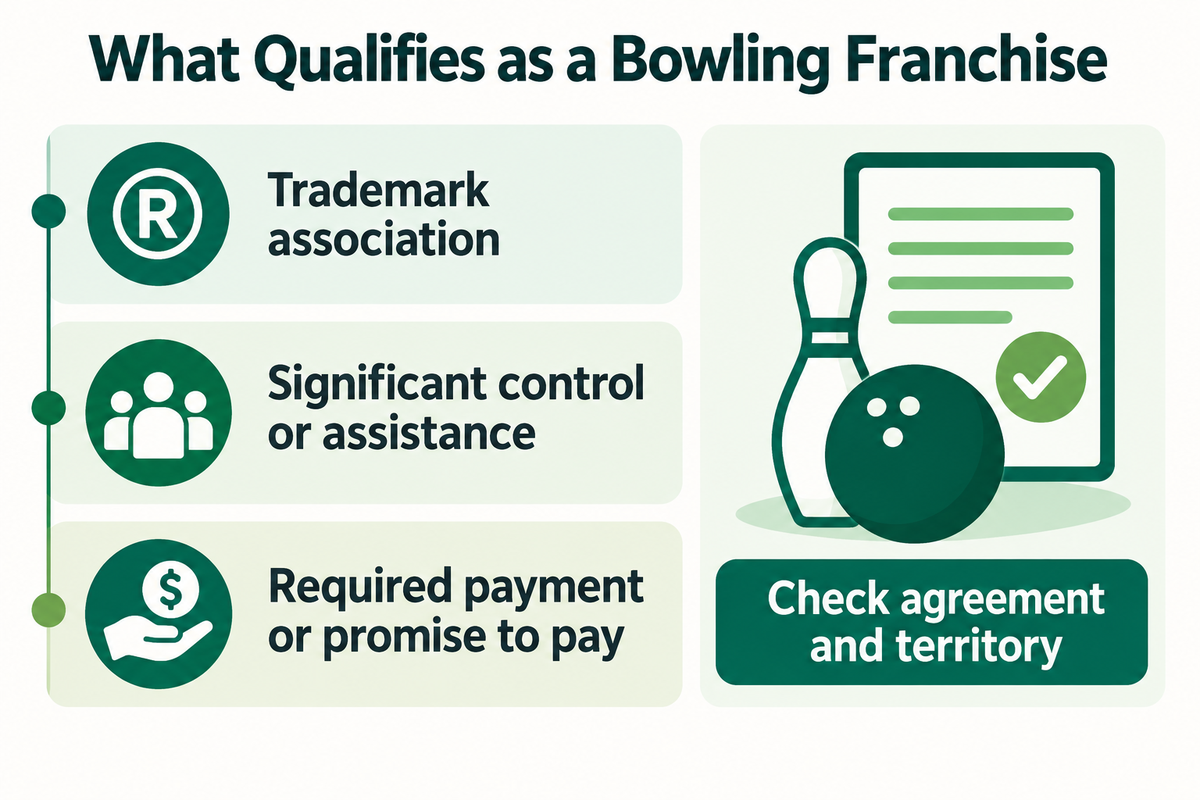
A bowling franchise allows its licensee to run a particular venue under the banner of the company. The franchise defines the terms of the relationship, such as the fees and obligations. Under the U.S. Federal Trade Commission’s definition, the analysis turns on association with the franchisor’s trademark, significant control or assistance by the franchisor, and a required payment or commitment to pay the franchisor or its affiliate.
Consider the FTC Franchise Rule. Ask what the seller can grant at your site. A chain’s location map shows where customers can bowl. A vendor’s proposal shows what it can supply. A franchise agreement tells you what you can operate under the brand and what you’ll owe for that right.
Include the contracting entity’s name on each offer, and use the current franchise disclosure document (FDD) and the proposed agreement to identify the fee recipient. Judge territory availability and protection by the written confirmation and terms of the agreement; a familiar sign on the building says little about this.
Which U.S. bowling brands invite franchise inquiries?
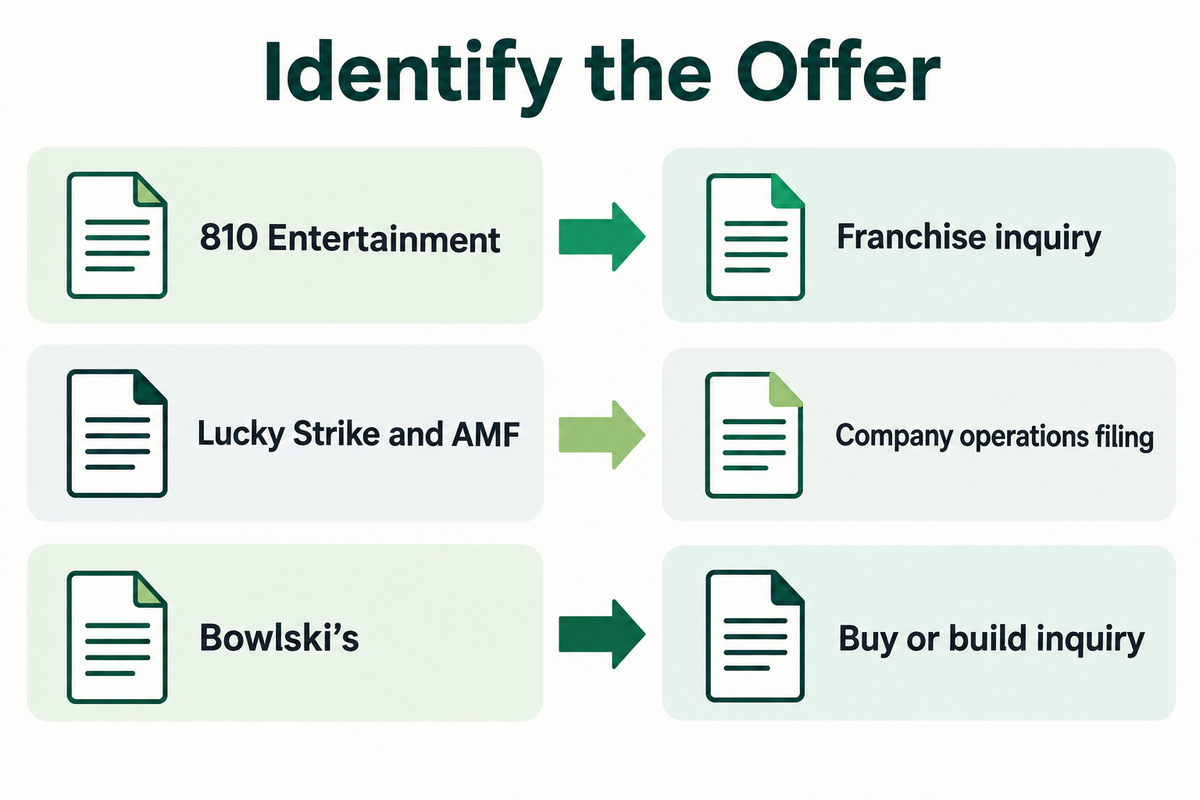
810 Entertainment invites prospective franchisees to inquire about its bowling and dining concept. Use the inquiry page to ask whether your market and preferred venue format are available. Other recognizable bowling brands belong on your comparison sheet only when you’ve identified a current offer and the entity making it.
Use 810 Entertainment’s franchise inquiry page to request current applicant qualifications, the proposed format and the current FDD. Keep applicant requirements separate from the initial investment and the cash the site needs through opening.
The same website describes an entertainment franchise with lanes, billiard tables and a choice of food and beverage options. Ask which part of the format is mandatory for your market. A facility built on a plan that centers around meal service can have a different kitchen and staffing budget from one that mainly serves league bowlers and walk-ins.
Lucky Strike Entertainment’s fiscal 2026 filing identifies the company as formerly Bowlero Corp. and describes its operations across brands, including Lucky Strike and AMF. An older filing also uses the Bowlmor AMF name in its corporate history. Check the date and legal entity before you treat an old listing as an offer. Use that filing to understand company operations and request written terms for any site-specific franchise opportunity. Bowlski’s site currently invites readers to buy an alley or hire it to help build one. Start that discussion as a property or project inquiry.
Franchise, acquisition or independent build?
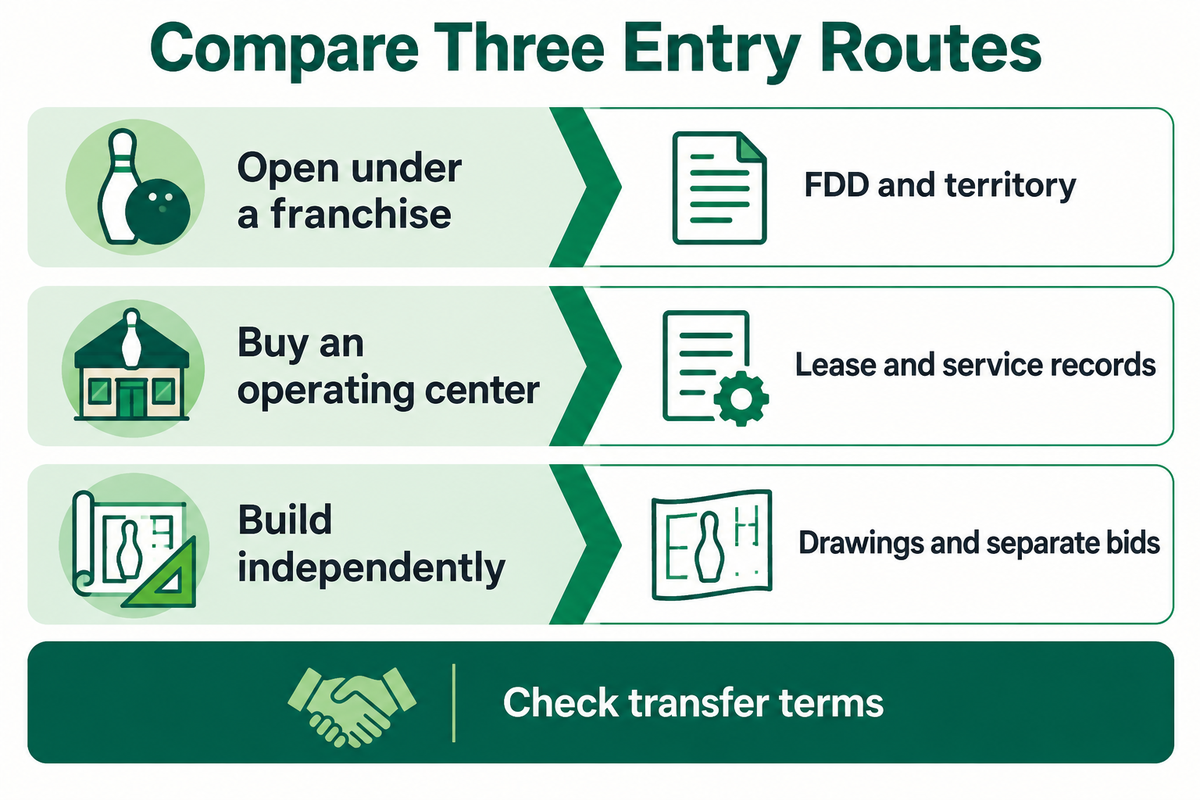
Choose a franchise for brand rights and operating support, an acquisition for an existing asset and operating record, or an independent build for control of the format. Compare those business models against the team and property that you can secure. Place the documents listed below in front of the person that will operate and finance the venue.
3-Route Bowling Decision Table
The 3-Route Bowling Decision Table compares what you gain, what you inherit and what to inspect before committing.
| Route | What you obtain | Main commitment | First evidence to request |
|---|---|---|---|
| Open under a franchise | Brand rights and support specified in the agreement | Budget for fees, design standards and required suppliers. | Current FDD, agreement and territory exhibit |
| Buy an operating bowling center | Existing assets and an operating history | Resolve lease assignment, repairs and any brand transfer. | Lease, equipment list, service logs and lane sales by time of day |
| Build independently | Control of layout, pricing and guest mix | Assemble the design, construction and operating team. | Measured site drawings and separate contractor and equipment scopes |
The routes can overlap. You can buy an existing franchisee’s center and continue with the brand. Under 16 CFR §436.1(t), a transfer by an existing franchisee falls outside the federal definition of a franchise sale when the franchisor has no significant involvement with the buyer. Approval or disapproval alone doesn’t count as significant involvement. Have counsel review the actual transaction and any state requirements.
For an acquisition, match financial results to lane reservations and point-of-sale reports by daypart, and identify who booked the busiest slots. Identify groups who plan to return. Go with the service technician on a slow night to evaluate the condition of the equipment and determine anticipated replacement needs. Include a pinsetter due for replacement in the investment model even if the seller kept last year’s repair bill low. Assess profitability after deducting the maintenance costs the buyer will need to fund.
If the bar is driving the cash flow, you’ll want to settle licensing prior to setting an opening or closing date. The California ABC guidance provides an example of conditional operation under a temporary permit pending the transfer of a license. Confirm the process for the venue’s jurisdiction and stress-test the budget if bar revenue starts later.
Budgeting for a Bowling Alley
Use the same cost worksheet for every site. For a franchise, include the initial investment disclosure from the franchisor next to signed quotes. For an acquisition, include the purchase price and repairs needed for your projected opening. Startup costs for an independent site depend on the building scope, vendor bids and the opening date.
How much does it cost to open a bowling alley?
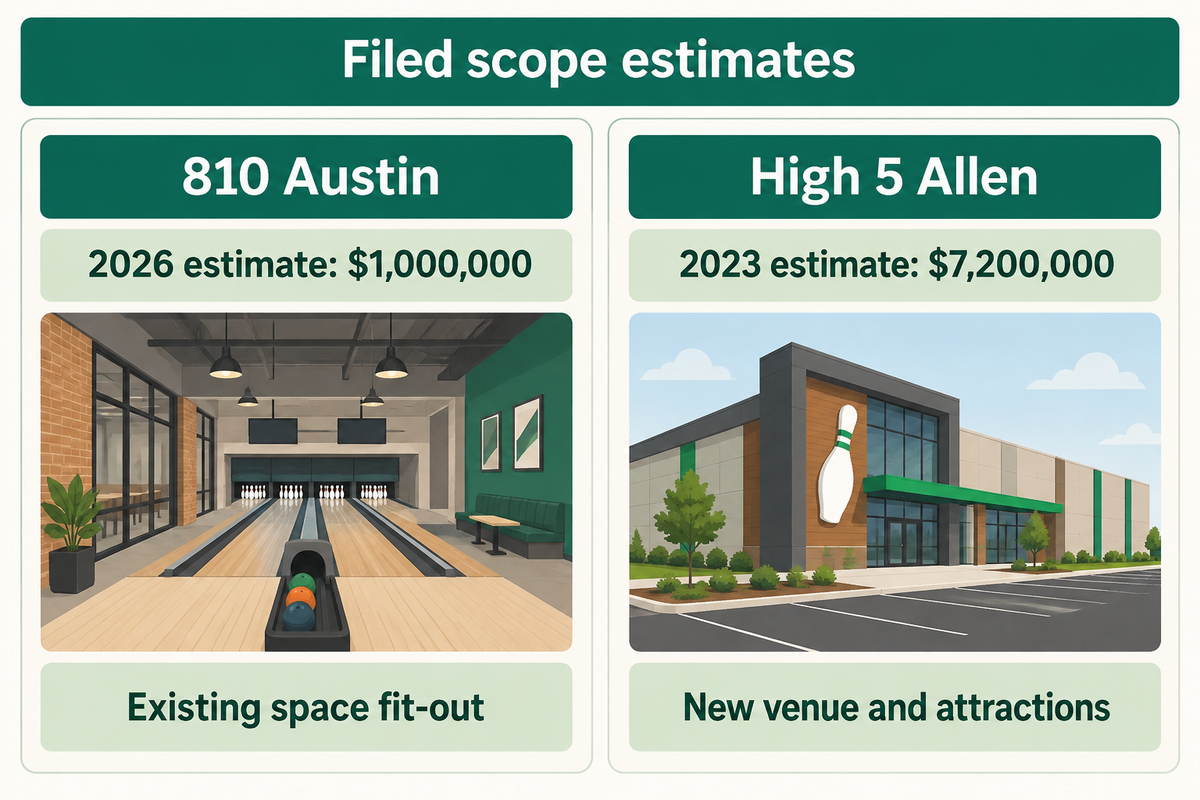
Texas project records show a $1 million interior build-out estimate registered in 2026 for 810’s planned venue in an existing Austin building and a $7.2 million new construction estimate registered in 2023 for High 5 in Allen, which includes other attractions. Each figure covers its filed construction scope. Budget the rest of the opening separately, including equipment, inventory and cash reserves where those sit outside the filed construction estimate.
| Project record | Filed size and estimate | Work described |
|---|---|---|
| 810 Billiards & Bowling, Austin | 2026 registration, 23,000 sq ft, $1,000,000 | Interior tenant fit-out in an existing building, including mechanical, plumbing and electrical work |
| High 5 Family Entertainment Center, Allen | 2023 registration, 43,360 sq ft, $7,200,000 | New construction with 16 lanes, a game room, laser tag, bars and outdoor miniature golf |
Set a due date for each item in the business plan. A construction payment, a deposit for bowling equipment and a recurring rent bill may fall in the same month. The Small Business Administration’s startup-cost guide separates one-time and monthly expenses. Use this format to show what inspection, training and initial operation of the business will look like in cash flow terms.
Make another worksheet and assume the opening of your center will be delayed. Include financing costs, rent, payroll for staff hired and insurance for the additional period. For a large family entertainment center (FEC), use the family entertainment center cost worksheet to separate the bowling vendor’s quote from other attraction costs.
What should you check in a franchise disclosure document?
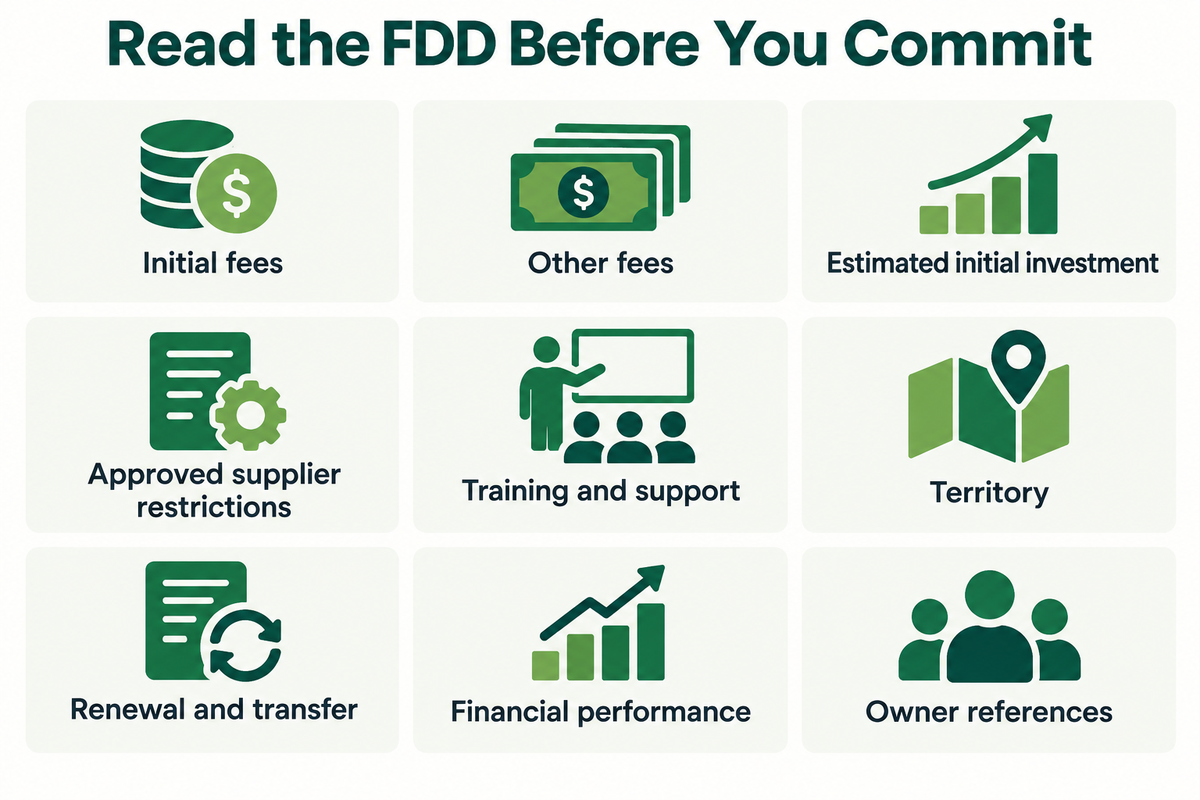
Check the fees, required suppliers, support, territory, exit terms and any financial performance representations in the FDD. For a covered U.S. sale, the FTC rule requires the franchisor to furnish the current document at least 14 calendar days before the prospect signs a binding agreement with the franchisor or its affiliate, or makes a payment to either in connection with the sale.
| FDD item | Disclosure category | Buyer’s check |
|---|---|---|
| 5 | Initial fees | List the fees, payments and commitments for goods or services received from the franchisor or an affiliate before opening, including when payments are due and which are refundable. |
| 6 | Other fees | Write down the royalty and advertising fee bases so the sales model reflects when each payment applies. |
| 7 | Estimated initial investment | Compare line items with your building and equipment bids. Enter any additional site costs on the cash calendar. |
| 8 | Restrictions on sources of products and services | Check how you can replace a component if an approved supplier has a delay. |
| 11 | Support, advertising, systems and training | Check who trains the general manager, who comes on site for launch and who pays travel costs. |
| 12 | Territory | Check the map and identify any channels or locations the franchisor reserves for itself. |
| 17 | Renewal, termination, transfer and dispute resolution | Identify fees, permissions and deadlines for a future sale. |
| 19 | Financial performance representations | Compare the operating format, reporting period and measures behind any claim. |
| 20 | Outlets and franchisee information | Speak to current and former owners about staffing, slow periods and major repairs. |
If Item 19 discloses a performance figure, compare the sample, period and what was measured using the Federal Trade Commission’s FDD guidance. For a profitable business to be viable from those sales, your gross margin needs to cover site rent, staffing, equipment maintenance and any royalties. A full-service kitchen and a counter selling packaged snacks assume different staffing scenarios. If you’re also looking at a play-led venue, look at the expense categories for indoor playground franchise costs separately.
Site Selection and Opening Sequence
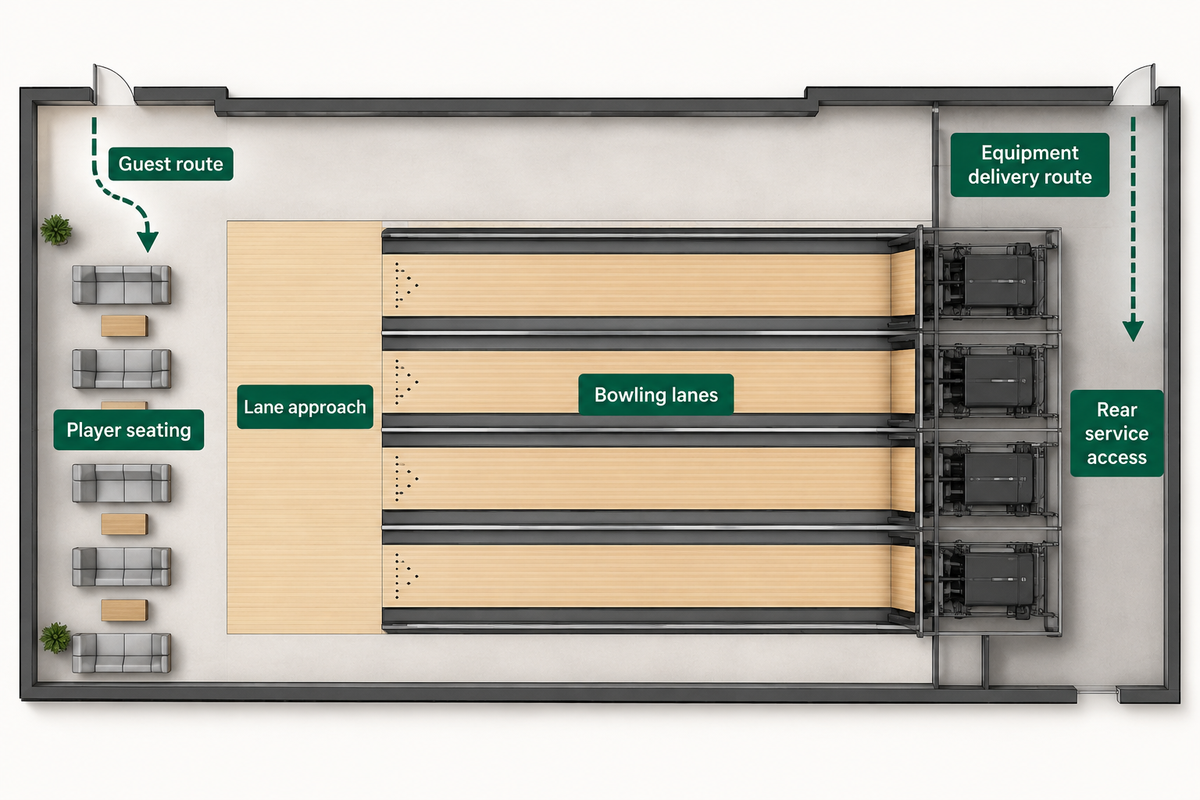
Set the lane format before you evaluate a property for a bowling entertainment business. Leave space for the approach and lane equipment. Draw separate paths for guests and equipment deliveries. Check if there are any obstructions that block either path.
How to start your own bowling alley?
Choose the venue format and have a measured floor plan tested by a designer and equipment supplier. Price the building and lane package separately. Make sure the use is permitted and the lease protects the venue’s operating needs. Schedule equipment delivery around construction and give the project team enough time for commissioning, training and the opening inspection.
- Test the use. Show the proposed bowling lanes, kitchen or snack bar, game room and party areas to the design team. Include any pro shop or other amenity when you identify the spaces customers and staff will use. Ask the local authority about the proposed occupancy and tell your design team which reviews apply.
- Draw the shared interfaces. Give the architect the slab, utility and access requirements before the contractor prices the work. Obtain lane, approach and rear-service drawings from the vendor.
- Put dates in writing. Confirm construction access and possession, as well as opening conditions, before committing to them. Time the delivery of large equipment when the route is clear.
- Close out the installation. Prior to acceptance, have the supplier demonstrate the lanes, ball returns and scoring with staff. Assign faults to the correct party.
Where the ADA Standards apply, the accessible route must serve at least 5% of each type of bowling lane, with at least one lane of each type under §206.2.11. Use the U.S. Access Board’s bowling lane guidance when the designer lays out the approach and player seating. For a wider venue, Dreamland’s family entertainment center layout guide shows how to map guest circulation across attractions.
What belongs in a bowling equipment quote?
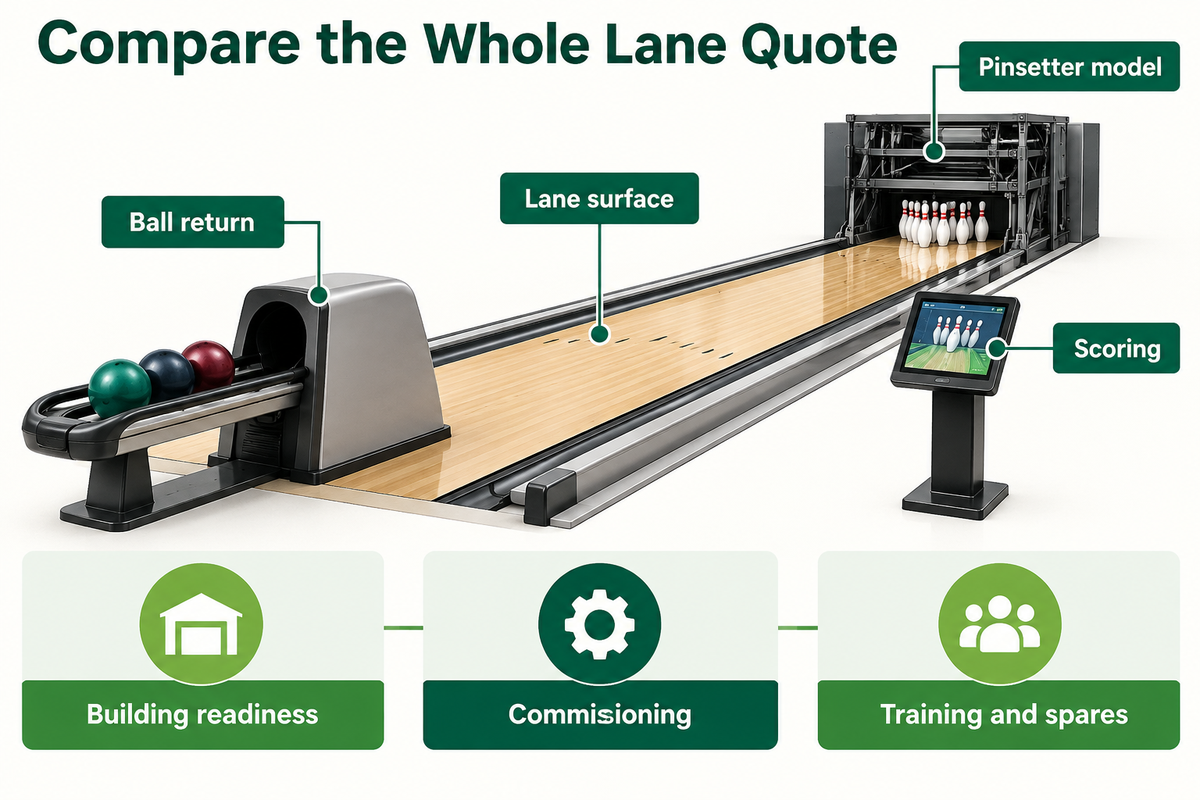
A quote for bowling equipment should identify the lanes, pinsetters, ball returns and scoring, plus delivery, installation and handover. Separate the equipment supply scope from contractor work required prior to equipment installation. Identify the exact equipment models and name the party responsible for accepting each shared interface. Ask for an acceptance document or test for each item.
4-Column Lane Quote Check
The 4-Column Lane Quote Check records the scope, inclusions, responsible party and acceptance evidence for each interface.
| Scope | Included | Responsible | Proof at handover |
|---|---|---|---|
| Lane hardware | Lane surfaces, exact pinsetter model, ball returns and scoring components | Equipment supplier | Model list and an operating test with a bowling ball |
| Freight and installation | Unload, move, assemble and commission | Name the installer and who provides lifting. | Delivery and installation sign-offs |
| Building readiness | Slab, electrical supply, data and rear access | Contractor and equipment vendor at their respective interfaces | Measured readiness checklist agreed by both |
| Service and acceptance | Staff training, warranty scope, stocked spares and service contact | Vendor and operator with duties assigned | Training record, parts list and documented test results |
Resources in Brunswick’s project planning documentation distinguish planning, construction, and equipment coordination. Capture the scope boundaries in your quotes. If USBC eligibility matters, check the United States Bowling Congress model list for the named string pinsetter and verify league requirements before ordering.
Find out how the technician can access the machines while the rest of the venue remains open. Describe the access required to the equipment needed for service. Who trains the staff? How are applicable hazardous-energy controls handled? OSHA’s hazardous-energy standard sets out the scope for covered servicing and maintenance. Keep that responsibility separate from the equipment acceptance test.
How many lane-hours must the venue sell?
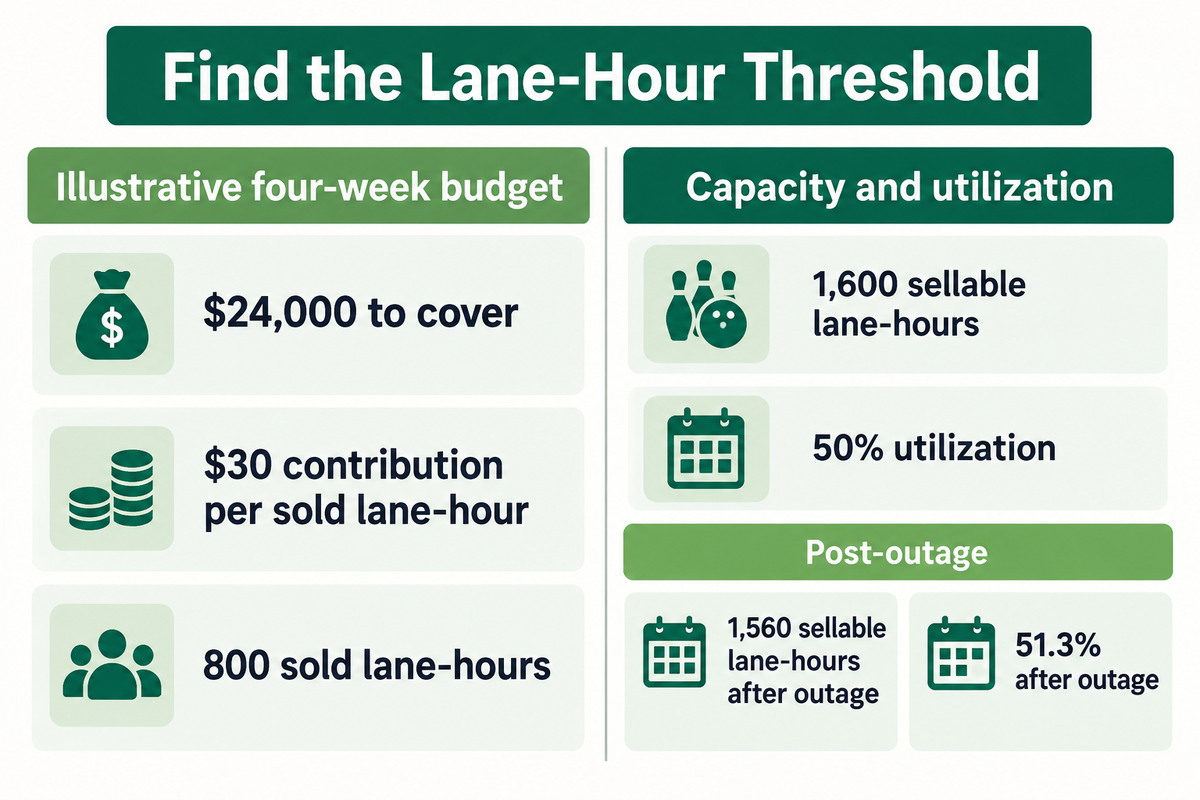
If each sold lane-hour makes a positive contribution, divide the fixed costs left after other attractions’ contribution by the contribution from each sold lane-hour. The result shows how many hours of bookings the venue needs to cover operating costs. Compare it with the hours you can actually sell after removing maintenance time and slots reserved for uses that generate no lane revenue.
The Small Business Administration break-even method divides fixed costs by price minus variable cost for a unit of sale. Use a sold lane-hour as the unit of measure. Assign party package revenue and its direct costs once across bowling and other activities. Include league bookings when planning, provided those bookings generate lane revenue.
| Input or result | Assumption or calculation | Replace with |
|---|---|---|
| Scheduled capacity | 10 lanes × 44 hours/week × 4 weeks = 1,760 scheduled lane-hours. | Count lanes and opening hours in the period. |
| Sellable capacity | 1,760 lane-hours less 160 blocked lane-hours leaves 1,600 sellable lane-hours. | Use the maintenance and event calendars. |
| Fixed operating costs | Assume $30,000 for the period. | Use recurring costs such as rent and base payroll. |
| Non-lane contribution | Assume $6,000 after the direct costs of those sales. | Use contribution from dining, arcade and other activities. |
| Costs for lanes to cover | $30,000 − $6,000 = $24,000. | Deduct non-lane contribution from shared fixed costs. |
| Realized lane price | Assume $36 per sold lane-hour. | Use the average earned after discounts and package allocations. |
| Lane contribution | $36 per sold lane-hour less $6 per sold lane-hour in variable costs = $30 per sold lane-hour. | Deduct the costs incurred to serve each paid hour. |
| Operating threshold | $24,000 ÷ $30 = 800 sold lane-hours, or 50% of sellable capacity. | Compare the threshold with bookings by daypart. |
| Outage sensitivity | 2 lanes × 20 hours = 40 fewer sellable lane-hours. The 800 lane-hour target rises to 51.3% of the remaining 1,560 lane-hours. | Remove the unavailable slots and check where bookings can move. |
Now enter those 800 hours on the booking calendar. If weekends fill and the total still lands at 780, the operation falls $600 short under these assumptions. If food and beverage or arcade contribution falls by $1,500, the target rises to 850 sold lane-hours. Test these conditions individually, and then combine them. This screen excludes debt payments, taxes and equipment replacement reserves.
For an existing venue, use sales data and the lane reservation report to show league and non-league bookings separately. Pull birthday parties into their own row, so that the package price doesn’t disguise the cost of each event. For a new bowling center, start with a conservative weekday schedule and count the staff needed to open the rest of the entertainment facility. Ask where you could place groups displaced during an outage. A lost slot matters when you cannot move its booking to another lane or time.
When should bowling share the floor with other attractions?
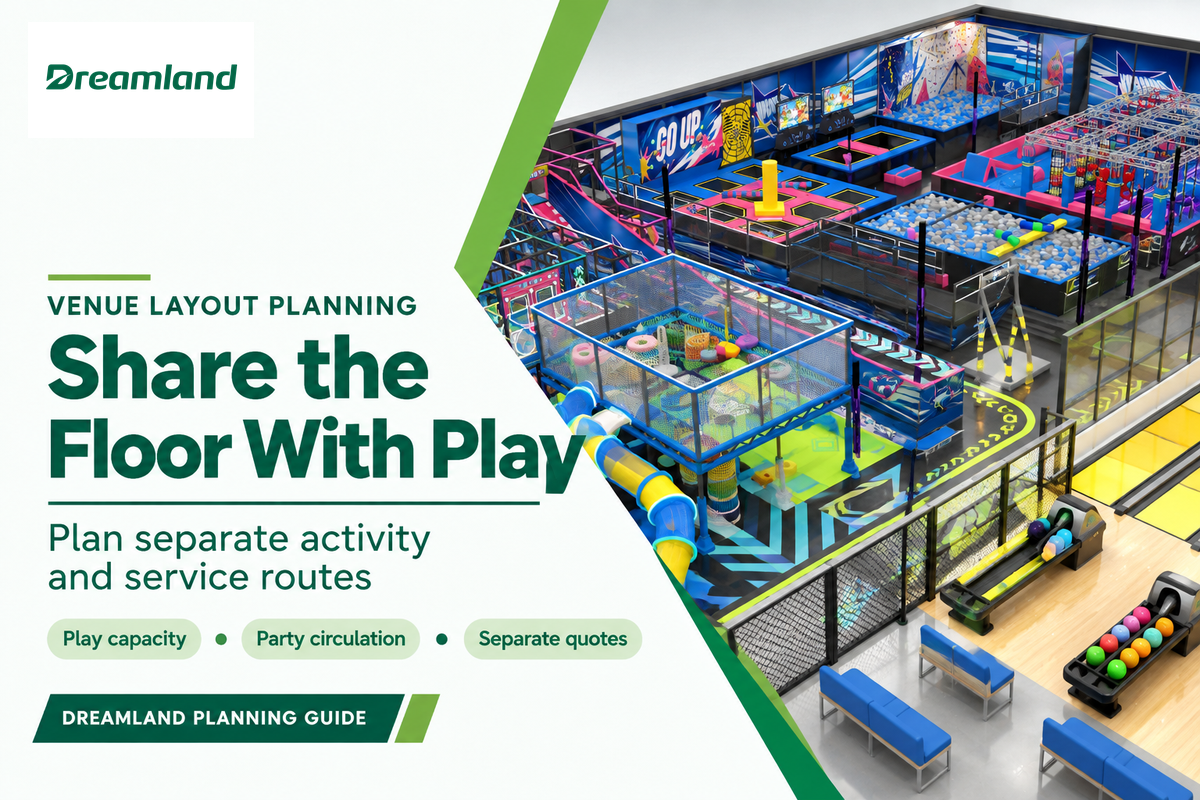
Pair bowling with a complementary attraction when it serves a different part of the visit or pays for space the lanes would otherwise leave underused. Arcade games can provide an activity for guests while they wait to bowl. Using a separate party room can free up lane side seating after a group finishes.
Estimate demand for each activity separately before combining the floor plans. An indoor play zone needs its own capacity, circulation and supervision plans. If you plan an upscale bar and restaurant, model the impact of table service and longer stays on the customer experience. For a dining-led venue, sometimes called eatertainment, model kitchen staffing, hospitality shifts and seating capacity separately from lane throughput. Check the cost of running each area during quiet hours before adding it to the concept.
A RePlay profile of Star Lanes Polaris describes a former retail space converted into a bowling venue with a private-event suite. Draw the route from check-in to the private area reserved for the group, so they can access it without having to cross the walk-in queue or the equipment service route. For a mall site, use the retail entertainment zone planning guide to account for foot traffic as well as bookings.
For a venue with a play area and lanes, use the guide to fitting bowling beside other attractions to brief the designer on the floor plan and attraction mix. For ideas on adjacent play equipment, consult Dreamland Playground. Give the lane-system specifications, installation and acceptance tests to the bowling specialist.
Frequently Asked Questions
Do Bowlero and AMF sell bowling franchises in the U.S.?
U.S. franchise availability for Bowlero or AMF is unconfirmed. Lucky Strike Entertainment’s fiscal filing describes company-operated venues, including AMF. For a property sale, identify the seller and the party that controls the name. Add brand rights to the purchase model once that party offers them in writing for the specific location.
Can I start a bowling alley in an existing retail space?
Yes, if the property can take the lane layout and your local authority approves the proposed use. Check the slab, column locations, service access and utilities using measured drawings. Ask the landlord about approvals for noise treatment, deliveries and any kitchen work before signing a lease or committing to a lane package.
Is the franchise fee the same as the startup cost?
The franchise fee buys the initial rights described in the agreement and is one part of the opening budget. Review the fees and initial investment disclosure together. Add site-specific construction quotes and map each payment to the date it falls due so your opening schedule and cash plan use the same assumptions.
Can I run a bowling franchise without managing it every day?
Yes, you can hire an operating manager if the agreement allows it. Check which duties stay with the owner, which training the manager needs and who can hire or approve repairs. Include a manager’s pay and cover for time off in the operating budget.
Is a smaller lane format a good fit for a family entertainment center?
Yes, a smaller format can work when the goal is short social sessions for families and group events. If you expect regular league business, verify the specifications for the competition first. Use a measured layout to see whether the smaller lanes create enough room for useful seating, a waiting lounge or an adjacent attraction. Price the full package and compare session length, throughput and staffing with the full-length option. Ask where spectators will stand during busy sessions.
What industry does a bowling alley fall under?
The U.S. Census Bureau’s Bowling Centers category (NAICS 713950) sits within arts, entertainment and recreation. It distinguishes the bowling industry from other amusement businesses. Food and beverage can be part of the operation. For a mixed venue, check its principal activity.
What records matter when buying an existing bowling alley?
Request the lease and any assignment terms, a model-by-model equipment list, service records and sales by day and time. Match maintenance invoices to the pinsetter inventory. Compare booking-system data with reported revenue, and separate current league contracts from occasional bookings. If the purchase depends on the seller’s bar sales, check the license and its transfer timing early. Those records help you estimate what’s likely to carry over when the ownership changes. Get key terms in writing before closing.
Plan a Play Area Beside Your Lanes
Send Dreamland your measured floor plan, lease status and expected mix of families and parties. Mark lanes and the service corridor on the floor plan and in the brief.
Dreamland provides commercial indoor play planning and equipment.
References & Sources
- 16 CFR Part 436, Disclosure Requirements and Prohibitions Concerning Franchising, Electronic Code of Federal Regulations.
- Lucky Strike Entertainment Fiscal 2026 Form 10-K, U.S. Securities and Exchange Commission.
- Bowlero Corp. Fiscal 2023 Form 10-K, U.S. Securities and Exchange Commission.
- Licensing Frequently Asked Questions, California Department of Alcoholic Beverage Control.
- Project TABS2026022603, 810 Billiards & Bowling, Texas Department of Licensing and Regulation.
- Project TABS2023017481, High 5 Family Entertainment Center, Texas Department of Licensing and Regulation.
- Calculate Your Startup Costs, U.S. Small Business Administration.
- Franchise Fundamentals and the Disclosure Document, Federal Trade Commission.
- Chapter 10 Guide for Sports Facilities, U.S. Access Board.
- Approved String Pinsetter Models, United States Bowling Congress.
- Control of Hazardous Energy, U.S. Occupational Safety and Health Administration.
- Break-Even Point Calculator, U.S. Small Business Administration.
- Star Lanes Polaris, RePlay Magazine.
- County Business Patterns, Bowling Centers (713950), U.S. Census Bureau.