Get in touch with Dreamland Playground Company

A golf simulator business rents out simulator bays by the hour and sells memberships, league nights, lessons, events and food and drink around that bay time. A four-bay venue needs about 1,260 sq ft of hitting bays before any lounge, approximately 13 feet of clear height for comfortable play, and enough bookings to clear a break-even line you can work out before you sign a lease.
If you plan to start a golf simulator business, check the numbers in this order: space requirements first (about 315 sq ft per full-swing bay), then startup cost ($45,000 of average simulator investment per bay), then the utilization that pays the rent (38% of open bay-hours at $50 an hour for four bays open 12 hours a day with $25,000 of monthly fixed costs, as worked out below).
Updated October 2026
Quick Specs
| Typical bay footprint | 15 ft wide x 21 ft deep, 13 ft high (NGF operator survey) |
| Average price per session | $55 for just over an hour, plus $40 food and drink per visit |
| Average group | 3 players per bay, about 90 minutes per visit |
| Hardware per bay (course operators) | $45,000 average reported |
| Break-even check | monthly fixed cost ÷ (hourly rate − cost per bay-hour) = bay-hours you must sell |
How a Golf Simulator Business Makes Money
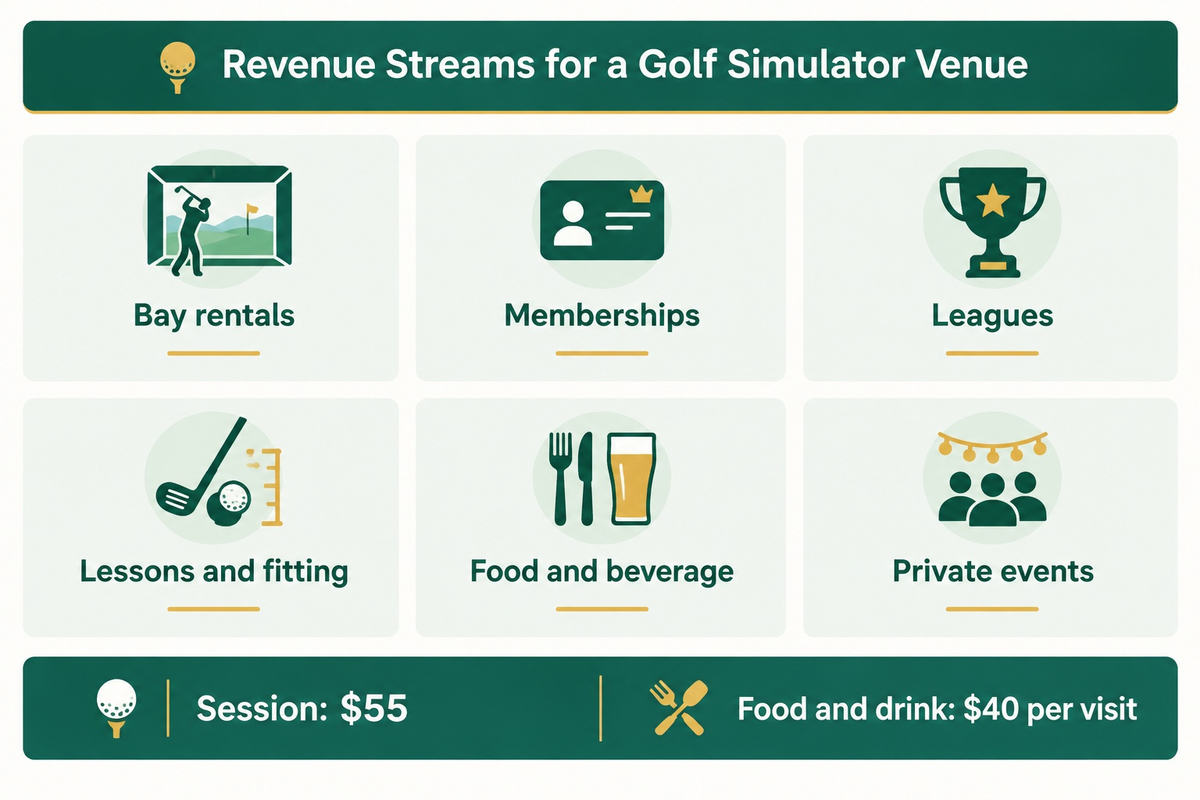
A commercial golf simulator business earns from bay rentals by the hour, recurring memberships and league fees, coaching by a PGA professional, and food and beverage sales. At U.S. golf facilities with simulators, the average session costs $55 and runs just over an hour, and guests spend another $40 on food and drink.
Those figures come from the National Golf Foundation’s 2025 white paper, The Golf Simulator Opportunity, which surveyed 354 golf facilities in November and December 2024 and was sponsored by the Indoor Golf Shop, an indoor golf equipment supplier. A $40 drink and food tab on top of a $55 session is a 73% uplift, so close to 42% of a $95 visit is food and beverage, not golf. That’s why so many venues are built as a golf simulator bar, an indoor golf business that sells an immersive experience with food, rather than a quiet practice studio. At a private golf club the model shifts: 59% of private facilities in the survey charge per simulator session, 18% fold it into member dues and the rest offer it free. The average group is three players, and more than 40% of groups split the bill, so a booking system that takes split payments at the bay saves staff time on every evening shift.
| Revenue stream | What the customer pays for | What you need in place |
|---|---|---|
| Bay rentals | One bay for 60–120 minutes, priced per bay, not per player | Online booking grid, peak and off-peak rates |
| Memberships | Included hours, priority booking, member rates | Recurring billing and a cap on peak-hour member use |
| Leagues | A season of weekly rounds on a fixed night | Simulator software with league and handicap game modes |
| Lessons and fitting | Coaching or club-fitting sessions using launch monitor data | A PGA professional on staff or renting bay time |
| Food and beverage | Drinks and shareable food delivered to the bay | Kitchen or bar fit-out, food permit, liquor licence |
| Private events | Corporate outings and birthdays booking several bays at once | Package pricing, a deposit rule, sitting areas for non-golfers |
Running one for profit is a different job from owning a home simulator. Software licences are a running cost: TrackMan, for example, sells its iO software to facilities as a Commercial License at $1,100 a year per unit, separate from the hardware. Pricing models impact profits as much as hardware. Birrdi, a booking-software vendor, says that during peak hours, members-only venues often generate roughly one-third the revenue per bay of hourly bookings, and that memberships fall away as the outdoor season opens. Memberships are the steadiest source of recurring revenue, but they need a cap on peak hours. A better model for most is a core of hourly rental, with memberships that only cover off-peak hours and league nights filling weekdays. For channel ideas that track bookings back to campaigns, see our guide to family entertainment center marketing.
Space Per Bay: Width, Depth and Ceiling Height
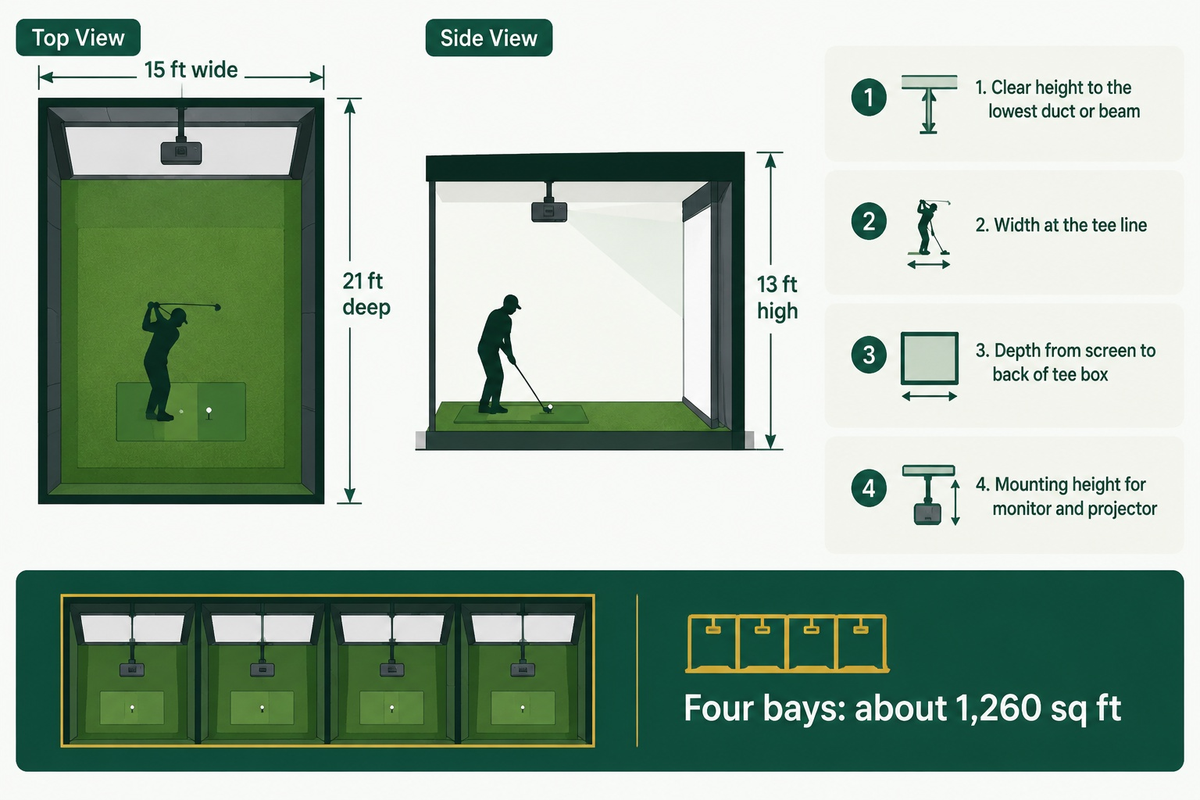
Commercial simulator bays at U.S. golf facilities average about 15 ft wide, 21 ft deep and 13 ft high, including the hitting area and swing space. Four bays therefore need about 1,260 sq ft of bay floor before you add a lounge, restrooms, a bar or a check-in desk.
“…simulators can be made to fit nearly any available space, as long as there’s room for a safe swing.”
The 13 ft figure is what installed facilities report, not a minimum. A tall golfer with a driver needs the full arc, and an overhead launch monitor or projector takes some of that height. Space is also the barrier most often named: 72% of golf facilities without a simulator cite it, ahead of cost at 53%. Prior to visiting a unit, take the following measurements:
- Clear height to the lowest duct, beam, sprinkler head or light fitting in the bay zone, not the ceiling height listed.
- Width at the tee line. For a centered hitting position that works for left- and right-handed players, you’ll need approximately 15 ft.
- Depth from the impact screen to the back of the tee box, plus room behind it to allow for seating.
- Height for mounting the launch monitor and projector, so the ball path and the image stay clear of the hardware.
Plan putting, coaching or net and display bays in that zone if your tallest expected golfer can’t swing a driver freely under the lowest obstruction. When a landlord won’t move ductwork, request the cost to reroute it in writing prior to signing the lease, because a 2 ft loss of clear height across a whole unit can remove a bay from the plan, regardless of the square footage. For determining aisle widths and how bays share a lounge, refer to our FEC floor plan design guide.
Is a 10×10 Room Big Enough for a Golf Simulator?
No, not for a commercial full-swing bay. A 10×10 space is 5 ft narrower than the average width of installed bays (15 ft) and less than half of the average depth of installed bays (21 ft), so it can’t accommodate a centered tee, a safe backswing and a screen offset for a single bay of paying customers.
A 10×10 space has a commercial use, and the NGF white paper states that not all simulators require a dedicated impact screen. A hitting net with a separate display screen, or a portable launch monitor, can turn a small room into a data-driven golf simulator space for coaching and club fitting. More than 20% of the facilities in the NGF white paper survey own a portable unit. In a venue, a compact space like this earns from a coach’s hourly rate, while the full-size bays carry the social bookings.
Startup Cost for a Four-Bay Golf Simulator Venue
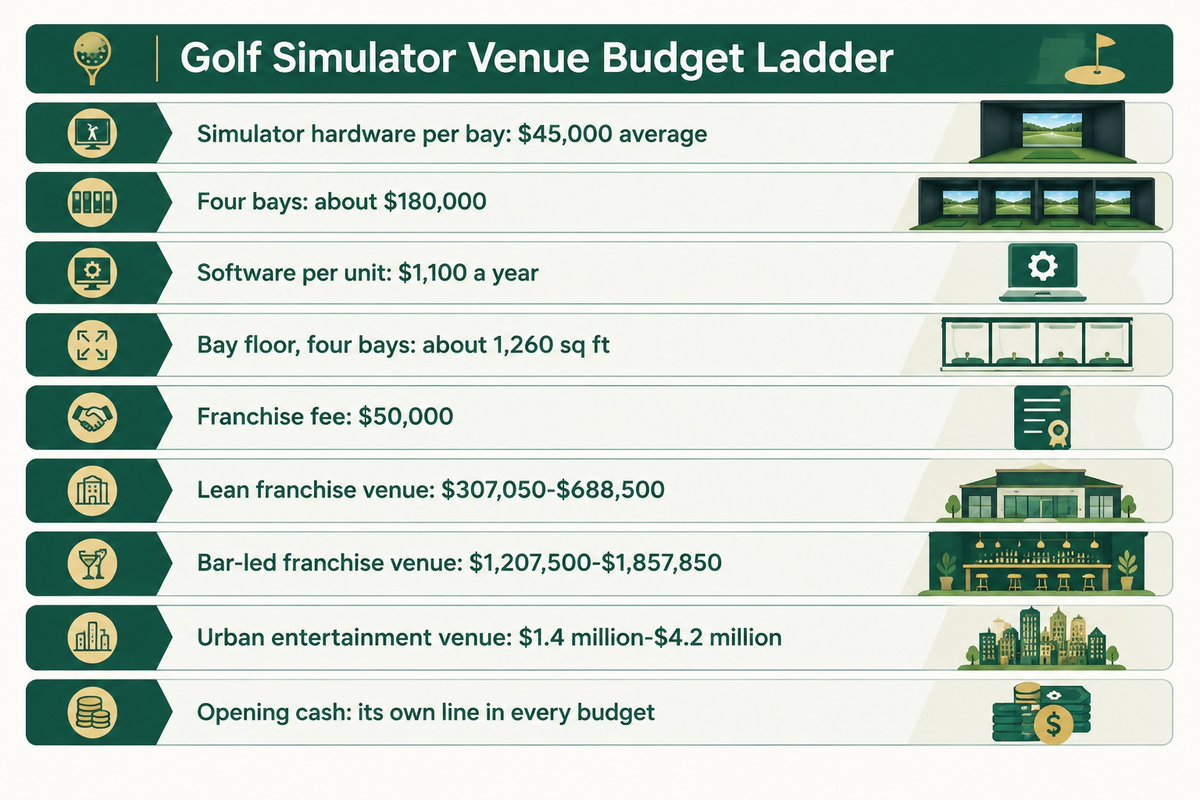
Golf facility operators who added simulators reported an average of $45,000 per bay, so four bays come to about $180,000 of simulator investment. Franchise budgets for a whole indoor golf facility, which cover franchise fees, equipment, real estate, and other startup costs, start at $307,050, reach $1,857,850 for a bar-led concept and run to $4.2 million for an urban entertainment format.
That gap is the buildout and the food and drink side, which is where first budgets usually go wrong. Build-out and opening cash depend on the unit’s condition, so price them from contractor quotes for walls, HVAC, electrical and the bar; the distance between $180,000 of hardware and the $307,050 low end of a lean franchise budget shows how large those lines can be. A helpful way to build your own is the split the U.S. Small Business Administration uses for start-up costs: one-time costs prior to opening in one column and monthly costs, like rent, payroll and software, in the other. The table below lists benchmarks you can cross-check against published information.
| Budget line | Benchmark | Basis |
|---|---|---|
| Simulator hardware, per bay | $45,000 average | NGF survey of golf facilities, 2024 |
| Hardware for four bays | About $180,000 | 4 x $45,000 |
| Simulator software, per unit | $1,100 a year | TrackMan iO Commercial License |
| Bay floor area, four bays | About 1,260 sq ft | 4 x (15 ft x 21 ft) |
| Franchise fee | $50,000 | The Back Nine, 2026 disclosure summary |
| Whole venue, lean franchise | $307,050–$688,500 | The Back Nine, 2026 disclosure summary |
| Whole venue, bar-led franchise | $1,207,500–$1,857,850 | X-Golf, current franchise listing |
| Whole venue, urban entertainment format | $1.4 million–$4.2 million | Five Iron Golf, as reported by Franchise Times |
| Opening cash | Its own line in every franchise budget | FTC rule: “Additional funds” line in Item 7 |
Two dates matter when you compare those ranges. Franchise Times reported X-Golf at $993,500 to $1.9 million after a year-end 2023 count of 99 units, while Entrepreneur’s franchise directory now lists $1,207,500 to $1,857,850. Ranges move with each year’s disclosure, and so every figure in your financial plan must carry the year next to it. Lenders also treat the two halves of the budget differently: serialized simulator hardware has resale value, while walls, ductwork and a custom bar have almost none, so expect the build-out to be the part you fund with cash. Our family entertainment center financing guide compares SBA 7(a), SBA 504 and equipment leasing for exactly this split, and the FEC startup cost calculator lays out the same one-time and monthly lines.
How Much Does a Full Golf Simulator Setup Cost?
Among golf facilities that installed one, the average simulator setup, covering a launch monitor, impact screen, enclosure, projector, hitting mat, computer and software, cost $45,000 per bay. About half of the operators without a simulator expected to spend under $20,000 per bay.
The NGF states that the $45,000 average may skew toward early, premium buyers, and that any component can be traded up or down. The launch monitor line has the widest spread, with both tracking method and course library changing the price. Beyond the initial installation cost, consider the annual licensing costs for commercial software, the cost of a spare impact screen, and the lost revenue from closing a bay while equipment is replaced.
Commercial Simulator Brands and What a Bay Costs
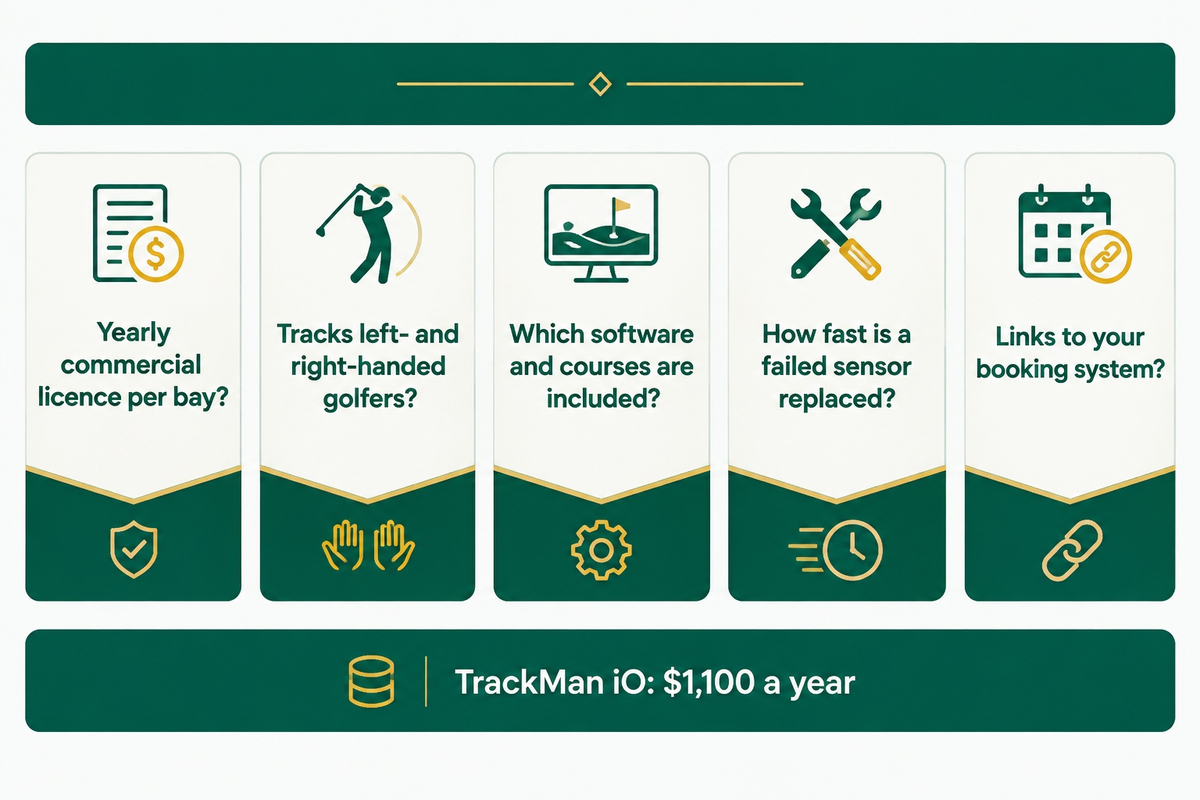
Most indoor golf businesses buy ceiling-mounted launch monitors such as TrackMan iO, or complete bay systems such as those made by TruGolf and Golfzon. Price per bay is determined by tracking hardware and course library, as well as the yearly commercial license, so check each quote against the $45,000 average for each bay reported by golf facilities in the National Golf Foundation survey.
On a golf simulator forum, one member advised business buyers that floor-side units such as SkyTrak and GCQuad make it harder to serve left- and right-handed players from one position.
Look at what you’ll pay in a year, beyond the sticker price, and compare systems on that. The features that matter most in a venue are commercial-grade parts that endure thousands of shots a week, both-handed play without moving the unit, and game modes for leagues, closest-to-the-pin events and a putting green. Ask every vendor the same five questions.
| Question | Why it changes your numbers |
|---|---|
| What is the yearly commercial licence per bay? | TrackMan iO lists $1,100 a year; over 5 years and 4 bays that is $22,000 |
| Does one unit track left- and right-handed golfers? | A centred unit avoids moving hardware between groups |
| Which simulation software and courses are included? | Course libraries and third-party programs such as TGC can be licensed separately; get the yearly cost per bay in writing |
| How fast does the support team replace a failed sensor? | A bay down on a Friday night loses peak-rate hours |
| Does it link to your booking system? | Automatic start and stop at booking times cuts front-desk work |
High-end systems with high-definition graphics and recreations of world-class courses capture avid golfers and league players. A closest-to-the-pin golf game keeps the non-golfers in the group engaged. Simpler indoor golf simulator systems with a driving range mode may be all a teaching bay needs. A scalable plan is to start with two high-end bays for group bookings and one coaching bay, then add additional bays based on booking demand. Golf simulator technology changes quickly, so ask for the upgrade path for the sensor and the golf simulation software, and keep dated receipts and serial numbers that support the hardware’s resale value.
Golf Simulator Pricing, Utilization and Break-Even
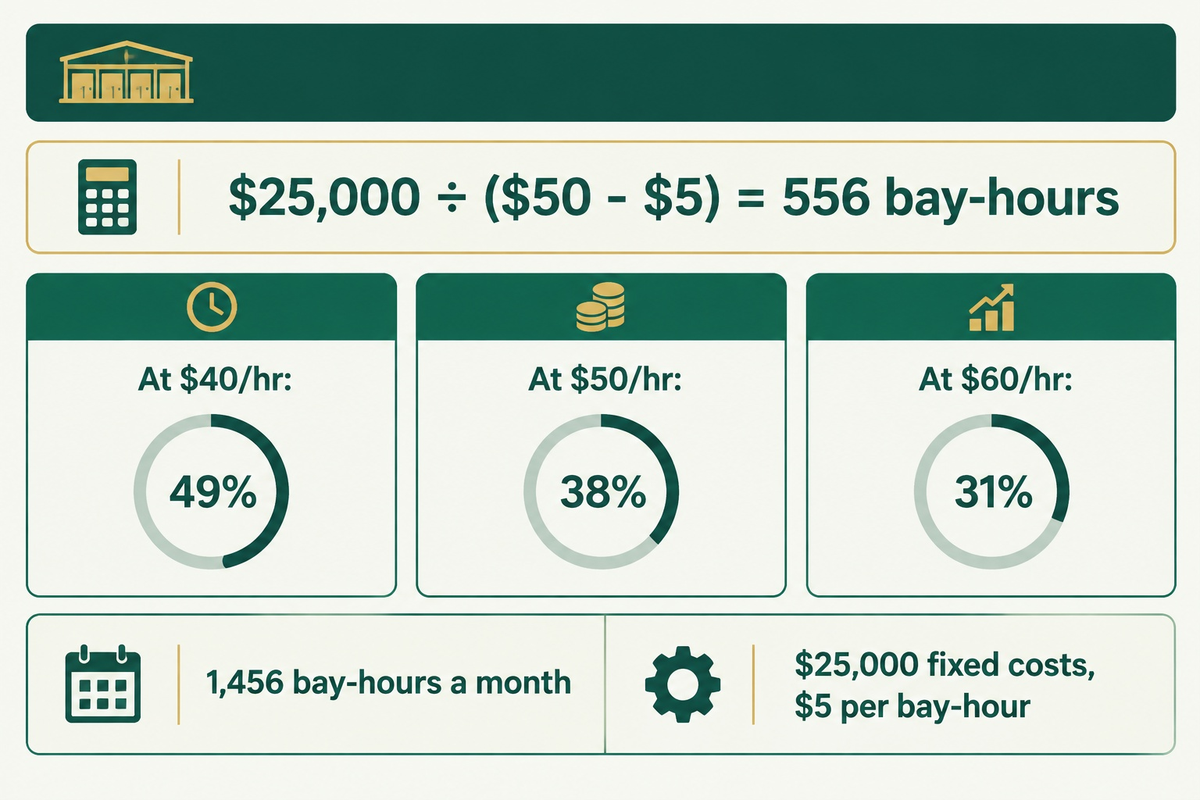
A four-bay venue open 12 hours a day has about 1,456 bay-hours to sell each month. With $25,000 of monthly fixed costs and $5 of cost per bay-hour, it breaks even at about 38% of those hours at $50 per bay-hour, 31% at $60 and 49% at $40.
The method is the SBA break-even approach: fixed costs divided by price minus variable cost gives the units you must sell, and here the unit is a bay-hour. Assumed inputs: 4 bays, 12 open hours a day, 7 days a week, $25,000 a month for rent, wages, software and loan repayments, and $5 per bay-hour for card fees, cleaning and consumables. Rates of $40, $50 and $60 bracket the $55 average session price. Replace every input with your own quotes; the grid shows how fast the answer moves.
| Utilization | Bay-hours sold | At $40/hr | At $50/hr | At $60/hr |
|---|---|---|---|---|
| 20% | 291 | $11,640 (−$14,815) | $14,550 (−$11,905) | $17,460 (−$8,995) |
| 25% | 364 | $14,560 (−$12,260) | $18,200 (−$8,620) | $21,840 (−$4,980) |
| 30% | 437 | $17,480 (−$9,705) | $21,850 (−$5,335) | $26,220 (−$965) |
| 35% | 510 | $20,400 (−$7,150) | $25,500 (−$2,050) | $30,600 (+$3,050) |
| 40% | 582 | $23,280 (−$4,630) | $29,100 (+$1,190) | $34,920 (+$7,010) |
| 45% | 655 | $26,200 (−$2,075) | $32,750 (+$4,475) | $39,300 (+$11,025) |
| 50% | 728 | $29,120 (+$480) | $36,400 (+$7,760) | $43,680 (+$15,040) |
| 55% | 801 | $32,040 (+$3,035) | $40,050 (+$11,045) | $48,060 (+$19,055) |
| 60% | 874 | $34,960 (+$5,590) | $43,700 (+$14,330) | $52,440 (+$23,070) |
Worked example at $50 per bay-hour: $25,000 ÷ ($50 − $5) = 556 bay-hours a month, and 556 ÷ 1,456 = 38%. Food and drink also generate revenue and are not included in the totals, so this grid is a floor rather than a forecast. The hours aren’t equal, either. Weekday mornings and summer afternoons are the slow blocks, while Friday and Saturday evenings sell out first, so set off-peak rates low enough to fill those blocks and keep peak prices firm. One booking platform’s advice to new owners is blunt: a full bay at $40 an hour beats an empty one at $65. Put the grid into your golf simulator business plan; our FEC business plan template has the same input fields, and our revenue per square foot benchmarks show how a 1,260 sq ft bay area compares with other attractions on the same floor.
Are Golf Simulator Businesses Profitable?
Most golf facilities that added simulators say yes: 70% report a positive effect on their numbers, the NGF puts the average time to that result at 7 months, and 80% were profitable within the first year. Those results come from golf facilities, where a golf course or club already owns the building and the customers.
A standalone venue pays rent, a full build-out and its own marketing before the first booking, so it needs the utilization from the grid above rather than a course’s head start. Treat the 80% figure as the ceiling of the case, not your forecast. Profitability for a leased venue comes from the habits operators describe: hourly pricing with off-peak discounts, leagues on the slowest weeknights, and food and beverage sales that turn a $55 bay booking into a visit close to $100. A prospective owner on a simulator forum summed up the risk plainly, calling it “a tough, potentially low margin business” and pointing to over-spending at start-up as the trap. Profit margins improve once leagues and memberships fill weeknights, because those hours add no rent. As a planning rule, aim for a lease and staffing plan that break even below 40% utilization at the rate your market accepts, so a slow summer doesn’t push the venue into a loss.
Payback is a separate test from monthly profit: divide what you spend before opening by the monthly result in the grid. With the same four bays, 12 open hours a day and $25,000 of monthly fixed costs, at 45% utilization the grid shows $4,475 a month at $50 an hour and $11,025 at $60, so $500,000 spent before opening takes about 112 months or 45 months to recover before any food and drink margin.
Indoor Golf Franchise or Independent Golf Simulator Bar
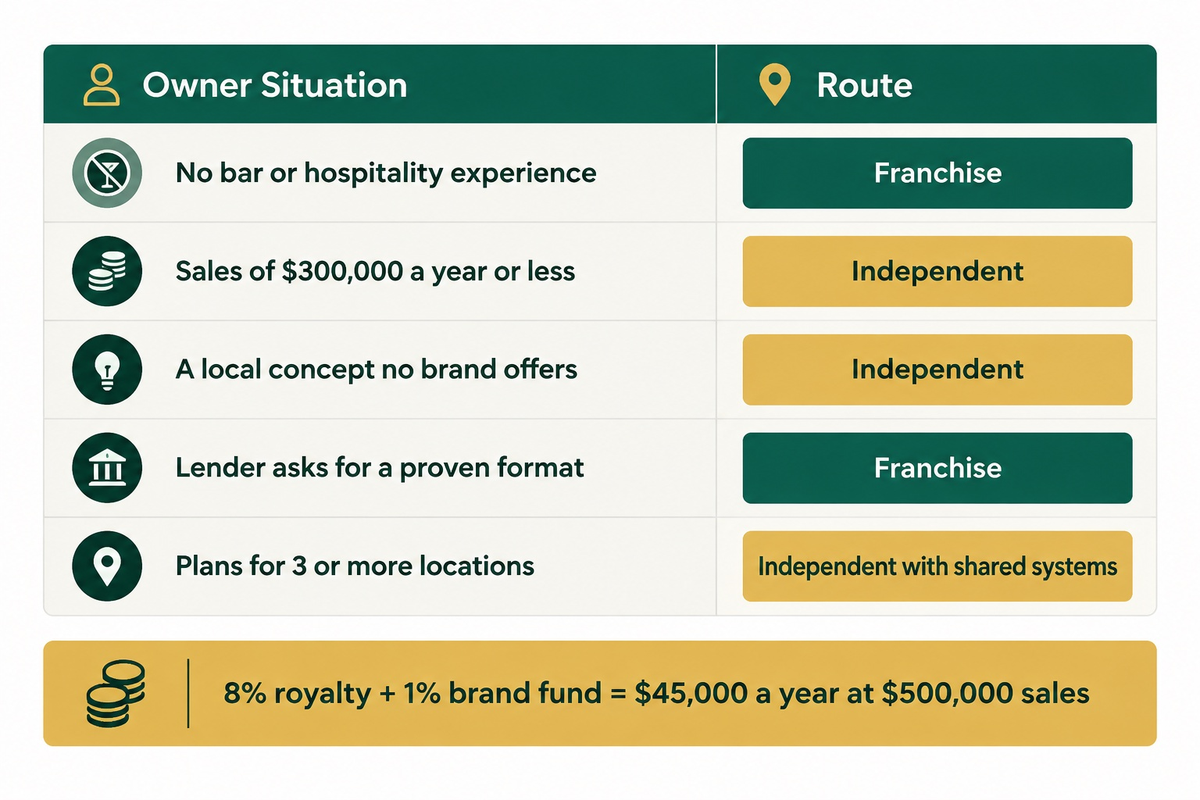
An indoor golf franchise suits a first-time owner who needs a tested layout, a disclosed cost table to show a lender, and a support team; an independent golf simulator bar suits an owner with hospitality experience who wants to keep the royalty. At $500,000 of yearly sales, an 8% royalty plus a 1% brand fund costs $45,000 a year.
Over five years that fee load reaches $225,000, more than the hardware for four bays. Those percentages are The Back Nine’s, and they sit alongside a $50,000 franchise fee. A franchisor’s disclosure document says what the fees buy, such as a format, purchasing terms, training, and a booking and marketing system, and the fees differ among the top golf simulator franchise brands. Golf entertainment chains like Topgolf are in a different class, with driving range bays on several acres. The royalty is an add-on to every dollar of bay and bar sales, not a lump sum. Before comparing franchise opportunities, read two sections of each franchisor’s disclosure document. The federal rule spells out what the estimated initial cost table (Item 7) must include:
“Include a category titled ‘Additional funds— [initial period]’ for any other required expenses the franchisee will incur before operations begin and during the initial period of operations.”
Item 19 is where a franchisor may publish earnings figures, and the same rule requires a reasonable basis and written substantiation for any it makes. A franchisor that publishes none has to say so. Use the following conditions to determine the route that’s more relevant to you.
| If this describes you | Lean toward | Because |
|---|---|---|
| No bar or hospitality experience | Franchise | Staffing, menus and booking rules come ready-made |
| Expected sales of $300,000 a year or less | Independent | At $300,000 of sales, a 9% fee load is $27,000 a year, paid before rent and wages |
| A local concept no brand offers | Independent | You keep the menu, pricing and simulator choice |
| Lender asks for a proven format | Franchise | A disclosed Item 7 budget gives the bank a reference |
| Plans for 3 or more locations | Independent with shared systems | One booking and league system can link every site |
You can see a similar line of thinking with playground franchises, and our franchise vs independent comparison works by looking at royalty math for an indoor play venue. Golf Lounge 18 in the U.S. Northeast shows how shared systems work across sites: it grew to 10 company-owned locations with over 110 TrackMan bays on one connected system before launching a franchise model, so a member in one city can play league night with a partner in another.
Golf Simulator Bar or 24/7 Unstaffed Studio
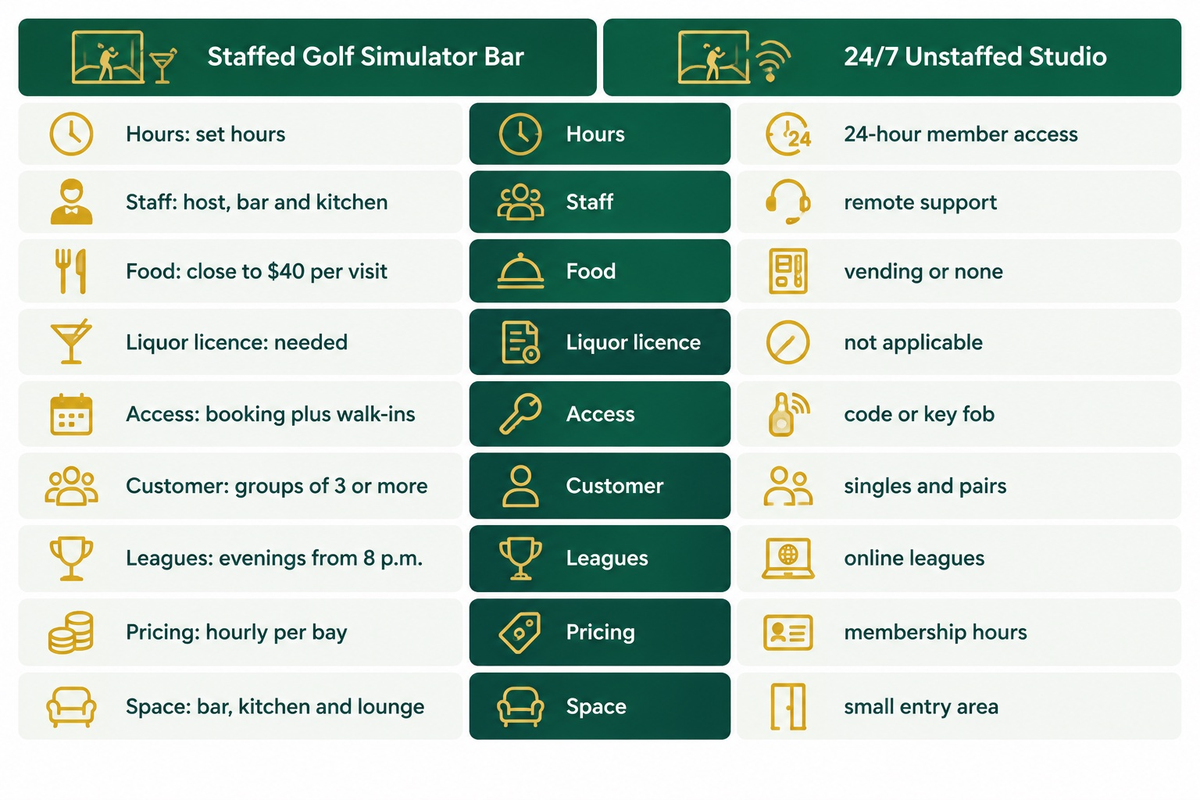
A golf simulator bar is a staffed venue with hospitality, food, drinks and events; a 24/7 simulator studio is an unstaffed space where members use a code or key fob to access a bay. A simulator bar earns more per visit, and a studio runs on lower wages and a smaller footprint.
Compared to golfers on a course, golf simulator guests need more assistance. Because, as the NGF found, guests ask for game setup, troubleshooting and shot alignment through the session, a staffed venue has more opportunities to sell food and earn another hour, and an unstaffed studio needs clear on-screen instructions and remote support. The models differ on almost every line:
| Item | Golf simulator bar | 24/7 unstaffed studio |
|---|---|---|
| Opening hours | Set hours, busiest on evenings and weekends | 24 hours, member access |
| Staff on site | Host, bar and kitchen staff every open hour | None; remote support line |
| Food and beverage | Core revenue, close to $40 per visit | Vending or none |
| Liquor licence | Needed, with staff on site while alcohol is served | Not applicable |
| Booking and access | Online booking plus walk-ins | Online booking, door code or key fob, cameras |
| Main customer | Groups of 3 or more, corporate and private events | Practising golfers, singles and pairs |
| Leagues | Evening leagues, often from 8 p.m. | Online leagues played on members’ own schedule |
| Pricing model | Hourly per bay, event packages | Membership with included hours |
| Space | Bays plus bar, kitchen and lounge | Bays plus a small entry area |
A sign-in waiver, a card-on-file deposit and cameras in each bay are standard in both. Look for booking software that manages split payments, member hours, and league scoring in one system. For what to review prior to signing, consult our venue booking and POS software guide, and our arcade card system guide for cashless payment if you set up games adjacent to the bays. If memberships carry an unstaffed studio, expect spring cancellations as the outdoor season returns and sell passes for summer off-hour bookings.
Location, Lease and Licensing Checks
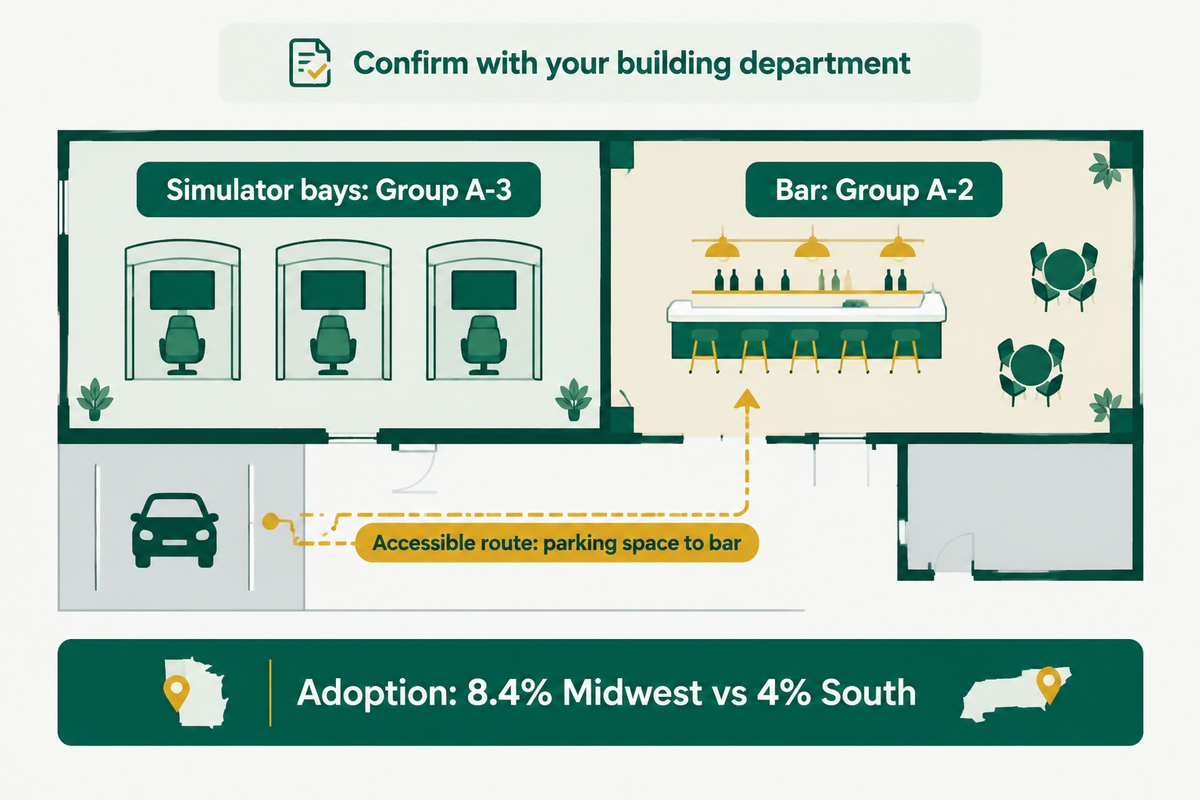
Opening a golf venue in leased retail space could prompt a change-of-use review under the building code. One code consultant on a building-code forum would classify the simulator space as assembly Group A-3, and a bar as Group A-2, making it a mixed occupancy. Check with your building department to confirm the classification prior to signing.
Zoning and the building code answer different questions. In the case discussed on a building-code forum, zoning had treated the venue like a bowling alley for parking, while the building code still looked at the bar and recreation areas separately. Occupancy decides exits, fire separation and whether sprinklers are needed, so get it in writing before you agree rent-free fit-out time. Accessibility applies from the parking space to the bar: the 2010 ADA Standards for Accessible Design came with revised Title III regulations, and the U.S. Access Board’s guidance for restaurants and retail spaces covers the accessible route, fixed dining surfaces and bar seating. Lease terms matter as much as the space: ask for a term longer than your payback period and an option to renew.
Location impacts demand more than any fit-out choice. Weather drives it, too: simulator adoption at U.S. golf facilities is 8.4% in the Midwest against 4% in the South, where outdoor golf runs all year, and 59% of simulator users cite weather-independent play as a benefit. An indoor golf center near offices fills weekday evenings; one near family housing fills weekends. If you’re adding bays to a larger attraction, the attraction mix planner and our family entertainment center planning guide show how simulator bays share space, staff and checkout with other attractions.
Pre-Lease Checklist for a Golf Simulator Business
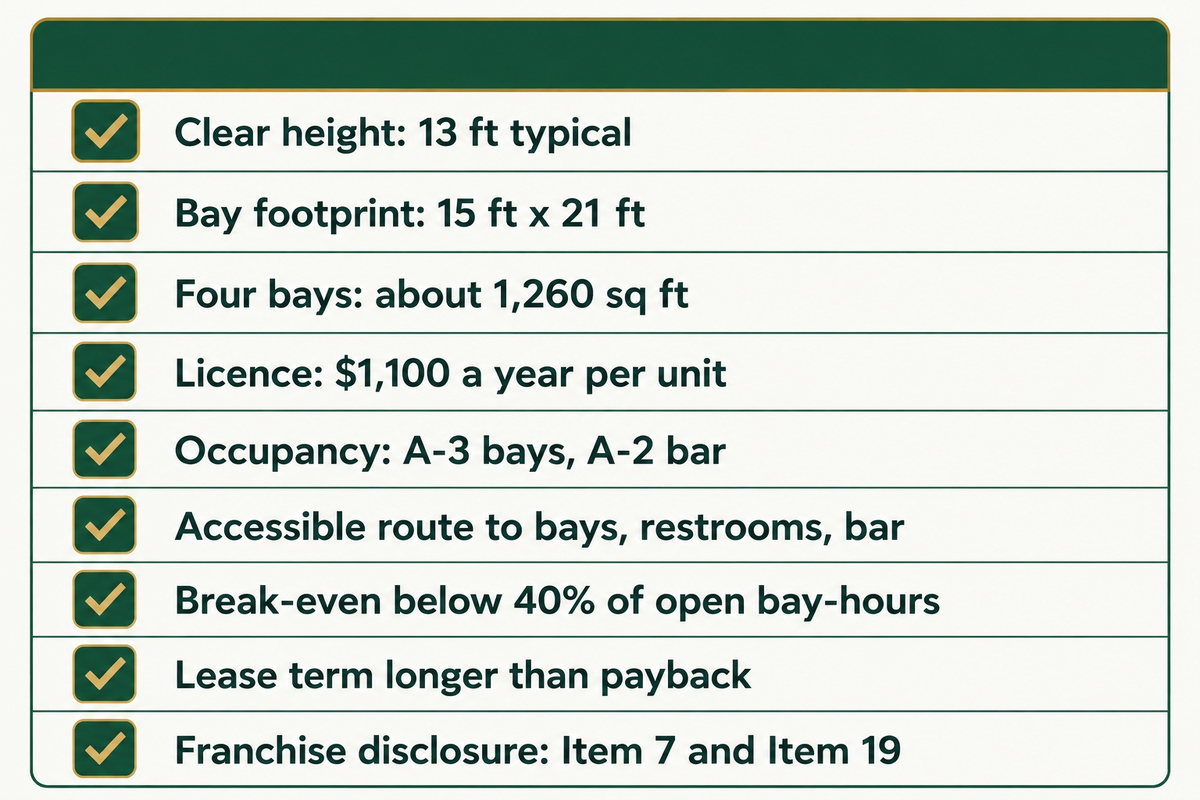
Use this checklist before signing a lease for a golf simulator business. Each row is a number to measure or a document to request. The accessibility row follows the 2010 ADA Standards for Accessible Design. A unit that fails two or more rows typically costs more to fix than to walk away from.
Pre-lease checklist: copy these rows into your site visit notes and supplier quote requests
| Parameter | Recommended range | Why it matters | How to verify |
|---|---|---|---|
| Clear height in bay zone | 13 ft typical in installed bays; a full driver swing must clear the lowest obstruction | Driver arc plus overhead launch monitor and projector | Laser measure to the lowest duct, beam or sprinkler |
| Bay footprint | 15 ft x 21 ft per bay | Centred tee for both-handed play and screen offset | Measured floor plan with column positions |
| Bay floor for four bays | About 1,260 sq ft before lounge and restrooms | Sets how many bays the unit can hold | Layout drawing from your designer |
| Software licence | $1,100 a year per TrackMan iO unit | Recurring cost on every bay | Written quote listing commercial licence terms |
| Occupancy classification | A-3 for bays, A-2 if a bar is added | Drives exits, separation and sprinklers | Pre-application meeting with the building official |
| Accessible route | From parking to bays, restrooms and bar seating | Required by the 2010 ADA Standards | Architect review of the existing entrance and restrooms |
| Break-even utilization | Below 40% of open bay-hours | Leaves room for slow summers | Bay-Hour Break-Even Grid with your rent and wage quotes |
| Lease term | Longer than your payback period, with a renewal option | Protects the build-out you cannot move | Draft lease reviewed against your plan |
| Franchise disclosure | Item 7 with an “Additional funds” line; Item 19 if offered | Shows full cost and any earnings basis | Request the current disclosure document |
Take the floor plan you measured to your first meeting with any designer or simulator vendor. With a layout based on the real column grid and clear heights, you’ll quickly see if the unit holds three or five bays and if the lounge is large enough to seat the private events that fill weekday afternoons.
Frequently Asked Questions
Q: How long do 9 holes of golf take on a simulator?
Nine holes take about 30 minutes for one golfer, since a single player can finish 18 simulated holes in about an hour, according to a booking-software vendor.
Groups take longer because each player hits every shot, and, accordingly, a threesome would take about 90 minutes to complete nine holes. The NGF said that simulator sessions typically last 90 minutes and often involve groups, so price bay blocks in 60- and 90-minute steps.
Q: What are the must-haves for a commercial golf simulator?
A commercial sim bay requires a launch monitor, an impact screen and enclosure, and a projector. There should also be a hitting mat, a computer running simulator software with a commercial license, and a link to your booking system.
Add padding on the side walls and a centred tee position for left- and right-handed players. There should also be seating behind the hitting area. A spare screen on the shelf keeps a bay open when one tears during a busy week.
Q: What is the average profit for a Back 9 franchise?
No public source gives an average profit for The Back Nine; the closest figure is average gross revenue, which MyGolfSpy put at $194,856 for 2024 before the 8% royalty, 1% brand fund, rent and wages.
A franchisor needs a reasonable basis for any earnings numbers it gives. Those numbers must appear in Item 19 of its disclosure document. Also request the names of current franchisees, and plug their rent and wage numbers into the break-even grid you’ll find in this guide.
Q: Can a golf simulator business operate year-round?
Yes, but summer is the slow season. Memberships drop once outdoor golf is available, while 59% of simulator users cite weather-independent play as a benefit.
Junior camps, leagues, and summer passes for early-morning and late-night slots help fill slow times. Also, keep evening rates firm.
Q: Do I need golf industry experience to own a golf simulator business?
Knowledge of golf isn’t as valuable as experience in hospitality and local marketing, as the majority of revenue is generated from groups, food and drink, and leagues as opposed to coaching.
Simulator guests need more hands-on help throughout a session, from setting up a game to adjusting alignment, so hire staff who are comfortable with the software. If you have never run a bar, a franchise or a general manager with a bar/beverage management background can fill the gaps. A PGA pro renting bay time for lessons and club fitting can be helpful, especially on weekday afternoons.
Q: Is a golf simulator business worth it?
A golf simulator business is worth it when your projected utilization clears break-even with room to spare, and 80% of golf facilities that added simulators turned a profit in the first year.
Test your numbers on the break-even grid before signing on the dotted line. Standalone venues carry rent and build-out costs that courses don’t have.
Q: Is a mobile golf simulator business profitable?
A mobile simulator business can be profitable because it skips the expense of a brick and mortar location. More of your bookings come from events as you won’t have to rely on walk-in customers.
Revenue comes from the number of corporate events, weddings, and fundraisers booked each month.
References & Sources
- The Golf Simulator Opportunity, 2025 Edition National Golf Foundation
- 16 CFR 436.5, Disclosure items (FTC Franchise Rule) Electronic Code of Federal Regulations
- Calculate your startup costs U.S. Small Business Administration
- 2010 ADA Standards for Accessible Design go into effect U.S. Department of Justice
- Accessible Retail Spaces and Restaurants U.S. Access Board
- TruGolf tees up new indoor simulator franchise Franchise Times
- X-Golf franchise profile Entrepreneur
About This Analysis
Dreamland plans family entertainment center layouts, so we built this golf simulator business guide around the questions owners bring to a floor plan: how many bays fit, what the build-out costs and how busy the bays must be. The per-visit and space figures come from the National Golf Foundation’s 2024 operator survey, and the break-even grid is our own calculation from the stated inputs.