Family entertainment center marketing connects a visit occasion with families who can book and attend. A good plan for a family entertainment business starts with available sessions, tracks each reservation and follows it through to the end, and evaluates the money left after delivery and campaign costs. More clicks help only when the venue can turn that interest into worthwhile visits.
Two measurable channel tests are a workable starting point for a small team, and a 90-day plan is a workable starting point as an editorial planning tool. Its worksheets separate new customers from returning households and keep future bookings out of settled attendance results. Owners and operators can take the same approach with a spreadsheet or a booking system.
Match the marketing promise to the venue
An entertainment center business needs a particular reason to visit, an audience that fits its attractions and a session it can deliver. Start with the occasion that has spare capacity. A weekday indoor play offer, a birthday package and a group event require different messages, even when they share the same building.
Examine the attraction mix before choosing photographs or special offers. State the value proposition as a visit the family can understand and book. Soft play for smaller kids calls for different information from a trampoline park, an arcade business or a venue with bowling lanes and laser tag. Parents planning a family outing must see the relevant age guidance, supervision and what admission includes. An immersive game may attract kids, while the adult buyer is unsure about access or session length. Show how interactive play differs from the arcade games included in the offer.
Consider a hypothetical family fun center with empty weekday sessions and busy Saturday birthday parties. Its manager wants to promote the most popular attractions because those photos attract the most reactions. However, a wide weekend promotion could draw more families to fully-booked sessions. The best first test names the available weekday session, shows that experience, and links directly to its booking options. The front desk staff checks if arrivals fit staffing and the advertised age mix. If parents are continually asking if the older siblings can participate, the offer needs a clearer boundary before the next advertisement runs. The problem is the match between promise and delivery, rather than a shortage of family entertainment center ideas.
IAAPA’s guest experience discussion connects aspects of a theme park operation such as queue, signage and cleanliness with the experience guests remember. It does not establish a guaranteed return rate. Use this distinction when you plan attraction mix and guest flow—memorable experiences require an offer the operating team can fulfill.
For the first 14 days of this proposed plan, pick one attendance issue and test the booking path for that issue. A venue can’t make a useful channel comparison if each advertisement promises a different package. Keep package design in the separate work to set admission and party prices.
Build the booking-to-attendance record first
Booking records should connect the campaign that produced a reservation to the final outcome of that visit and the realized revenue. Keep guest counts separate from reservation counts. One party can contain many people and one household can return many times; neither can be understood from total purchases alone.
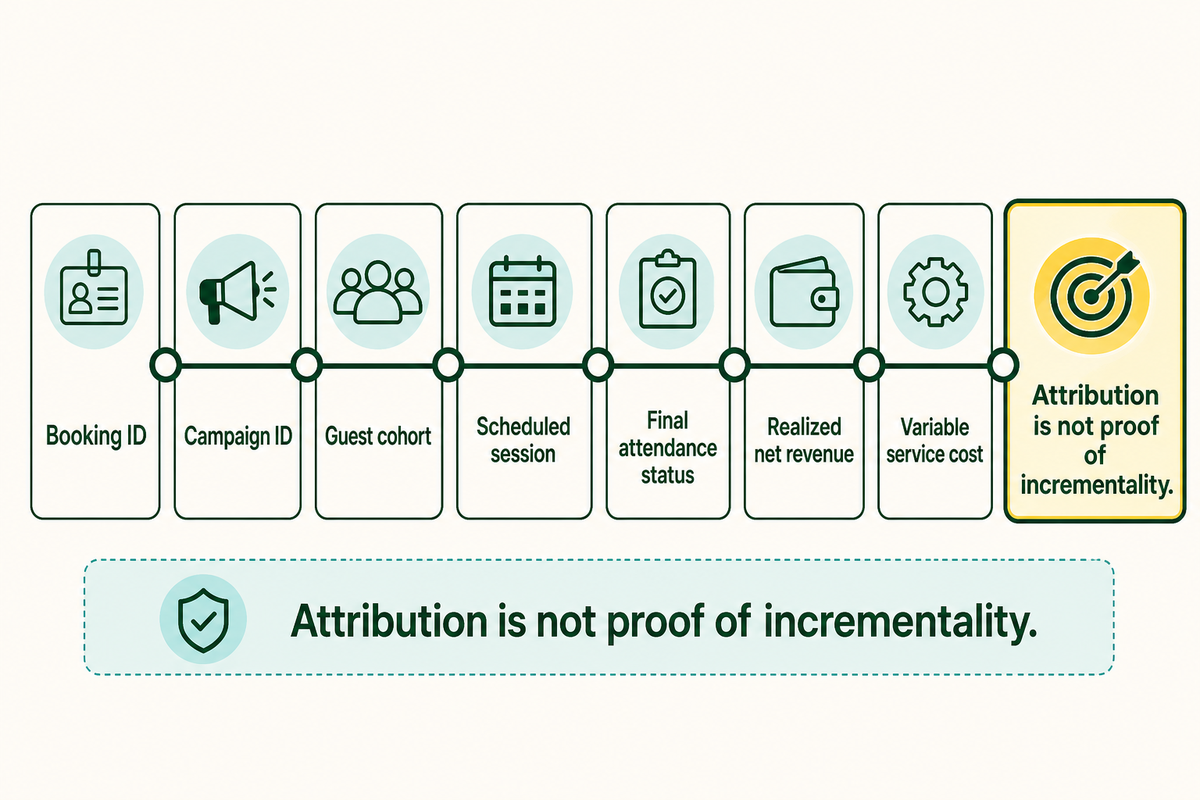
7-Field Attendance Attribution Ledger
The 7-Field Attendance Attribution Ledger joins campaign, booking and fulfillment records to allow an operator to reconcile attended business without counting revenue twice.
Editorial worksheet: seven fields, with fictional sample values
Field
Example
Meaning and boundary
Booking ID
B-001
One reservation; keep guest count in a separate linked record.
Campaign ID
WEEKDAY-A
Use a consistent rule; unknown source stays unknown.
Guest cohort
New household
Separate returning guests and existing members.
Scheduled session
Weekday afternoon
Future sessions remain pending until resolved.
Final attendance status
Attended
Confirm with a check-in or redemption record.
Realized net revenue
US$50
After discounts and refunds; use a consistent tax basis.
Variable service cost
US$20
Include costs caused by fulfilling this reservation.
Purchase and refund events described in Google’s e-commerce documentation include transaction identifiers. Those events provide a useful join, but do not independently prove physical attendance. Test them against the venue’s check-in record. Spending should appear once in the campaign summary, rather than being fully repeated on every booking record.
Before the test, choose the attribution rule that applies. Customers’ responses can help describe the journey to a booking, but don’t replace the center’s transaction records. A campaign code, tagged link and staff question may disagree; keep the evidence and label the rule instead of crediting the same sale to several channels. Marketing can report unknown-source bookings separately without forcing them into the best-performing campaign.
Data-driven insights require relevant data. A worksheet full of children’s details isn’t needed. Use pseudonymous booking IDs for export of marketing data, limit access, and agree on a retention period based on business need. The Federal Trade Commission’s business data guide states to keep data needed and limit access. Protect pseudonymous data as well.
A seven-field worksheet is a good start for reconciliation, not a complete customer database. If per-person cost is of concern, add a guest count field. Leave unresolved reservations pending; a sale for next month can’t be reported as an attended visit this week.
Choose two channels for one attendance problem
Select marketing strategies that can drive revenue from available sessions, based on the attendance problem and the audience you want to reach. Location-based discovery can introduce new visitors; a permissioned customer list can reach repeat customers. Each test needs a valid offer, an owner, a spending limit, and a measurable outcome.
Which family entertainment center marketing strategy is best?
The best starting strategy is to specifically address a measurable offer for an available session. Consider email when a relevant, permissioned customer base exists. A paid social ad can test a measurable offer; however, no channel is automatically best for every entertainment venue or guaranteed to produce incremental visits.
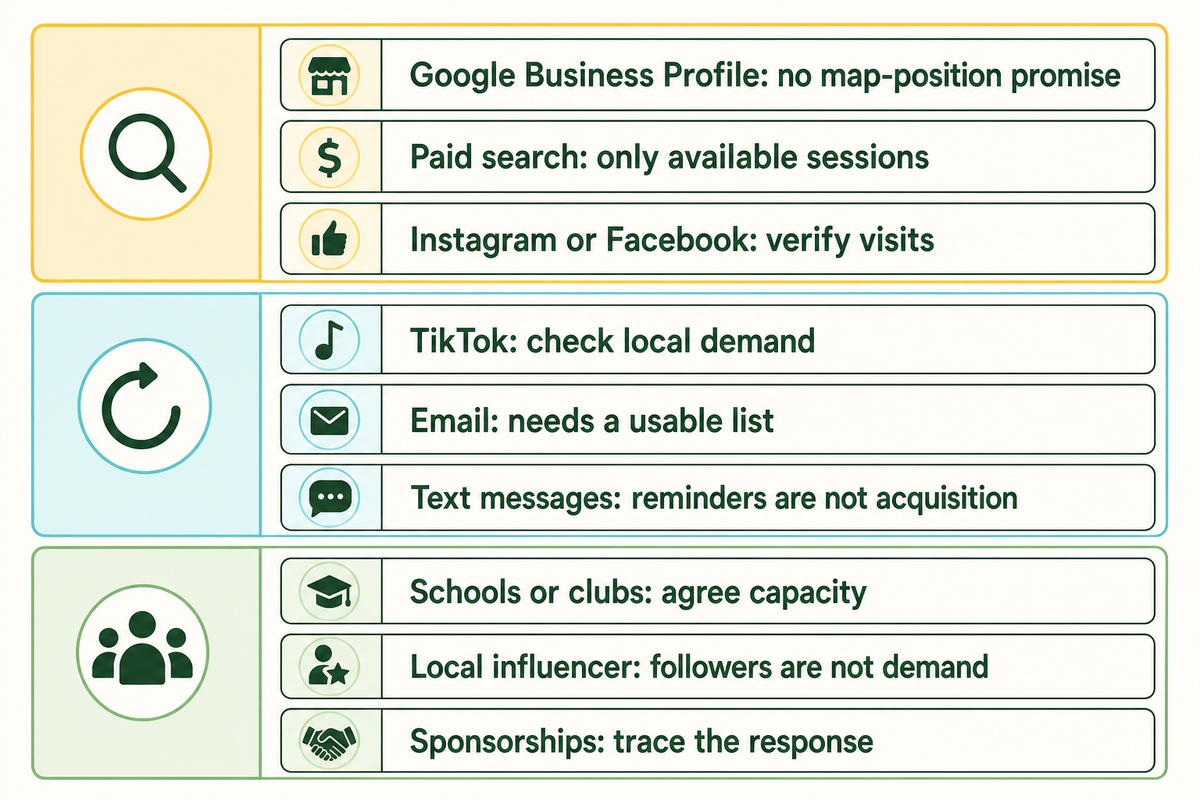
Channel-fit matrix: proposed tests, not performance rankings
Channel type
Useful occasion
Evidence to retain
Limitations / Not suitable for
Google Business Profile
Nearby family fun
Booking source and attended outcome
Cannot promise a map position.
Paid search
A specific party or activity search
Search intent, cost and reservation ID
Pause when the promoted session is unavailable.
Instagram or Facebook
A visual activity offer
Creative version and completed visits
Reactions do not establish attendance.
TikTok
A short demonstration of the experience
Relevant local inquiries and bookings
Wide reach may be outside the service area.
Email
A relevant reason to return
Eligible cohort, delivery and outcome
No usable list means no meaningful list test.
Permissioned text messages
A timely session reminder
Permission, opt-outs and booking outcome
Do not treat reminders as new acquisition.
School or club partnerships
Group bookings
Partner code and delivered event
Capacity and package fit must be agreed.
Local influencer
A demonstrated visit experience
Fee, supplied benefits and attributable bookings
Follower totals do not prove local demand.
Community sponsorships
A relevant neighborhood event
Full cost and traceable response
Goodwill alone is not a measured sales return.
Two channels are a practical workload limit for this plan, not a statistically proven optimum. An operator without a usable list might pair paid search with local search (discovery) instead of creating an email audience. A venue that’s already receiving relevant inquiries might get more results from improving its booking path than adding more external sources of traffic.
Building strong local relationships also takes selection. In Recreation Management’s sports-park reporting, operator Chris Coleman describes a shift away from broad outreach to more targeted outreach based on the needs of the organizations. This shows that targeted partnerships can be effective; however, this doesn’t mean that an indoor playground campaign will be effective.
Keep the definition of a visit occasion and the accounting method consistent during the 30-day channel comparison. A family-focused message for new households and exclusive offers for members address different cohorts. Report them separately, even if both appear in the same sales funnel.
Set a test budget from contribution, not gross bookings
A test advertising budget needs to fit the contribution available from delivered visits and the cash the venue can risk. Gross reservations can include refunds, unfulfilled sessions and sales that would have happened anyway. Compute a settled cohort first, then separate an operational spending decision from any claim that advertising caused the revenue.
The U.S. Small Business Administration’s break-even guidance distinguishes fixed costs from variable costs. For a campaign worksheet, subtract variable fulfillment costs and the campaign’s complete cost from realized sales. Agency fees, creative production and supplied promotional benefits belong in that cost definition when they’re part of the test.
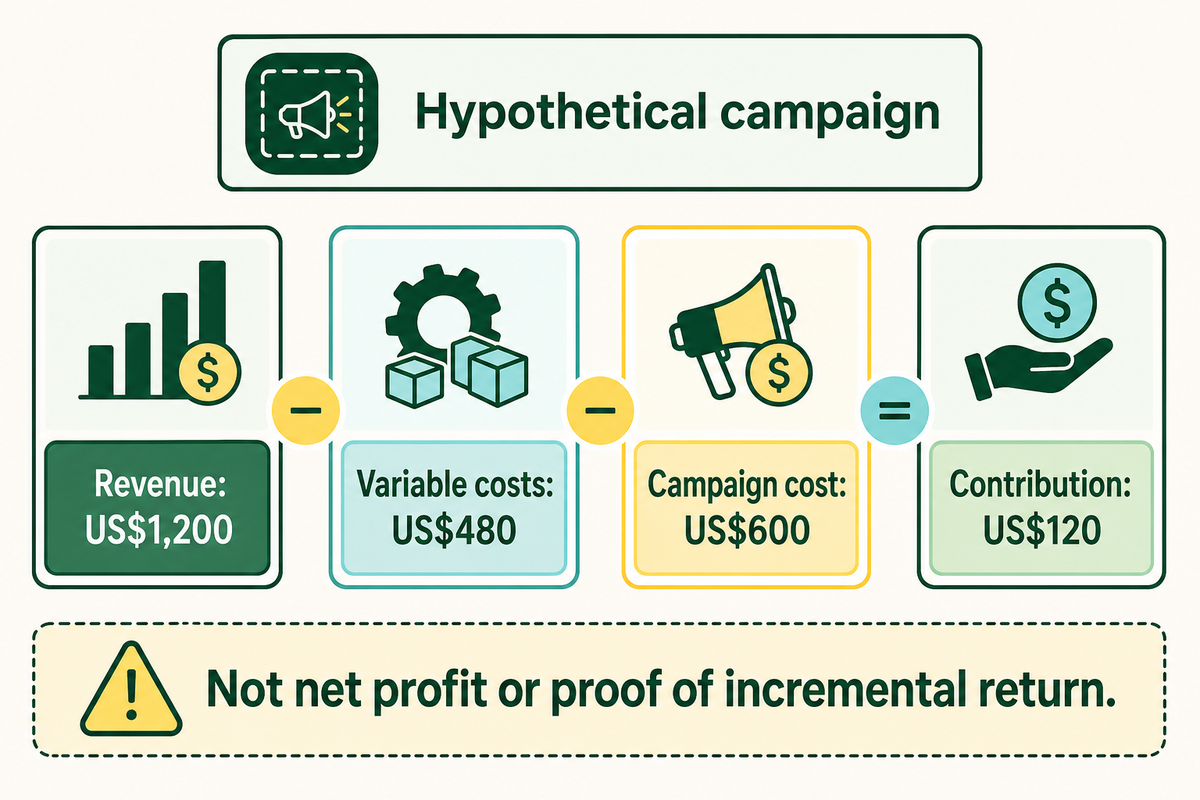
Suppose a manager closes the reporting window for a hypothetical campaign with 30 bookings. Six were fully refunded and didn’t attend. Front-desk records confirm that the remaining 24 bookings attended; subtraction alone wouldn’t prove this. Each attended booking produced US$50 of realized revenue and US$20 of variable service cost. Campaign costs totaled US$600. Finance reconciles the refunds once in net revenue, rather than subtracting them again later. No future reservations remain unresolved in this example, and no retained deposits are included. The worksheet can describe what happened to the cohort, but it still cannot say how many visits were caused by the advertising.
Hypothetical campaign reconciliation in US dollars
Measure
Calculation or input
Limitations / Not suitable for
Original reservations
30 bookings
Not a count of people.
Fully refunded, not attended
6 bookings
Assumed zero retained revenue here.
Confirmed attendance
24 bookings
Requires check-in evidence.
Net revenue per attended booking
US$50
Fictional input, not a market price.
Realized net revenue
24 × US$50 = US$1,200
Future bookings excluded.
Variable service costs
24 × US$20 = US$480
Include the actual incremental delivery costs.
Contribution before campaign
US$1,200 − US$480 = US$720
Fixed overhead remains unpaid by this calculation.
Campaign cost
US$600
Assumed to include the complete test cost.
Contribution after campaign
US$720 − US$600 = US$120
Neither net profit nor proof of incremental return.
Cost per attended booking
US$600 ÷ 24 = US$25
Not cost per person or per new household.
An extra US$10 of variable cost on each of those 24 bookings would consume US$240 and turn the US$120 balance into a US$120 deficit. This sensitivity is important to consider with respect to exclusive discounts or free add-ons that appear cheap in advertisements. Use your own costs to improve the venue revenue model; this example supplies no universal advertising percentage.
Keep nonrefundable deposits and costs of cancelled bookings in clearly labeled categories if they exist. A US$120 positive balance on 24 attended bookings is a narrow observed outcome. It doesn’t cover all fixed costs, define customer lifetime value, or justify unrestricted growth in spending.
Make local discovery and the booking page agree
Local discovery works best when it’s a clear path to the promised visit. Make your Google Business Profile, ads, and booking page consistent with your hours, location and the details of your offer. Make your family entertainment center easy to evaluate: explain the package, show available sessions and display cancellation terms before asking for a payment.
Google’s local-ranking explanation names relevance, distance and popularity. Active posting doesn’t buy a guaranteed position. Posting accurate business information is more helpful than collecting random SEO tips.
“There’s no way to request or pay for a better local ranking on Google.”
Walk through the mobile checkout with the operations team. Test the date selector, package inclusions, deposit, and confirmation message. Next, test the form using just a keyboard to check if the labels and error messages describe the interaction. The U.S. Department of Justice Accessibility Guide covers these issues. A clean automated report doesn’t show the mobile checkout experience is accessible.
Useful structured data should describe the visible venue information; it cannot repair a confusing offer. Show family entertainment center attractions as guests will encounter them. Permissioned user-generated content and photographs of a prepared party room can explain the experience without relying on vague claims about unforgettable family experiences.
Reputation management requires a clear boundary as well. Google Maps policy prohibits incentives for posting reviews and selectively soliciting positive reviews. A loyalty reward for a visit is a separate activity from a reward for a public rating. Keep the activities separate.
Carry out a full booking walkthrough prior to test launch day 15 and capture the faults observed. There are offers that promise but don’t deliver an available session. Stop the advertisement until the inventory error is corrected. Use the same ownership habits as described in the indoor playground operations guide to resolve the fault.
Separate retention results from acquisition results
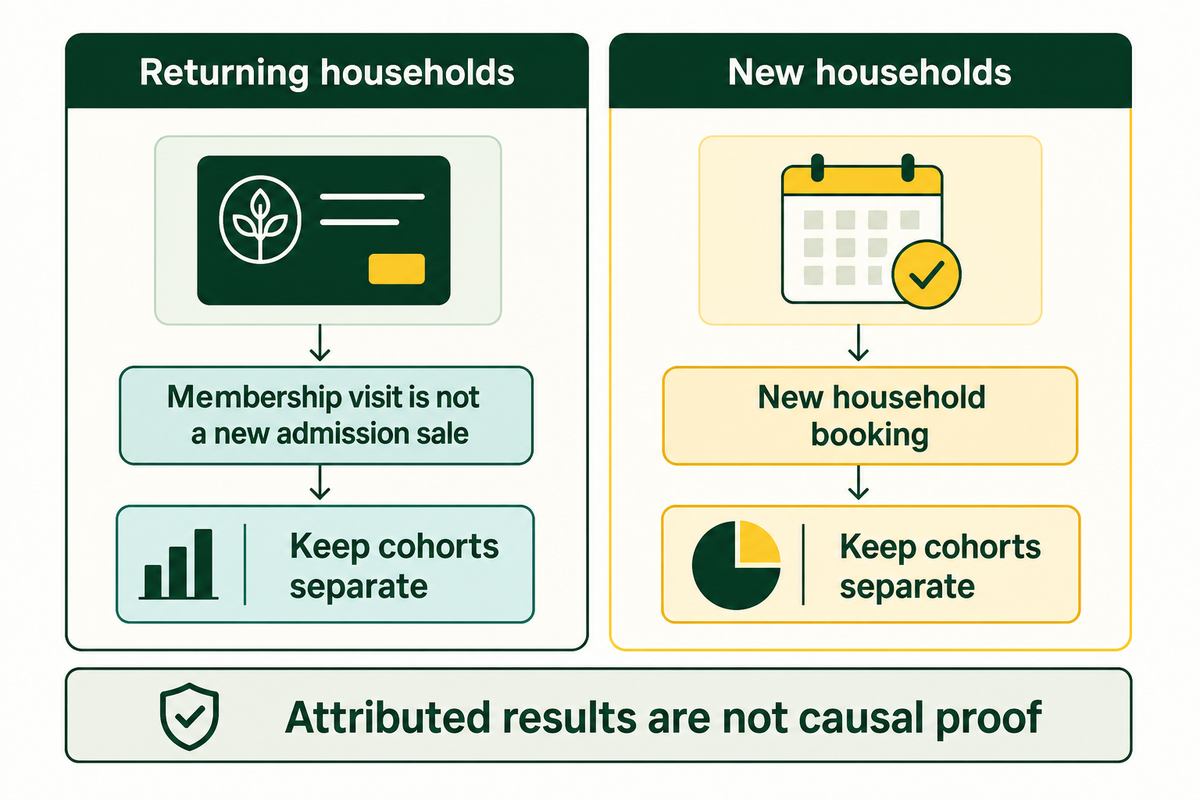
Retention campaigns should measure the actions of eligible returning households. Acquisition campaigns should track the behavior of new households. Membership use is not automatically a new admission sale. A campaign can be credited for visits that would have occurred regardless of the campaign. An attributed sale doesn’t always mean campaign demand has increased.
Does family entertainment center marketing work?
Marketing can produce bookings and useful customer responses, but the outcome depends on the offer, audience, delivery and costs. Reconciled records show attributed performance. Small cohorts may remain inconclusive even after a full planning cycle, and a negative contribution result can justify an operational stop without settling causality.
Imagine an existing member gets a message about early access. The member clicks, and then uses an admission included in the membership program. A dashboard may credit that visit to the message, yet recording a fresh full-price admission would invent revenue. The operator should retain the visit as engagement, record any separately purchased extras and account for the membership sale using the venue’s consistent policy. If the event consumes scarce capacity, finance should account for the costs of delivery. Customer loyalty may matter even if not every repeat visit results in a new sale and personalized experiences don’t remove that accounting distinction.
“Conversion Lift” documentation from Google explains the difference between attributed results and measurement of treatment-vs-control. An appropriate hold-out would allow for an assessment of incrementality; however, a small venue may not have a large enough sample for a reliable estimate. Comparing different holiday weeks without making adjustments for changes isn’t a comparable experiment.
In order to send exclusive offers, choose a loyalty program’s objective. Measure customer retention, additional purchases, or usage of slower days, based on that objective. Metrics like message opens help diagnose delivery, and they don’t by themselves show efforts to boost customer loyalty have created new contribution.
During a 30-day review window, keep the eligibility and visit dates of the returning cohort consistent. Report existing member visits separately from new membership sales. If the sample is too small or circumstances changed, record “inconclusive” rather than presenting attributed revenue as a measured causal effect.
Run the 90-day plan with stop and scale rules
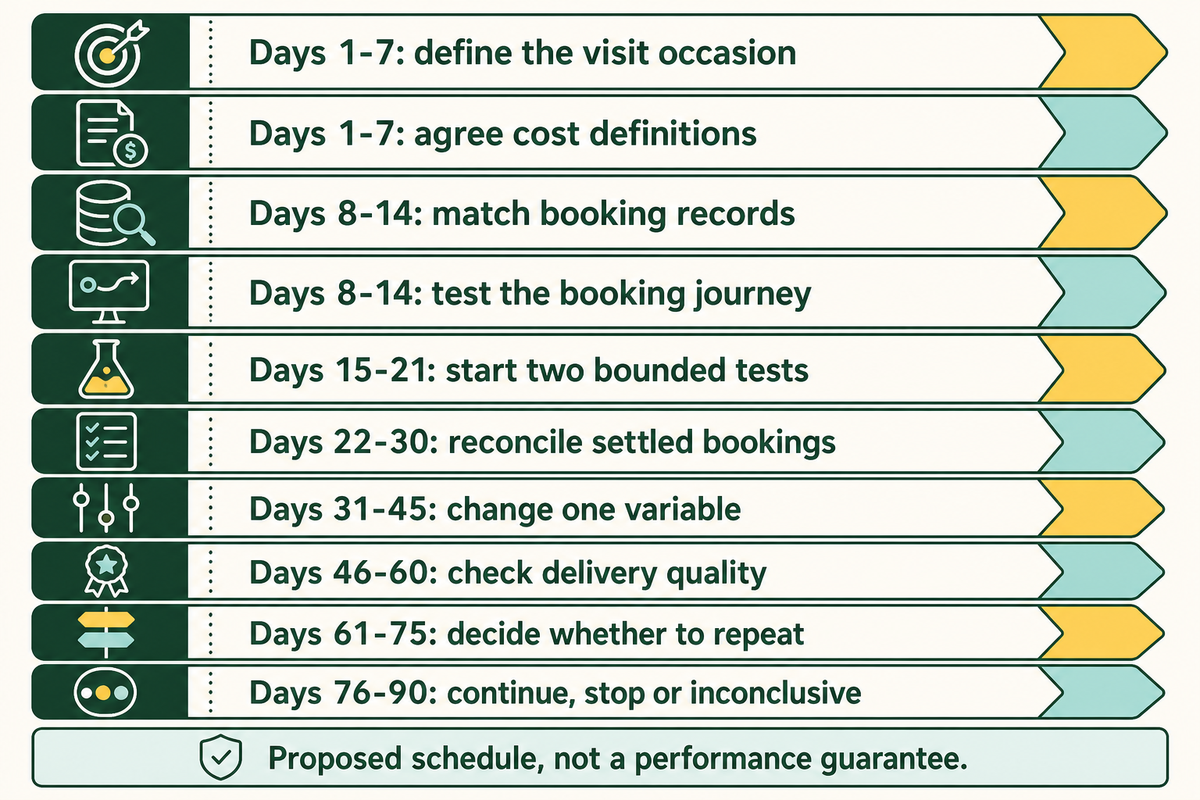
If you run a family entertainment center, marketing, the front desk, and finance get a 90-day plan coordinating their work. For validation, first validate records. Then run bounded tests and change only one variable at a time. Review completed cohorts before extending spend, allowing an inconclusive result when the sample is insufficient.
90-Day Channel Decision Board
The 90-Day Channel Decision Board assigns campaign work and spending decisions to named owners while keeping unresolved results visible.
Proposed work schedule; dates are not performance guarantees
Window
Work and owner
Evidence before the next decision
Limitations / Not suitable for
Days 1–7
Operations defines the available visit occasion.
Session, audience and staffing fit.
Do not promote unavailable inventory.
Days 1–7
Finance agrees the cost definition.
Refund, variable-cost and campaign-cost treatment.
No gross-booking shortcut.
Days 8–14
Front desk checks record matching.
Booking ID reaches the final visit record.
Unknown outcomes stay unresolved.
Days 8–14
Marketing tests the booking journey.
Mobile, keyboard and confirmation checks.
Fix broken steps before buying traffic.
Days 15–21
Campaign owner starts two bounded tests.
Offer, audience, budget and stop limit recorded.
Two is a workload choice, not an optimum.
Days 22–30
Finance reconciles eligible settled bookings.
Attended contribution and unresolved count.
Future parties need a later review.
Days 31–45
Marketing changes one variable.
Reason and new creative or offer version.
Several simultaneous changes obscure diagnosis.
Days 46–60
Operations checks delivery quality.
Arrival handling, complaints and session availability.
More demand can exceed delivery capacity.
Days 61–75
Owners decide whether to repeat a bounded test.
Settled contribution and uncertainty statement.
A small positive sample is insufficient for broad scaling.
Days 76–90
Team records continue, stop or inconclusive.
Next budget, owner and outcome-review date.
Day 90 is not a guaranteed proof deadline.
Separate controllable failures from weak demand. A broken checkout requires a repair. Unprofitable delivery requires a cost or offer review. A campaign with few settled bookings may need more observation within its agreed risk limit, rather than a confident verdict. School calendars, weather and competing special events can change the comparison.
When not to buy more traffic
Extra digital marketing spend is a poor next purchase when the offered goods can’t be booked or delivered. Check the booking page and inventory and front-desk response before deciding that reach is the bottleneck. A family entertainment center’s campaign can attract more families while exposing a mismatch in session times or package inclusions.
Also pause an expansion when the original spending limit is reached, unresolved bookings dominate the report or the team cannot explain a cost difference. Google suggests interpreting lift measurements with the study timing and uncertainty; a daily dashboard isn’t a completed experiment. Protecting cash is an operating decision and doesn’t disprove a channel’s effectiveness.
A successful FEC can still run an unsuccessful test. Keep the next commitment bounded until evidence supports it, and don’t change the offer, audience, and price together. That discipline allows a center business plan to accept a poor result without turning a small test into a large commitment.
Key takeaway
A 90-day schedule organizes decisions; it does not guarantee enough evidence to scale. Continue only within a defined cash limit, with settled attendance records and an explicit account of uncertainty.
Industry outlook: choose providers by the data they can return
When selecting a marketing provider, focus on records and work that can be measured and reviewed. As of October 2026, the official measurement and review policies checked for this guide support practical procurement questions. Ask how the provider handles refunds, protects data exported from the provider, and distinguishes attributed bookings from incremental results before you engage the provider’s service.
Integrated software can reduce double-entry, but purchasing the software doesn’t establish a successful family entertainment center or effective strategies. FEC owners need to test the software’s impact on the reservation workflow. A CRM, or customer relationship management system, may help organize the customer base; its value depends on whether records remain useful through cancellations and repeat visits.
Create a sample reservation. Use a test account and the intended campaign identifier.
Change its outcome. Demonstrate a reschedule and a refund without losing the original identity.
Confirm the visit record. Show where an attended status comes from and how duplicate entries are prevented.
Export and reconcile. Return the necessary fields, explain account ownership and restrict access to the export.
For a limited-time promotion, confirm the end date displayed is the same as the offer configuration. Ask the agency what fees are outside of media spend and who owns the advertising accounts. Ask the booking provider what fields can be exported and what happens when the service is discontinued. Product demonstrations should follow this journey rather than substitute a polished dashboard for reconciliation. The FTC’s data-handling guidance is relevant here: retain what the business needs, with a defined disposal policy.
Review incentives deserve a separate procurement question. The FTC’s review-rule guidance dates the US rule to October 21, 2024 and distinguishes incentives conditioned on sentiment. More generally, Google’s policy bans review incentives. A provider’s claim of legal compliance doesn’t establish compliance with every platform’s rules.
Dreamland Playground concerns equipment and project planning. The public scope states the design and manufacture of the equipment and the support for its delivery; no performance guarantee for campaign planning follows. To discuss your venue layout, send your project city, your floor plan with clear heights, age mix, your budget and your target opening date. Include what problem you’re attempting to address (e.g. party arrivals interfering with open play). That gives equipment planning a concrete brief while leaving advertising and reservation-provider choices with the appropriate specialists.
Family entertainment center marketing FAQs
Why is family entertainment center marketing important?
Marketing connects a bookable visit occasion with families who can attend it.
Its value depends on what happens after the advertisement: whether the session is available, the family arrives and the visit leaves enough contribution to cover campaign costs. A useful plan therefore connects promotion, booking, front-desk records and finance. Attention is an intermediate signal; the operating outcome determines whether a campaign merits another bounded test.
What should a family entertainment center marketing plan include?
Include the audience, visit occasion, available session, offer, owner and measurement rules.
Then document the channel, spending limit, booking identifier, attendance outcome and reporting window. Add a decision date and conditions for stopping or extending the test. Keep admission-price design in the pricing plan so a channel comparison is not distorted by several simultaneous changes. Business planning should also assign responsibility for refunds and unresolved future reservations.
Do you need a family entertainment center marketing agency?
An agency can supply time or specialist skills, but the venue still owns its measurement decisions.
Ask the provider to demonstrate one booking through cancellation or attendance and into an export you control. Compare the full fee, media spend, account ownership and reporting scope before making a decision. Hiring support does not remove the need to check available capacity, delivery costs or the quality of the customer experiences that the advertisement promises.
How long should a small venue test a channel?
Use 90 days as a planning window, not a guaranteed proof period.
Review tracking early, then wait for relevant bookings to reach their visit dates. Longer booking cycles need a later outcome review. Small samples can remain inconclusive.
Should campaign reports count guests, bookings or visits?
Keep all three measures, with a consistent denominator for each calculation.
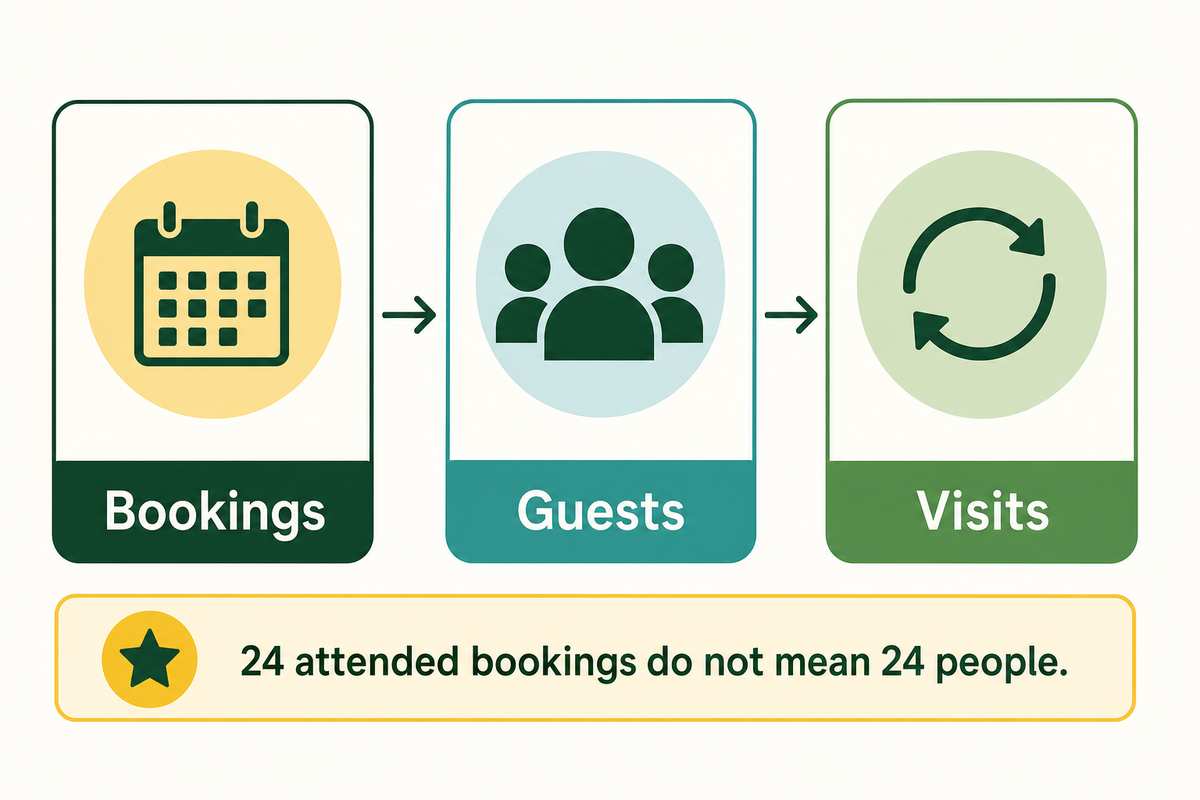
One party booking may bring many guests, while one household may make several visits. Advertising cost divided by attended bookings is therefore different from cost per guest or cost per newly acquired household. In the hypothetical example, 24 attended bookings do not mean 24 people. Link records using a booking identifier, retain separate guest counts where available, and mark unresolved future sessions as pending. Reconcile realized sales after refunds once; do not subtract the same refund again when calculating contribution. A membership visit should also remain distinct from the sale of a membership.
Dreamland Playground publishes practical planning guides for commercial indoor-play projects, including family entertainment centers, shopping malls, hotels, restaurants, churches, and other venue types.
Use these guides to frame the questions that should be resolved before concept selection: venue size, intended age groups, project location, attraction mix, operating priorities, timeline, and delivery constraints. Final recommendations should be based on the real site and applicable local requirements.
Start With The VenueFloor area, clear height, site location, intended audience, and target opening date create the working brief.
Clarify The ScopeConcept, equipment, production, shipping, installation, and operating inputs can vary from one project to another.
PROJECT / VENUE / TIMELINE
Prepare Your Project Brief
Venue TypesFEC · Mall · Hotel · Restaurant · Church
Start WithFloor area · Clear height · Age groups · Country