Indoor Playground Pricing Strategy: Admission, Parties & Memberships | Dreamland Playground is a pricing framework that starts with capacity, visit behavior, and break-even pressure before an operator copies ticket prices from another venue. Admission, birthday party packages, and a membership program each sell a different promise. Treating them as one price list is how a busy play space can still miss its cash flow target.
Fast Answer: Start With Capacity Before Copying Competitor Prices
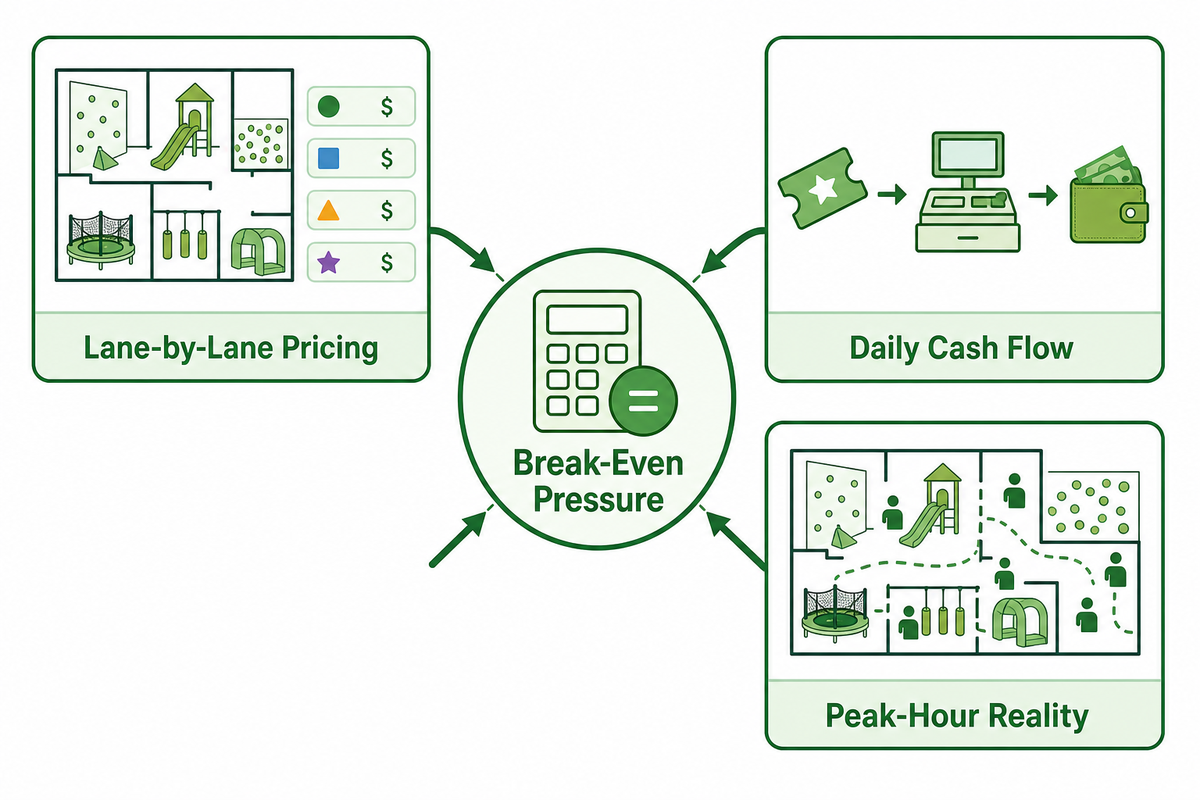
Start with this practical test: fixed monthly costs divided by contribution per visit tells you how many paid visits the indoor playground business must carry before profit is even possible. SBA break-even guidance uses fixed costs divided by price minus variable cost. For an indoor play area, that formula should be run by lane, not as a single venue average.
Admissions protect daily cash flow. Parties protect high-demand weekend hours. Memberships pull families back during slower times. One family may use all 3, but each lane asks a different capacity question.
Before setting any final price, write down 6 inputs: maximum children per session, real front-desk throughput, cleaning time, staff count, party room turnover, and off-peak hours that can accept member visits. During a busy Saturday, a ball pit, toddler equipment, climbing walls, trampoline zones, and a soft play structure may feel full long before the lease area looks full on paper.
Quick formula: monthly fixed costs / average contribution per paid visit = paid visits needed before the venue clears fixed cost pressure. Run the same check for party rooms and memberships so one popular offer does not weaken another.
How profitable is an indoor playground?
Profitability depends on rent, payroll, insurance, equipment costs, climate control, admission mix, party fill rate, and member visit frequency. Indoor playground cost estimates without those inputs are only rough market research. Better question: how many paid child visits, party bookings, and member visits can the floor plan support in a normal month?
3-Lane Pricing Board: Admission, Parties, and Memberships
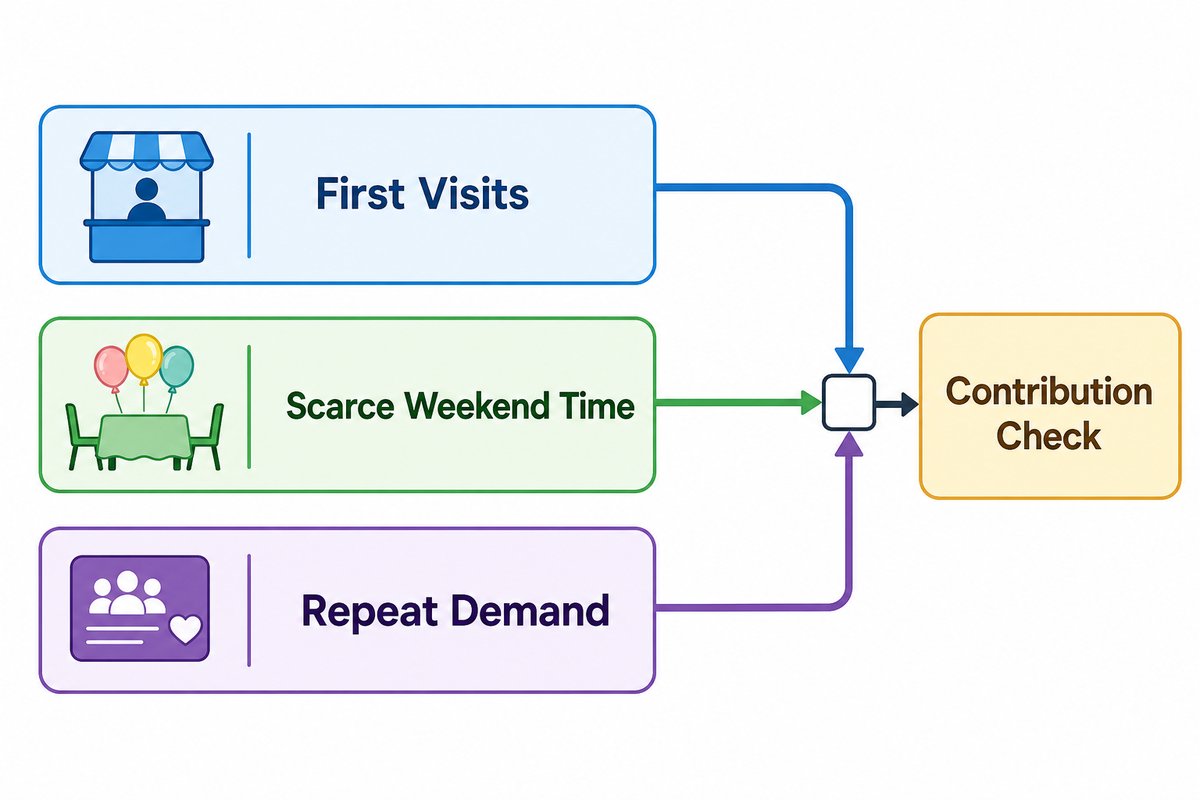
This 3-Lane Pricing Board turns pricing strategies into a business management tool. It separates the job of each revenue lane so the operator can see which offer drives first visits, which offer sells scarce weekend time, and which offer creates repeat demand.
This is where a commercial indoor playground differs from a simple amusement counter. Operators are selling more than access. They are selling a safe environment for children, predictable party hosting, active play, parent comfort, and enough service discipline to become profitable and sustainable. Use the SBA break-even method behind the board so each lane has its own cost and contribution check.
Revenue lane
Customer behavior
Pricing lever
Margin risk
Review metric
Open play admission
First visit, walk-in parent
Timed pass or all-day pass
Peak crowding
Paid visits per hour
Toddler admission
Shorter visit, more supervision
Age-zone ticket
Too much discount
Use of toddler zone
Sibling ticket
Family with 2 or more children
Second-child rule
Per-child yield falls
Average spend per family
Standard party
Birthday group
Guest minimum plus room time
Room sold below slot value
Party gross margin
Premium party
Parent wants less work
Theme, food, host, add-ons
Labor and food creep
Add-on attach rate
Monthly membership
Repeat local family
Visit-count break-even
Peak-hour dilution
Member visits per month
Off-peak pass
Weekday caregiver
Time-limited access
Confusing calendar
Off-peak utilization
Private hire
School, church, company event
Block booking fee
Lost open-play sales
Revenue per blocked hour
Cafe and retail
Waiting parent
Bundle or add-on
Waste and slow service
Spend per visiting family
The board is deliberately plain. It gives the owner, manager, and front desk the same answer when someone asks why a premium Saturday party costs more than a weekday toddler ticket. Review it every 30 days during launch.
Admission Pricing: Turn Visit Length and Age Zones Into a Ticket Ladder
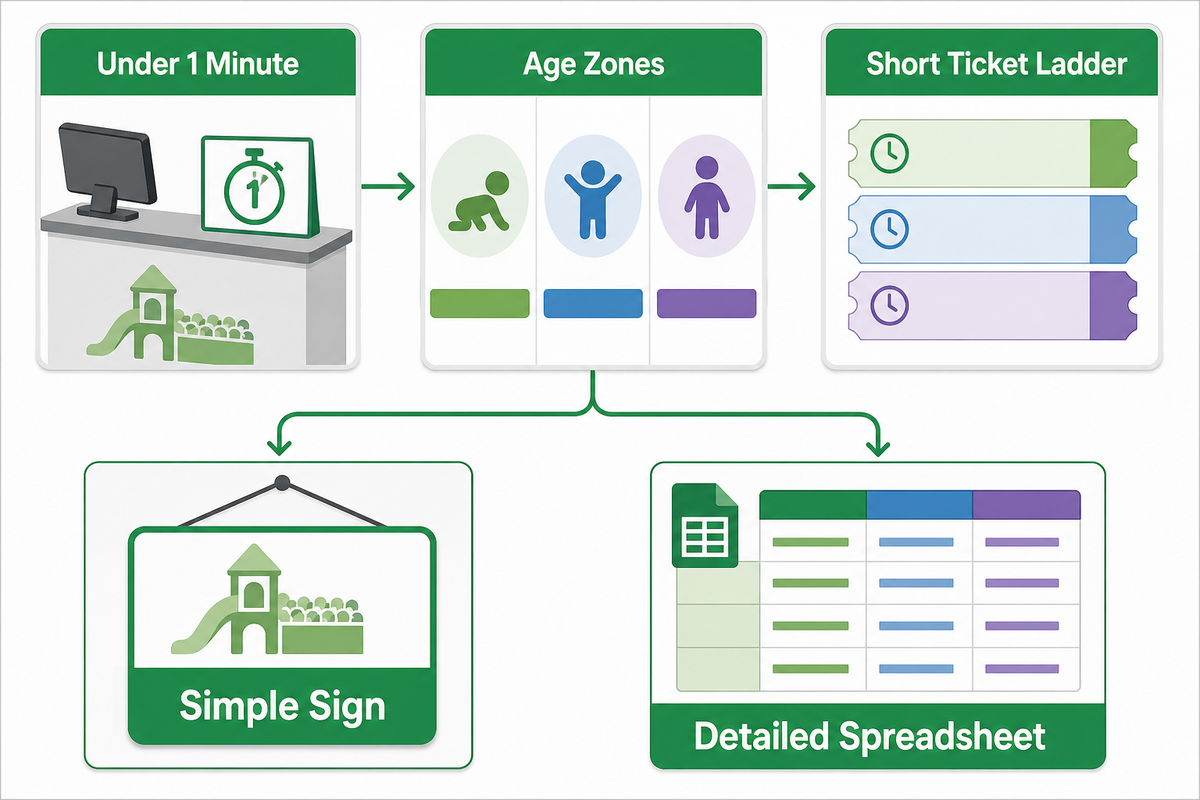
Admission pricing should make sense in less than 1 minute at the front desk. Parents need to know who pays, how long the visit lasts, which play area applies to each age, and whether socks or adult entry are included.
Age zones matter for safety language and capacity planning. CPSC’s public playground handbook is written for children from 6 months through 12 years and discusses age separation and adult supervision. ASTM F1918-21 is the public standard listing for soft contained play equipment, with a scope that covers users from a 5th percentile 2-year-old to a 95th percentile 12-year-old. The ANSI overview of ASTM playground standards is another useful standards reference point. Those documents do not tell an operator what to charge, but they explain why toddler, preschool, and school-age areas should not be priced as if they create the same supervision load.
Short ticket ladders are easier for staff to explain, while detailed back-office rules protect capacity. Trying to open an indoor playground with 9 admission options can slow every transaction. Starting an indoor playground with only 1 all-day ticket can overload peak hours. Local fit is the test.
9-Input Peak-Hour Capacity Ledger
Capacity input
Admission impact
Party impact
Membership control
Owner
Fire-rated occupancy
Sets a hard upper limit
Limits private hire size
Can require blackout hours
Landlord and operator
Usable play surface
Shapes timed capacity
Protects group circulation
Caps member crowding
Designer
Toddler zone size
Supports lower age ticket
Affects mixed-age parties
Use family rules
Operator
Front-desk speed
Controls entry queue
Prevents late party starts
Member check-in shortcut
Manager
Cleaning interval
May favor 90 min sessions
Creates room reset gap
Exclude reset windows
Shift lead
Staff per zone
Raises variable cost
Adds host labor
Push visits off peak
Payroll owner
Attraction mix
Allows premium ticket
Supports theme upgrades
Reserve high-wear zones
Owner
Parent seating
Increases dwell time
Affects party comfort
Supports weekday pass
Designer
Climate control load
Raises operating costs
Affects long events
Check summer usage
Facility owner
A ticket ladder can include an all-day pass, a 90 min pass, a toddler ticket, a sibling rate, an adult policy, and a sock rule. Keep the sign simple. Keep the spreadsheet more detailed.
Party Packages: Price the Room, Staff, Food, and Weekend Slot
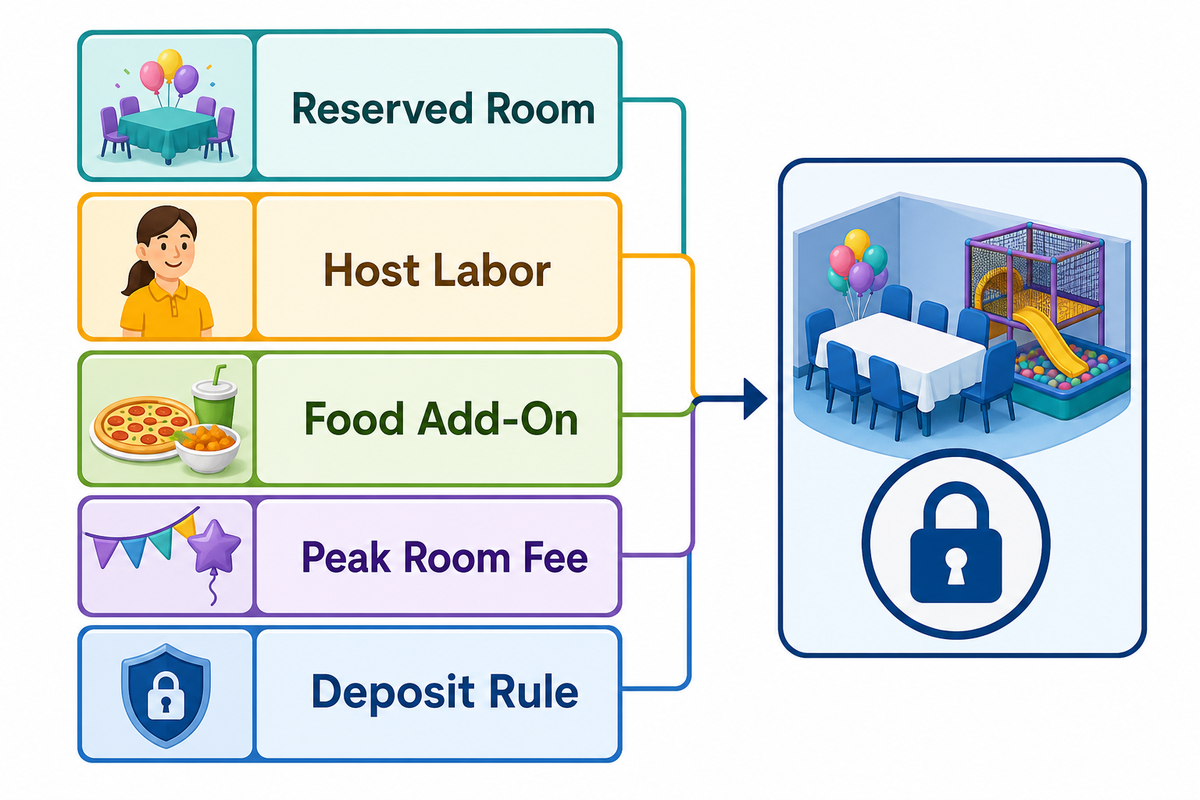
Birthday party packages are not bulk admissions with cake. They sell a reserved room, a start time, a cleaning window, host staff, food service, invitations, add-ons, and a calmer parent experience. That package may use 2 hours of scarce weekend capacity even when the children spend only part of that time inside the play space.
Party rooms create a different indoor playground pricing strategy because the room slot expires. Sell a Saturday 2 pm booking too cheaply and the lost value cannot be recovered later. Weak deposit rules can leave staff scheduled and food ordered without the visit volume needed to cover the gap, so the break-even calculation should be run on party contribution, not only day-pass traffic.
9-Row Party Room Margin Stack
Cost or value layer
What to count
Pricing decision
Leakage signal
Room minutes
Setup, event, cleanup
Sell 90 min or 120 min blocks
Late turnover
Host labor
Greeting, room support, reset
Charge for hosted tiers
Staff pulled from floor
Included children
Base guest count
Set extra-child fee
Crowded room
Food service
Pizza, drinks, plates, cleanup
Separate food add-on
Low food margin
Theme kit
Decor, signage, party favors
Premium package only
One-off buying
Peak slot
Saturday and Sunday demand
Peak room fee
Weekend sellout with low margin
Deposit
Booking commitment
Clear nonrefundable or reschedule rule
No-show bookings
Private attraction use
Ninja course, trampoline, climbing walls
Paid upgrade
High-wear equipment free
Photos and gifts
Memory item, gift bag, retail
Optional add-on menu
Missed retail spend
How much does it cost to set up an indoor playground?
Indoor playground equipment, build-out, professional installation, shipping, rent deposits, insurance, staffing, software, signage, startup costs, and the grand opening budget all affect setup cost. Dreamland Playground supports space planning, floor plan design, 3D design, equipment production, shipping, installation support, and after-sales service, so the actual cost should be tied to a real layout rather than a generic square-foot guess.
Memberships: Set the Break-Even Visit Count Before You Discount
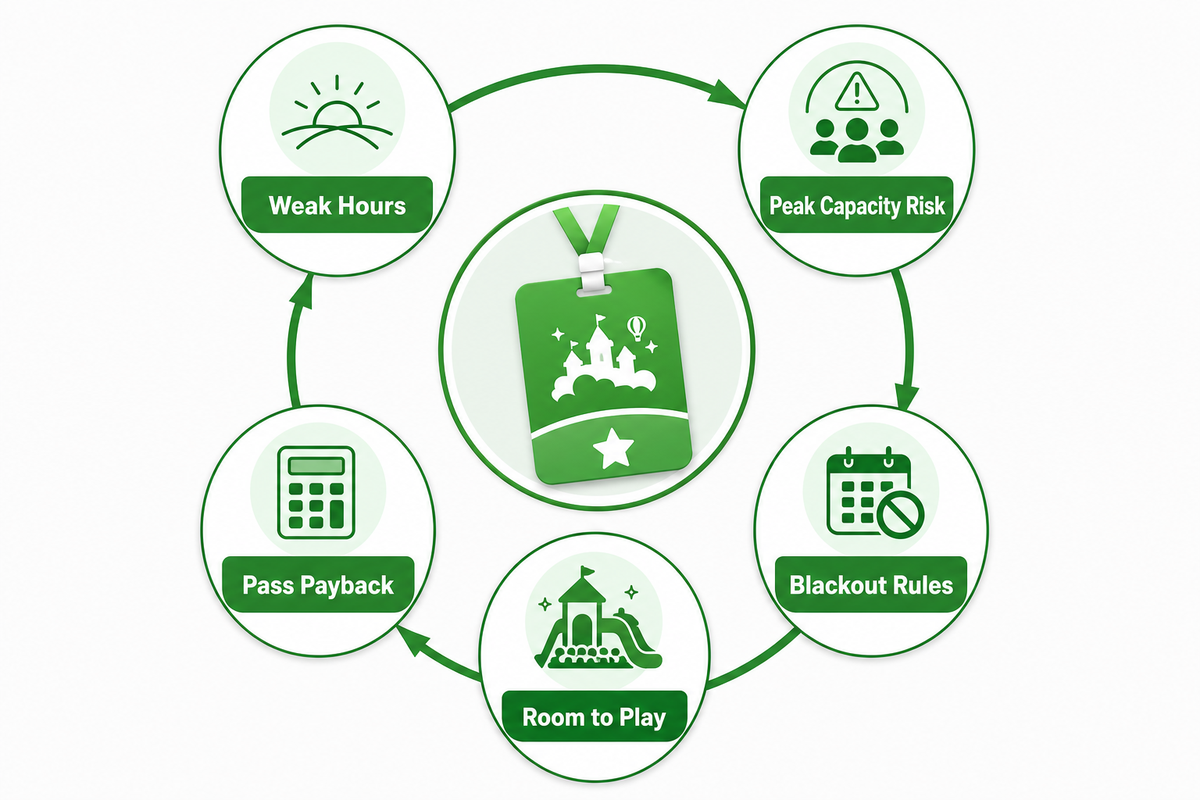
Membership is useful when it fills weak hours and builds repeat habits. Risk appears when it gives heavy users first claim on peak capacity. Start with this formula: monthly pass price divided by the average day-pass price equals the visit count at which the family feels the pass has paid back; then check the same offer against SBA break-even logic before discounting peak visits.
Once a family breaks even after 2 visits, many members will treat the 3rd and 4th visit as free. That can be fine on Tuesday morning. It can be costly on a rainy Saturday when demand is high and full-price admission families are waiting.
Membership rules should state the child count, sibling rule, guest discount, blackout dates, cancellation terms, and birthday-party relationship. Some indoor soft play venues use memberships mainly for weekday caregivers. Larger FEC projects may tie memberships to attraction access, arcade value, trampoline parks, sensory play zones, or cafe credit. Each family entertainment center with diverse needs should model the return on investment and ROI case separately.
Does an indoor playground make money?
An indoor playground can make money when the customer base, rent, labor, equipment costs, and repeat-visit behavior fit the local market. Successful indoor playgrounds usually know their lane mix. They do not treat a membership as a blanket discount. Their goal is a thriving business where repeat demand moves into times where the play area has room.
Competitor Price Checks: Normalize What Is Included Before You Match
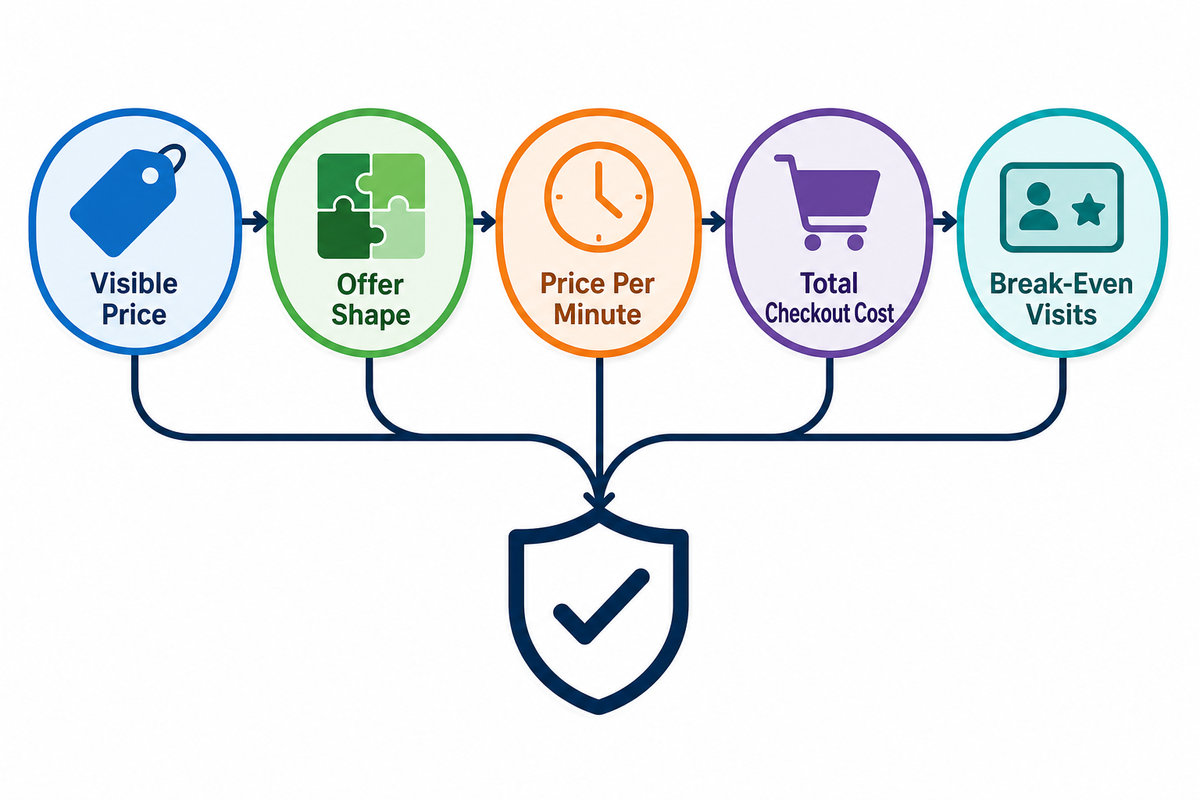
Competitor price checks are useful only after the operator normalizes what is included. Lower admission price may exclude adults, socks, re-entry, party room time, or premium play equipment. Higher package price may include food, private room minutes, cleanup, invitations, and an extra host.
Do not treat public price pages as proof of what your final price should be. They are local snapshots. Use them to test offer shape, customer language, and gaps in your own pricing board. Also check whether the compared venue serves the same age mix and equipment category; CPSC age guidance and ASTM F1918-21 scope language are not pricing tables, but they help prevent false comparisons.
9-Type Offer Normalization Scorecard
Offer type
What to compare
Why it changes value
Your check
Timed admission
60 min, 90 min, 120 min
Visit length changes capacity
Compare price per minute
All-day admission
Re-entry, wristband, peak rules
Dwell time can crowd the floor
Track average stay
Age-tiered pass
Toddler, preschool, school-age
Zones have different staff needs
Match to zone capacity
Adult policy
Free adult, paid adult, extra adult
Parent seating is limited
Check seat turnover
Sock policy
Included, required, reusable
A small line item changes parent reaction
Show total checkout cost
Party package
Guest count, food, host, room
Included service changes margin
Break out included labor
Premium party
Theme, private zone, extra time
Sells scarcity and less parent work
Protect weekend slot value
Membership
Child count, blackout dates, guests
Can move repeat visits off peak
Calculate break-even visits
Group booking
School, daycare, church, camp
Uses block time and staff
Compare revenue per hour
Use the scorecard as a guardrail for marketing strategies. Hard-to-compare offers push parents toward the lowest visible number. Show the length, inclusions, exclusions, and upgrade path clearly.
Venue Model Adjustments: Play Cafe, Mall Zone, Hotel Kids Club, or Large FEC
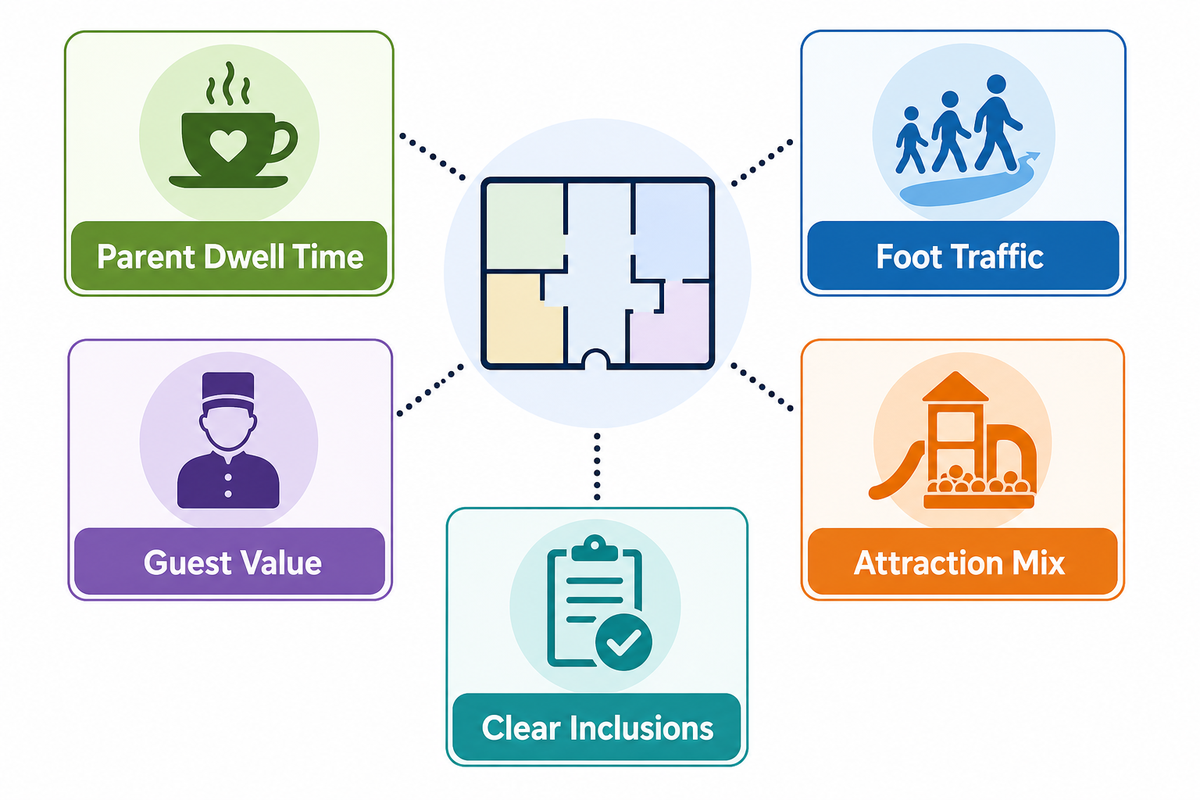
Play cafe pricing has to account for parent dwell time and food convenience. Mall entertainment zone pricing may care about foot traffic, weekday occupancy, and short sessions. Hotel kids club setup pricing may be sold as guest value rather than a pure day-pass business. Large FEC planning may mix indoor playground equipment with arcade, trampoline, ninja course, climbing walls, food, retail, and party rooms.
That is why indoor playground design and pricing should be built together. Floor plans with 1 party room and a large free-play zone need a different revenue mix than projects with 3 party rooms, a cafe, and several premium attractions.
Dreamland Playground can customize layout, theme, play structure, and equipment selection around space, target age group, local market, budget, and business needs. For mall sites, compare the mall entertainment zone revenue model. Resort and hotel projects should review the hotel kids club setup model before setting public admission.
Before signing the price board, separate market analysis from building and legal checks. Demography and income shape local demand, while regulation, fire safety, occupational safety and health, bathroom count, ceiling height, infrastructure, heating, ventilation, and air conditioning, maintenance downtime, and the manufacturing schedule shape usable capacity. Shopping mall sites, coffeehouse-style play cafes, amusement park-style FECs, and obstacle course add-ons can also affect bank financing and investment review. Clear inclusions reduce false advertising risk.
Indoor playground involves equipment design and human behavior at the same time. Low-friction tickets may raise traffic, but poor fit between price and layout can hurt service quality, physical activity flow, and parent comfort.
Booking Rules That Protect Margin: Deposits, Time Slots, and Blackout Dates
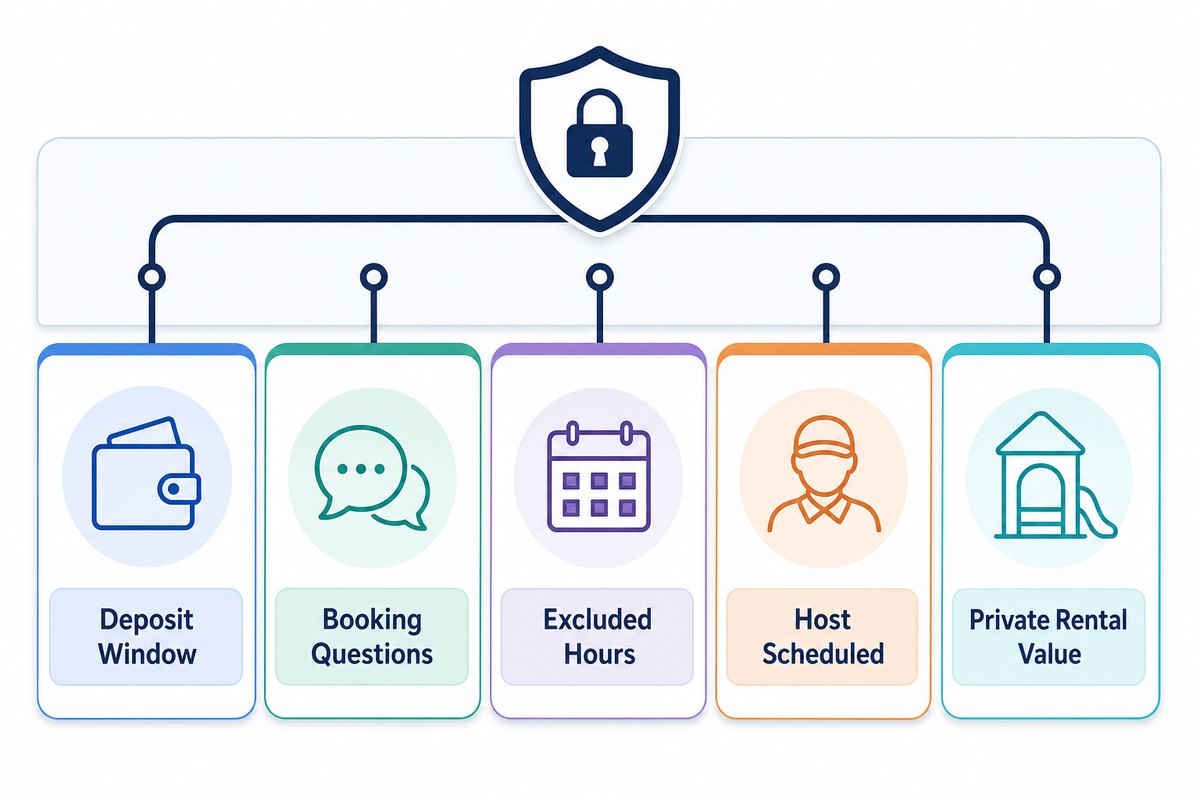
Booking rules should be written before the public price menu goes live. Deposit, cancellation window, no-show rule, add-on menu, private rental policy, and membership blackout calendar protect the price board after customers start using it.
For parties, the rule must answer 5 questions: how much is due at booking, when the balance is due, how rescheduling works, which food can be brought in, and what happens when the guest count changes. For memberships, the rule must answer 4 questions: which child is covered, which hours are excluded, how guests are handled, and how cancellation works.
Booking pages should also protect the staff. Premium parties that include a host need that host on the schedule. Rooms that require 15 min of reset time need that gap in the booking calendar. Private rentals that block open play for 2 hours should clear the lost admission value.
What Changes in 2026: Demand Timing, Labor, Insurance, and Parent Expectations
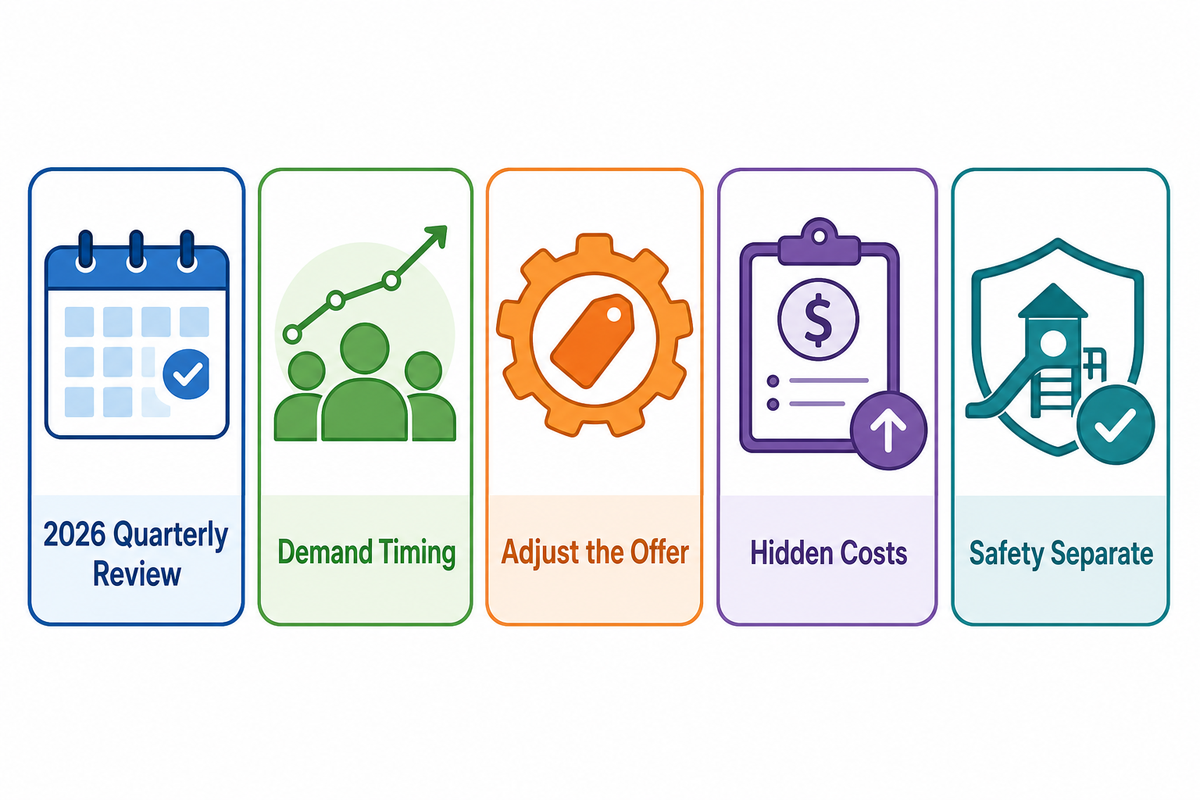
Pricing should be reviewed quarterly in 2026 because demand timing, staffing, insurance pressure, parent expectations, and attraction wear can change after launch. IAAPA benchmark reports cover topics such as admissions, staffing, guest behavior, revenue, expenses, attendance trends, and spending patterns, but public pages do not provide universal indoor playground price numbers. Treat benchmark sources as comparison context, not a ready-made menu.
Quarterly review does not mean changing ticket prices every few weeks. It means checking the pricing board against facts: weekday attendance, weekend wait time, party fill rate, member visit count, refund requests, cafe sales, staff hours, and comments from parents. When demand is high in one lane and weak in another, adjust the offer, not only the price.
Hidden costs can appear after opening a playground: extra cleaning, socks inventory, seasonal HVAC load, worn pads, food waste, payment fees, or staff overtime. Healthy profit margin is rarely protected by a single admission price. It is protected by the relationship between ticket prices, party packages, membership terms, day-to-day operating costs, and operational efficiency.
Indoor playground industry safety standards also vary by product family and market. Dreamland can design products according to relevant EN and ASTM requirements based on product type and destination market. Operators should keep soft contained play equipment standards separate from price benchmarking so price pressure never weakens the safe environment for children.
Build Your First 90-Day Pricing Test Board
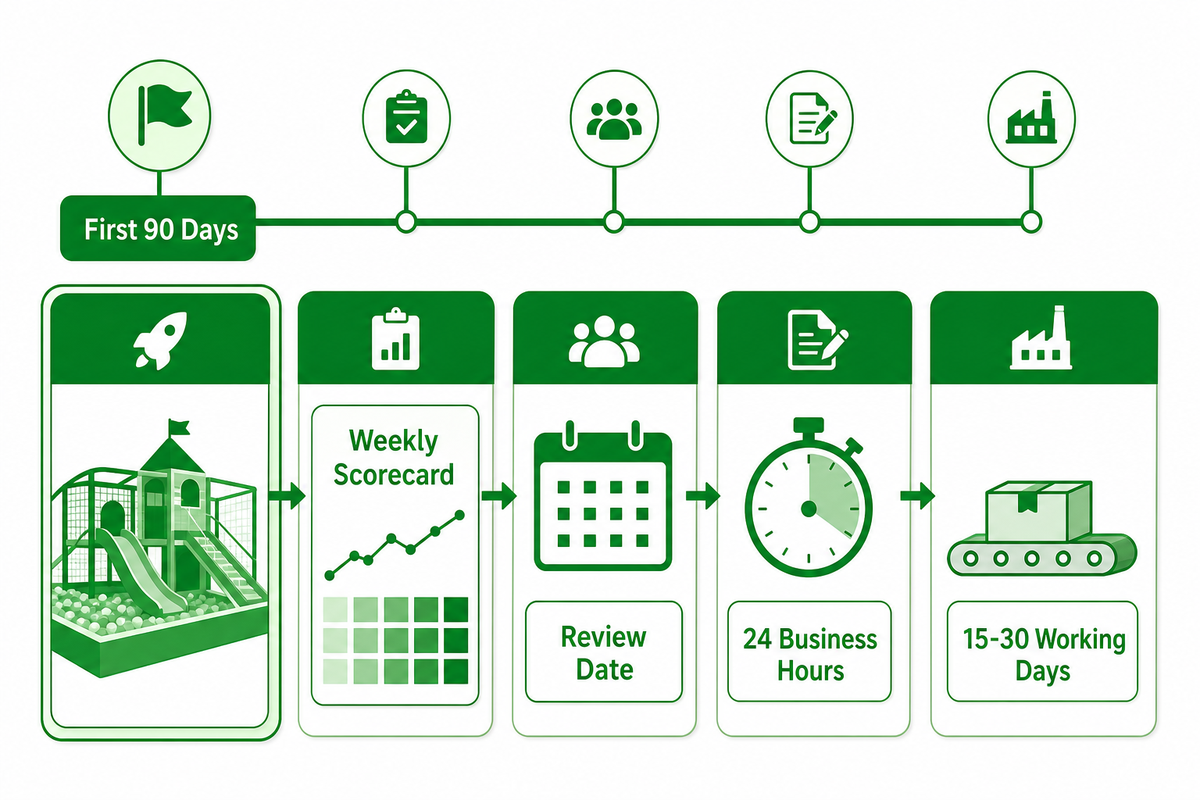
The first 90 days should test the price board, not prove that every launch decision was right. Use a simple weekly scorecard with paid visits, average family spend, party inquiries, booked parties, member signups, member visits, refunds, staff hours, and parent objections.
Set a review date before launch. Full admission lines with empty party rooms may mean the package is unclear or under-promoted. Fast membership sales with weekend waits may call for blackout rules or more weekday value. Slow cafe sales should send the team back to parent seating, dwell time, and checkout flow before blaming menu price.
For the 90-day test, record time and demand in the same sheet: 30 min queue spikes, 60 min short sessions, 90 min standard sessions, 120 min party blocks, 2 hours of private hire, 3 hours of deep-clean scheduling, 1 day weather swings, 7 days of weekly traffic, 30 days of member behavior, 90 days of launch evidence, and 1 year of renewal planning. Keep the raw log format consistent as well: 4 hours of Saturday open play, 6 hours of Sunday party demand, 8 hours of weekday slack, 14 days of deposit lead time, 21 days of promotion review, 60 days of membership retention, 6 months of seasonality, 9 months of payroll pattern, 12 months of renewal risk, 18 months of lease pressure, 24 months of equipment refresh assumptions, 36 months of lease renewal planning, and 48 months of attraction refresh planning.
Dreamland’s business plan page states that quotation can be prepared within 24 business hours, free 3D concept work on standard model library projects can take 3 working days from an approved floor plan, and production can take 15-30 working days after drawing approval. Those timelines help an investor link the pricing model to project schedule, equipment production, shipping, and launch planning.
Plan the price board with the layout
Share your space size, target age group, venue model, and launch goals. Dreamland Playground can help connect indoor playground equipment, floor plan design, party rooms, and admission capacity before the final price menu is printed.
What is a good starting admission price for an indoor playground?
Start with capacity-safe economics, then compare local offers.
There is no universal admission price that fits every indoor playground. Start with fixed costs, variable visit costs, expected dwell time, age-zone capacity, and local family spending behavior. Then compare local ticket prices only after you normalize visit length, adult entry, socks, re-entry, and included attractions. Staff should be able to explain the first price quickly, and finance should see how it supports cash flow.
How should I price indoor playground birthday parties?
Price birthday parties from the reserved room slot, host labor, food load, cleaning window, included children, weekend scarcity, add-ons, deposit risk, and reset time before discounting admission.
Birthday packages should not be priced as discounted admission. Count room time, cleaning time, host labor, included children, food service, theme materials, and the value of the weekend hour. Then create base, standard, and premium packages with clear add-ons. Deposit and reschedule rules help protect the room if a family cancels close to the event date.
Are indoor playground memberships worth offering?
Memberships work best when they fill slower hours.
Membership is worth offering when it creates repeat visits without taking too much peak capacity from full-price visitors. Calculate the break-even visit count first. Once the pass pays back after 2 visits, the operator must decide whether the 3rd and 4th visit should be welcome on weekends, weekdays only, or controlled by blackout dates. Rules matter as much as price.
Should adults pay admission at an indoor playground?
Adult admission depends on seating, supervision, and local expectations.
Many venues include 1 adult with a child ticket and charge for extra adults when seating is tight. Publish the policy before checkout.
How often should an indoor playground update prices?
Review the pricing board every quarter, then change public prices only when attendance, party conversion, member visits, refunds, and staff-hour evidence point the same way.
Quarterly review is a good rhythm because school calendars, weather, labor schedules, insurance renewals, party demand, and parent value perception can move during the year. Look at paid visits, weekend wait times, party conversion, member visits, refund requests, staff hours, and cafe spend. Weak lanes should trigger offer review first. Price changes should follow a clear pattern, not a single slow week.
What should be included in a party package?
Clear party packages state room time, included child count, open-play access, host support, food, cleanup, add-ons, deposit terms, and extra-child fees so parents can compare tiers.
Package pages should name the included children, room minutes, open-play access, food and drink items, setup help, cleanup support, socks policy, outside food rule, extra-child fee, and private attraction access. Premium tiers can add themes, longer room time, private play blocks, or gift bags. Booking pages should state deposit and cancellation terms before payment.
Dreamland Playground publishes practical planning guides for commercial indoor-play projects, including family entertainment centers, shopping malls, hotels, restaurants, churches, and other venue types.
Use these guides to frame the questions that should be resolved before concept selection: venue size, intended age groups, project location, attraction mix, operating priorities, timeline, and delivery constraints. Final recommendations should be based on the real site and applicable local requirements.
Start With The VenueFloor area, clear height, site location, intended audience, and target opening date create the working brief.
Clarify The ScopeConcept, equipment, production, shipping, installation, and operating inputs can vary from one project to another.
PROJECT / VENUE / TIMELINE
Prepare Your Project Brief
Venue TypesFEC · Mall · Hotel · Restaurant · Church
Start WithFloor area · Clear height · Age groups · Country