Get in touch with Dreamland Playground Company

Updated November 2026 · Commercial Venue Engineering & FEC Cost Guide
The cost to build a mini golf course in the U.S. starts between $150,000 and $500,000 USD for a commercial 18-hole build at Amusement Products and Adventure Golf & Sports. Custom 18-hole concrete courses at Harris Miniature Golf Courses cost $300,000 to $600,000 USD, and full turnkey venues exceed $750,000 USD with land and site work.
A commercial miniature golf course is a contoured 9-hole or 18-hole putting attraction built over concrete slabs or interlocking polymer panels. Prospective investors wishing to build a new facility must clear four engineering hurdles in sequence. First, separate bare course quotes from civil grading and currency labels. Second, consider the trade-off between indoor tenant sprinklers and outdoor drainage. Third, verify 2010 ADA Standards §239.2 (≥50% accessible holes) and §1007.3 geometry. Fourth, model SBA 7(a) debt against realistic hourly player throughput.
How Much Does It Cost to Build a Mini Golf Course by Hole Count and Build Tier?
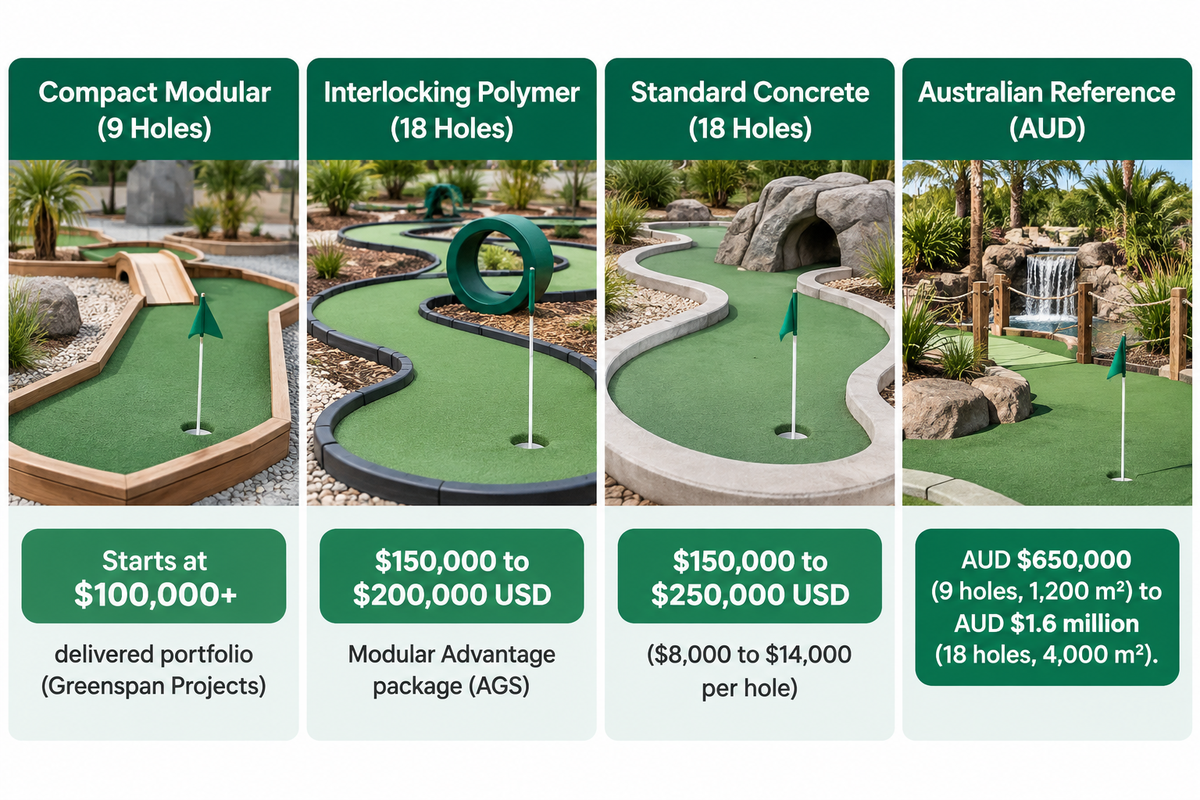
Standard U.S. 18-hole poured-concrete courses cost $150,000 to $250,000 USD ($8,000 to $14,000 per hole) at Amusement Products, whereas interlocking polymer panel packages run $150,000 to $200,000 USD at Adventure Golf & Sports. Heavily themed adventure or indoor builds reach $300,000 to $1,500,000 USD at Amusement Products and exceed $2,000,000 USD at Greenspan Projects.
There are two main reasons first time buyers misread online quotes. First, prices for builder courses cover design and construction of holes and do not include land, stormwater retention, restrooms, and parking. Automated search summaries mix U.S. Dollars and Australian Dollars. Brisbane builder Mini Golf Creations quotes AUD $650,000 for 9 holes on 1,200 m² and AUD $1.6 million for 18 holes on 4,000 m². Completed courses span AUD $550,000 to $1.85 million.
| Build Tier & Format | Hole Count | Published Course Price Band | Currency & Named Source | Excluded Site & Facility Items |
|---|---|---|---|---|
| 1. Small Backyard / Rental Amenity | 1–3 holes | Private residential custom quote | USD (HomeFix Guides residential scope) | Not built for public commercial foot traffic |
| 2. Compact Commercial Modular | 9 holes | Starts at $100,000+ delivered portfolio | USD (Greenspan Projects entry modular) | Building lease, HVAC, restrooms, POS counter |
| 3. Interlocking Polymer Modular | 18 holes | $150,000–$200,000+ (Modular Advantage®) | USD (Adventure Golf & Sports) | Water hazards, custom props, slab prep, freight |
| 4. Standard Commercial Concrete | 18 holes | $150,000–$250,000 ($8,000–$14,000/hole) | USD (Amusement Products) | Land acquisition, rough grading, clubhouse |
| 5. Professional Outdoor Concrete | 18 holes | $150,000–$500,000+ course package | USD (AGS & Amusement Products) | Off-site utility extensions, parking lot paving |
| 6. Custom Designed Concrete Course | 18 holes | $300,000–$600,000 (>$750,000 all-in) | USD (Harris Miniature Golf Courses) | All-in figure includes site prep & amenities |
| 7. Indoor or Heavy Water/Theme Build | 18 holes | $300,000–$1,500,000 | USD (Amusement Products) | Base shell rent and Group A-3 sprinkler main |
| 8. Flagship Resort / Tech Adventure | 18 holes | $100,000 to $2,000,000+ delivered range | USD (Greenspan Projects) | Full-service F&B kitchen, liquor license, bar |
| 9. Australian Landscaped Reference | 9 vs. 18 holes | AUD $650,000 (9h) / AUD $1,600,000 (18h) | AUD (Mini Golf Creations, Australia) | Council approvals & 10%–20% contingency |
Municipal park procurements follow the same scope for turnkey contracts. In the City of Hendersonville Edwards Park design-build RFQ, the City combined topographic surveying, stormwater grading, ADA paths and lighting into a single bid. Investors wanting to compare indoor golf bays against putting greens can look at the golf simulator business startup costs and floor space.
Why Does a 9-Hole Mini Golf Course Cost 65% to 75% of an 18-Hole Course?
Fixed costs like civil engineering, permits, and crew mobilization, and plumbing a kiosk stay largely the same when the hole count is cut in half. Hence, a 9 hole build on similar land doesn’t cut an 18 hole budget in half. Mini Golf Creations notes that fixed design and site-establishment costs per hole drop across 18 holes. Unlike comparable-footprint builds, total per-hole construction costs still increase when overall landscaped site area expands from 1,200 m² (AUD $650,000) to 4,000 m² (AUD $1.6 million).
Select 9-hole formats when miniature golf supports a hotel, campground, brewery, or arcade, versus drawing destination traffic alone. If you build 9 holes first and expand later, masterplan the full 18-hole drainage and conduit layout on day one. Mini Golf Creations cautions that a 9-hole layout designed in isolation generally blocks the second phase of development.
Indoor Blacklight vs. Outdoor Concrete Mini Golf: Fit-Out Cost and Build Time
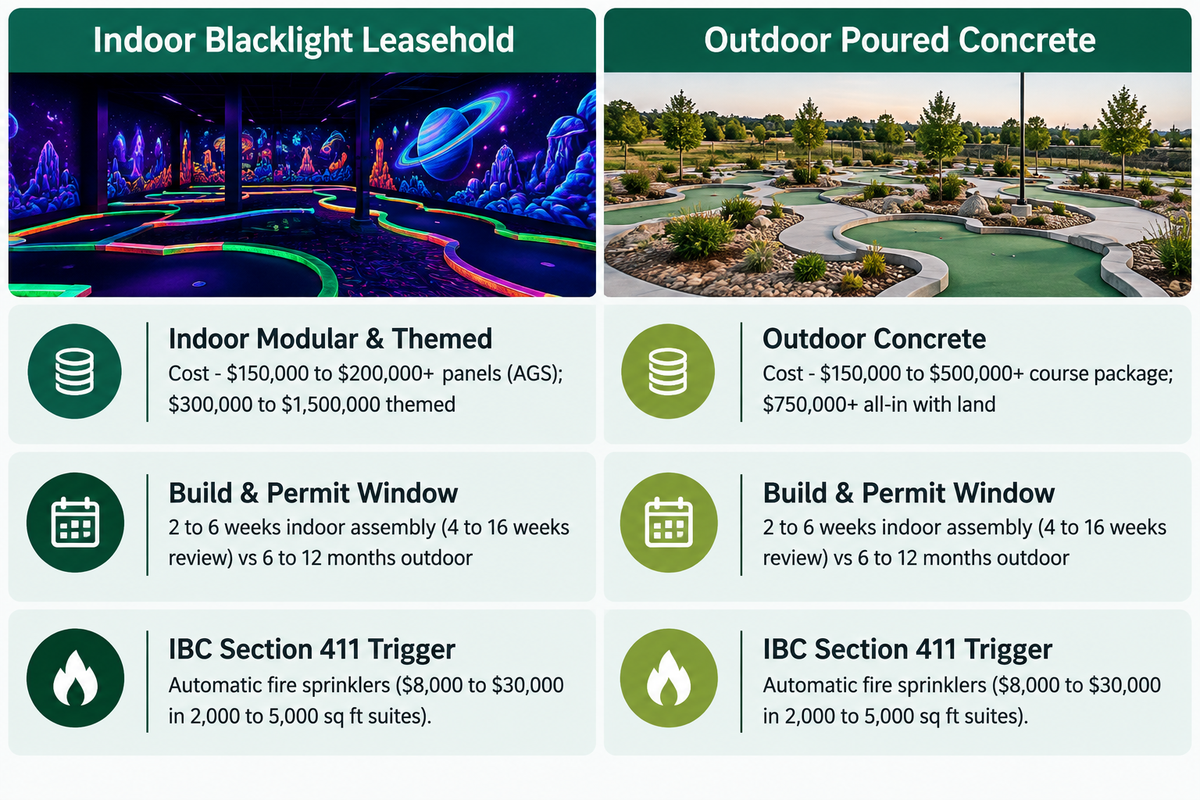
Indoor facility or intricate themed miniature golf course builds run $300,000 to $1,500,000 USD per Amusement Products, whereas outdoor 18-hole concrete courses run $150,000 to $500,000+ USD. Prefabricated indoor holes assemble on site in 2 to 6 weeks. Outdoor civil builds take 2 to 4 months of active construction and 6 to 12 months with permits per HomeFix Guides.
Indoor startup budgets run $150,000 to $200,000+ USD for bare 18-hole modular panels (Adventure Golf & Sports) and $300,000 to $1,500,000 USD for full themed facilities (Amusement Products). Shell utilities depend on prior tenant buildouts, and an indoor golf course requires Assembly Group A-3 occupancy. Converting a retail premise adds lease deposits, HVAC tonnage, restrooms, and 4 to 16 weeks of stamped plan review per StartPermit’s IBC Group A-3 and Section 411 code guide. Operators planning retail layouts can check our mall entertainment zone space planning guide before signing a lease.
Code Trigger Alert: IBC Section 411 Special Amusement Buildings
Standard Group A-3 assembly spaces only require fire sprinklers above code occupant-load thresholds, whereas darkened blacklight or maze-like layouts with obscured exits trigger International Building Code (IBC) Section 411. According to StartPermit, Section 411 requires automatic fire sprinklers ($8,000 to $30,000 in 2,000 to 5,000 sq ft tenant suites and higher in larger shells) with zero occupant-load exception. It also requires the installation of smoke detectors, shutoff of audio-visual equipment, and the activation of emergency lighting in the event of a fire-alarm condition.
| Decision Dimension | Indoor Blacklight / Modular Shell | Outdoor Poured Concrete Parcel |
|---|---|---|
| 1. Course Package Cost (18 Holes) | $150,000–$200,000+ modular panels (AGS) | $150,000–$600,000 concrete build (Amusement Products / Harris) |
| 2. Complex Facility / All-In Investment | $300,000–$1,500,000 indoor/themed course build (before rent) | $750,000+ all-in with land, grading, lighting & clubhouse |
| 3. Typical Gross Footprint | 6,500 sq ft average (2,500–10,000 sq ft range) | 22,000 sq ft average (13,000–30,000+ sq ft range) |
| 4. On-Site Course Installation | 2 to 6 weeks after shell readiness | 2 to 4 months active earthwork, concrete & turf |
| 5. End-to-End Permit & Launch Window | 4–16 weeks architectural plan review + TI buildout | 6 to 12 months including stormwater & civil permits |
| 6. Annual Operating Days | 365 days climate-controlled play | Minimum 90 days in cold regions; year-round in warm climate |
| 7. Primary Code Bottleneck | IBC Group A-3 sprinklers & Section 411 dark-egress alarms | Municipal impervious-surface & storm-drain retention |
| 8. Lease-End Asset Portability | Modular polymer panels unbolt and relocate | Not applicable (cast-in-place concrete stays in ground) |
| 9. Primary Routine Upkeep | UV lamp replacement, HVAC filters, tee-mat vacuuming | Daily leaf/debris blowing, UV turf wear, pond dosing |
How Much Does It Cost to Build an Indoor Mini Golf Course Inside a Leased Shell?
Amusement Products quotes indoor or heavily themed 18-hole mini-golf course builds at $300,000 to $1,500,000 USD before base shell rent and the Group A-3 sprinkler main. Bare 18-hole modular polymer panels are quoted at $150,000 to $200,000+ USD at Adventure Golf & Sports, before the addition of HVAC ductwork, ADA compliant restrooms, and upgrades to the fire alarm system.
Negotiate for a landlord tenant improvement allowance for the permanent mechanical, electrical and sprinkler main work prior to signing your lease. Classify modular putting panels as trade fixtures so you can remove them at the end of your lease.
Modular Panel Courses, Portable Setups, and Tech-Infused Scoring Upgrades
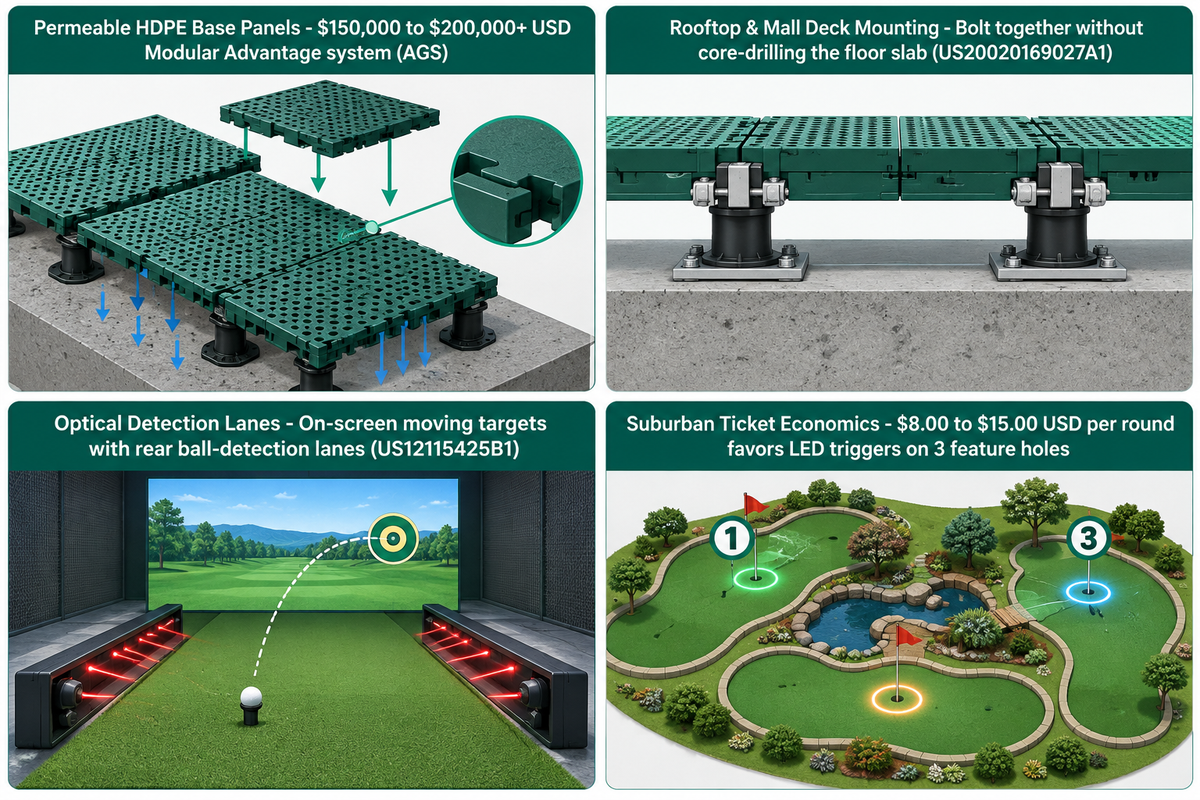
Permanent 18-hole interlocking polymer courses run $150,000 to $200,000+ USD via Adventure Golf & Sports’ Modular Advantage system. Custom modular and themed adventure builds at Greenspan Projects span $100,000 to over $2,000,000 USD. Adding proprietary automated scoring further pushes venues into seven-figure budgets.
Interlocking high-density polyethylene panels solve weight and drainage limitations where concrete mixers can’t reach. Recycled polymer base panels are water-permeable and bolt together without core-drilling the floor slab. Sectional cup-panel filings, such as USPTO publication US20020169027A1, pioneered interlocking modular cup panels, while Adventure Golf & Sports deploys custom modular systems for rooftops, piers, cruise ship decks, and upper mall floors.
To evaluate whether automated digital scoring fits your capital budget, look at how sensor lanes replace manual scorecards and physical rebuilds. Modern gamified lanes, such as Puttshack’s standalone structure under USPTO Patent US12115425B1 (October 2024), pair on-screen moving targets arranged in rows with rear optical ball-detection lanes. Vertical digital screens let operators update game rules via software without rebuilding physical obstacles. Legacy radio-frequency cup systems (USPTO Patent US5582550A) required custom coded balls that raised consumable replacement bills whenever guests lost balls.
When Does Automated Ball-Tracking Scoring Justify Its Per-Hole Cost Premium?
Tech-infused chains target high-volume urban venues. For example, Blooloop’s report on Puttshack’s $150 million growth round (led by BlackRock and Promethean Investments) shows tech-infused chains rely on high-volume bar checks.
Suburban family centers charging $8.00 to $15.00 USD per round rarely recover six-figure sensor budgets from ticket sales alone. Family amusement venues achieve strong playability and a memorable round at lower cost by placing LED and audio triggers on three signature feature holes.
Miniature Golf Course Size: Square Footage, Acreage, and ADA 50% Accessibility Rules
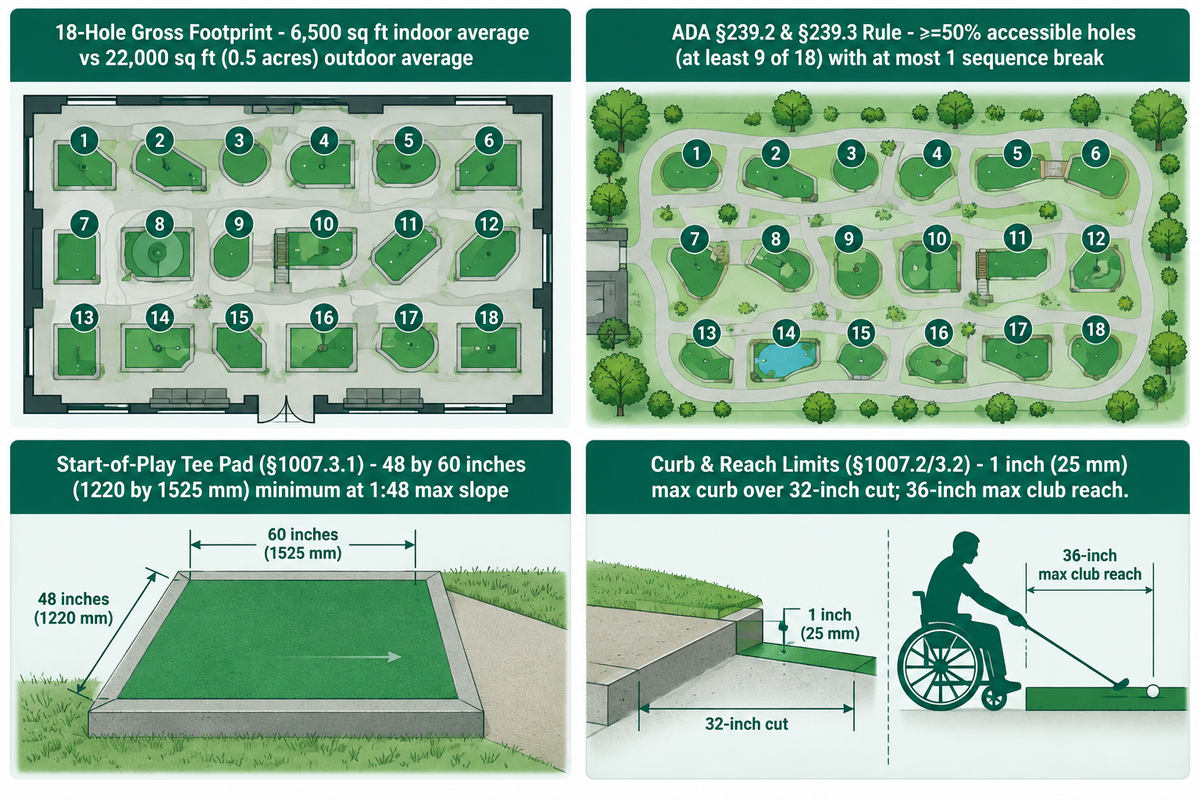
Miniature golf course size averages 6,500 square feet indoors (2,500 to 10,000 sq ft) and 22,000 square feet outdoors (0.5 acres, or 13,000 to 30,000+ sq ft) for 18 holes per Amusement Products. Ultra-compact 9-hole indoor layouts fit inside 1,600 square feet per Greenspan Projects. Landscaped 9-hole outdoor courses need 500 to 800 m² (5,380 to 8,610 sq ft) of playing area per Mini Golf Creations, while its quoted AUD $650,000 9-hole project sits on a 1,200 m² landscape parcel.
“A clear floor or ground space 48 inches (1220 mm) minimum by 60 inches (1525 mm) minimum with slopes not steeper than 1:48 shall be provided at the start of play.”
Each and every commercial U.S. layout must clear an ADA §239 Consecutive-Hole Route Audit under the Department of Justice 2010 ADA Standards for Accessible Design (§239.1 through §239.3). Those federal standards enforce the Americans with Disabilities Act of 1990 for all commercial recreation facilities. Under §239.2 and §239.3, >=50% of holes must be ADA-compliant under §1007.3 in consecutive order. Designers may include at most one break in the sequence, provided the final hole on the course is the last accessible hole and exits directly without backtracking.
Blueprints must meet three §1007 tolerances before crews pour durable concrete curbs. The height of curbs at route crossings can’t be more than 1 inch (25 mm) with a minimum cut of 32 inches (815 mm) (1007.2 Exception 2). Playing-surface ramps allow up to a 1:4 slope for a 4-inch (100 mm) rise (§1007.2 Exception 3). Ball-rest zones must be a maximum club reach of 36 inches (915 mm) from a 36 by 48 inch wheelchair space that’s 1:20 or flatter (1007.3.2).
Suppose an investor leases a retail shell for an 18-hole layout. For an 18-hole layout sized to Amusement Products’ 6,500-square-foot indoor benchmark, §239.2 rules require at least 9 holes to meet §1007.3. Routing Holes 1 through 8 plus Hole 18 as accessible satisfies the single-break rule. Holes 9 through 17 can then feature steeper elevation changes on a raised deck. Adding nine 48 by 60 inch tee pads, 36-inch accessible routes, and queueing zones explains why 4,000 square feet of turf needs 6,500+ gross square feet. Review our FEC floor plan design and traffic flow guidelines for aisle planning.
ADA §239 & §1007 Design Do’s
- Group at least 9 of 18 accessible holes together, with Hole 18 being the last hole (§239.3).
- Drop perimeter curbing to 1 inch (25 mm) max across a 32-inch (815 mm) entry cut (§1007.2 Exception 2).
- Keep accessible ball-rest pockets within 36 inches (915 mm) of a 36 by 48 inch wheelchair space (§1007.3.2).
Inspection-Failing Layout Mistakes
- Scattering 9 accessible holes on odd numbers with two or more sequence breaks.
- Adding 3- or 4-inch continuous brick borders around tee mats without a 32-inch flush cut.
- Routing the accessible exit from Hole 18 back across active putting lanes on holes 14-17.
How Many Holes Must Be Wheelchair Accessible Under the 2010 ADA Standards?
At least 50 percent of miniature golf holes must be wheelchair accessible under 2010 ADA Standards §239.2 (§1007.3). That equals at least 5 accessible holes on a 9-hole course, or 9 on an 18-hole layout.
At existing building alterations, DOJ Title III rules (28 CFR §36.403(f)) limit mandatory path-of-travel upgrades to 20% of the primary alteration cost. New holes must still comply with full §1007.3 requirements.
Construction Line Items: Site Grading, Drainage, Putting Turf, Obstacles, and Lighting
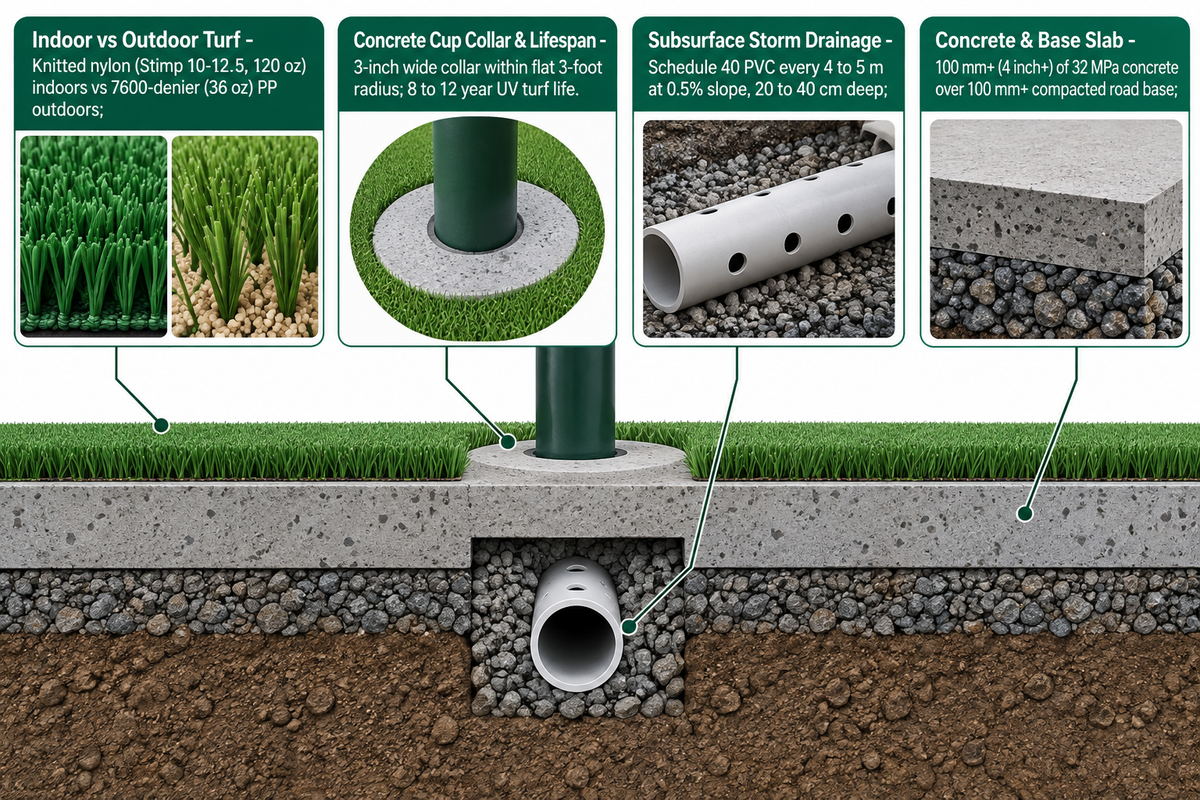
Outdoor concrete builders pour 100 mm+ (4 inch+) slabs of 32 MPa concrete over 100 mm+ compacted road base per Mini Golf Creations. Commercial synthetic turf lasts 8 to 12 years outdoors per HomeFix Guides, and nylon greens roll at Stimp 9 to 12.5 per SYNLawn. You can estimate $8,000 to $14,000 per hole for standard concrete work at Amusement Products.
Outdoor golf courses avoid constant patching after heavy rain when subsurface site prep places structural drainage 20 to 40 cm underground, as documented by GolfMasters. Crews trench a Schedule 40 PVC storm drain line every 4 to 5 meters at a 0.5% minimum slope beneath 10 to 15 cm of washed aggregate. When compacting base stone with a walk-behind plate compactor, Synthetic Grass Warehouse limits lift thickness to 2-inch layers for 80% minimum compaction.
Use glue-down knitted nylon over indoor concrete and sand-filled polypropylene outdoors in a warm climate, matching artificial turf yarn and foam underlayment to your site’s topography. SYNLawn Precision Putt nylon (Stimp 10-12.5) and 120 oz, 1-inch Tee Strike mats glue down with no infill over indoor concrete. Outdoors, nylon expands over concrete and locks ball speed. Challenger Industries data published by DP Turf shows that 7600-denier sand-filled polypropylene (36 oz) is a heavier, thicker yarn than 5700-denier (30 oz). A thicker blade in a warm climate wears less in UV. In sand top-dressing, crews can adjust speed around each contour and the sand traps.
Common Mistake: Dirt-Set Cups & High-Maintenance Waterfalls
Setting putting cups directly into compacted dirt causes flagstick wobble and rainwater heave. Synthetic Grass Warehouse notes this creates a raised “volcano effect” lip around the hole. Set each cup inside a concrete collar at least 3 inches wide and 1 inch deeper than cup height within a flat 3-foot radius. Likewise, Harris Miniature Golf Courses’ layout error guide warns against each untreated outdoor timber obstacle, blind sightlines, and high-upkeep ponds. Dry sculpted rock creeks, blue turf hazards, and LED lighting create visual drama without pump failures.
How Long Does Synthetic Mini Golf Turf Last Before Replacement?
Ultraviolet (UV) stable synthetic turf used for mini golf lasts 8 to 12 years under normal outdoor wear, per HomeFix Guides. Hitting that lifespan requires clearing leaf debris daily and running spring and quarterly seam inspections.
High-friction tee mats and bank-shot corners lead to more wear and tear than fairways. Staff can replace worn tee zones mid-cycle without a color mismatch by ordering dye-lot-matched turf rolls during installation.
All-In Startup Budget, Annual Ownership Costs, and SBA Loan Financing
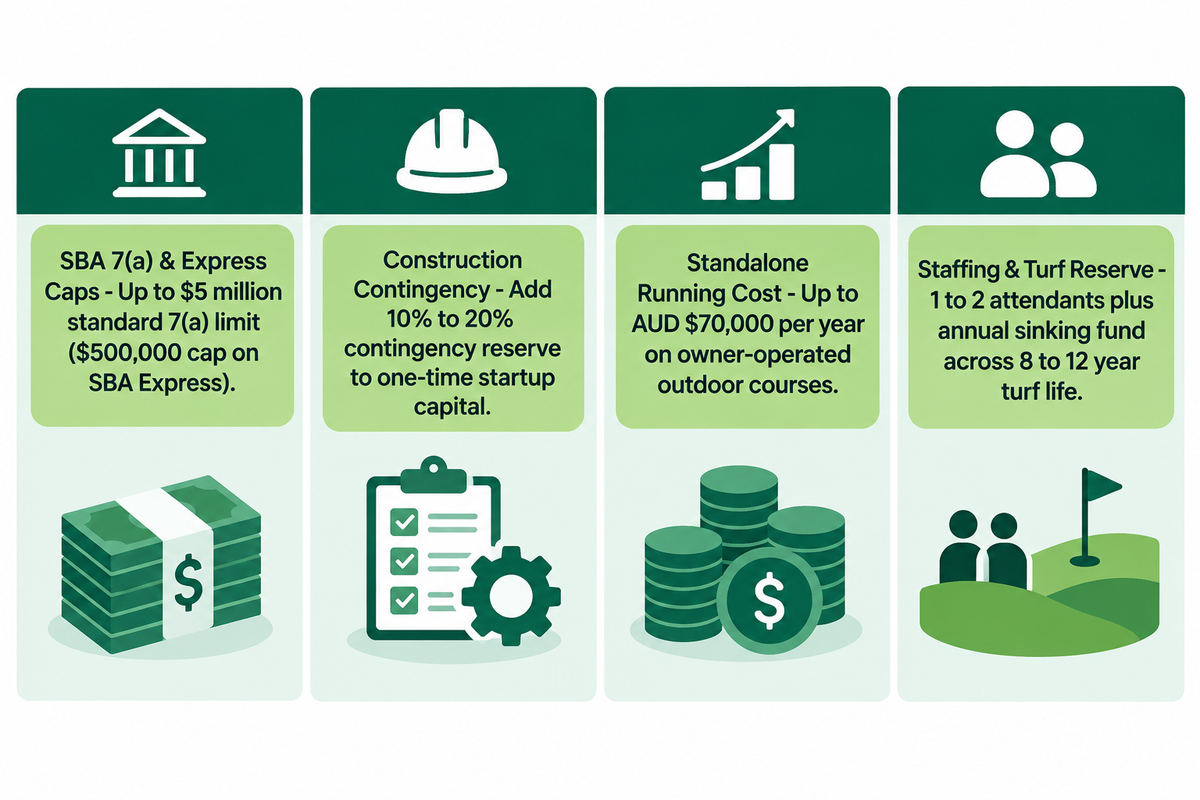
Standard U.S. Small Business Administration (SBA) 7(a) loans finance up to $5 million ($500,000 cap on SBA Express) for commercial course development, leasehold improvements, and equipment. Standalone annual running costs stay lean, benchmarked up to AUD $70,000 per year on owner-operated outdoor courses by Mini Golf Creations before commercial lease or debt service.
When writing a bank-ready business plan, SBA startup budgeting rules separate one-time capital outlays from operating expenses. Add a 10% to 20% construction contingency (Mini Golf Creations) to the plan. It’s a core financial consideration for lenders. Mini golf course business owners often pair conventional real estate mortgages with SBA 504 fixed asset debentures to purchase land. Operators serving a lot of miniature golf guests in leased indoor shells use SBA 7(a) loans– see our family entertainment center financing options and lender terms.
Startup & Annual Ownership Ledger (SBA One-Time vs. Monthly Split)
One-Time Startup Capital Bucket:
- Course Package & Contingency: Bare modular or concrete course contract plus a 10% to 20% construction contingency reserve (Mini Golf Creations).
- Civil Permits, Sprinklers & Amenities: Stormwater grading, restrooms, lighting, and parking outdoors, or IBC Section 411 sprinklers ($8,000 to $30,000 in small tenant suites per StartPermit) and HVAC indoors.
- Opening Inventory & POS: Multi-length putters, low bounce golf balls, scorecards, POS kiosk, and working capital for off-season reserves.
Recurring Monthly & Annual Ownership Bucket:
- Staffing & Operations: 1 to 2 attendants on standalone courses (Amusement Products). Include general and participant liability insurance, utilities, and local ads.
- Turf Sinking Reserve: Fund an annual reserve across the 8 to 12 year outdoor turf lifespan (HomeFix Guides) so replacement turf comes from cash flow.
How Much Profit Do Mini Golf Courses Make? Paid-Round Break-Even Math and Ancillary Revenue
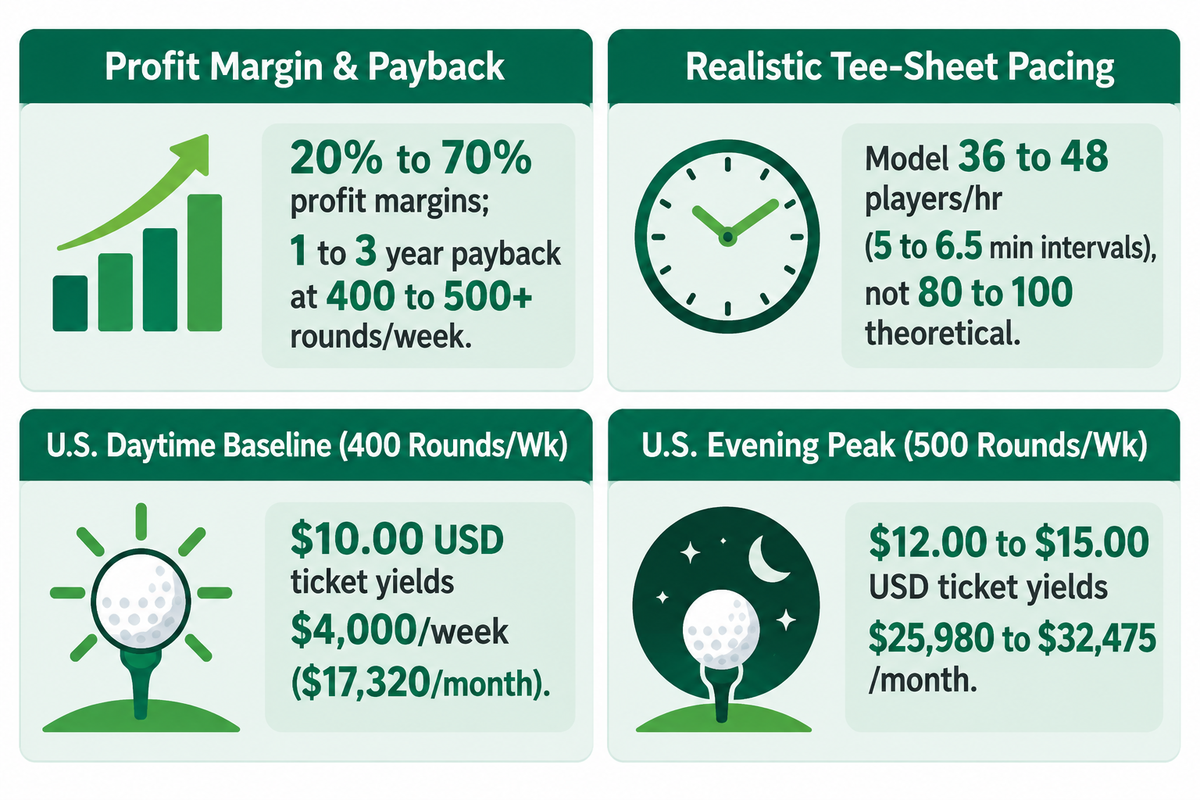
Well-run commercial courses deliver 20% to 70% profit margins, according to Harris Miniature Golf Courses. Initial construction is paid back in 1 to 3 years per Harris and Amusement Products (under 2 years on strong sites per Greenspan Projects). A successful miniature golf course typically handles 400 to 500+ rounds per week per Amusement Products, supported by a 41% six year increase in U.S. golf participation to over 48 million players (National Golf Foundation).
Model steady launch flow near 36 to 48 players per hour (four-player groups teeing off every 5 to 6.5 minutes). Don’t model Harris Miniature Golf’s theoretical 80 to 100 players per hour at 100% efficiency. Harris’s revenue calculator starts daytime utilization at 20% to 25% ($10.00 default within an $8.00 to $15.00 USD band). Evening utilization starts at 40% to 50% ($12.00 default night ticket).
Published inputs for the revenue and break-even worksheets below: SBA’s break-even formula is fixed operating costs divided by ticket price per round. Row 1 divides Mini Golf Creations’ published AUD $70,000 annual standalone running cost (AUD $5,833 per month before rent or debt) by its AUD $15.00 base ticket. Rows 2 and 3 multiply Amusement Products’ 400 to 500 weekly rounds by Harris’s $10.00 daytime, $12.00 evening, and $15.00 top-of-band USD rates across 4.33 weeks per month.
| Operating Benchmark Scenario | Published Cost or Volume Input | Published Ticket Rate | Monthly Output (×4.33 wks) | Weekly Output |
|---|---|---|---|---|
| 1. Standalone Running-Cost Break-Even (AUD, Mini Golf Creations) | AUD $70,000 / year (AUD $5,833 / month) | AUD $15.00 base ticket (up to AUD $25+) | 389 paid rounds / month | 90 rounds / week |
| 2. U.S. Daytime Target Volume (USD, Harris & Amusement Products) | 400 rounds / week baseline | $10.00 USD daytime default ($8.00–$15.00 band) | $17,320 gross tickets / month | $4,000 gross / week |
| 3. U.S. Evening / Peak Volume (USD, Harris & Amusement Products) | 500 rounds / week target | $12.00 evening default to $15.00 USD top rate | $25,980–$32,475 gross / month | $6,000–$7,500 gross / week |
On these inputs, hitting Amusement Products’ 400 to 500 weekly rounds clears standalone break-even, while bundling parties, snacks, and games cuts required footfall per rent dollar. Local rent and seasonal operating days (minimum 90 days in harsh climates per Harris Miniature Golf) govern each site’s net cash flow. While IAAPA’s FEC mini-golf analysis notes mini golf’s surge in the FEC attraction mix, families who have played mini golf spend more when Hole 18 exits beside concessions and games. Review our arcade business plan and machine revenue benchmarks to size redemption zones.
Turnkey Mini Golf Course Builders, Quote Exclusions, and Multi-Attraction FEC Zoning
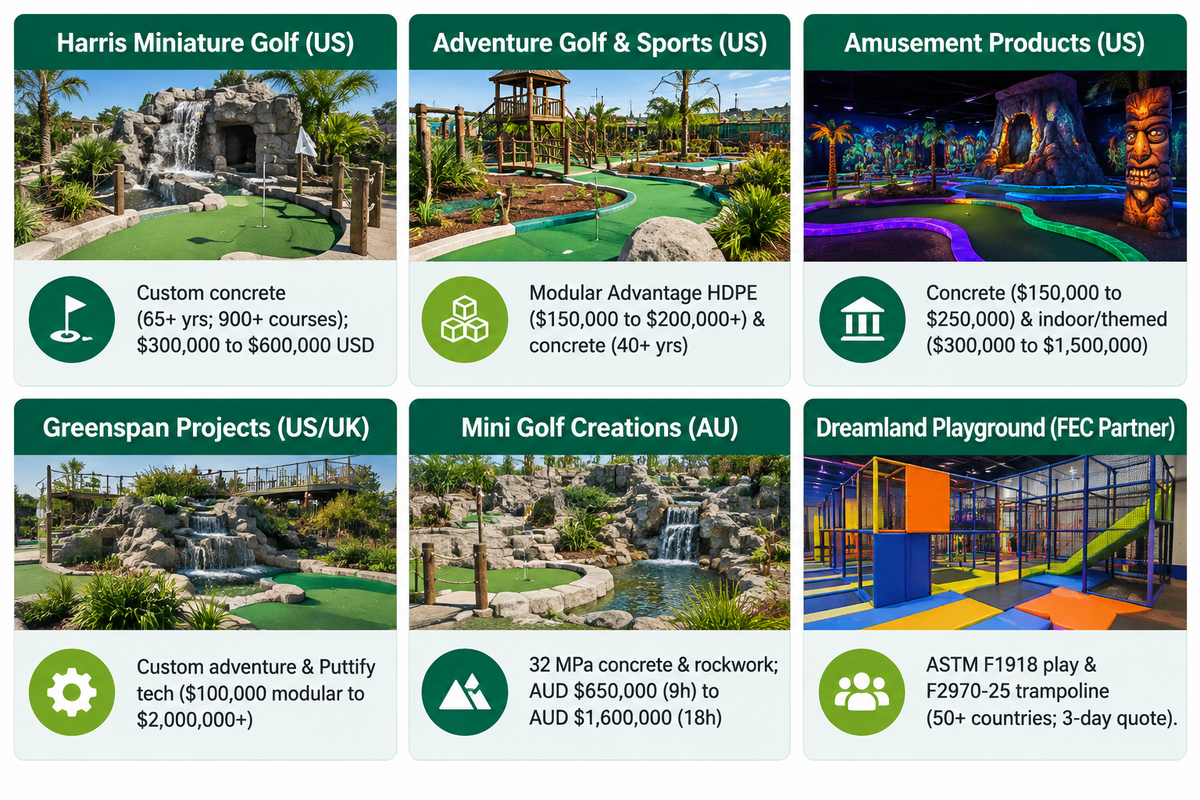
Building a successful miniature golf anchor inside a family entertainment center pairs a specialist course contractor with a dedicated indoor play manufacturer. Harris Miniature Golf Courses, Adventure Golf & Sports, Amusement Products, Greenspan Projects, and Mini Golf Creations build the putting greens. Dreamland Playground (Dreamland Playground Co., Limited, dreamlandplus.com) manufactures adjacent ASTM F1918 indoor playgrounds, toddler zones, and ASTM F2970-25 trampoline courts across more than 50 countries. Our Wenzhou team returns custom play layouts and quotes in 3 working days, and never builds concrete greens or putting turf.
Before you open a mini golf venue or pay a deposit, consult at least two course builders to audit scope exclusions. Greenspan Projects advises one vendor’s “premium” package can be another’s entry level. Turnkey course quotes often exclude freight, unloading forklift, rough grading and trenching for utilities, and the local engineer’s stamp. Operators comparing independent builders against franchised royalties can review miniature golf franchise fees vs. independent course ownership.
| Specialist Vendor | Core Build Method & Experience | Published Price / Scope Anchor | Items to Verify on RFQ |
|---|---|---|---|
| Harris Miniature Golf Courses (US) | Custom poured concrete (65+ yrs; 900+ courses) | $300,000–$600,000 USD 18-hole (>$750,000 all-in) | Rough grading, clubhouse, local civil permits |
| Adventure Golf & Sports / AGS (US) | Modular Advantage® HDPE panels & concrete (40+ yrs) | $150,000–$200,000+ modular; $150,000–$500,000+ concrete | Water features, custom theme props, slab flatness |
| Amusement Products (US) | Championship concrete & FEC attractions (60+ yrs) | $150,000–$250,000 standard; $300,000–$1,500,000 indoor/themed | Commercial shell HVAC, fire sprinklers, lighting |
| Greenspan Projects (US / UK / Global) | Custom adventure golf & Puttify tech modular | $100,000 compact modular to $2,000,000+ themed | AV/scoring software licensing vs. optional props |
| Mini Golf Creations (Australia / Global) | Golfer-led 32 MPa concrete & natural rockwork (14+ courses) | AUD $650,000 (9h) to AUD $1,600,000 (18h) | Currency conversion (AUD), council approvals |
| Dreamland Playground (FEC Play Partner) | ASTM F1918 soft play, toddler & ASTM F2970-25 trampoline zones (50+ countries) | Custom project quote & layout in 3 working days (no MOQ) | Does NOT build putting greens; EXW–DDP sea freight separate |
Have a skilled architect oversee sightlines and age barriers between putting holes and active play zones. Install waist-high perimeter fencing and dedicated putter-swing buffers beside any ASTM F2373 toddler zone so stray golf balls never enter soft-play mats. Place shared birthday suites and café seating between the greens and play frames. Use our turnkey family entertainment center planning guide to align column grids and ceiling heights professionally, which supports guest enjoyment and low-maintenance traffic flow. Proper zoning supports play frames and guest enjoyment.
Frequently Asked Questions About Mini Golf Course Construction Costs
Q: Can you build a commercial mini golf course for under $50,000?
No for permanent public venues; budgets below that level cover only a small backyard putting green or light portable event mats with no site grading. Commercial modular projects at Greenspan Projects begin at $100,000 USD, and 18-hole commercial courses at Adventure Golf & Sports and Amusement Products start at $150,000 USD before restrooms, lighting and permits.
Q: Do you need municipal building permits to build a miniature golf course?
Yes for every commercial facility, and often for large residential backyard builds involving soil grading, retaining walls or tall light poles. Outdoor commercial builds require recreation zoning, site-plan, and stormwater drainage permits. Indoor commercial venues require an International Building Code Group A-3 Certificate of Occupancy, fire-marshal approval, and 2010 ADA accessible route verification.
Q: How long does it take to design and build an 18-hole mini golf course?
An 18-hole poured in place outdoor course takes 6 to 12 months end-to-end (2 to 4 months of active construction) per HomeFix Guides. Prefabricated modular indoor courses assemble on-site in 2 to 6 weeks after stamped architectural plan review (4 to 16 weeks for plan review and approval per StartPermit) and tenant buildout finish.
Q: How much does mini golf typically cost per player per round?
Standard U.S. courses charge $8.00 to $15.00 USD per round ($10.00 daytime and $12.00 evening defaults per Harris Miniature Golf). In Australia, Mini Golf Creations reports commercial ticket prices of AUD $15 to $25+ per round.
Q: Should the cost to build a mini golf course be capitalized for tax accounting?
Yes. Under U.S. federal tax accounting rules, improvements made to land (excavation, storm drains, and greens for example) and leasehold improvements (curbing, light poles, and synthetic turf for example) are capital expenditures. Owners depreciate those assets over their applicable recovery period (such as land improvements outdoors or qualified improvement property indoors) rather than deducting them as single-year repairs. Replacement putters, golf balls, and scorecards are treated as operating supplies. Confirm Bonus Depreciation eligibility with your CPA.
Q: How much space do you need between mini golf holes for player safety?
Provide unobstructed putter-swing clearance around every tee mat and eliminate blind spots along perimeter barriers per Harris Miniature Golf Courses. Connect accessible holes with a continuous 36-inch (915 mm) minimum accessible route under 2010 ADA Standards Section 1007.2.
Q: How much ceiling height do you need to pair indoor mini golf with a commercial indoor playground?
Standard indoor miniature golf holes fit comfortably under typical retail ceilings, unless special mezzanine decks are specified. Pairing indoor mini golf with a multi-level commercial indoor playground (ASTM F1918) or a trampoline court (ASTM F2970-25) requires additional vertical space to accommodate a multi-tier structure and provide adequate clearance for overhead jumping. Measure the exact clear height under the lowest HVAC ducts, sprinkler main, and structural beams first, since clear height governs soft-play deck levels and trampoline clearance in Dreamland Playground’s space planning.
Planning a Hybrid Mini Golf & Family Entertainment Center?
While builders construct your putting greens, Dreamland Playground manufactures ASTM F1918 indoor playgrounds, toddler soft-play zones, trampoline courts, and ninja courses to increase family dwell time and boost birthday party bookings. Send us your CAD floor plan and clear ceiling height and we’ll provide a 2D or 3D layout of your play zone in 3 working days.
About This Engineering & Cost Review
This guide synthesizes published commercial pricing from Adventure Golf & Sports, Harris Miniature Golf Courses, Amusement Products, Greenspan Projects, and Mini Golf Creations (AUD). It pairs those benchmarks with Access Board 2010 ADA Standards (239 & 1007), U.S. SBA 7(a)/504 loan rules, and Dreamland Playground’s Wenzhou FEC layout data. Reviewed by the Dreamland Playground technical team.
References & Sources
- Chapter 10: Recreation Facilities (§1007 Miniature Golf Facilities) U.S. Access Board
- 2010 ADA Standards for Accessible Design (§239 Miniature Golf Facilities) U.S. Department of Justice
- SBA Lender Resources: 7(a) and 504 Loan Maximums U.S. Small Business Administration
- Plan Your Business & Calculate Startup Costs U.S. Small Business Administration
- RFQ: Design-Build Services for a Miniature Golf Course at Edwards Park City of Hendersonville, NC
- Golf’s Growth Era: The Road to 50 Million Golfers National Golf Foundation (NGF)
- Understand the Mini Golf Explosion and Apply the Lessons to Your FEC IAAPA
- The Cost to Design & Build a Mini Golf Course Adventure Golf & Sports
- ROI & Revenue Calculator: How Much Does It Cost To Build a Mini Golf Course? Harris Miniature Golf Courses
- Common Mistakes in Mini Golf Course Design Harris Miniature Golf Courses
- Mini Golf Course Cost: A Complete Price Breakdown Amusement Products
- How Much Does It Cost To Build A Mini Golf Course in 2026? Greenspan Projects
- Commercial Mini Golf Course Construction Australia (AUD Benchmarks) Mini Golf Creations
- 9 Hole or 18 Hole Mini Golf Course? How to Choose Mini Golf Creations
- Artificial Grass for Golf & Putting Greens SYNLawn
- Nylon Putting Greens vs. Polypropylene Golf Greens DP Turf / Challenger Industries
- Perfecting Putting Green Surfaces, Part 1 Overview Synthetic Grass Warehouse
- Drainage and Subgrade of the Putting Green GolfMasters
- Assembly Occupancy (A-3) and IBC/IFC Section 411 Special Amusement Provisions StartPermit
- Puttshack Raises $150m to Expand Tech-Infused Mini-Golf Concept Across US Blooloop
- US12115425B1: Standalone and Multigame Miniature Golf Structure USPTO via Google Patents
- US5582550A: Automatically-Scoring Mini-Golf Game USPTO via Google Patents
- US20020169027A1: Sectional and Portable Miniature Golf Course or Putting Green USPTO via Google Patents