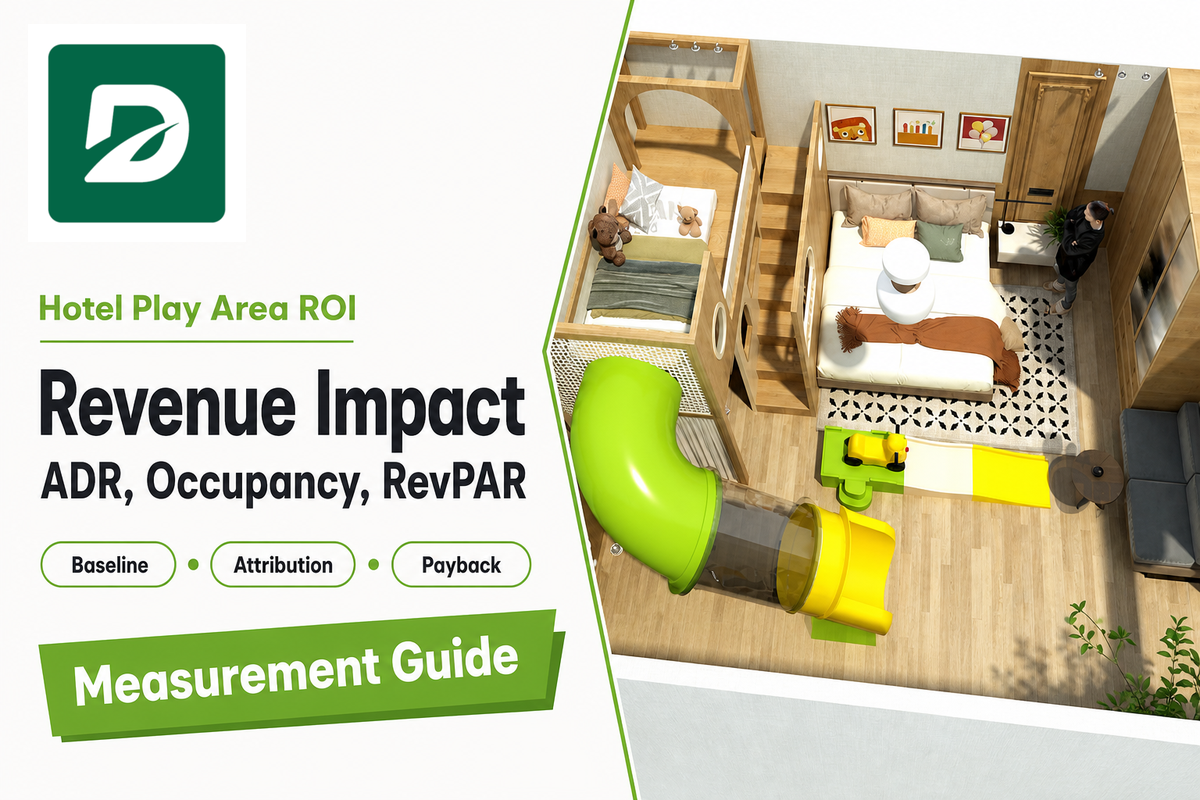
Bottom line: a hotel kids club can support family demand, premium packages, direct fees and on-property spend. Public evidence still doesn’t prove a universal ADR or occupancy lift. Hotel Playground Revenue Impact, hotel play area ROI is the practice of measuring whether a play area changes ADR, occupancy, RevPAR, package conversion, direct club fees or on-property spend.
For a hotel owner, a play area isn’t just another line in the capex budget. It changes who books, how parents compare your property, how long families stay on site and whether adult amenities can be sold while children are engaged in safe, age-suitable programming. That’s why the ROI question matters. It’s also why it needs careful measurement.
Dreamland Playground builds custom hotel kids club and indoor play projects around space, age group, market, theme, budget and operating goals. This article gives hotel teams a practical measurement framework before they start a hotel kids club setup project, use the hotel kids area planner or compare suppliers.
What A Hotel Play Area Can And Cannot Prove
A kids club can be a booking reason for families, especially in resorts, all-inclusive hotels and family-heavy urban properties. Industry reporting on kid-friendly hospitality demand supports the market signal, but it does not prove a guaranteed ADR, occupancy or RevPAR increase for every hotel.
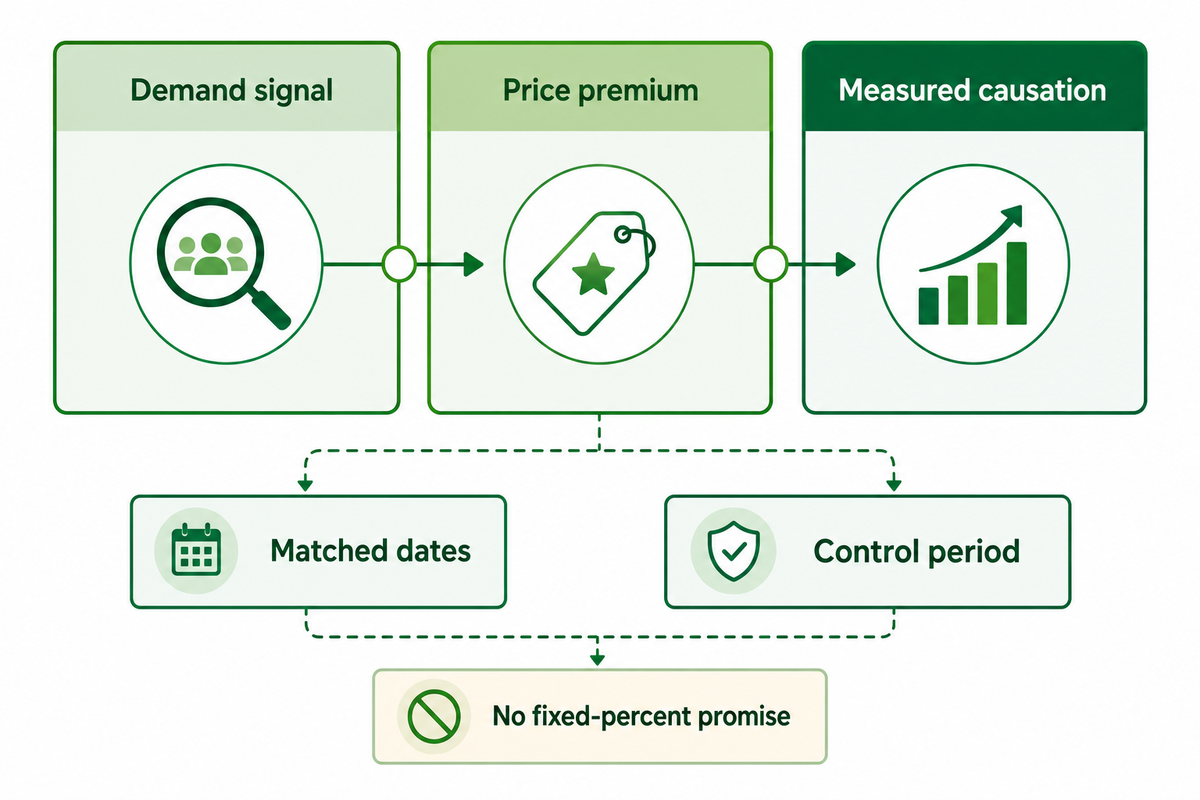
That distinction matters. Supplier claims often blur three different ideas: demand signal, price premium and measured causation. Family travelers may prefer children’s amenities, but that doesn’t automatically mean every room can carry a higher rate. Buyer-side measurement needs before-and-after data, matched dates and a clean control period.
In this run, the research record didn’t find a third-party study that directly ties hotel kids clubs to a fixed ADR, occupancy or RevPAR uplift. Treat any fixed-percentage promise as unsupported unless the seller can show the property type, date range, comp set, source data and method used.
Measurement guardrail: the risk is overclaiming from a 1-month booking change. Because public evidence doesn’t verify a fixed uplift, Dreamland Playground treats ADR impact as a hypothesis until a hotel buyer can compare matched dates, room type, package code, factory scope, certified safety documents and at least 60 days of operating data.
Industry media does report a large kid-friendly hospitality opportunity, but that’s a market-sizing signal, not a hotel-by-hotel payback guarantee. Safer article framing uses a measurement plan: identify the revenue line, choose the metric, gather the baseline and keep the result inside the evidence.
Start With The Hotel Metrics: ADR, Occupancy And RevPAR
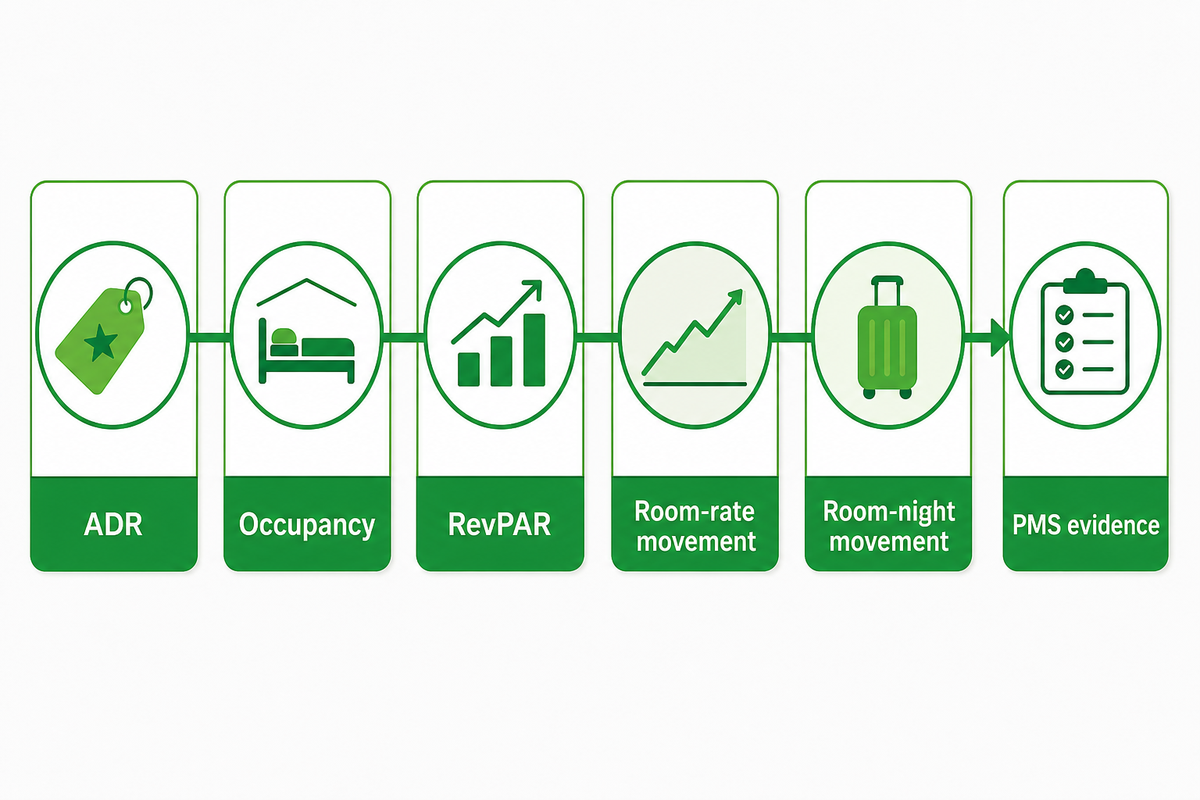
Before attributing revenue to a play area, use standard hotel math. STR and CoStar define ADR, occupancy and RevPAR in a way that keeps room-rate movement separate from room-night movement.
One common mistake is mixing rate, volume and family-room type into one claim. Because the root cause may be a city event, school calendar or channel promotion, the hotel buyer should keep a verified metric trail. Dreamland’s planning team can then connect equipment layout, factory production checks, installation scope and the PMS evidence needed for a practical ROI review.
Metric
Formula
What It Can Show
What It Cannot Show Alone
ADR
Room revenue / rooms sold
Whether occupied family rooms sold at a higher average rate.
Whether the kids club caused the rate movement.
Occupancy
Rooms sold / rooms available
Whether more available rooms were filled.
Whether the demand was from families or from wider market compression.
RevPAR
Room revenue / rooms available
Combined rate and occupancy effect.
Whether growth came from price, volume, mix or non-amenity events.
TRevPAR
Total property revenue / rooms available
Room, F&B, spa, activity and paid-session revenue together.
Which revenue line was triggered by the play area.
LOS
Room nights / bookings
Whether families stayed longer after programming was added.
Whether longer stays were driven by school holidays or packages.
Family mix
Family bookings / total bookings
Whether the property won more family demand.
Whether family demand is profitable after added costs.
Ancillary capture
F&B, spa and activities per occupied family room
Whether parents spent more on site.
Whether spending would have happened without the kids club.
Direct club revenue
Sessions x fee x paid children
Direct monetization where the club is paid.
The full value of a complimentary or package-included club.
Repeat family rate
Returning family guests / prior family guests
Whether children and parents come back.
Short-term payback during launch months.
Gross contribution
Incremental revenue – variable cost
Payback capacity after staffing, cleaning and activity materials.
Net profit if fixed overhead or debt cost is excluded.
Why Family Demand Makes The ROI Question Worth Measuring
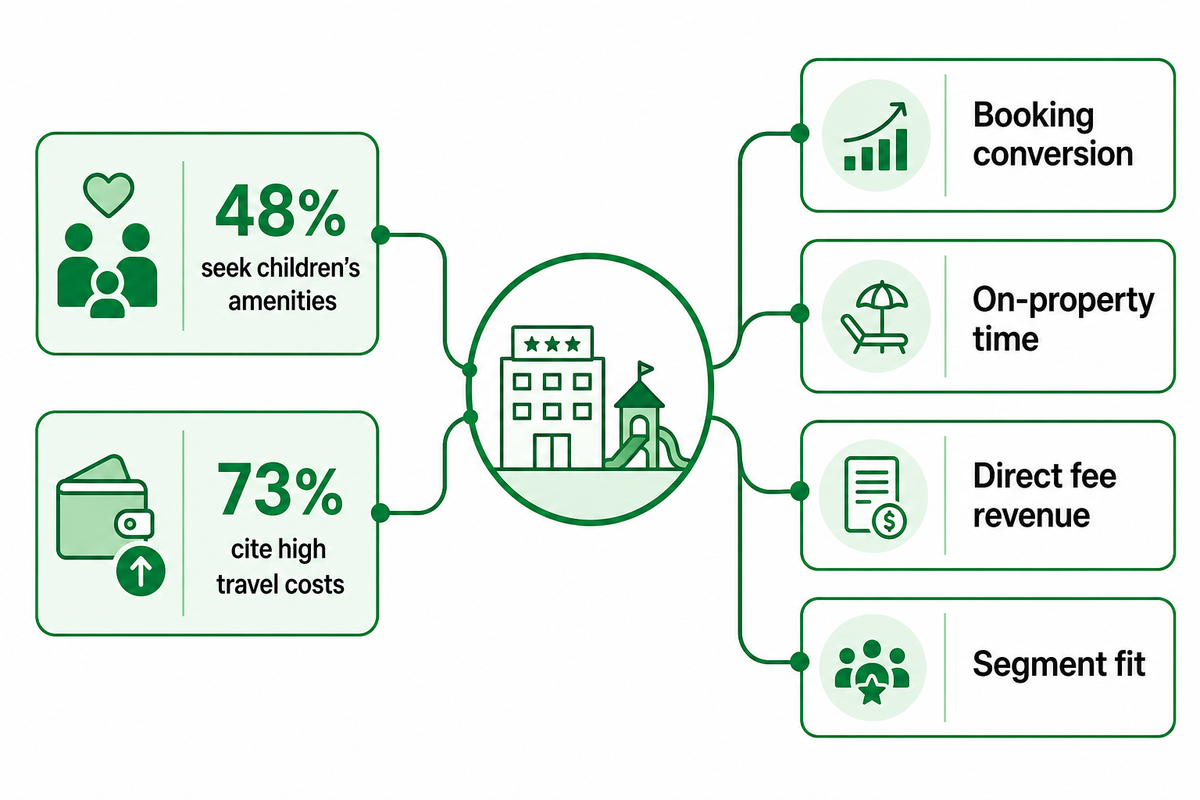
Family demand isn’t imaginary. The 2025 U.S. Family Travel Survey reported that 48% of parents looked for children’s amenities such as pools, game rooms or kids clubs when selecting accommodation. The same report found affordability pressure, with 73% of parents citing high travel costs as a concern.
That combination is useful for hotel planning. Families want child-friendly amenities, but they’re also price-aware. Kids club planning should therefore earn its place through a clear package, better booking conversion, longer on-property time or direct fee revenue. It shouldn’t rely on vague premium language.
For hotels with kids in the booking mix, the segment details matter. Luxury resorts, urban destination hotels and family-friendly beach properties may use the same kids’ club label, but the childcare model can be very different. Toddler rooms need a different child care ratio, noise plan and parent handoff than an adventure zone for older kids. Some hotels design craft sessions for kids ages 4 and up so children can make friends while hotel guests spend 2 hours at breakfast, spa or meetings during a family vacation. Record the charged rate per day, session length in hours, cleaning window in minutes, 30 cm storage clearance, 45 cm bench height and staffing roster before treating the club as a revenue lever.
One peer-reviewed study on city-hotel family amenities also found a gap between what hotels offer and what parents expect. Because the study is limited to one city and one research setting, it shouldn’t be stretched into a global ROI claim. It does show that play rooms and mini clubs belong in the family-accommodation decision.
The ADR-Occupancy Attribution Ladder
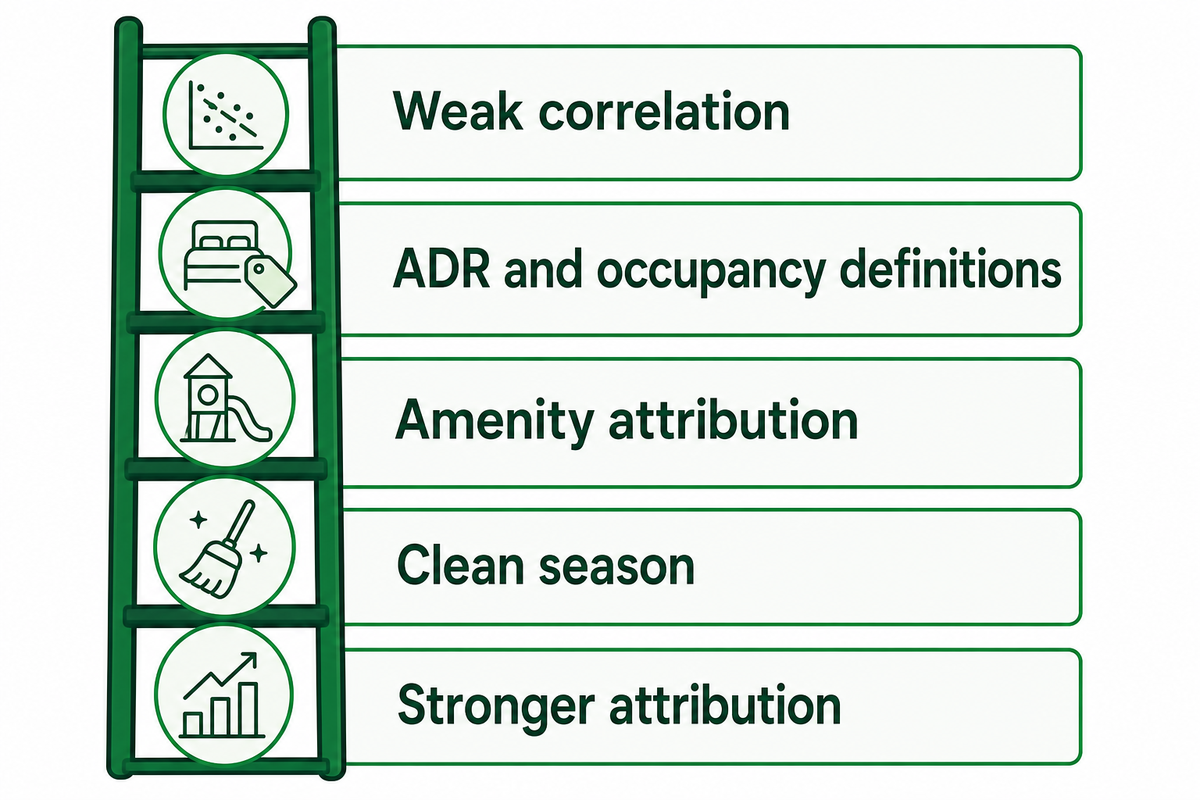
The ADR-Occupancy Attribution Ladder is a practical way to prevent overclaiming. It ranks evidence from weak correlation to stronger attribution, using standard ADR and occupancy definitions before any amenity attribution is discussed. Most hotels shouldn’t claim the top level until the play area has at least one clean season of operating data.
Level
Evidence
Hotel Question
Safe Interpretation
1
Families ask about kids club during sales calls.
Is the amenity part of demand discovery?
Demand signal only.
2
Kids club page gets qualified traffic.
Are planners comparing family facilities?
Content and merchandising signal.
3
Family package conversion rises.
Does the offer help booking conversion?
Package contribution, not total hotel lift.
4
Family ADR beats non-family ADR on matched dates.
Is there a family rate premium?
Mix-adjusted premium candidate.
5
Family occupancy rises on shoulder dates.
Does the amenity fill low-demand periods?
Occupancy effect candidate.
6
Length of stay improves for family guests.
Are families staying longer because children are engaged?
LOS contribution candidate.
7
Ancillary spend rises during club hours.
Do parents buy spa, F&B or adult activities?
On-property capture candidate.
8
Direct paid-session revenue is tracked.
Can the club pay part of its own operating cost?
Direct revenue proof.
9
Matched control dates remove market compression.
Would demand have risen without the play area?
Stronger attribution.
10
Seasonal cohort data repeats.
Does the effect persist across comparable periods?
Defensible business case.
The Kids Club Revenue Stack
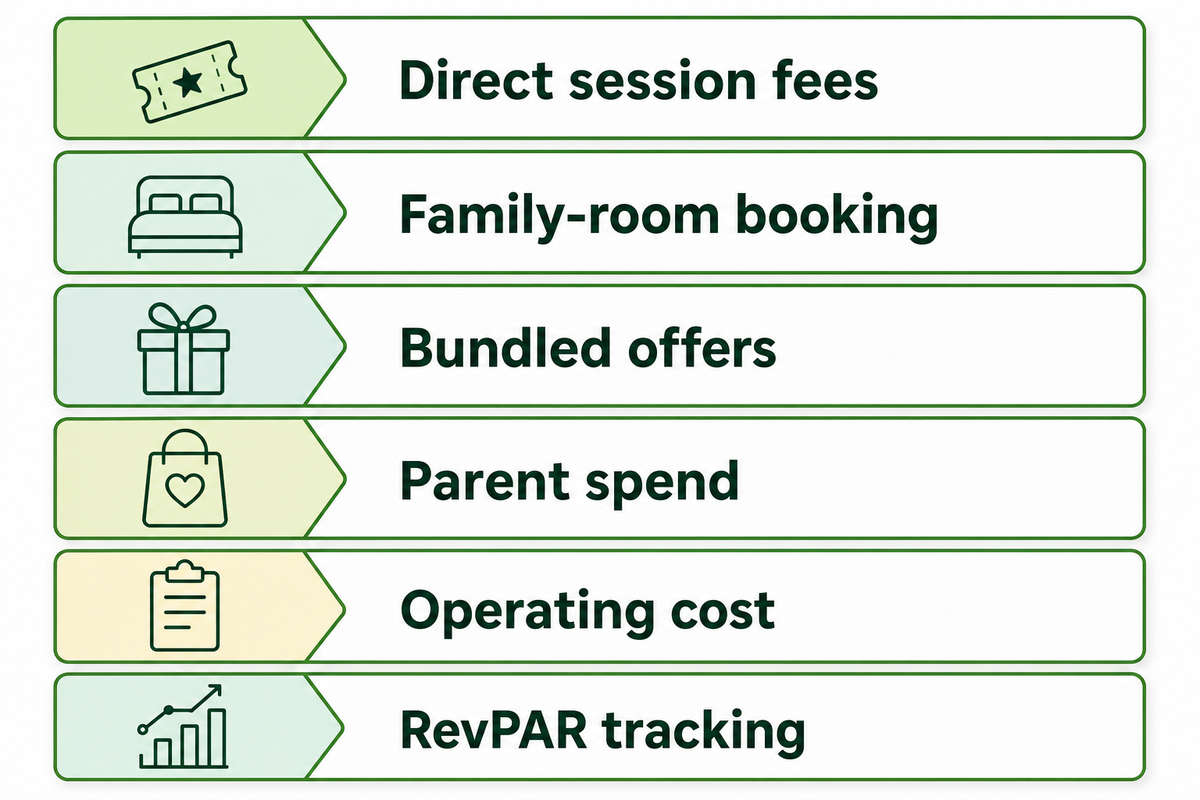
The Kids Club Revenue Stack separates money the hotel can count from value it can only infer. This matters because a complimentary club can be valuable even when the club itself has no fee. It may support family-room booking, bundled offers or parent spending elsewhere on the property, while rooms-side metrics still need separate ADR, occupancy and RevPAR tracking.
Revenue Type
Measurement
Typical Data Owner
Main Risk
Room ADR premium
Family ADR minus matched non-family ADR
Revenue manager
Market events and room-type mix.
Occupancy lift
Incremental family room nights on matched dates
Revenue manager
School holiday distortion.
Package margin
Package revenue minus included activity cost
Commercial team
Discount hides the real margin.
Paid sessions
Sessions x children x fee
Kids club operator
Low usage outside peak days.
F&B capture
Parent spend during club hours
F&B manager
Spend may shift from another meal period.
Spa and wellness
Adult treatment bookings tied to club windows
Spa manager
Attribution without reservation notes.
Events and parties
Birthday, camp, holiday program bookings
Events team
Cannibalizing public-area capacity.
Day visitor fees
Non-stay children or member access
Recreation team
Security and guest experience conflicts.
Direct booking share
Family direct bookings vs OTA bookings
Digital team
Campaign mix changes.
Repeat demand
Returning family stays and review mentions
CRM team
Long payback window.
A Practical ROI Model For A 100-Room Hotel
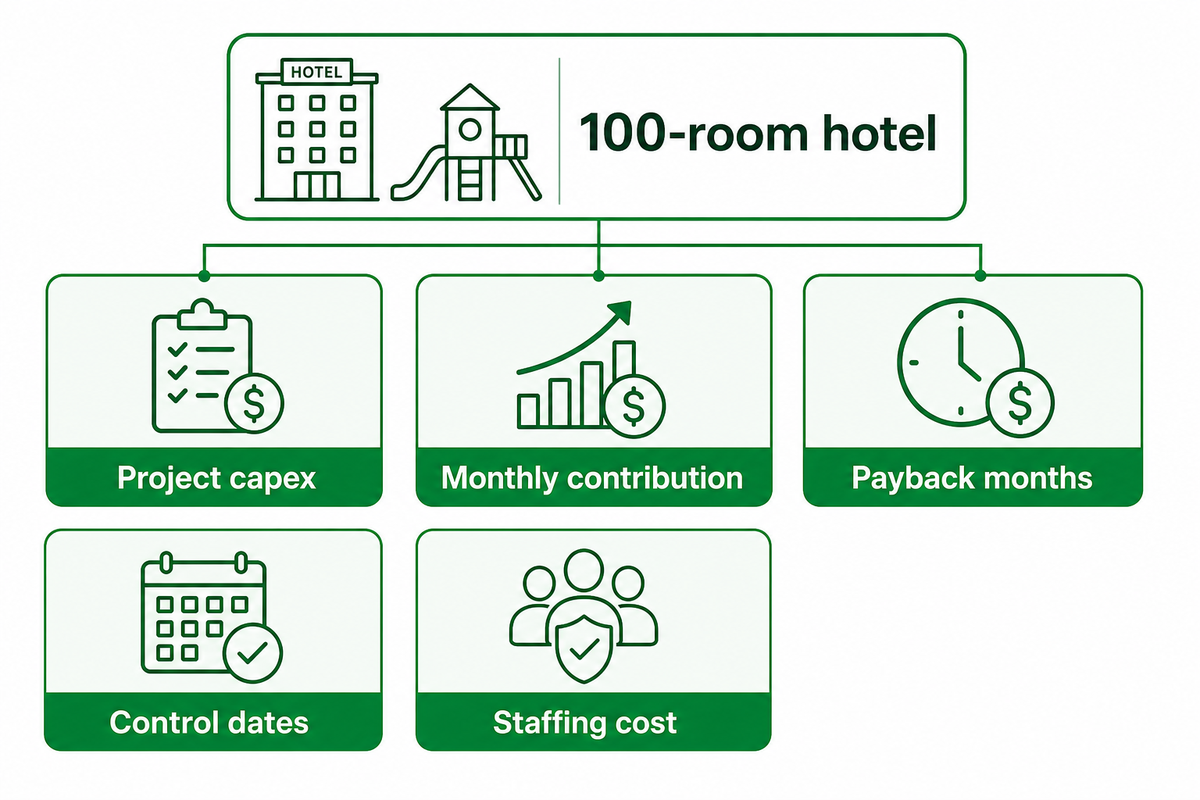
This sample isn’t an industry benchmark. Treat it as an internal planning model, the kind a hotel team can rebuild with its own PMS, POS and package data. Replace every number with your property’s own room count, seasonality, margin and cost data, then compare it with a current market baseline such as CoStar’s May 2026 U.S. hotel performance report.
ROI modeling becomes risky when it assumes every family booking is incremental. Because room-night demand can move for reasons outside the kids club, ask the revenue manager to verify the control dates, the operations team to confirm staffing cost, and Dreamland to separate factory production, installation support and maintenance inputs from the revenue hypothesis.
Input
Illustrative Value
Why It Matters
Evidence Needed
Rooms
100
Defines inventory base.
PMS room count.
Measured nights
30
Keeps test period defined.
Date range and comp calendar.
Baseline occupancy
65%
Starting point for room-night math.
Same-period prior year or matched control.
Test occupancy
68%
Possible volume change.
PMS and channel reports.
Baseline ADR
US$165
Starting rate.
Rooms revenue report.
Test ADR
US$171
Possible premium.
Matched room-type rate data.
Incremental room nights
90
100 rooms x 30 nights x 3 percentage points.
Occupancy bridge.
ADR premium on sold rooms
US$12,240
68 rooms x 30 nights x US$6.
Room-type and package controls.
Extra occupied-room revenue
US$15,390
90 extra room nights x US$171.
Matched dates.
Paid club sessions
160 x US$35
Direct club revenue if charged.
POS or activity software.
Ancillary spend
US$18 x 400 family room nights
F&B, spa or activity capture.
Folio tags or package codes.
Monthly gross contribution
Revenue less variable cost
Payback numerator.
Labor, cleaning and activity-cost data.
The basic payback formula is simple: payback months = project capex divided by monthly gross contribution. The difficult part isn’t the formula. The difficult part is proving the gross contribution is incremental and not just a different label for revenue the hotel would have earned anyway.
Case Pattern: Paid Sessions And Included Access
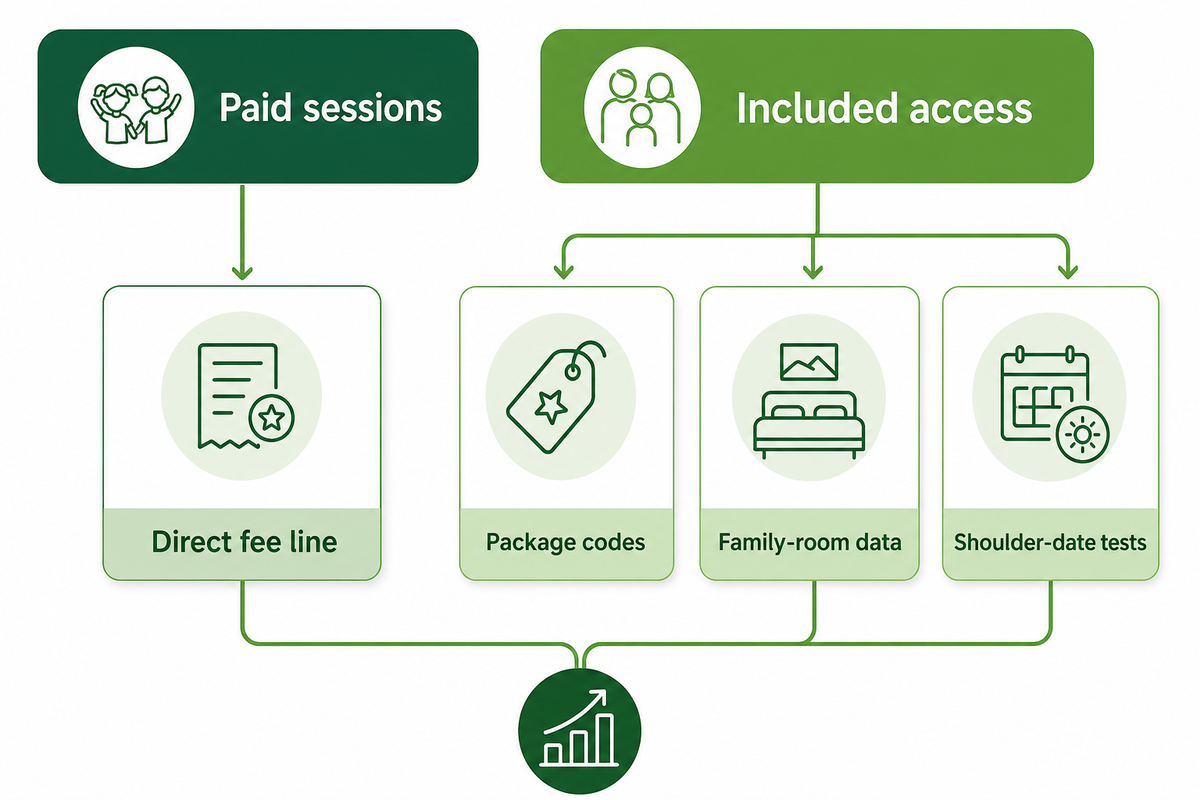
Some hotels monetize the club directly. Waldorf Astoria Orlando’s WA Kids Club page lists an age range of 5-12 and publishes paid options, including per-child and hourly fees. That makes the direct-revenue line visible to a planner.
Other hotels include access in a resort fee, family package or all-inclusive resort rate. In that model, the kids club may affect ADR or conversion indirectly, but the hotel needs package codes and family-room data to measure the contribution. Complimentary access isn’t free. Rate, package margin or operating budget pays the bill, and peak season results should be separated from shoulder-date tests.
Paid-session pricing can still fail if the hotel copies another property without matching age range, staff hours, parent trust and local demand. Because Waldorf’s public page is one official property example, use it to frame a direct-fee scenario, not to claim a global benchmark. Dreamland can then translate the hotel buyer’s target ages, factory-made activity zones and support scope into a measurable operating brief.
Useful rule: if the kids club is charged separately, start with session revenue and gross margin. If access is included, start with booking conversion, family ADR, length of stay and on-property spend.
What To Track Before And After Launch
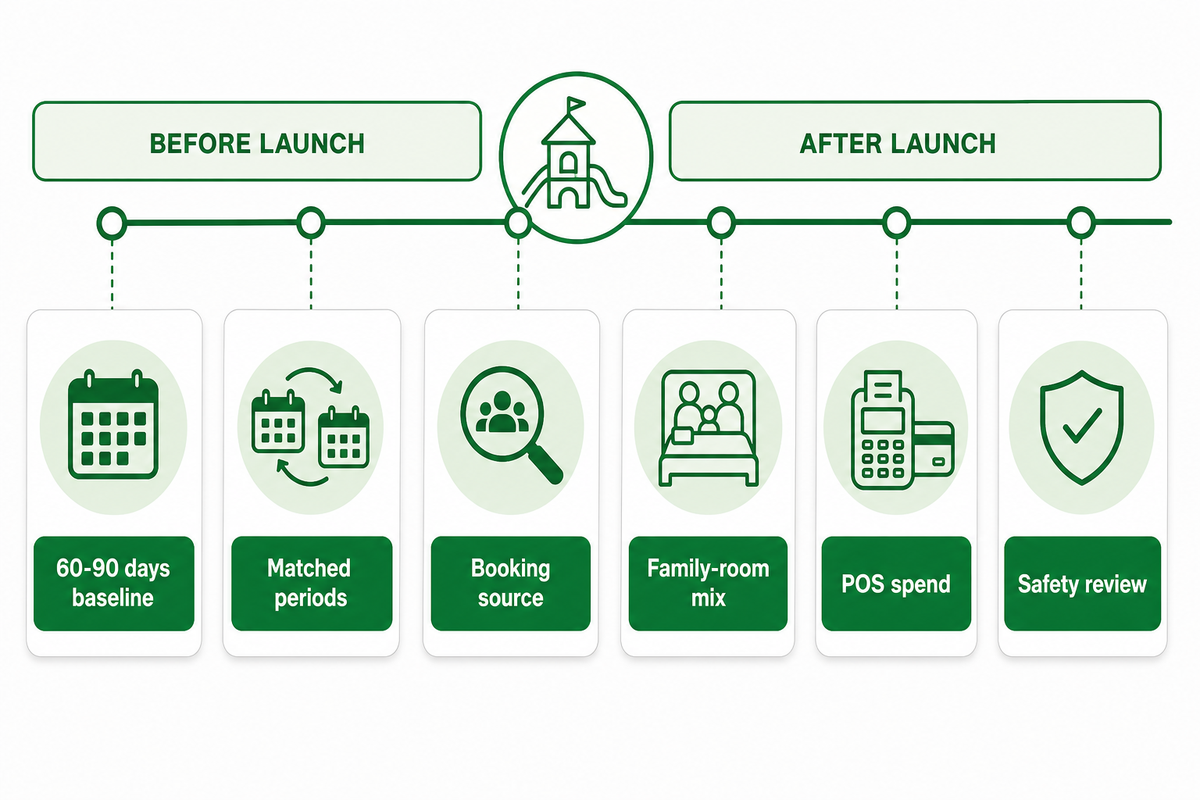
Good measurement starts before production, not after the playroom opens. Hotel teams should record at least 60-90 days of baseline data before launch, then compare matched periods after launch. Public playground guidance can also change over time, as shown by the 2025 Federal Register notice for the CPSC playground safety handbook update, so safety review and business measurement should move together.
Tracking Field
Before Launch
After Launch
Decision Use
Family booking tag
Create in PMS or CRM.
Require for family packages.
Separates family demand from all demand.
Kids club exposure
Add website and offer tracking.
Tag visitors who viewed club content.
Links marketing to bookings.
Room type
Record standard, suite and connecting-room mix.
Compare by family stay.
Prevents ADR mix error.
Package code
Define family/kids club package codes.
Track margin, not only revenue.
Shows whether discounting funded demand.
Club attendance
Prepare registration fields.
Track child age, session and length.
Connects amenity use to stay data.
Parent spend window
Choose spa, F&B or activity windows.
Compare spend during club sessions.
Measures ancillary capture.
Review mentions
Record current family-review language.
Tag kids club, playroom and staff mentions.
Tracks brand-experience proof.
Complaint types
Record noise, crowding and safety complaints.
Compare incident and complaint rate.
Protects margin and reputation.
Repeat stays
Set family cohort baseline.
Measure 6-12 month return behavior.
Captures longer-term value.
Operating cost
Budget staff, cleaning, replacement and activity supplies.
Track actual monthly cost.
Keeps payback honest.
How Dreamland Supports A Measurable Hotel Kids Club Project
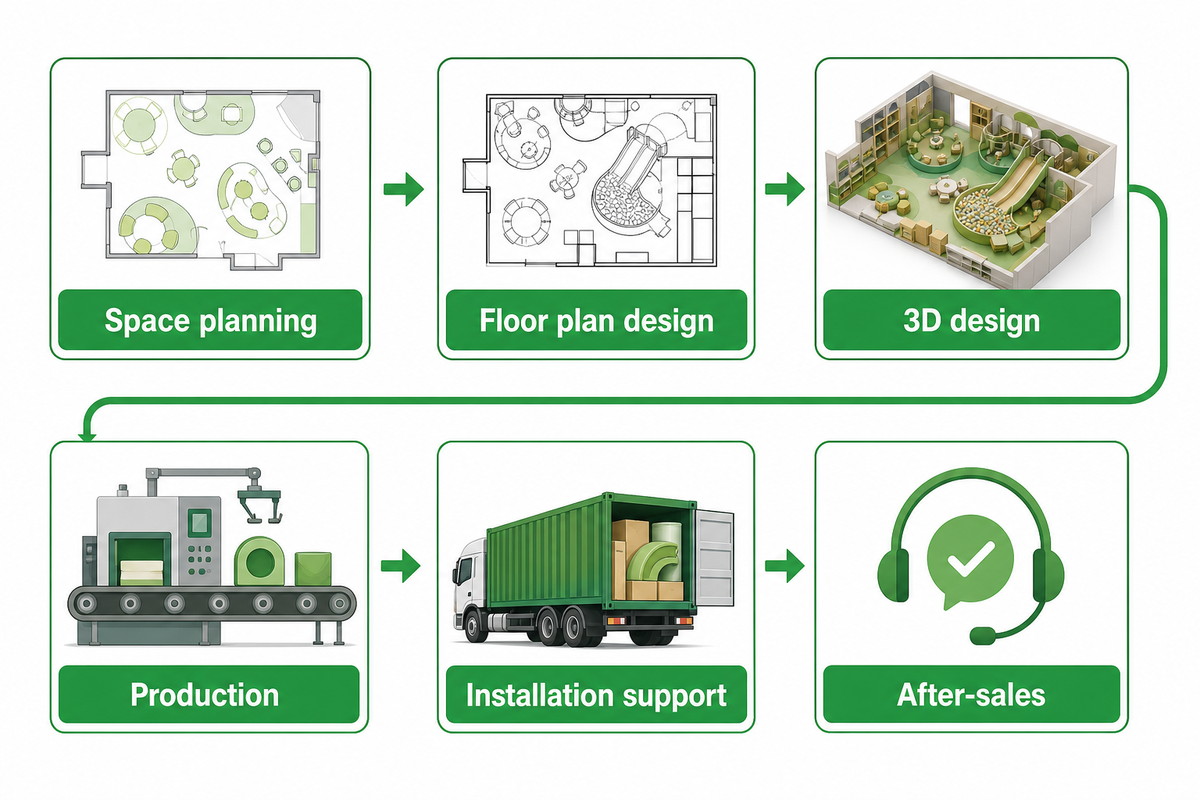
Dreamland Playground is a professional playground equipment manufacturer and project solution provider in China. For hotels and resorts, the useful value isn’t only equipment production. The project needs space planning, floor plan design, 3D design, production and installation support, because each design affects cost, supervision, age zoning and the guest path.
Dreamland designs around the client’s space, target age group, local market, theme, budget and business needs. That fits the ROI method above: the hotel can set the measurement plan before the layout is frozen. Small children’s play areas, staffed resort kids clubs and larger family entertainment zones shouldn’t share the same ROI assumptions.
Dreamland also has its own production team and quality-control process. Materials, structures, parts, surfaces and packaging are checked during production. Depending on product type and target market, products can be designed according to relevant EN and ASTM safety requirements; public safety guidance such as the CPSC playground handbook update notice is part of the buyer’s evidence trail. For ROI planning, this means the financial model should include the cost of design review, quality checks, freight, installation support and long-term maintenance instead of only the visible equipment price.
The project brief should also record the measurable inputs before design starts: available floor width in mm, ceiling height in m, entrance width in mm, target age band in years, planned supervision hours per day, expected cleaning minutes per session, peak attendance %, monthly staffing cost, maintenance reserve %, and target payback budget in 12 months, 18 months or 24 months. These are planning fields, not promised outcomes.
It can support a higher family-room rate when the amenity is visible, trusted and tied to a real package, but the hotel still needs matched date and room-type data before claiming ADR impact. Compare family-room ADR against similar dates without the club, then remove dates affected by holidays, citywide events or sudden market compression. If the evidence is only a sales opinion, keep the claim as a hypothesis.
How should a hotel calculate kids club ROI?
Start with incremental room revenue, direct club fees, ancillary spend and variable cost. Then divide project capex by monthly gross contribution to estimate payback. The key is not the formula; it is the attribution trail. Keep package codes, family-room tags, session attendance and labor cost in the same review so the model does not count revenue that the hotel would have earned anyway.
Is occupancy impact easier to prove than ADR impact?
Not always. Occupancy can be distorted by holidays, events and market compression, so a peak-date comparison can mislead the hotel team. Cleaner testing uses a matched shoulder-date cohort where family demand, room type, channel mix and package exposure are tracked before and after launch. If those controls are missing, call the result a demand signal rather than occupancy proof.
Should a kids club be free or paid?
Paid sessions make direct revenue visible. Included access may work better for premium positioning, especially when the property sells family packages, resort-fee access or adult spa and dining time. The hotel should still measure family-package conversion, total property spend, staffing cost and complaint rate, because a busy free club can lose money if labor or cleaning expands faster than gross contribution.
What size hotel needs a kids club?
There’s no universal room-count threshold. The better test is family mix, available space, staffing model, safety review, expected usage and whether the hotel can track the revenue lines.
What should a hotel prepare before asking Dreamland for a plan?
Prepare room count, target child ages, available area, ceiling height, brand theme, budget range, supervision model, market, and the metrics you want to measure after launch.
Dreamland Playground publishes practical planning guides for commercial indoor-play projects, including family entertainment centers, shopping malls, hotels, restaurants, churches, and other venue types.
Use these guides to frame the questions that should be resolved before concept selection: venue size, intended age groups, project location, attraction mix, operating priorities, timeline, and delivery constraints. Final recommendations should be based on the real site and applicable local requirements.
Start With The VenueFloor area, clear height, site location, intended audience, and target opening date create the working brief.
Clarify The ScopeConcept, equipment, production, shipping, installation, and operating inputs can vary from one project to another.
PROJECT / VENUE / TIMELINE
Prepare Your Project Brief
Venue TypesFEC · Mall · Hotel · Restaurant · Church
Start WithFloor area · Clear height · Age groups · Country