Commercial arcade game leasing typically costs between $150 to $500 per machine per month over 24 to 60 months. Amusement guides from JVL and equipment lessors corroborate this commercial band. Venues can also choose a dollar buy-out lease, a short-term flat rental, or a 50/50 revenue share placement with zero cabinet cost.
Federal tax law and repair duties differ sharply across these contracts. True operating leases allow monthly rent under IRC Section 162, while nominal buyout leases trigger Section 179 and shift repair duties on the venue. Rental options help you choose the right offering before signing.
Can You Lease Arcade Machines? Four Commercial Acquisition Models Explained
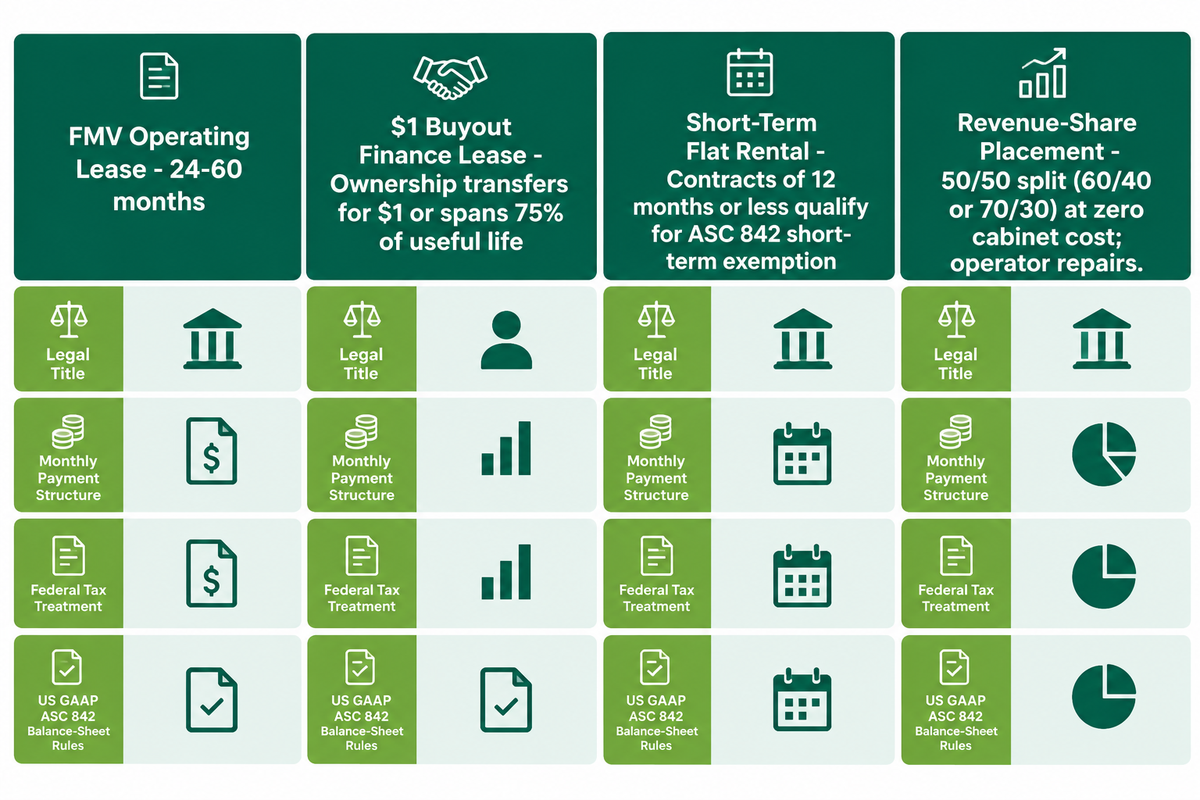
Yes, commercial venues can acquire arcade machines through four contract models: Fair Market Value (FMV) operating leases, $1 buyout finance leases, short-term flat rentals, and revenue share placements. Disclosures from Betson Financial Services, Player One Amusement Group (P1AG), and JVL illustrate how each option separates title and service risk. Federal depreciation and rent-deduction distinctions for business equipment are detailed in IRS Publication 946.
Rental stores such as Aaron’s or Rent-A-Center in the consumer market are often confused with Business-to-Business (B2B) equipment leases. The consumer market for video games is often home based and uses light weight cabinets. The commercial market for arcade game rentals and multi-year leases equip bars, bowling alleys, hotels and family entertainment centers (FECs) with commercial grade video games and redemption units.
Planners also use arcade rentals for special events, private events and trade shows. These arcade game rentals for events are generally under one year. A permanent video arcade or multi-attraction FEC requires multi-year protection for cash flow and equipment uptime.
How Do Flat-Rate Leases Differ From Revenue-Share Placements?
Under a flat-rate lease, your venue pays a fixed monthly fee and keeps 100% of collections, whereas under a revenue-share placement a route operator supplies and services machines at zero cabinet cost for a 50/50 split. Flat-rate lessees can control pricing and swipe settings on games like Donkey Kong and use free-play mode for corporate game nights. Flat-rate lessees in bars and arcades still owe the full lease payment even if traffic is low.
With a revenue-share placement, your venue supplies floor space, power, and internet for card readers. The operator owns, repairs and delivers the arcade equipment to offer arcade placements. Splits can shift to 60/40 or 70/30 based on cabinet cost and prize responsibility.
Tax rules also separate FMV leases from dollar-buyout contracts. An FMV operating lease leaves tax ownership with the lessor, and you can’t claim Section 179 or depreciation. You can deduct the monthly payments under IRC Section 162.
A nominal-buyout finance lease is treated the same as a financed purchase for federal taxes. At the end of the term, ownership transfers for a nominal fee, or the lease spans 75% or more of the useful life. Your business can claim Section 179 and MACRS in the first year. Monthly payments are split between interest and principal. Under US GAAP ASC 842, equipment leases over 12 months are also reported on the balance sheet as a Right-of-Use (ROU) asset and lease liability. Contracts of 12 months or less qualify for the short-term exemption.
Contract Dimension
FMV Operating Lease
$1 Buyout Finance Lease
Short-Term Flat Rental
Revenue-Share Placement
Legal Ownership
Lessor retains title
Transfers to venue for $1
Rental company retains title
Route operator retains title
Typical Term
24–60 months
24–60 months
1 day to 12 months
12–36 months
Upfront Cash
1–2 advance payments
1–2 advance payments or down payment
Security deposit + delivery fee
$0 cabinet cost (venue preps power/space)
Revenue Retained
100% by venue
100% by venue
100% by venue (or free play)
Commonly 50% (range 30%–60%)
Slow-Month Risk
100% on venue
100% on venue
100% on venue
Shared (drops with play volume)
Default Maintenance
Venue (unless full-service rider)
Venue (after OEM warranty)
Usually rental provider
Route operator (parts & technician)
Game Rotation Rights
Return/upgrade at term end
Venue sells or trades in
Flexible swaps per agreement
Operator swaps stale titles (3–6 mo)
IRS Section 179
No (deduct rent via IRC §162)
Yes (subject to annual caps)
No (deduct rental expense)
No (not capital equipment)
ASC 842 Balance Sheet
ROU asset + liability (>12 mo)
Capitalized asset + debt
Exempt if ≤12 months
Check embedded lease rules
Best Commercial Fit
Fast-changing video & VR titles
Proven FEC anchor cabinets
Trade shows, corporate & seasonal tests
Bars, hotels, unproven traffic
How Much Does Arcade Game Leasing Cost Per Month and Over Full Term?
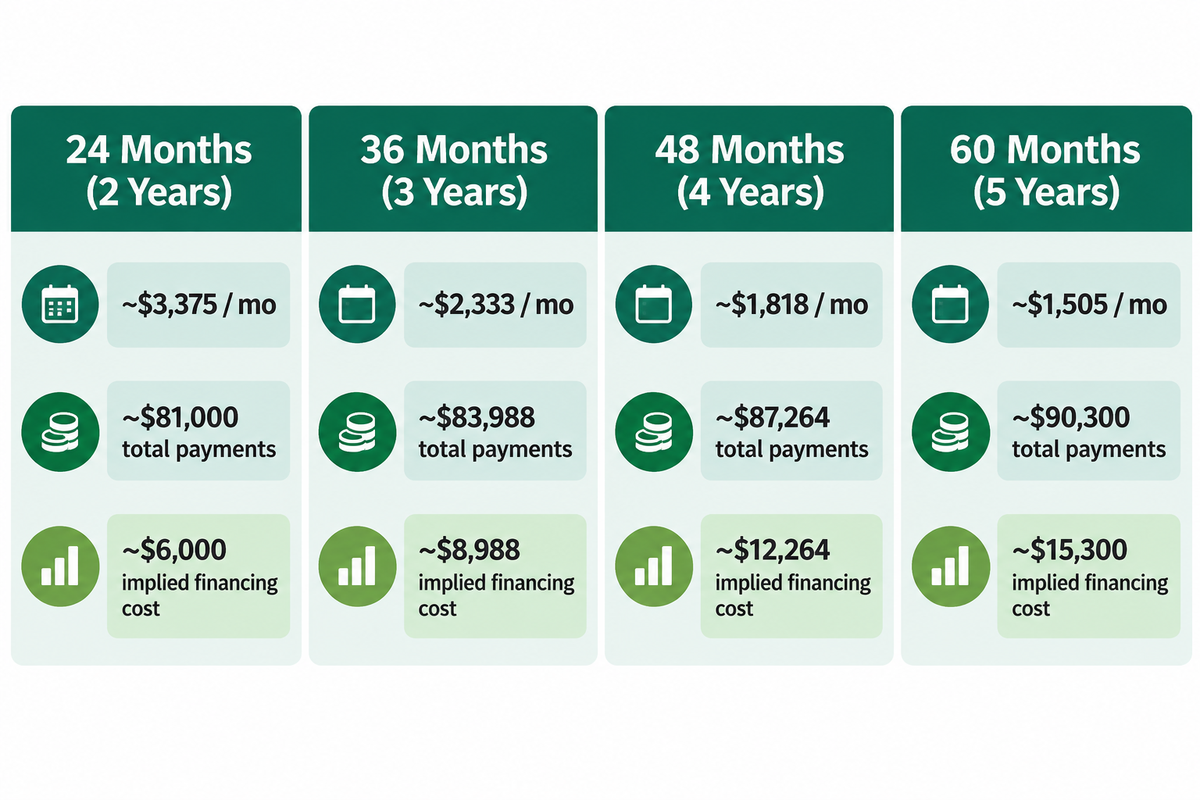
Commercial arcade game leasing runs $150 to $500 per cabinet per month on standard multi-year agreements, while multi-seat VR setups exceed $800 monthly. For a complete package, Trust Capital publishes a $75,000 arcade equipment dollar-buyout lease example (established business, ~650 credit) at roughly $3,375/month over 2 years down to $1,505/month over 5 years. Venues can review that full term breakdown in the Trust Capital arcade equipment leasing rate guide.
Monthly payments for a classic arcade game track retail cabinet value, business credit, and term length. A classic arcade game or retro upright like Donkey Kong for bars and arcades costs far less than a modern redemption cabinet, Big Buck shooter, or boxer machine. Popular arcade classics, especially games like Donkey Kong or Space Invaders, offer an affordable entry point for bars and arcades. Rent My Arcade (a regional Twin Cities operator) lists classic rentals such as Space Invaders at $175 for month one, $200 for two months, and $225 for three months. After those initial three months, its rate drops to $75/month plus a $75 refundable deposit and delivery.
Lease Term ($75,000 Package, $1 Buyout)
Est. Monthly Payment
Total Payments Over Term
Implied Financing Cost
Source & Condition
24 Months (2 Years)
~$3,375 / mo
~$81,000
~$6,000
Trust Capital (~650 credit, established)
36 Months (3 Years)
~$2,333 / mo
~$83,988
~$8,988
Trust Capital (~650 credit, established)
48 Months (4 Years)
~$1,818 / mo
~$87,264
~$12,264
Trust Capital (~650 credit, established)
60 Months (5 Years)
~$1,505 / mo
~$90,300
~$15,300
Trust Capital (~650 credit, established)
What Upfront Deposits, Delivery Fees, and Buyout Terms Hide in Commercial Leases?
Commercial arcade leases often require one or two months’ advance payment, a documentation fee, liftgate delivery and setup charges, and an end-of-term buyout (nominal, 10% PUT, or FMV). Start-ups under two years often require larger deposits or a personal guarantee. Heavy redemption cabinets and pinball machines require a liftgate, pallet jack and inside placement. Request an itemized quote separating inbound delivery and setup, card reader installation, interim rent and return crating to ensure hidden freight doesn’t eat away monthly savings.
Lease vs. Buy vs. Finance vs. Revenue-Share: Full-Term Cash-Flow Comparison
Most family entertainment centers use a hybrid strategy with the best of both worlds; buy or finance proven anchor games, and place costly or unproven titles on a revenue-share. Buying a 30-to-50 game FEC package outright costs roughly $80,000 to $250,000 upfront. Leasing arcade games offers strong capital flexibility to outfit your floor without paying the full price on day one.
The U.S. Small Business Administration (SBA) advises building a 5-year financial outlook (monthly in Year 1, quarterly in Year 2, annual in Years 3–5).
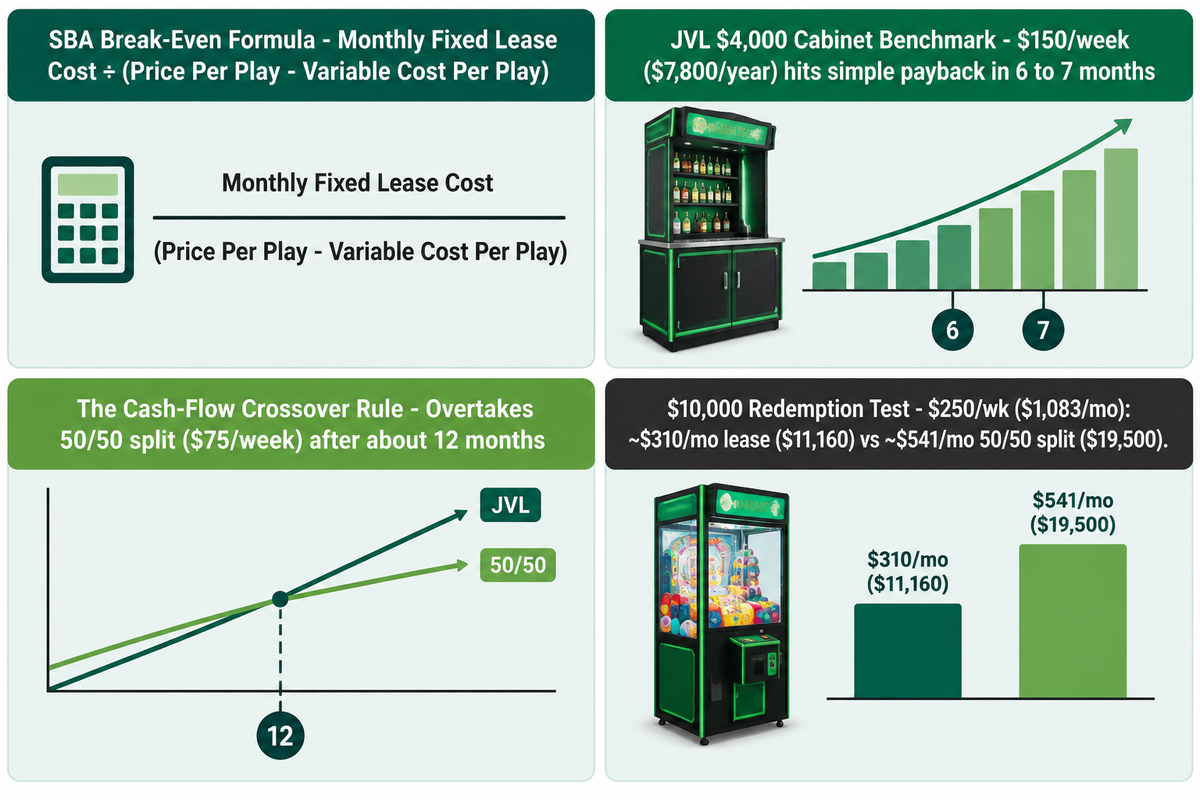
Separate one-time startup costs from recurring monthly lease obligations. Then, test fixed monthly lease payments against revenue-sharing using the break-even analysis formula provided by the SBA.
Monthly Break-Even Plays = Monthly Fixed Lease Cost ÷ (Price Per Play – Variable Cost Per Play)
Variable cost per play covers prize redemption, e-ticket liability and card processing costs. After a leased cabinet clears its fixed monthly payment, the venue keeps all additional revenue generated by that cabinet. Under a 50/50 revenue split, your fixed monthly fee drops to zero during slow months, though the venue gives up half during peak months.
How Profitable Is Owning vs. Leasing an Arcade Machine?
In JVL’s worked bar-arcade example, a $4,000 purchased cabinet earning $150 per week ($7,800/year) hits simple payback in 6 to 7 months, but overtakes a 50/50 split ($75/week) only after about 12 months. We call this The Cash-Flow Crossover Rule. Owning beats a 50/50 revenue split only when cumulative net cash from ownership passes the free cash you would have collected under a split.
“Paying for itself isn’t winning yet: at $150 a week the owner overtakes the split after about a year, or a bit over a year once running costs are counted.”
Before running costs, buying overtakes a 50/50 split at roughly twice the simple payback period. If your venue closes, loses traffic or wants to switch out games before month 12, buying trails revenue-sharing.
Now test a $10,000 commercial redemption cabinet using Betson’s conditional supplier planning benchmark of $250 per week ($1,083/month). A 36-month lease at ~$310/month totals $11,160 and leaves ~$773/month before prizes and repairs. A 50/50 split pays the operator ~$541/month ($19,500 over 36 months) while covering repairs. High-traffic venues save thousands by financing or buying a proven selection of arcade games. Unproven locations avoid having to invest capital early by starting with revenue-share. For broader budgeting, see how to map equipment leasing into the capital plan and review family entertainment center financing options.
How Commercial Arcade Revenue-Share Agreements Split Gross Collections and Prize Costs
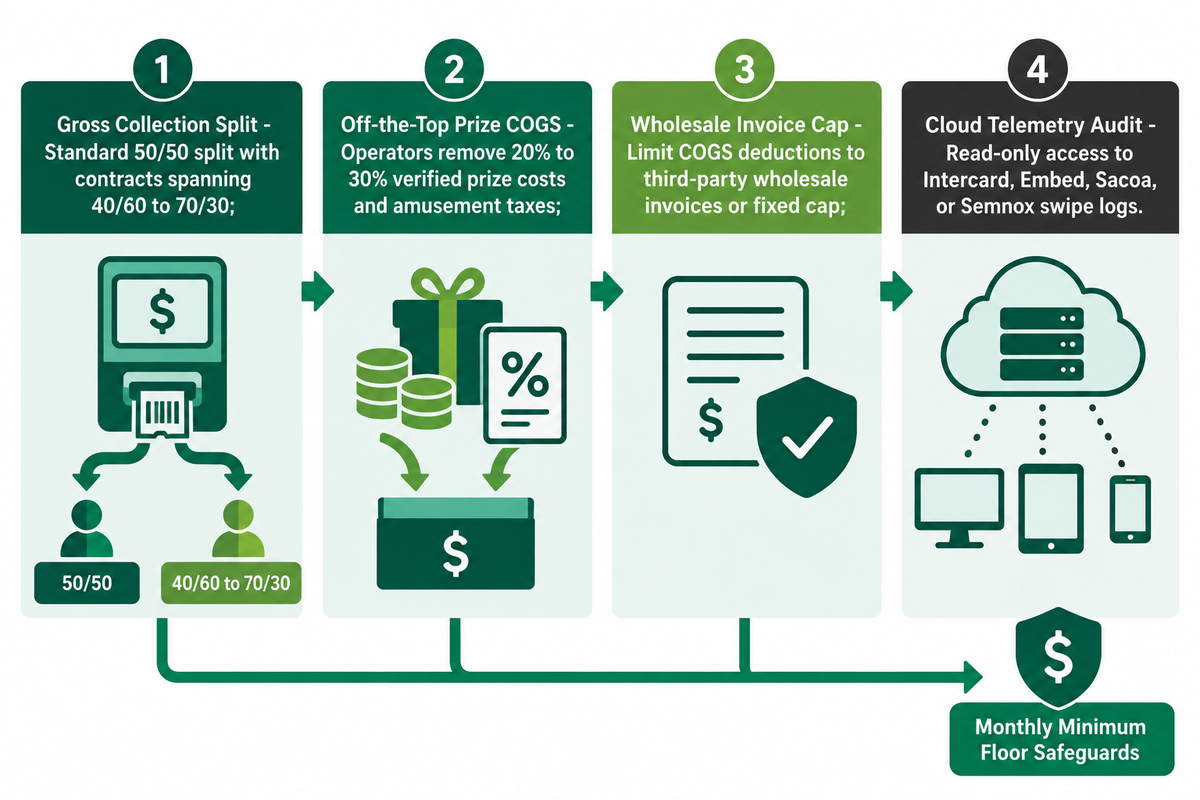
Standard revenue-share placements split gross collections 50/50, with contracts spanning 40/60 to 70/30. Agreements range from 40/60 to 70/30. The exact percentages depend on traffic, the costs associated with the prize, and the liability of the location. A 50/50 split rarely represents half of the gross swipes after sales tax and card fees are collected and prize merchandise is removed.
Most accounting disagreements occur when a venue assumes the operator pays for prize plush and tickets, when in fact, the contract may provision for prize cost of goods sold (COGS) to be subtracted from the top before net proceeds are split.
Should Prize and Ticket Costs Be Deducted Before or After the Revenue Split?
For machines and games (claw machines and ticket redemption machines) operators sometimes remove verified prize costs (typically 20% to 30% of gross play) and amusement taxes from the gross before splitting the proceeds 50/50 with the location. This structure ensures both parties agree on prize payout. An operator who bills the prize at an inflated cost recoups a higher share of proceeds, at the expense of the location.
Write three audit protections into every revenue-share agreement:
Limit COGS deductions to actual third-party wholesale invoices or a fixed percentage cap, rather than an open-ended operator allowance.
If the contract stipulates a monthly minimum revenue floor, the split becomes a fixed lease during slow periods.
Who Pays for Maintenance, Spare Parts, and Downtime in an Arcade Lease?
A revenue-share placement means the route operator owns the cabinets, and pays for preventive maintenance and spare parts, and technician visits. With a net equipment finance lease, your location pays for all repairs, parts and downtime. Assume a monthly lease payment doesn’t include coverage for repairs. Industry route-vs-lease breakdowns such as Amuze Products’ arcade revenue-sharing guide confirm that net commercial leases place parts and service costs on the venue.
A busted cabinet on an affordable contract for popular arcade machines hurts twice on a fixed lease. The machine gets no revenue from prime real estate, and you keep paying the full monthly fee. In contracts with revenue-share play, Operators rarely pay up for lost play. Both parties lose collection until a repair tech is dispatched.
What Service-Level Agreement (SLA) Protects Your Venue From Broken Machines?
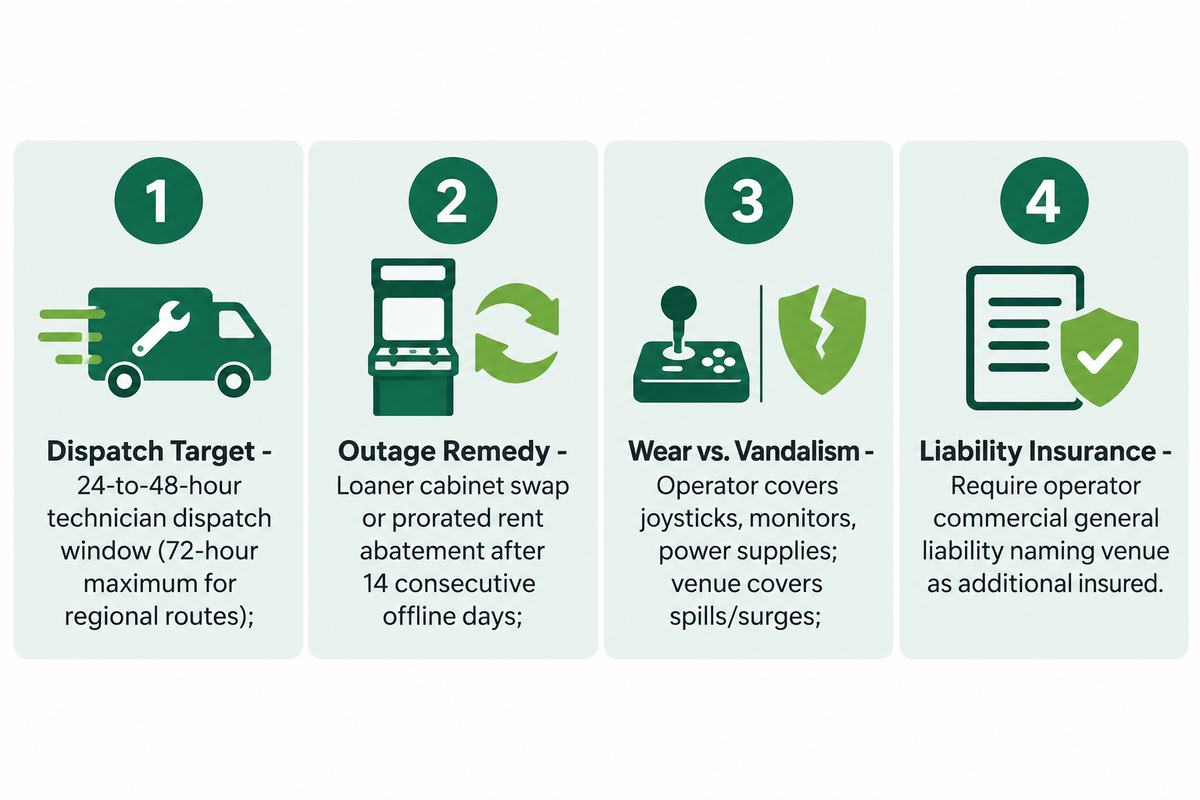
A protective, full-service lease, or placement SLA, contains a 24-to-48-hour window for a technician dispatch (up to 72 hours for remote routes), a 14-day outage swap or rent abatement clause, defined limits on vandalism, and liability insurance.
Set a 24-to-48-hour dispatch target for logged fault notices with a 72-hour maximum for regional service routes.
Initiate a loaner cabinet swap or prorated rent abatement for a machine that’s offline for 14 consecutive days.
Assume regular play wear (joysticks, microswitches, monitors, power supplies, card readers) is the responsibility of the operator, while the venue covers customer vandalism, liquid spills, building power surges, and unauthorized service.
Require revenue-share Operators to have commercial general liability insurance, where your venue is added as an additional insured.
Renewal Traps, Residual Buyouts, and Exit Liabilities You Must Audit Before Signing
Commercial equipment leases typically require a 60-90 day written non-renewal notice before expiration, and some extend this window to 180 days. Failing to submit this notice will result in an evergreen auto-renewal. Many of these evergreen clauses extend your agreement for an additional 12 months. Commercial lending advisories from MidBank note that missing a 60-90 day certified-mail notice window commonly triggers 12-month auto-renewals and return crating charges.
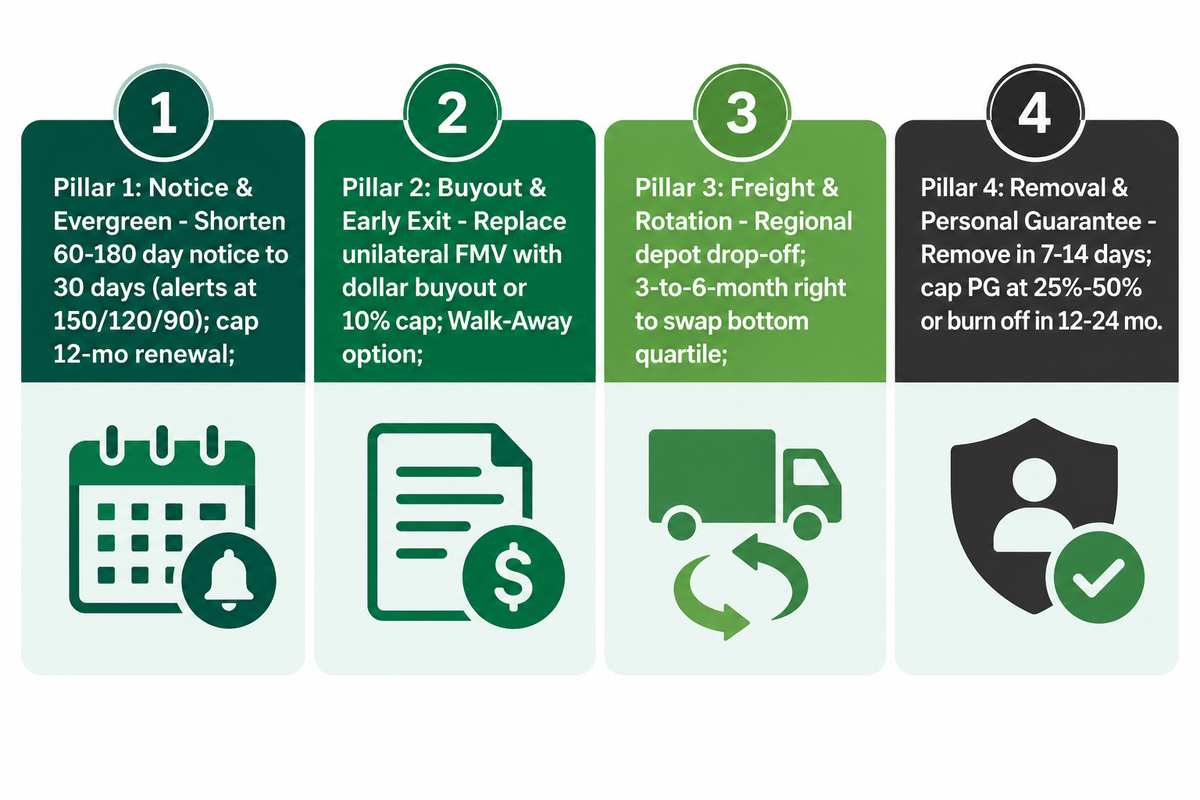
Courts enforce B2B evergreen clauses strictly because consumer auto-renewal laws rarely apply to business leases. Perform a 4-Pillar Arcade Contract Audit on the 10 contract clauses below before signing on the dotted line.
How Do Evergreen Auto-Renewal and Fair Market Value (FMV) Buyouts Work?
Evergreen clauses provide for automatic renewal of the contract if the required notice isn’t given. A fair market value (FMV) buyout clause provides the lessor the right to unilaterally set the purchase price for the equipment. Used arcade cabinets don’t have a significant secondary market, which can result in an inflated FMV quote.
#
Contract Clause
Standard Lessor Trap
Buyer Negotiation Fix
1
Notice Window
60–180 days prior via certified mail only
Shorten to 30 days and set calendar alerts at day 150, 120, and 90
2
Evergreen Renewal
Automatic 12-month lock-in on missed notice
Cap automatic extension to month-to-month
3
FMV Buyout
Lessor unilaterally sets “Fair Market Value”
Replace with dollar buyout or fixed residual cap (e.g., 10% of cost)
4
Return Freight
Lessee crates, insures, and ships cross-country
Limit return drop-off to nearest authorized regional depot
5
Return Condition
“Refurbished” standard triggers restoration fees
Specify “working order, normal commercial wear excepted”
6
Early Termination
100% of remaining payments accelerated immediately
Negotiate Walk-Away option or no prepayment penalty (e.g., Betson)
7
Game Rotation
Stale titles sit earning low revenue for 3 years
Write 3-to-6-month right to switch out games in bottom quartile
8
Exclusivity Clause
Bars venue from adding owned games or rival vendors
Restrict exclusivity strictly to the operator’s designated zone
9
Removal Timeline
Abandoned cabinets block new tenants after exit
Mandate operator removal within 7–14 days post-termination
10
Personal Guarantee
Unlimited personal asset exposure on LLC default
Cap PG at 25%–50% or burn off after 12–24 on-time payments
Matching Acquisition Models to Venue Type: FECs, Bars, Hotels, Malls, and Bowling
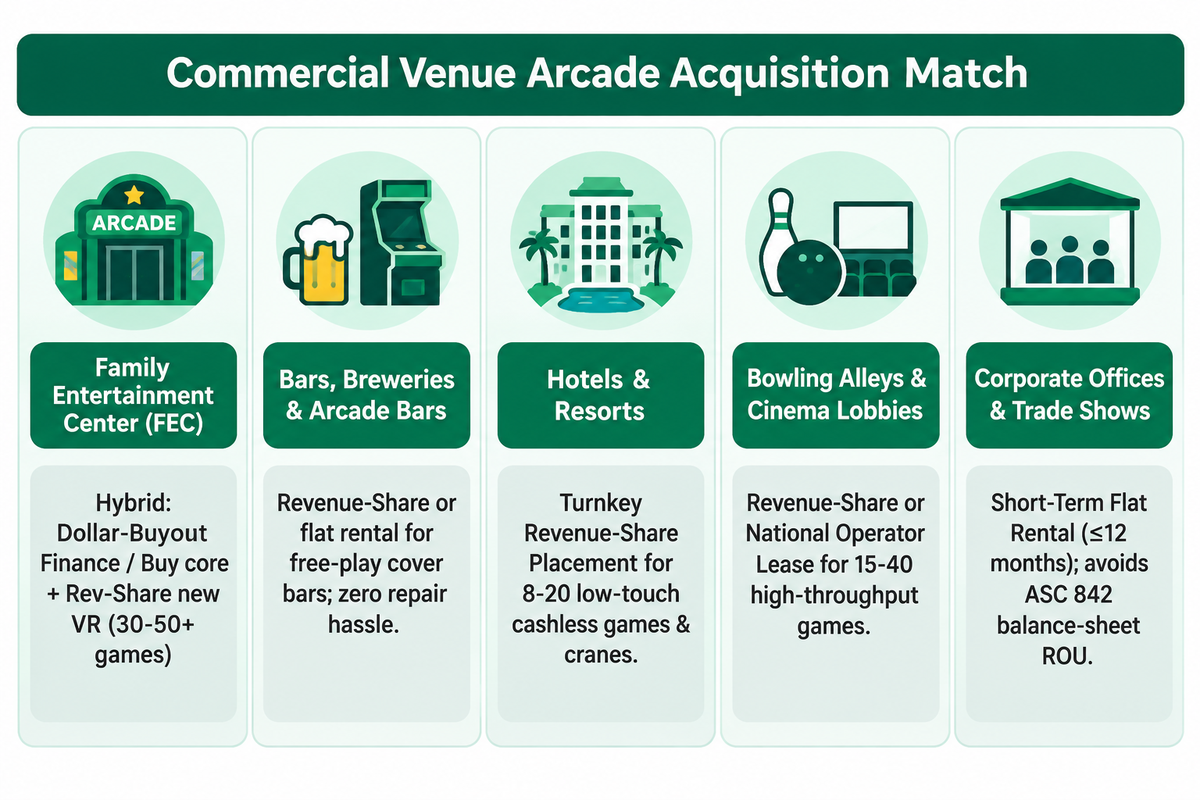
High traffic family entertainment centers (FECs) which have on-site technicians can be more profitable by financing or purchasing core cabinets and placing value-added services on a revenue-share (e.g. VR) vs. turnkey placements, which are better suited for hotels, bars and unstaffed corridors. Plan for approximately 50 to 70 square feet per machine, which includes space for players and aisles. Structuring your contract to align with your technician’s capability is also important.
Venue Format
Recommended Model
Typical Game Mix
Key Operational Reason
Family Entertainment Center (FEC)
Hybrid: Dollar-Buyout Finance / Buy core + Rev-Share new VR
Tie your cabinet count to a complete venue pro-forma before signing. Our guide on how to build an arcade business plan, shows how to calculate expected weekly revenue from gaming, as well as expected rent, payroll and entertainment options.
US Commercial Arcade Leasing Companies, Distributors, and Qualification Thresholds
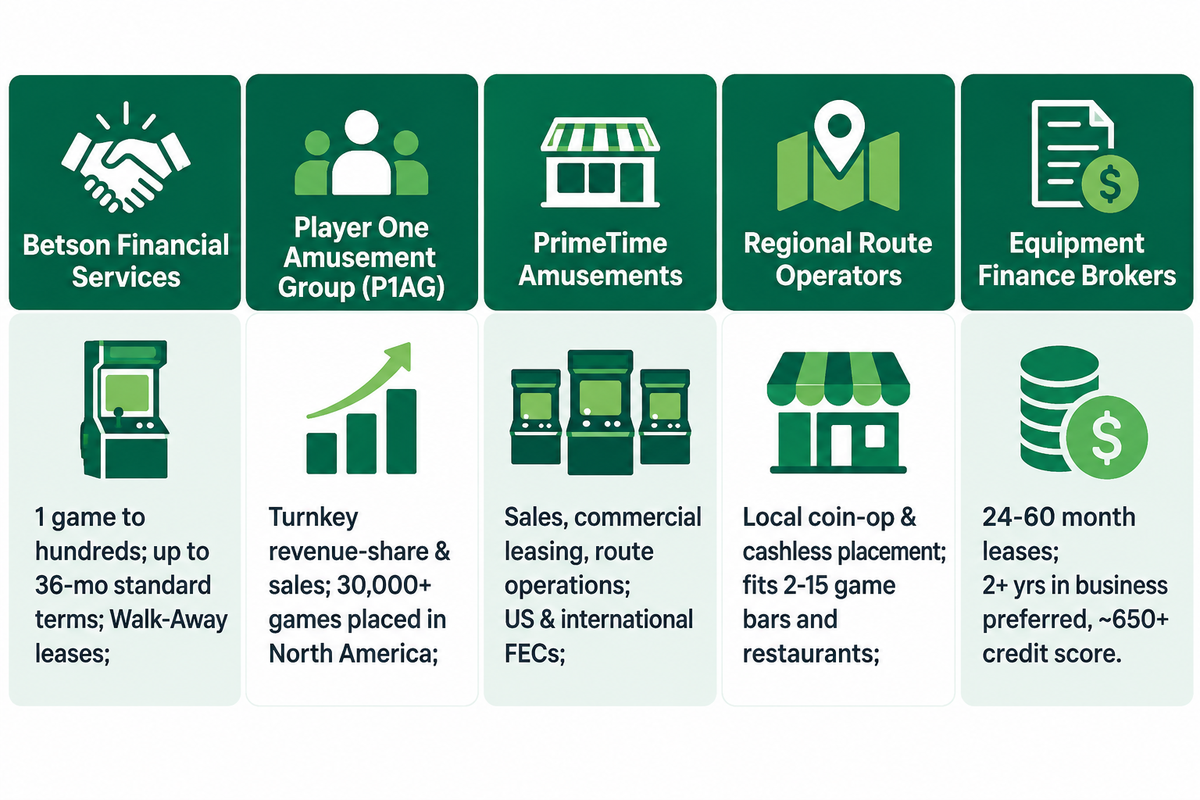
US venues procure machines via three channels. These include a national distributor’s finance team, turnkey route operators, and equipment finance brokers. Betson Financial Services can finance projects from one game to hundreds, using standard terms of up to 36 months, Walk-Away lease, and no prepayment penalties. Player One Amusement Group (P1AG) operates 30,000+ placed games in North America and qualifies venues based on floor space and traffic, not a strict visitor minimum. Operators can compare direct distributor underwriting terms through Betson Financial Services alongside commercial financing preparation guidance from the U.S. Small Business Administration.
Years of experience and a huge selection of popular titles have been established by major distributors over the years. Each company offers financing and also offers maintenance as service scope varies. For instance, a distributor may provide seasonal payment plans and also offers leasing, while a turnkey operator provides financing to offer arcade equipment placements tailored to local bars and restaurants. Wide commercial offerings allow you to refresh your selection and maintain that wide range of arcade in sync with player demand.
1 game to hundreds; up to 36-mo standard terms; nationwide US
Business credit application, cash-flow review, seasonal plans available
Player One Amusement Group (P1AG)
Turnkey revenue-share partnerships & sales
30,000+ games placed across North America
Floor area, guest dwell time, traffic quality, multi-attraction fit
PrimeTime Amusements
Sales, commercial leasing, route operations
US & international; turnkey game rooms & FECs
Site layout feasibility, revenue potential, credit for leases
Regional Route Operators (e.g., OneSource Amusements, Game Time Vending)
Local coin-op & cashless placement
State/metro service routes (e.g., Texas, Florida)
Proximity to technician route; fits 2–15 game bars and restaurants
Equipment Finance Brokers (e.g., Trust Capital, The Pinball Company partners)
Dollar buyout, 10% PUT, and FMV leases
24–60 month commercial equipment leases
Time in business (2+ yrs preferred), ~650+ credit score, vendor invoice
Space, Power, and Floor-Plan Readiness Before Signing an Arcade Lease
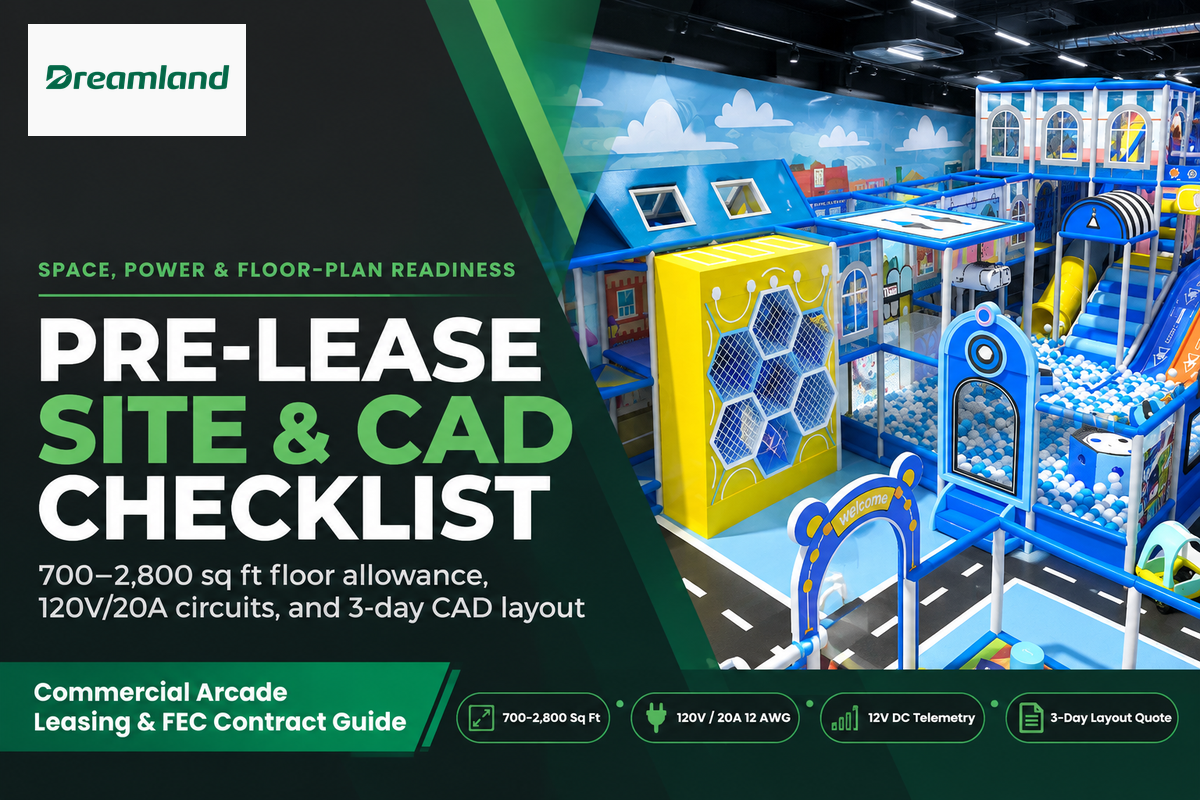
Physical space constraints are the biggest obstacle when deploying system-wide components. The greater the number of games in the system, the larger the space requirement. Allow about 700 sq ft for 10 games or 2,800 sq ft for 40 games. Space is required for footprint of arcade cabinets, player access and stance, and clear walkways.
Prior to delivery day, perform four site checks to make sure all the electrical work is completed.
Standard North American cabinets pull 120V/15A, so install 20A branch circuits with 12 AWG wiring (NEMA 5-20R or 5-15R outlets) and industrial surge protection. Heavy motion simulators or VR arenas may require dedicated 10 AWG lines.
Card readers (Intercard, Embed) draw 12V DC and transmit play counts over Ethernet or dedicated Wi-Fi to cloud audit servers. So, pull clean network drops prior to cabinet installation.
Measure the width of your double doors, the weight limits of your elevators, and the height of your lowest clear ducts before procuring deluxe cabinets or multi-level play structures.
Keep high-traffic queuing arcade areas separate from toddler soft play and the main entrance. See our FEC floor plan design guide for zone circulation ratios.
For venues with multiple attractions like soft-play, ninja courses, and indoor playgrounds, along with a arcade zone, our space planning and layout begins with your room measurements. You’ll receive a quote for a custom layout within 3 working days if you upload a CAD file, or a dimensioned sketch, with clear height written on it. Dreamland Playground creates custom play structures and offers venue layout services; we don’t provide arcade machine financing, lease underwriting or third-party certification.
Frequently Asked Questions About Arcade Game Leasing
Can a small bar or restaurant lease just two or three arcade machines?
Yes, distributor finance arms approve single or small multi units of the arcade lease for credit review. On the other hand, small to medium route operators place two to five coin-operated or cashless cabinets in neighborhood bars and restaurants on a 50/50 revenue sharing basis. You pay no upfront cost for the cabinets and the operator does the technical service.
What monthly budget should a venue plan per leased commercial arcade cabinet?
Monthly cabinet rates should track the $150 to $500 multi-year benchmarks. Classic local rentals can drop to $75 monthly after initial three-month terms, while large VR attractions exceed $800 per month. Budget for one to two advance payments, liftgate delivery fees and possible return freight when calculating your total budget.
Are commercial arcade lease payments tax-deductible compared with buying equipment?
Under true FMV operating leases where the lessor retains tax ownership, 100% of monthly rent is deductible under IRC Section 162 without Section 179 eligibility. Conversely, contracts with a nominal buyout or a term spanning at least 75% of useful life qualify as financed purchases for Section 179 expensing and MACRS depreciation.
Does a dollar-buyout arcade lease transfer ownership at term end?
Yes. After you complete all scheduled monthly payments and pay the nominal purchase price, legal title passes to your business. No further lease obligations apply, which is useful for cabinets that are expected to be kept for five years.
When does a hybrid buy-and-revenue-share strategy beat leasing an entire FEC arcade?
When your family entertainment center has steady traffic and an on-site technician, a hybrid fleet can beat leasing an entire arcade. Purchasing or financing durable anchor games allows you to keep 100% of collections after the crossover point. JVL’s bar model places that crossover at about twice simple payback. In the meantime, placing expensive new VR or untested redemption units on revenue-share protects cash reserves and transfers mechanical repair and obsolescence risk to the route operator.
Who handles amusement machine permits and local taxes on leased cabinets?
In revenue-share placements, route operators usually file local amusement stickers and remove amusement taxes before splitting net revenue. In leases, the host venue handles local business licenses, property taxes, and permits.
What physical site details do arcade suppliers ask for before quoting a layout?
When obtaining a quote from a supplier for a dedicated gaming area, they’ll require details such as the total gaming square footage, the clear height to the lowest HVAC duct, the width of doorways and columns for delivery, available 120V 20A circuits with surge protection, and the age group and window of the expected guests, as well as the opening schedule. You should also confirm available 120V/20A electrical branch circuits with surge protection plus your target guest age mix and opening timeline so game zones fit cleanly beside seating or soft-play areas.
Planning an Integrated FEC or Indoor Play Space Around Your Arcade Zone?
Map your expected room traffic, height, and flow before signing multi-year arcade equipment leases. For your expected site, floor plan, or dimensioned drawing, and your target guest age group and budget, contact Dreamland Playground. Our design team delivers a custom play-space layout proposal within 3 working days.
Dreamland Playground publishes practical planning guides for commercial indoor-play projects, including family entertainment centers, shopping malls, hotels, restaurants, churches, and other venue types.
Use these guides to frame the questions that should be resolved before concept selection: venue size, intended age groups, project location, attraction mix, operating priorities, timeline, and delivery constraints. Final recommendations should be based on the real site and applicable local requirements.
Start With The VenueFloor area, clear height, site location, intended audience, and target opening date create the working brief.
Clarify The ScopeConcept, equipment, production, shipping, installation, and operating inputs can vary from one project to another.
PROJECT / VENUE / TIMELINE
Prepare Your Project Brief
Venue TypesFEC · Mall · Hotel · Restaurant · Church
Start WithFloor area · Clear height · Age groups · Country