Get in touch with Dreamland Playground Company

Updated November 2026 · Commercial Venue Engineering & Startup Operations Guide
Budget $200,000 to $1.5 million to open a roller skating rink inside a 15,000 to 30,000 square foot building, per JIM and ROLLER startup guides. That budget sets the capital floor when planning how to open a skating rink. Bare synthetic ice installations run $14,000 to $395,000, while small-to-mid commercial ice surfaces cost $150,000 to $950,000 per Sports Venue Calculator. Full municipal single-sheet arena replacements reach $39.125 million.
A skating rink is a Group A-3 or A-4 venue built around an unobstructed rink floor, a skate rental counter, and party and food zones. Every future rink owner must clear six steps in sequence. First, select the skating format. Second, secure a five-year business plan for up to $5 million in SBA 7(a) debt. Third, assess clear-span shells under the 2021 IBC Table 1004.5. Fourth, identify flooring and HVAC. Fifth, bind music licenses and participant insurance. Sixth, position ancillary attractions.
Roller vs. Synthetic vs. Refrigerated Ice: Choosing Your Skating Rink Format and Startup Budget
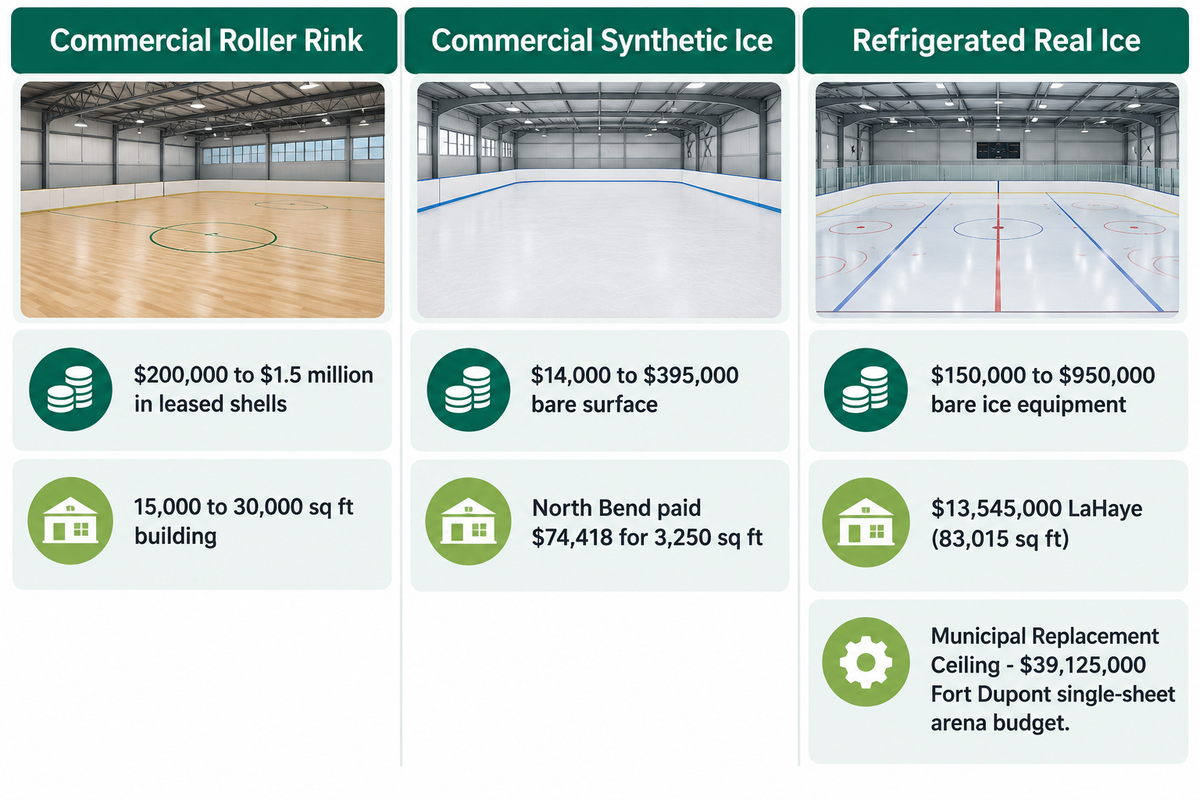
Commercial roller rinks open for $200,000 to $1.5 million in leased shells, and bare synthetic ice surfaces run $14,000 to $395,000 before tenant fit-out. Refrigerated single-sheet projects span $150,000 to $950,000 for bare-shell ice equipment up to $39.125 million for municipal replacement builds. Collegiate data in Athletic Business’s LaHaye Ice Center showcase logs $13,545,000 across 83,015 square feet. Choose a roller skating business when startup capital stays under $1.5 million and contract hockey is absent.
Audited municipal purchases bookend the extreme ends of the spectrum for founders who want to open a venue. In 2022, North Bend, Oregon paid $74,418 plus shipping for a 3,250-square-foot synthetic package. Meanwhile, Washington, DC budgeted $39,125,000 for its single-sheet Fort Dupont replacement arena. Investors comparing chillers and sub-slab heating can check our detailed cost to build an ice rink by project type.
| Capital & Operating Dimension | Commercial Roller Skating Rink | Commercial Synthetic Ice Rink | Refrigerated Real Ice Rink |
|---|---|---|---|
| 1. Leased Shell / Surface Startup | $200,000–$1,500,000 all-in startup (JIM & ROLLER) | $14,000–$395,000 surface + shell fit-out | $150,000–$950,000 small-to-mid ice surface + plant |
| 2. Property & Arena Benchmarks | $400,000–$3,000,000 property + $350,000–$3,000,000 fit-out | $74,418 + shipping (North Bend 3,250 sq ft package) | $13,545,000 collegiate (LaHaye); up to $39,125,000 municipal |
| 3. Bare Skating Surface Cost | $15,000–$45,000 tile; $150,000–$315,000 maple | Glice starts at $16,000 curling; $32,000–$36,000 rec/hockey | Chilled brine or direct-expansion refrigerated slab |
| 4. Standard Sheet & Gross Footprint | 8,000–15,000 sq ft floor in 15,000–30,000 sq ft building | 3,250–3,500 sq ft municipal pads up to full indoor sheets | 17,000 sq ft NHL (85×200 ft) in 35,000–83,015 sq ft arena |
| 5. Ice Resurfacer Requirement | Not applicable (microfiber dust mop & scrubber) | Not applicable (daily rotary power scrubber + vacuum) | Dedicated Zamboni or Olympia resurfacer bay + melt pit |
| 6. Monthly Energy & HVAC Load | Standard comfort HVAC + 35%–50% RH wood control | Standard comfort HVAC; zero refrigeration electricity | Continuous chiller plant + active desiccant dehumidifier |
| 7. Skate Edge & Wheel Upkeep | Urethane wheel rotation, bearings, and toe stops | Frequent steel blade sharpening (10–15 min on regular panels) | Routine hollow blade sharpening between ice sessions |
| 8. Sanctioned Competition Eligibility | Eligible for artistic roller, speed, and roller derby | Not approved by international ice sports federations | Required for sanctioned youth, collegiate, and IIHF hockey |
| 9. Primary Revenue Anchor | Open family skate, birthday parties, school STEM, arcade | Mall attractions, seasonal local parks, skill clinics | Contract youth hockey ice rental + learn-to-skate |
Buyers looking to open a new business often confuse a $90,000 floor quote with full startup costs and capital outlays. Published cost tables on USA Skating Rinks show renovation ($350,000–$3,000,000) plus lighting and sound ($95,000–$700,000) outspend the rink’s bare floor. Budgets shift when a shell requires column removal, slab replacement, or fire-main upsizing. In one Ice-World case, an operator installed synthetic panels, but later switched to real ice after skaters disliked the added drag.
How much money does it take to start a skating rink in a leased building versus building new?
Starting a roller rink in a leased shell takes $200,000 to $1.5 million across U.S. operator guides. Annual property leases run $50,000 to $250,000, whereas buying commercial property costs $400,000 to $3,000,000 before $350,000 to $3,000,000 in renovations.
Repurposing a vacant supermarket, bowling alley, or warehouse to avoid multi-year ground-up construction (opening a rink) is typically faster and less expensive. Washington, D.C.’s replacement for Fort Dupont, for example, allotted $39,125,000 during the spring 2023 through the fall 2025 build schedule. Collegiate single-sheet expansions such as Liberty University’s 83,015-square-foot LaHaye Ice Center totaled $13,545,000.
Writing a Bank-Ready Skating Rink Business Plan and Securing SBA Financing
A bank-ready roller skating rink business plan pairs a five-year forecast with monthly Year-1 cash flow. That package qualifies borrowers for up to $5 million through the U.S. Small Business Administration (SBA) 7(a) loan program. Separate one-time buildout expenses from six months of liquid working capital ($60,000 to $120,000 on leaner roller rinks). Lenders reject plans that project Saturday crowds across 52 weeks.
⚠️ Common Mistake: Copying Legacy $43,000 Internet Business Plan Templates
One top-ranking roller skate rink business sample plan still lists legacy 2003 figures: $43,000 in narrative start-up costs ($33,000 itemized start-up expenses), $10,000 for renovations, and $2,000 for insurance. Submitting 2003 numbers to an SBA underwriter causes instant rejection because modern Group A-3 sprinklers, participant insurance, and commercial floors cost far more.
Local market research aligns your ice skating rink business plan and financial spreadsheet with real drive-time data. Count households with school-age kids and rival forms of entertainment or recreational activities within 15 to 20 miles (or 50 miles in rural counties). A future roller skating rink owner looking for help can connect with the RSA as a future member for guidance on what they need to get started. Roller Skating Association startup resources share valuable insights among webinars, weekly town hall meetings, and the boot camp at the annual RSA convention and trade show.
Match your loan type to real estate control in the roller skating industry. SBA 7(a) loans cap at $5 million (with many roller rinks borrowing $300,000 to $750,000 after a 20% to 30% down payment) for tenant fit-out, rental skates, POS systems, and working capital. SBA 504 loans finance land purchases or business owners buying an existing rink that already holds Assembly zoning.
Leasing or Converting a Building: Square Footage, Clear-Span Layout, IBC Occupancy, and Parking
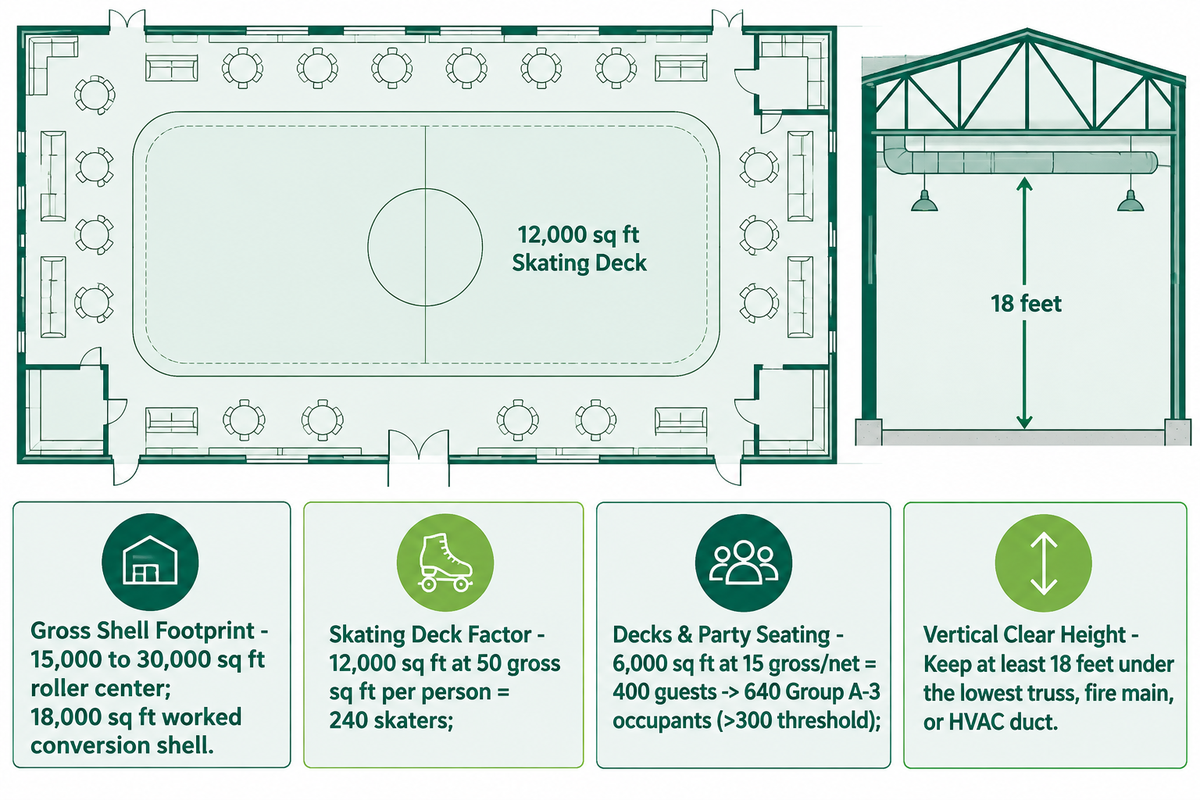
Commercial roller skating centers need 15,000 to 30,000 square feet of gross area, while single-sheet NHL ice rinks need 35,000 to 83,015 square feet around a 17,000-square-foot sheet. According to 2021 International Building Code (IBC) Table 1004.5, officials allow 50 gross square feet per person on rinks. Perimeter decks use 15 gross square feet per person, and party tables use 15 net. Reject shells with columns within the oval.
A Group S-1 warehouse conversion to an Assembly Group A-3 skating center changes both fire and plumbing math immediately. Consider an IBC Table 1004.5 occupant-load calculation for converting an 18,000 square foot clear-span warehouse shell. A 12,000 sq ft skating deck at 50 gross = 240 skaters, while 6,000 sq ft of perimeter deck and party seating (3,000 gross decks plus 3,000 net tables) at 15 = 400 guests -> 640 Group A-3 occupants. Going over the 300 person IBC 903.2.1.3 fire protection threshold requires automatic sprinklers, panic hardware, and ADA compliance (ICC A117.1-2017) with additional restrooms. Final sprinkler and plumbing calculations are determined by the Local Authority Having Jurisdiction.
| Pre-Lease Screening Gate | Roller / Synthetic Target Spec | Refrigerated Ice Target Spec | Walk-Away Red Flag |
|---|---|---|---|
| 1. Gross Building Area | 15,000–30,000 sq ft (8,000–15,000 sq ft pad) | 35,000–83,015 sq ft (17,000–19,600 sq ft sheet) | No lobby/skate-exchange depth outside the rink wall |
| 2. Clear-Span Column Grid | Unobstructed clear span across the full skate oval | Unobstructed clear span over 85×200 ft NHL dasher box | Load-bearing columns inside the active skating lane |
| 3. Clear Height Under Ducts | 16–20+ ft below lowest truss, sprinkler, or HVAC duct | 22–28+ ft clear above slab for air stratification & lighting | Under 14 ft below ducts where multi-level play is planned |
| 4. IBC Table 1004.5 Load | 50 gross rink + 15 gross decks + 15 net party tables | 50 gross ice + 15 gross decks + fixed bleacher count | Undersized water main unable to feed Group A-3 sprinklers |
| 5. Concrete Slab Condition | Flat, vapor-retarded slab free of hydrostatic moisture | Insulated, frost-heave-protected sub-slab heating bed | Active slab moisture vapor without landlord TI credit |
| 6. On-Site Parking Access | Dedicated lot sized for overlapping weekend party sessions | Dedicated lot sized for back-to-back hockey team turnovers | Shared industrial truck court with weekend tow rules |
How many square feet and how much clear ceiling height do you need for a roller skating rink?
Keep at least 18 feet of clear height under the lowest truss, fire main, or HVAC duct. Target 15,000 to 25,000 square feet of assembly-zoned building space (with ROLLER recommending at least 17,000 square feet) around an 8,000 to 15,000 square foot unobstructed skating floor per JIM.
Measuring to the roof deck instead of the lowest duct blocks two-story play structures and raised DJ booths. Our guide to commercial entertainment lease negotiation terms and buildout clauses shows how you can lock in landlord delivery clauses for roof leaks, power capacity, and 60-to-90-day Certificate of Occupancy inspections.
Skating Rink Flooring, HVAC Utility Loads, and Rental Skate Equipment Specifications
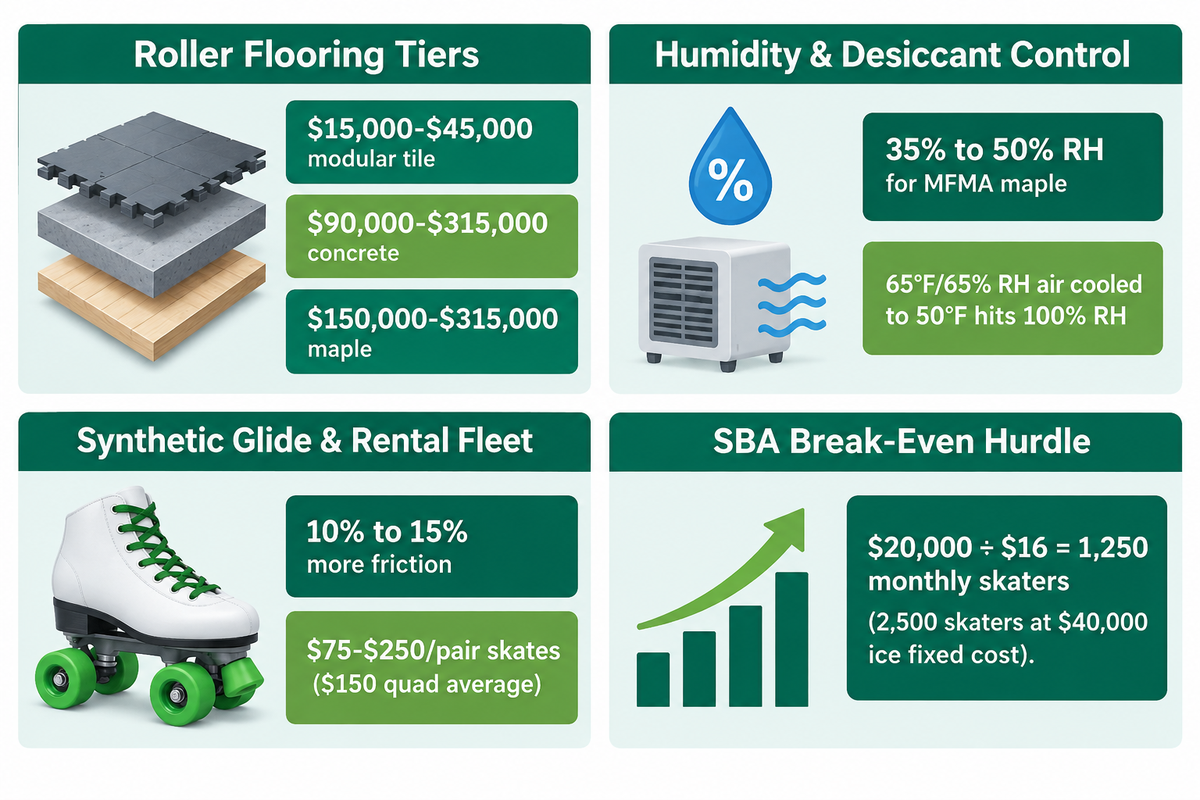
Commercial roller flooring costs $15,000 to $315,000 across published U.S. cost guides, while HVAC separates dry comfort cooling from continuous ice chillers and desiccant dehumidifiers. As The ACHR NEWS reports on arena humidity, cooling 65°F outdoor air at 65% relative humidity to 50°F indoors drives humidity to 100% RH. Silica-gel desiccant wheels strip moisture before it condenses on the ice, matching DC DGS’s Fort Dupont arena spec.
Synthetic polymer panels remove chillers but increase blade friction and sharpening labor. Skating on synthetic panels is like pushing a sled through slush. UHMW-PE synthetic panels add 10% to 15% more friction than real ice, according to USA Skating Rinks. Regular synthetic panels also dull steel blades in 10 to 15 minutes, according to Glice AG. Claims of low friction in ASME’s synthetic ice report only apply to sliding speeds at low velocities, and no international federation has approved synthetic ice for competition. Horizontal and vertical interlocking joints shown in UK patent GB2490870B keep seams flat.
How much does a commercial roller skating rink floor cost by material?
Commercial ~15,000-square-foot floor installations run $15,000 to $45,000 for modular tiles and $90,000 to $255,000 for synthetic poured coatings per ROLLER data on USA Skating Rinks. Coated concrete runs $90,000 to $315,000, while northern hard maple costs $150,000 to $315,000.
Hardwood maple leads for artistic roller sports and rhythm nights when HVAC holds indoor humidity between 35% and 50% RH per Maple Flooring Manufacturers Association (MFMA) recommendations. Poured concrete better suits bank-track bowl or derby layouts. Rental skates run $75 to $250 per pair plus $30 to $150 for helmets and pads ($40,000 to $60,000 for a baseline 400-pair startup fleet). In her 10 things operators must know guide, former Rinksider Magazine editor Susan Geary prices commercial leather quad skates near $150 per pair. Stocking Riedell, Sure-Grip, Golden Horse, or Crazy Skates cuts repairs and feeds skate shop and pro shop sales.
Apply the SBA break-even formula, Fixed Costs ÷ (Price − Variable Costs) = Break-Even Point in Units, to compare monthly overhead. Suppose a dry skating business carries $20,000 in monthly operating costs (one-sixth of JIM’s $120,000 six-month reserve), collects $15 admission plus $5 skate rental ($20 per guest), and spends $4 in variable food and card fees ($16 margin). That dry venue breaks even at $20,000 ÷ $16 = 1,250 monthly skaters (~313 weekly). If year-round refrigeration pushes monthly fixed costs to $40,000 at the same margin, break-even doubles to 2,500 monthly skaters unless contract hockey ice rentals offset plant power.
Permits, Music Licensing (ASCAP/BMI/SESAC/GMR), Safety Statutes, and Rink Liability Insurance
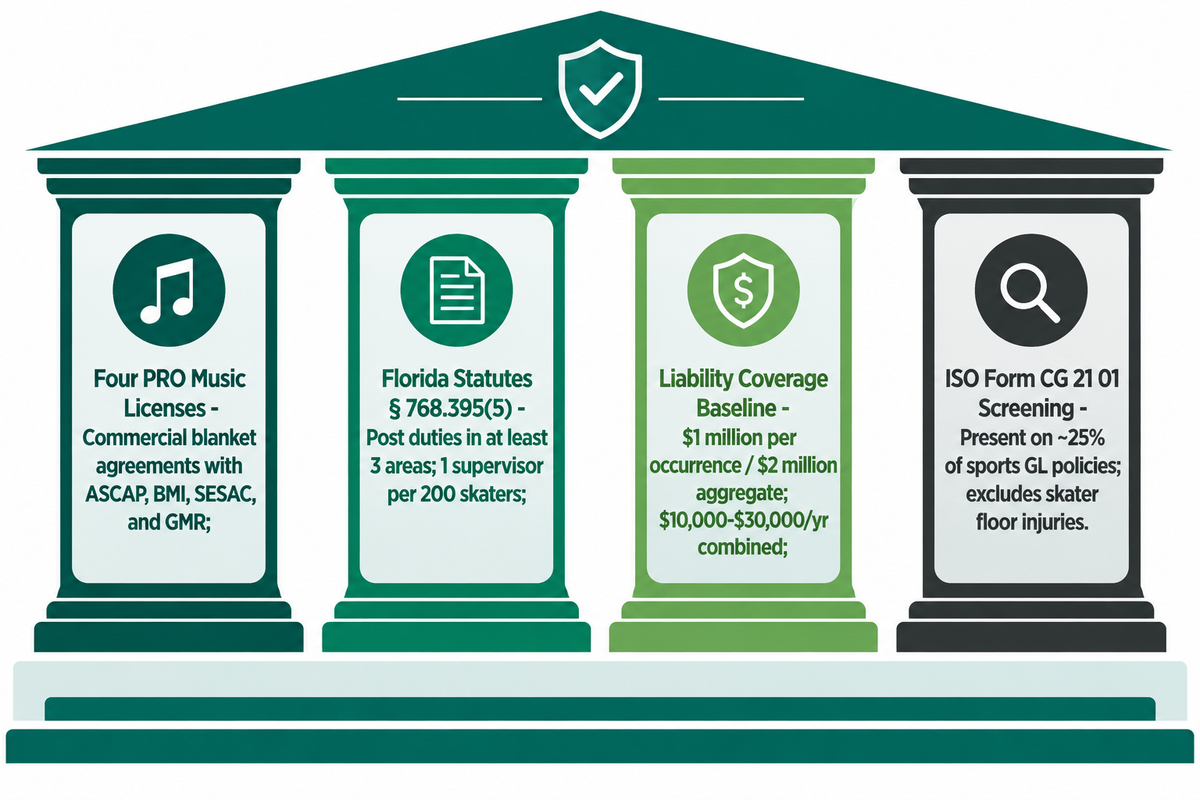
Legal openings require four Performing Rights Organization (PRO) music licenses (ASCAP, BMI, SESAC, and GMR) as well as an Assembly Certificate of Occupancy. In addition, operators need statutory Roller Skating Rink Safety Act signage and Participant Legal Liability coverage without ISO Form CG 21 01. Under Florida Statutes § 768.395 (Chapter 2023-56), failing to perform the duties outlined in the Safety Act constitutes a negligent act and gives up protection from inherent risks.
“Conspicuously post in at least three areas on the premises, the responsibilities of roller skaters and spectators under subsection (6) and the duties of the operator under this subsection.” “Have at least one roller skating rink supervisor or manager on duty for every 200 skaters when the roller skating rink is open for business.”
Subsection (5) also outlines additional operational requirements that keep sessions safe and fun. Operators must sweep and inspect the rink surface before every session and check fire extinguishers regularly. Staff are also required to maintain rental skates in sound mechanical condition and to keep exit and service-area lights on when rink lights are dimmed. Similar signage and floor inspection requirements are specified in parallel Roller Skating Safety Acts of Illinois, Michigan, New Jersey, Georgia, Ohio, and Texas.
Music licensing adheres to federal copyright law. Personal Spotify, Apple Music, and YouTube accounts are licensed for private home listening only. Public skates require a cleared B2B commercial music service or blanket license from ASCAP, BMI, SESAC, and GMR.
Do
- Bind commercial blanket licenses with ASCAP, BMI, SESAC, and GMR before opening night
- Post statutory skater and operator duty signs at the entrance, skate counter, and rink apron
- Verify affirmative Participant Legal Liability and Participant Accident coverage in the full policy
- Log pre-session floor sweeps, quarterly emergency-light tests, and rental-skate truck checks
Don’t
- Stream personal Spotify, Apple Music, or YouTube accounts over the rink sound system
- Accept a one-page Certificate of Insurance without reading the full exclusions schedule
- Bind a General Liability policy carrying ISO Form CG 21 01 sports-participant exclusion
- Turn off exit or service-area lighting during dark cosmic or adult skate sessions
What kind of insurance do you need to open a skating rink, and what do standard policies exclude?
Carry at least $1 million per occurrence and $2 million aggregate General Liability paired with affirmative Participant Legal Liability and Participant Accident coverage. Also include property insurance, workers’ compensation, and liquor liability insurance if alcohol is sold, with combined roller-rink insurance running $10,000 to $30,000 annually per JIM.
Standard Commercial General Liability policies often attach ISO Form CG 21 01 ( Exclusion: Athletic or Sports Participants ). Sadler Sports found CG 21 01 on roughly 25% of sports general liability policies, meaning only spectator slip-and-fall coverage is provided. Specialty Insurance broker Bobby Sharp says there is a strong claim denial occurrence for an operator who carries a million dollar liability coverage who then faces a claim for a participant injury because CG 21 01 was attached. Kelly Insurance Group says cracked rental wheels or loose plates can also lead to a product liability claim.
Staffing, POS Ticketing, Floor Guard Ratios, and Daily Rink Operations
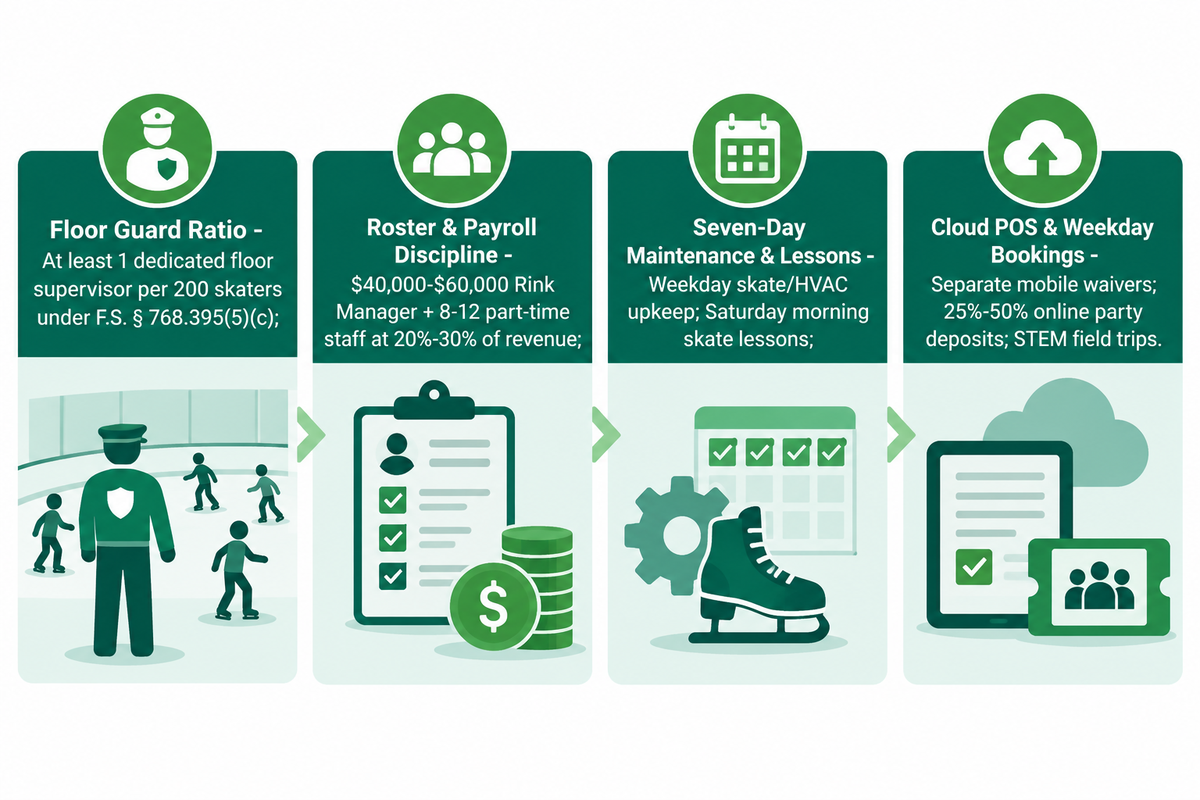
Staff every open session with at least 1 dedicated floor supervisor per 200 skaters under Florida Statutes § 768.395(5)(c). Pair that guard ratio with a full-time Rink Manager ($40,000 to $60,000 salary) and 8 to 12 part-time skate counter, DJ, party, and concession staff while keeping total payroll at 20% to 30% of revenue.
Running a roller skating rink is a seven-day operation. As Susan Geary mentions on RollerSk8r, weekday business operations cover skate maintenance, bearing and toe-stop swaps, ceiling dust cleaning, HVAC service, payroll, and group booking calls. Beginners without lessons and adults returning after 30 years account for most ambulance calls. Skate lessons on Saturday mornings attract people from neighborhood schools.
Clearing lobby queues is done by separating mobile waiver check-ins from shoe exchange. Set your cloud POS to capture digital waiver signatures and 25% to 50% party deposits online. Stabilize summer revenue by pairing monthly passes with our membership retention strategies for recurring venue revenue. Fill Tuesday through Thursday mornings with STEM field trips, local roller derby bouts, and future marketing campaigns from our weekday school and group event promotion playbook and marketing plan.
Is Owning a Skating Rink Profitable? Multi-Attraction FEC Zoning with Playgrounds, Arcades, and Party Rooms
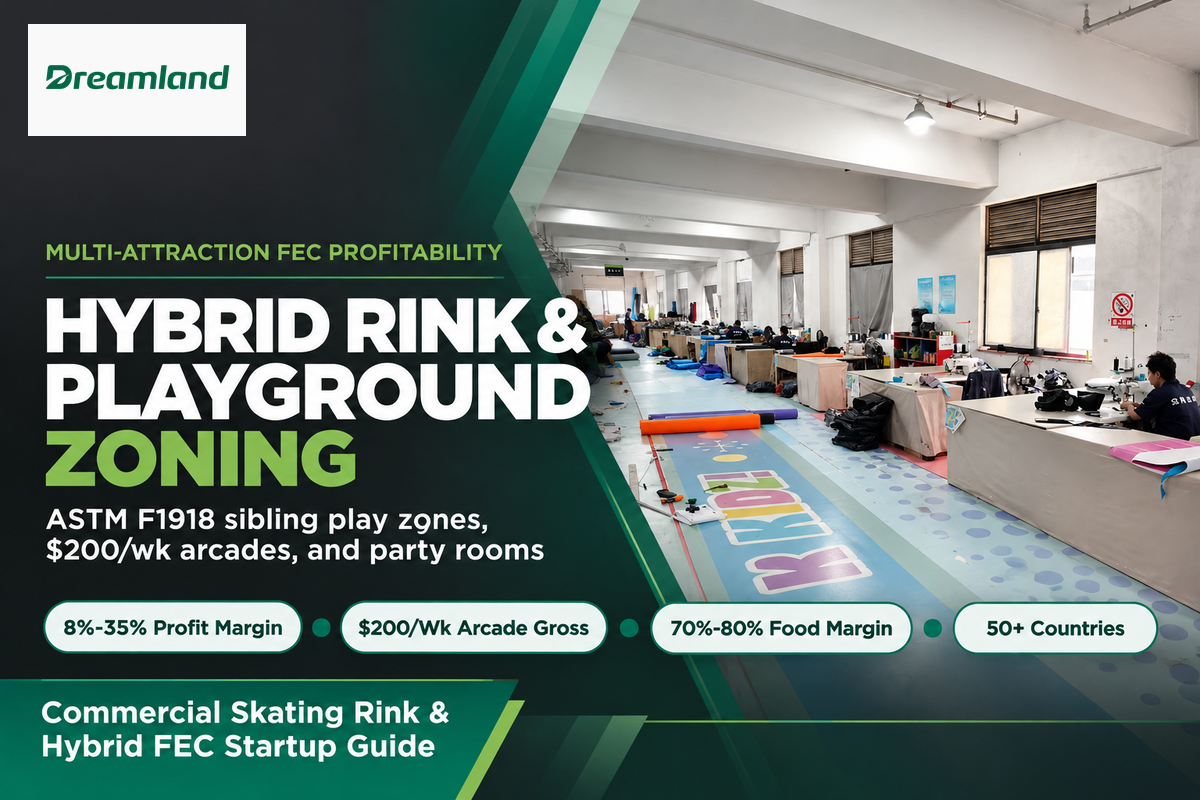
Yes, owning a skating rink is profitable when zoned as a multi-attraction family entertainment center, with diversified roller venues reaching 8% to 35% profit margins across JIM and ROLLER benchmarks. Betson reports a $12,000 to $15,000 commercial arcade game grosses $200 per week, while concessions deliver 70% to 80% gross margins. Guidance from the Roller Skating Association operator archive stresses diversifying parties and school functions beyond weekend gate tickets.
Market reports compiled by BMI Leisure value global family entertainment centers at $32.62 billion to $34.4 billion in 2025. Mordor Intelligence projects $34.57 billion for 2026, with arcades holding a 36.4% share. Dave & Buster’s FY2025 10-K across 243 venues logged 62.9% entertainment revenue and 37.1% food and beverage, yet saw a 5.0% comparable-store dip. Entrepreneurial rink operators cannot solely depend on the size of a building to house multiple age group activities; other factors must encourage families to stay longer and rebook.
Is owning a roller skating rink profitable as a standalone venue versus a family entertainment center?
Yes for a hybrid family entertainment center, whereas standalone gate-only rinks face tight Year-1 margins under fixed seven-day rent and capped Saturday capacity. Hybrid FECs have an advantage because they capture non-skating siblings and provide arcade and food court amusements and birthday party packages ($250 to $400).
At a standalone rink, a family with a 10-year-old skater and a 3-year-old toddler leaves early once the toddler grows restless. Adding glass-walled party rooms, cashless arcades, and an enclosed indoor playground extends dwell time and lifts customer satisfaction. Dreamland Playground is the commercial play-equipment brand of Zhejiang Dreamland Co. Ltd. Our factory in Wenzhou manufactures custom commercial indoor playgrounds, trampoline parks, and ninja courses for clients across 50+ countries. Our engineering team can provide 3D layouts and floor plans for space planning and equipment layouts. Dreamland Playground does not manufacture skating floors, skates, or ice chillers.
Separate play zones by age beside an active rink. Create multi-level, soft-contained play structures around ASTM F1918 (and EN 1176 where applicable) for older kids, while gating a padded toddler zone for kids under 2. Keep parent sightlines from the café to the rink rail and play gate. Review our sizing rules for pairing an active skating anchor with custom sibling play zones and multi-zone FEC floor plan design and sightline zoning.
90-Day Pre-Opening Launch Timeline and 5 Deal-Breaker Mistakes That Sink New Rinks
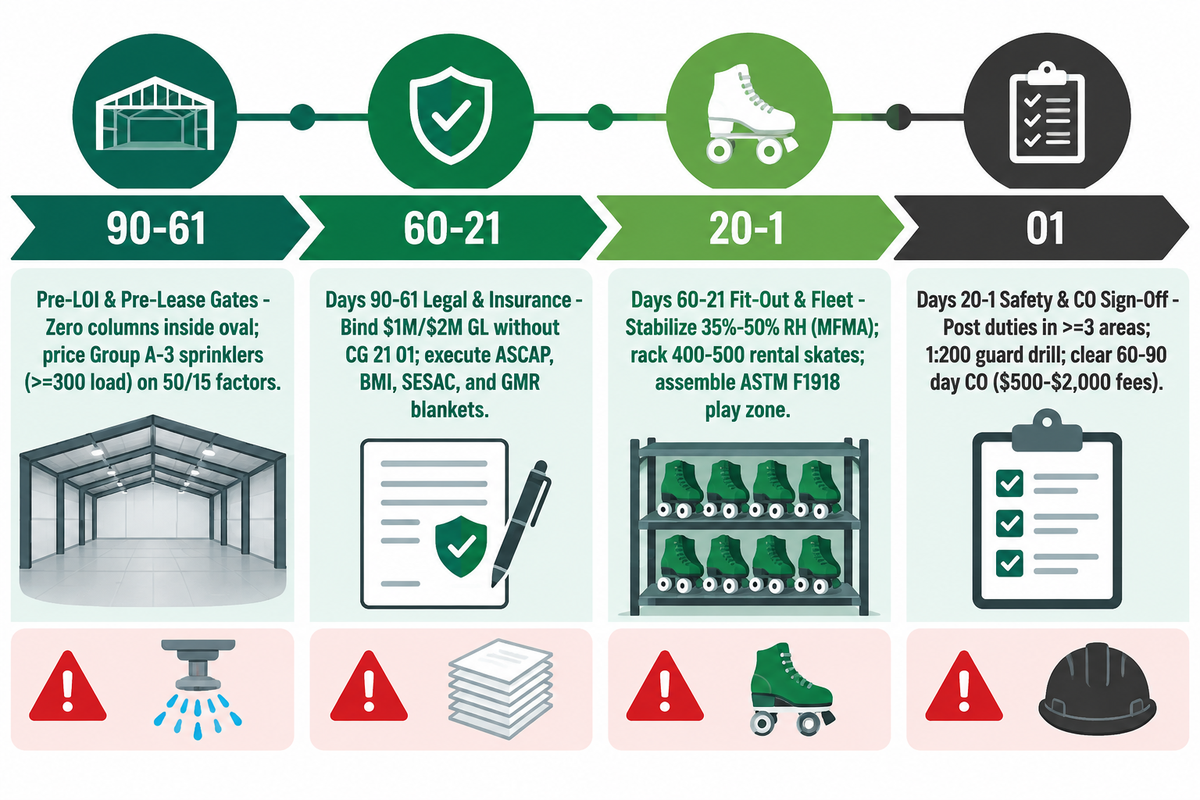
After permitting and buildout, execute a structured 90-day countdown (matching the typical 60-to-90-day Certificate of Occupancy inspection window) to start a roller or ice venue. Screen out five deal-breakers early: oval columns, unfunded Group A-3 sprinklers, CG 21 01 exclusions, home tiles, and zero working capital under SBA fixed-cost rules.
| Launch / Veto Gate | Window | Required Execution Standard | Deal-Breaker Consequence if Missed |
|---|---|---|---|
| 1. Clear-Span & Column Veto | Pre-LOI | Zero structural columns inside the active skating oval or sheet | Permanent collision hazard and unusable rink geometry |
| 2. IBC Table 1004.5 Fire/Plumbing | Pre-Lease | Price Group A-3 sprinklers (≥300 load) on 50/15 gross & 15 net factors | Unfunded six-figure sprinkler and water-main retrofit |
| 3. Participant Liability Bind | Days 90–61 | Confirm $1M/$2M GL + Participant Legal Liability; reject CG 21 01 | Uninsured skater wrist and ankle lawsuits on the floor |
| 4. Four-PRO Music Licensing | Days 90–61 | Execute ASCAP, BMI, SESAC, and GMR commercial blanket agreements | Federal statutory copyright infringement claims per song played |
| 5. Floor Cure & HVAC Balance | Days 60–31 | Stabilize 35%–50% RH (MFMA) for maple cure or test desiccant rotor | Soft peeling urethane coat, cupped maple, or arena ceiling drip |
| 6. Skate Fleet & Sibling Play Install | Days 60–31 | Rack 400–500 bulk-ordered rental skates; assemble ASTM F1918 play zone | Peak Saturday size stockouts and early toddler family exits |
| 7. Cloud POS, Waivers & Newsletter | Days 45–21 | Launch online party booking, downloadable school packet, and email list | Opening month opens with empty party rooms and lobby queues |
| 8. Safety Act Signage & Guard Drill | Days 20–7 | Post duties in ≥3 areas; drill ≥1 supervisor per 200 skaters & dark-skate exits | Loss of statutory inherent-risk defense under state safety acts |
| 9. Fire Marshal CO & Soft Open | Days 7–1 | Clear 60–90 day CO inspection ($500–$2,000 fees); run invite-only test skate | Public grand opening halted or 1-star opening-weekend reviews |
Collect all pre-signing verifications in one diligence file. Obtain written AHJ confirmation of Group A-3 occupant load, full policy forms without CG 21 01 exclusions, and subfloor moisture readings. Hold six months of liquid working capital so post-pandemic supply or permit delays never stall your launch.
Frequently Asked Questions About Opening a Skating Rink
Q: How much working capital reserve do you need beyond buildout to open a skating rink?
Hold at least six months of fixed operating expenses in dedicated cash reserves ($60,000 to $120,000 on smaller roller venues) separate from construction contingency.
Size the cash reserve to cover lease payments, utility demand, insurance, SBA debt service, and payroll for the key employees during the 12-18 month startup period.
Q: Can you open a commercial skating rink using residential DIY backyard synthetic ice panels?
No: Residential backyard liner kits and thin home plastic tiles rapidly curl, separate, and gouge under public skate traffic.
Synthetic commercial rinks include dense sintered UHMW-PE or HDPE panels with horizontal and vertical interlocking joints on a flat subfloor and require perimeter dasher containment boards, rotary power scrubbers, and commercial automatic blade sharpening machines.
Q: How often does a hardwood maple roller skating rink floor need recoating vs. sanding?
Screen and recoat northern hard maple roller floors every 12 months before urethane traffic lanes wear down to raw wood.
Full drum sanding down to bare wood is postponed for many years when operators ban outdoor street skates, dust-mop before every session, and hold indoor relative humidity steady within MFMA’s 35% to 50% RH band.
Q: Can I play Spotify, Apple Music, or YouTube playlists inside a commercial skating rink?
No. Consumer streaming accounts cover private listening only, so commercial skating venues must license public playback across ASCAP, BMI, SESAC, and GMR or subscribe to a business-cleared music platform.
Q: What is the difference between commercial general liability and participant liability insurance for a skating rink?
Standard Commercial General Liability covers slip and fall claims by non-skating spectators in lobbies and snack bars. Participant Legal Liability covers paying skaters injured on the active rink surface.
Ask for the complete policy form and endorsement schedule in writing before coverage is bound. Written broker confirmation ensures ISO Form CG 21 01 is absent and recreational skaters, lesson students, party guests, and adjacent play-zone users stay covered.
Q: How many pairs of rental skates should a new roller or ice rink purchase?
An initial purchase of 400-500 pairs (roughly $40,000 to $60,000 for roller rinks), weighted toward youth and mid-adult sizes, is advised so back-to-back Saturday birthday party sessions never stall.
Q: How much ceiling height do you need to add a multi-level indoor playground next to a skating rink?
Plan for 14 to 20+ feet (4.3–6.1+ m) of unobstructed clear height for a two- or three-level commercial indoor playground, or 10 to 12 feet (3.0–3.6 m) for a single-level under-2 toddler soft-play area.
Always measure vertical clearance from the finished floor to the lowest HVAC duct, fire-sprinkler main, or roof truss chord rather than the roof deck so custom decks meet ASTM F1918 and EN 1176 clearances.
Key takeaway
Sequence your rink launch in strict order: verify clear-span column spacing and landlord utility capacity before signing a lease, then pair open skating with weekday school groups, party rooms, and sibling play zones.
Planning a Hybrid Skating Rink & Family Entertainment Center?
Adding an age-separated indoor playground, trampoline zone, or ninja course next to your skating floor will keep non-skating siblings engaged and increase birthday party bookings. Send Dreamland Playground your dimensioned floor plan, under-duct clear height, column grid, and target age bands to receive a custom 2D floor plan and 3D play-zone concept.
Why Our FEC Planning Team Wrote This Guide
This startup guide integrated U.S. SBA 7(a) lending guidelines, 2021 IBC Table 1004.5, MFMA humidity standards, Florida Statutes § 768.395, and local municipal budgets for arenas. It pairs those public standards with Dreamland Playground’s Wenzhou manufacturing and FEC layout experience across over 50 countries. It was reviewed by the Zhejiang Dreamland Co. Ltd. technical team.
References & Sources
- LaHaye Ice Center Architectural Showcase Athletic Business
- 7(a) Loans Program Overview U.S. Small Business Administration (SBA)
- Build a Lender-Ready Plan & Operator Resources Roller Skating Association International (RSA)
- 2021 International Building Code Section 1004.5 & Table 1004.5 International Code Council (ICC)
- Solving Humidity Problems in Ice Rinks The ACHR NEWS
- A Surface Slicker Than Ice American Society of Mechanical Engineers (ASME)
- GB2490870B: Interlocking Synthetic Ice Skating Floor Panels UK Intellectual Property Office via Google Patents
- Humidity and Environmental Recommendations for Maple Flooring Maple Flooring Manufacturers Association (MFMA)
- Break-Even Point Calculator & Fixed Cost Guide U.S. Small Business Administration (SBA)
- Florida Statutes § 768.395: Roller Skating Rink Safety Act (Chapter 2023-56) The Florida Legislature (Online Sunshine)