Get in touch with Dreamland Playground Company

In the commercial amusement industry, a redemption game awards tickets or points exchangeable for merchandise; gameplay can involve skill, chance, or a combination of both. Unlike mobile apps built around digital in-game purchases, physical ticket machines drive repeat card swipes. Frank Seninsky in Vending Times sets ticket payouts between 15% and 35% by game for a 25% weighted floor average.
| Parameter | Commercial FEC Standard | Engineering & Financial Basis |
|---|---|---|
| Commercial Cabinet Pricing | Varies by cabinet archetype and supplier quote | Published examples include $4,000 new ($2,000 used) for ICE Cyclone; request a supplier quote for full room packages |
| Target Ticket Payout Ratio | 15%–35% by game | 18%–24% CenterEdge benchmark; 25%–35% Betson benchmark |
| Wholesale Ticket Valuation | Verified from landed prize cost per ticket | Palm Fun calculates ticket value from landed prize cost including freight, customs duties, storage, and shrinkage |
| Arcade Revenue Mix | Core ticket redemption and merchandiser zone | Balanced alongside video, racing simulator, sports cabinets, and indoor playground attractions |
| Cabinet Height | Big Bass Wheel Pro: 82 in.; Monster Drop: 96 in. | Installation space also accommodates player use, top-mounted accessories, and service access |
| Electrical and Access Planning | ANSI/UL 22 addresses machine electrical safety; NFPA 70 addresses installation | Size branch circuits for continuous and noncontinuous loads under NFPA 70; ADA § 403.5 sets a 36-inch minimum continuous clear aisle width |
What Is a Commercial Arcade Redemption Game and How Does the Ticket Loop Work?
A commercial arcade redemption game is a money-operated or card-operated amusement machine which, when played, dispenses paper tickets or digital e-tickets as gameplay outcomes. Guests amass tickets over many plays and trade them in for merchandise prizes. According to Frank Seninsky in Vending Times, game payouts range from 15% to 35% across the floor.
Prospective investors who want to know how to start a family entertainment center get confusing search results. Home console searches bring up Rockstar Games’ epic Red Dead Redemption and Undead Nightmare zombie outlaw bundle starring John Marston. Consumer review sites like GameSpot also cover Red Dead Redemption 2, Take-Two’s console ports for Xbox One, and the Game of the Year Edition. In a commercial family entertainment center (FEC), however, redemption gameplay means physical arcade machines. Games are monetized by mechanically spinning wheels and dropping balls. Alley rollers are put to the same purpose.
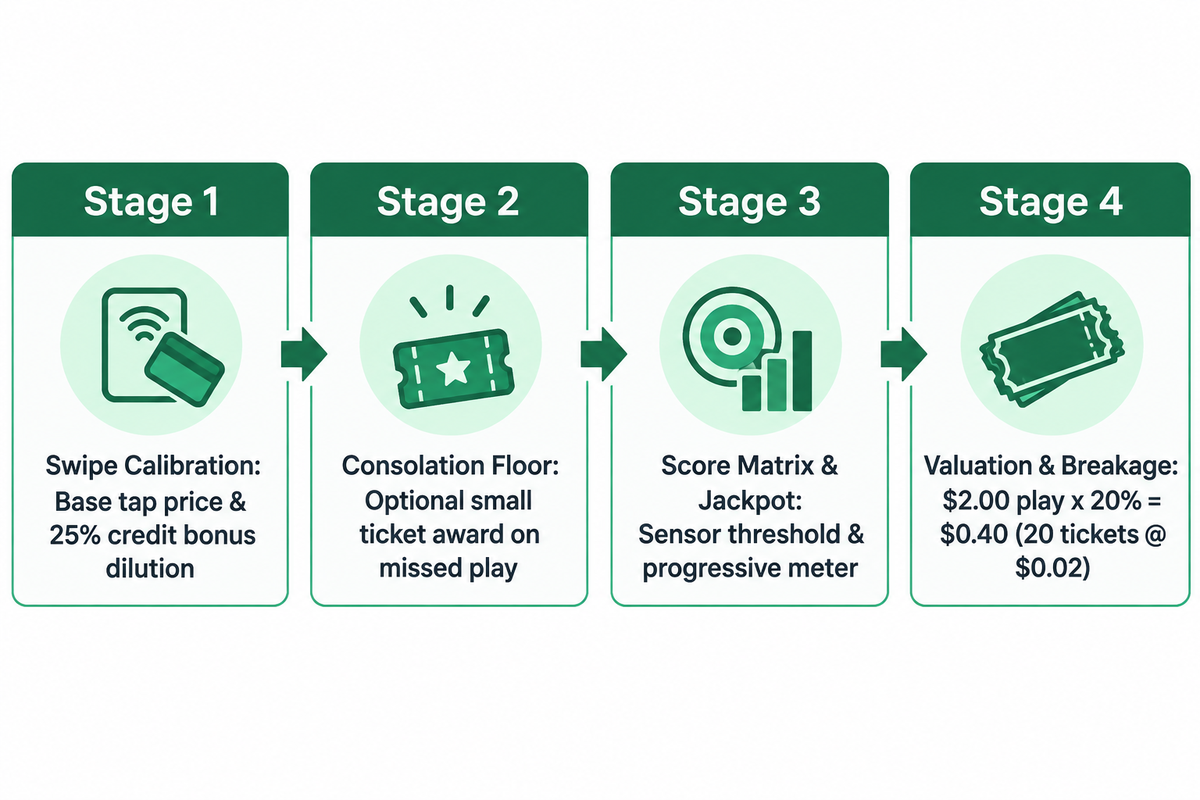
Casino EGDs strictly adhere to cash wagering laws. For example, Illinois Administrative Code Title 86, Section 3000.615 mandates casino licensees to post minimum theoretical aggregate payout percentages for cash slots. Family arcade redemption machines don’t award cash. Redemption machines, or cabinets, award tickets or points exchangeable for merchandise; some models also offer consolation tickets or progressive jackpots, across a four stage operating loop.
- Stage one contains swipe price calibration. Here, the operator sets the base card tap or token price per play and accounts for bonus-credit dilution on multi-play card packages.
- This stage covers optional consolation tickets on supported cabinets. When enabled by operator settings, the mainboard can issue a small ticket award following a missed attempt.
- Stage three implements the score matrix or optional progressive jackpot. Sensors award ticket bundles based on a score threshold, and configured progressive models can increment a jackpot meter under operator-set rules.
- Stage four tracks landed ticket valuation and breakage. Operators divide landed cost of merchandise by ticket price. The net prize cost is determined by unredeemed paper tickets and deferred e-ticket balances.
How Does an Arcade Ticket Redemption Machine Calculate Payout Percentage?
The payout percentage of an arcade ticket redemption machine is calculated by multiplying the average tickets issued per paid play by the landed cost of one ticket, dividing by the cash price per play and stating the result as a percentage. Skyfun’s operator payout guide demonstrates this using a $2.00 game targeting a 20% payout. That target allows for $0.40 in prize cost per play. At an internal cost of $0.02 per ticket, the machine dispenses an average of 20 tickets per play.
Promotional bonus credits reduce realized cash per play. To calculate the prize-cost-to-cash-revenue ratio, prize cost per play must be divided by realized cash per play rather than nominal card credits. With a 25% credit bonus and unchanged price and prize cost per play, the prize-cost-to-cash-revenue ratio increases by 25% relative to its nominal level.
Which 5 Redemption Game Categories Earn the Highest Revenue per Square Foot?
Five game categories anchor an arcade floor: multi-station rotary coin/marble pushers, vertical wheel spinners, timed ball-drop cabinets, alley rollers, and parent-child kiddie redemption games. Licensed blockbuster wheel and frontier shooting galleries also gain traffic. As far as redemption games are concerned, cabinet size, play cycle speed, and ticket drawers are the main things operators consider.
When measuring FEC revenue per square foot, operators separate net cabinet footprint from installed operating floor area. Under the U.S. Access Board ADA Chapter 4 (§ 403.5) accessible route guidelines, public game aisles require at least 36 inches of continuous clear width. A circular wheelchair turning space has a minimum diameter of 60 inches; a compliant T-shaped layout is another option. Passing spaces can use a 60-inch-square clear area or a compliant T-shaped intersection.
| Cabinet Model / Archetype | Redemption Category | Cabinet Dimensions (W × D × H) | Weight & Ticket Capacity | Payout & Sourcing Basis |
|---|---|---|---|---|
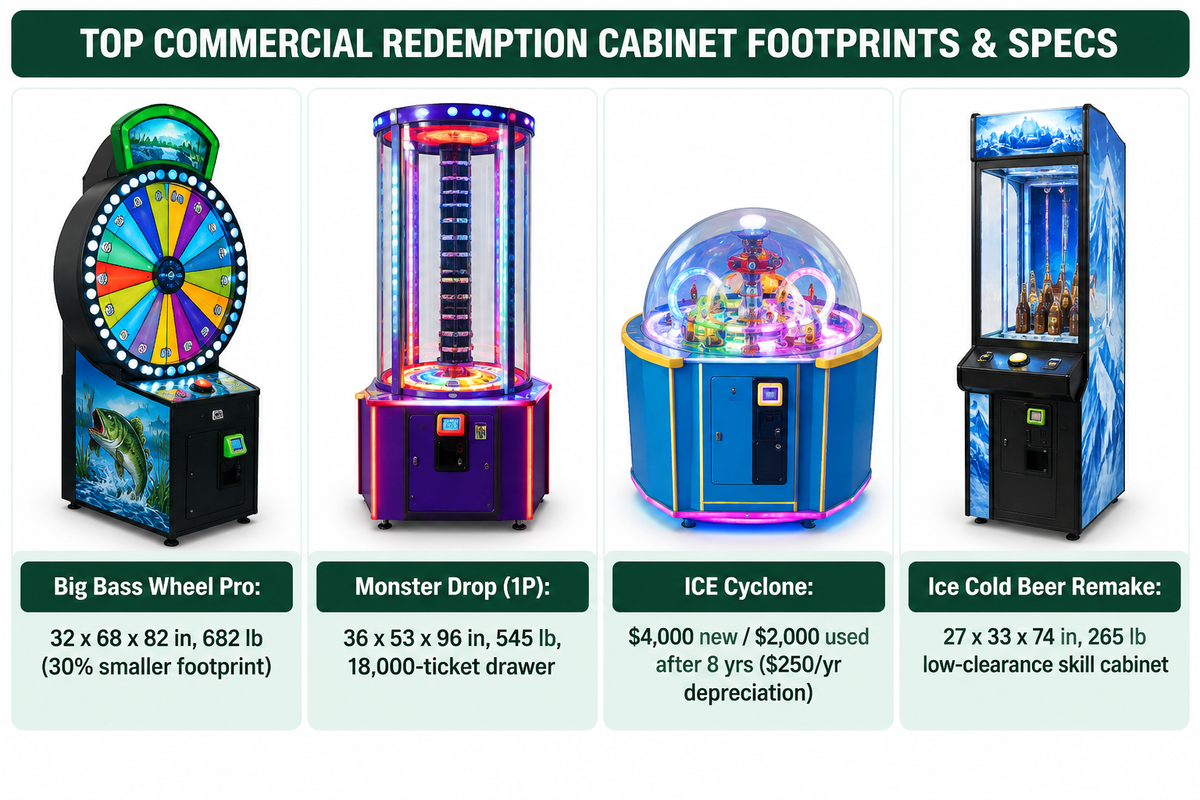
| Bay Tek Big Bass Wheel Pro | Vertical Wheel Spinner | 32 × 68 × 82 inches | 682 lb; 30% smaller footprint than original Big Bass Wheel | Calibrated within Seninsky’s 15%–35% floor band |
| Benchmark Monster Drop (1P) | Timed Ball-Drop Skill | 36 × 53 × 96 inches | 545 lb; 18,000-ticket drawer | Progressive jackpot drop; high weekend ticket capacity |
| Benchmark Monster Drop (2P) | Dual-Station Ball Drop | 67 × 40.25 × 93 inches | Twin 18,000-ticket drawers (36,000 total) | Dual-player cabinet sharing one central progressive display |
| Bay Tek Quik Drop | Rapid-Fire Bucket Drop | Tall marquee skill cabinet (verify bay height) | Request distributor quote by configuration | Rapid-fire timed bucket challenge driving repeat swipes |
| Multi-Station Closed-Loop Pusher | Rotary Coin / Marble Pusher | Center-island multi-player cabinet (varies by station count) | Multi-sided card reader stations; request supplier spec sheet | Verify state coin-pusher legality before ordering |
| ICE Cyclone Quick-Coin | Light-Stop Timing Wheel | Compact single-station timing cabinet | $4,000 new / $2,000 used after 8 years ($250/yr depreciation) | Documented 8-year route workhorse in Vending Times |
| Ice Cold Beer Mechanical Remake | Dual-Joystick Rod Skill | 27 × 33 × 74 inches | 265 lb cabinet weight | Classic mechanical rod-guidance play with ticket dispenser |
| Linked Arcade Basketball Bank | Sports Hoop Redemption | Multi-lane linked basketball cage (varies by manufacturer) | 35% frame and hoop structure cost share | Operator-configured ticket payout alongside timed sports play |
| Parent-Child Whacker / Water Duo | Toddler Kiddie Redemption | Low-deck toddler cabinet (sized for child sightlines) | Request factory container quote for toddler zone bundles | Placed along soft-play perimeter for parent-child play |
Which Redemption Game Archetypes Deliver the Fastest Payback in a Family Entertainment Center?
Multi-player closed-loop pushers, vertical wheel spinners, and timed ball-drop cabinets drive rapid card-swipe turnover in a family entertainment center because each round finishes quickly. Legacy Distribution’s Big Bass Wheel Pro specifications list a compact cabinet measuring 32 inches wide × 68 inches deep × 82 inches high and weighing 682 lb. That footprint uses 30% less floor space than the original Big Bass Wheel. Similarly, Benchmark Games’ Monster Drop specifications pair a 96-inch drop tower (36 × 53 × 96 inches, 545 lb) with 18,000-ticket drawers. Large ticket storage cuts down staff refill stops during weekend peaks.
However, operators should never make a 100% quick-drop floor. Dataintelo’s Global Arcade Basketball Market report puts the worth of commercial arcade basketball machines at $1.8 billion in 2025. The report forecasts the market to reach $3.1 billion by 2034 with a 6.2% CAGR. Additionally, Fortune Business Insights forecasts the commercial arcade-grade air hockey and table games to rise at a 6.22% CAGR by 2034. Operators set ticket payouts on sports and alley games based on the prizes offered and the demand of the players in that area.
Low ceiling ductwork can obstruct tall vertical wheel and ball-drop marquees. In low-clearance bays, be sure to verify the actual cabinet height with any top-mounted accessories and request lower-profile skill cabinets, such as a 74-inch Ice Cold Beer remake or low-deck kiddie tables.
Arcade Redemption Payout Math, Prize Cost of Goods Sold, and Package Budget Modeling
To calculate the ticket payout ratio for arcade games, multiply the number of tickets dispensed per game by the landed prize cost per ticket, and divide by the realized cash revenue per game. Palm Fun cites a CenterEdge payout benchmark of 18% to 24%. The total package budgets depend on the number of cabinets and the quotes by the suppliers.
“The golden rule of redemption then is the same today: a game’s ticket payout percentage is the inverse of its entertainment value. I set payouts at 15% to 35% across the floor, resulting in a weighted average ticket payout percentage of about 25%.”
Why do new operators lose margin when machines are set to 25%?
There are competing variables addressed in Palm Fun’s ticket payout and CenterEdge COGS guide. First, there’s landed prize overhead. This includes cost of freight, customs, warehouse storage, and counter shrinkage. Then there’s unredeemed ticket breakage. This occurs when players keep paper tickets as souvenirs, thus reducing immediate counter redemptions. Ticket balances, however, are represented electronically as a deferred liability. Meanwhile, Jiami Games’ FEC ROI analysis and MP Amusement’s reward-value guide warn against cutting payouts too low or buying slow-moving cheap prizes. When consoles look unreachable, families stop reloading their game cards.
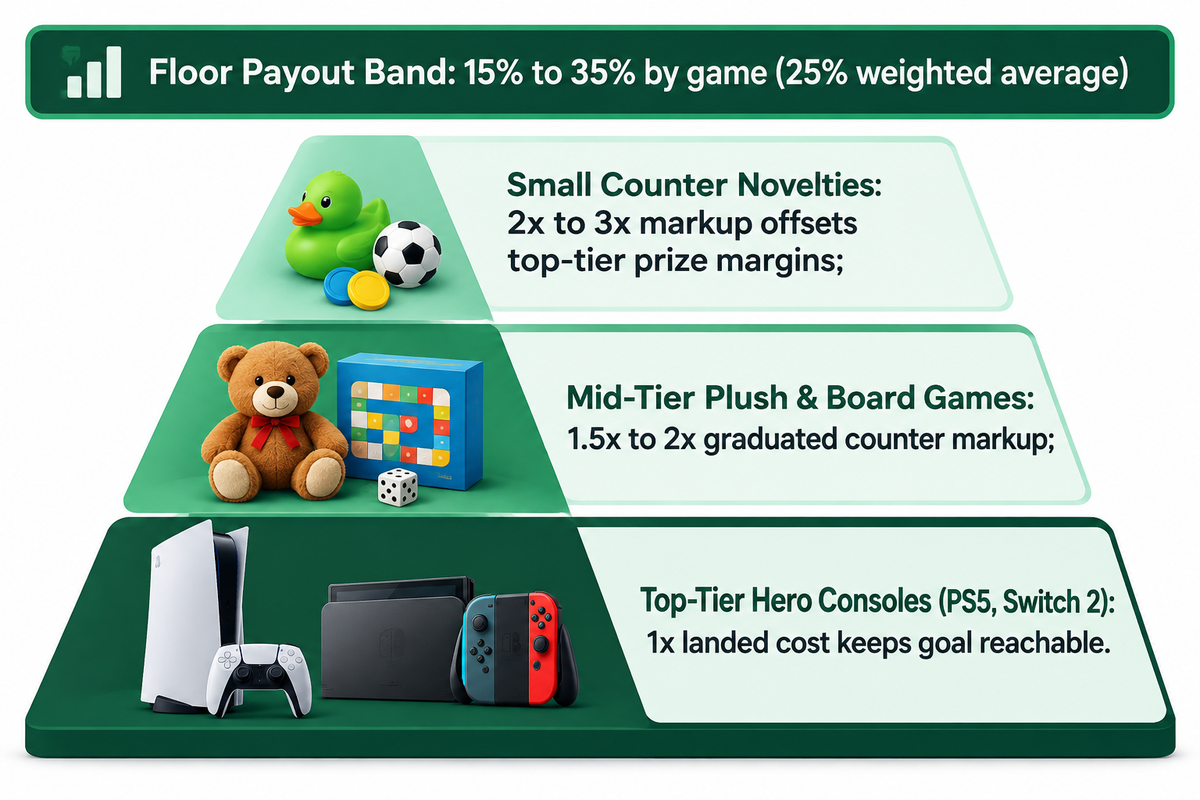
What tricks do you use to keep the prizes that people strive to win exciting without draining your wallet due to high COGS? Betson Enterprises’ arcade revenue guide suggests a graduated redemption counter mark-up. Small counter novelties should be marked up 2x to 3x, and mid-tier plush or board games should be priced at 1.5x to 2x. Top-tier prizes like PlayStation 5 (PS5) consoles should be marked up 1x. You can apply that same 1x markup to a Nintendo Switch 2 system at the prize counter.
Worked Example: Published Per-Play & $10 Spend Payout Audits
Operators can verify machine settings using two publicly available industry calculations from Skyfun and Betson Enterprises. These calculations show what a gross arcade prize margin looks like before other costs such as rent and payroll.
- According to Skyfun’s per play payout example, a game sold at $2.00 per play with a 20% target prize-cost ratio affords $0.40 prize cost per play (i.e., $2.00 × 0.20 = $0.40).
- Using Skyfun’s formula, if an internal landed ticket cost is $0.02 per ticket, that $0.40 prize budget would yield an average emission of 20 tickets per play (i.e., $0.40 ÷ $0.02 = 20 tickets).
- In Betson’s $10 spend example, if a game room targets a 25% to 35% payout with $0.01 ticket value, 300 tickets would be dispensed per $10 spend (i.e., $3.00 prize value ÷ $10.00 spend = 30% gross payout).
- For equipment depreciation, Frank Seninsky notes an ICE Cyclone purchased new for $4,000 and sold used after 8 years for $2,000 carries a net capital cost of $250 per year.
| Ledger Metric / Control Layer | Target Operating Band | Formula / Field Verification Rule | Margin Impact if Misconfigured |
|---|---|---|---|
| 1. Realized Cash per Swipe | Verified from card-system reports | Cash collected ÷ plays funded by paid and bonus credits | With a 25% credit bonus and unchanged price and prize cost per play, the prize-cost-to-cash-revenue ratio rises by 25% relative to its original level |
| 2. Mercy Ticket Floor | Configured per cabinet model | Optional consolation ticket award on supported kiddie and wheel cabinets | Setting consolation tickets too low on toddler games discourages repeat family swipes |
| 3. Average Jackpot Tickets per Play | Tracked per measurement period | Total jackpot tickets awarded during the measurement period ÷ total plays during that period | Loose optical timing windows let skilled players drain progressive jackpots |
| 4. Landed Cost per Ticket | $0.005–$0.02 per ticket ($0.01 baseline) | (Wholesale prize cost + freight, customs duties, storage, and shrinkage) ÷ ticket price of item | Palm Fun notes that ignoring freight and shrinkage understates real prize COGS |
| 5. Unredeemed Ticket Breakage | Paper souvenirs vs. deferred RFID | 1 − (Tickets permanently redeemed ÷ Total tickets issued) | Tickets held on e-ticket cards for future visits remain a deferred redemption liability |
| 6. Gross Operating Area per Game | Model footprint + player & aisle zone | Cabinet footprint + player zone + ADA § 403.5 36-inch minimum clear aisle width | Narrowing aisles below 36 inches blocks wheelchair and stroller circulation |
| 7. Equipment Procurement Channel | Request project quote by cabinet mix | Blend domestic marquee cabinets with factory-direct container consolidation | Compare landed container freight and warranty support against domestic distributor pricing |
| 8. Impulse & Mid-Tier Counter Markup | 2x–3x (small) / 1.5x–2x (mid) | Graduated counter markup recommended by Betson Enterprises | Higher markup on small impulse novelties offsets lower margins on top-tier prizes |
| 9. Hero Console Prize Tier Markup | 1x landed cost | High-end electronics (PS5, Xbox Series X|S, Nintendo Switch 2) | Pricing hero consoles at 1x keeps aspirational display items achievable for repeat players |
Paper Ticket Dispensers vs. Cashless e-Ticket Card Systems and Self-Service Kiosks
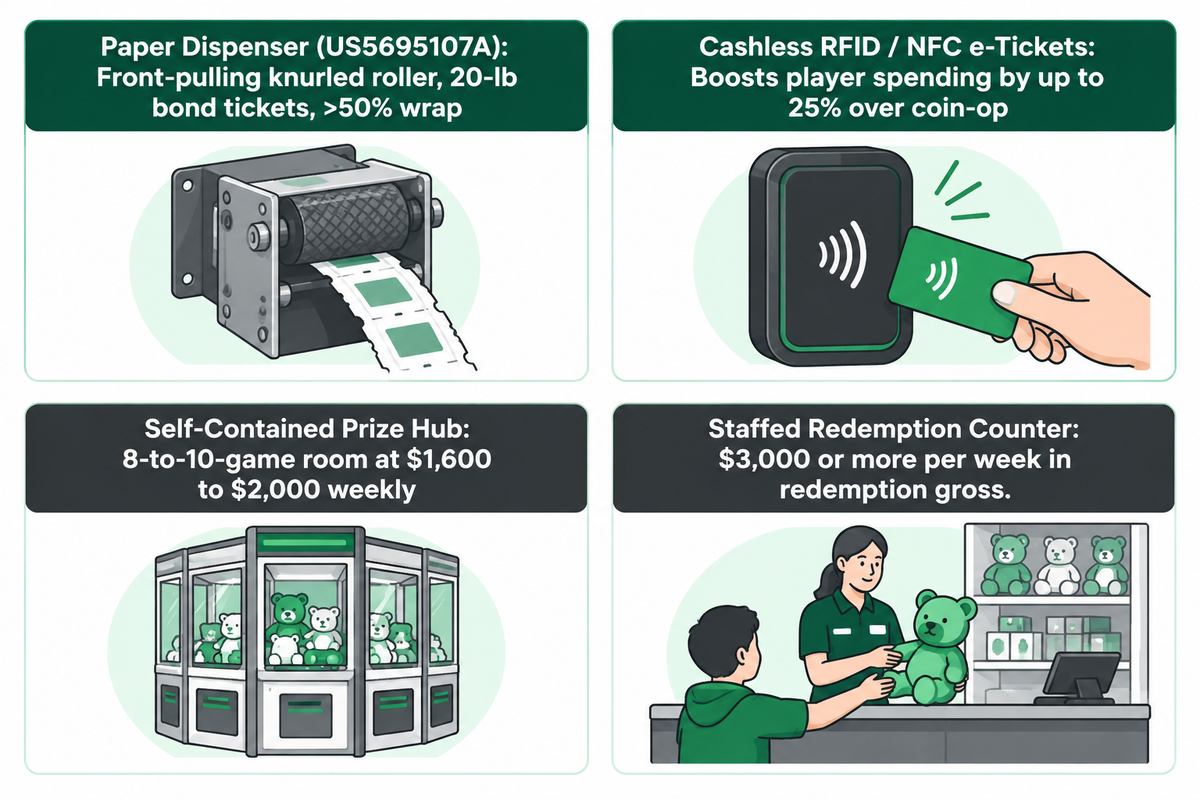
Paper ticket dispensers suit smaller game rooms where young children enjoy holding physical paper ticket strips. Cashless e-ticket card systems eliminate paper jams and are directly linked to automated kiosks. According to Jiami Games, cashless RFID and e-ticket systems boost player spending by up to 25% as compared to coin-op play. Frank Seninsky reports in the Vending Times that an 8-to-10-game room producing $1,600 to $2,000 weekly is sufficient to support a self-contained prize hub, while $3,000 per week is sufficient to support a staffed counter.
Why do paper tickets jam under heavy weekend traffic? USPTO Patent US5695107A (Ticket Dispenser with Ticket Guide and Drag Mechanism) explains the mechanical geometry. Early arcade dispensers pushed stiff 80-to-100-lb cardstock tickets from rear pinch rollers. Modern dispensers pull thin 20-lb bond paper tickets from the front using a knurled metal drive roller with over 50% wrap. A leaf-spring drag shoe maintains tension while an infrared optical sensor behind the exit slot counts center-punched notches. Arcade technicians on Reddit’s r/arcade maintenance threads note that paper cellulose dust coats those optical sensors and cutter blades. Regular compressed-air cleaning prevents runaway dispenses and accordion jams.
Should a New FEC Use Paper Ticket Dispensers or a Cashless e-Ticket Card System?
A family entertainment center generating $3,000 or more per week in redemption gross can support a staffed redemption counter. Smaller 8-to-10-machine rooms generating $1,600 to $2,000 per week can pair paper tickets or e-tickets with a self-contained prize hub. Jiami Games reports that cashless RFID, iOS, or Android NFC e-ticket systems lift guest spending by up to 25%. Cloud-connected card readers also get free upgrades for tap firmware on the latest mobile devices. In Vending Times , Frank Seninsky says self-contained hubs serve 8-to-10 game centers without the need for a redemption counter payroll. Examples include Tickets to Prizes by Benchmark, Prize Center by Smart Industries and Prize Hub by Bay Tek.
| Comparison Dimension | Mechanical Paper Ticket Dispenser | Cashless RFID / NFC e-Ticket System |
|---|---|---|
| Cashless Reader Interface | Front-pulling knurled roller + optical notch sensor (US5695107A) + ticket eater | On a compatible dispenser-emulation connection, the reader receives the cabinet’s ticket-control signal and returns ticket-count pulses to the cabinet |
| Consumable Media | 20-lb bond fanfold paper ticket bricks (unit cost varies by order volume) | Reusable RFID player cards or wristbands (unit cost varies by chip type and order volume) |
| Primary Failure Mode | Paper dust and LED glare on optical sensors; humidity causing rubber roller slip | Wireless access point drop or mismatched voltage/signal polarity during retrofits |
| Revenue Impact | Tactile paper strips favored by young children; requires manual brick refills | Up to 25% higher player spend over coin-op via package reloads and zero ticket-jam downtime |
| Prize Fulfillment Thresholds | 8–10 games ($1,600–$2,000/wk): automated prize hub | $3,000+/wk redemption gross: staffed showcase & slatwall counter |
How to Zone an Arcade Redemption Floor Next to an Indoor Playground or Trampoline Park
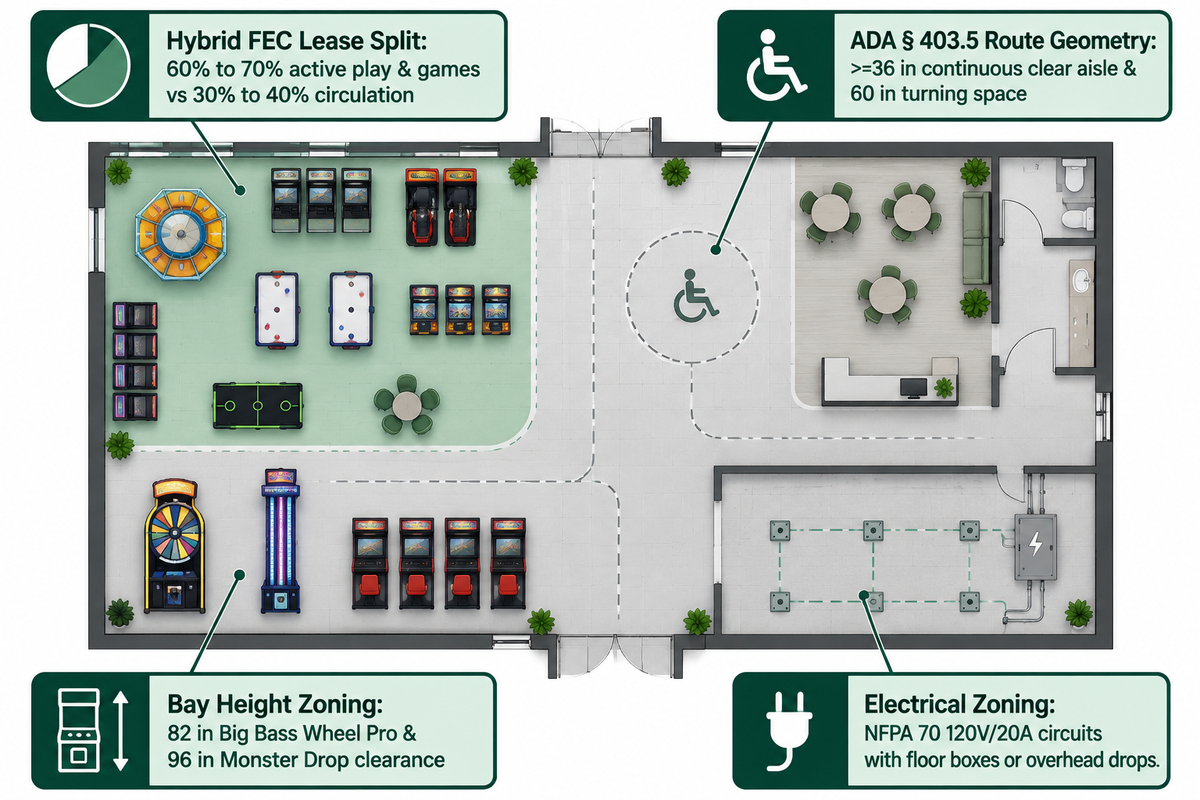
When zoning an arcade redemption floor next to a ASTM F1918 soft playground or a ASTM F2970 trampoline park, match the footprint and height of each cabinet to your floor plan. Provide a continuous, unobstructed aisle width of 36 inches (§ 403.5). Circular wheelchair turning spaces must have a minimum diameter of 60 inches; a compliant T-shaped layout is another option. Passing spaces can use a 60-inch-square clear space or a compliant T-shaped intersection.
Hybrid family entertainment centers designed by Dreamland Playground allocate 60% to 70% of their gross lease area to active play and game attractions. The remaining 30% to 40% is used for ADA circulation paths, shoe-change benches, party rooms, restrooms, and prize storage. You can test your building shell ratio before ordering machines, using our usable area and occupant load calculator. Once your area and occupant load are determined, use our FEC floor plan design and attraction mix guide to determine the best placement of your attractions.
How Much Space, Clear Height, and Electrical Power Does an FEC Redemption Zone Need?
An FEC redemption zone requires a per-cabinet floor allowance covering the machine footprint, player stance, and 36-inch minimum ADA aisle width. Installation space also accommodates player use, top-mounted accessories, and rear service access. Branch circuits installed under NFPA 70 must be sized for continuous and noncontinuous cabinet loads. Check your ceiling heights with our clear height and level count checker and follow four site zoning rules:
- Cabinet height varies across models. For example: 82 inches for Big Bass Wheel Pro and 96 inches for Monster Drop. Installation clearance allows for player use and access to upper mounted gear as well as service access. Place tall arcade cabinets in bays with adequate overhead clearance outside ASTM F1918 soft play and ASTM F2970 trampoline safety zones.
- Place low-deck parent-child redemption tables near the perimeter fence that demarcates the soft play area from the party corridor. Tables should be situated along the sock-to-shoe transition buffer. Parents sitting on viewing benches in the soft play area should have clear lines of sight to both the party corridor and the redemption tables where children are tapping their game cards.
- For U.S. electrical installations, an ANSI/UL 22 certification from an OSHA-recognized testing laboratory, attests to the compliance of the covered machine with that standard. The installation of wiring is governed by NFPA 70. Size each 120V/20A circuit for continuous and non-continuous loads, and use recessed floor boxes or overhead drops for island pushers.
- At the main check-in lobby, orient the redemption prize wall so illuminated glass cases holding aspirational prizes (such as 4K resolution monitors with HDR support) face the entry desk. Incoming families notice a number of enhancements when you add bright showcase lighting, and they immediately see the reward for choosing a higher card tier.
Skill vs. Chance Compliance, Sourcing Channels, and Maintenance Pitfalls to Avoid
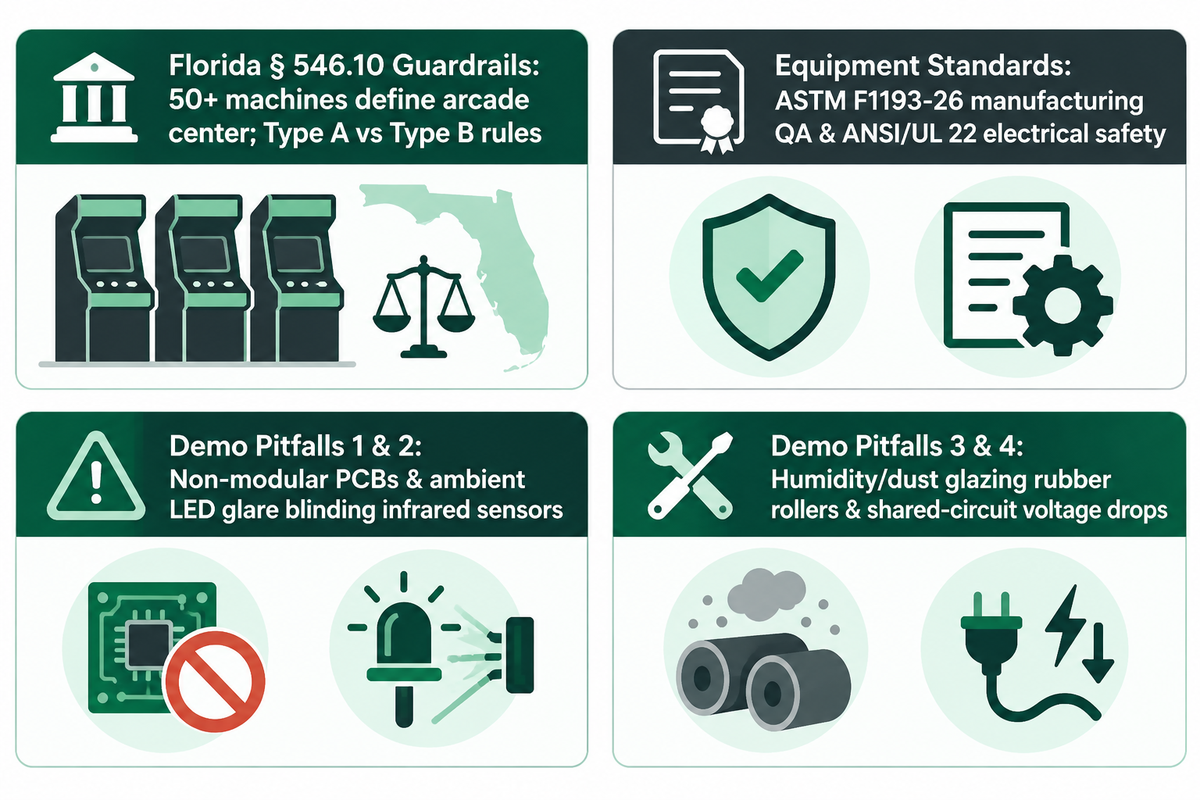
Before operating commercial redemption machines, venue owners review applicable state skill-versus-chance amusement laws and relevant equipment standards. They typically post equipment standards, and instructional materials about game operation, along with required warnings to address consumer protection. ASTM F1193-26 speaks to the quality, manufacture, and construction of amusement rides and devices, while ANSI/UL 22 speaks to the electrical safety of amusement and gaming machines. Buyers should also inspect modular PCBs and optical ticket sensors during factory demonstrations. Enabling auto-adjusting win-ratio firmware or placing Type B machines in ineligible venues can reclassify arcade games as unlawful gambling devices.
1. Statutory Skill-vs.-Chance Guardrails (Florida § 546.10, Texas § 47.01, and Casino EGD Rules)
Florida amusement statutes place strict, technical barriers between legitimate family skill-redemption games and illegal slot or eight-liner machines. Florida Statutes Section 546.10 (Family Amusement Games Act) mentions three particular statutory rules that are overlooked by generic vendor blogs:
- Section 546.10(3)(a) and (b) segregate Type A and Type B machines in Florida. Under Florida law, a business is an “arcade amusement center” if it operates 50 or more coin-operated amusement machines, and Section 546.10(6)(a) restricts the type of venues that can have Type B machines.
- Section 546.10(3)(e) enforces a ban on win/loss ratio manipulation by prohibiting any “material element of chance” in skill machines.
- State and municipal codes such as Texas Penal Code Section 47.01(4)(B) and Port Arthur’s 2026 eight-liner ordinance prohibit cash or cash equivalent payouts. Keeping pure skill settings and non-cash merchandise caps also aligns with standard amusement underwriter rules when budgeting indoor playground insurance cost by venue size.
2. Manufacturing QA (ASTM F1193-26) and 4 Field Maintenance Pitfalls to Avoid
A manufacturer’s quality assurance program aligning with ASTM F1193-26 (Standard Practice for Quality, Manufacture, and Construction of Amusement Rides and Devices) is desirable when sourcing rides and amusement devices and integrated FEC packages. ASTM International published the active F1193-26 edition in September 2026. For turnkey hybrid venues, coordinate the delivery of your arcade games with your custom ASTM F1918 playground build schedule. Make sure container shipments are aligned with your site development schedule.
Common Mistake: Accepting Non-Modular Mainboards and Skipping Open-Door Sensor Tests
A demo audit of four common floor failures in the ticket redemption industry available at Palm Fun’s website, outlines several expensive pitfalls that buyers experience in a showroom. First, the use of integrated, non-modular PCBs, means that you must replace the entire mainboard when a single motor driver fails. Second, ambient LED spotlight glare blinds infrared optical ticket sensors whenever service doors are opened. Third, humidity and paper dust glaze rubber drive rollers until tickets slip and trigger false empty alarms. Fourth, shared circuit voltage drops during motor start-ups, reset the logic, or cause ghost ticket dispenses. Always specify modular I/O driver boards, shielded optical notch sensors, and dedicated surge-protected power supplies.
Frequently Asked Questions About Commercial Arcade Redemption Games
1. What is the difference between a ticket redemption game and a prize merchandiser?
Ticket redemption games provide paper tickets or digital tickets for later exchange at a prize counter, while prize merchandisers hold merchandise for immediate redemption. Repeat play ticket games build customer loyalty and increase card swipes. Prizes from prize merchandisers, by comparison, are immediately available from the gamefield.
2. What is a healthy ticket payout percentage for a family entertainment center arcade?
Frank Seninsky reports in Vending Times that commercial operators set ticket payouts between 15% and 35% by game for a 25% weighted average, while Palm Fun cites an 18% to 24% CenterEdge benchmark at a $0.01 ticket value. Under a mathematical model, a 25% nominal prize-cost ratio with 15% permanent paper-ticket breakage yields a 21.25% realized prize-cost ratio; tickets held for future redemption aren’t permanent breakage.
3. Are arcade coin pushers and ticket redemption games legal in all US states?
In most U.S. jurisdictions, skill-based ticket redemption machines that award non-cash merchandise prizes within statutory limits are legal, including under Florida Statutes Section 546.10. Restrictive regulations vary across states and municipalities. Rotary coin pushers are restricted unless configured as a compliant skill game. Machines that pay out cash or gift cards are in violation of gambling laws.
4. How do operators estimate how many redemption games fit in an arcade room?
Operators divide usable floor area by each model’s footprint plus player stance, rear service clearance, ADA § 403.5, a minimum of 36″ aisles, and compliant wheelchair turning and passing spaces.
5. Can existing paper-ticket arcade machines be converted to cashless card readers?
Yes, most commercial ticket machines use a standard coin-and-ticket pulse wiring loom. With a dispenser emulation connection, technicians disable the paper dispenser and connect an RFID e-ticket reader.
Plan Your Hybrid Indoor Playground & Arcade Redemption Layout
Opening a family entertainment center or arcade? Check out our easy to follow guide on starting a family entertainment center. You can also forward your CAD building shell to Dreamland Playground for a custom 3D zone layout and equipment plan.
References & Sources
- U.S. Occupational Safety and Health Administration (OSHA) / Federal Register: NRTL Program Recognition Including ANSI/UL 22 Standard for Amusement and Gaming Machines
- The Florida Senate: Florida Statutes § 546.10: Family Amusement Games Act (Type A & Type B Skill-Based Amusement Machines)
- Illinois General Assembly Joint Committee on Administrative Rules (JCAR): (86 Ill. Adm. Code Part 3000 (§ 3000.615 Payout Percentage for Electronic Gaming Devices))
- U.S. Access Board: (ADA Standards Chapter 4: Accessible Routes (§ 403.5 Clear Width Guidelines))
- ASTM International: (ASTM F1193-26: Standard Practice for Quality, Manufacture, and Construction of Amusement Rides and Devices (Active 2026 Edition))
- United States Patent and Trademark Office (USPTO) / Google Patents: (U.S. Patent No. 5,695,107 (Ticket Dispenser with Ticket Guide and Drag Mechanism for Use with Thin Tickets))
- Vending Times (Frank Seninsky, AEM / AMOA): (Adding Redemption Games to Route Operations: Payout Calibration and Prize Hub Thresholds)
- Betson Enterprises: How to Make More Money in Your Arcade Game Room: Payout Percentage & Counter Markup
- Legacy Distribution: (Bay Tek Big Bass Wheel Pro Commercial Redemption Cabinet Specifications)
- Dataintelo: Global Arcade Basketball Market (2025-2034 Forecast & Component Benchmarks)
- Fortune Business Insights: Commercial Arcade Table & Air Hockey Market Size, Share & Industry Analysis, By Type (Arcade Tables, Air Hockey)