Get in touch with Dreamland Playground Company

Family entertainment center financing uses U.S. Small Business Administration (SBA) loans up to $5,000,000, 12- to 72-month equipment leases, landlord tenant-improvement allowances, and 10% to 40% borrower cash equity so each asset class matches its collateral life and draw schedule. Unlike a municipal amusement park, which is a public bond-backed issue, a private family entertainment business must split real estate, leasehold buildout, anchored play structures, and high churn arcade hardware to create a successful family entertainment center without depleting opening cash.
| Funding Route | Primary Eligible FEC Assets | Statutory Cap or Typical Ticket | Repayment Term | Minimum Borrower Equity |
|---|---|---|---|---|
| SBA 7(a) Standard Loan | Leasehold buildout, mixed amusement equipment, kitchen equipment, and working capital | Up to $5,000,000 gross loan cap (75% guaranty above $150,000) | Up to 10 years (working capital/equipment); up to 25 years (real estate) | 10% minimum project equity under lender SOP 50 10 8 rules |
| SBA 504 CDC Debenture | Owner-occupied commercial real estate, ground-up construction, and long-life heavy machinery | Up to $5,000,000 CDC debenture ($5,500,000 for eligible energy/manufacturing projects) | 10, 20, or 25 years fixed-rate CDC debenture plus senior bank first lien | 10% base; 15% new business or single-purpose building; 20% if both apply (13 CFR 120.910) |
| $1 Buyout Capital Lease / EFA | Long-life bolted indoor playgrounds, trampoline frames, climbing walls, and bowling lanes | $25,000 to $400,000+ per equipment schedule (lower standalone caps for unseasoned startups) | 36 to 72 months fixed monthly payments with $1.00 purchase at maturity | 0% to 20% security deposit or advance rental payments based on credit tier |
| Fair Market Value (FMV) Lease | High-churn arcade cabinets, virtual reality simulators, redemption games, and card systems | $15,000 to $250,000 bundled game room schedules | 12 to 60 months with end-of-term return, renewal, or FMV purchase option | 1 to 2 advance monthly payments for established operators |
| Conventional Bank & Seller Note | Existing FEC acquisitions, real estate mortgages, and subordinated seller standby financing | Sized to 65% to 75% loan-to-value (LTV) on appraised real estate collateral | 5 to 10 years (business note) or 15 to 25 years (commercial mortgage) | 20% to 40% conventional cash down payment; seller standby note can offset up to half of SBA 7(a) 10% injection |
How Does Family Entertainment Center Financing Split Across the Capital Stack?
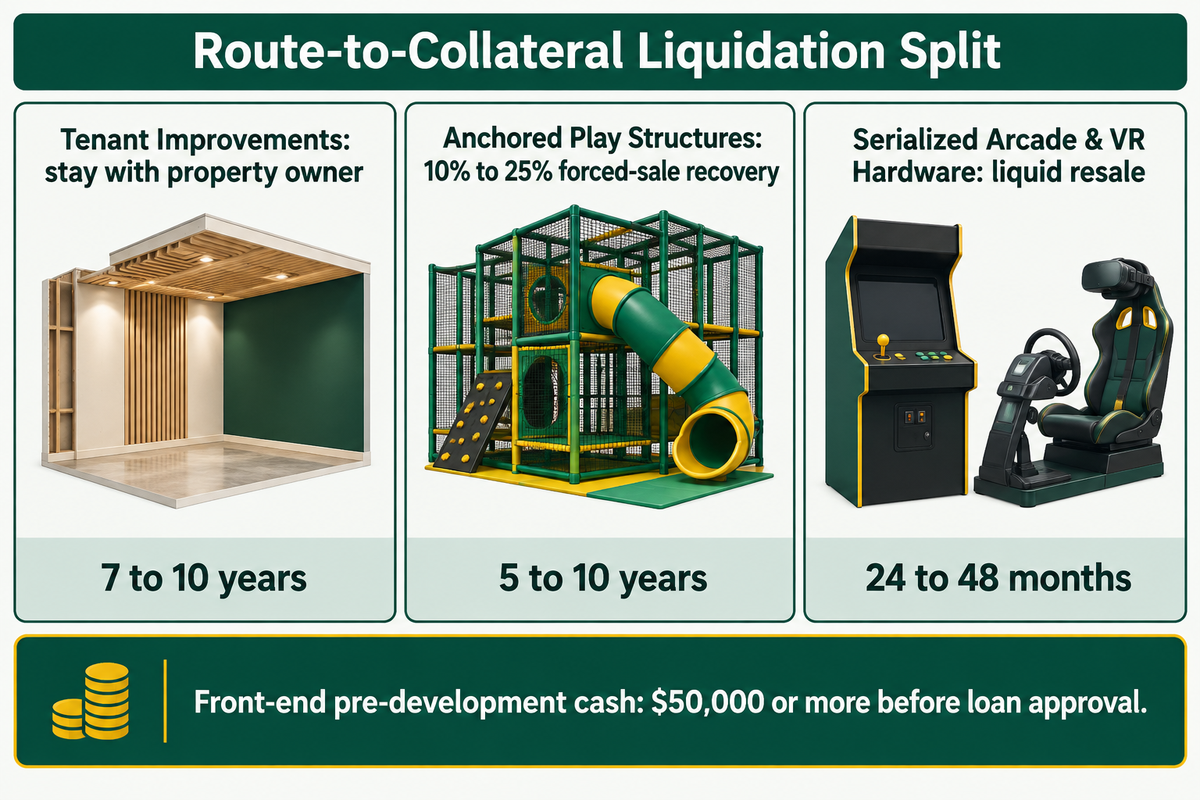
Family entertainment center financing separates into distinct collateral buckets because, in the eyes of commercial lenders, real estate and leasehold improvements, anchored play structures, and serialized arcade hardware, among other assets, have different values at liquidation. Matching each cost bucket to its corresponding financing options prevents long-term buildout costs from consuming working capital before the opening of the venue.
When business owners plan to start a family entertainment center, viewing the entire startup budget as a single borrowing request is the quickest way to get an underwriting decline. Every family entertainment center business plan must demonstrate to creditors what physical collateral supports each debt if the entertainment venue closes early. Heating, ventilating, and air conditioning systems, fire sprinkler systems, and other utility systems and improvements become the landlord’s property upon installation and offer zero removal recovery to an equipment lessor. An equipment lessor, however, may take serial-numbered arcade cabinets and point-of-sale equipment and unbolt them from the venue.
To control your overall cost of financing and structure a bankable center business plan, operators first itemize your FEC startup cost buckets by physical recovery class, then model your FEC capital stack across available business funding options so debt maturities match asset lifespans. According to the U.S. Small Business Administration 7(a) Loan Program, federal loan guarantees can package leasehold buildout, furniture, fixtures, equipment, and working capital up to a $5,000,000 statutory limit, whereas specialty equipment financing programs isolate tangible attraction hardware on 24- to 72-month schedules.
| Asset Category & Collateral Class (Route-to-Collateral Match Matrix) | Typical Cost Items | Lender Liquidation View | Best-Fit Funding Options | Target Maturity |
|---|---|---|---|---|
| 1. Real Estate & Building Shell | Land purchase, 15,000 to 40,000 sq ft building shell, parking lot, structural roof raising | High recovery if general-purpose; ~70% alternate-use value cap reported by FEC consultants for specialized shells | SBA 504 50/40/10 structure or 25-year SBA 7(a) commercial real estate loan | 20 to 25 years |
| 2. Landlord Tenant Improvements (TI) | HVAC tonnage upgrades, ESFR fire sprinklers, ADA restrooms, electrical subpanels, party rooms | Near-zero forced-sale recovery in leased retail shells; stays with property owner | Landlord tenant improvement allowance (TIA) paired with SBA 7(a) buildout tranche | 7 to 10 years (matched to initial lease term) |
| 3. Anchored Indoor Playground Structures | Multi-level steel play frames, fiberglass slides, soft-play toddler zones, safety netting | 10% to 25% forced-sale recovery due to custom column-grid geometry and dismantling labor | SBA 7(a) equipment tranche or $1 buyout capital lease paired with 30% borrower equity deposit | 5 to 10 years |
| 4. Trampoline Courts & Ninja Courses | ASTM F2970 trampoline beds, airbag pits, ninja warrior truss rigs, climbing walls | Low-to-moderate secondary recovery; requires engineering recertification upon relocation | SBA 7(a) term note or 48- to 60-month $1 buyout equipment finance agreement (EFA) | 4 to 7 years |
| 5. Bowling Alley Lanes & Mini Golf Courses | Synthetic bowling alley approaches, string pinsetters, modular miniature golf courses, LED props | Moderate recovery on pinsetters and scoring consoles; low recovery on custom theming | SBA 504 long-life machinery debenture (if 10+ year life) or 60- to 84-month EFA | 7 to 10 years |
| 6. Serialized Arcade Cabinets & VR Pods | Video simulators, redemption cranes, skee ball lanes, multiplayer virtual reality arenas | High liquid resale value through national coin-op distributors and game-room auctions | Fair Market Value (FMV) operating lease for rotation or 36- to 48-month equipment loan | 24 to 48 months |
| 7. Cashless Card Systems & POS Hardware | RFID wristband readers, self-serve kiosk towers, server racks, waiver check-in tablets | Rapid technology depreciation over 36 months; software licenses carry zero collateral value | 24- to 36-month vendor technology lease or SBA 7(a) equipment package | 24 to 36 months |
| 8. Commercial Kitchen Equipment & Cafe | Hoodless pizza ovens, walk-in coolers, espresso machines, stainless prep tables | Established secondary restaurant auction market; 30% to 50% recovery on standard models | $1 buyout restaurant equipment lease or SBA 7(a) FF&E allocation | 36 to 60 months |
| 9. Pre-Opening Soft Costs & Working Capital | Feasibility research, architectural/MEP stamps, permits, staff training, initial inventory, cash reserve | Zero tangible collateral recovery; underwritten strictly against borrower equity and cash flow | Borrower cash equity injection plus SBA 7(a) working capital loan sleeve | Equity (permanent) or 5 to 10 years (7a) |
Separating equipment from tenant improvement allowances protects your cash available at launch. In commercial retail leases, landlords reimburse negotiated tenant improvement allowances only after you complete construction, pass municipal occupancy inspections, and deliver unconditional contractor lien waivers. According to leisure feasibility consultants at White Hutchinson, operators spend $50,000 or more in front-end money for architectural drawings, market analysis, and lease deposits before a primary construction loan is approved. A dedicated working capital reserve ensures holdback funds don’t constrain pre-opening marketing and payroll.
SBA 7(a) vs. SBA 504 Loans for Family Entertainment Centers
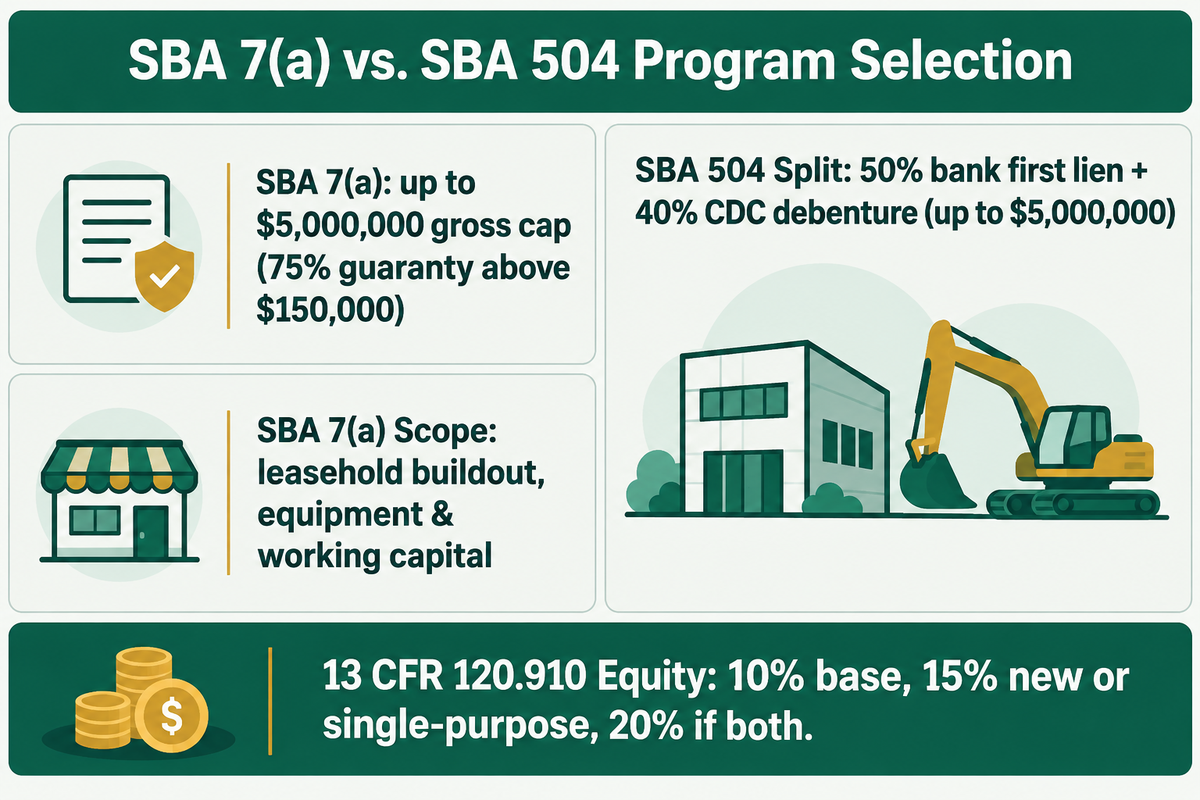
Choose an SBA 7(a) loan when your family entertainment center leases space and needs working capital, FFE and equipment. An SBA 504 loan is best for the purchase of long-term heavy equipment or commercial real estate, where tighter use-of-proceeds rules are outweighed by a 20- or 25-year fixed-rate debenture.
While both programs are backed by the Small Business Administration, they serve different business development goals in the entertainment industry. According to the U.S. Small Business Administration SOP 50 10 Lender and Development Company Loan Programs, the 7(a) loan program allows participating lenders to advance up to a $5,000,000 gross loan maximum, with standard SBA guaranties covering up to 85% of general 7(a) loans of $150,000 or less and up to 75% of loans exceeding $150,000 (up to a maximum SBA guaranty exposure of $3,750,000). Because 7(a) proceeds can fund leasehold improvements, custom amusement equipment, furniture, fixtures, and a working capital loan under a single note, it’s the primary business loan for leased-box indoor playgrounds and family fun centers.
The U.S. Small Business Administration’s 504 Loan Program provides funds for the purchase of capital equipment and/or real estate for job-creating community economic development projects through a combination of a bank or credit union and a Certified Development Company (CDC) as described in 13 CFR § 120.862. In a standard 504 package, the business lender provides 50% of the project funds with a first lien mortgage or equipment security agreement, the CDC issues an SBA-guaranteed debenture for up to 40% of the project (limited to $5,000,000 for standard projects and $5,500,000 for qualifying energy public-policy projects), and the borrower contributes the balance of the equity.
“A 504 loan cannot be used for working capital or inventory, consolidating, repaying or refinancing debt, or speculation or investment in rental real estate.”
Source: U.S. Small Business Administration, 504 Loans Program Eligibility Guidelines
Operators must also verify statutory borrower contribution tiers before assuming a flat 10% down payment applies to an SBA 504 venue. Under 13 CFR § 120.910 (Borrower Contributions), the borrower must contribute at least 10% of the Project cost (excluding administrative costs) for an established general-purpose facility, at least 15% if the borrower is a new business (operating for 2 years or less), at least 15% if the Project involves a limited or single-purpose building or structure, and at least 20% when both conditions apply. Purpose-built bowling centers, indoor waterparks, or specialized entertainment complexes frequently trigger the 15% or 20% equity tier, and 13 CFR § 120.910(b) bars borrowers from using another SBA business loan program to fund that required 504 contribution.
That legal restriction doesn’t mean that SBA 504 excludes all soft costs and leased land buildouts. As outlined in 13 CFR § 120.882 (Eligible Project Costs for 504 Loans), a 504 project budget can include directly attributable professional, architectural and engineering fees, interim bridge-loan costs of funds and fees, and a construction contingency reserve up to 10% of the construction cost, as well as qualified debt refinancing under § 120.882(g). In addition, 13 CFR § 120.870 permits 504 financing for building improvements on leased land if the lease term at least equals the debenture maturity and the CDC secures a valid collateral assignment. However, for retail shopping center leases where the land can’t be pledged and pre-opening working capital is needed for marketing, payroll and spare parts, an SBA 7(a) loan or a hybrid 7(a) plus equipment lease would be the best option.
| Program Parameter | SBA 7(a) Standard Loan | SBA 504 CDC Debenture Package |
|---|---|---|
| Maximum Statutory Limit | $5,000,000 gross loan ($3,750,000 max SBA guaranty) | $5,000,000 CDC debenture (40% piece); total project can exceed $12,000,000+ with bank first lien |
| Eligible Use of Proceeds | Real estate, retail leasehold buildout, equipment, inventory, business acquisition, and working capital | Owner-occupied real estate, heavy equipment (10+ year life), and attributable construction/soft costs (13 CFR 120.882) |
| Startup Working Capital & Inventory | Fully eligible inside the same loan package | Excluded on ground-up projects (requires separate 7(a) or conventional line) |
| Minimum Borrower Contribution | 10% minimum equity injection for startups and acquisitions under SOP 50 10 8 lender rules | 10% existing general-purpose; 15% new business OR single-purpose property; 20% if both apply (13 CFR 120.910) |
| Repayment Maturity | Up to 10 years for equipment/working capital; up to 25 years for real estate (blended maturity allowed) | 10 years for heavy machinery/equipment; 20 or 25 years for real estate debentures |
| Interest Rate Structure | Variable (tied to Prime Rate plus SBA spread cap) or fixed per lender negotiation | CDC debenture locked at fixed rate tied to U.S. Treasury rates; senior bank first lien negotiated separately |
| Prepayment Penalty Horizon | None if maturity is under 15 years; 3-year step-down (5% / 3% / 1%) if maturity is 15 years or longer | Declining prepayment penalty across the first 10 years on 20- and 25-year debentures (5 years on 10-year notes) |
| Collateral & Guaranty Rules | First lien on financed assets plus available personal real estate if collateral shortfall exists; 20%+ owners sign Form 148 | Senior bank holds 1st lien (50% LTV); SBA/CDC holds 2nd lien (40% LTV) on project assets; 20%+ owners sign personal guarantees |
Equipment Financing and Leasing for Playgrounds, Arcades, and Attractions
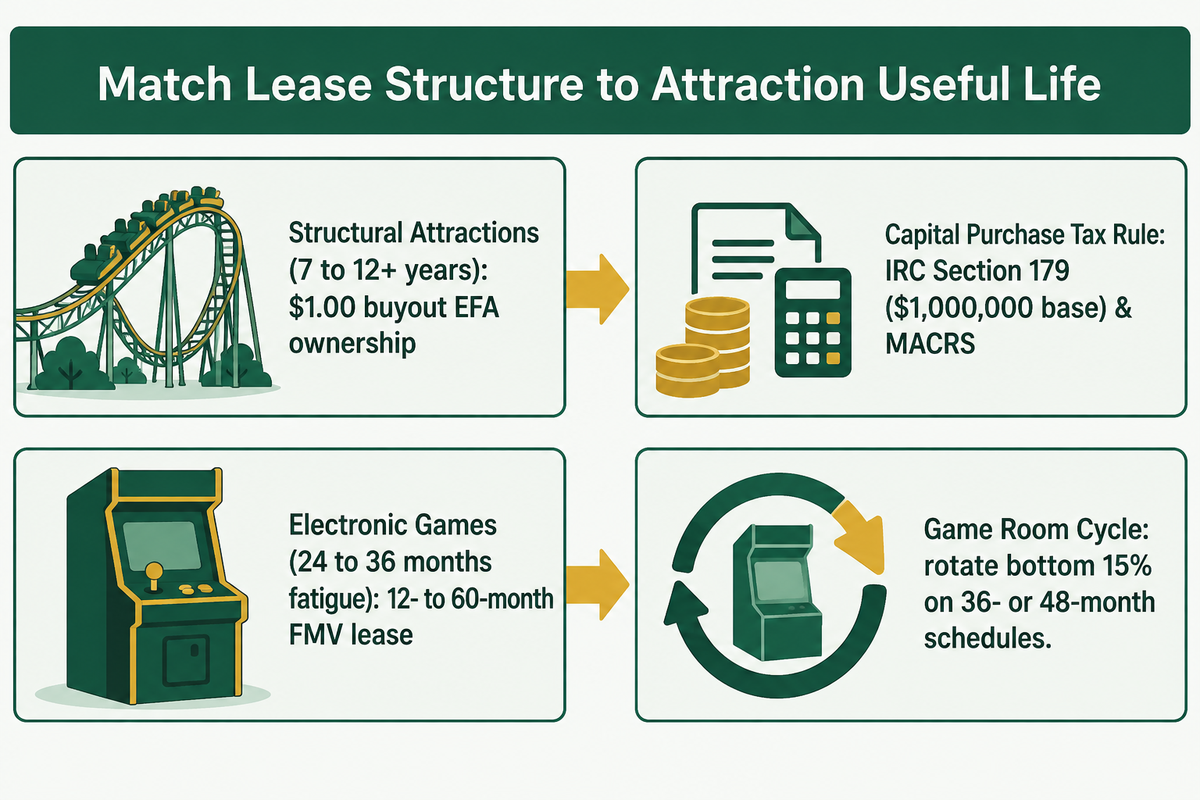
Use a $1 buyout capital lease or equipment finance agreement (EFA) for long-life structural attractions, such as an indoor playground or climbing wall, or a bowling alley, which have an economic useful life of seven to ten years. Use a fair market value (FMV) operating lease for arcade machines, which are fast-depreciating items, like cabinets or a VR unit, which require periodic game room replacements.
ELFA contract guidelines match the useful life and obsolescence rates of attraction hardware to an asset class in your entertainment center business. In the family entertainment industry, attraction hardware divides into two distinct depreciation profiles:
-
✔
Structural & Anchored Attractions ($1 Buyout Lease / Equipment Loans): Multi-level soft-play structures, child activity zones, trampoline courts, toddler edutainment center modules, indoor mini golf obstacles, and string-pin bowling alley packages have a service life of 7 to 12+ years. Because you’ll never return a custom-fitted play structure at the end of the term, an EFA or $1 buyout financing agreement gives you full ownership at maturity for $1.00 instead of buying the equipment outright with cash. -
✔
High-Churn Electronic Attractions (FMV Operating Lease): Video simulators, virtual reality arenas, and novelty redemption cranes experience rapid player fatigue after 24 to 36 months. Under ELFA lease classifications, an FMV lease lets the lessor price residual value into the contract, lowering monthly payments across 12- to 60-month schedules (commercial equipment lenders such as Pathward offer 12- to 60-month FMV terms) and letting operators return, swap, or purchase the arcade cabinet at fair market value when the lease expires.
One of the most expensive structuring mistakes in the amusement industry is placing three-year high-rotation video games within a ten-year SBA note. By year four, a dated simulator generates a fraction of its initial foot traffic and customer retention, and you still owe six years of principal and interest on the machine. Keeping your game room on a separate 36- or 48-month equipment replacement cycle allows you to rotate the bottom 15% of underperforming games for future releases, without having to refinance your building debt.
There are also differences in tax treatment based on the structure of the contract. Under Internal Revenue Service Publication 946 (How To Depreciate Property), qualifying tangible business equipment financed through an equipment loan, EFA, or conditional $1 buyout capital lease is treated as a capital purchase eligible for IRC Section 179 immediate expensing (statutory base limit of $1,000,000, indexed annually for inflation) and MACRS depreciation. True fair market value operating lease payments are deducted as monthly rental expenses, preserving balance-sheet borrowing capacity when considering competing financing offers.
What Equity Injection, Collateral, and DSCR Do FEC Lenders Require?
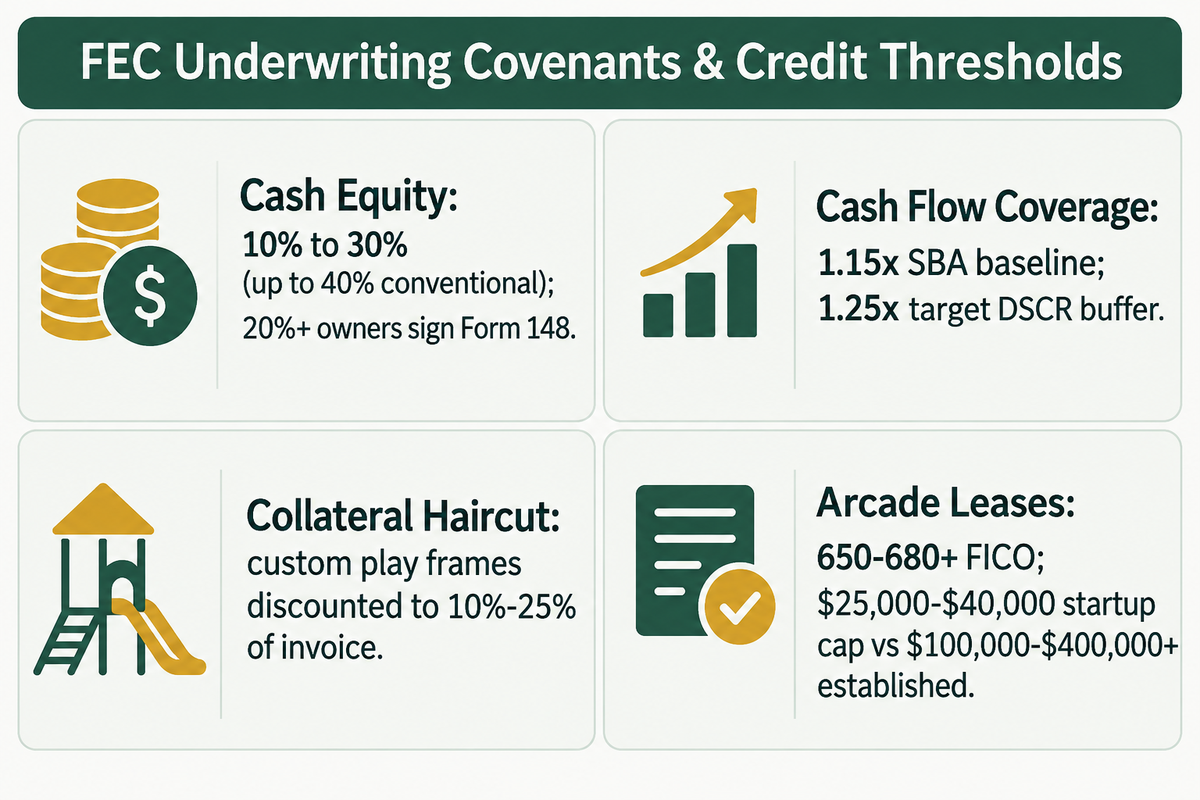
Most family entertainment center lenders require a 10% to 30% borrower cash equity injection (up to 40% for conventional startup real estate loans), a minimum projected debt service coverage ratio (DSCR) of 1.15x to 1.25x, unlimited personal guarantees from all 20%+ owners, and a first-priority UCC-1 or mortgage lien on project assets.
Under 13 CFR § 120.102 and SBA SOP 50 10 8 underwriting standards, repayment ability from the cash flow of the small business is the primary consideration for any loan approval, while 13 CFR § 120.110 screens out passive or speculative ventures. While the SBA sets a baseline minimum DSCR of 1.15x on historical or projected net operating income, commercial bank credit committees and SBA lenders such as Live Oak Bank target a 1.25x or higher coverage buffer for startups in the hospitality and entertainment sector. Before submitting an application process package, operators should build monthly indoor playground financial projections backed by local demographic data that show how admissions, birthday parties, and food service cover debt service even after a 15% revenue haircut.
⚠️ Why Custom Playgrounds Face Collateral Haircuts
Many lenders discount the forced-liquidation value of custom-built indoor playground structures, ninja warrior rigs, and themed buildouts to 10%-25% of the invoice price when underwriting collateral coverage. Compared to a standardized redemption game that can be wheeled onto a liftgate, a site-specific steel play frame engineered to your building’s column grid costs considerably more to dismantle, transport, and re-certify. Should your collateral package leave a shortfall after those discounts, liens on the personal real estate of the guarantors are required by SBA lenders.
Being able to forecast when lenders will require an equity injection helps avoid surprises at the commitment letter stage. NerdWallet and specialized amusement brokers summarizing commercial lending state the SBA 7(a) program requires a 10% cash down payment minimum. Commercial lending summaries from NerdWallet and specialty amusement brokers note that while SBA 7(a) permits a 10% minimum cash down payment, conventional bank financing for a new family entertainment center demands 20% to 40% borrower equity when the founders lack a proven track record in multi-unit hospitality. Any individual or investor owning 20% or more of the project must sign an unconditional personal guarantee (SBA Form 148). Spousal guarantees are required if personal assets held jointly by spouses are pledged as collateral.
What Credit Score Do I Need to Finance Arcade Equipment?
Specialty amusement equipment leases span dollar-out buyouts and fair market value (FMV) leases. Specialty amusement equipment lenders look for a personal FICO score of 650 to 680+ for standard $1 buyout or FMV lease programs, while top-tier rates and zero-down “application-only” approvals up to $150,000 or $250,000 require a 700+ personal credit score and at least two years of time in business. For SBA 7(a) loans up to $500,000, the SBA uses the FICO Small Business Scoring Service (SBSS), which blends personal credit, business credit bureau files, and financial statements. The SBSS combines elements of all the major credit bureaus. Arcade equipment leases may extend credit to borrowers with a personal credit score between 620 and 650 by requiring a 15% to 25% security deposit, a shorter 24 to 36 month funding terms schedule, or a creditworthy guarantor.
Can a Brand-New Arcade Qualify for Financing?
Yes, a brand-new arcade can qualify for equipment loans or leases, but startup programs cap single-lender exposure much tighter than established-operator facilities. According to industry finance disclosures published by FamilyEntertainmentCenter.com, standalone startup equipment lease approvals without prior operating history cap around $25,000 to $40,000 per lessor unless the operator bundles the arcade package inside an SBA 7(a) loan or pledges additional collateral. By contrast, an amusement operator with 2+ years of operating history can finance $100,000 to $400,000+ of new arcade cabinets across multiple syndication desks. According to arcade supplier PrimeTime Amusements, equipping a modern commercial game room runs $8,000 to $12,000 per machine (roughly $200 to $300 per square foot of arcade floor space), meaning a 40-game startup room usually combines an SBA 7(a) core loan with one or two supplemental equipment leases.
Coordinate Equipment Deposit Milestones with Lender Draw Schedules
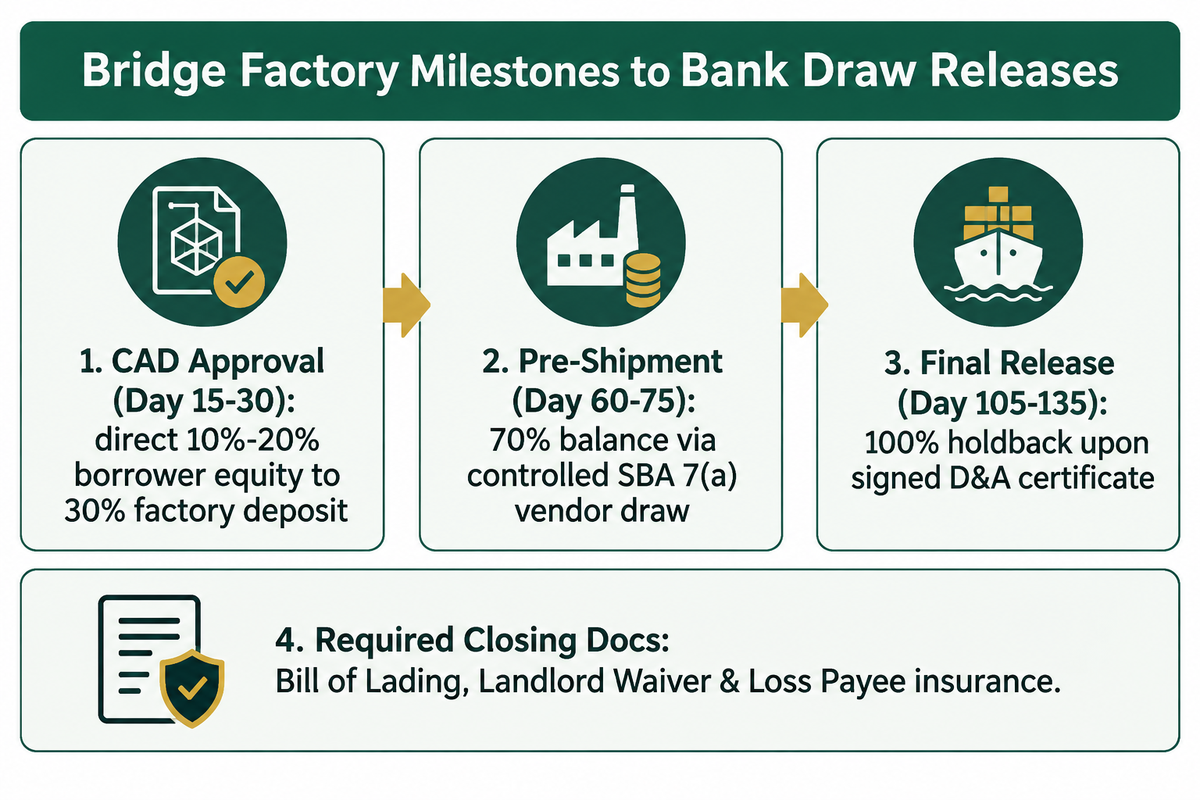
Custom commercial playground equipment manufacturers require a 30% production deposit upon approval of their CAD layout, and the remaining 70% balance upon shipment. In contrast, banks and equipment lessors in the U.S. disburse funds only upon the equipment’s arrival on site. Mapping equity cash flow to factory deposits prevents a mid-buildout manufacturing freeze.
One of the most frequent construction bottlenecks in family entertainment center financing happens ninety days prior to grand opening. You would have your SBA 7(a) loan or equipment lease approved, signed your contract for your custom indoor playground, and sent the supplier’s 30% deposit to your bank loan closer, only to find out that the bank’s construction disbursement department won’t wire funds for unbuilt equipment sitting on a factory floor overseas or out of state.
When securing progress draws, commercial lenders won’t issue pre-delivery wires because an unfinished custom play frame can’t be repossessed until it’s fabricated, cleared through customs, and delivered to your leased space. A business lender agreeing to fund progress draws will require, prior to final release, a commercial bill of lading/delivery acceptance certificate, and signed Landlord Waiver of Distraint (confirming the building landlord subordinates any statutory lien on your attraction equipment) and your commercial playground insurance documents naming the lender as Loss Payee and Additional Insured.
| Draw-Schedule Holdback Map Stage | Manufacturer / Contractor Milestone | Standard Lender Disbursement Policy | Borrower Cash Coordination Solution |
|---|---|---|---|
| Stage 1: Design & Engineering (Day 0–15) | 3D CAD floor plan sign-off, ASTM F1918/F1487 structural engineering review | 0% lender draw; loan is still in underwriting or closing checklist review | Pay design deposit from borrower cash; retain itemized paid receipts for SBA equity injection credit |
| Stage 2: Factory Production Start (Day 15–30) | 30% equipment manufacturing deposit required to cut steel and mold slides | Equipment lessors rarely fund >10%–25% pre-delivery without an interim funding rider; SBA banks require equity injected first | Allocate your mandatory 10%–20% borrower equity injection directly to the 30% factory deposit wire |
| Stage 3: Pre-Shipment Factory Balance (Day 60–75) | 70% balance due after factory test-assembly photos/video and before container loading | Domestic lenders hold funds until domestic port arrival or warehouse bill of lading unless pre-approved for factory escrow | Negotiate an SBA 7(a) controlled vendor draw backed by factory inspection photos, commercial invoice, and marine cargo insurance |
| Stage 4: Ocean/Domestic Freight & Customs (Day 75–105) | Freight forwarder duties, port drayage, and site unloading | Soft shipping costs are often excluded from standalone equipment leases unless bundled on a turnkey invoice | Fund freight/duty via SBA 7(a) working capital/installation tranche or turnkey delivered vendor billing |
| Stage 5: On-Site Installation & Final Acceptance (Day 105–135) | Installation crew completion, safety walk-through, and certificate of occupancy | 100% final equipment lease or construction holdback release upon signed Delivery & Acceptance (D&A) certificate | Deliver signed D&A, Landlord Waiver, and Loss Payee insurance binder 10 business days before final crew sign-off |
💡 Pro Tip: Direct Your Equity Injection to Factory Deposits
Because SBA lenders require you to spend your 10% to 20% borrower equity injection before the bank disburses loan funds, ask your loan closer to approve paying the playground manufacturer’s 30% production deposit from your borrower equity account. The closer should credit every dollar toward your equity injection, while leaving the bank’s construction draws available to domestic contractors and delivered hardware. Keep the wire transfer confirmation and commercial invoice, and a cleared bank statement to provide to the loan closer for equity injection credit.
Stress-Test Monthly Debt Service Against Ramp-Up and Seasonal Troughs
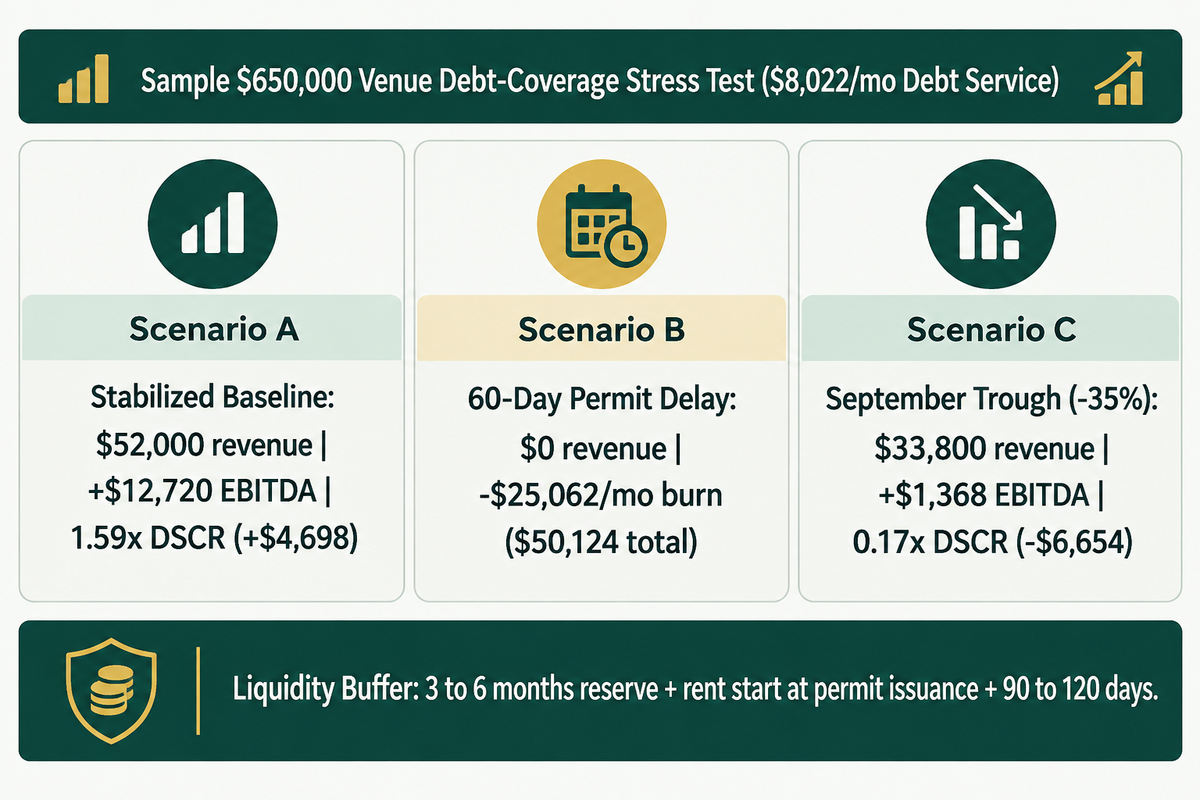
Averaging annual revenues downplays weekday seasonality and results in family entertainment center loan defaults. Stress testing your monthly debt service against a 60-day permit delay and a 35% September attendance trough shows if you have enough working capital to cover off-peak months and maintain a Debt Service Coverage Ratio (DSCR) of 1.00x or greater.
Vendor blogs often state that an indoor playcenter or family fun center gets an 18-24 month automatic payback on investment and that admissions cover rent while food and beverage sales automatically cover expenses. Lenders scoff at such assumptions. In the real world, occupancy costs, supervisory payroll, insurance, property tax and equipment loans are due on the first of the month regardless of school and weather calendars.
Whereas summer heatwaves, winter school breaks, and weekend birthday parties drive peak cash receipts, back-to-school weeks in September and October or post-holiday weeks in January regularly compress weekday foot traffic by 30% to 45%. Conversely, regular 30-45% compression of weekday foot traffic during Back-to-School weeks and post-holiday weeks drives declining sales. Most operators reviewing FEC revenue mix benchmarks build their capital stack to account for their weakest quarter, thereby ensuring their venues remain profitable to meet creditor covenants.
The Debt-Coverage Stress Ladder below models a sample $650,000 indoor playground and arcade project ($350,000 SBA 7(a) 10-year note at 10.5% interest = $4,723/month; $150,000 60-month $1 buyout equipment lease at 11.5% equivalent rate = $3,299/month; $150,000 borrower cash equity including $45,000 dedicated working capital reserve; total scheduled monthly debt service = $8,022/month) across three monthly operating conditions:
| Debt-Coverage Stress Ladder Metric (Sample $650k Venue) | Scenario A: Stabilized Baseline Month | Scenario B: 60-Day Permit / Construction Delay | Scenario C: Off-Peak September Trough (-35% Attendance) |
|---|---|---|---|
| Gross Monthly Venue Revenue (Admissions, Parties, Arcade, Cafe) | $52,000 | $0 (Venue closed awaiting final fire/occupancy sign-off) | $33,800 (65% of baseline attendance; stable average customer spend) |
| Cost of Goods Sold & Variable Party/Food Supplies (14%) | -$7,280 | $0 | -$4,732 |
| Fixed Base Rent, CAM, Property Tax & Insurance | -$14,500 | -$14,500 (Rent abatement expired; insurance active) | -$14,500 |
| Operating Payroll, Utilities, Marketing & Maintenance | -$17,500 | -$4,200 (Core manager salary + minimum utilities) | -$13,200 (Flexed weekday hourly staffing) |
| Net Operating Income (EBITDA Available for Debt Service) | +$12,720 | -$18,700 | +$1,368 |
| Scheduled Monthly Debt Service (SBA 7a + Equipment Lease) | $8,022 (Full P&I + Lease) | $6,362 (Interest-only SBA draw + active equipment lease) | $8,022 (Full P&I + Lease) |
| Monthly DSCR & Net Cash Impact on Reserve | 1.59x DSCR (+$4,698 net cash surplus) | Negative Coverage (-$25,062/mo burn; 60-day delay consumes $50,124) | 0.17x Monthly DSCR (-$6,654 cash deficit drawn from reserve) |
Even when an FEC business generates a healthy 1.59x DSCR during stabilized months, a 60-day municipal permitting or sprinkler inspection delay after your landlord rent-free period expires burns $50,124 in cash before the doors open. Also, an off-peak September month creates a $6,654 debt service shortfall even after cutting hourly staff. To secure the loan and help you secure enough liquidity to survive year-one ramp-up, build three to six months of fixed occupancy and debt payments into your SBA 7(a) working capital line, and negotiate landlord rent commencement tied to permit issuance plus 90 to 120 days rather than lease execution. Additionally, negotiate with landlords to delay the start of the rental payment to after permits are issued, plus 90 to 120 days, instead of the lease execution date.
How 2025–2026 Lending Scrutinizes New vs. Existing FEC Acquisitions
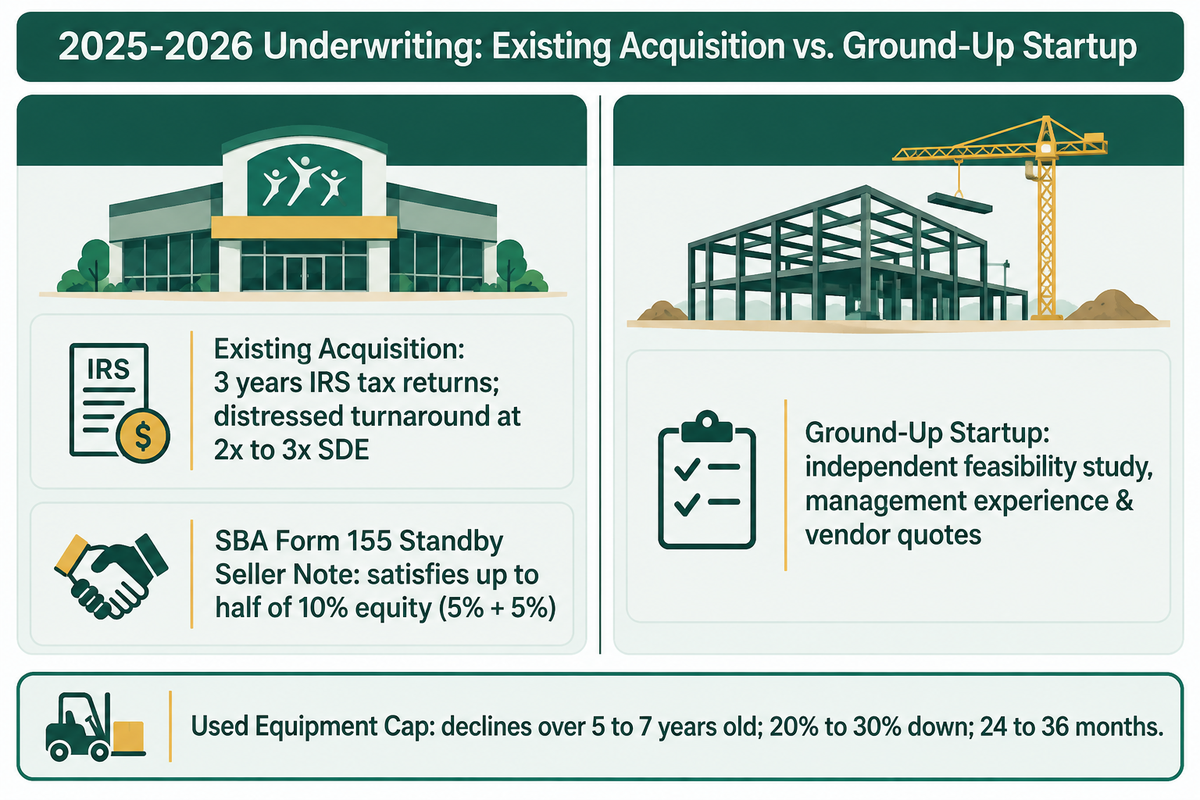
Between 2025 and 2026, commercial underwriters will evaluate existing FEC acquisitions against three years of filed federal tax returns and equipment obsolescence, while ground-up startups will be reviewed against independent feasibility studies and management industry experience. Neither route qualifies based on broker pro formas.
In the years 2025 and 2026, high commercial interest rates and strict bank credit committees caused the underwriting spread between purchasing an established business and building a new attraction from scratch to widen. Acquiring a family entertainment center and applying for an SBA loan enables lenders to size the maximum loan against the seller’s last three years of filed IRS tax returns and bank statements, excluding off-statement cash receipts or unsubstantiated broker add-backs. In practitioner valuation discussions among small business operators, buyers of underperforming venues determine the worth of aging centers primarily based on the liquidation value of depreciated equipment and remaining lease rights, typically spanning 2x to 3x Verifiable Net Seller Discretionary Earnings (SDE) for distressed turnaround scenarios.
To obtain an SBA 7(a) loan for a change-of-ownership, lender rules (summarized in SOP 50 10 8 and reiterated by SBA lenders, like Live Oak Bank) require a minimum 10% equity injection by the buyer. A seller promissory note can satisfy up to half of that required 10% injection (meaning 5 percentage points of total project cost from the buyer’s cash and 5 percentage points from the seller note) only if the seller note is placed on full standby for the entire life of the SBA loan via SBA Form 155. However, to allow the seller note to be fully standby, the note must be placed on SBA Form 155, for the full life of the SBA loan.
Ground-up startup company applications carry a higher burden of proof. Because a new venue has no prior tax returns, underwriters examine if the owners and operators have direct hospitality or multi-unit retail management experience, if the market demand and the targeted market demography support the projected attendance without cannibalizing other venues, and if the strong business plan is supported by written vendor quotes as opposed to square foot estimates.
Can I Finance the Purchase of a Used Ride or Attraction?
Financing used equipment is achievable, but commercial equipment lessors take a stricter stance on age, interest, and term for used equipment as compared to new factory warrantied equipment. Most equipment financing programs decline used arcade cabinets or rides over 5 to 7 years and require a 20 to 30 percent down payment and cap the term at 24 to 36 months. Separately, if you purchase a used mechanical ride, trampoline court, or play structure through an SBA 7(a) loan, your lender and liability insurance carrier require original manufacturer’s serial plates, structural safety inspections, and spare parts support to release the funds.
Prepare Your Itemized Equipment Quote Brief for Underwriters
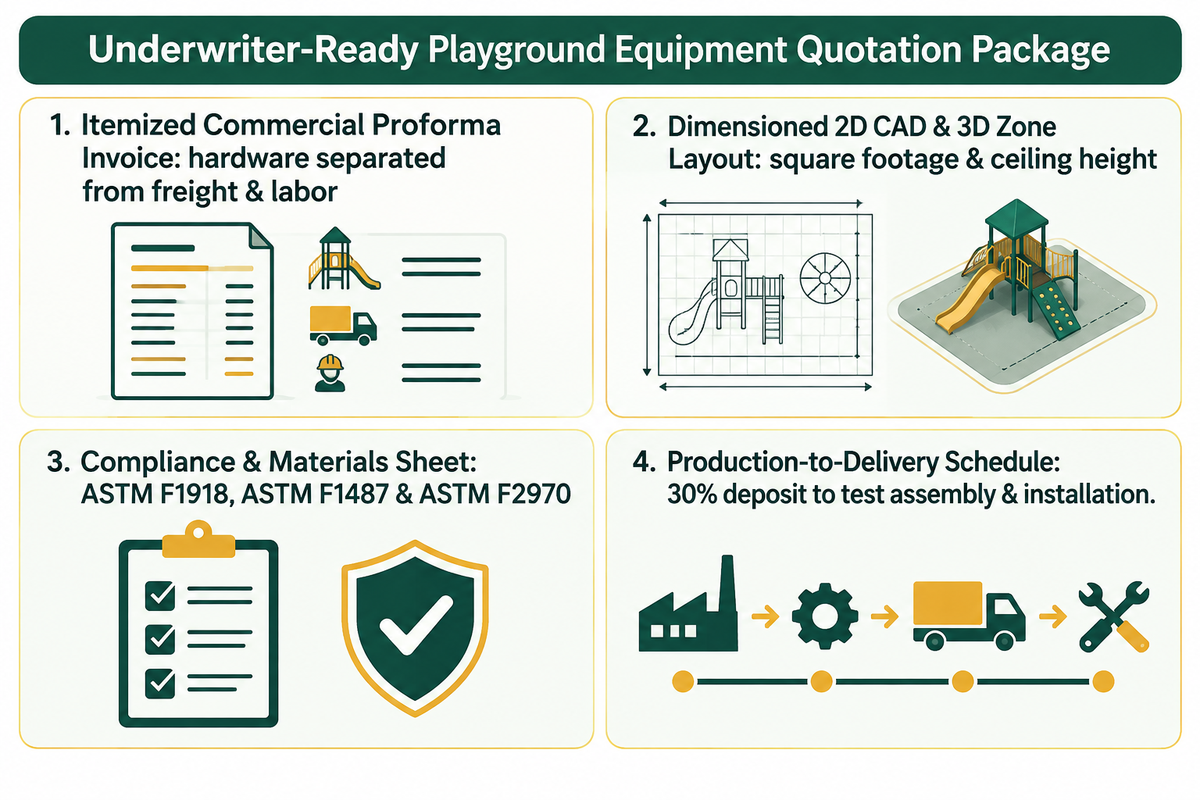
Lump-sum playground estimates are not acceptable to lenders because underwriters need to separate collateral hardware from shipping costs and installation costs. Requesting an itemized equipment quotation package with 3D CAD layouts, ASTM compliance scope, and milestone schedules gives your bank and equipment lessor the exact records required to clear credit review.
Before a binding commitment letter can be issued, a collateral review desk must confirm the type and model number of the equipment you want, who manufactures it, and how each dollar breaks down between hard assets and soft or service costs (i.e. installation costs). Dreamland’s public FEC planning guide separates commercial play space design, manufacturing and logistics, from financing and building permit processes.
Dreamland Playground is an attraction manufacturer that offers custom 3D space design, attraction manufacturing, logistics, and installation services. We don’t provide loans or financing, nor do we provide legal, financial or brokerage services. When you assemble your investor and lender business plan pack and compare the FEC project assumptions across your venue layout, request the following underwriter-ready supplier package to attach directly to your loan file:
Underwriter-Ready Playground Equipment Quotation Checklist (RFQ Brief)
-
✔
Itemized Commercial Proforma Invoice: Separates tangible attraction hardware (steel framing, slides, soft-play obstacles, trampoline beds, ninja course modules) from ocean/land freight, customs tariffs, and on-site installation labor so equipment lessors and SBA closers can assign each line to the right financing sleeve. -
✔
Dimensioned 2D CAD & 3D Zone Layout: Shows exact square footage by attraction zone, ceiling clear-height clearance, column-grid integration, and ASTM F1918 / F1487 safety use-zone boundaries required by municipal building departments and insurance underwriters. -
✔
Compliance & Materials Specification Sheet: Lists galvanized steel pipe gauges, fire-retardant vinyl/foam certifications, and third-party testing records (ASTM F1918 for soft-contained play, ASTM F1487 for public playground equipment, ASTM F2970 for trampoline courts) that lenders require to confirm insurability and resale value. -
✔
Production-to-Delivery Milestone Schedule: Documents exact lead times from CAD sign-off and 30% production deposit through factory test assembly, pre-shipment inspection, transit window, and on-site installation completion so your bank can align its construction draw calendar.
You will need to provide the city where the project is located, your building DWG or PDF floor plan with ceiling height, target age zones, your attraction budget and target grand opening quarters to our engineering team, in order to receive an itemized commercial playground quotation and custom CAD layout.
Family Entertainment Center Financing FAQs
How much does it cost to start a family fun center?
View Answer
Startup approximates budget costs for a family fun center across four key categories:
$50,000+ in front-end pre-development cash for real estate or lease security deposits
Tenant improvements for the installation of HVAC and fire sprinkler systems
$8,000 to $12,000 per arcade machine and other play structures,
And three to six months of working capital for pre-opening expenses.
Prior to seeking financing, make sure you’ve written quotes from contractors and equipment vendors for the exact floor plan you want, then include a dedicated cash reserve for the first few months of operations to cover payroll, insurance, and other startup expenses.
Are family entertainment centers profitable?
View Answer
Yes, a family entertainment center can indeed generate positive operating cash flow through admissions, birthday party packages, and sales of food and/or games. Operating cash flow must cover rent, payroll, insurance, maintenance and scheduled debt service at a 1.25x coverage ratio to be considered positive cash flow. Lenders want to evaluate your net operating cash flow for the year to see if seasonal, weekday and other troughs would put you in a negative operating cash flow situation that would eat into working capital. They’ll want to see that you’ll be able to cover debt service and equipment lease payments.
How does family entertainment center financing work for a startup?
View Answer
Yes, the combination of a cash equity investment of 10 to 40 percent, an SBA 7(a) or SBA 504 loan of up to $5,000,000, and 24 to 72 month equipment leases, finances the opening of a startup family entertainment center. An applicant’s layered capital structure matches each cost bucket with the most appropriate source of capital. Approval is based on a documented business plan, personal guarantees from major owners and vendor quotes.
Can I bundle skee ball financing with other arcade equipment?
View Answer
Yes, Specialty amusement equipment lenders regularly combine skee ball lanes, redemption games, virtual reality pods, and card readers from various vendors into a single master lease or equipment finance agreement and charge a single monthly fee.
Can I use a business loan for marketing and advertising?
View Answer
Yes, an SBA 7(a) loan or dedicated working capital line can fund pre-opening marketing and grand opening promotions. On the other hand, SBA 504 debentures and equipment leases can’t pay advertising costs and are limited to fixed assets.
About This Analysis
This guide attempts to align the U.S. Small Business Administration (SBA) 7(a) and 504 regulations (13 CFR Part 120) and Equipment Leasing and Finance Association (ELFA) contract standards to the actual production schedules we manage, including deposits and deliveries, as a commercial indoor playground manufacturer. Worked debt service tables model sample capital structures for stress testing and not for financial or tax advice.
References & Sources
- Terms, Conditions, and Eligibility for 7(a) Loans U.S. Small Business Administration (SBA)
- 504 Loans for Long-Term Fixed Assets U.S. Small Business Administration (SBA)
- 13 CFR § 120.910: Borrower Contributions Under the 504 Loan Program Electronic Code of Federal Regulations (eCFR)
- 13 CFR § 120.882: Eligible Project Costs for 504 Loans Electronic Code of Federal Regulations (eCFR)
- 13 CFR § 120.870: Leasing Policies Specific to 504 Loans Electronic Code of Federal Regulations (eCFR)
- 13 CFR § 120.862: Economic Development Objectives for 504 Loans Electronic Code of Federal Regulations (eCFR)
- 13 CFR § 120.102: Repayment Ability and Cash Flow Underwriting Electronic Code of Federal Regulations (eCFR)
- 13 CFR § 120.110: What Businesses Are Ineligible for SBA Business Loans Electronic Code of Federal Regulations (eCFR)
- SOP 50 10: Lender and Development Company Loan Programs U.S. Small Business Administration (SBA)
- Publication 946: How To Depreciate Property (Section 179 and MACRS) Internal Revenue Service (IRS)