Hotel Kids Club Setup means turning a guest promise into a room, a team and a service that the hotel can actually open. Starting with who attends and who supervises, confirming local requirements, budgeting and planning, commissioning equipment and rehearsing the first visit, all lead up to opening day. There are other tasks, including buying an indoor playground for hotel use. A kids’ club strategy starts with the service promise.
A drawing isn’t enough to win over a general manager. Reception must describe the same offering that recreation can deliver, housekeeping can reset and finance can fund. The ten steps that follow focus on launch preparation, with detailed design and equipment supply links shown separately.
Start here
Write the service promise before freezing the layout. A parent-accompanied room, a hosted family activity and staff-supervised care have different operating arrangements. Requirements follow the actual service and destination. The worked examples below use hypothetical inputs; they aren’t approved staffing ratios, room capacities or real hotel results.
Define what parents can book
Define the kids club as a specific service before choosing equipment: who can attend, whether parents stay, what staff do, when sessions happen and how guests book. The price is determined by a fee or an included room-package benefit. Other questions about supervision and the hotel’s duties remain unanswered.
What can reception promise parents before the service opens?
Reception can only confirm the service in the approved brief. If parents must remain inside, booking copy should say so before a reservation is confirmed. Staff can’t supervise children without parents present unless the hotel procedures, permissions and cover support that. Don’t explain supervision as a transfer of legal guardianship.
Imagine the hotel opening a craft room next to its lobby. The recreation lead plans family sessions. However, a sales email calls the room a babysitting amenity. A couple expects to leave their child while they dine. More cushions or a different play structure won’t fix that. The project team must modify the offer or fund and review a different service. In the example below, it chooses a parent-accompanied session and changes the guest wording. The ages and timings are planning inputs to test, not legal limits or a recommendation for every kid.
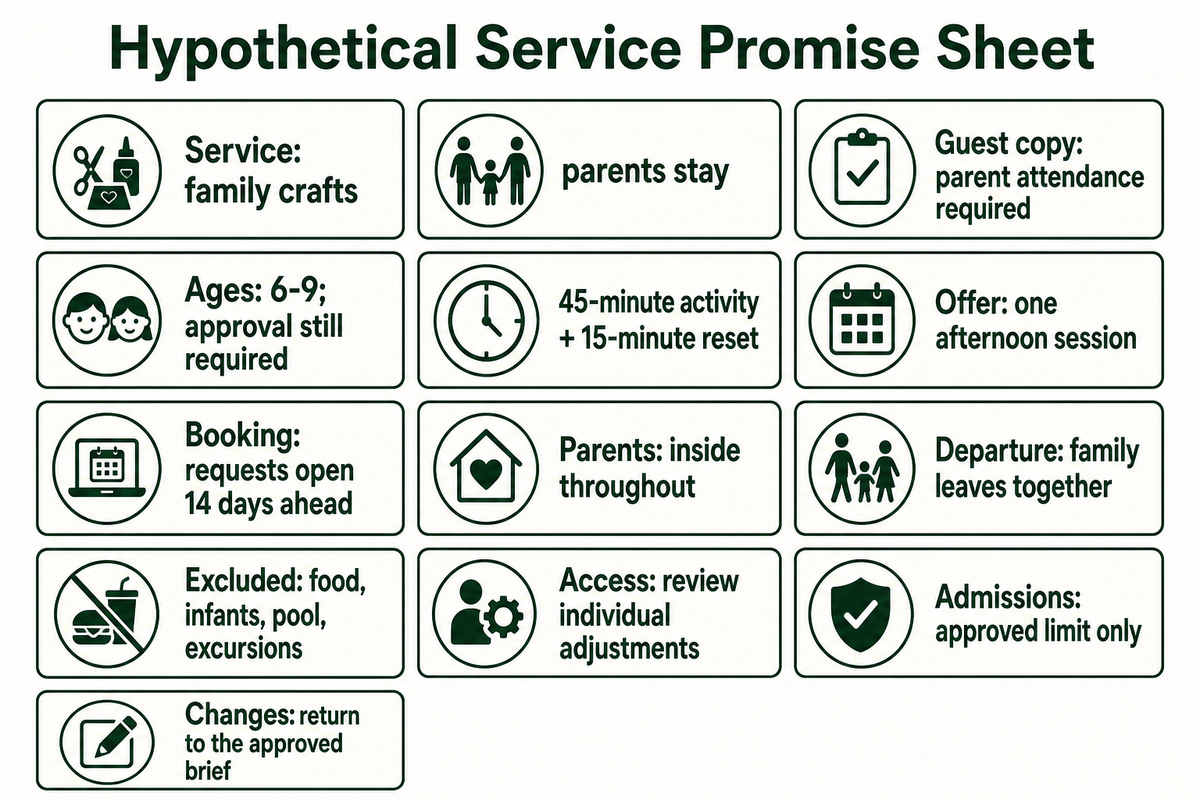
Service Promise Sheet, illustrative parent-accompanied craft session
Decision
Filled example
Owner / acceptance check
Service model
Hosted family arts and crafts; parents remain with their children
Recreation confirms the actual supervision arrangement
Guest wording
Family craft session; parent attendance required
Front office tests website, booking email and desk script
Intended ages
6–9 years in this hypothetical brief; final eligibility needs approval
Recreation and responsible local reviewer
Session length
45 minutes of activity; a separate 15-minute reset allowance
Recreation and housekeeping verify the proposed sequence
Opening offer
One afternoon session each operating day
Hotel owner funds the roster before advertising
Booking window
Requests open 14 days ahead in this example
Reservations applies the approved session limit
Parent location
Inside the activity room throughout the session
Staff explain this before confirming a reservation
Collection
Family leaves together; no drop-off collection service offered
Front desk avoids promising babysitting
Excluded activities
Food service, infant care, pool visits and excursions
Any later expansion receives its own review
Access requests
Individual needs and reasonable service adjustments are reviewed
Named hotel contact responds before the booking
Published limit
Only the locally approved room, activity and staff limit
Recreation controls bookings; demand estimate does not set this
Change control
Any new hours, ages or parent-presence promise returns to the brief
Hotel owner authorizes the revised service
A 45-minute family craft session is a different guest promise from care with drop-off, even if they both use the same indoor room. The Service Promise Sheet connects the parent-presence rule, admitted ages, booking process, and accountable hotel roles. Approval concerns the complete service; the activity duration alone does not establish an exemption.
Use family demand to set the opening brief
Project estimated demand for each proposed session from the hotel’s own family bookings. Consider the eligible ages and the likely window of attendance. Total room count is too broad: some occupied rooms have no children, and interested families may want different hours. Use the estimate to test the offer; keep it separate from the approved operating limit.
Reservation records, pre-arrival questions and guest interviews can reveal whether families want a morning activity, an afternoon break or a shared evening experience. A new hotel can explore expressions of interest before opening, then test the reviewed service within its established permissions. A pilot is not an exemption from operating requirements.
Hypothetical demand calculation
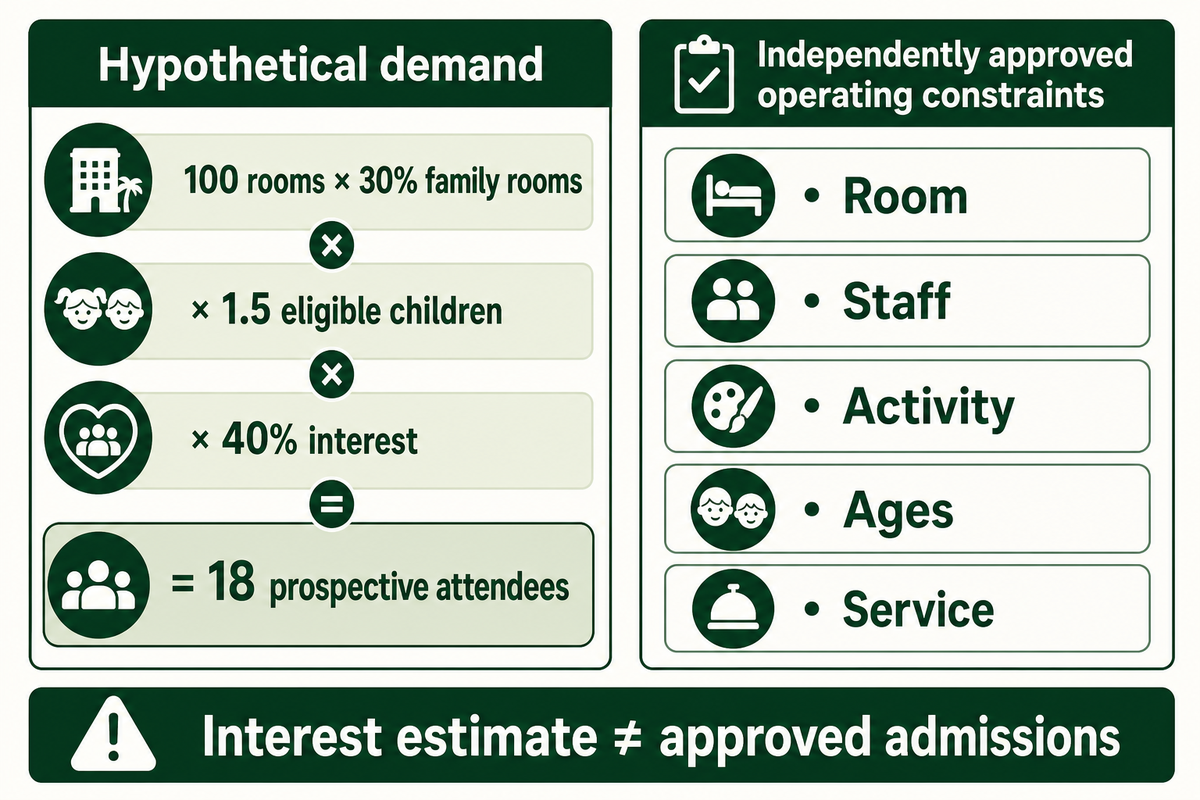
100 occupied rooms × 30% family rooms × 1.5 eligible children per family room × 40% interested in one session = 18 prospective attendees.
These assumed inputs estimate interest. They don’t approve a group of 18 children, specify room area or prove that the roster can supervise them.
The bookable limit must respect the applicable room, staff, activity, age-group and service restrictions. Identify the most restrictive approved constraint for each session. An attractive floor plan that can accommodate more equipment can’t remedy a lack of qualified cover, and a peak beach day shouldn’t become the forecast for the entire season.
The Family Travel Association’s January 2026 report provides directional context, including a reported 57% of parents in its 2025 survey planning multigenerational travel. It republishes Travel Weekly discussion and survey findings. That population isn’t your guest list, and interest isn’t a reservation in your club.
Demand planning can generate 18 potential attendees while the approved bookable limit remains lower. Keep two records: hotel’s interest assumptions and signed operating limits. If they disagree, adjust the schedule, reviewed staffing or offer before accepting reservations. Equipment capacity and total hotel rooms can’t determine admissions.
Make the room workable for the whole hotel
Walk the complete guest and on-site staff route before freezing the room: arrival, parent waiting, activity, toilet access, storage, cleaning and departure. A club can be persuasive in a design, but can also create queuing in hotel circulation or make surfaces hard to reach. Facilities, recreation, housekeeping and reception should review the same plan.
Find out where a stroller waits without blocking an exit, where staff see arriving families and how loose material gets to a secure store. Check noise near the hotel room corridor, delivery access, ventilation, fixings and maintenance access with the responsible professionals. Code dimensions should be part of the approved drawings for the project, and not a general blog rule.
The U.S. Access Board play-area guide addresses accessible routes and play experience. It contains specific provisions for soft-contained structures. Determine your product and site scope. Access also pertains to service policies. The Department of Justice guidance for covered childcare programs states individualized assessment of access and reasonable policy changes are required along with effective communication. A blanket disability exclusion isn’t a review substitute.
How can hotels modify their physical room environments to immediately relieve the stress of traveling parents?
Start with the arrival task: clear directions to an intelligible entry point to express access needs. Give guest access instructions relevant to the service. Put the parent conversation outside the play queue. The lobby is a shared hub of circulation; review the logistical handoff there. Then review the proposed layout through the existing hotel kids club design guide by property level, rather than treating a luxury finish as proof of a workable room.
Access for cleaning needs a separate walk-through. The CDC guidance for early care and education programs outlines the difference between cleaning and sanitizing/disinfecting and recommends cleaning first and following the manufacturer’s instructions for product contact time. Have housekeeping demonstrate how they would reach the equipment and allow the contact time.
Confirm the service, permissions and opening limits
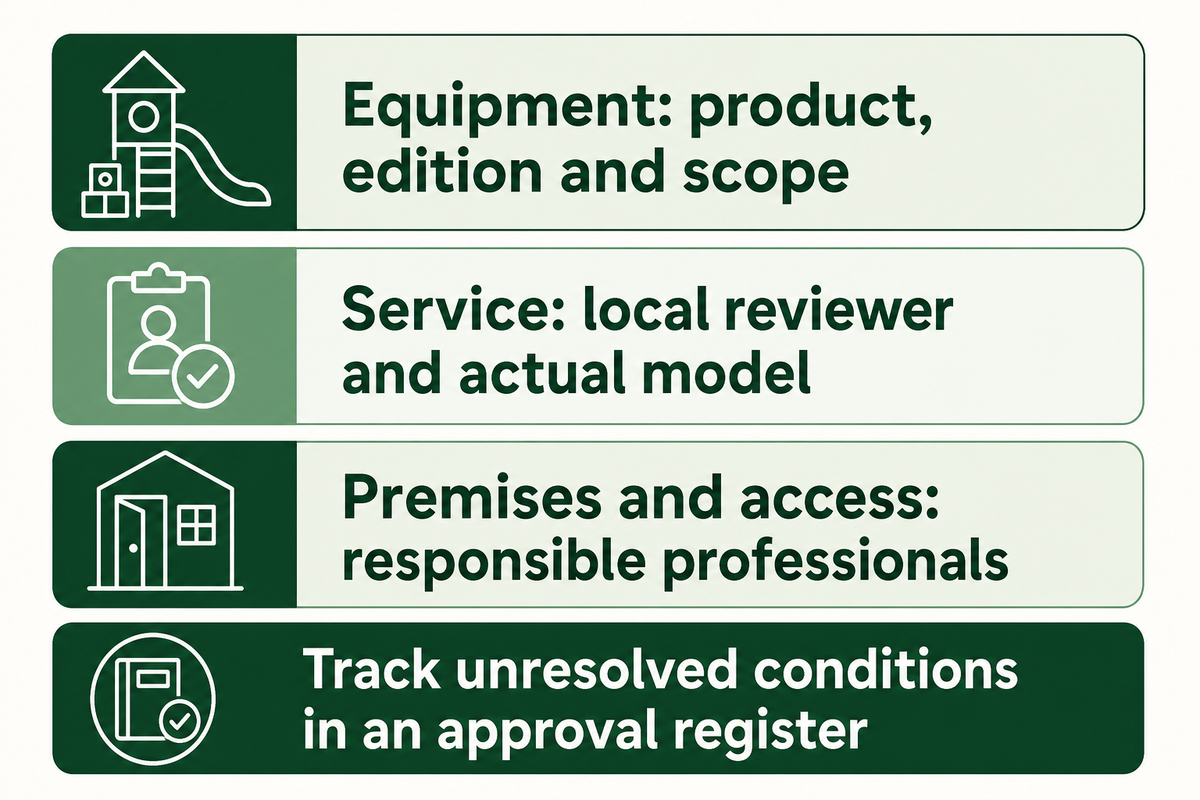
Name the local childcare reviewer where applicable, building and fire professionals, accessibility adviser, insurer and hotel service owner. Each has a different question to resolve; a supplier test report cannot close every approval or establish the operating model.
Record service classification, admitted ages, locally applicable staff qualifications and supervision limits, emergency arrangements and outstanding conditions. Create an approval register for the actual service, room and equipment before taking bookings. Review these against the final room and activity list. Avoid borrowing a staffing ratio from another destination or assuming a parent-stay label removes every premises, safeguarding or accessibility duty.
Separate equipment evidence from permission to operate
As noted in ASTM’s public catalog, F1918-21 has an Active status for soft contained play equipment. Its published scope excludes several other equipment families and does not generally address accessibility. Thus, referencing that standard does not serve as a conformity certificate for the room or a childcare license or approval for water parks. Contact the responsible reviewer for information on what requirements apply to each item and check the latest edition at the time of procurement.
England offers a useful example of why a short-session slogan is unreliable. Ofsted’s crèche exemption guidance sets multiple conditions, including no more than four hours a day for children under eight, parents remaining in the immediate area and being summonable, short-term convenience and no long-term commitment. Those conditions are specific to that exemption and jurisdiction, not a worldwide hotel rule.
Examples from England of a crèche with a 4-hour daily ceiling require that the other stated conditions for exemption are also satisfied. The hotel’s approval register should show the relevant authority decision, insurance scope and equipment evidence separately. A short duration, free access or a supplier certification can’t be substituted for a project-specific confirmation of the complete guest service.
Train staff for arrival, sessions and collection
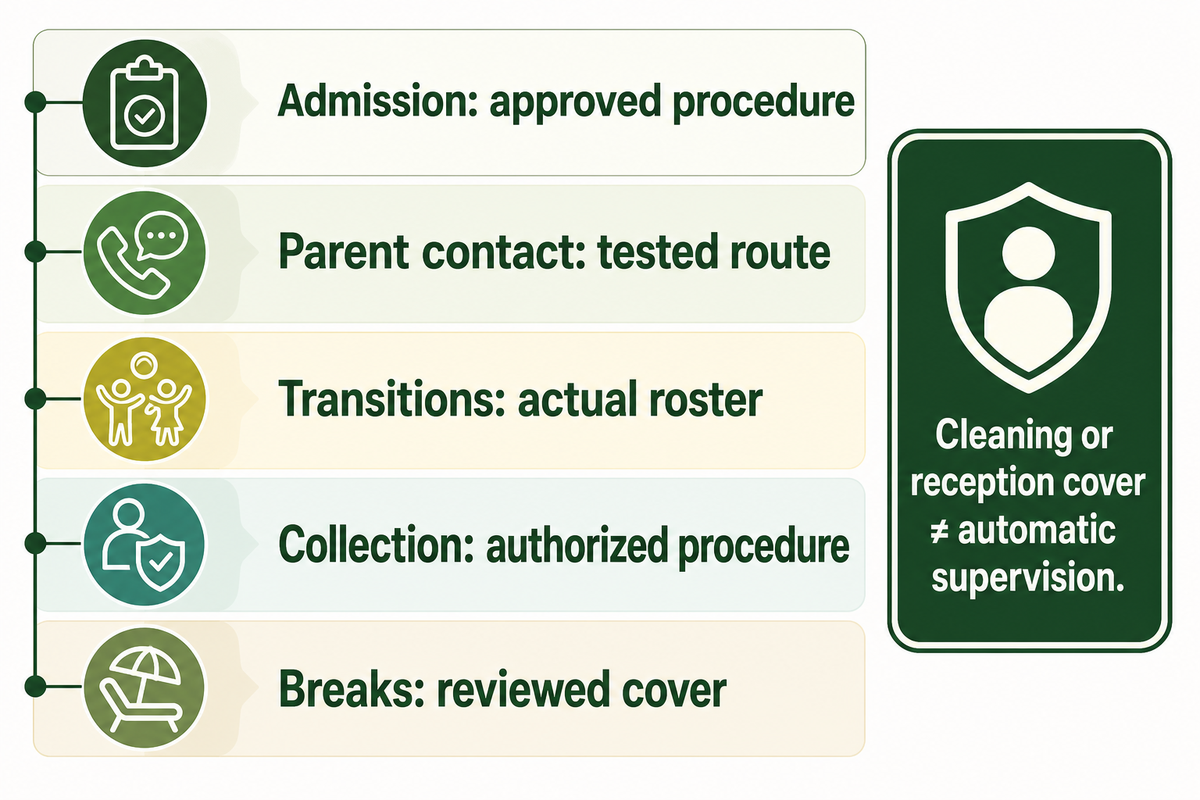
Staff readiness means doing the approved procedures with the actual roster as opposed to just attending a presentation. Test admission, parent contact, activity transitions, authorized collection, escalation and cover during breaks. A person cleaning equipment or covering reception cannot automatically be counted as simultaneously supervising the club; the locally approved arrangement must govern the schedule.
ChildCare.gov’s staff guidance explains that requirements vary with setting, ages and position. The hotel should confirm recruitment checks, qualifications, first-aid arrangements and training with its local advisers. Include interaction boundaries, staff and volunteer conduct, monitoring and the reporting route for safeguarding concerns. An open sightline is useful, but it doesn’t replace those organizational duties.
“Each program can keep children safe by teaching all staff how to look, listen, and engage.”
Head Start describes positioning, scanning and counting, listening, predicting, and engaging or redirecting children. Its name-to-face transition approach can inform a hotel’s reviewed procedure. Head Start program requirements don’t govern every hotel. The contribution here’s a useful practice, not an imported legal rule.
During a staff walk-through, dedicate time to identifying who checks arrival details, who maintains child accounting and who takes over when the activity host leaves. The handoff practice should be done prior to the room being busy with children. Emergency family reunification needs its own contact and identification procedure; ordinary sign-out alone does not cover relocation.
A proposed 15-minute staff briefing can explain the process, but it cannot prove competence by itself. Have the receiving staff member in the installed room show you their arrival, transition and relief tasks. Document any steps missed, and have the team member perform the exercise before he/she is assigned the task. The illustrative time allowance is for example purposes only.
Select equipment around the first season of activities
Choose playground equipment from the service and activity plan, not the available space first. The team needs a core mix of age-appropriate activities it can host, observe and reset. Each of Commercial play structures, miscellaneous items, and quiet areas should have a specified task, applicable product requirements and a practical maintenance route.
A craft station needs storage and cleaning access; a storytelling corner needs an audible conversation. Soft play can be an attraction within the offer, but it should not absorb the whole room if families are booking a hosted workshop. Review cleaning and observation against CDC’s setting-specific cleaning guidance and the applicable equipment instructions.
Activity-to-equipment matrix, nine options to screen against the approved service
Activity type
Equipment / room task
Reason to change or reject it
Soft play
Age-matched commercial play structures and clear observation positions
The intended children cannot use it as planned or staff cannot see them
Arts and crafts
Washable worktable, secure materials storage and accessible seating
Reset cannot follow the cleaning procedure
Storytelling
Quiet seating away from arrival queues
Noise from active play prevents conversation
Cooperative floor games
Clear floor zone and movable, age-suitable items
Moving furniture interrupts an accessible route
Indoor scavenger hunt
Picture clues within the approved room boundary
The activity sends children into public hotel circulation
Treasure hunts
Reusable clues and a defined supervised activity area
The theme relies on an unapproved outdoor route
Construction play
Suitable loose pieces and a documented storage check
Small-piece suitability does not match the admitted ages
Family workshops
Shared parent-and-child seating and a host position
Advertised participation differs from the parent-presence brief
Teen studio
A genuinely separate, reviewed program and age-appropriate resources
A token screen corner is being used to claim a teen offer
The matrix screens activity ideas; it isn’t approval of every option. Resorts may want a shared family workshop, while another requires an approved supervised session. Introducing Wildlife visits and pool activities, and off-site museum trips, can create other work streams. Keep them outside the initial indoor brief unless separately assessed and provided for.
The existing resort playground theme examples can be used for creative direction. Ask the designer how a chosen theme supports the planned task, rather than adding another themed component because it looks good. Equipment should be installed following the reviewed layout and service scope.
Budget the service before approving equipment
Budget for opening costs and the recurring service. Equipment costs don’t communicate what the advertised opening hours will really cost. Consider preparation, cleaning, breaks and relief cover, as well as training and management, and activity time. Operating costs should be aligned to the hotel’s fully loaded rates and the agreed service schedule.
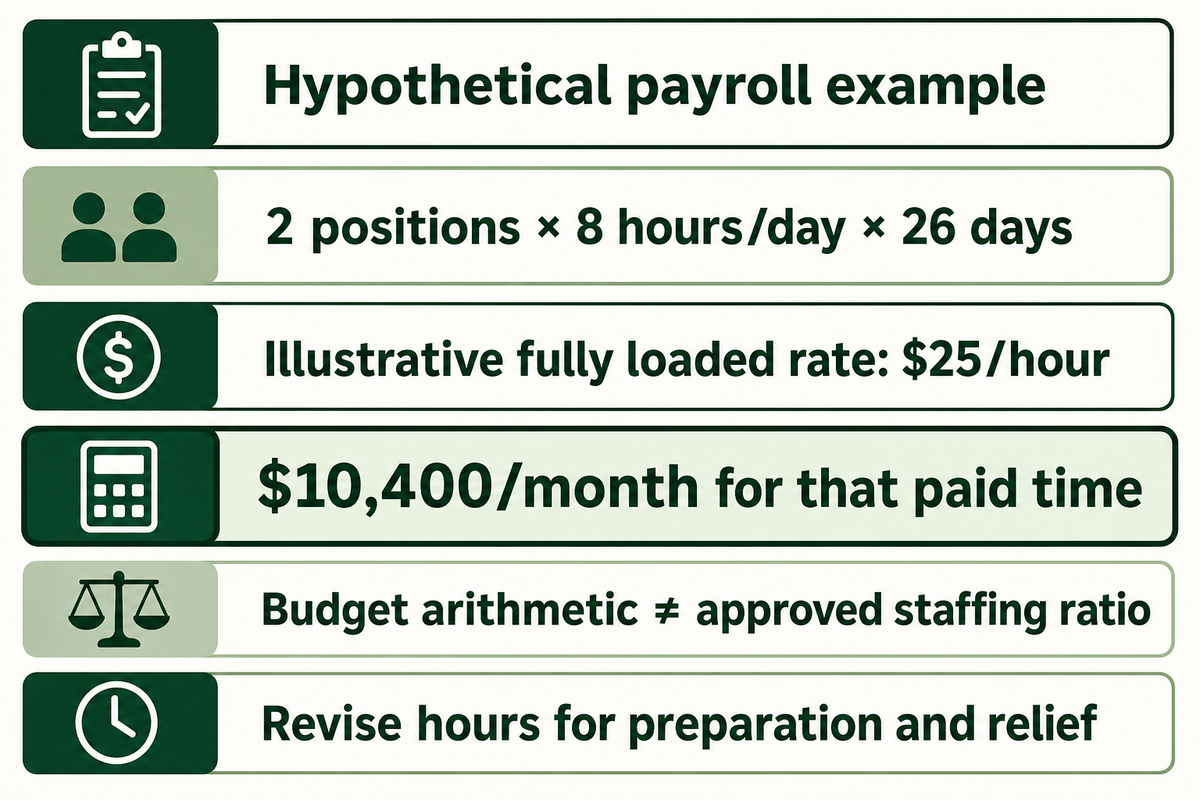
Suppose a separate hypothetical hotel budget assumes two paid staff positions for eight hours a day over 26 operating days, with an illustrative fully loaded rate of $25 per hour. Multiplying 2 × 8 × 26 × $25 provides $10,400 per month for that paid time. The example makes a finance assumption visible; it doesn’t indicate that two people are sufficient for any given group. The illustration of 18 attendees is separate from this. If the approved service needs more cover, preparation or relief, revise the paid hours and costs before you lock in the opening offer.
Finance can compare a funded schedule to a reviewed offering, but shouldn’t close the gap by assuming extra room bookings. Allocate ownership for fit-out, freight and installation, professional reviews, insurance, activity consumables, housekeeping, spare parts and working capital. Included access still consumes paid time.
Give insurance and staffing their own budget owners
For a separate business case, the hotel Playground Revenue Analysis can be used. Here, the owner is asked if he/she can fund the promise for the first season, with light reservations. It may be more credible to have a smaller funded opening offer, as compared to longer, advertised hours with no relief plan.
The hypothetical $10,400 monthly calculation doesn’t include non-staff costs and doesn’t approve a staffing ratio. Finance should retain the 26-day and $25-per-hour assumptions so changes can be priced openly. A supplier quotation and an expected room-rate benefit do not replace the hotel’s recurring payroll and operating-cost decisions.
Commission the equipment and collect the handover file
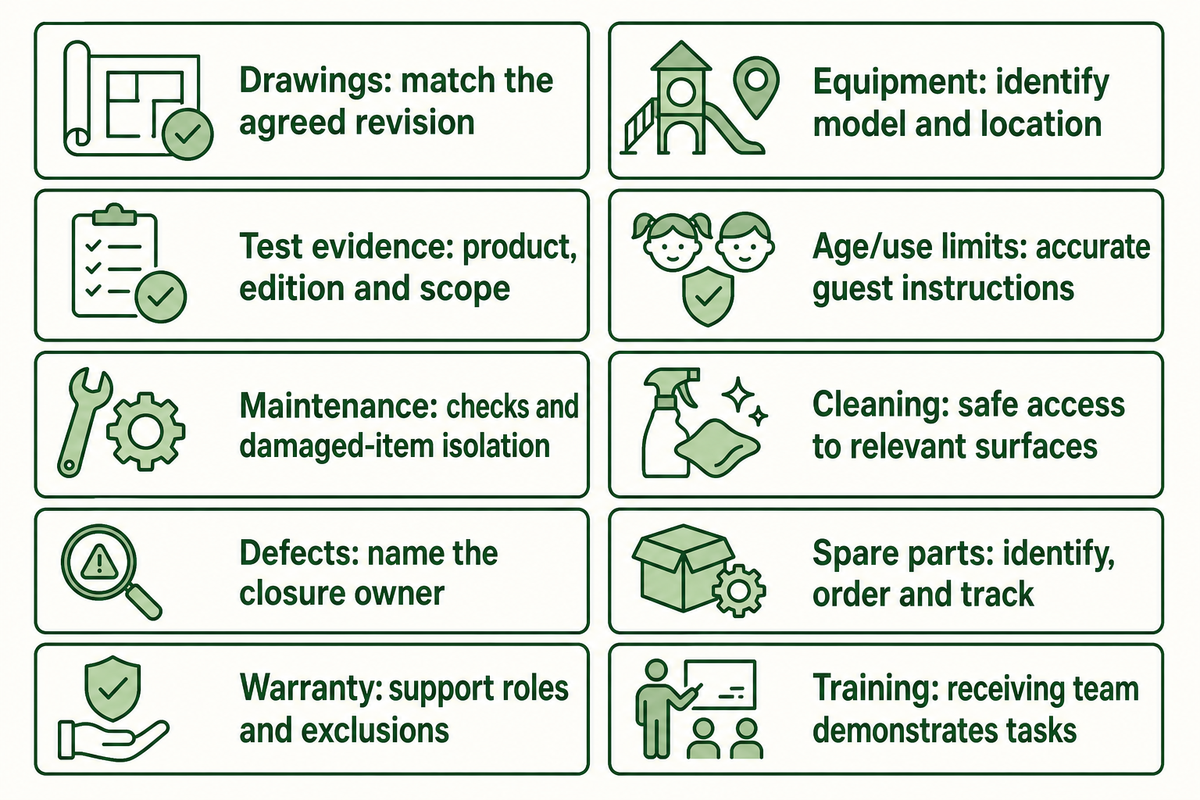
Accept the completed work within the agreed drawings, definition of the product scope and project deliverables. Procurement needs identifiable equipment and evidence, facilities needs maintenance instructions, and recreation needs usable limits and demonstrations. Record unresolved defects with owners and closure evidence; installation completion and hotel permission to open are separate decisions.
Ask the project’s responsible reviewer to verify if the relevant product-standard evidence covers the equipment installed and listed editions. Other model or category test reports can’t be treated as equivalent by appearance. The hotel’s accessibility and building reviews still need their own scope.
Hotel kids club handover, evidence that turns installed equipment into a maintainable room
Deliverable
Hotel user
Acceptance question
Approved drawings and revision list
Architect / project director
Does the installed arrangement match the agreed revision?
Installed-equipment schedule
Facilities / procurement
Can each item, model and location be identified?
Product-specific test or inspection evidence
Responsible project reviewer
Does the evidence cover this product, edition and project scope?
Age and use limits
Recreation
Can these be translated into accurate guest instructions?
Operating and maintenance instructions
Facilities
Can routine checks and damaged-item isolation be performed?
Cleaning instructions and access
Housekeeping
Can staff reach the relevant surfaces without unsafe improvisation?
Open-defect record
Project director
Which items remain unresolved and who closes each one?
Spare-parts and replacement route
Procurement
How are wear parts identified, ordered and tracked?
Warranty and support contacts
Hotel owner / facilities
Who handles each issue and what does the contract exclude?
Installer demonstration / training record
Recreation / facilities
Has the receiving team demonstrated the agreed tasks?
These are contractual acceptance requests to agree for the project; not every row is a statutory document in every market. Ensure facilities has the manual needed to demonstrate the maintenance task; an unresolved defect may impact whether an activity can operate. Resolve those practical consequences instead of collecting a folder solely to mark handover complete.
Dreamland’s hotel kids club setup solution covers its equipment and project-support offering. Send the measured room, approved service brief and activity priorities when discussing the scope. Confirm inspections, training, spare parts, warranty responsibilities and exclusions in writing rather than inferring them from a general capability statement.
Rehearse the first guest visit before opening
Run the booking-to-departure journey with hotel staff before inviting children to participate, with reception, recreation, facilities and housekeeping. The First Guest Rehearsal tests whether reception, recreation, facilities and housekeeping can deliver one approved promise.
The emergency test should account for children and staff after movement, use the approved family-contact route and verify authorized collection at the agreed location. Head Start’s attendance and reunification guidance is a methods reference for these two responsibilities and should be implemented in line with hotel’s approved emergency plan, rather than considered as local law.
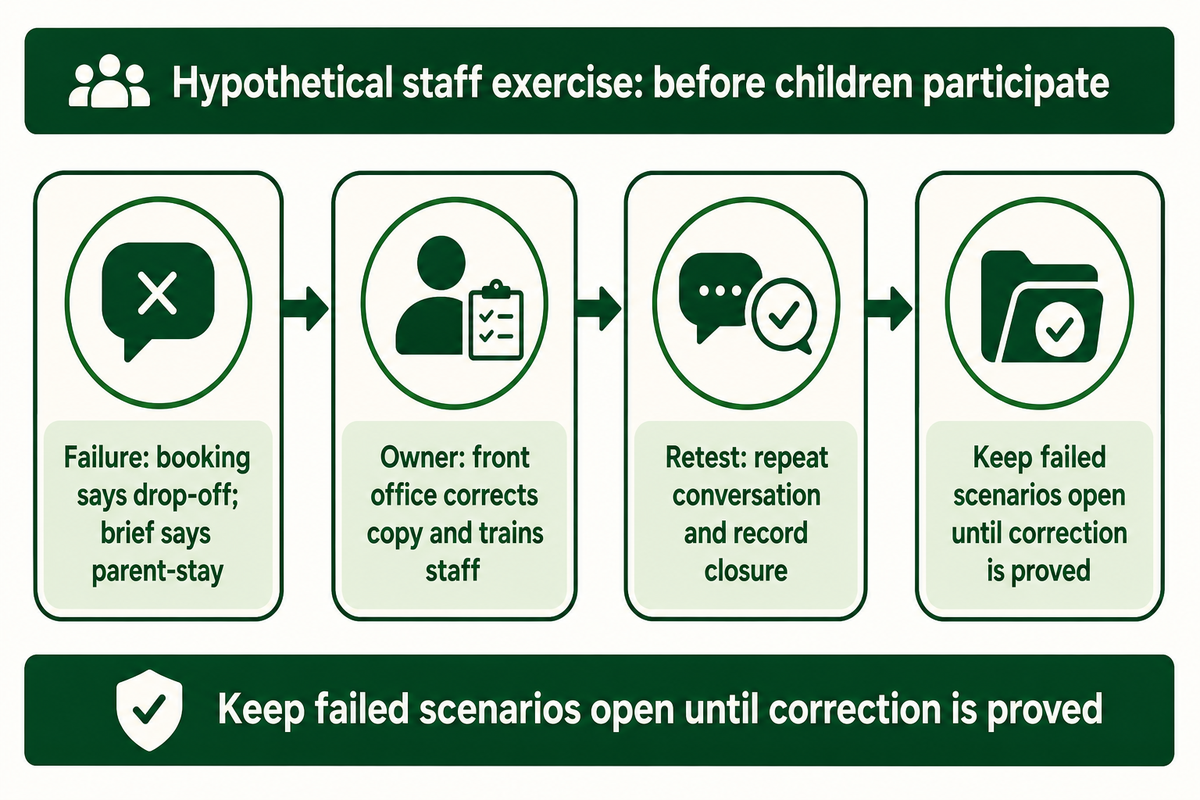
In a hypothetical staff exercise, a reservation agent says a parent can leave for a restaurant booking. A host states an approved craft session requires the parent to stay. The team captures a failed promise test. Front office changes the booking confirmation and trains the desk team; recreation checks the revised wording against the Service Promise Sheet. Only then does the team repeat the conversation and record whether the conflict is closed. The outcome of the test is more important than whether the room appeared ready. There’s no need to admit children in order to prove there’s a mismatch. Include exceptions and emergency relocation as well as a smooth arrival; log each defect, corrective owner and retest result before opening the affected service.
First Guest Rehearsal, filled hypothetical findings before opening
Scenario
Expected hotel action
Illustrative result / next owner
Front desk advertises drop-off
Compare the promise with the parent-stay Service Promise Sheet
FAIL: rewrite booking copy; train reception; repeat the test
A younger child requests entry
Explain approved age eligibility and available alternatives
PASS in the example: no staff override invented
The session is full
Offer the approved waitlist or another session; no extra admission
PASS: reservation control follows the approved limit
Roster cover is unavailable
Keep the affected session closed until authorized cover is available
Refer to the named contact for individual assessment
PASS: request reviewed rather than rejected by a blanket rule
An unknown adult seeks collection
Apply the approved identity and authorization procedure
PASS: staff escalate; no collection based on room number alone
Emergency relocation occurs
Account for children and staff and repeat checks at the agreed destination
FAIL: assign attendance/reunification owner and repeat drill
A parent cannot be reached
Use approved emergency contacts and escalation arrangements
PASS: communication owner follows the documented route
A safeguarding concern is raised
Follow local reporting duties and the hotel’s response procedure
PASS: staff identify the responsible escalation owner
Equipment is damaged before arrival
Isolate it and confirm whether the session can still operate
PASS: facilities and recreation record the decision
Cleaning reset runs late
Delay admission; complete the documented room-ready check
FAIL: housekeeping and recreation adjust the proposed schedule
Some examples show how to record the results of the tests; these don’t mean a real hotel was, in fact, tested. Add destination-specific checks with the relevant professionals. Secure guest records, access requests and contact information under the hotel’s applicable privacy process. A later guest pilot stays within permissions, approved limits and the agreed service.
A 30-minute front-office rehearsal may uncover a mismatch of the promise before the guests arrive; it’s one activity and not a complete emergency or safeguarding assessment. Keep all failed scenarios open until the named owner provides a correction and evidence of a retest. If the service record is in conflict and a room has been opened to the service, then the original problem hasn’t been corrected.
Build a service families will still want next season
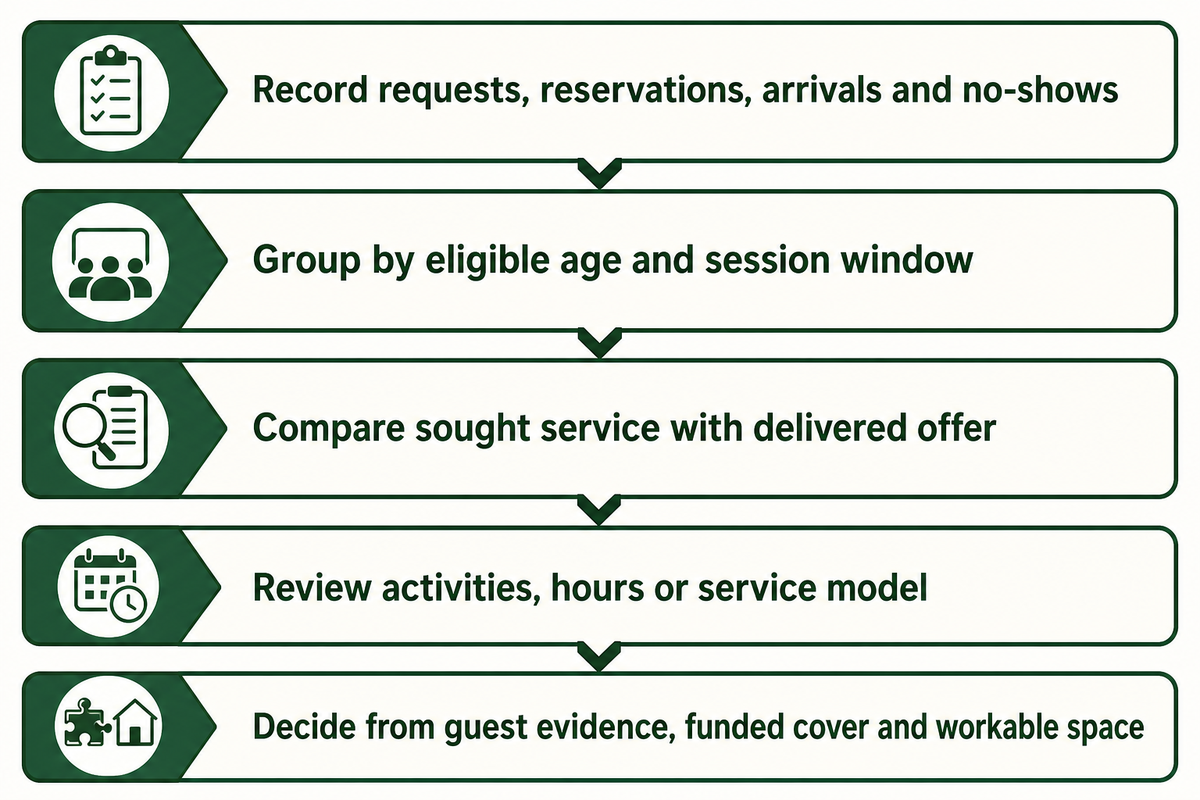
Use early attendance and guest feedback to decide on the next season. Count requests, reservations, arrivals, no-shows and declined bookings, by eligible age group and session window. Then compare the service families sought with the one the hotel offered. Revising the activities or adjusting the hours of operation, or a reviewed service model, may be more appropriate than adding new equipment.
The Family Travel Association report states that Donna Douglas of the Bermuda Tourism Authority spoke to a change in trend to bring families together. That observation challenges a universal drop-off assumption; it does not show that all families want the same vacation or prove a hotel revenue effect. The survey has a varying time horizon, which shouldn’t be presented as a comparable annual growth rate. A parent-and-child workshop may complement an approved supervised program.
Review the club alongside the hotel’s broader family-friendly amenity planning. Decide from guest evidence, funded cover and the space the hotel can operate, rather than copying a premier resort’s attraction without its staffing model.
Before changing the offer, return to the service brief. A new age group, longer schedule or outdoor activity can alter requirements, logistics and costs. Families’ ability to make a reservation and enjoy the experience should be tracked. Don’t call a few positive comments an increase in room rate.
Frequently Asked Questions
Is hotel kids club setup always a childcare project?
Not every hotel play space provides drop-off care.
Define whether parents remain with their children, staff host family activities or staff supervise children during a booked session. Then ask the relevant local authority how that exact service is classified. A label on the door, a free price or a short session does not itself establish a licensing exemption. Record the agreed classification before publishing the guest offer.
Is a hotel kids club free or paid?
Access can be included, charged per session or offered through a mixed arrangement.
That commercial choice is separate from supervision. An included session can still require qualified staff, records and approved operating limits. Decide which service the hotel can reliably fund and describe before setting the guest price or publishing the booking page. Finance should account for paid cover, preparation, cleaning and relief time as well as time spent running activities.
What insurance should a hotel kids club arrange?
Ask the hotel’s insurer to review the actual proposed service before opening.
Describe who supervises, which ages attend, what activities run and whether sessions are booked or included. Ask how the policy treats those activities, staff duties and any specialist services. Record requirements and exclusions alongside local approvals. General hotel cover or an equipment supplier’s certificate does not by itself confirm cover for the proposed club. Keep a named owner for following up unresolved questions.
Does every hotel need a staffed drop-off club?
No; some properties may be better served by parent-accompanied play or hosted family activities.
Use observed guest demand and the approved service scope to choose. Hotel star rating alone is not a complete operating brief, and a family-friendly label does not determine the supervision arrangement.
Who can supply equipment for a hotel kids club?
Choose a supplier that can work from the measured room, intended ages, product type and destination requirements.
Define the project deliverables in the order. Dreamland publicly offers planning, design, equipment production, installation support and after-sales service. Confirm inspections, documents, training, maintenance and exclusions in writing; a broad capability statement is not site-specific approval. The hotel still owns its service brief and opening decision. Supply support and authority review have different jobs, even when both contribute to the same project.
Which quality standards apply to a hotel kids club?
Applicable standards depend on the play product, site and destination market.
Ask for the relevant requirement set and product-specific evidence. The hotel’s responsible advisers should review the installed room and service; one equipment standard is not approval for every activity.
What should be checked after the first month?
Compare what the hotel promised with what families could actually book and attend.
Review age-specific requests, session attendance, rejected bookings, no-shows, housekeeping reset time, staff cover, parent comments and incidents. Look for repeated mismatches, such as advertising morning sessions while families request evening ones. Decide which changes need revised staffing, permissions, equipment or guest wording before altering the offer. A short pilot or improved comments cannot prove that the club caused higher room rates.
The supplier perspective behind this opening guide
Dreamland Playground supplies play equipment and publishes this hotel launch guide; it has a commercial interest in equipment projects. The company’s public service description supports its stated planning and supply scope. The service sheets and calculations here are author-developed examples informed by public sources, not verified hotel trials. Local service decisions remain with the hotel and its responsible advisers.
Bring the service brief to the equipment discussion
When the hotel has agreed its parent-presence model, guest ages and opening activities, discuss how the room can support them. Prepare the measured layout and handover expectations so the equipment scope follows the service you intend to deliver.
Dreamland Playground publishes practical planning guides for commercial indoor-play projects, including family entertainment centers, shopping malls, hotels, restaurants, churches, and other venue types.
Use these guides to frame the questions that should be resolved before concept selection: venue size, intended age groups, project location, attraction mix, operating priorities, timeline, and delivery constraints. Final recommendations should be based on the real site and applicable local requirements.
Start With The VenueFloor area, clear height, site location, intended audience, and target opening date create the working brief.
Clarify The ScopeConcept, equipment, production, shipping, installation, and operating inputs can vary from one project to another.
PROJECT / VENUE / TIMELINE
Prepare Your Project Brief
Venue TypesFEC · Mall · Hotel · Restaurant · Church
Start WithFloor area · Clear height · Age groups · Country