Age-Based Zone Design is a planning and operating method that decides who uses each space, how children and adults move, what staff can see, and what evidence must be approved. Use actual operating sessions, separate incompatible movements, test each boundary, and document the controlling licensing rule. A color-coded floor plan by itself is not a safe operating plan.
This guidance addresses planning and acceptance decisions. It is not a substitute for a local licensing review, an accessibility analysis, an equipment specification, or a supplier proposal. One age label can describe a developmental reference, an intended product user, a classroom group, or a regulated category; those meanings are not interchangeable.
“Playgrounds should be laid out to allow parents or caregivers to keep track of children as they move throughout the playground environment.”
Quick Answer: What Age-Based Zone Design Controls
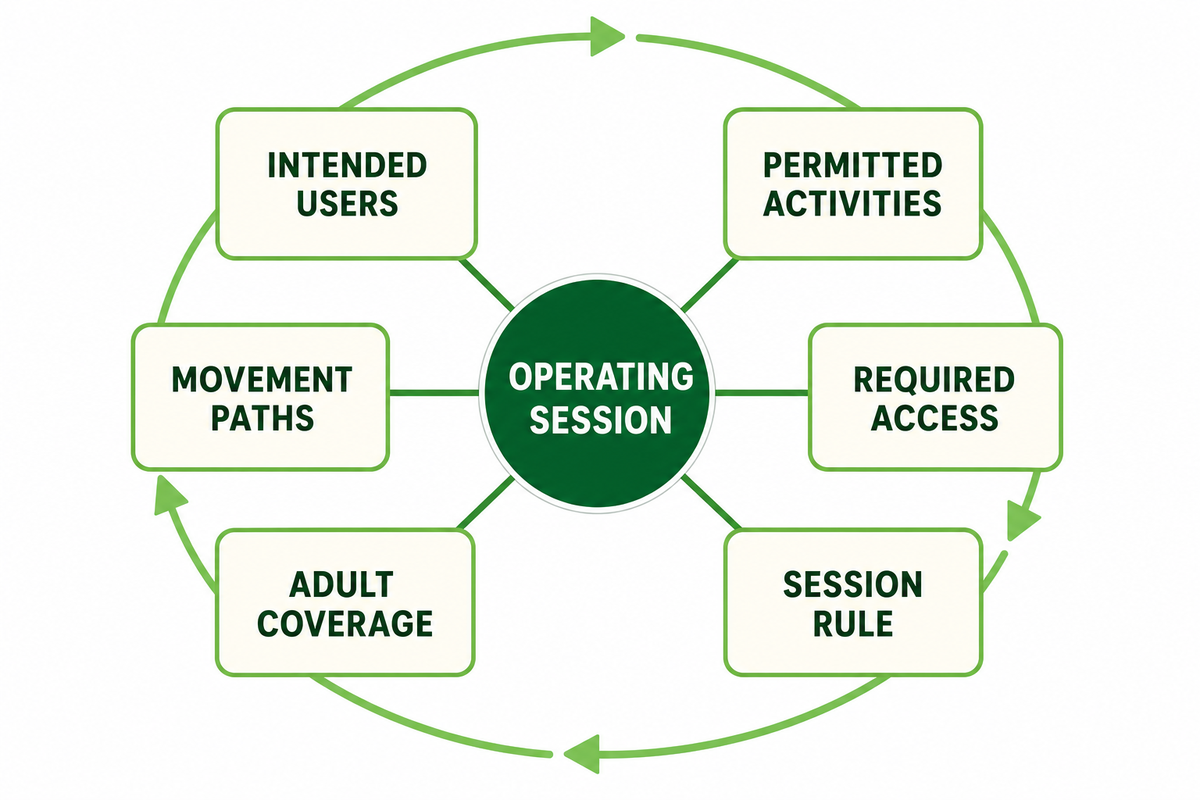
That visibility requirement turns age-based zoning into an operational control, not a collection of themed displays. Practical plans combine six factors: intended users, permitted activities, movement paths, adult coverage, required access, and the operating rule for each session. If any one of those factors changes, the zone decision has to be reviewed as well. Operational risk grows because a new group, route, or staffing pattern can invalidate an otherwise familiar layout.
Treat the operating session as the design unit: a named group of children, assigned staff, authorized equipment, a route pattern, and a start-to-finish handoff. One space can support different operating sessions in the morning and the afternoon. Its drawing should identify which boundaries are fixed and which controls vary.
Decision rule
Do not approve a zone because its label sounds age-appropriate. Approve it only when the intended users, activity conflicts, staff coverage, access scope, hygiene route, emergency path, and responsible owner can all be named.
For a commercial project handoff, Dreamland’s daycare play area design services cover configuration and supplier-side project work. This guidance remains on the buyer’s planning, assessment, and approval side so the two pages don’t compete for the same search intent.
Start With an Age-and-Ability Register, Not Color Labels
That operating frame starts with the CPSC handbook’s three overlapping planning bands for public playgrounds: toddlers from 6 through 23 months, preschool-age children from 2 through 5 years, and school-age children from 5 through 12 years. It also notes that child development is fluid and says facilities using paid, trained supervision may consider their own age groupings.
This flexibility does not authorize a departure from any mandatory rule. Head Start safety requirements for covered center-based programs state that equipment and materials must permit the separation of infants and toddlers from preschoolers during play. State, tribal, local, or program rules may be more demanding. Use the CPSC bands as planning guidelines; document the authority controlling the program before approving a mixed-age grouping.
For early childhood planning, an age band defines an intended population; it is not an assurance that each child in a given age group possesses every skill. Record the specific ages, observed behaviors, and support needs relevant to each session. Turning 2 years old does not give a child a new set of skills overnight. The register makes that nuance reviewable without weakening a mandatory separation rule.
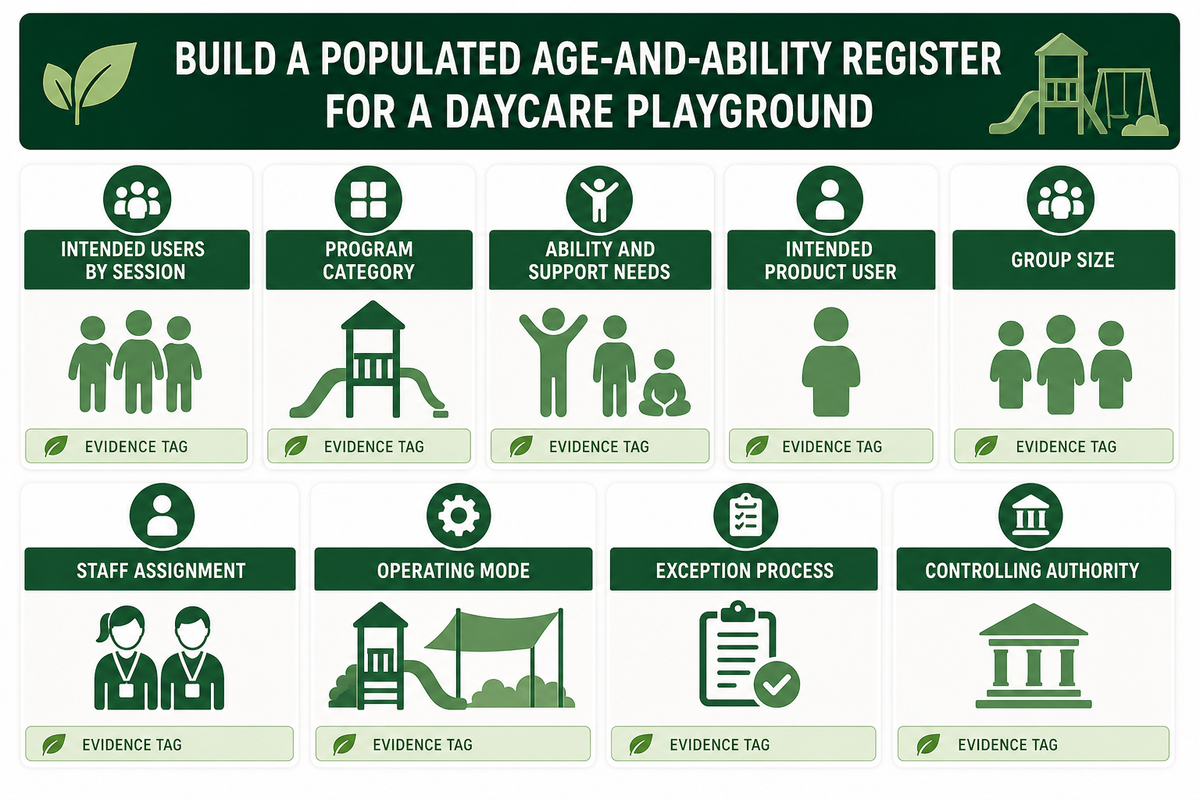
Nine Inputs for an Age-and-Ability Register
Input type
What to record
Design consequence
Do not use when
1. Enrollment band
Youngest and oldest intended users by session
Sets the first equipment and supervision screen
A future program may serve a different band
2. Program category
Classroom, Head Start, private daycare, hotel club, or other use
Identifies which operating rules need review
The category is assumed from the building name
3. Ability range
Mobility, balance, reach, communication, and support needs
Changes routes, transfer points, and adult assistance
A diagnosis is being guessed or displayed publicly
4. Intended product user
Age and ability stated for each play component
Prevents a room label from overriding product scope
The label or instructions are unavailable
5. Group size
Children present in each operating mode
Tests queues, crowding, and adult coverage
It is copied from maximum enrollment rather than the session
6. Staff assignment
Named roles, primary positions, and handoffs
Makes the plan testable under a real roster
A drawing merely shows generic adult icons
7. Operating mode
Simultaneous, staggered, or single-group use
Determines whether a boundary or schedule carries the control
Staff cannot enforce the planned mode
8. Exception process
Who reviews a child-specific accommodation or temporary change
Keeps exceptions deliberate and documented
It becomes an informal workaround
9. Controlling authority
Applicable licensing, program, access, and safety reviewer
Turns open legal questions into assigned approvals
A supplier is asked to make the legal determination alone
Scope snapshot: CPSC band endpoints include 6 months, 23 months, 2 years, 5 years, 5 years, and 12 years. Head Start §1302.21 distinguishes classes serving children under 36 months and classes whose majority are age 3 or ages 4 and 5. Its covered center-based rule states 35 square feet (about 3.25 m²) indoors and 75 square feet (about 6.97 m²) outdoors per child. ADA play-area scope begins at 2 years, while its route guide uses a 50% elevated-component rule; that does not mean 100% of all components. These are source-specific examples, not universal design targets.
Use an age band and standards selector as a briefing aid, then confirm the result against the actual facility, product documentation, and authority. A planning tool can organize questions; it cannot determine jurisdiction.
Translate Child-Development Goals Into Zone Controls
When designing a playground, do not start by promising playgrounds for children of all ages. Define the age range and specific age group for each operating session. Product literature can write preschool bands as 2-5, ages 2-5, or 2 to 5, while another document says children ages 2 years through 5 years. CPSC planning shorthand also identifies 6 months through 23 months and 5 years through 12 years. The age-and-ability register, not the notation, controls the brief.
Next, connect child development goals to observable behavior. Record the needs of children across different ages and abilities, including cognitive and physical demands and the relevant stages of play. Vague promises such as “help kids build social skills,” “kids learn cooperation,” or “helps them develop” are not acceptance criteria. State how children can engage alone or alongside peers, and when they engage in cooperative activity. If the aim is to encourage imaginative play, encourage kids to engage, or encourage the development of a skill, name what staff should observe.
Only then review play structures. For each piece of equipment, record the manufacturer’s intended users. Phrases such as “equipment for this age” and “equipment for each age group” are shorthand, not acceptance evidence. Check whether the equipment designed for the session matches the playground equipment designed for that age band. A list can include equipment such as low platforms, spring riders, or chain or rope climbers, but every item still needs its own review. Commercial playground equipment can group similar-looking playground structures into different types of equipment with different motion, access, and inspection requirements.
Finish with the operating context. Inclusive design does not mean every child uses every component, and “designed for children” does not establish one universal age. When teams build a playground, choosing the right boundary begins with space requirements, session rules, and movement paths. In limited space, the same route can serve several types of play only when movement conflicts remain controlled. Playground surfacing, access, staff positions, and sanitation routes belong in the same review. Safe play is an operating outcome to test, not a label attached to younger kids or a product category.
Separate Conflicting Movements Before Choosing Play Equipment
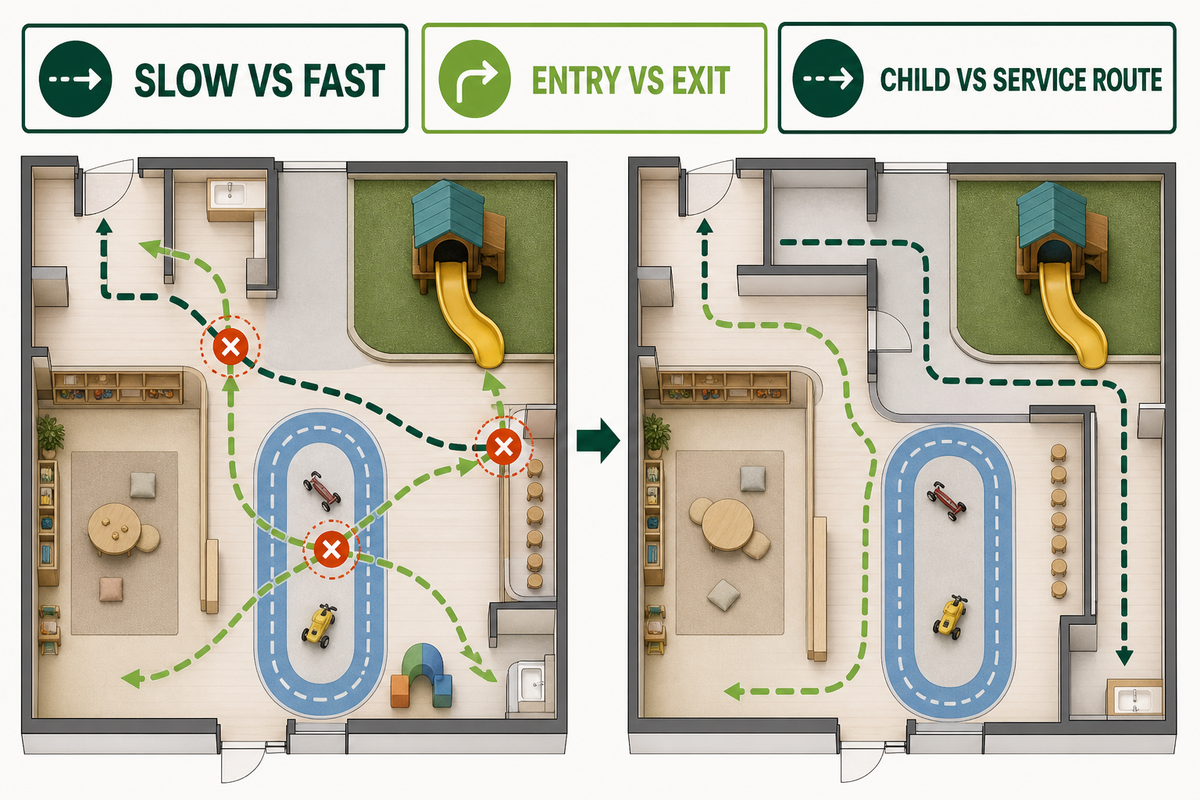
Once the age-and-ability register is set, place activities on the plan only after marking movement. Fast running shouldn’t pass through a quiet floor-play area. A slide exit should not discharge into an entry queue. A gate should not open into a swing or circulation path. CPSC guidance specifically calls for separating conflicting activities; the exact use zone remains equipment-specific.
Four overlays come first: slow versus fast movement, moving versus stationary activity, entry versus exit, and children’s circulation versus staff service routes. Only then add equipment footprints and the use-zone requirements from the applicable instructions. Do not invent a general clearance: visually similar items can have different motion and fall scenarios.
When teams design playgrounds, familiar product names can pull attention away from paths. A low climber, freestanding panels, or spring riders are examples of types of equipment that still need product-specific review. Selecting age-appropriate playground equipment means checking the intended age and ability for each item, not assigning equipment to an age group by appearance alone. This guide does not recommend a model or configuration.
Do
Draw entry, exit, running, queue, and service arrows.
Mark product-specific use zones from approved documents.
Observe a realistic peak session before freezing the plan.
Do not
Fill empty floor area first and solve circulation later.
Use a painted stripe as the only control for a high-energy crossing.
Assume adult attention cancels a poor exit path.
Run the Boundary Stress Test
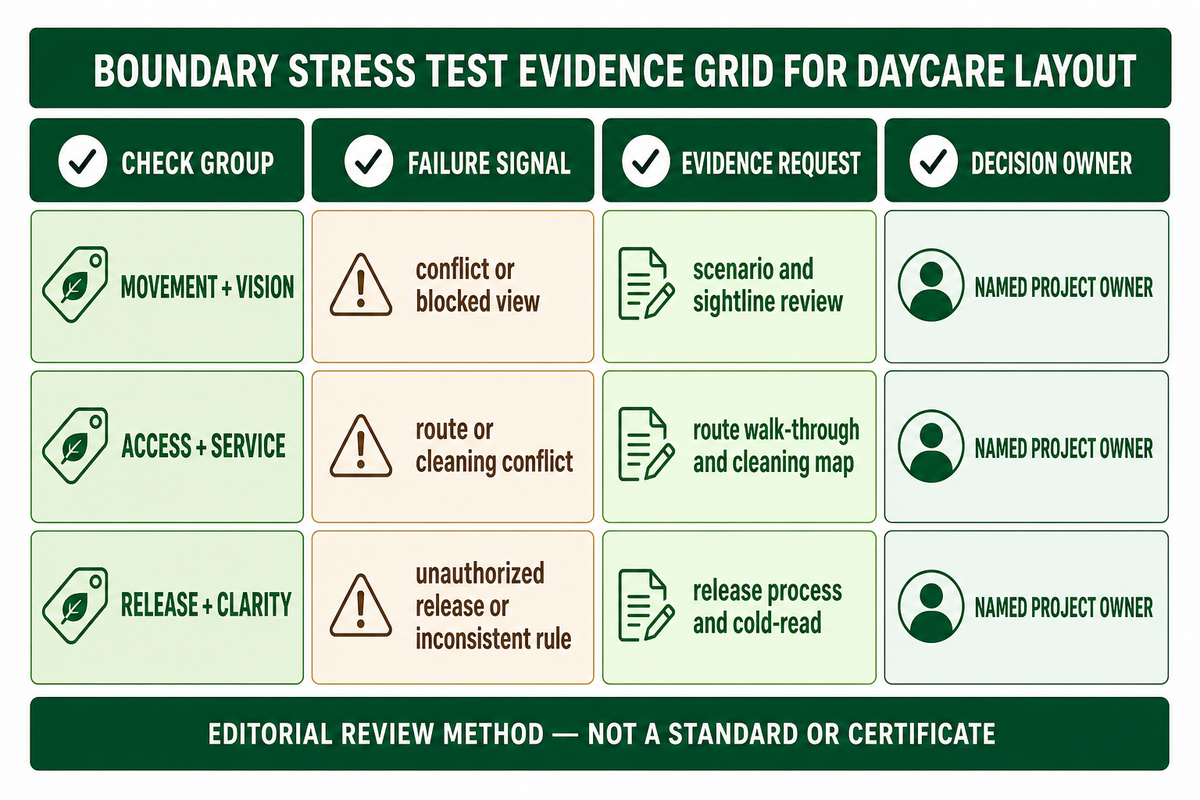
After the movement overlay, dividers can stop one crossing and create another failure. The Boundary Stress Test is an editorial decision method for reviewing walls, nets, gates, railings, low furniture, surface changes, and schedule-only boundaries. It isn’t a safety standard or certification; its caregiver-vision check applies the Head Start active-supervision principles to a layout review.
Boundary Stress Test Evidence Grid
Check
Failure signal
Evidence to request
Decision / limitation
1. Child movement
Children detour through another activity or climb the divider
Observed path trace and boundary detail
Redesign; not suitable if it creates a new conflict
2. Caregiver vision
A child disappears behind an opaque or crowded edge
Eye-level sightline drawings from real positions
Lower, open, move, or remove the obstruction
3. Staff response
An adult must cross a queue, locked gate, or active route
Timed walk-through under operating conditions
Add a safe response path; time is project-specific
4. Required access
A gate, lip, queue, or surface break interrupts a required route
Scoped component and route review
Correct within applicable access scope; do not generalize it
5. Cleaning transfer
Used items or tools cross clean child circulation
Collection-to-storage route map
Separate the route or change the handoff
6. Emergency route
The boundary narrows, delays, or confuses the planned response
Applicable emergency plan and drill observation
Authority review required; this table is not an egress code check
7. Authorized release
Entry control and child handoff share an unowned opening
Arrival/departure responsibility map
Assign control; not suitable as an unattended gate
8. Maintenance
Fasteners, mesh, hinges, or floor edges cannot be inspected
Access detail and inspection task list
Provide inspection access or choose another boundary
9. Operating clarity
Staff describe different rules for the same opening
Cold-read interview and session procedure
Rewrite ownership; signs alone are not enough
Test the approved layout, not a simplified image. Put staff in their planned positions, introduce realistic queues and transitions, and record each failure with an owner. Boundaries pass only for the operating mode that was tested.
Design the Adult Coverage System
Staff coverage begins with positions and paths. Head Start describes active supervision through staff positioning, scanning and counting, listening, anticipating children’s behavior, and engaging and redirecting. Transitions are times when even more attention is required because the group and staff members are in motion.
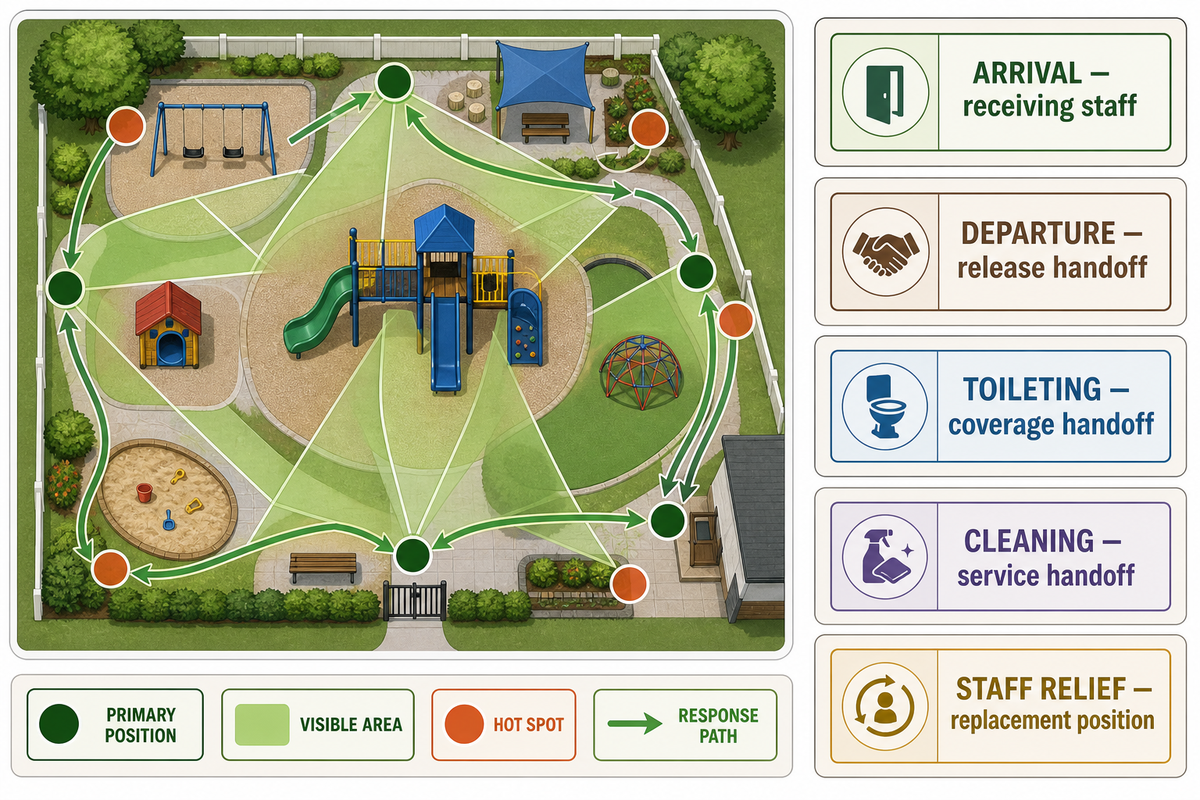
Draw one primary position for each role, the areas visible from it, the hot spots needing more attention, and the route to reach them. Then ask another staff member to read the plan without coaching. If that person cannot tell who owns the gate, quiet area, toilet transition, or temporary absence, the drawing has not carried the operating decision. Risk rises because transitions change both the group location and the adult response path.
Do not combine staffing approval with spatial review. Head Start guidelines help explain why. Ratios and maximum group sizes can depend on the age of the majority of children, the children’s needs, and stricter state or local licensing provisions. Do not apply federal figures blindly to another program or country.
Coverage cold-read
Mark every normal staff position.
Shade what each person can see without leaving that position.
Trace a safe response path to each hot spot.
Simulate arrival, departure, toileting, cleaning, and staff relief.
Ask an uninvolved staff member to name each handoff owner.
An indoor playground operations guide can provide broader operating context. Use it after the age-zone layout has a clear session map.
Keep Required Accessible Routes Continuous
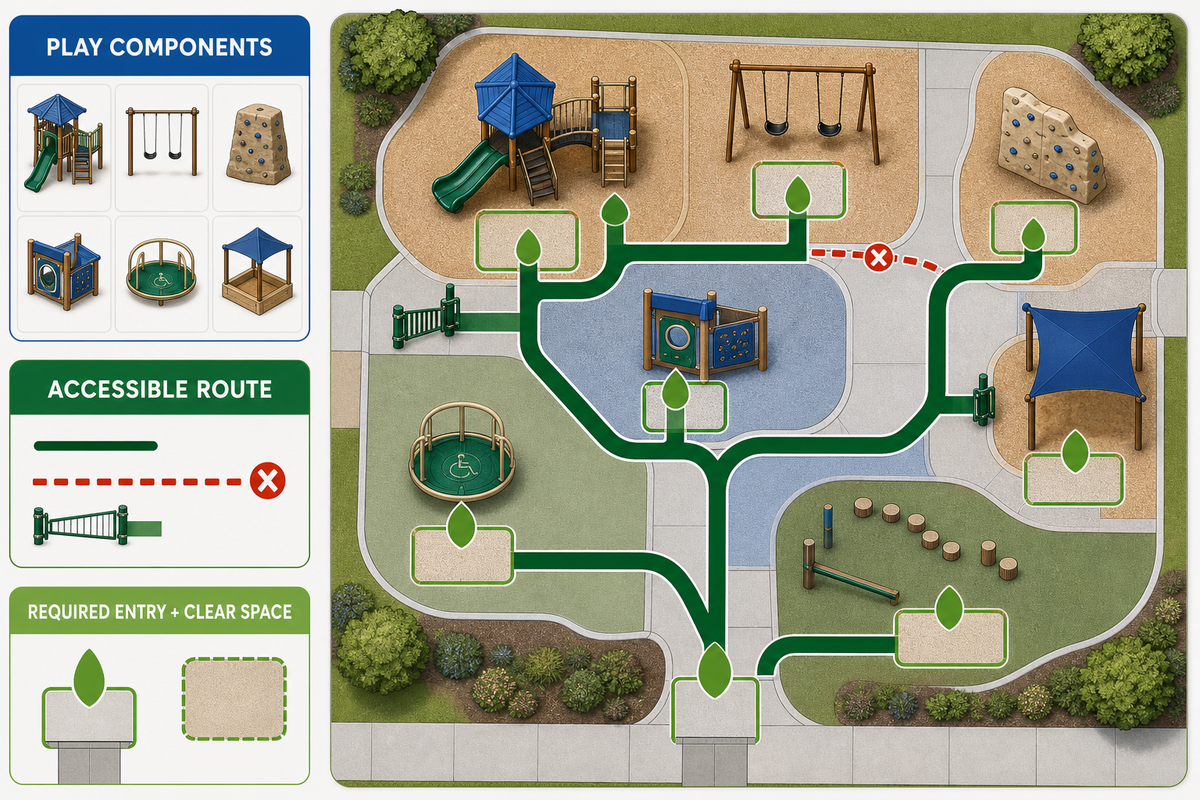
Accessibility is neither one isolated equipment corner nor a claim that every surface and component has an identical federal requirement. For covered U.S. play areas, the Access Board guide connects required ground-level and elevated play components through accessible routes and clear spaces. Section 240 scopes play areas for children ages two and older and states exceptions. The project team must identify the rule, jurisdiction, component counts, and alterations that actually apply. This is a procurement risk because a supplier drawing still needs review by the responsible access reviewer.
On the plan, number every play component, classify it correctly, identify required entries and clear spaces, and trace the applicable route. Then overlay the age zones, gates, queues, and surfacing transitions. A zone line that breaks a required route has not passed, even if the destination component looks accessible in isolation.
Always check edition and scope before purchasing. The public ASTM store identifies F1487-25 for public-use playground equipment, while other product classes can have different scopes. This article did not access paid clauses and cannot attest one standard governs every daycare site. Use a supplier-side commercial overview to identify the applicable product class before purchase; then verify the applicable edition, standard text, and project review independently.
Treat Hygiene and Transitions as Route Design
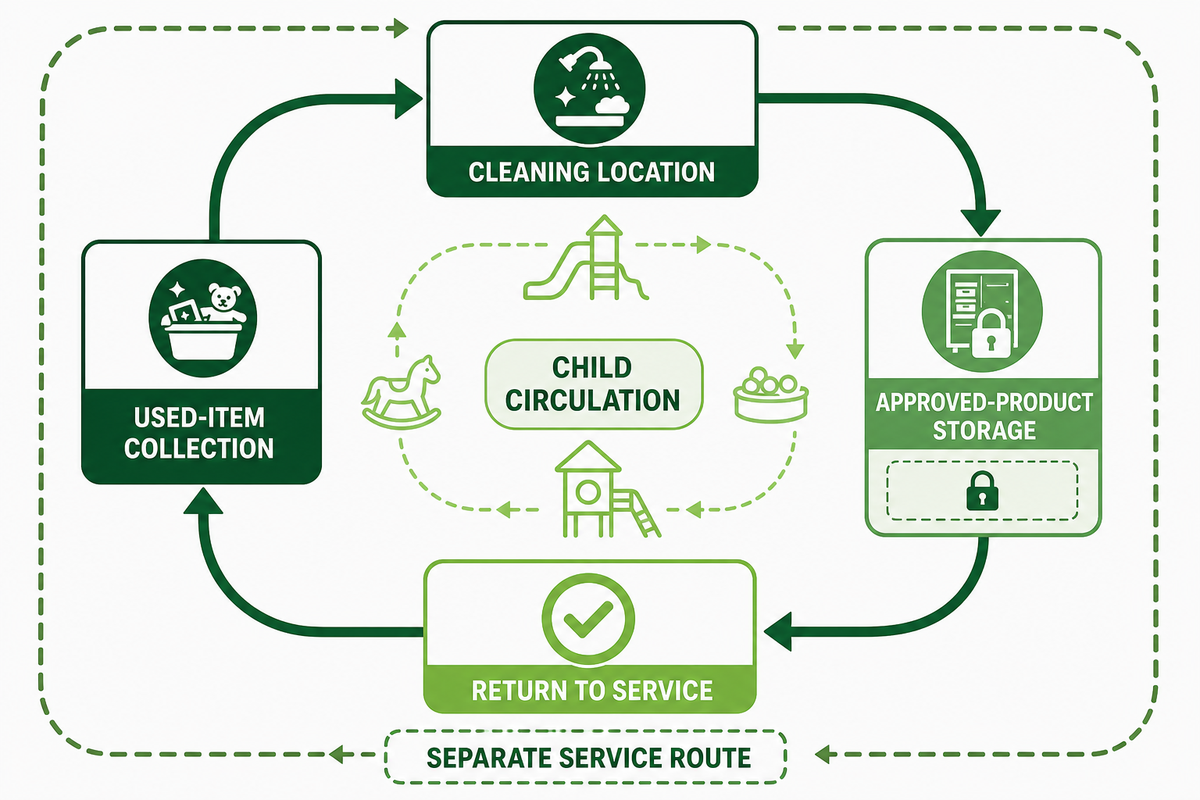
After access routes are traced, cleaning crosses operational boundaries as well as material borders. CDC guidance for early care and education differentiates cleaning, sanitizing, and disinfecting. Cleaning removes debris, dirt, and impurities and must precede the others. The later action depends on the item and context. Mouth-contact items, visibly dirty surfaces, and areas affected by illness do not all follow one generic response. For an operator, the risk grows because an unowned collection route can move used items back across child circulation.
Identify where used items are collected, where they’re cleaned, where approved products are stored, and how they’re returned to service. Store and use chemicals out of reach of children. Map cleaning-tool and service routes to prevent child access or exposure. Verify labels and material compatibility rather than assuming one generic chemical or schedule.
Transitions are subject to the same rules. Arrival, departure, toileting, group change, and cleaning closure can change sightlines and the adult position. Write each transition as a brief sequence: trigger, group position, adult owner, head count verification, gate state, route, and ending signal.
Plan Mixed-Age Sessions Without Blurring Responsibilities
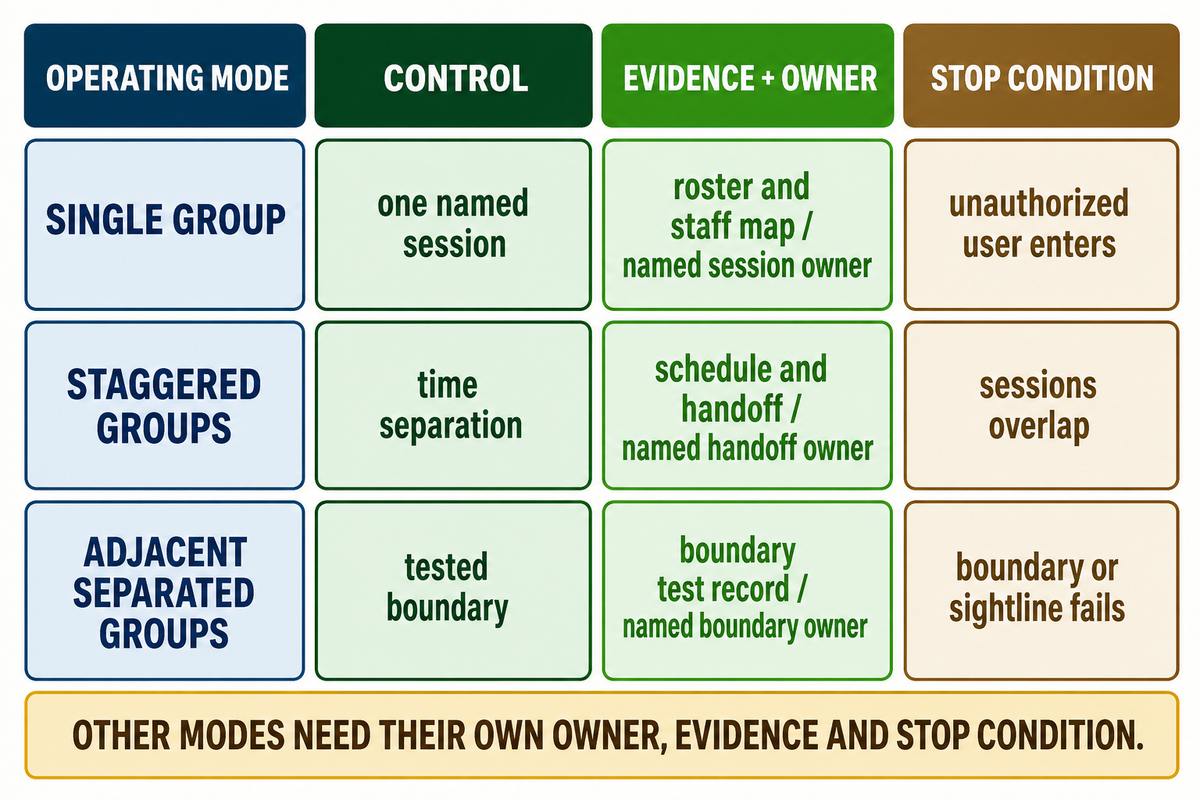
Developmental overlap doesn’t itself authorize shared use. First confirm program rules, local licensing, ratios, and group size, along with equipment scope and child-specific needs. Then select the operating mode that staff can reliably run.
Operating mode
Control carried by
Evidence before approval
Do not use when
Single group
Exclusive session and reset
Schedule, reset checklist, entry control
Overlapping arrivals defeat exclusivity
Staggered groups
Time separation and handoff
Transition duration and count ownership
The schedule has no recovery margin
Adjacent separated groups
Physical boundary plus staff roles
Boundary Stress Test and cold-read
Sightlines or required routes fail
Shared low-energy area
Restricted activity and direct coverage
Permitted-user and behavior criteria
Equipment or program rules require separation
Shared circulation only
Timed crossing and gate owner
Crossing sequence and stop condition
A group waits in an active use zone
Family event exception
Written temporary plan
Attendance, roles, equipment closure, approval
Normal staffing is assumed sufficient
Child-specific accommodation
Individual support decision
Authorized plan and responsible staff
Private information would be displayed publicly
Weather relocation
Alternate room plan
Capacity, routes, closed items, handoff
The alternate space has not been reviewed
Open flexible use
Continuous staff judgment
Authority approval and observed trial
Rules, product scope, or staffing cannot support it
Identify the operating mode by name. “Flexible” isn’t a standard operating procedure. If staff are expected to remember an unwritten exception, the plan already relies on individual knowledge that may be lost when personnel change.
What Is Changing in 2026—and What Still Needs Proof?
Sensory, nature-based, mixed-age, and inclusive themes appear frequently in current playground design discussions. They can help a team state a design objective, but they don’t prove safer supervision, accessible participation, easier cleaning, or better business performance. The evidence test stays the same: name the intended benefit, the operating condition, the acceptance check, and the owner. Broader visual trend reviews can supply context, but retail assumptions should not be imported into daycare operations.
Play spaces can support imaginative play, social skills, and unstructured play while still separating incompatible movement. The goal isn’t to promise one “best playground” for kids of all ages. It is to help younger children and older kids use different age-and-ability settings under rules that staff can explain and run.
Ask what the concept changes on the plan. A sensory retreat may need visual connection without high traffic. Nature materials can change maintenance and cleaning questions. Flexible zones can increase the number of operating modes staff must learn. This is an operator verification risk because a trend label says nothing about the acceptance evidence. No adoption percentage or outcome rate is asserted here because the reviewed commercial trend pages cannot carry that claim.
Freeze the Age-Zone Control Proof Set Before Supplier Layout Review
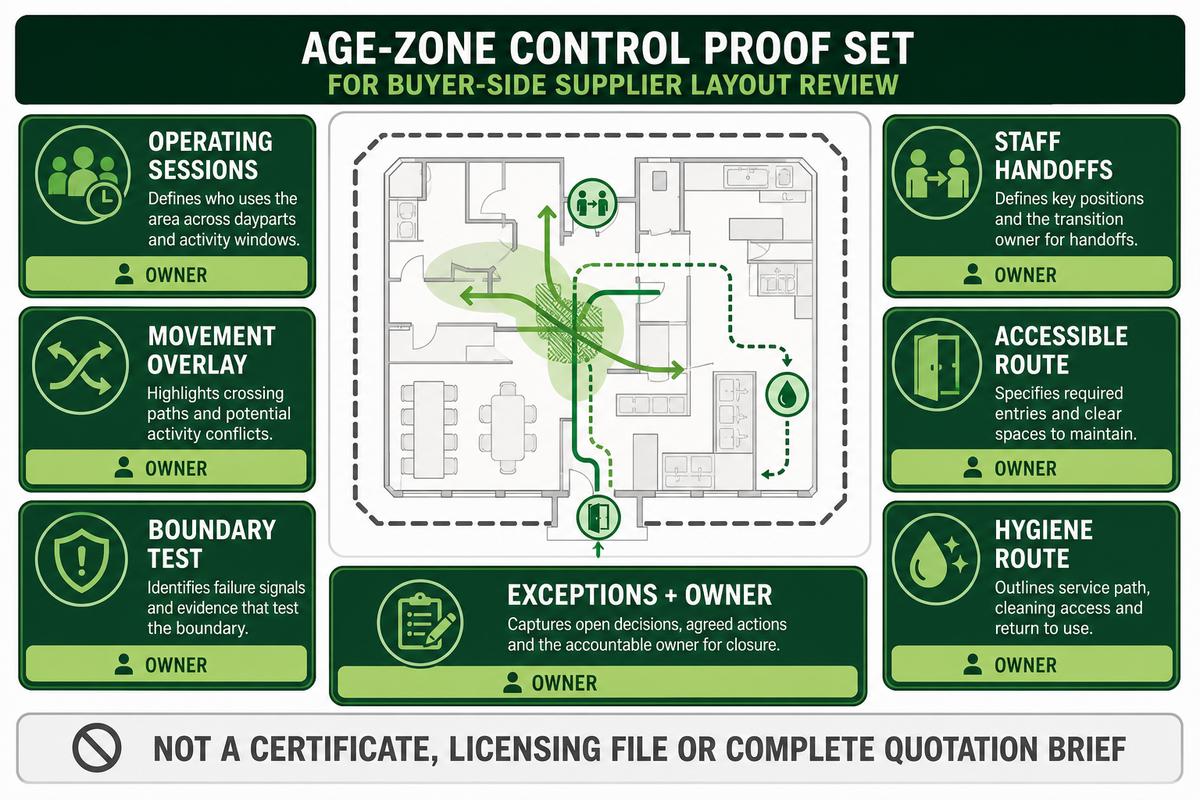
The Age-Zone Control Proof Set is a buyer-side operating record. It freezes the assumptions behind the drawing before a supplier layout review. It is not a certificate, licensing file, or complete quotation brief. Each item should identify the current decision, open exception, evidence, and person who can close it. Missing owners create a procurement risk because the supplier and buyer can otherwise interpret the same exception differently.
Age-Zone Control Proof Set
Operating sessions and intended-user register
Activity and crossing-path overlay
Boundary Stress Test record
Staff positions, hot spots, and handoffs
Required accessible-route overlay
Hygiene and transition route
Open exceptions, owner, and revision date
Handoff rule: send the same proof set to every shortlisted provider so proposed layouts are compared against the same operating assumptions.
Estimate room demand before layout work with a room size and children served calculator, but treat the result as an input, not an approval.
Dreamland Playground can use the completed proof set to develop a project-specific floor plan and three-dimensional concept around the client’s space, age groups, market, theme, budget, and operating needs. Keep local authority approval, product-scope confirmation, and operating acceptance with the responsible project parties. Keep this guide’s buyer-side acceptance criteria separate from supplier equipment recommendations and quotations.
After the Age-Zone Control Proof Set is defined, these questions test the age-band, boundary, access, and supplier-handoff decisions that most often need clarification.
What age groups should a daycare playground use?
CPSC’s bands of 6–23 months, 2–5 years, and 5–12 years are useful U.S. public-playground references, not universal classroom assignments. Record actual enrollment, product scope, abilities, program rules, and local licensing. A covered Head Start center serving both cohorts must be able to separate infants and toddlers from preschoolers during play.
Can toddlers and preschoolers share one play area?
Sometimes, a facility can use one area if controlling program rules, local licensing, ratios, group size, product scope, and child needs allow it. A covered Head Start center serving both cohorts must still be able to separate infants and toddlers from preschoolers during play. Name the shared operating mode, boundary, staff coverage, transitions, equipment restrictions, and stop condition. If staff cannot enforce those controls, use separate sessions. Recheck the arrangement whenever enrollment, staffing, equipment access, or the operating schedule changes.
Does a divider make an age zone safe?
No. Dividers can reduce one conflict while blocking sightlines, staff response, required access, cleaning transfer, or emergency action. Test the divider with staff in assigned positions, realistic queues, every planned transition, and the authority’s applicable requirements before accepting that operating mode.
Must every playground surface and component be accessible?
Do not make that blanket claim. In the United States, applicable standards use scoping rules for play areas, components, routes, entries, clear spaces, age, alterations, and exceptions. Identify what is required for the specific project and have the responsible access reviewer confirm it.
What age-zone evidence should accompany the supplier brief?
Attach the Age-Zone Control Proof Set: operating sessions, intended users, movement overlay, boundary decisions, staff coverage, required accessible-route overlay, hygiene and transition routes, plus open exceptions, owners, and revision date. Keep licensing applicability, authority approvals, commercial terms, and the complete document request in their own project records.
Scope note: U.S. sources are used as transparent examples for a guide aimed at U.S. and international project teams. They don’t establish the rule for every country, facility, product class, or program. Confirm current local requirements and editions before approval.
Dreamland Playground publishes practical planning guides for commercial indoor-play projects, including family entertainment centers, shopping malls, hotels, restaurants, churches, and other venue types.
Use these guides to frame the questions that should be resolved before concept selection: venue size, intended age groups, project location, attraction mix, operating priorities, timeline, and delivery constraints. Final recommendations should be based on the real site and applicable local requirements.
Start With The VenueFloor area, clear height, site location, intended audience, and target opening date create the working brief.
Clarify The ScopeConcept, equipment, production, shipping, installation, and operating inputs can vary from one project to another.
PROJECT / VENUE / TIMELINE
Prepare Your Project Brief
Venue TypesFEC · Mall · Hotel · Restaurant · Church
Start WithFloor area · Clear height · Age groups · Country


![Age-Based Zone Design for Daycare Playgrounds [Guide]](https://dreamlandplus.com/wp-content/uploads/2026/09/age-based-zone-design-guide-blog-featured.png)


![Age-Based Zone Design for Daycare Playgrounds [Guide]](https://dreamlandplus.com/wp-content/uploads/2026/09/age-based-zone-design-guide-blog-featured-150x150.png)