An indoor playground operations guide is a control framework, not merely a collection of checklists. It should name who owns each control, connect routine checks to an exception log, keep unsafe areas closed, and show who may authorize reopening. Those details must still follow the installed equipment, manufacturer instructions, mall procedures, insurer conditions, and local requirements.
Key takeaway
A mall playground is ready to operate when responsibilities, routines, exceptions, records, and reopening authority work as one control system, not when somebody has merely ticked every box.
This guide gives mall owners, facility managers, operators, shift supervisors, cleaners, and maintenance providers a practical structure for that system. It isn’t a universal safety manual or legal opinion. Requirements for inspection, accessibility, occupancy, first aid, privacy, chemicals, emergency planning, and staff coverage vary by jurisdiction and site.
Indoor playgrounds have become mixed operating environments rather than one equipment category. Indoor playgrounds offer active play, parties, food-adjacent traffic, and different attractions under one roof, so an indoor playground requires more than generic playground safety tips. This is an operations manual framework, not an ultimate guide to the indoor playground business, a business plan for how to open an indoor playground, or a substitute for site-specific indoor play area requirements. It doesn’t set equipment prices, repeat market research, select high-quality materials, or design your playground. Those commercial decisions belong in their own project process.
No complete guide to indoor playground safety can erase country-level differences in inspection, staffing, cleaning, accessibility, and emergency duties. Good management can prioritize safety, but no checklist can ensure safety or prevent injuries entirely. In practice, the goal is to turn applicable safety rules, safety protocols, and safety measures into daily operations that staff can observe, record, escalate, and improve.
An indoor playground operations guide template becomes useful only after the site names its assets, roles, evidence sources, and escalation routes. For playground management, local decisions must remain visible to the people opening, supervising, cleaning, maintaining, and releasing each zone.
1. Define the Mall Operating Boundary Before Opening
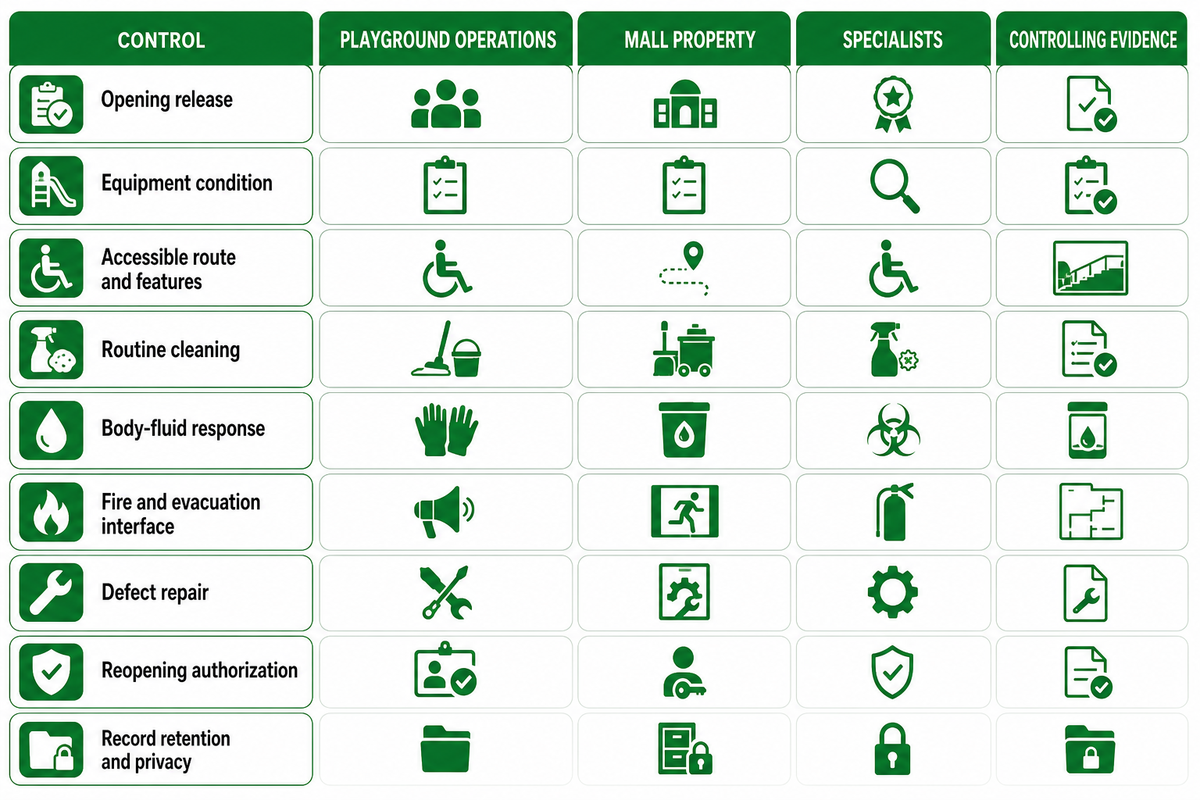
Begin by assigning every recurring control to an owner and a controlling evidence source. Shopping malls can own the building alarm, common-area evacuation route, utility isolation, or after-hours access while a separate playground operator owns admissions, floor supervision, and daily equipment observations. Cleaners, specialist maintainers, suppliers, and local authorities may each control another part of the answer.
Don’t let a contract label substitute for an operating decision. In the United States, for example, the Department of Justice Title III technical-assistance manual explains that a landlord and tenant may allocate work between themselves while both can retain external responsibilities. It also states that accessible features must be kept operable and accessible routes free of obstruction. Apply that point only where Title III is relevant, and get qualified advice for the actual property.
Use the following editorial grid as a starting workshop tool. “Consulted” doesn’t mean legally responsible, and the completed grid doesn’t interpret mall playground lease responsibilities.
Mall Control Interface Ledger
Control
Operating owner
Required interface
Controlling evidence
Opening release
Playground shift lead
Mall duty manager
Signed opening record and open-exception list
Equipment condition
Playground operator
Maintainer and supplier
Installed-equipment register and instructions
Accessible route and features
Named property and operating owners
Qualified accessibility adviser
Applicable law, approved plan, inspection record
Routine cleaning
Cleaning contractor or trained staff
Operator and material specialist
Surface map, product label, supplier instructions
Body-fluid response
Trained response lead
Facility and cleaning teams
Site procedure and applicable health rules
Fire and evacuation interface
Mall emergency lead
Playground floor lead
Approved mall emergency plan and drill record
Defect repair
Competent maintenance owner
Operator and supplier
Work order, approved parts, repair evidence
Reopening authorization
Named site authority
Competent verifier
Return-to-service criteria and verification
Record retention and privacy
Operating company
Property, insurer, qualified adviser
Site policy and applicable privacy rules
2. Run One Open-Live-Close Operating Cycle
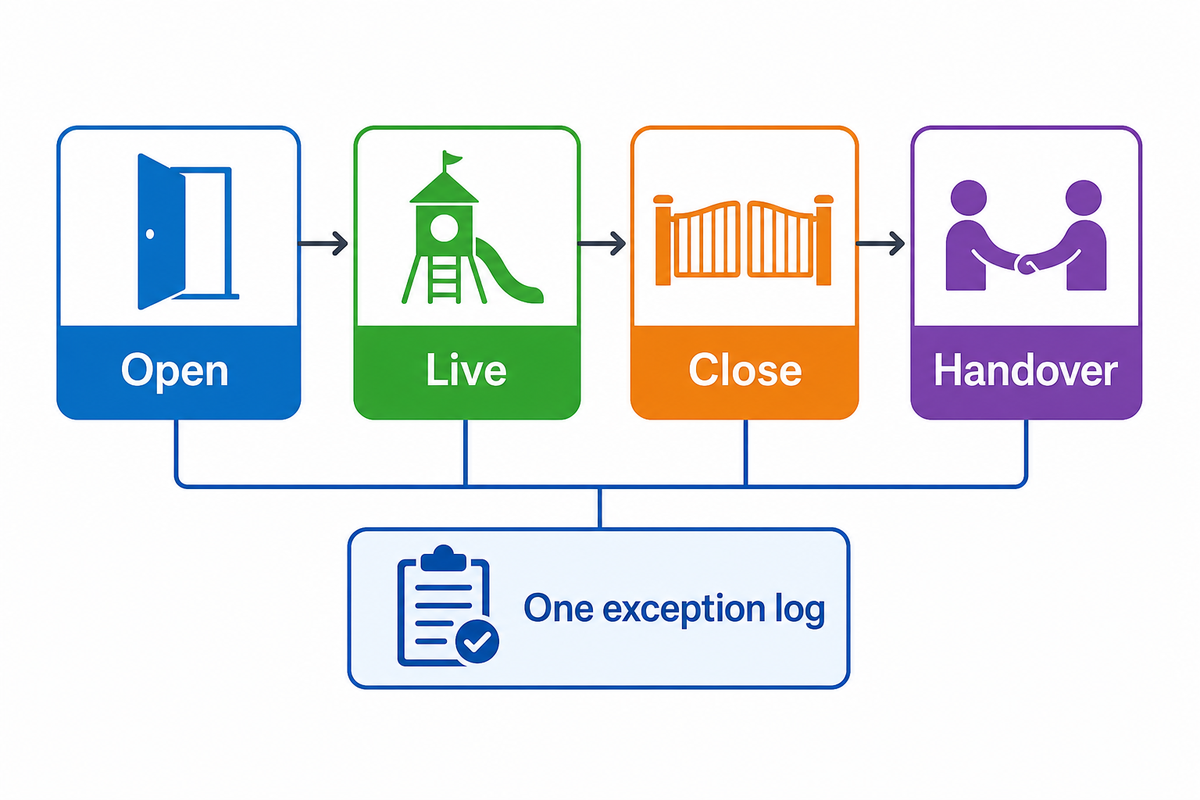
Opening, live-floor, and closing checks have different jobs, but every exception should enter one traceable action log. Opening confirms the known starting state. Live-floor observations catch changing conditions while guests are present. Closing records deterioration, cleaning needs, missing items, and work that must be completed before the next release.
An opening check isn’t a promise that a condition will stay safe all day. Traffic moves furniture, liquids spill, fasteners loosen, visibility changes, and guests use equipment in unexpected ways. Staff therefore need a simple route from an observation to immediate control: assign an exception ID, isolate or manage the exposure, name the action owner, set a due point, and state whether the exception blocks a zone or the whole play area.
Shift Exception Relay
Stage
Question
Record
Release rule
Open
Is the expected starting state verified?
Observer, time, zone, exceptions
Named lead accepts only allowed open items
Live
What has changed since opening?
Observation, immediate control, owner
Affected exposure is controlled at once
Close
What must be restored before the next shift?
Condition, cleaning, stock, work orders
Unclosed items transfer to a named recipient
Handover
Who now owns every unresolved item?
Recipient, acknowledgement, due point
No orphaned exception
How Can You Best Maintain a Play Structure?
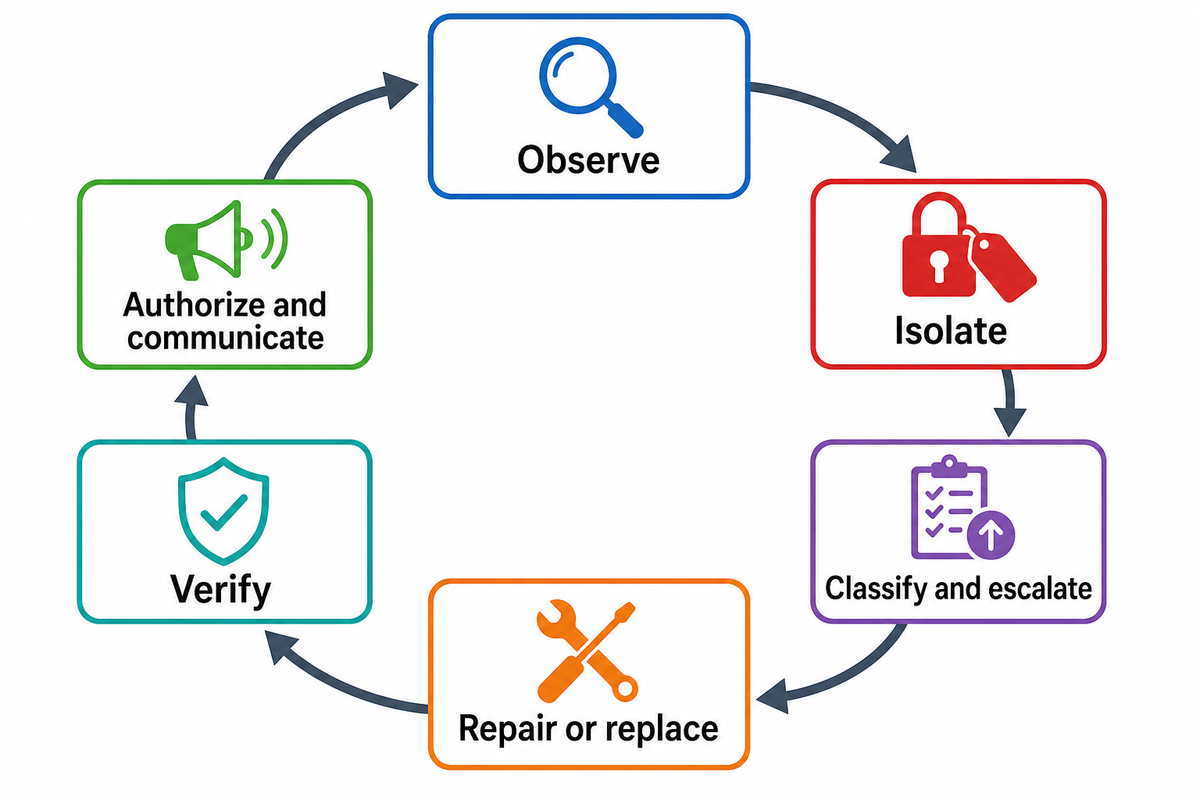
Use a repeatable loop: observe the installed structure, isolate any affected exposure, record the exact condition, escalate to the correct owner, complete an authorized repair, and verify the return-to-service criteria. Maintenance is weaker when staff keep separate paper lists that don’t share exception IDs. It’s stronger when the closing shift can see what the opening shift is still forbidden to release.
UK Health and Safety Executive play guidance also offers an important restraint: control real risks without letting paperwork replace judgment. Use records to support action, communication, and learning.
3. Run the Red-Tag Release Chain
A defect isn’t closed because somebody noticed it, wrote a work order, or completed a repair. When the open-live-close cycle finds a defect, its exception log should feed this loop. Affected equipment or zones remain controlled until the required verification is complete and the named reopening authority communicates the release. This editorial loop turns that principle into six visible steps.
Observe — record the exact asset, zone, condition, time, and observer without guessing at the cause.
Isolate — prevent access to the affected exposure and check whether connected equipment must also close.
Classify and escalate — route the finding under the site risk process to the authorized operational, maintenance, supplier, property, or authority contact.
Repair or replace — use approved instructions, parts, methods, and competent personnel appropriate to the installed asset.
Verify — compare the completed work with the written return-to-service criteria and record the evidence.
Authorize and communicate — have the named authority release the zone and tell admissions, floor, cleaning, and property teams what changed.
Each record should connect defect ID, asset or zone, initial observation, isolation, linked incident, repair evidence, verifier, reopening authority, and date and time. If site rules require an independent or authority inspection, an internal check can’t replace it.
Equipment maintenance is therefore part of the shift system, not a separate folder that only a technician sees. Operations teams need enough instruction to recognize escalation triggers, follow safety rules for isolation, and preserve evidence without attempting unauthorized repairs. Maintaining your playground also means reviewing repeat findings: recurring wear, entrapment concerns, missing barriers, or failed closures can justify a wider technical review even when each individual report appears minor.
How Often Should an Indoor Playground Be Inspected?
There’s no globally safe single answer. Separate frequent staff observations from scheduled detailed playground safety inspections and any independent or competent-person review. Set each interval from manufacturer instructions, equipment type, use intensity, defect history, risk assessment, applicable local rules, and mall or insurer conditions. Record both the check and the closure evidence for every finding.
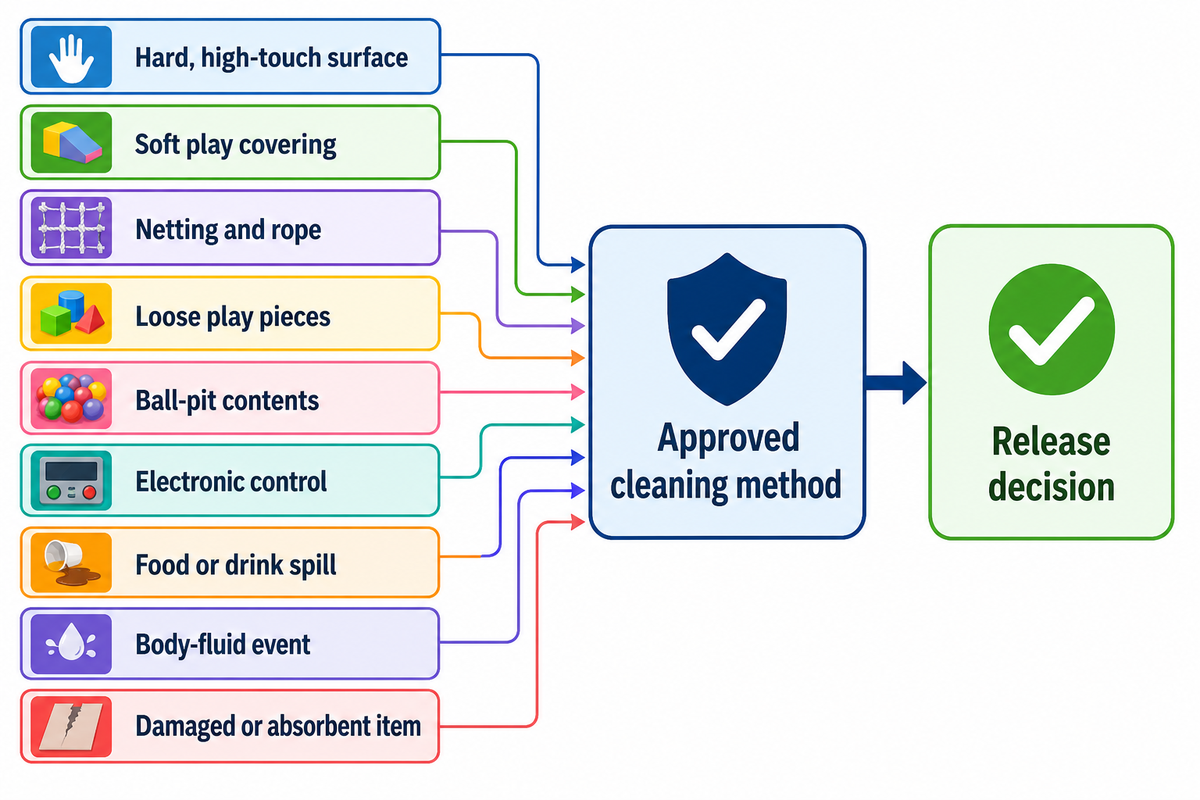
4. Use the Surface Event Cleaning Selector
Choose cleaning actions by surface, soil, contamination event, product label, contact time, ventilation, and material compatibility. Cleaning removes dirt and organic material. Sanitizing and disinfecting are different actions with product- and setting-specific instructions. A stronger chemical isn’t automatically a better answer.
The CDC early-care and education guidance distinguishes these actions and stresses cleaning first where required, following label directions, keeping a surface wet for the stated contact time, ventilation, and chemical safety. Its setting matters; use it as a control model, not as a universal commercial rule. The CDC’s general facility guidance likewise ties decisions to surface type, touch frequency, traffic, illness events, and facility-specific regulations.
Surface Event Cleaning Selector
Surface or event
Decision
Control evidence
Record or limit
Hard, high-touch surface
Clean; add an approved further action when justified
Product label and surface instructions
Method, product, time, staff
Soft play covering
Use a material-compatible method
Supplier care instructions
No unapproved soaking or chemical
Netting and rope
Clean without weakening fibers or connections
Manufacturer method
Inspect condition after cleaning
Loose play pieces
Batch, clean, dry, inspect, return
Material and site procedure
Keep dirty and released batches separate
Ball-pit contents
Use the approved batch method and inspect the pit
Equipment and chemical instructions
Record batch release and damaged items
Electronic control
Use electronics-safe products and application
Device manual
Prevent liquid ingress
Food or drink spill
Control access, remove soil, clean, dry
Site hygiene procedure
Check slip and residue risk
Body-fluid event
Close affected area and follow the site response
Applicable health rules and product label
Exposure, PPE, cleaning, disinfection, release
Damaged or absorbent item
Isolate; assess repair, deep treatment, or replacement
Material specialist and site policy
Do not return if release criteria fail
Minnesota Department of Health indoor-play guidance gives useful documented-monitoring and body-fluid closure examples, but it’s written for indoor play areas in Minnesota food businesses. Don’t export its cadence as a global requirement. Build the site matrix with the responsible cleaner, operator, facility manager, and equipment or material specialist, then cross-check the applicable playground safety standards hub.
Connect the play-area matrix with restroom and food-area procedures where traffic crosses those boundaries. Hygiene standards may come from different authorities and contracts, so the shift lead needs a clear interface rather than one invented rule. No cleaning program is stress-free: products can damage materials, wet surfaces can create access problems, and rushed reopening can undo otherwise careful work.
Use the matrix as the controlled core of the site’s indoor play area maintenance and sanitation procedure. It should point staff to approved playground cleaning methods without pretending that one product or schedule fits every installed surface.
5. Cover Zones, Blind Spots, and Shift Handover
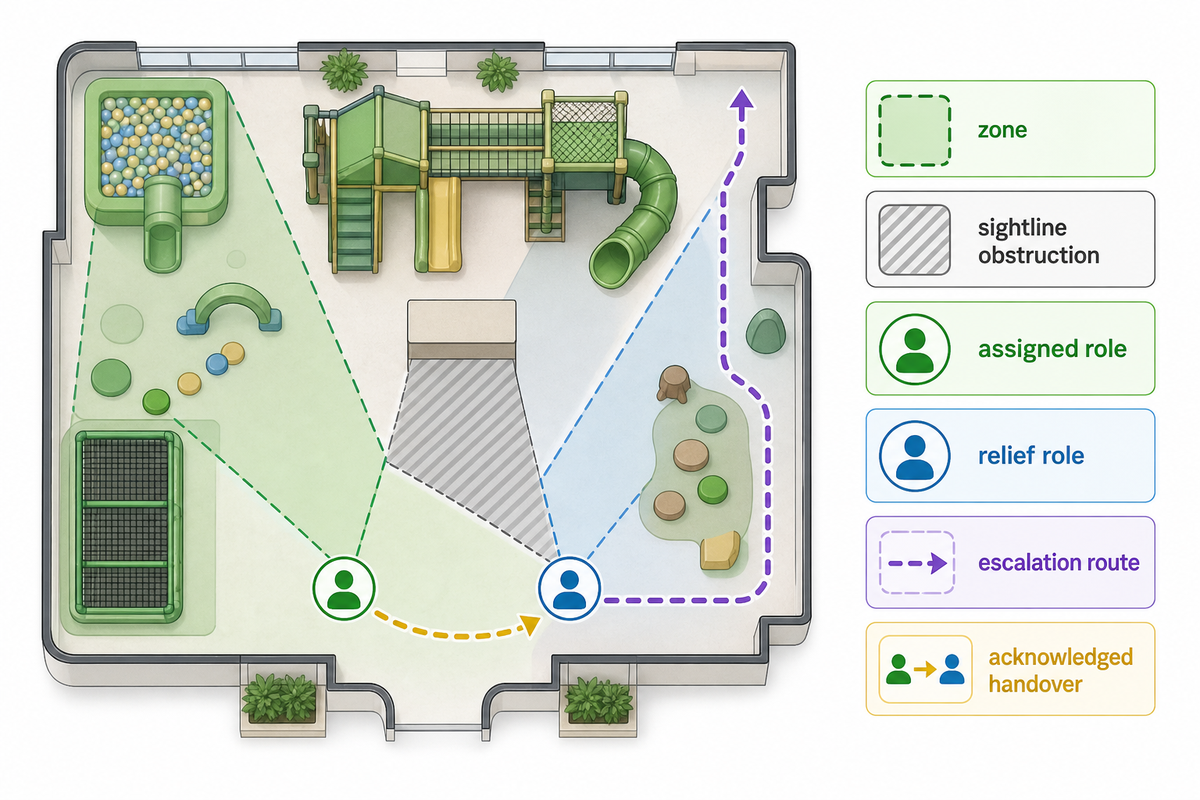
Reliable supervision comes from visible coverage, role clarity, relief coverage, escalation, and acknowledged handover. Once surface controls are defined, staff coverage determines whether people can detect and act on exceptions. A headcount ratio alone can’t tell you whether a staff member can see a slide exit, respond to a climbing zone, manage an admission queue, or leave for a break without creating a blind spot.
Divide the operating floor into named zones. For each zone, record the activity, expected behavior, sightline obstruction, assigned role, relief role, and escalation route. Then test the map during busy arrivals, parties, cleaning, staff breaks, and partial closures. A mirror or camera can support awareness where lawful, but it doesn’t automatically replace active staff observation.
“The quality of the supervision depends on the quality of the supervisor’s knowledge of safe play behavior.” Karen Shipman, described in the original 2003 article as a CPSI and risk management coordinator at JBL&K Risk Services, quoted by Playground Professionals
A shift handover should name every open zone restriction, equipment exception, unusual guest issue, incomplete cleaning action, stock shortage, and expected contractor visit. Incoming supervisors acknowledge the list and know which conditions block release. Staff training should cover observable behaviors and escalation decisions, not just a tour of the facility.
Indoor playground safety training should test whether staff can recognize a trigger, apply the immediate control, find the correct instruction, and transfer the open issue to its owner.
Supervision should also fit the activity. Age-appropriate play for a young-child zone can demand different staff attentiveness than age-specific challenge features or climbing structures. During play sessions, observers may need to watch entrances, slide exits, turn-taking, guest behavior, and changing clear sightlines simultaneously. Active play is often associated with the power of play, promoting physical activity, cognitive skills, and positive experiences; this guide makes no medical or developmental outcome claim. Operationally, the point is simpler: engaging environments still need defined coverage throughout playtime. Consistent roles help create a welcoming environment and build trust, but they don’t replace competent decisions.
Do
Assign named zones and relief roles.
Test sightlines under real operating conditions.
Transfer open exceptions with acknowledgement.
Train staff to act on defined triggers.
Don’t
Assume one ratio fits every layout and activity.
Let breaks silently remove zone coverage.
Treat signs as a substitute for supervision.
Hand over with an untracked verbal warning.
6. Control Admissions, Capacity, and Higher-Risk Activities
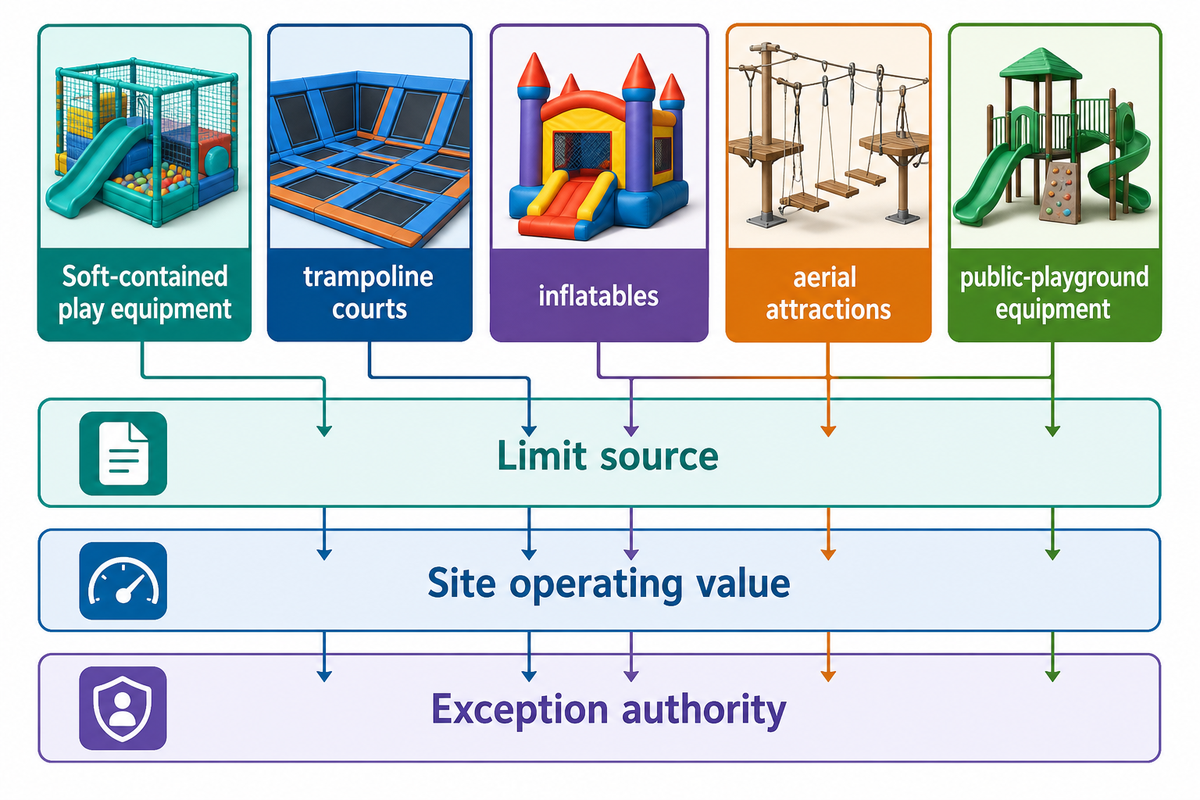
Admissions should translate approved limits into live operating decisions. Keep a register that identifies the source of each limit, the site operating value, how staff count or classify admissions, the temporary restrictions in force, and who may approve an exception. Don’t merge building occupant load, manufacturer capacity, and the operator’s live limit; they answer different questions.
Age, height, guardian, clothing, health, and activity restrictions need an evidence source and a consistent check-in method. Wristbands, time blocks, or digital check-ins may help staff recognize groups, but the chosen method must also fit privacy and accessibility requirements. If an area closes, admissions and floor staff should receive the restriction together.
Build the live register around decisions staff can actually make. A useful entry identifies the attraction, approved-limit source, current operating restriction, counting method, who can change the status, and the time the next review is due. It should also show whether a guardian rule, age or height control, footwear rule, or temporary equipment restriction applies. When several rules overlap, train admissions staff to follow the most restrictive applicable operating condition until an authorized review says otherwise.
Higher-risk activities need their own release and staffing logic. A trampoline zone, climbing feature, or timed challenge may require a separate briefing, readiness check, supervision role, or participant-control method under the installed-equipment instructions and local requirements. If that specialist role is unavailable, the operating response may be to keep the activity closed rather than let general floor coverage absorb it. Record that closure on the same exception board used by the shift team so marketing, admissions, floor staff, and the mall duty manager don’t communicate conflicting availability.
A family entertainment center may also run a trampoline park area, party packages, toddler soft play, or timed challenges beside general family entertainment. Treat those as distinct operating profiles. One wristband color, guardian statement, or staff briefing may not control them all, and staff shouldn’t copy a restriction to another attraction without checking its evidence source.
Maintain a type-specific standard register. Soft-contained play equipment, trampoline courts, inflatables, aerial attractions, and public-playground equipment do not share one generic standard field. The official scope page for ASTM F1918-21, for example, identifies the scope and exclusions for soft-contained play equipment. The current ANSI listing for ASTM F2970-25 covers institutional trampoline courts, including those in shopping centers, and includes operation, maintenance, inspection, and owner/operator responsibilities.
These references establish scope; they don’t prove that a product is certified, that an installation complies locally, or that the standard applies to every feature. Responsible professionals must determine the approved values and applicable requirements for the installed attraction.
7. Handle Incidents Without Losing the Evidence
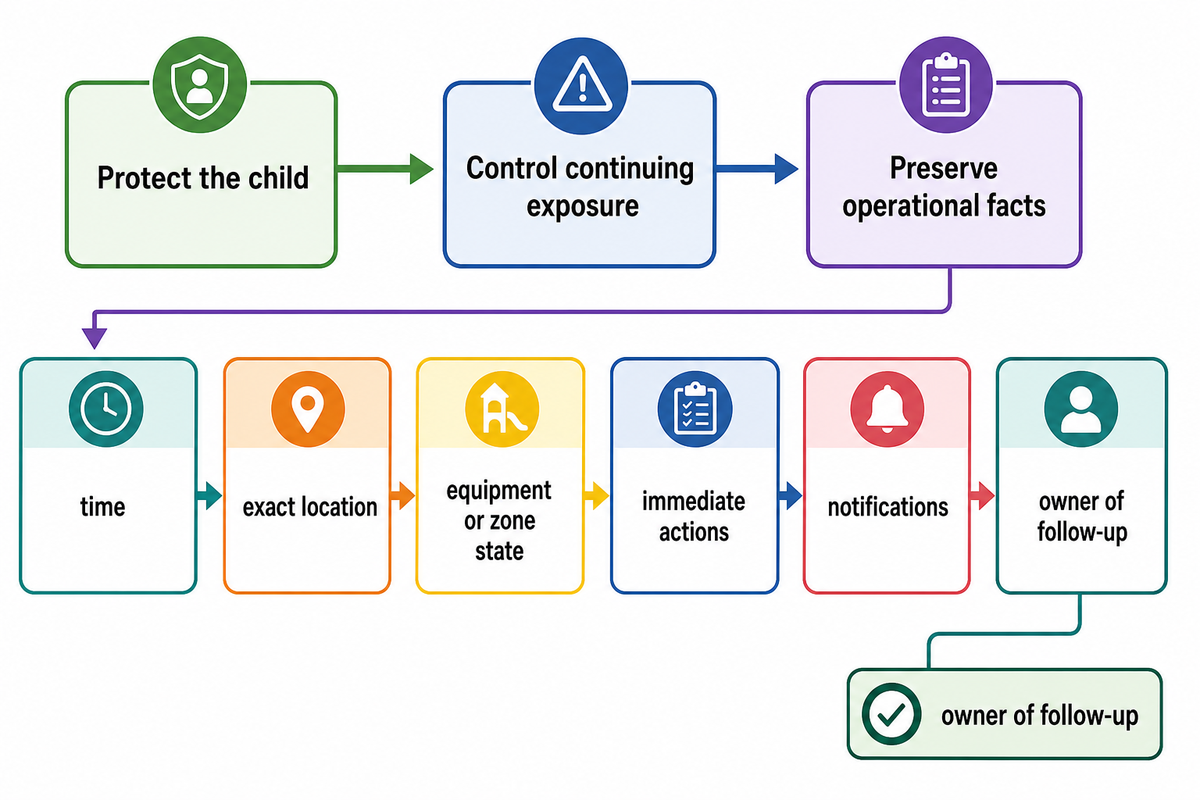
Protect the child and control any continuing exposure first; preserve operational facts immediately afterward. When an admission or activity limit is breached, the incident record should preserve which rule and operating status applied. An incident record should state time, exact location, equipment or zone state, witness details handled under the site’s privacy rules, immediate actions, notifications, and the owner of follow-up. Where lawful and appropriate, photographs can preserve condition evidence, but access and retention need site controls.
Link the incident to a defect ID when equipment condition is involved. Don’t repair, clean, reset, or reopen before the required evidence is captured unless immediate safety or care demands it. Record what changed and why. This gives the review team a defensible sequence without asking floor staff to decide fault.
Keep the operating review distinct from legal conclusions. That record shouldn’t claim that a waiver settled responsibility, an insurance policy guarantees cover, or the absence of an injury proves the area was safe. Route those questions to the appropriate qualified advisers and the existing guide to indoor playground liability planning.
Review incidents to find control failures and useful lessons. HSE’s proportionate approach recognizes that play has benefits and not every accident proves serious failure, while poor maintenance can introduce risks unrelated to those benefits. That distinction helps a review remain fair without becoming passive.
8. Connect Emergency Response to Continuity and Reopening
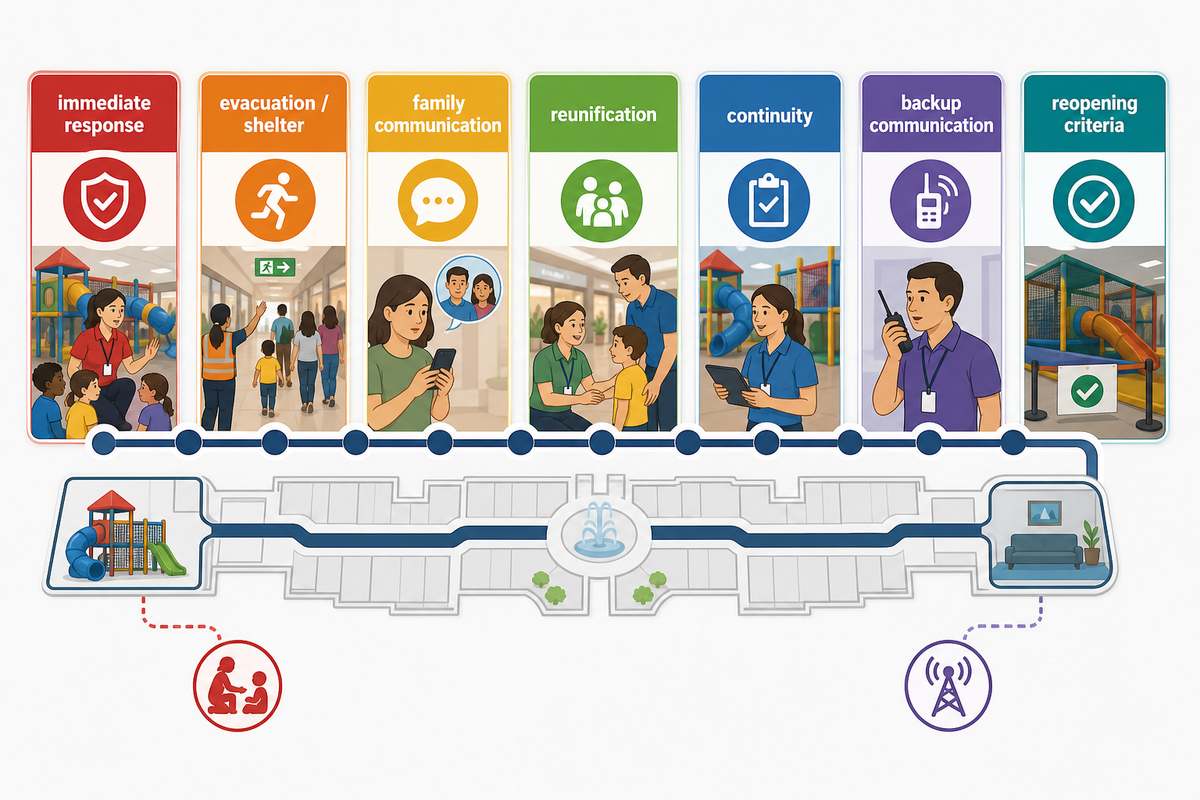
The playground plan must connect immediate response with the shopping mall’s evacuation, shelter, family communication, reunification, continuity, and reopening decisions. Incident handling becomes emergency continuity when the disruption extends beyond one child, asset, or zone. A standalone emergency card is inadequate if it sends guests toward a closed route or gives playground staff a communication role the mall team controls.
Map credible triggers to immediate actions, routes, assistance needs, assembly or shelter points, child-and-guardian accounting, family communication, backup communication, property or authority notifications where applicable, and reopening criteria. Plan for partial loss as well as complete closure: power, water, ventilation, payment systems, access control, staff availability, or a single attraction can fail independently.
Ready.gov continuity guidance recommends identifying risks and impacts, developing strategies, defining teams and tasks, and testing the plan. The Head Start emergency preparedness manual adds child-centered perspectives on roles, community resources, response, recovery, mental health, and returning to routine. Both require scope judgment when adapted to a commercial mall playground.
Drills should test interfaces, not theater. Can the floor team hear the trigger? Who assists a child or adult who can’t use the default route? Which team controls the guest list? How are separated families reunited? Who confirms that utilities, equipment, access routes, staffing, and authority conditions are suitable for reopening? Site plans, local responders, and the responsible authority set the final answer.
9. Review Control Drift Every Week
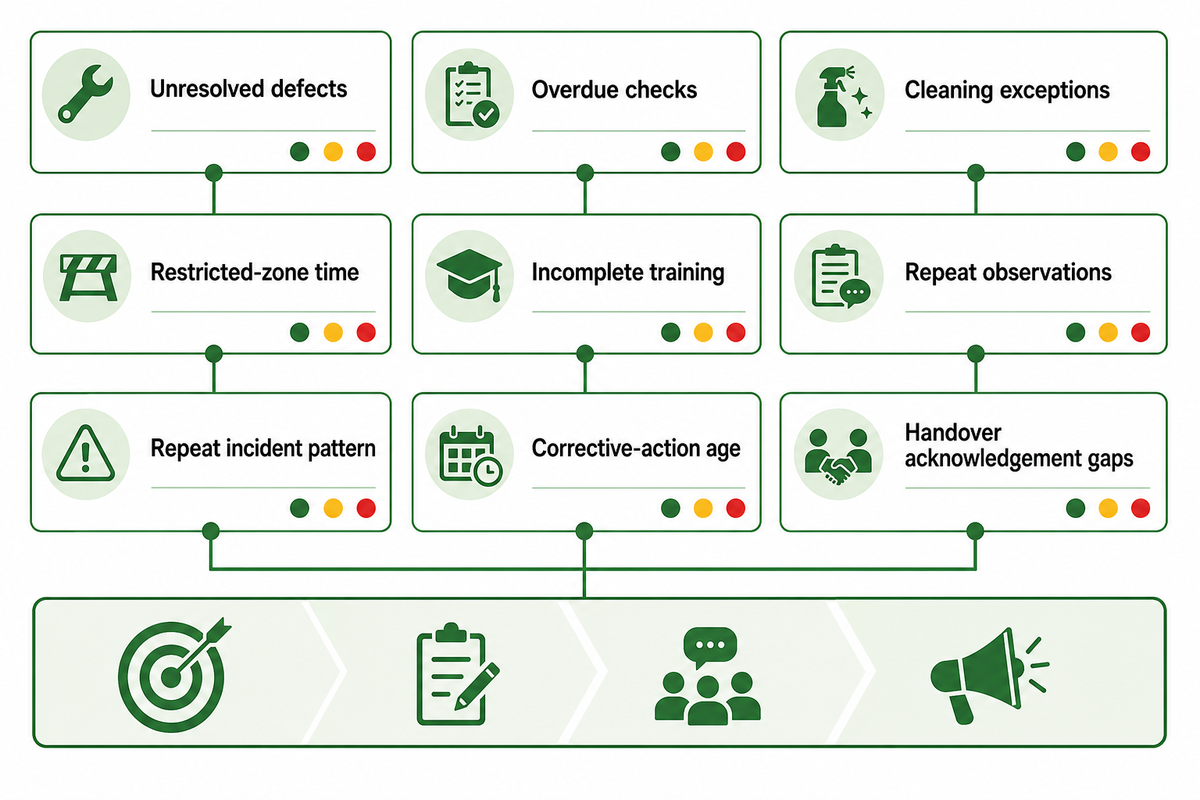
Review the conditions that management can act on before complaints, downtime, or revenue reveal a larger problem. This editorial sheet doesn’t provide industry benchmarks and doesn’t claim to predict child-injury reduction. Each site should set alert triggers only after it has defined the record, owner, risk route, and review period.
Weekly Control Drift Review
Indicator
Source record
Owner
Management question
Unresolved defects
Defect log
Operations and maintenance
Which exposure remains open?
Overdue checks
Inspection schedule
Safety or quality owner
Why was the control missed?
Cleaning exceptions
Hygiene log
Cleaner and supervisor
Is method, time, or access failing?
Restricted-zone time
Exception board
Operations
What delays restoration?
Incomplete training
Competence register
Team lead
Which role lacks authorized coverage?
Repeat observations
Opening and live-floor logs
Shift leads
Is the prior action ineffective?
Repeat incident pattern
Incident register
Review owner
What common condition needs action?
Corrective-action age
Action tracker
Named action owner
What blocks closure or escalation?
Handover acknowledgement gaps
Shift record
Operations manager
Which exception lost ownership?
Assign an action, due date, and escalation when a locally defined trigger is crossed. Finance and owners should see this review, but keep operating control distinct from the mall entertainment center revenue model. A profitable week doesn’t close an overdue safety action.
10. Keep the Live Operations File Current After Acceptance
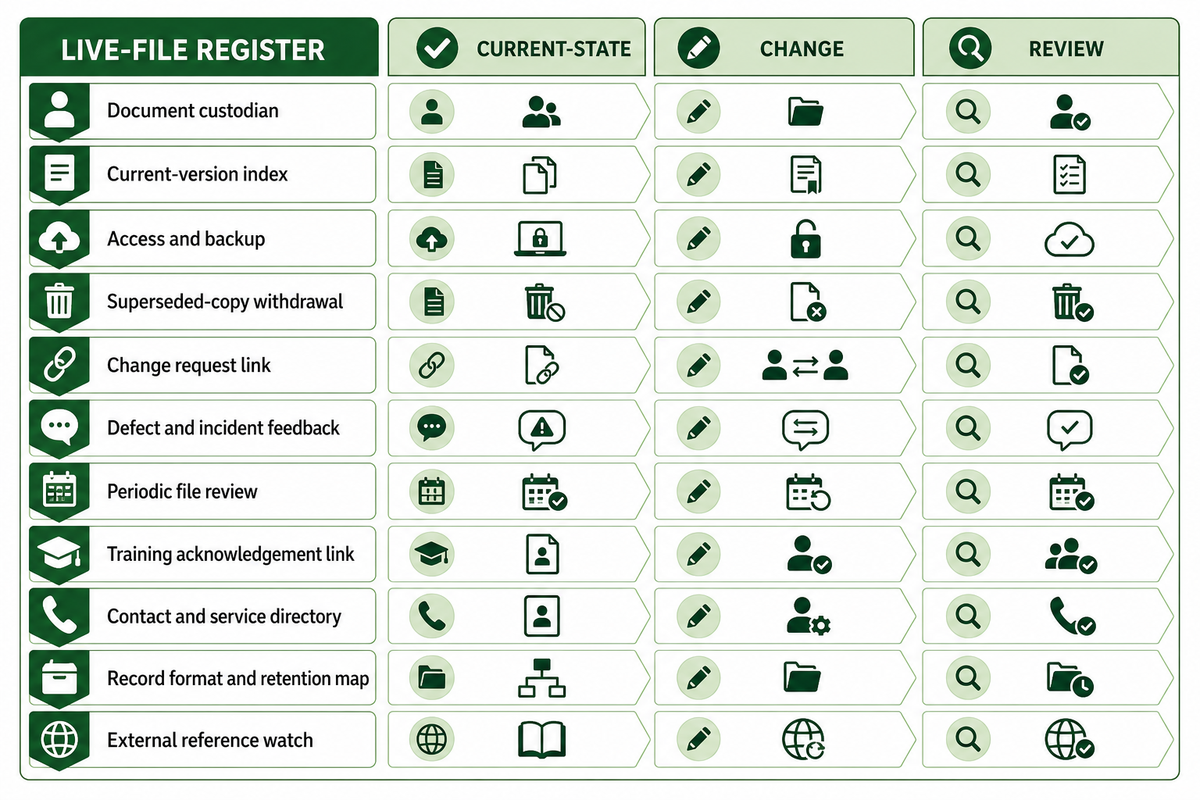
Project acceptance should give operations a controlled starting set of records. From that point, the operator needs a live file that identifies the current instruction, record custodian, approved change, and withdrawal of superseded copies. This is document control after acceptance, not a second delivery checklist.
Use the existing mall play zone handover and acceptance checklist to confirm what the project team delivered. The operating task begins after those items are accepted: keep them current, accessible, linked to exceptions, and reviewable throughout the facility’s working life.
Dreamland Playground’s user-supplied service scope covers space planning, floor-plan and 3D design, production, shipping, installation support, quality control, and after-sales service. That first-party scope helps define the project-to-operations interface; it isn’t independent proof of a particular customer outcome or product certification. Buyers evaluating an indoor playground for shopping mall can use the parent solution page for equipment, design, material, project, investment, and quotation questions. This article remains focused on live operating control after acceptance.
Live Operations File Register
Item type
Post-acceptance question
Operating use / review trigger
Document custodian
Name the role that owns the current file
Role or contractor change
Current-version index
List each controlled record and approved revision
New manual, standard, plan, or instruction
Access and backup
Give authorized shifts access and protect a recoverable copy
System, permission, or location change
Superseded-copy withdrawal
Remove obsolete instructions from points of use
Any approved revision
Change request link
Connect the approved change to affected records and training
Equipment, layout, chemical, or role change
Defect and incident feedback
Review whether an event exposes an outdated instruction
Repeat defect, incident, or near miss
Periodic file review
Record the reviewer, gaps, actions, and next review basis
Site-defined review point
Training acknowledgement link
Record which affected roles received a changed instruction
Revision that changes a task or authority
Contact and service directory
Verify named escalation and service contacts remain current
Supplier, contractor, or property-team change
Record format and retention map
Identify format, access, privacy, and retention controls
System, policy, or legal requirement change
External reference watch
Review whether referenced instructions or guidance changed
Supplier or authority update
Keep standard and guidance status current. The 2025 Federal Register notice records updates to the US Consumer Product Safety Commission Public Playground Safety Handbook while preserving the distinction between handbook guidance and voluntary technical standards. The live file should name exact documents and editions, not say only “ASTM compliant” or “meets safety standards.”
Plan the live operations file before production ends
Dreamland Playground can coordinate project planning, custom design, production, shipping, installation support, and after-sales communication around the needs of the installed site. Ask which accepted records will enter the live operations file and who will maintain them after opening.
What should an indoor playground operations manual include?
At minimum, define roles, opening, live-floor and closing routines, inspection, isolation, cleaning, supervision, admissions, incident reporting, emergency communication, reopening, training evidence, document control, and review ownership. Add the installed-equipment register, emergency contacts, forms, escalation routes, and revision history. Link to manufacturer instructions, mall procedures, insurer conditions, and local requirements. Test access and understanding during handovers and drills. A manual that staff can’t retrieve or act on isn’t an effective operating control on each operating shift.
How often should indoor playground equipment be inspected?
No single interval suits every site. Separate frequent staff observations from detailed inspections and competent-person reviews. Use manufacturer instructions, attraction type, use profile, local rules, mall and insurer conditions, defect history, and risk assessment. Record the person, result, exceptions, and closure evidence.
What is the difference between cleaning, sanitizing, and disinfecting?
Cleaning removes dirt and organic material. Sanitizing reduces microorganisms to a defined level; disinfecting follows an authorized product label against specified organisms. Confirm material compatibility, contact time, and ventilation carefully, then separately record unusual contamination events and the release decision.
Are ASTM F1918 and EN 1176 the same?
No. They’re different standards families with distinct scopes and market contexts. Cite the exact edition and product or installation scope, then have responsible authorities and qualified professionals confirm applicability. A citation alone never proves product certification or local compliance in the target market.
Who can reopen an isolated play zone after a defect?
The written process must name the competent verifier and reopening authority. If site rules require testing, independent verification, or local inspection, a repair invoice can’t replace it. Record the asset, acceptance criteria, evidence, decision, date, and release communication to staff.
Should a mall use the supplier’s checklist as its full operating manual?
No. Supplier instructions are one controlled input. The site manual must also address the installed environment, staff coverage, cleaning products, emergency interfaces, privacy, insurer conditions, local rules, and property-management responsibilities. Preserve the authority and scope of every source without merging them.
Dreamland Playground publishes practical planning guides for commercial indoor-play projects, including family entertainment centers, shopping malls, hotels, restaurants, churches, and other venue types.
Use these guides to frame the questions that should be resolved before concept selection: venue size, intended age groups, project location, attraction mix, operating priorities, timeline, and delivery constraints. Final recommendations should be based on the real site and applicable local requirements.
Start With The VenueFloor area, clear height, site location, intended audience, and target opening date create the working brief.
Clarify The ScopeConcept, equipment, production, shipping, installation, and operating inputs can vary from one project to another.
PROJECT / VENUE / TIMELINE
Prepare Your Project Brief
Venue TypesFEC · Mall · Hotel · Restaurant · Church
Start WithFloor area · Clear height · Age groups · Country