Get in touch with Dreamland Playground Company

(Updated August 2026)
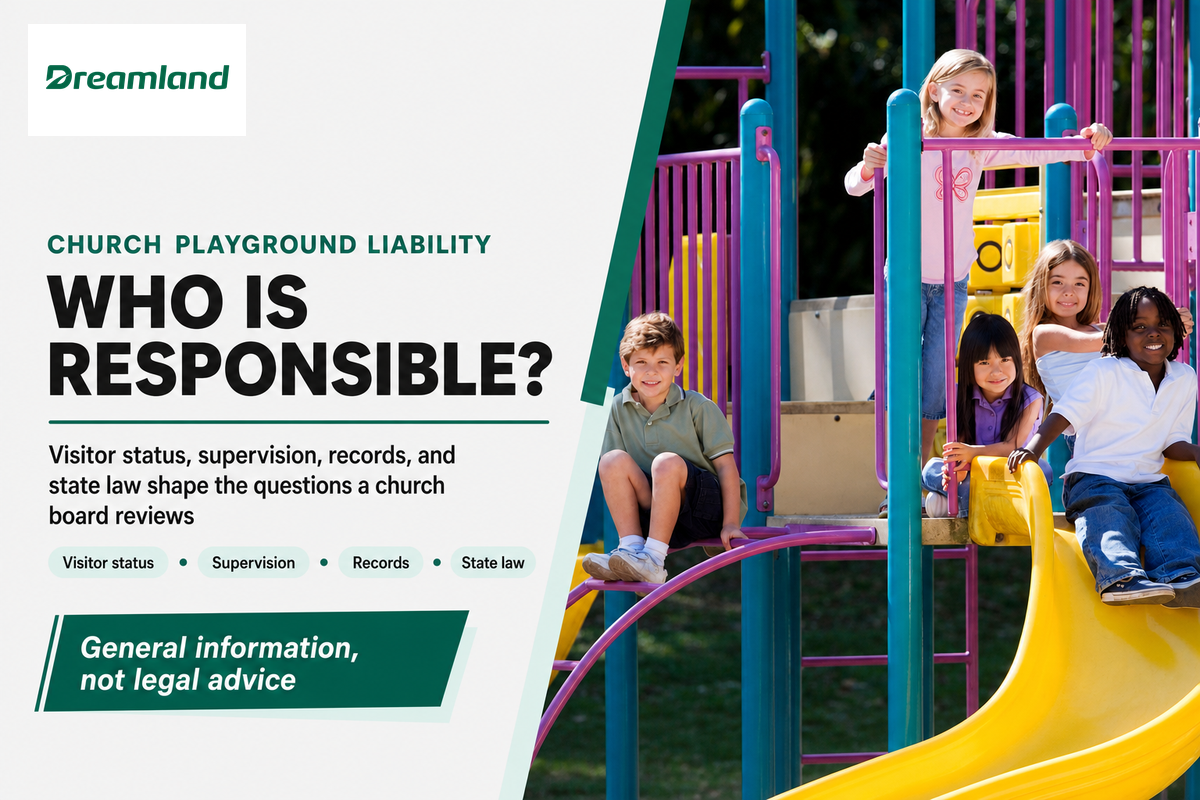
Church playground liability starts when a congregation opens equipment to children, members, visiting families, or a neighborhood child who enters through an unlocked gate. The immediate question isn’t whether an injury occurred, but which facts state premises-liability law treats as relevant: visitor status, a dangerous condition, notice, supervision, causation, and the church’s response. This is general educational information, not legal advice for a particular incident or state.
Church playground liability is the legal responsibility a congregation carries as a property owner when children are injured on its playground, and it depends on who the child was (member, guest, or trespasser), whether the equipment met applicable safety standards, and whether supervision was adequate. Being responsible for injuries or held liable for injuries sustained is never automatic; it depends on the applicable duty, a proven breach, causation, and state law. Courts weigh these factors separately, an injury alone doesn’t establish fault. Churches that document inspections, match equipment to age-appropriate standards, and keep supervision records are in a materially different legal position than those that have done none of that.
Key facts before you read further
- Don’t presume the church was negligent just because someone was injured on the church playground – a New York court did just this to find no liability for the church (Church Law & Tax).
- Visitor status, premises condition, and negligent supervision are separate questions; no single label decides the whole claim.
- Safety standards can inform reasonable-care analysis, but whether a voluntary standard is legally binding depends on state and local law.
- A dated inspection or supervision record is more useful than a policy that can’t be tied to the date of the incident.
- When an outside group uses the playground, its contract doesn’t automatically erase the church’s property duties.
What “Church Playground Liability” Actually Means
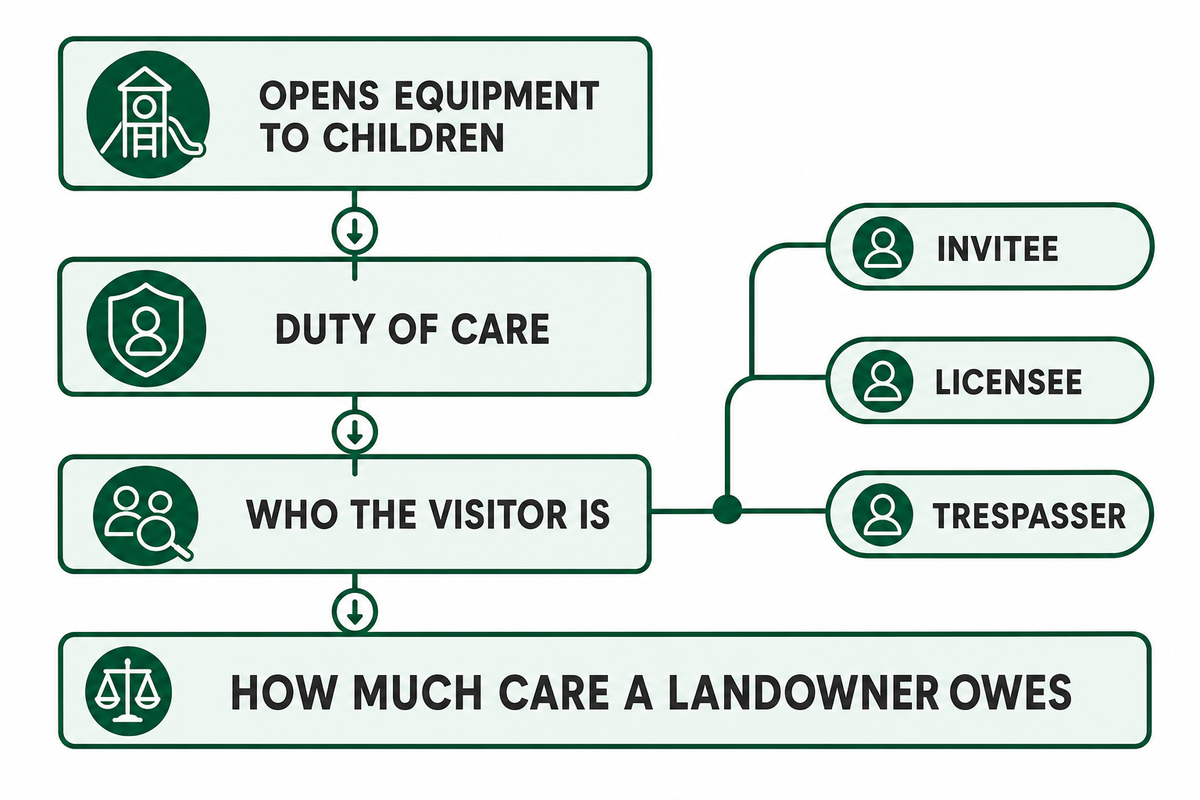
Church playground liability describes the legal responsibility a congregation takes on the moment it opens playground equipment to children, whether those children are members, visiting guests, or neighbors who let themselves through an unlocked gate. Under premises-liability law, a church functions the same way any other property owner does: it owes visitors on its property a duty of care.
How much care it owes depends heavily on who the visitor is and why they’re there. Cornell Law School’s legal dictionary lays out the three traditional visitor categories, invitee, licensee, and trespasser, that most states still use to sort out exactly how much care a landowner owes.
These legal concepts can blur together in church-facing writing, but they resolve differently in practice. Don’t assume that assumption of risk applies the same way to private property and a public park; the governing state law and the facts control. Negligence claims may focus on a dangerous condition even when a child is injured while equipment appears intact. Working through the premises-liability issues in order, visitor status, the applicable duty of reasonable care, and supervision, helps identify the questions that matter. An injury alone remains insufficient proof.
What trips up a lot of church boards is treating “premises liability” as one single standard. It isn’t. For example, a congregant attending Sunday service, a renting daycare’s staff, and a child who wandered in after hours aren’t owed the same legal duty, and a playground can be involved in claims that have nothing to do with equipment defects at all – negligent supervision is analytically separate and can stand or fall on its own facts, regardless of how well-maintained the structure is.
Planning a church playground project from the ground up is a physical-design question; this article covers the premises-liability and supervision questions that sit alongside it.
Here’s a concrete way to see why the distinction matters: a board that budgets for equipment and surfacing but never asks who its playground’s actual visitors will be, members only, or also renters, neighbors, and after-hours walk-ins, is budgeting for the physical risk while leaving the legal risk unassessed.
The two sections below (visitor status, then supervision) exist specifically because they get evaluated separately in a real claim, not as a single combined “was the church careless” question.
Church Property, Visitor Status, and the Legal Concepts That Shape Duty of Care
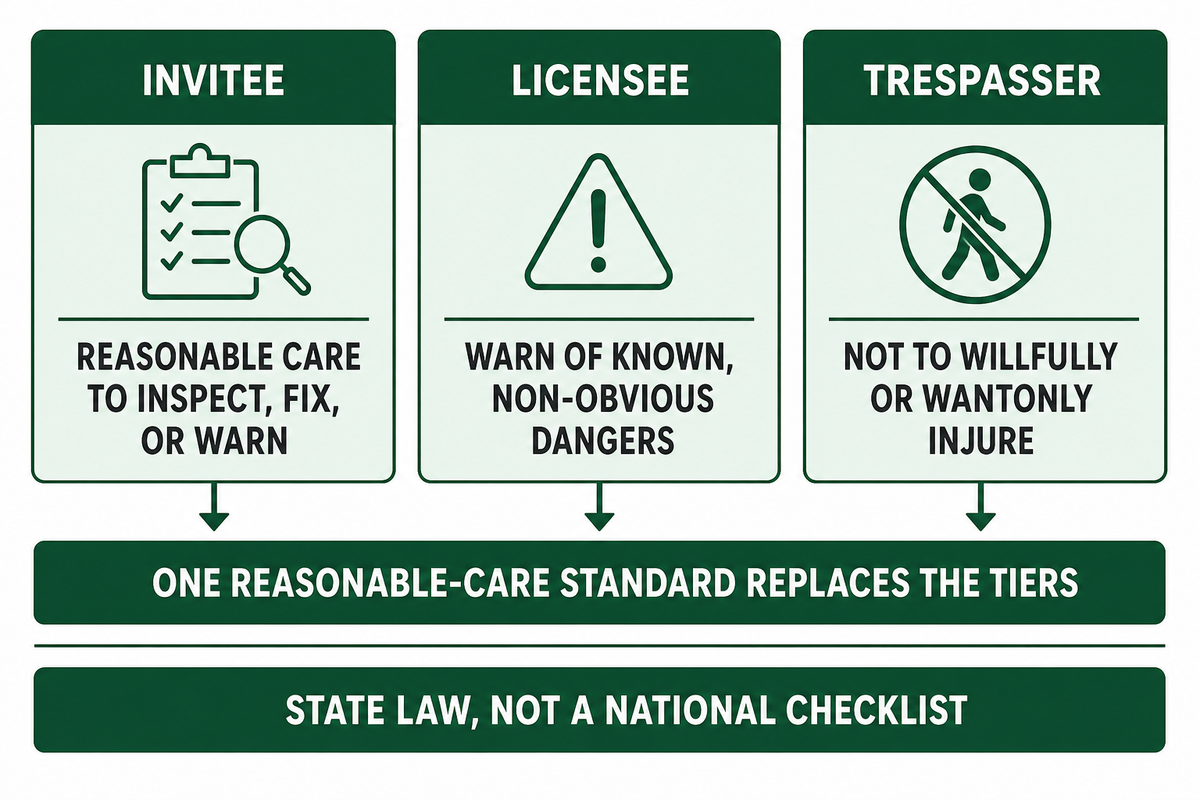
Visitor labels can help identify questions for local counsel, but state law, not a national checklist, determines the applicable duty of care.
Three visitor categories, invitee, licensee, and trespasser, set different duty-of-care standards in many U.S. states, and which one applies to a given child can change what a church legally owed that child before an injury. An invitee (someone on the property for the church’s benefit, such as a congregant or a paying renter’s guest) is generally owed the highest duty: the church must exercise reasonable care to inspect for hazards and either fix or warn of them.
A licensee (a social guest, present with permission but not for the church’s benefit) is owed a narrower duty – warn of known, non-obvious dangers, but no independent duty to go looking for hazards; a trespasser is owed the least, generally just a duty not to willfully or wantonly cause harm – with one major exception for children, covered in the next section.
| Visitor / Situation | Legal Category | Duty of Care Owed | Limitations / When This Doesn’t Apply |
|---|---|---|---|
| Congregant attending a service or program | Invitee | Reasonable care to inspect for and fix, or warn of, discoverable hazards | Does not apply in general ordinary-care states — see below |
| Guest at a church-sponsored event | Invitee | Same standard as above | Same jurisdiction caveat |
| Staff or children of a renting outside group | Invitee (typically) | Same duty to inspect and maintain a reasonably safe condition | Whether insurance covers this duty is a separate question — see below |
| Neighbor’s child invited by staff to play | Licensee | Warn of known, non-obvious hazards; no duty to inspect | Turns on whether the visit benefits the church |
| Social guest outside any church program | Licensee | Same as above | — |
| Adult entering without permission | Trespasser | No duty except not to willfully or wantonly injure | No duty to inspect or warn of ordinary hazards |
| Child entering without permission | Trespasser — but see attractive nuisance | Duty can rise toward the invitee standard | Only when playground equipment qualifies — see next section |
| Any visitor in California and similar states | General “ordinary care” duty | One reasonable-care standard replaces the tiers above | Visitor-status categories above do not control the outcome here |
| Any visitor where charitable or recreational-use immunity applies | Potentially reduced or barred liability | Varies significantly by state | Not covered in depth here — confirm with local counsel |
That last row matters more than it looks. This table reflects a common framework, but it isn’t universal. California Civil Code Section 1714 uses a general duty of “ordinary care,” following the state’s Rowland v.
Christian line of cases. Assuming this table applies nationally would overstate the law; check your own state’s rule before treating any single row as settled.
Attractive Nuisance Doctrine: Why Children Get Special Legal Protection
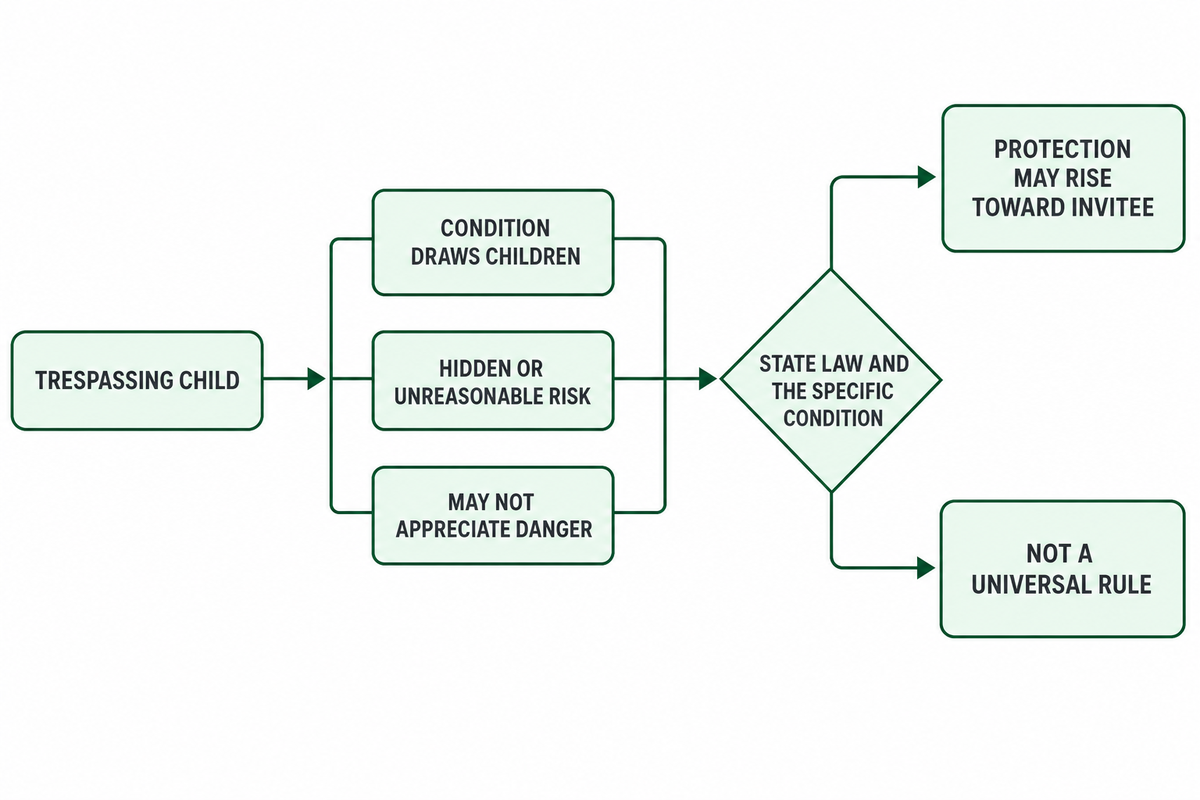
Attractive nuisance doctrine is a legal exception that can raise a trespassing child’s protection toward the invitee standard when a condition on the property predictably draws children and creates a hidden or unreasonable risk. As Cornell Law School’s legal dictionary explains, children can’t always be expected to appreciate danger as an adult trespasser could. Some playground conditions may prompt this analysis in some jurisdictions, but whether the doctrine applies depends on state law and the specific condition involved.
This is genuinely useful for a church safety committee to understand, but it’s also one of the most overstated legal doctrines in playground-safety writing online. It isn’t a simple, universal rule that automatically covers every unlocked church playground.
Because play equipment is designed to attract children, churches should keep the area free of separately hazardous conditions such as broken fasteners, degraded surfacing, and exposed rebar. These steps may reduce preventable injury, but foreseeability and legal duty remain fact-specific.
When the Doctrine Doesn’t Apply
Cornell’s own description of attractive nuisance doctrine is explicit that it’s applied narrowly and on a fact-specific basis, not as a bright-line national rule. Some states carve out entire categories of equipment from attractive nuisance law – Indiana, for example, generally excludes swimming pools from attractive-nuisance treatment unless there’s a hidden danger the child couldn’t have appreciated even with a pool’s obvious visibility.
Courts in different states also weigh differently how “hidden” a danger has to be, how far the child traveled to reach it, and whether the church took reasonable steps (a locked gate, a fence, posted signage) to keep children out in the first place. Assuming attractive nuisance doctrine will always work in a church’s favor, or always work against it, means skipping the fact-specific analysis that actually decides these cases.
In practical terms, attractive nuisance doctrine doesn’t ask “was a child hurt on our equipment.” It asks whether the equipment was the kind of thing that predictably drew a child in, whether the danger was one a child couldn’t reasonably be expected to recognize, and whether the church took steps proportionate to that risk. Locking a gate after hours, maintaining fencing around the play area, and keeping equipment free of hidden hazards (rusted anchors, exposed bolts, damaged surfacing) all speak directly to that analysis, regardless of what a state’s specific case law says about the doctrine’s outer edges.
Negligent Supervision: The Second Way Churches Get Sued
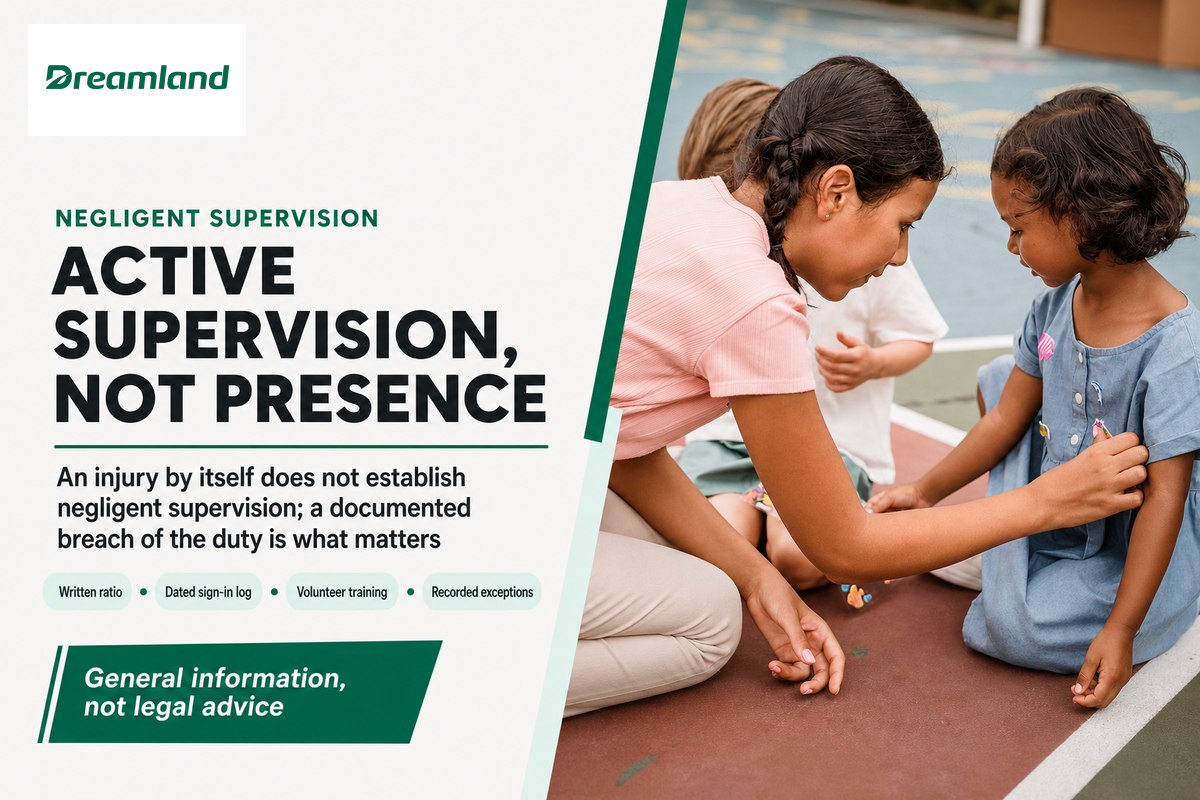
When a documented breach of supervision duty, not just an injury, can be shown, negligent supervision can become a separate basis for a claim, independent of the condition of the playground equipment. Church Law & Tax summarizes the general point: a church may be held legally responsible when a failure to exercise adequate care in supervision causes an injury, apart from any property defect.
An injury by itself doesn’t establish negligent supervision. Church Law & Tax reports that a New York court found a church not liable for a child’s fall from playground equipment because no specific breach of supervisory duty was shown. That’s a civil-liability finding, not the dismissal of criminal charges.
One child-supervision training resource notes that supervisors must weigh several conditions at once when deciding what is safe, healthy play. It says general presence in the area does not, by itself, satisfy its supervision guidance. Treat this as practical training guidance, not a legal standard.
What does “adequate supervision” look like in practice? In one Reddit discussion snippet, caregivers and even licensing bodies will frequently default to ratio as a practical yardstick; that’s anecdotal, not legal authority. Written adult-to-child ratios can help a church define its own operating expectations, but a church shouldn’t copy a daycare ratio without checking the rules that apply to its programs and location. Dated records of who supervised each session can show what the church planned and what happened on a particular day.
Picture a fairly typical Sunday: a volunteer coordinator is short-staffed because two regular helpers called out sick, so the children’s ministry combines two age groups onto the playground under one adult instead of two. Nothing goes wrong for months – until the week a four-year-old climbs higher than the equipment’s intended age range while the rest of the group sits effectively unsupervised, because the lone volunteer is across the yard helping a different child at the water fountain. If a claim follows, the church’s defense will lean entirely on whatever it can show about its normal staffing plan, whether the short-staffed day was a documented exception or the unwritten norm, and whether anyone flagged the gap beforehand. Without a written ratio policy and a record of who was present, there’s very little for a defense attorney to work with.
Claimants alleging negligent supervision generally need not prove that a church acted knowingly or maliciously; ordinary carelessness may be enough, depending on state law and the facts. Churches don’t necessarily need full-time staff at every playground, but for children playing in each program, their policies should state which activities require supervision. If a child gets hurt, contemporaneous records can show whether a staffing gap was an isolated oversight. For neighborhood children, supervision requirements can depend on visitor status, attractive-nuisance law, the church’s knowledge, and whether unsupervised access was allowed. In practice, records should show whether the church provided adequate supervision on the date of an incident.
Do
- Write down a specific adult-to-child ratio for playground time and keep to it
- Keep a simple, dated sign-in log of which adult supervised which session
- Train volunteers on active supervision, not just physical presence in the area
- Document any staffing gap as an exception, with the reason recorded
Don’t
- Assume “an adult was nearby” satisfies the supervision standard
- Let staffing ratios drift informally without anyone deciding it’s acceptable
- Rely on memory instead of a written log after an incident
- Treat supervision and equipment maintenance as the same risk category
Church Playground Safety and Risk Management: How Standards Affect Liability Claims
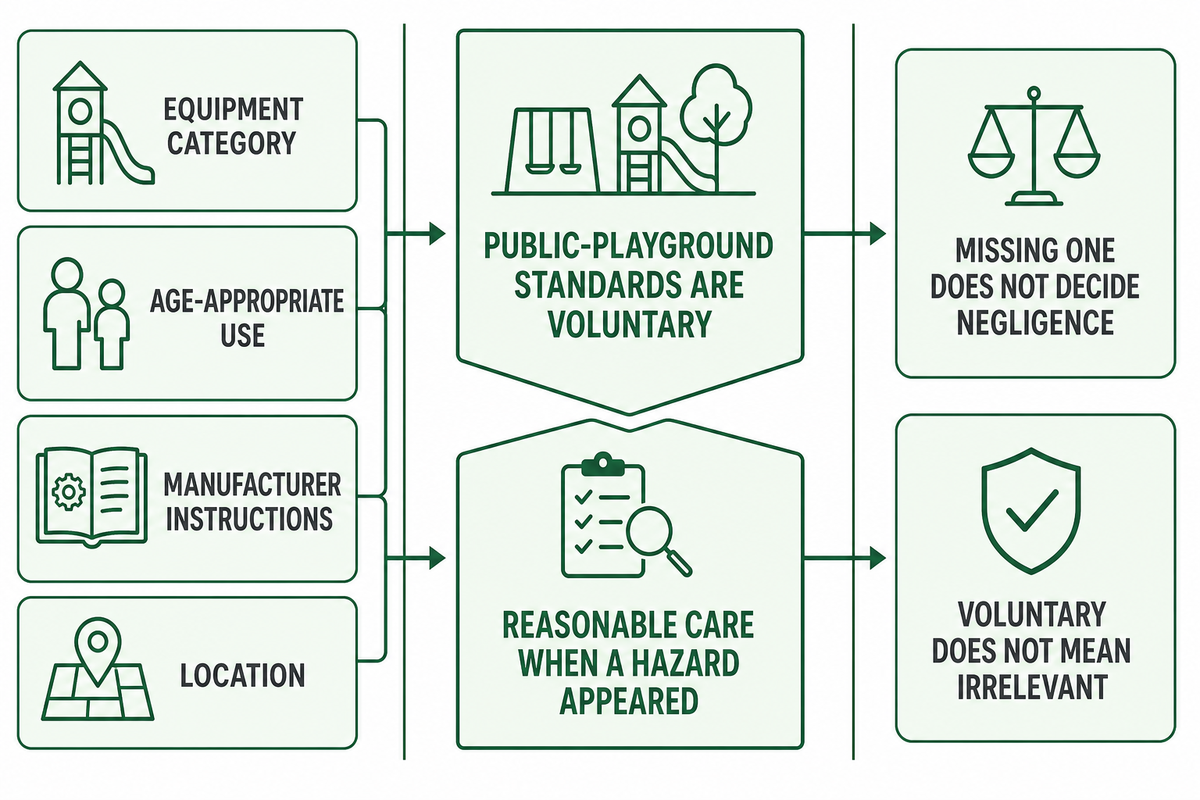
Industry standards matter here as evidence and operating guideposts, not as a second standards guide. A church must first identify which rules fit its equipment category, age-appropriate use, manufacturer instructions, and location. Our playground safety standards hub owns the detailed ASTM, CPSC, and equipment-scope comparison.
For a liability analysis, the narrower question is whether the board identified applicable safety expectations and exercised reasonable care when a hazard appeared. The U.S. Consumer Product Safety Commission describes public-playground standards as voluntary and notes that its handbook is referenced by many, but not all, state and local jurisdictions. Missing a voluntary standard doesn’t automatically decide a negligence claim, while calling it voluntary doesn’t make a dangerous condition irrelevant.
For exact playground requirements, including playground fall zones and fall protection, use the current CPSC Public Playground Safety Handbook, the manufacturer instructions, and local rules. This article doesn’t reproduce those specifications.
Use the CPSC public playground safety checklist as a screening tool, then ask a qualified inspector which detailed provisions apply. Keep the inspection result with the installation records and any corrective action. That record supports the legal question this article owns: what the church knew, when it knew it, and what it did next.
Liability Issues on Church Property: Outside Groups, Supervision, and Contracts
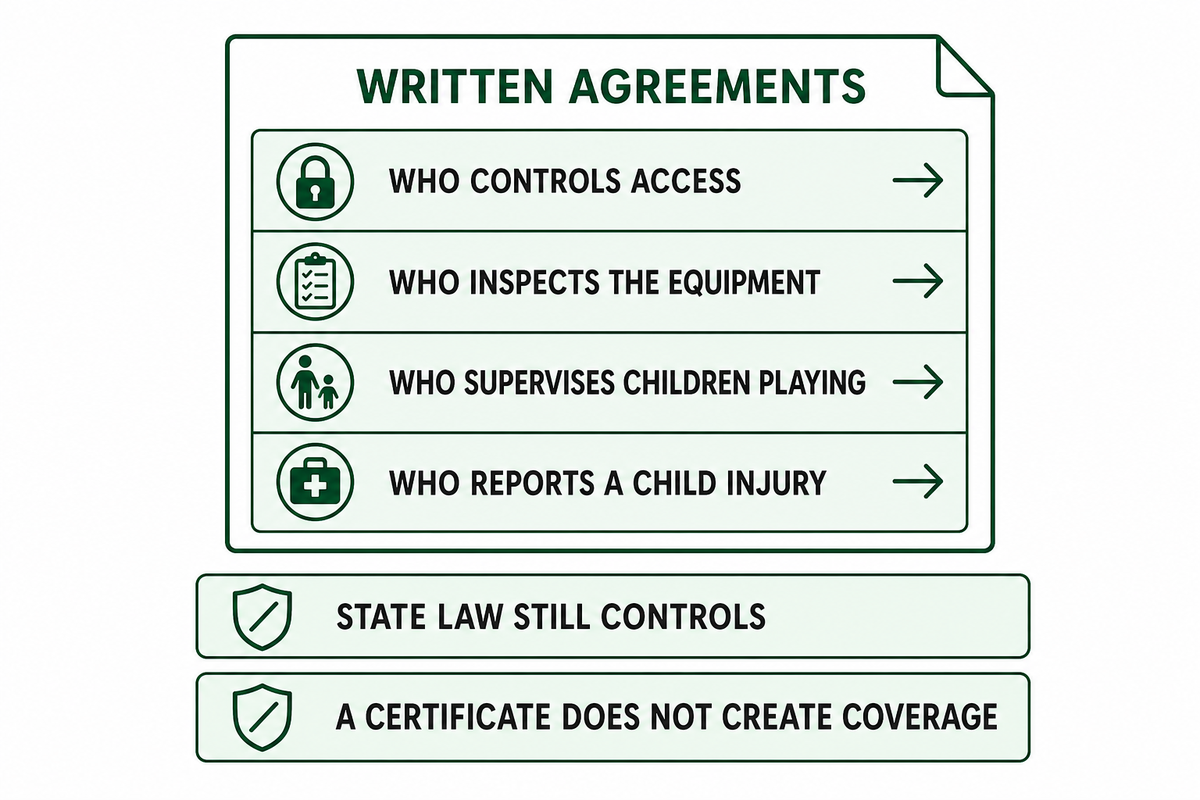
When a daycare, school, or outside ministry uses the playground, responsibility doesn’t automatically shift away from the church. Written agreements should say who controls access, who inspects the equipment, who supervises children playing, and who reports a child injury. Those assignments help establish the facts, but state law still controls whether the church, the visiting group, or both can be held liable for injuries sustained on church property.
Coverage is a separate inquiry. The Texas Department of Insurance explains that a certificate of insurance doesn’t create or extend coverage. Questions about a waiver involving a minor should be reviewed separately by local counsel under the applicable state law. Use the live indoor playground insurance requirements guide for policy types, exclusions, endorsements, and insurer-facing documentation; ask local counsel and a licensed insurance professional to review the actual arrangement.
The 4-Record Claim-Date Evidence Trail
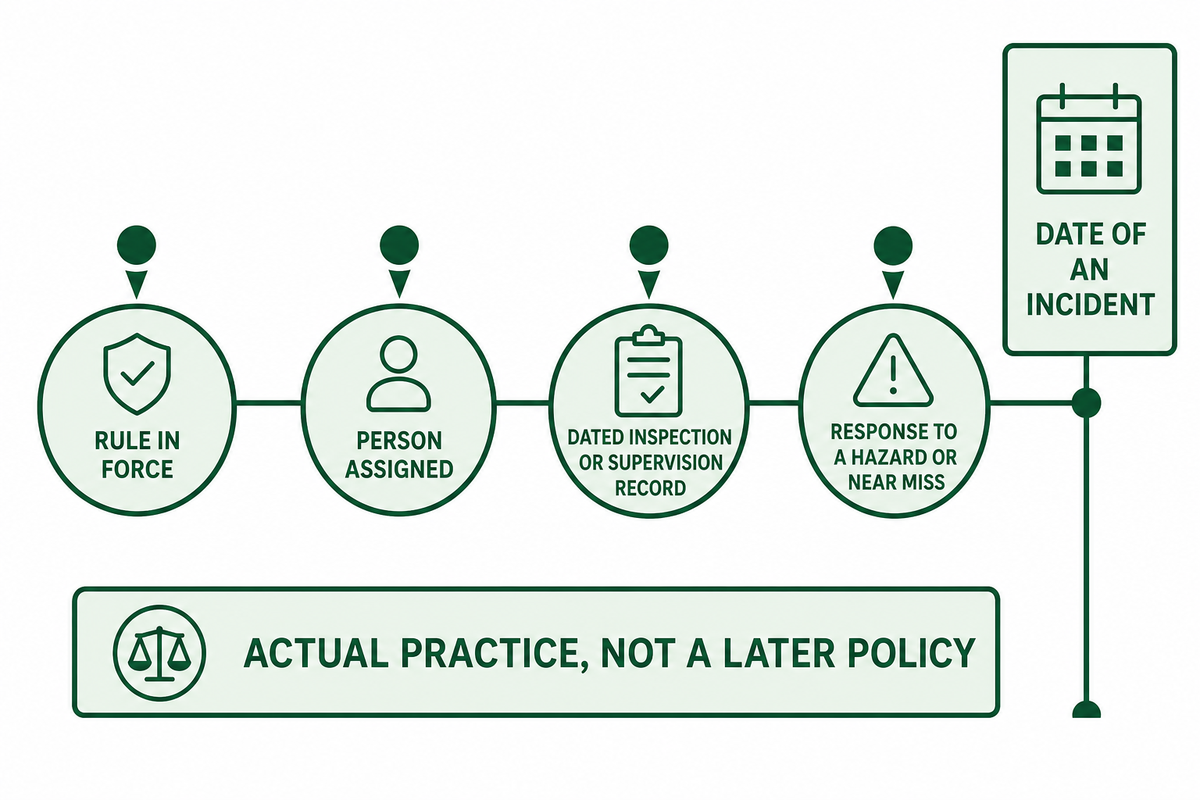
A defensible file connects the church’s written rule to what happened on the date of an incident.
The 4-Record Claim-Date Evidence Trail is a practical board framework, not a legal test: the rule in force, the person assigned, the dated inspection or supervision record, and the response to any hazard or near miss. Together, those records show the church’s actual practice rather than a policy written after a child gets hurt.
That Church Law & Tax example discussed above is useful because its reported outcome turned on whether a specific supervisory breach was shown, not merely on the injury. Contemporaneous records help counsel test that same distinction against the facts of a later claim.
Keep inspection logs, volunteer rosters, sign-in records, incident reports, photos, and corrective-action notes in one accessible location. Records don’t guarantee a legal outcome, but they can help counsel reconstruct notice, oversight, supervision, and response without relying on memory. Ask local counsel how long to retain them and what additional records the governing legal system requires.
Inspection and Maintenance Records That Support the Liability Analysis
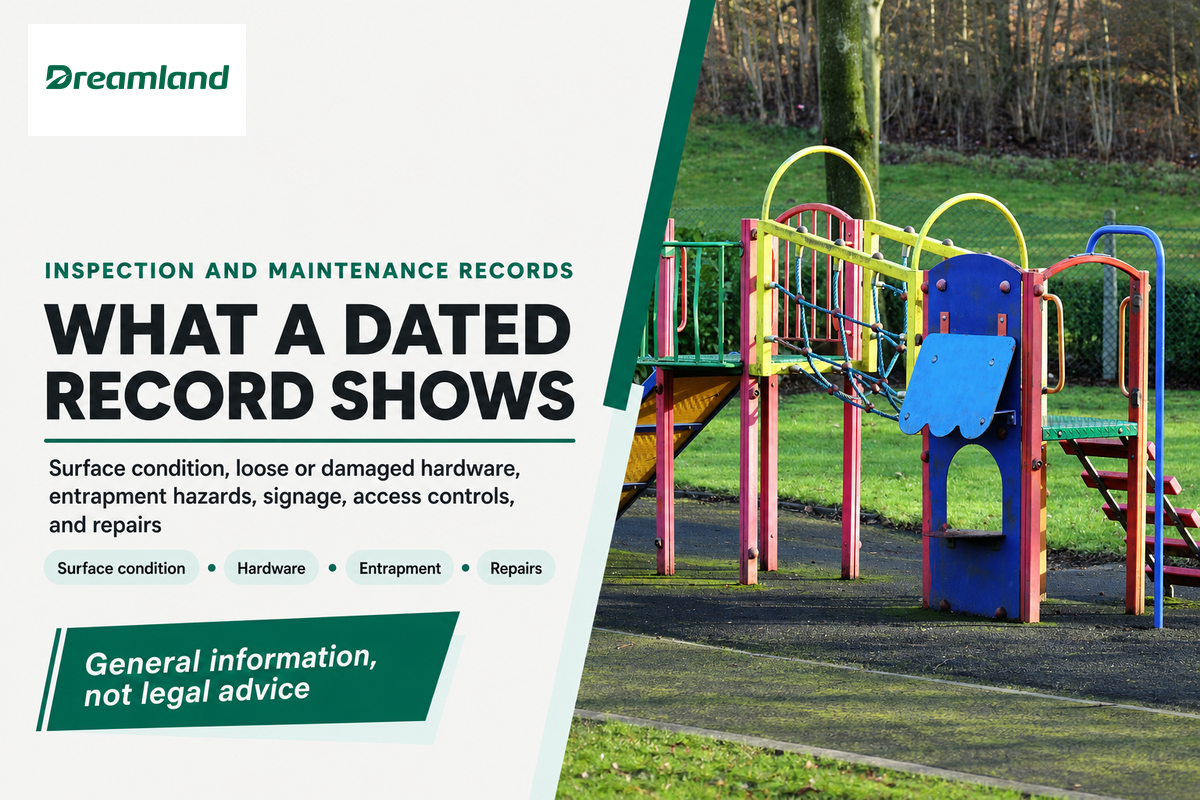
Routine maintenance should produce a dated record of the surface condition, loose or damaged hardware, entrapment hazards, signage, access controls, and repairs. If the playground design includes safety surfacing such as engineered wood fiber, record the material condition and the measurement method specified by the manufacturer or qualified inspector. This record is meant to preserve a safe environment and show whether a preventable condition was found and corrected, not to publish one universal pass/fail number.
New play equipment should arrive with installation and manufacturer documents, followed by a qualified post-installation review when appropriate. The CPSC handbook provides a public reference point, while the exact inspection method still depends on the equipment, manufacturer, and local requirements. Preserve the findings, the person responsible, the completion date, and evidence that a dangerous condition was closed or the equipment was taken out of use.
A Practical Risk Management Checklist for Church Boards
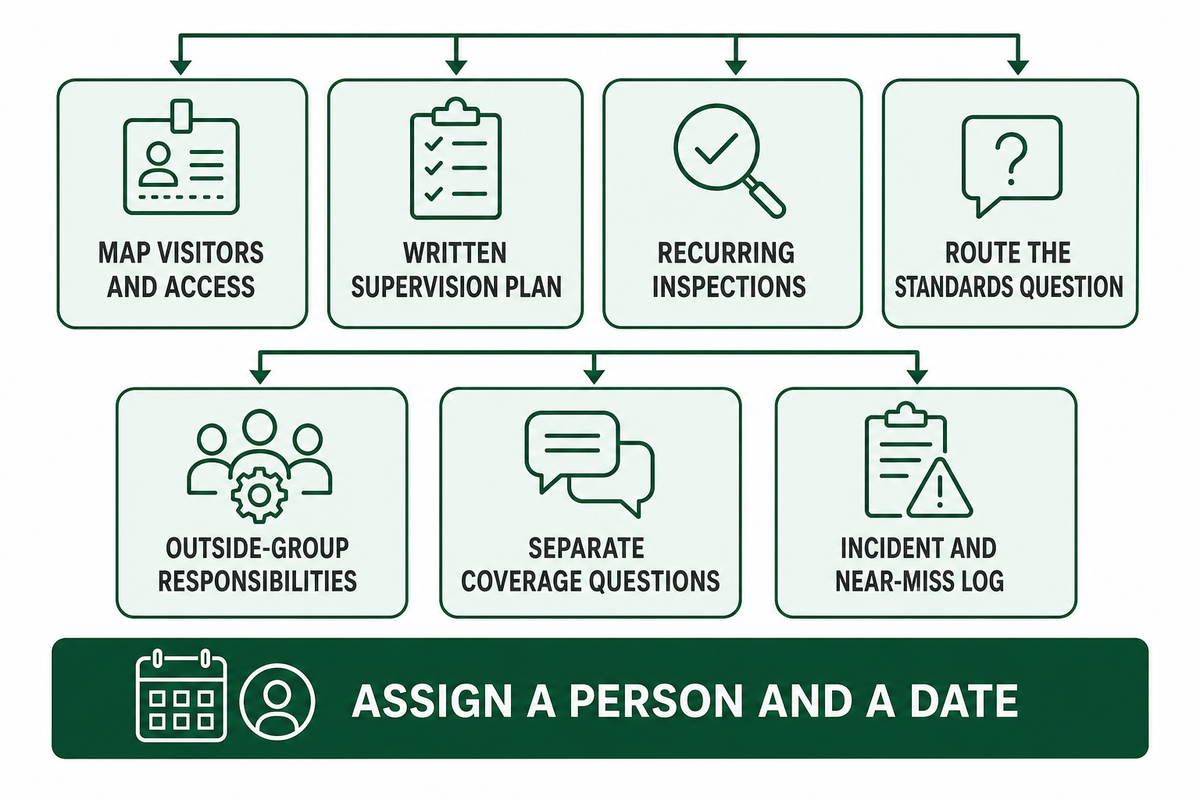
A board-level checklist is useful only when it assigns a person and a date to each task. Use the CPSC screening checklist as one reference, turn verbal assurances into records, and don’t treat the list below as a substitute for local legal advice or a qualified site inspection.
- Map visitors and access — identify members, invited groups, renters, and foreseeable neighborhood children, then document gates, signage, and rules for unsupervised access.
- Establish a written supervision plan — define an adult-to-child ratio appropriate to the program and applicable local rules, then keep a dated log of who supervised each session.
- Schedule recurring inspections — set a cadence for checking surfacing depth, hardware wear, and entrapment points, and log each inspection with a date and inspector name.
- Route the standards question — record which equipment scope, manufacturer instruction, and local rule a qualified reviewer used instead of assuming one standard covers every structure.
- Define outside-group responsibilities — state who controls access, inspects equipment, supervises children, and reports incidents when another organization uses the site.
- Escalate separate coverage questions — send policy, exclusion, waiver, and endorsement questions to licensed local professionals rather than treating them as premises-liability conclusions.
- Keep an incident and near-miss log — record what happened, when, who was present, and what corrective action followed.
Why Playground Injury Claims Turn on Documented Facts
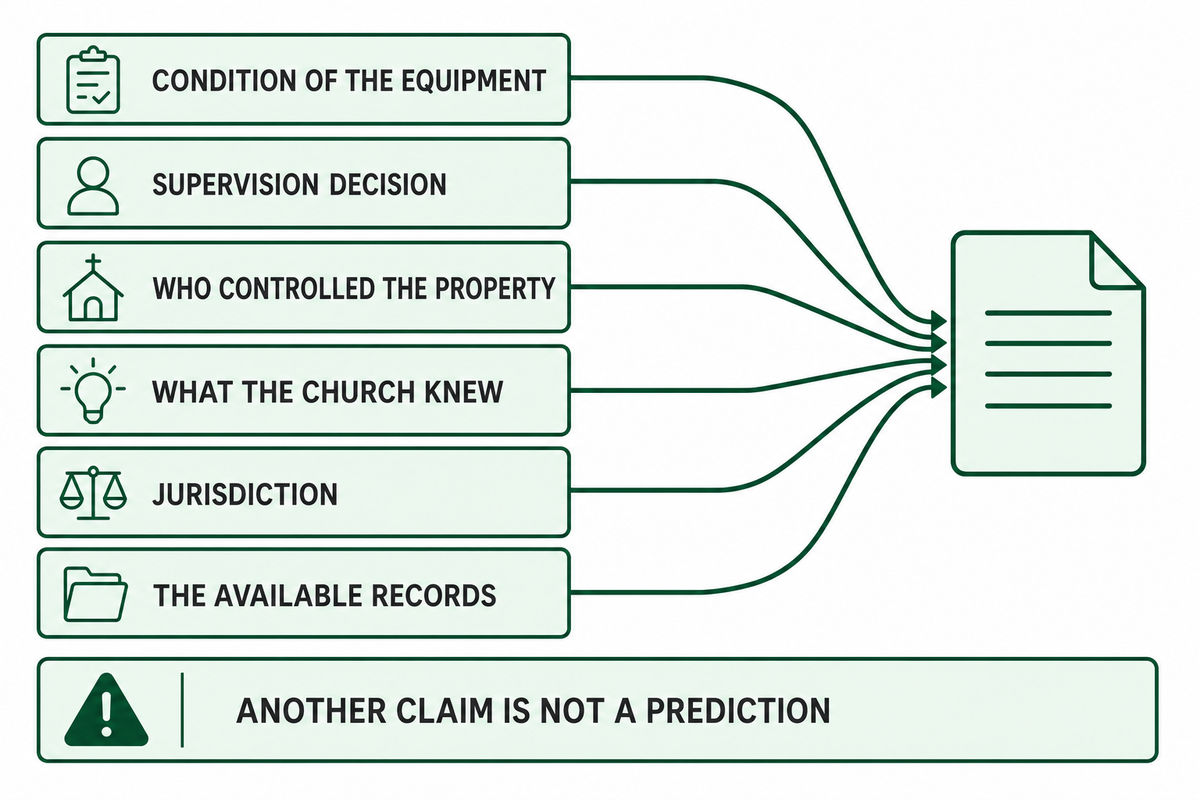
Church playground injury claims are fact-specific. A court, insurer, or counsel may need to distinguish a condition of the equipment from a supervision decision, identify who controlled the church property at the time, and evaluate what the church knew before the incident.
That’s why a church shouldn’t treat another organization’s reported claim, settlement, or court summary as a prediction of its own outcome. Jurisdiction, visitor status, the condition involved, the governing statute, the available records, and causation can change the analysis. Ask local counsel to evaluate the actual facts rather than using generalized stories as precedent.
For boards, the practical lesson is narrower: preserve dated inspection logs, access records, supervision plans, incident reports, photographs, and corrective-action notes. Those records can’t guarantee an outcome, but they make it possible to establish what the church actually did.
Key takeaway
Documentation cannot guarantee an outcome, but written supervision plans, dated inspection logs, access records, and incident reports can help establish what the church actually did.
Church Playground Liability FAQs: Who Is Responsible for Injuries?
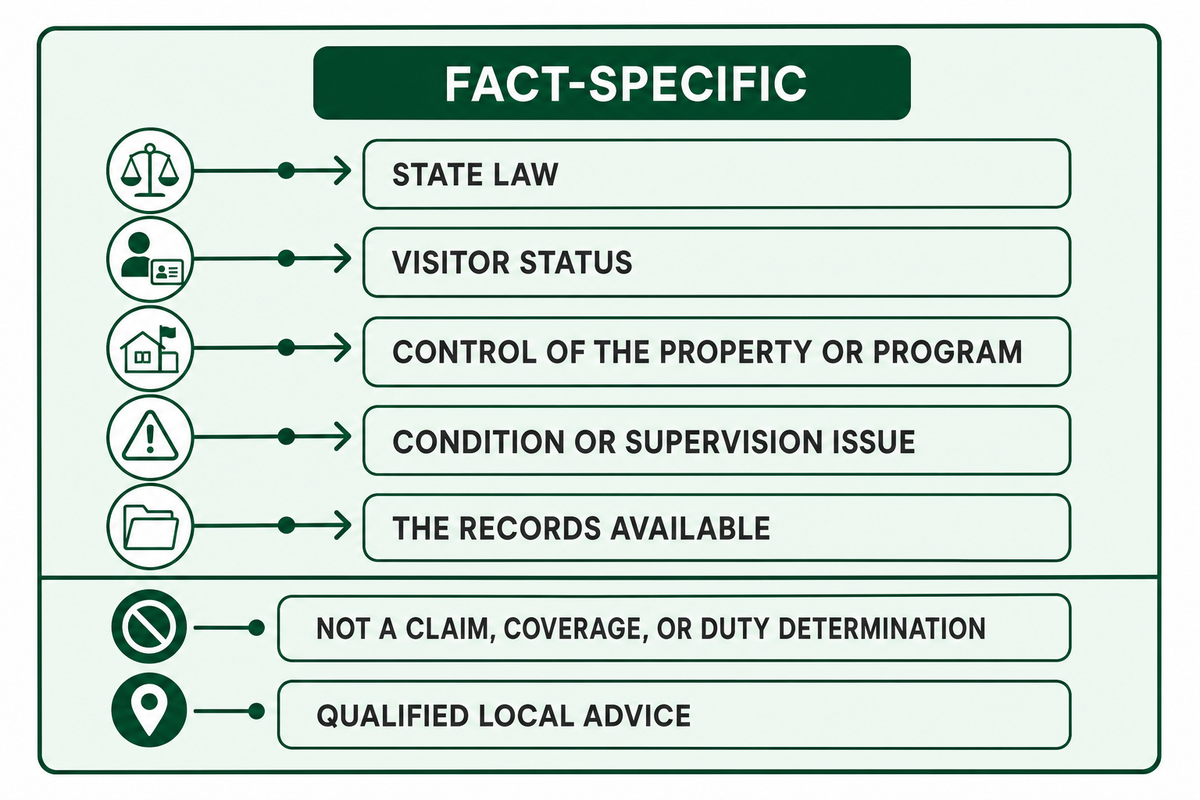
Responsibility for a church playground injury is fact-specific and can depend on state law, visitor status, control of the property or program, the condition or supervision issue, and the records available. The FAQs below explain general questions boards should review, but they do not determine a specific claim, coverage result, or legal duty without the governing facts and qualified local advice.
Should a church have liability insurance for its playground?
Read the answer
A church should not operate a playground without reviewing liability coverage, but policy types and limits are outside this article’s premises-liability lane. Use the insurance guide linked in the outside-groups section as an educational handoff, then ask a licensed insurance professional to review the church’s actual policy, exclusions, and programs.
Who may be responsible if a child enters the playground after hours?
Read the answer
That depends on state premises-liability and attractive-nuisance law, the child’s status, whether the church knew children were entering, the condition involved, and the steps taken to restrict unsupervised access. A locked gate, accurate signage, documented inspections, and prompt correction of hazardous conditions may matter, but no single measure decides every claim.
Should a church have a playground at all, given the liability exposure?
Read the answer
That decision depends on the congregation’s mission, site, budget, ability to supervise, maintenance capacity, insurance terms, and local law. Before proceeding, the board should obtain an equipment and site assessment, adopt written inspection and supervision procedures, and confirm coverage with licensed local professionals. Document the decision and revisit it when programs, equipment, staffing, or insurance policy terms change.
Can a church get a grant for a playground?
Read the answer
Funding options and eligibility change by location and program. Use our church playground budget guide as a starting point for researching current funding routes; this article addresses liability and compliance rather than promising grant availability.
What documentation does a church need to defend a playground injury claim?
Read the answer
The paperwork that may help in a dispute falls into four practical categories: a written, dated inspection log; installation and repair records; supervision rosters for staffed or volunteer-run sessions; and incident or near-miss reports showing what happened and what corrective action followed. A simple binder or shared folder updated consistently is more useful than a sophisticated system used inconsistently. See The Claim-Date Evidence Trail, then ask local counsel what the church should retain.
Planning or upgrading a church playground?
The liability framework above is one part of the planning process. Dreamland Playground supports churches with space planning, age-appropriate design, equipment production, shipping, and installation support for church playground projects. Start with the project details and site constraints before requesting a layout.
A note on scope: This article explains general legal and insurance concepts as they commonly apply to church playgrounds in the United States; it isn’t legal advice, insurance advice, or engineering advice, and it doesn’t account for every state-specific charitable-immunity or recreational-use-immunity statute. Dreamland Playground is a playground equipment manufacturer, not a law firm or insurance agency, for a specific claim, coverage question, or compliance determination, consult a licensed attorney and your insurance carrier directly. Facts and figures above reflect information available as of August 2026; standards and regulations are periodically revised, so confirm current requirements before relying on any specific figure.
References & Sources
- Invitee, Licensee, and Trespasser, Wex Legal Dictionary Cornell Law School
- California Civil Code Section 1714 California State Legislature
- Attractive Nuisance Doctrine, Wex Legal Dictionary Cornell Law School
- Liability for Playground Injuries Church Law & Tax
- Negligent Supervision of Church Workers, Other Cases Church Law & Tax
- Public Playground Equipment Voluntary Standards U.S. Consumer Product Safety Commission
- Public Playground Safety Checklist U.S. Consumer Product Safety Commission
- Certificates of Insurance FAQ Texas Department of Insurance
- Playground Supervision Training Guidance Get Safety Trained
- Negligent Supervision Settlement Report Raphaelson & Levine Law Firm