Indoor playground financial projections are a 5-year cash-flow model for launch cost, revenue ramp, operating cost, debt, and reserve planning. Useful projections connect attendance capacity, birthday parties, memberships, payroll, rent, insurance, equipment payments, and working capital into one story a lender can question.
Fast Answer: What Goes Into a 5-Year Indoor Playground Projection?
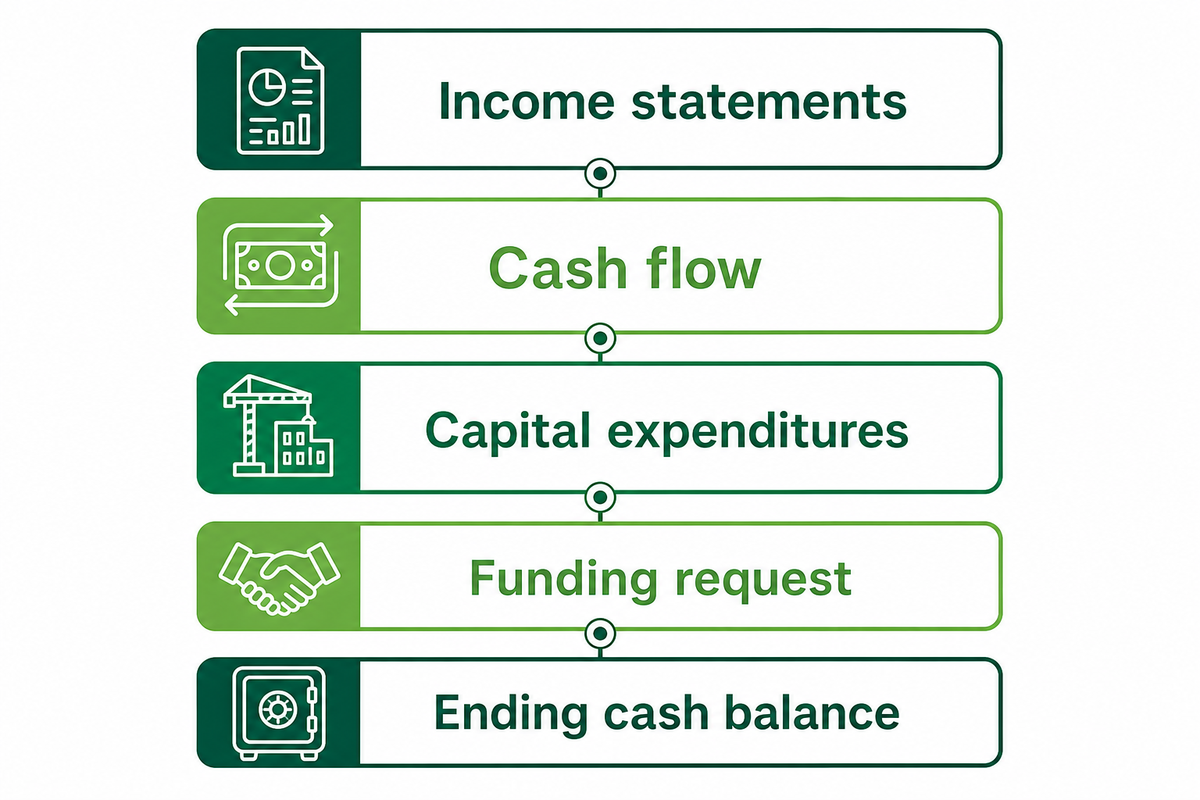
SBA business-planning guidance supports an indoor playground projection with 5 years of income statements, balance sheets, cash flow, capital expenditures, startup costs, debt assumptions, and a funding request that matches the project schedule. Indoor play centers also need a first-year monthly ramp because rent, deposits, payroll, launch marketing, and paid admissions rarely arrive in a neat annual average.
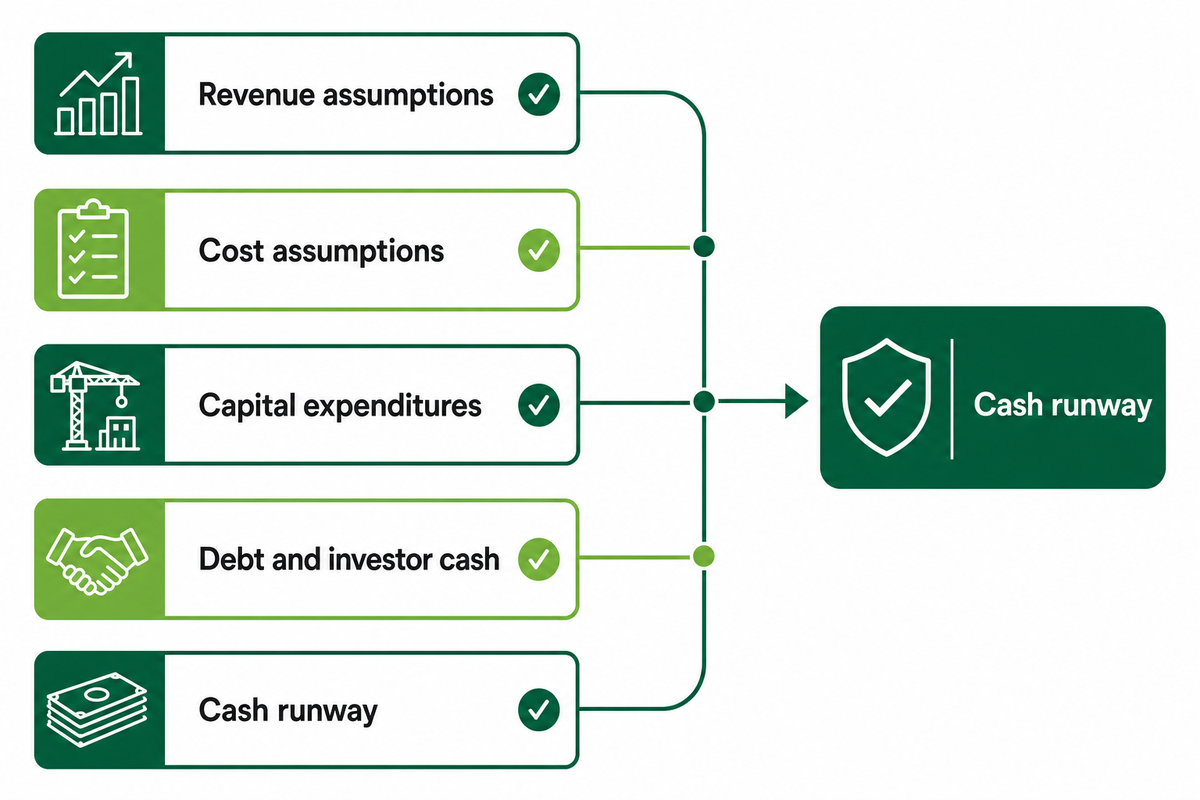
Practical planning is not about proving a best-case return. Your model should show what must happen for the venue to pay rent, payroll, insurance, utilities, loan payments, maintenance, and tax obligations while still keeping enough cash for slow months.
Fast formula: opening cash + monthly operating cash inflow – monthly operating cash outflow – debt service – capital payments = ending cash balance. If the ending balance goes negative before month 12, the plan needs more capital, slower spending, higher contribution margin, or a different opening schedule.
Treat the projection as a cash-timing document first and a profit story second; if a number cannot be traced to a quote, calendar, or operating assumption, label it as a placeholder.
Lease, broker quote, utility estimate, payroll plan
Cash flow
When does cash get tight?
Timing of receipts, payroll, debt, repairs
Opening calendar, lender term sheet, reserve policy
8-Point Cash Timing Worksheet
Checkpoint
Cash question
Evidence to attach
Lease signing
Which deposits are due before build-out starts?
Security deposit, first rent date, and any free-rent clause.
Design approval
When does the floor plan freeze enough for quoting?
Signed layout, attraction list, age range, and site measurements.
Equipment order
What deposit starts production?
Supplier quote, payment milestone, and drawing approval date.
Freight booking
When does shipping cash leave the account?
Freight quote, delivery term, port cost, duty estimate, and insurance note.
Build-out draw
Which contractor invoices arrive before opening?
Electrical, flooring, surfacing, signage, furniture, and permit invoices.
Hiring start
How much payroll is paid before launch revenue?
Training roster, manager schedule, payroll tax, and opening-week labor plan.
Opening month
Can cash cover a soft start?
Launch offer, marketing spend, admission ramp, party deposits, and reserve draw.
First review
Which assumption must change after 30 days?
Paid visits, party inquiries, membership signups, refunds, repairs, and closing cash.
Build the Model Spine: Revenue, Costs, Capital, and Cash
Financial model structure should be easy to audit, which is why SBA planning guidance separates projections, funding requests, and assumptions instead of treating them as one profit line. Keep assumptions in one place and calculations in another. Any lender, partner, or project developer should be able to trace one claim, such as party revenue in year 2, back to party-room count, booking slots, booking rate, average package price, deposit policy, host labor, food cost, and calendar limits.
One profit line hides the reason a venue fails. Even a venue with positive annual profit can run out of cash if deposits, rent-free periods, debt draws, production payments, shipping, and build-out invoices land before ticket sales grow.
Year-One Monthly Forecast: Why Annual Averages Hide the Risk
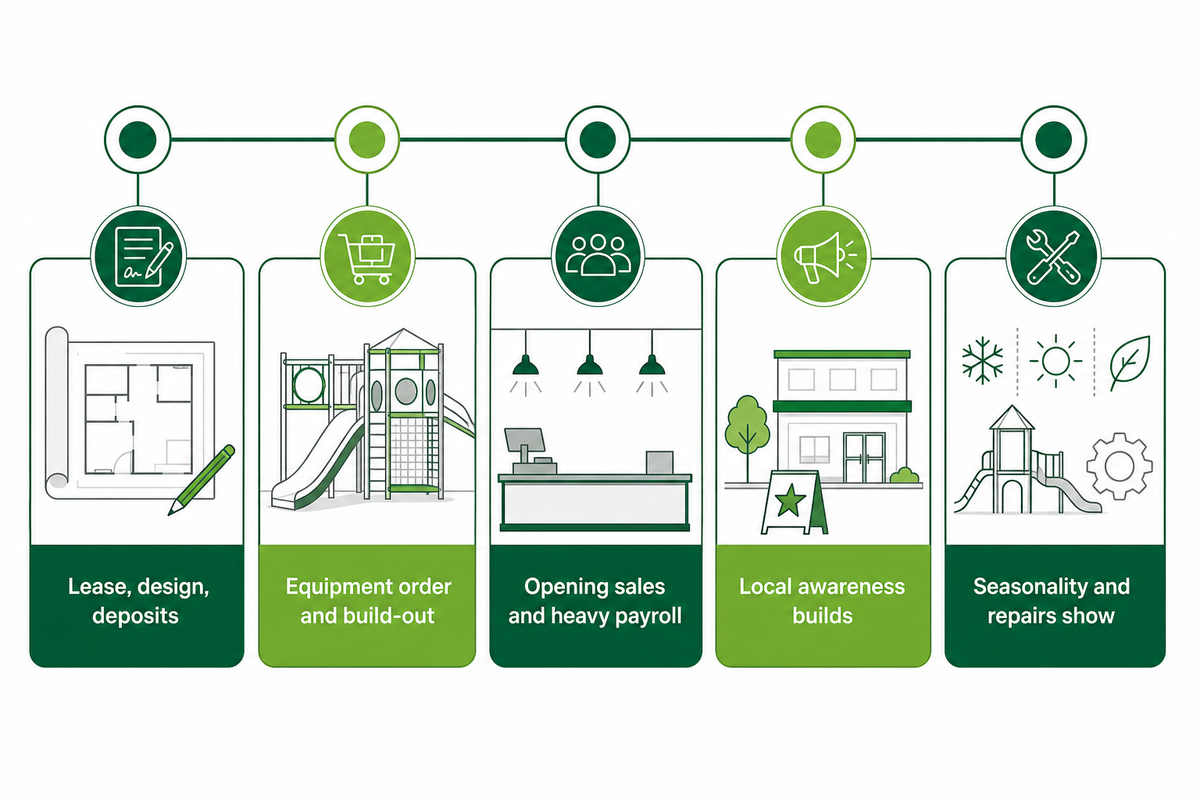
Year 1 should be built month by month. SBA business-plan guidance supports more detailed early projections for funding work, and indoor playground cash flow makes that detail necessary. Before admission revenue begins, a rent deposit, equipment deposit, balance payment, freight bill, build-out invoice, insurance premium, and pre-opening payroll may all arrive.
Yearly averages can hide 3 common problems: the venue opens later than planned, paid visits ramp slower than the rent schedule, or the first party calendar is weak until local parents trust the site. Five-year forecasts can still use annual columns for years 2-5, but year 1 needs the operating calendar.
Year-One Monthly Ramp
Month block
Cash event
Model input
Red flag
Pre-opening 1
Lease, design, deposits
Security deposit, rent start, design fee
Rent starts before funding is closed
Pre-opening 2
Equipment order and build-out
Deposit, balance date, contractor draws
Equipment quote treated as full startup budget
Launch month
Opening sales and heavy payroll
Training hours, marketing, opening discount
Full staffing with soft demand
Months 2-3
Local awareness builds
Paid visits, party inquiries, reviews
Strong open play but no party bookings
Months 4-6
Repeat behavior appears
Membership signups, churn, off-peak use
Members crowd peak slots too early
Months 7-12
Seasonality and repairs show
Weather swings, maintenance, staff turnover
No reserve for slow weeks
Revenue Streams: Model Each Lane Separately
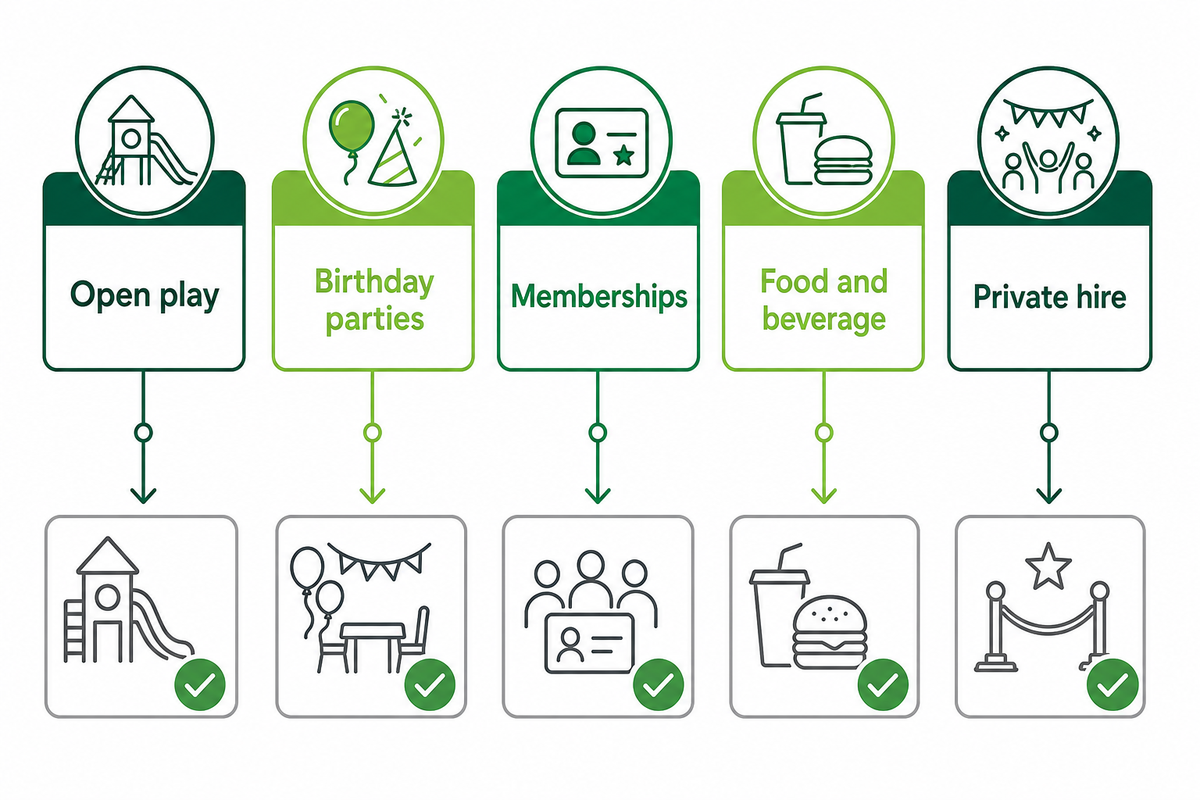
Do not flatten revenues into one ticket number. Open play uses hourly capacity. Birthday parties use scarce room blocks and host labor. Memberships sell repeat access and can weaken peak capacity if the rules are loose. Food, beverage, retail, socks, camps, private hire, and add-ons each have different gross margin and staff load.
In a family entertainment center with arcade, trampoline, ninja course, toddler zone, cafe, and party rooms, the forecast needs more lanes than a small children’s play area inside a mall. One 5-year model can support both projects if every lane has its own unit driver and capacity ceiling.
Market and Funding Inputs to Add Before the First Draft
Market analysis for a United States venue should use Census Business Builder or equivalent local data to define families with children, disposable income, local demand, target audience, competitor play cafe offers, and partnerships with local schools, malls, or hotels. That research helps identify market gaps, size the indoor play area, specify facilities for children, and test whether the concept can encourage repeat visits.
Before launching an indoor playground, owners should understand the business, choose the type of business and business structure, and decide whether to buy into a franchise, build your own brand, or operate as an independent business. A free template or business plan template can organize the work, but a solid business plan still needs a unique selling proposition, marketing strategies, business goals, and a path to profitability.
Model category
Projection question
Evidence to attach
Indoor playground startup costs
Do total startup costs match the steps to open?
Equipment quote, rent deposit, freight, fit-out, safety standards, ASTM safety standards, and soft play scope.
Space scale
Which indoor play area size fits the rent?
Replace placeholder 300 m², 500 m², and 800 m² cases with the signed floor plan.
Timeline
How long is cash tied up before launch?
Use quote dates, a 3 days concept cell, a 15-30 working days production cell, and a 60 days shipping placeholder until the freight quote arrives.
Funding options
Can business loans secure funding without starving working capital?
Loan term sheet, owner equity, $25,000 reserve placeholder, $5,000 contingency cell, and ability to repay the loan.
Admission model
What paid-visit count supports weekday cash?
Replace a $12 ticket, 2 hours session, 90 min toddler session, and 30% off-peak utilization with local price-board evidence.
Party model
How much calendar capacity can parties sell?
Test a $250 package, 3 hours room block, and 4 parties/day only as editable assumptions.
Revenue growth
When does annual revenue support a profitable indoor playground?
Visit ramp, party calendar, memberships, retail, food, and playground ideas that fit local demand.
Payroll type
Does staffing break the contribution margin?
Model a $15.00/hr local wage placeholder, 4 hours training block, 8 hours weekend shift, and payroll tax assumptions.
5 red flags
What could damage the financial future?
Weak market analysis, high payroll, loose membership rules, unclear play structures, no 3 months cash reserve, and no 12 months replacement calendar.
Careful planning protects a new business from treating every attractive indoor playground idea as bankable. Owners seeking investment should show how safety standards, attraction mix, price board, operating calendar, and children and parents served by the concept make the plan durable, not just exciting.
Revenue stream
Unit driver
Capacity limit
Variable cost
Evidence source
Open play
Paid child visits
Session capacity and check-in speed
Socks, cleaning, card fees
Local price board and floor plan
Birthday parties
Booked room slots
Rooms, reset time, weekend calendar
Host labor, food, supplies
Booking calendar and package sheet
Memberships
Active members and visits
Blackout rules and off-peak hours
Incremental cleaning and service
Membership terms and visit logs
Food and beverage
Spend per visiting family
Kitchen speed and seating
Inventory, waste, staff
Supplier costs and menu test
Private hire
Booked block hours
Lost open-play time
Extra staffing and cleanup
School, church, company inquiries
Startup Costs and Capital Expenditures: What Must Be Funded Before Revenue
Startup costs should follow the cash curve, not the sales brochure. SBA startup-cost guidance separates fixed costs, selling price, projected unit sales, and variable cost per unit for break-even planning. In an indoor playground business plan, that means the funding request should cover more than indoor playground equipment price.
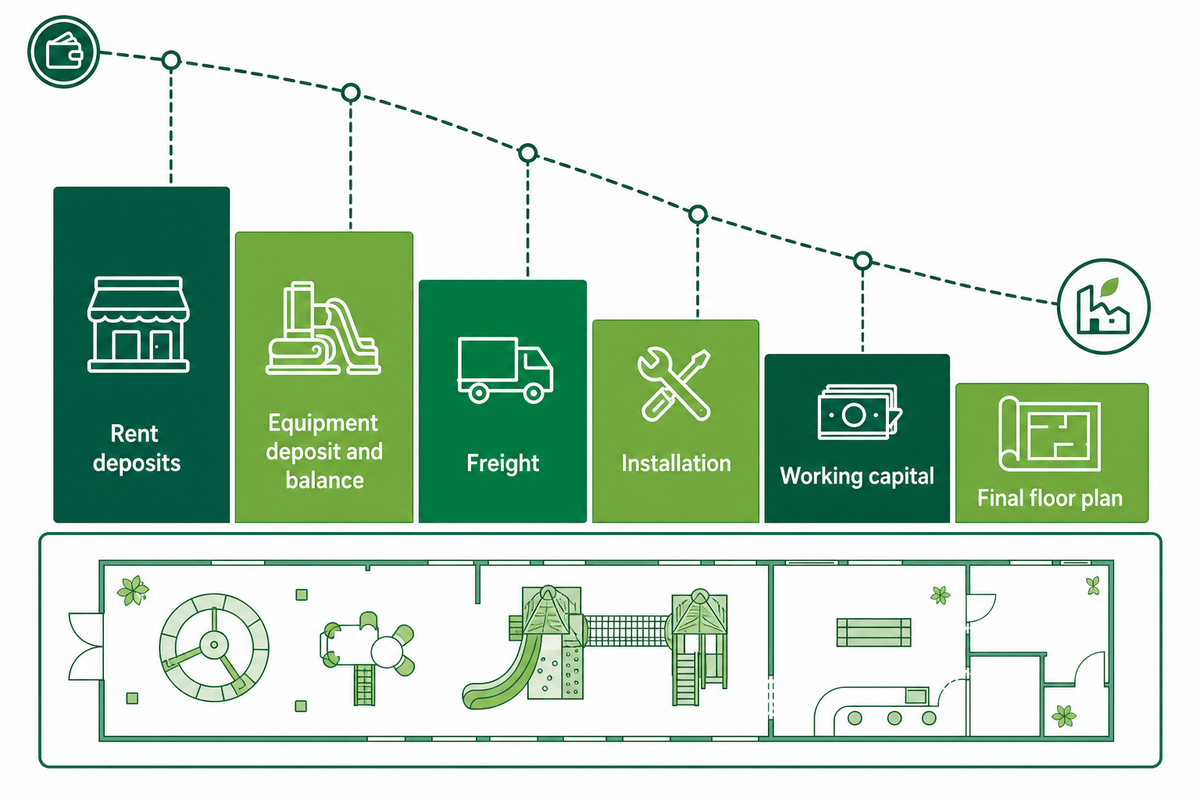
Build in rent deposits, utility deposits, equipment deposit and balance, freight, duty, customs, installation, surfacing, signs, furniture, point-of-sale software, permits, design, architect or engineer review, legal setup, insurance, pre-opening payroll, grand-opening marketing, first inventory, and working capital. The indoor playground business plan should show which line is a one-time capital expense, which line repeats monthly, and which line depends on the final floor plan.
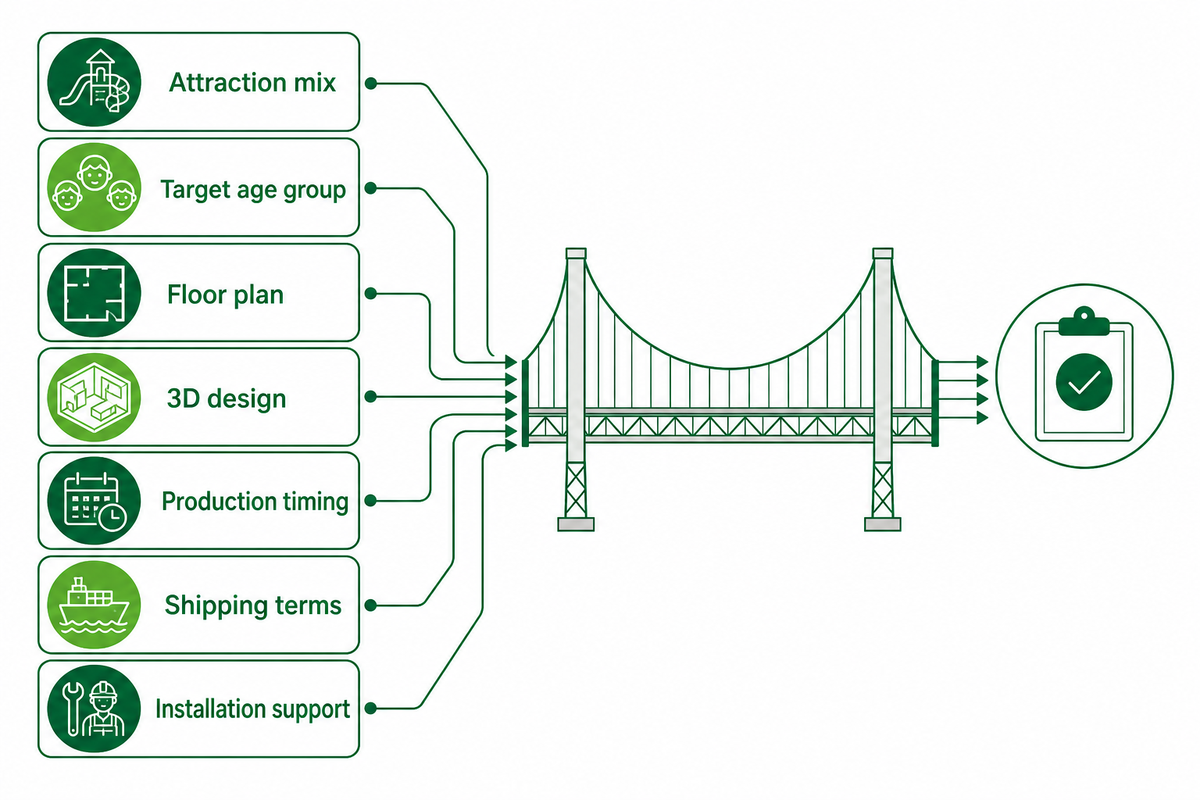
Dreamland Playground supports space planning, floor plan design, 3D design, equipment production, shipping, installation support, and after-sales service. Those project steps help turn a rough capex list into a schedule with quote dates, drawing approval, production timing, shipping terms, and install planning.
Floor plan and 3D design choices affect revenue capacity, equipment budget, installation planning, and launch cash timing.
Payroll, Rent, Insurance, and Other Fixed Costs
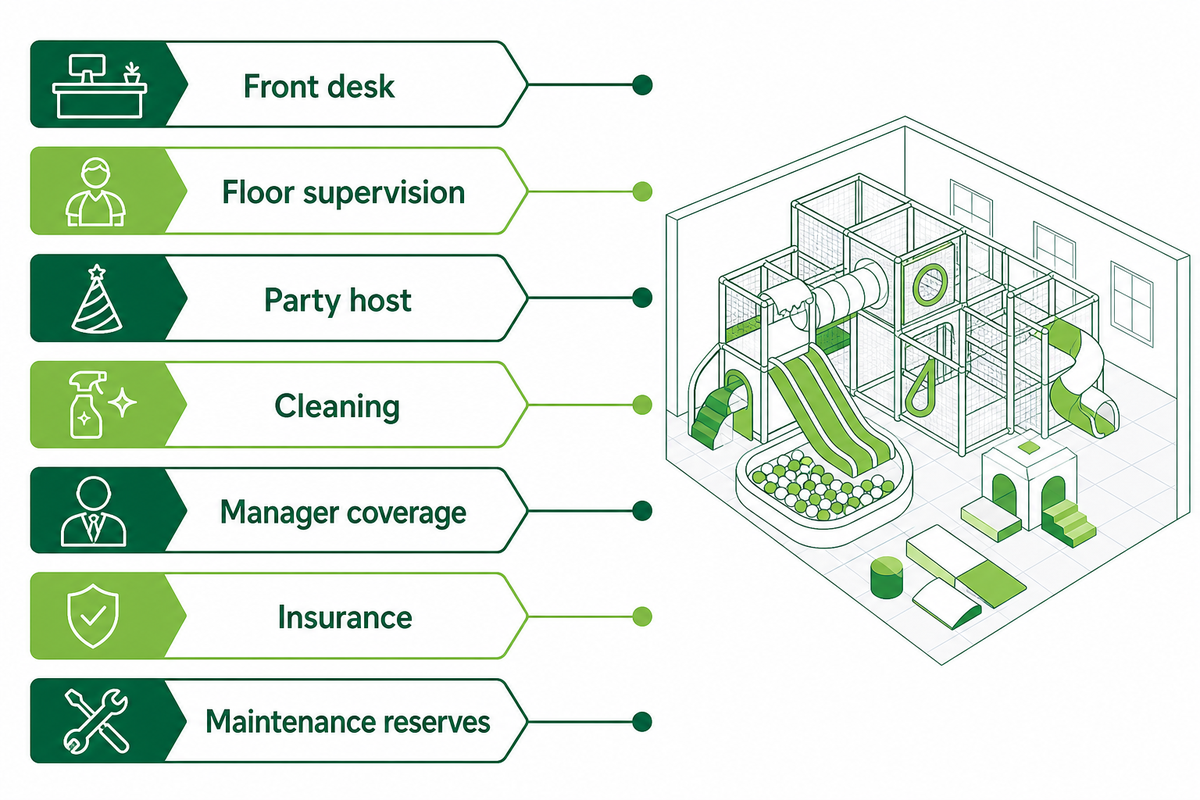
Payroll is not a pure variable cost. A staffed session needs a minimum roster even when attendance is soft. Model front desk, floor supervision, party host, cleaning, manager coverage, training, overtime, payroll tax, and owner salary separately. Then replace every national benchmark with local wage evidence before making a funding decision.
BLS NAICS 713 data delivers a public national baseline for amusement and recreation attendants. In the 2025 table reviewed for this article, the median hourly wage is 15.00 USD and the mean hourly wage is 15.28 USD. That isn’t a local quote for your city. It’s a prompt to pull state, metro, and competitor wage evidence before you sign a lease or promise a staffing plan.
Rent, insurance, utilities, software, payment fees, cleaning, repairs, music licensing, security, pest control, and maintenance reserves should each have a monthly line. Insurance should be reviewed against your attraction mix, age range, services, staffing, party policy, and lease requirements. For early planning, connect this work to an insurance spend sanity-check.
Break-Even and Cash-Flow Formulas for Indoor Play Centers
SBA break-even guidance uses fixed costs divided by price minus variable cost. For an indoor playground, apply that logic by lane. The contribution from a weekday admission ticket isn’t the same as a hosted birthday party, a monthly membership, or a food-and-beverage add-on.
Start with these formulas:
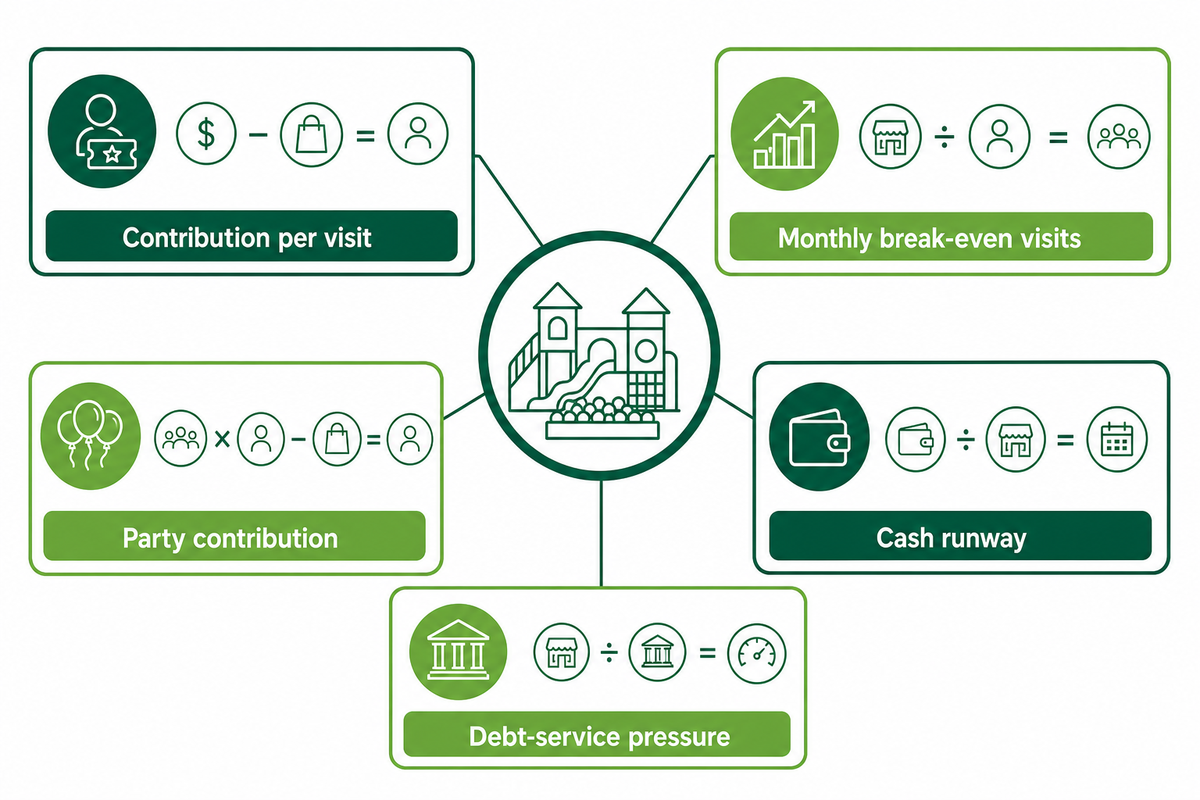
Contribution per visit: average price – variable cost per visit.
Monthly break-even visits: monthly fixed costs / contribution per visit.
The indoor playground break-even model should be read as a stress test. Profitability on paper can coexist with a negative bank balance when sales ramp slowly or build-out takes longer than expected.
Conservative, Base, and Strong Cases: Sensitivity Grid
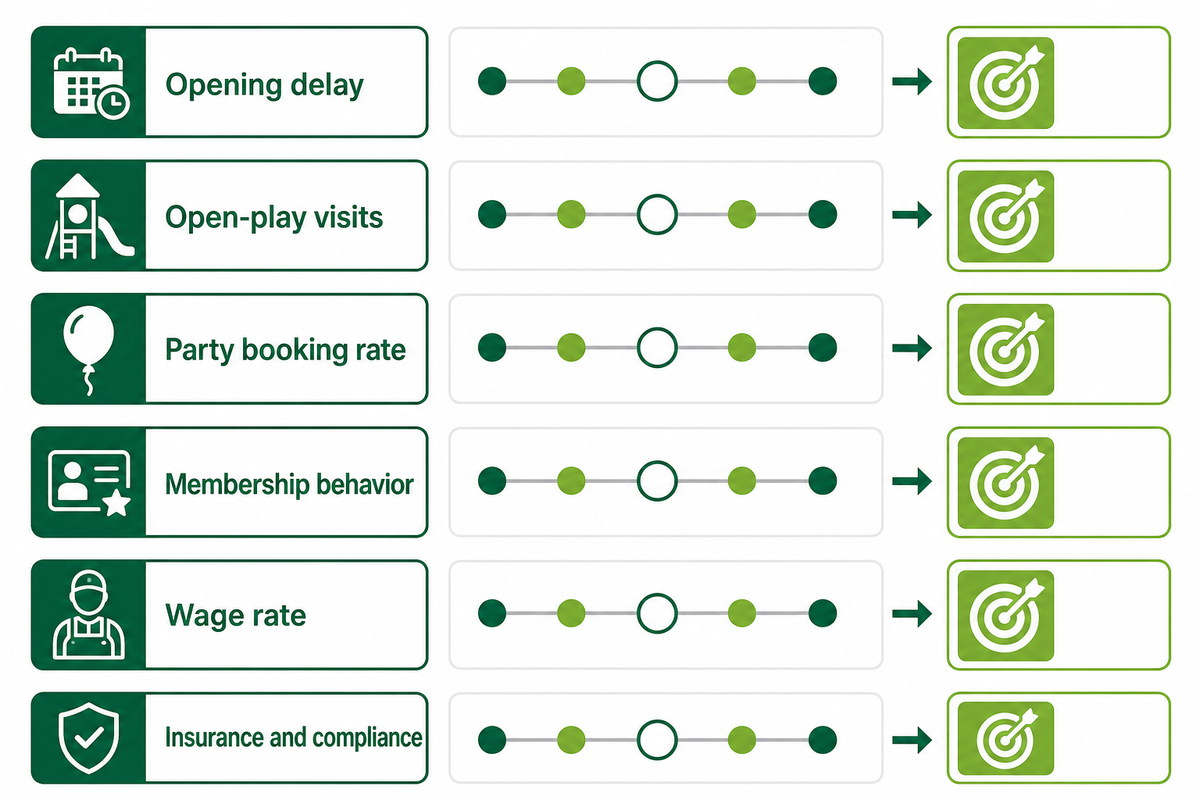
Strong cases are useful only if the conservative case tells you what could break. Use SBA planning guidance to keep assumptions visible, then test operator and competitor research against payroll assumptions, revenue stream dependency, and break-even timing that arrives too early. Do not let the strongest case be the only case that can pay the bills.
Scenario Sensitivity Grid
Assumption
Conservative case
Base case
Strong case
Decision trigger
Opening delay
Extra 30-60 days
Planned date
Early handover
Reserve must cover rent and payroll
Open-play visits
Slow local awareness
Planned ramp
Fast repeat demand
Marketing spend or offer changes
Party booking rate
Weak first 90 days
Steady weekend bookings
Waitlist on peak slots
Package, deposit, and room-count review
Membership behavior
High use, low margin
Off-peak repeat visits
Healthy weekday demand
Blackout dates and visit limits
Wage rate
Above national baseline
Local average
Efficient staffing
Staffed-session model update
Insurance and compliance
Higher premium or added requirement
Quoted cost
Clean review
Capital reserve and opening checklist
Lender Evidence Packet: What Proves Each Assumption?
Lenders and investors do not need every assumption to be perfect. They need to see which assumptions are facts, quotes, local estimates, or still-open risks. Census Business Builder can support market research with demographic and economic data, comparisons, time series, and downloadable reports. Put that evidence beside the revenue formula, not inside it.
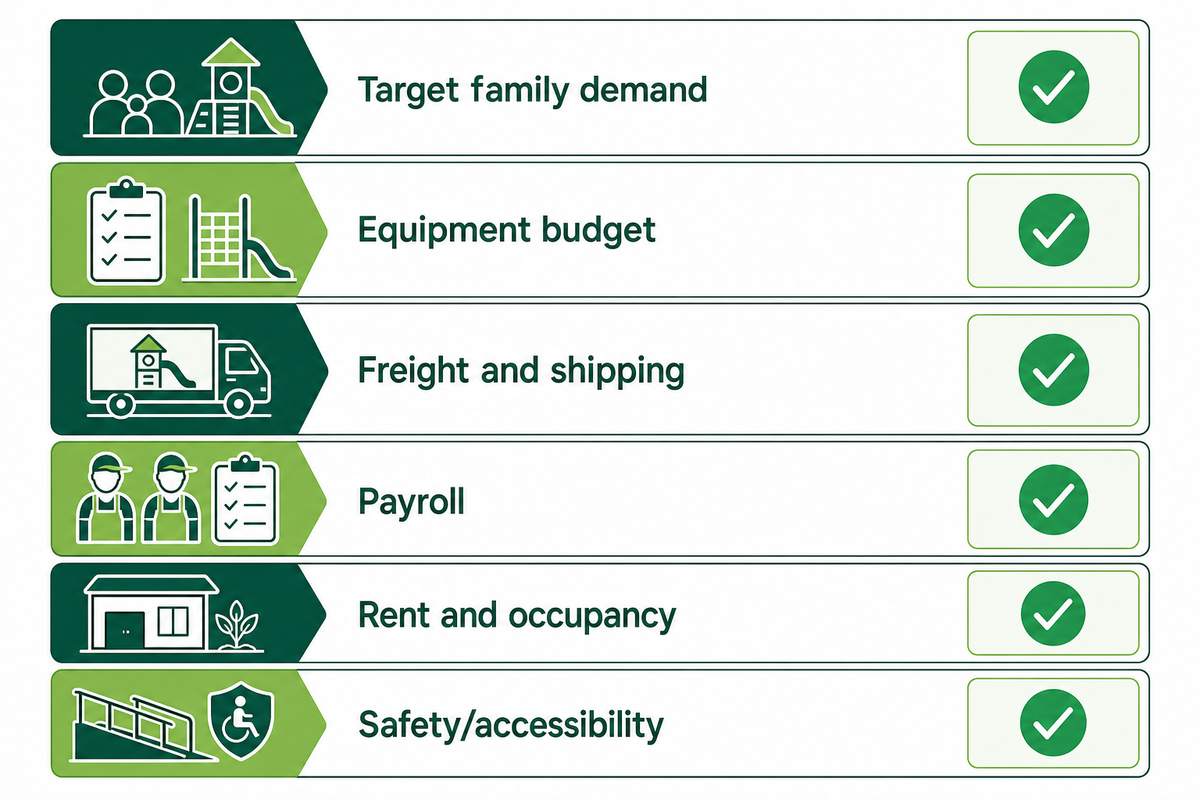
Lender Evidence Packet
Assumption
Document to attach
What it proves
Who should sign off
Target family demand
Census catchment pull and local competitor visit notes
There is a defined audience, not only a broad parent claim
Owner and lender
Equipment budget
Dreamland quote, floor plan, 3D concept, attraction list
The cost matches the selected layout
Owner and supplier
Freight and shipping
Incoterm and freight estimate
Cash timing includes the delivery path
Owner and freight partner
Payroll
BLS/local wage pull and staffed-session schedule
Labor cost is tied to operating hours
Finance and operations
Rent and occupancy
Lease draft, rent schedule, occupancy notes
Fixed cost and capacity have a source
Owner, landlord, code reviewer
Safety/accessibility
ADA review, ASTM/product notes, local code answers
Budget includes review and correction risk
Owner and qualified local reviewer
How Dreamland Turns Project Details Into Better Projection Inputs
Dreamland Playground is a professional playground equipment manufacturer and project solution provider in China. Its team supports indoor playgrounds, family entertainment centers, trampoline parks, ninja courses, adventure parks, shopping mall play areas, schools, hotels, resorts, and outdoor play spaces from the first idea through design, production, shipping, installation support, and after-sales service.
Within financial projections, the value is not only a price list. Dreamland can help define the attraction mix, target age group, theme, layout, floor plan, 3D design, equipment production plan, shipping path, installation support, and after-sales service; the Dreamland project services overview helps connect those steps to budget assumptions. Those details can reduce the number of blank assumptions in the model.
Use the wording supported by Dreamland’s current business-plan page: quotation within 24 hours on business days, 3D concept in 3 working days from an approved floor plan, production in 15-30 working days after drawing approval, and shipping terms such as EXW, FOB, CFR, CIF, DDU, or DDP. Products can be designed according to relevant EN and ASTM safety requirements depending on product type and target market, but local code, permits, insurance, and lender review remain separate.
Build the projection from a real floor plan
Share your venue size, target age group, business model, city, budget range, and preferred theme. Dreamland Playground can help connect indoor playground equipment, 3D design, production timing, shipping terms, and installation support to the numbers in your financial plan.
How do I make financial projections for an indoor playground?
Start with a 5-year model that separates revenue streams, startup costs, fixed costs, variable costs, debt, and cash flow. Build year 1 by month, then model years 2-5 annually or quarterly. Operators who plan to start an indoor playground should attach evidence for floor plan, equipment quote, lease terms, wages, insurance, Census market pull, and booking-capacity math. Keep an assumption note for each number, especially opening cash, timing, evidence source, and the person responsible for updates.
How many years should an indoor playground forecast cover?
Lenders and investors typically expect 5 years because the forecast shows launch, ramp-up, stabilization, debt pressure, capital spending, and replacement reserves. The first year deserves the most detail because pre-opening cash, rent, payroll, marketing, and party bookings do not arrive evenly. A single annual year-one column can hide cash shortages.
What revenue streams should I model separately?
Model open play, birthday parties, memberships, food and beverage, retail, private hire, camps, and add-ons separately. Each lane has a different unit driver and capacity limit. Open play depends on paid visits and session capacity. Parties depend on room slots and host labor. Memberships depend on repeat visits, blackout rules, and peak-time crowding.
What costs are easy to miss?
Common missing costs include pre-opening rent, equipment balance payments, freight, duty, customs, installation, surfacing, permits, signs, furniture, software, insurance deposits, training payroll, socks inventory, launch marketing, maintenance reserve, and working capital. Time them by month instead of placing them in one startup line.
What is a realistic break-even test?
Realistic break-even testing separates fixed monthly costs from contribution per lane. Calculate how many paid visits, party bookings, member months, and parent purchases cover rent, payroll, insurance, utilities, debt service, and maintenance. Then stress test lower attendance, higher wages, opening delays, weaker party demand, slower membership growth, higher utilities, added repairs, and loan-payment timing. Use the test twice: planned demand, then 10% fewer visits or 30 days of delay. Check whether ending cash stays positive.
Can Dreamland help estimate equipment and layout costs?
Yes. Dreamland Playground can connect layout, attraction mix, age range, theme, equipment scope, production timing, shipping terms, and installation support to the budget inputs in your projection. That support helps owners replace broad square-foot guesses with project-specific quote, design, production, and delivery assumptions.
Dreamland Playground publishes practical planning guides for commercial indoor-play projects, including family entertainment centers, shopping malls, hotels, restaurants, churches, and other venue types.
Use these guides to frame the questions that should be resolved before concept selection: venue size, intended age groups, project location, attraction mix, operating priorities, timeline, and delivery constraints. Final recommendations should be based on the real site and applicable local requirements.
Start With The VenueFloor area, clear height, site location, intended audience, and target opening date create the working brief.
Clarify The ScopeConcept, equipment, production, shipping, installation, and operating inputs can vary from one project to another.
PROJECT / VENUE / TIMELINE
Prepare Your Project Brief
Venue TypesFEC · Mall · Hotel · Restaurant · Church
Start WithFloor area · Clear height · Age groups · Country