Liability insurance for indoor playground refers to the broker review of policies that may respond to visitor claims, service-error allegations, severe losses, and related venue responsibilities. It is not one thing with one definite answer.
For indoor playground and soft play operators General liability, professional liability, umbrella coverage
Important boundary: This article is general education, not legal or insurance advice. Dreamland Playground designs and manufactures play equipment and supports project planning. Licensed insurance professionals and local counsel must confirm coverage, exclusions, certificates, endorsements, permits, professional-service duties, and local duties before you open or renew.
Fast Answer: What liability insurance does an indoor playground usually discuss?
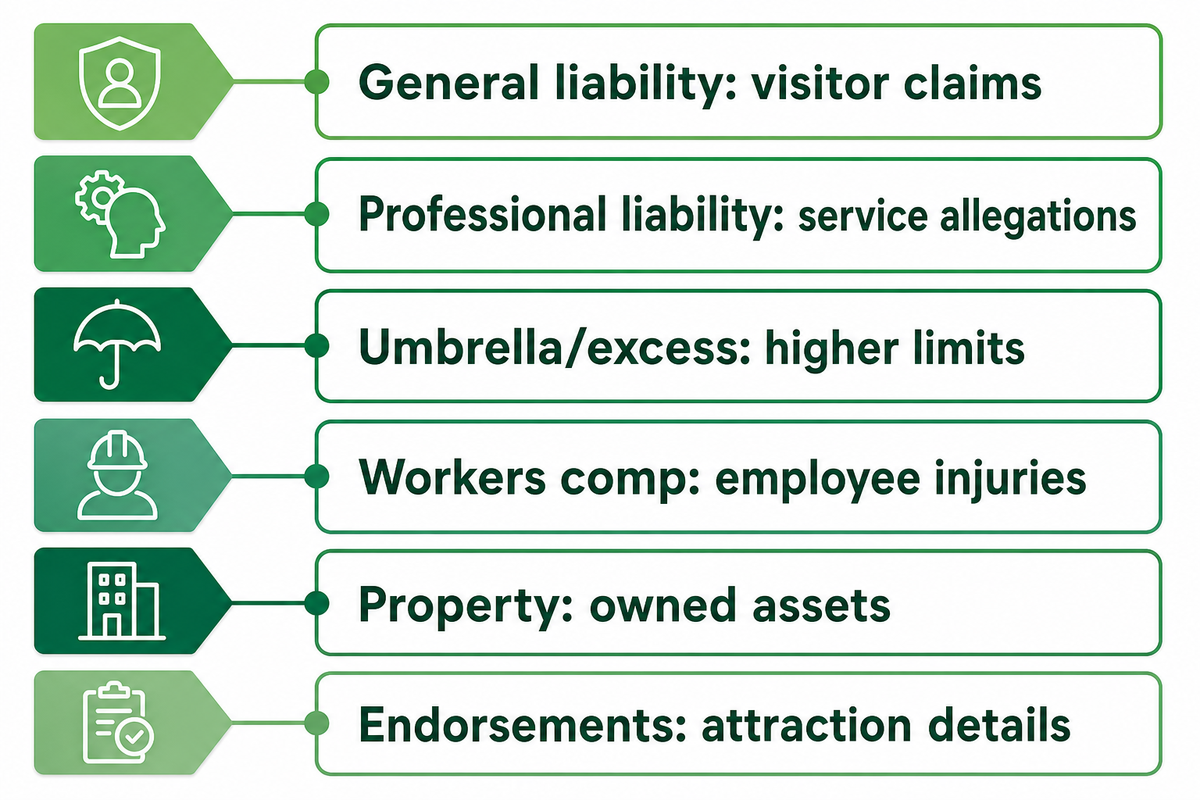
Most indoor playground operators start with general liability insurance, then review professional liability insurance, umbrella liability insurance, workers compensation, commercial property insurance, special endorsements, and professional-service claim questions. Exact indoor playground insurance planning depends on attractions, staff, lease terms, events, food service, local rules, prior claims, and the carrier’s underwriting appetite.
The mistake is asking, “What policy covers everything?” A better first question is, “Who could make a claim, and what event would trigger it?” The NAIC glossary is useful for term definitions, including commercial general liability, professional liability, occurrence, aggregate limit, bodily injury, and workers compensation. It does not decide what every indoor play center must buy.
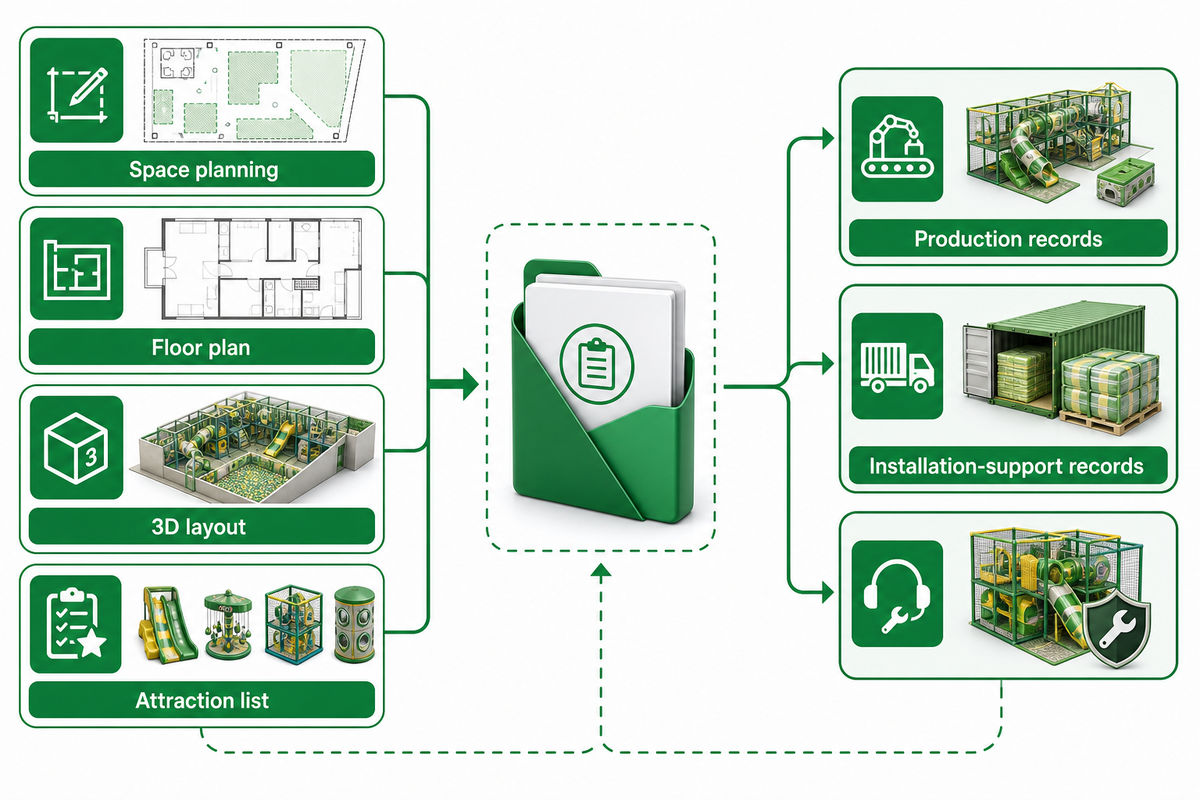
Because the coverage risk changes when one venue combines toddlers, trampolines, food service, school groups, and a mall lease, the first broker packet should separate at least 6 claim sources before price shopping. Dreamland Playground can support that packet with a floor plan, age-zone map, attraction list, and 3D layout so the broker reviews the actual venue rather than a generic policy checklist.
Usually discussed first
General liability coverage for visitor injuries or other people’s property damage, subject to the actual policy language.
Often reviewed next
Many venues also consider umbrella or excess limits, professional liability, sexual-abuse coverage, commercial property, worker’s compensation, employees’ autos, third-party incidents, and non-owned exposure.
A broker may ask different questions for a small toddler soft play area than for a family entertainment center with trampoline courts, a ninja course, climbing elements, a party room, and food service. That is why the strongest preparation step is a clear file, not a copied policy list.
Liability Responsibility Map: who can create a claim?
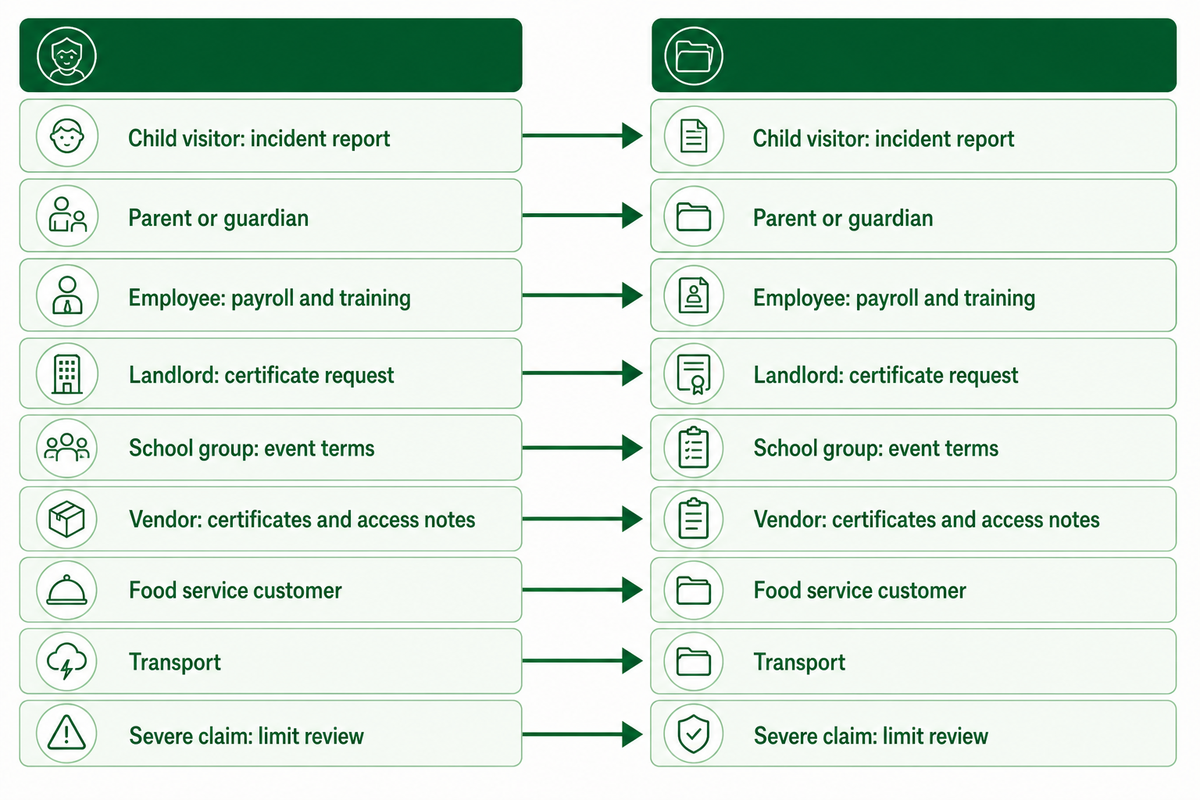
Start the Liability Responsibility Map with each person or party involved in the scenario, then relate that incident to the most appropriate coverage discussion. Separating visitor claims, employee claims, service allegations, landlord requirements, vendor incidents, and large-loss events helps the broker evaluate each potential coverage exposure independently from the others.
Possible claimant or requirement source
Example trigger
Coverage conversation to raise
Document to prepare
Child visitor
Slip, trip, collision, fall, or alleged unsafe condition
General liability insurance, medical payments if offered, exclusions
Delivery, repair, cleaning, or installation support incident
Vendor certificates, premises liability, contractual risk transfer
Vendor COI, delivery schedule, access notes
Food service customer
Food-related complaint or spill in cafe/party area
General liability plus food-service endorsement review
Food-service scope, cleaning plan, local permit record
Transport or off-site activity
Owned, hired, or non-owned auto exposure
Hired and non-owned auto, commercial auto if applicable
Vehicle use policy, driver list, event route notes
Severe claim scenario
Claim may exceed primary coverage limits
Umbrella liability insurance or excess liability review
Current policy limits, lease limits, contract limits
Use this map as a conversation tool. This is not a coverage promise, and it does not replace policy review.
General liability insurance for indoor playgrounds
This section applies the responsibility map above: general liability insurance is usually the first liability category discussed for visitor bodily injury and third-party property damage. For an indoor playground, that can include premises and operations questions, products or completed operations wording, occurrence and aggregate limits, medical-payment wording, exclusions, and certificate requests from landlords or event partners.
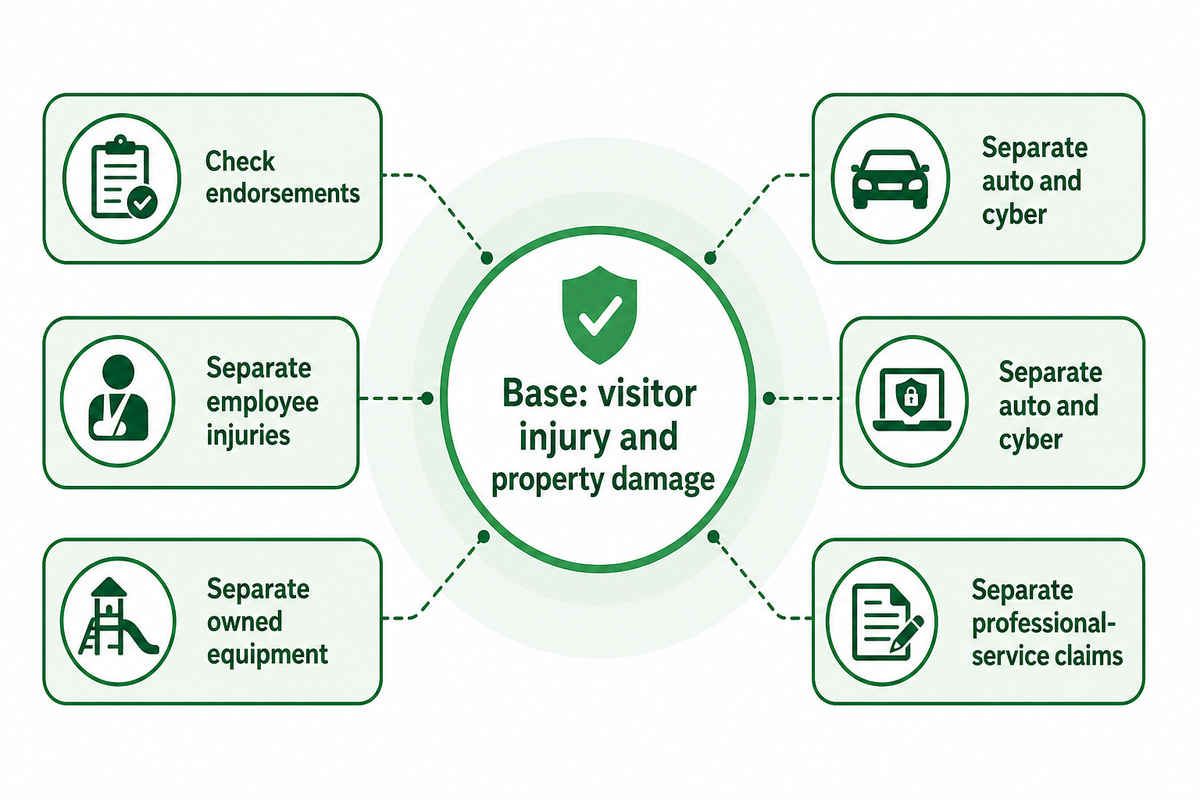
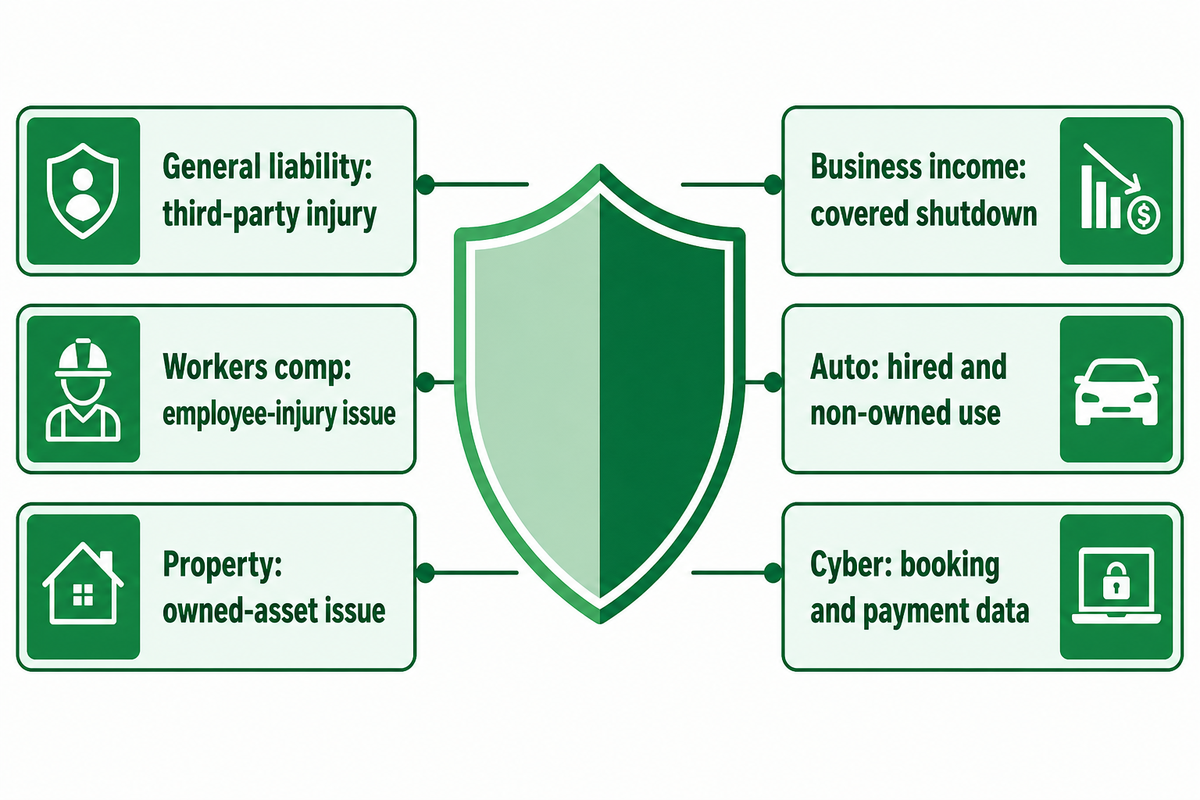
General liability is not the same thing as a complete indoor playground insurance plan. General liability may not answer employee injuries, owned equipment damage, business interruption, auto use, cyber issues, abuse allegations, or professional-service claims. It also may need endorsements when the venue includes trampolines, indoor climbing walls, inflatables, ninja obstacles, ropes elements, or other higher-movement attractions.
Your broker file for this section should include the floor plan, attraction list, age zones, height ranges, play rules, posted signs, supervision plan, party-room policy, cleaning schedule, safety inspection routine, and any prior claims or loss runs. If a landlord asks for 1000000 USD per occurrence or 2000000 USD aggregate language, give that request to your broker instead of copying limits from another venue.
Because one general liability form can leave a gap around employees, property, auto, cyber, or professional services, Dreamland Playground treats the 12-month operations file and attraction schedule as separate evidence. The risk-control file should name the covered operations, then the broker can test endorsements against the real layout.
Professional liability: when advice, design, or services need separate review
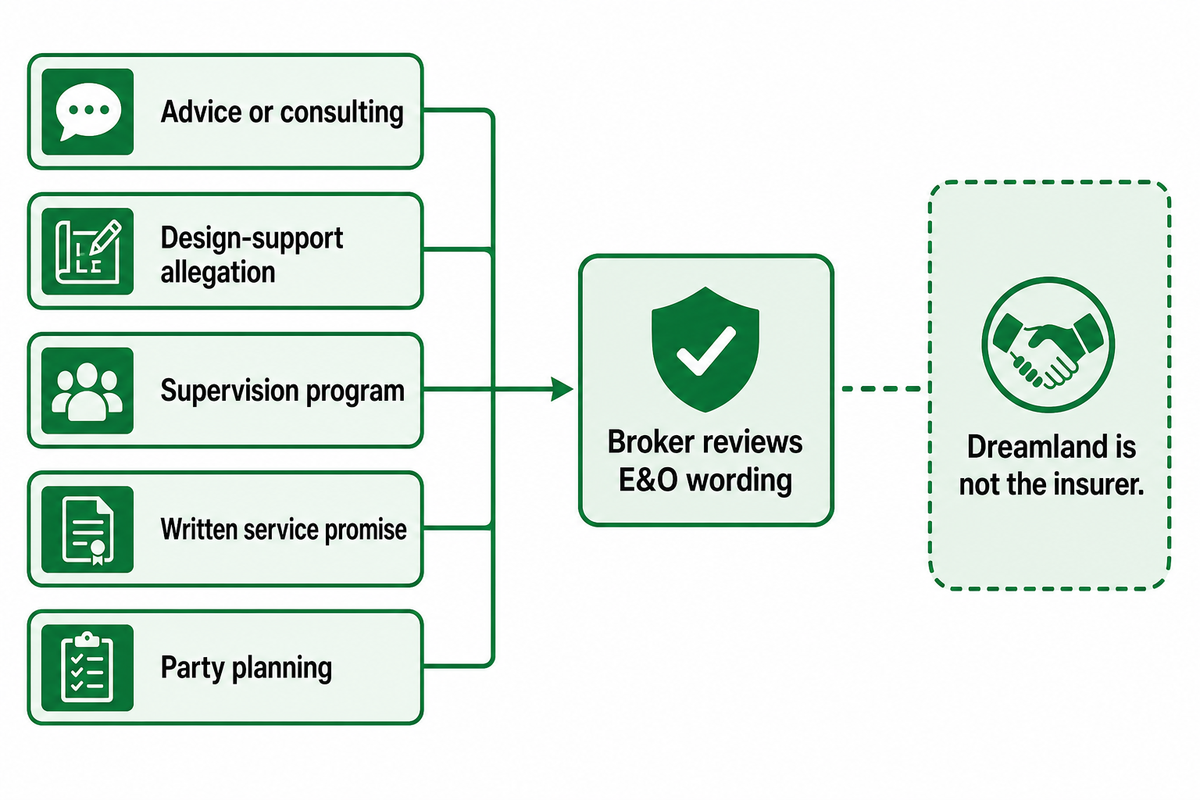
Professional liability insurance belongs in the conversation when the business sells advice, consulting, design support, supervision programs, franchise-style systems, staff training, party planning, or written service promises. Coverage hinges on more than the play structure alone. It is whether a customer could allege an error, omission, negligent service, or breach of duty.
NAIC’s glossary defines professional liability in service-error terms. That matters for operators who offer more than walk-in admission. A facility that hosts birthday parties, advises other operators, sells a curriculum, designs layouts for third parties, or promises supervised programs may need a separate review. A general liability policy should not be assumed to handle those allegations without broker confirmation.
Dreamland’s role also needs a clear line. Dreamland Playground can help with space planning, floor plan design, 3D design, production documents, shipping records, and installation support. That project file can help the operator explain the venue. It does not turn Dreamland into the operator’s insurance adviser, legal adviser, or policy approver.
Because professional liability turns on alleged service errors, keep the proposal scope, drawings, change approvals, and handover notes dated in one file. Dreamland Playground’s project documents define what was supplied, while the licensed broker decides whether errors-and-omissions wording applies to the operator’s services.
Umbrella or excess liability: higher limits for severe claims
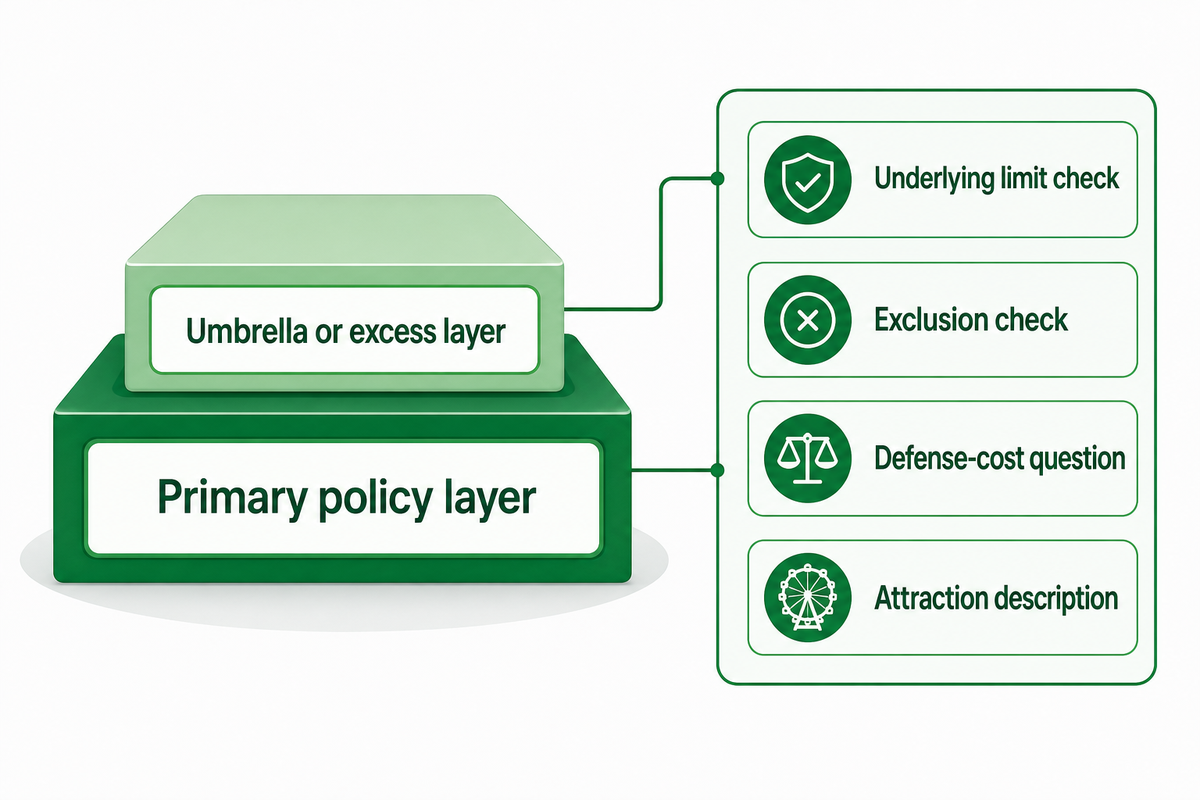
This next layer is different from the professional-service review above: umbrella liability insurance or excess liability can add limits above primary policies when a severe claim goes beyond the underlying coverage. Operators usually raise this topic when leases, school contracts, large parties, mall locations, trampoline zones, or higher-capacity family entertainment centers create larger limit expectations.
NAIC’s umbrella explainer describes the basic excess-layer idea, but the exact result depends on the policy. Ask about underlying-limit requirements, defense costs, exclusions, abuse and molestation wording, assault and battery wording, whether professional liability can sit underneath the umbrella, and whether every attraction is inside the covered operations description.
Because the excess layer depends on the underlying policy schedule, put lease limits, school contract limits, current primary limits, and 60-day renewal timing in the same review file. Dreamland Playground’s attraction list and capacity notes help the operator explain why a severe-loss scenario is being reviewed.
Keep cost discussion narrow on this page. A 1000000 USD liability policy cost question is real, but it belongs with a broker and with a separate cost model, because location, square footage, revenue, attractions, claim history, payroll, and coverage wording change the quote. If you’re checking broad budget reasonableness, use Dreamland’s insurance spend sanity-check as a preparation aid, not as a quote.
Other policies operators often confuse with liability coverage
Indoor playground insurance conversations sometimes put liability, property, employees, auto, cyber, and income exposures in one sentence. Break out those exposures and it helps the broker to identify the gaps. Workers compensation is an employee-injury issue, commercial property insurance is an owned-asset issue, and general liability insurance is a third-party injury or damage issue.
Policy or endorsement
What it usually addresses
Why it is often confused
Broker question
General liability insurance
Third-party bodily injury or property damage
It is the first policy many landlords ask about
Are all attractions and operations listed?
Professional liability insurance
Service errors, omissions, advice, or written promises
Operators may assume service claims fall under general liability
Do design, consulting, party, or training services create exposure?
Umbrella or excess liability
Higher limits above primary policies
It sounds like a replacement policy, but it usually sits above others
Play equipment loss feels like a liability issue to new owners
What replacement values and exclusions apply?
Business income and extra expense
Revenue loss after covered property damage
Operators often call it loss-of-business coverage
What waiting period and restoration period apply?
Abuse and molestation coverage
Allegations involving children and staff or volunteers
It may be excluded, sub-limited, or separately underwritten
What screening, supervision, and reporting rules are required?
Hired and non-owned auto
Non-owned vehicle use for errands, events, or transport
Operators may think auto exposure does not exist without owned vehicles
Who drives, for what purpose, and under what policy?
Cyber liability
Online booking, customer data, payment systems
Indoor playground risk is usually imagined as physical only
What customer data and payment systems are stored?
Equipment breakdown
Mechanical or electrical failure of covered equipment
It can be confused with product liability or warranty coverage
Which systems are scheduled and maintained?
For certificate requests, don’t rely on memory. Put the landlord, school, event partner, vendor, and franchise party in a single party matrix. Dreamland’s certificate of insurance party matrix can help you list who asked for what before your broker drafts certificates.
Attraction-to-Policy Risk Matrix: soft play, trampoline, ninja, adventure, and mall areas
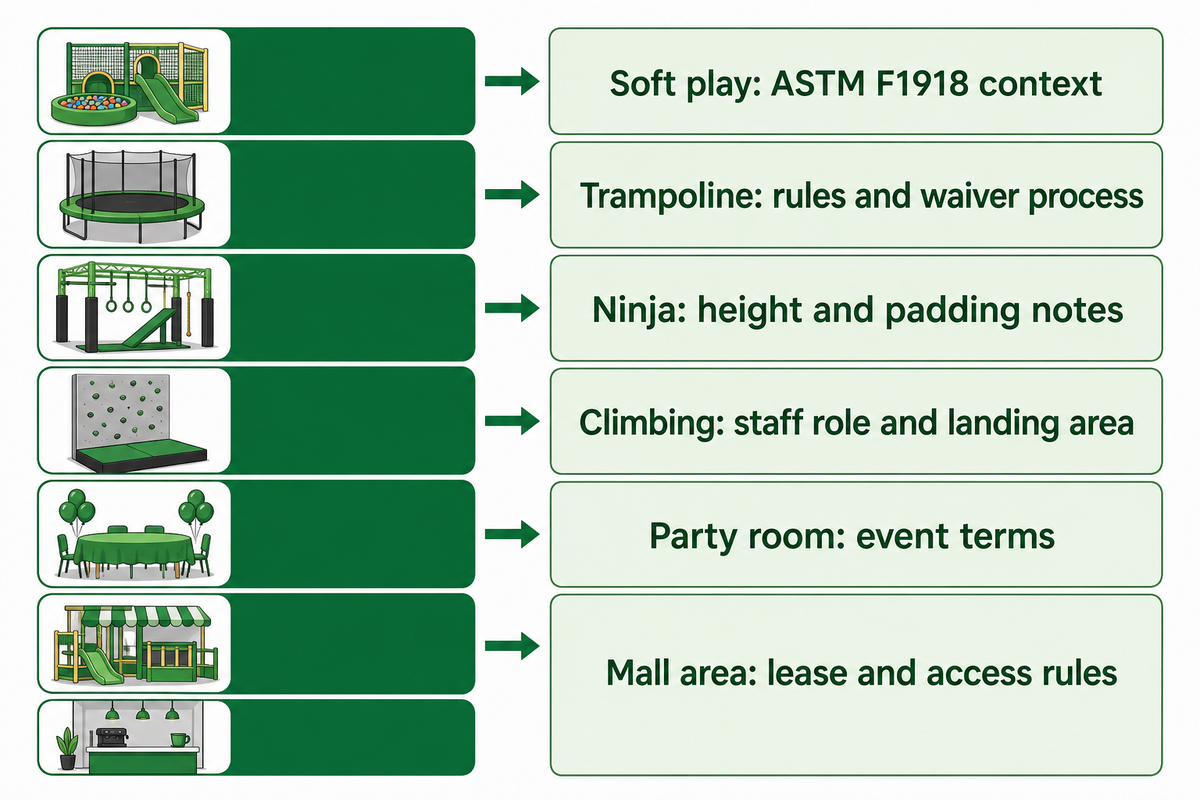
The Attraction-to-Policy Risk Matrix does not say one attraction automatically creates one policy. It shows which details usually change the insurance review. Brokers may ask about age separation, height, motion, supervision, waivers, maintenance, food service, mall lease terms, and whether the activity is named or excluded.
For soft contained play, ASTM F1918-21 public metadata lists section topics such as materials and manufacture, access and egress, structural integrity, maintenance, fire safety, and evacuation. The 2010 ADA Standards and the Access Board play area guide help frame play-area accessibility files, including Section 240 and Section 1008 context. Those sources help organize documentation. They are not insurance policy rules.
Attraction or zone
Risk details to describe
Insurance review question
File evidence to prepare
Soft contained play
Age range, tunnels, slides, ball pit, netting, access/egress
Is soft play insurance wording broad enough for the listed structure?
Is property, cyber, or crime exposure part of the package?
Asset list, payment system notes, CCTV policy
Mall play area
Open circulation, landlord rules, shared access, lease limits
Does the lease require higher coverage limits or additional insured wording?
Lease clause, floor plan, traffic-control plan
Cafe or snack area
Food handling, spills, allergy notes, seating
Does the policy include food-service operations?
Menu scope, cleaning log, local permit record
In some markets, a broker may use public liability insurance as the local label for visitor-facing liability, while U.S. buyers may hear Umbrella insurance as shorthand for an excess layer. For a shopping mall play area, family entertainment center insurance review, or mixed-attraction venue, keep risk management notes tied to the actual layout and operations. ASTM International, the Americans with Disabilities Act of 1990, and ADA play area guidance can support documentation, but they do not set the policy wording.
Because attraction names can hide different risk details, Dreamland Playground keeps drawings, age zones, equipment specs, and maintenance schedules in the same project file. That lets the broker compare soft contained play, trampoline, ninja, climbing, cafe, and mall-area exposure without treating the venue as one generic indoor playground.
If your project is inside a shopping mall, also review Dreamland’s mall entertainment zone guide for lease, traffic, and revenue-planning context. Mall rules can affect certificates, capacity, access routes, and opening-hours responsibilities.
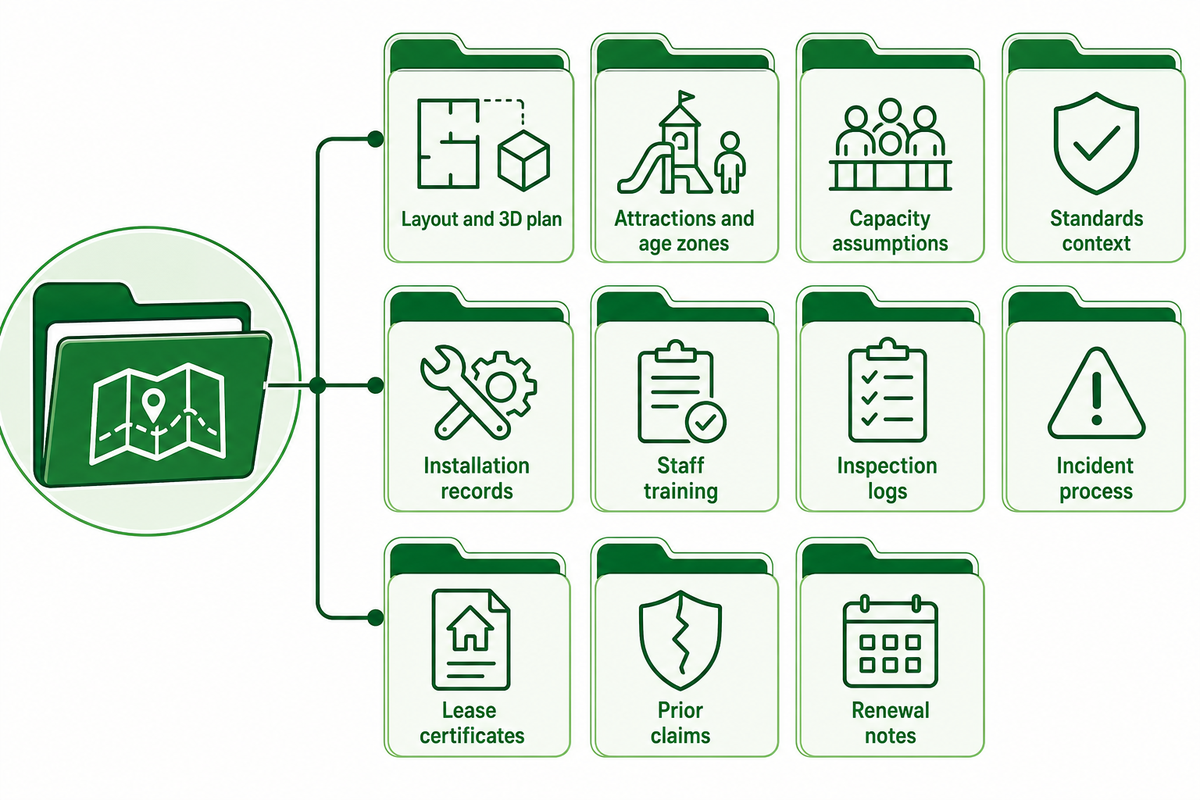
12-Folder Insurance Quote File Builder: documents to prepare before requesting quotes
The Insurance Quote File Builder turns your play project into a clean broker packet. It doesn’t replace a broker application, but it gives the underwriter a clearer view of the venue: layout, attractions, age zones, capacity assumptions, standards context, staff plan, inspections, maintenance, incident reporting, and lease requirements.
Project file note: For insurance purposes the floor plan is evidence, not decoration. It allows the broker to see which risks should be named in the quote request.
12-Folder Broker File Map
Use 12 folders before you request quotes. The exact format can be a PDF, shared drive, or broker portal upload, but the content should stay dated and versioned. If you later add a trampoline court, ninja lane, cafe, toddler zone, or larger party schedule, update the file before renewal instead of waiting for a claim.
Data field
Broker-file target format
Why the broker cares
Renewal lead time
60 days before renewal; 12 months of current records
Shows whether the file is current before policy review.
Incident intake
24 hours for first internal note; 7 days for file closeout
Shows how quickly facts are captured after an event.
Lease notice window
30 days for certificate changes; 90 days for renewal notice
Connects insurance timing to landlord obligations.
Record retention
2 years minimum file folder; 1 year quick-review folder
Helps the operator find logs during quote review.
Daily opening check
15 min walk-through; 4 hours maximum between spot checks
Shows that inspections are part of operations, not an afterthought.
Staff refresher cycle
3 months for supervisor review; 6 months for full team refresh
Shows how rules and incident steps are repeated.
Cleaning response
1 day cleaning log; 10 min spill-response target
Links housekeeping to slip-and-trip prevention.
Vendor certificate cycle
12 months standard certificate; 24 months long-term service file
Separates vendor risk from operator risk.
Change-order archive
5 years project archive; 30 days change-review target
Keeps layout and equipment changes tied to dated approvals.
Policy comparison note
Deductible options field and alternate deductible field
Gives the broker a clean place to compare quote options.
Party program review
10 days before launch; 20 days for vendor review
Flags new programs before guests arrive.
Capacity update
Whole-venue count field and zone-level count field
Separates whole-venue capacity from zone-specific operations.
These are planning fields, not legal requirements. Your broker may ask you to replace timing fields such as 24 hours, 48 hours, 72 hours, 7 days, 14 days, 30 days, 45 days, 60 days, 90 days, 2 weeks, 4 weeks, 6 weeks, 8 weeks, 12 months, or 1 year with the values in your lease, policy, and operating plan.
Floor plan with a three-dimensional overview that shows exits, playground space, party room areas, café areas, and staff supervision sightlines.
List of attractions, including soft play, trampoline, ninja course, climbing, inflatables, arcade, and mall-area specifics.
Age zones and height restrictions, including child-only separation, parent access, and any adult-access zones.
Target capacity assumptions by zone and by full venue.
Equipment notes: model number, materials used, and applicable standards such as ASTM F1918. Keep this as safety-standard context, not insurance approval.
Installation records, commissioning notes, change approvals, and handover documents.
Staff training plan, supervision rules, cleaning schedule, and opening / closing checklist.
Safety check program and log sheets based on the manufacturer’s guidelines when supplied.
Incident report form and escalation process if there’s an injury, complaint, equipment fault or ‘near miss’.
Waiver, party agreement, school/group visit form, and posted rule photos.
Prior loss or claim records, inspection records, and broker correspondence if the facility is already operational.
CPSC’s Public Playground Safety Handbook is not an insurance document, but the current 2025 handbook page is useful safety-file context for inspection, maintenance, surfacing, supervision, and manufacturer-instruction discipline. Dreamland’s underwriter document checklist can help turn these ideas into a practical pre-quote packet.
How Dreamland Playground can support your insurance preparation file
Dreamland Playground project documents connect back to the 12-folder broker file: Dreamland Playground can provide the project side of the file: space design, space planning, floor plan, 3D layout, custom product, attraction list, age-zone plan, shipping, on-site set-up, after-sales support. That support can improve the broker conversation, but it doesn’t control coverage.
Every project is different. Dreamland builds designs around the client’s space, target age group, local market, theme, budget, and business needs. A small children’s play area needs a different file from a large family entertainment center with trampoline, ninja, adventure, arcade, cafe, and mall lease obligations.
Dreamland has its own production team and quality-control process. Materials, structures, parts, surfaces, packaging, and other details can be checked during production. Products can be designed according to relevant EN and ASTM safety requirements, depending on product type and target market. Those records can help operators explain the project. They do not replace staff training, local permits, insurance review, or incident protocols.
The risk is a mismatch between the broker packet and the installed play space, because missing drawings, attraction lists, or dated change approvals can leave an application vague. Dreamland Playground has provided playground solutions for clients in more than 50 countries, but every file still needs local law, lease terms, and carrier forms checked by the operator’s licensed advisers.
Prepare your project file before the broker call
Provide your room dimensions, designed or actual, area-wide average target age, attraction list, planned ride types, budget range. Dreamland can organize to help prepare the playground layout and equipment documentation needed for a detailed insurance preparation packet.
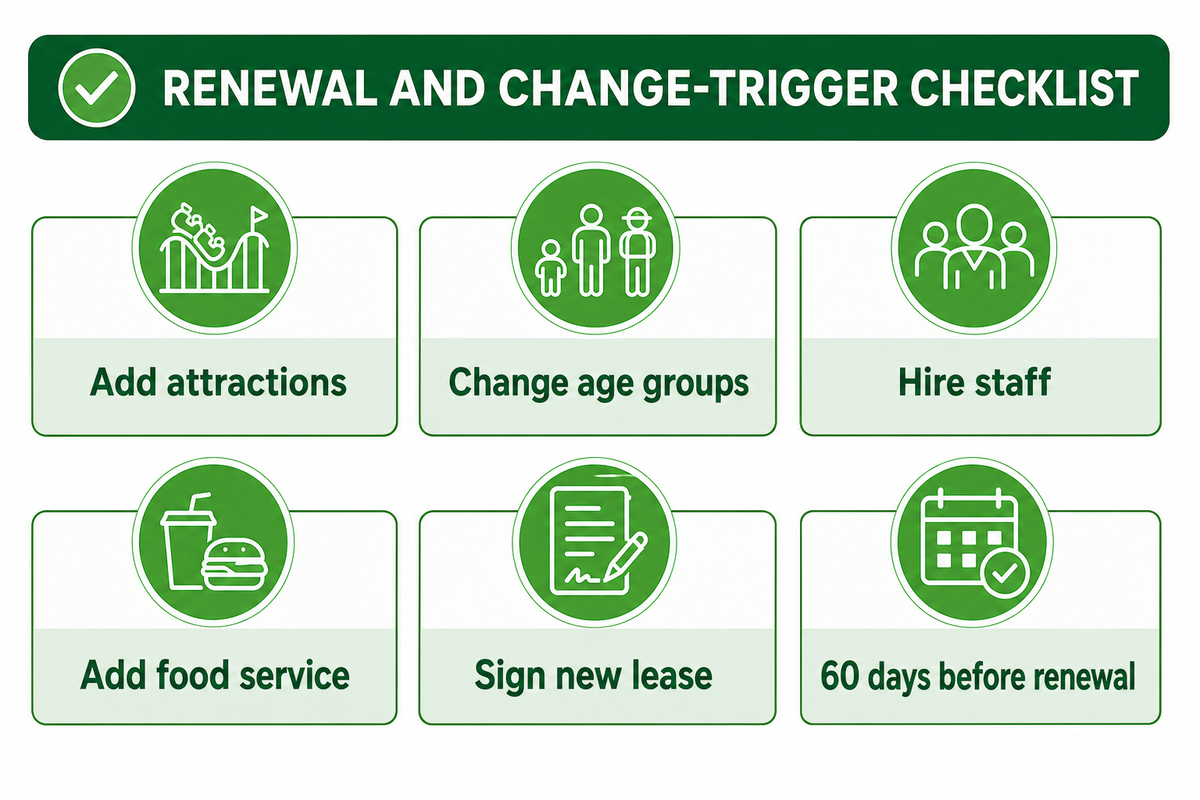
Audit your coverage before material changes, not just post-claim. New attractions, age-group changes, increase in staff, birthday-party operations, food service, lease changes, utilization increases, new vendors, reported incidents, or expansion into a large family entertainment center can alter the information needed by a broker.
Establish a renewal file date at least 60 days prior to policy renewal. Gather the current floor plan, attraction list, incident reports, inspection logs, maintenance records, lease requirements, staffed personnel counts, payroll projection, revenue changes, vendor certifications. If your operations changed mid-year or part-way through the year, consult with your broker to confirm whether the policy description and endorsements continue to be appropriate to the venue.
What kind of insurance do I need for an indoor playground?
Most companies start with general liability insurance, then add upon that, commercial property, workers compensation, umbrella or excess coverage, and any required endorsements. The right plan depends on the attractions, employment levels, lease arrangements, birthday parties, food service, waivers, prior claims, and local conditions. A licensed broker must verify what’s needed. Also provide the broker a written attraction list and existing floor plan before purchase.
Is general liability enough for an indoor playground?
Starting with general liability insurance makes sense; however, it often won’t be sufficient. It may not cover employee injury, property damage, abuse and molestation, automobile exposure, cyber risk, design professional liability, or higher limits. Know what the exclusions are, know where the gaps are, before opening. They can change with add-ons, new programs, contracts, or attractions.
What is umbrella liability insurance for an indoor playground?
Umbrella liability/ excess liability may provide excess limits above primary policies for catastrophic claims. It’s subject to existing limits, policy language, exclusions, and the carrier’s terms. It makes sense where a venue, landlord, school client, event contract, or attraction mix creates a high-limit or higher-limit expectation. Inquire if defense costs erode the limit, and what policies are to be underlying.
Does Dreamland Playground sell insurance?
No. Dreamland Playground is a commercial playground equipment manufacturer and provides project planning, design, production, shipping, and installation-support records. It sells no insurance, doesn’t act as a broker or carrier, doesn’t offer legal or professional-service advice, doesn’t authorize policies, doesn’t guarantee premium discounts, and doesn’t determine whether a carrier will accept an application. Use Dreamland project documents as the prep material for your licensed broker.
What documents do brokers usually ask for?
Brokers can request a floor plan, attraction list, age zones, staff plan, safety rules, inspection logs, incident procedures, lease requirements, prior claims, and equipment documentation. Dreamland can supply project-side layout, 3D design, equipment specifications, production documentation, shipping records, installation support files, and cleaner handover documentation. The operator remains responsible for staff training, local permits, claims reporting, and policy review.
How do trampoline or ninja attractions affect coverage?
Higher-movement attractions can prompt brokers to inquire more about supervision, height, age separation, rules, waivers, maintenance logs, staff training, injury history, and exclusion language. A few carriers may categorize trampoline park coverage, ninja courses, climbing, or adventure attractions in a different way than soft contained play. Is each attraction described to ensure it’s covered?
Do playground insurance requirements vary by state or country?
Yes. Local law, venue type, payroll, lease terms, school contracts, and carrier rules vary. Operators should verify requirements before opening, renewing, hiring staff, adding attractions, signing a lease, hosting school groups, serving food, or changing ownership. A rule that fits one state, country, mall, or franchise agreement may not fit another project. Before you copy a checklist from another operator, compare the venue type, age range, payroll status, square footage, lease certificate language, food-service scope, and attraction mix with your own project. Then ask local professionals to confirm the rule set. This extra check matters most for projects that combine toddlers, older children, party traffic, cafe service, mall foot traffic, and higher-motion attractions in one business model.
Keep related questions such as “How much does a one million USD liability insurance policy cost?”, “What permits does an indoor playground need?”, and “Is owning an indoor playground profitable?” separate from coverage advice: one is quote-specific, one is local permitting, and one belongs in the business plan.
Bottom line: liability insurance for indoor playground operations is a risk-description problem before it is a price problem. Build the file, define the attractions, separate claim triggers, and then ask licensed professionals to confirm policy wording.
Dreamland Playground publishes practical planning guides for commercial indoor-play projects, including family entertainment centers, shopping malls, hotels, restaurants, churches, and other venue types.
Use these guides to frame the questions that should be resolved before concept selection: venue size, intended age groups, project location, attraction mix, operating priorities, timeline, and delivery constraints. Final recommendations should be based on the real site and applicable local requirements.
Start With The VenueFloor area, clear height, site location, intended audience, and target opening date create the working brief.
Clarify The ScopeConcept, equipment, production, shipping, installation, and operating inputs can vary from one project to another.
PROJECT / VENUE / TIMELINE
Prepare Your Project Brief
Venue TypesFEC · Mall · Hotel · Restaurant · Church
Start WithFloor area · Clear height · Age groups · Country