Mall Playground Lease Guide is a business checklist for separating the rent structure from buildout duties, safety review, accessibility routes, insurance, operating rules, and the documents your playground supplier needs before design.
This article is a business planning guide, not legal, tax, insurance, or building-code advice. Ask a retail lease attorney, local code official, fire reviewer, insurer, and landlord construction team to review the final agreement for your site.
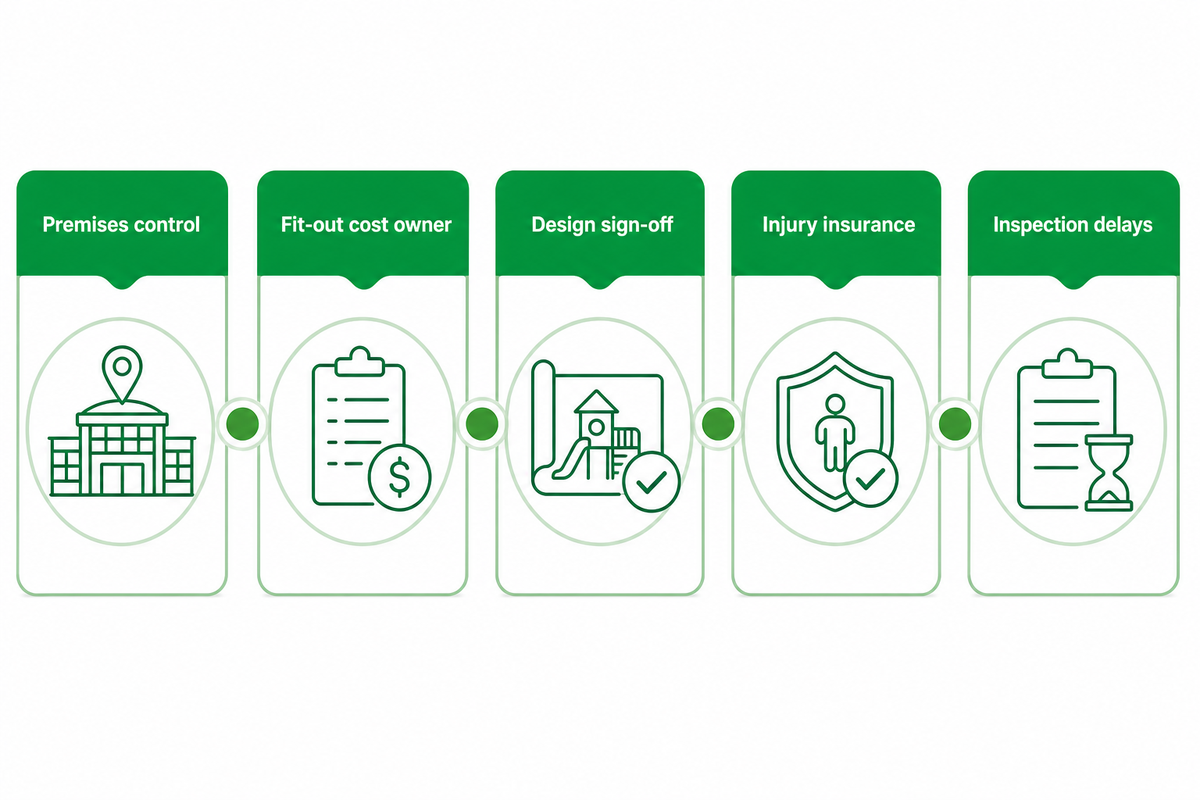
A mall playground lease is not just a standard space lease with playground equipment added later. It defines who controls the premises, who pays each fit-out cost, who signs off on the indoor playground, who carries injury-related insurance, who keeps incident records, and how inspections or landlord approvals can delay opening.
If there is an existing indoor playground, family entertainment center, soft play, trampoline park, ninja course, or children’s play court, use the lease to bridge the gap between the business plan and a physical interactive playground. The permitted-use language, retail-space boundary, common-area traffic, work letter, drawing approval, landlord design guidelines, signage, operating hours, utilities, janitorial and maintenance duties, and renewal options can make or break the plan.
A standard lease may cover space requirements, rent, term, permitted use, alterations, maintenance, expenses, insurance, transfer, defaults, and renewal options. A mall playground still needs more detail because small children are customers, the environment is interactive, and the project may affect common areas, fire review, structural conditions, noise, cleaning, and brand controls.
One important limit: a lease can assign tasks between landlord and tenant, but that assignment does not erase public-facing legal duties. In the United States, ADA Title III guidance explains that landlord and tenant allocation in a lease is effective between the parties, while both may still face ADA responsibility for a covered place of public accommodation. Treat every responsibility table in this article as a negotiation aid, not a shield against statutory, customer, regulator, or insurer claims.
Before the rent review, maintain a record of the operating model. Will the site be a free mall amenity, a ticketed indoor playcenter, a party venue, an FEC mix of attractions, or a branded playground within a larger entertainment complex?
That decision impacts revenue stream, staffing, liability insurance, cleaning, age-range management, posted regulations, emergency procedures, and the sort of commercial playground equipment that can be installed.
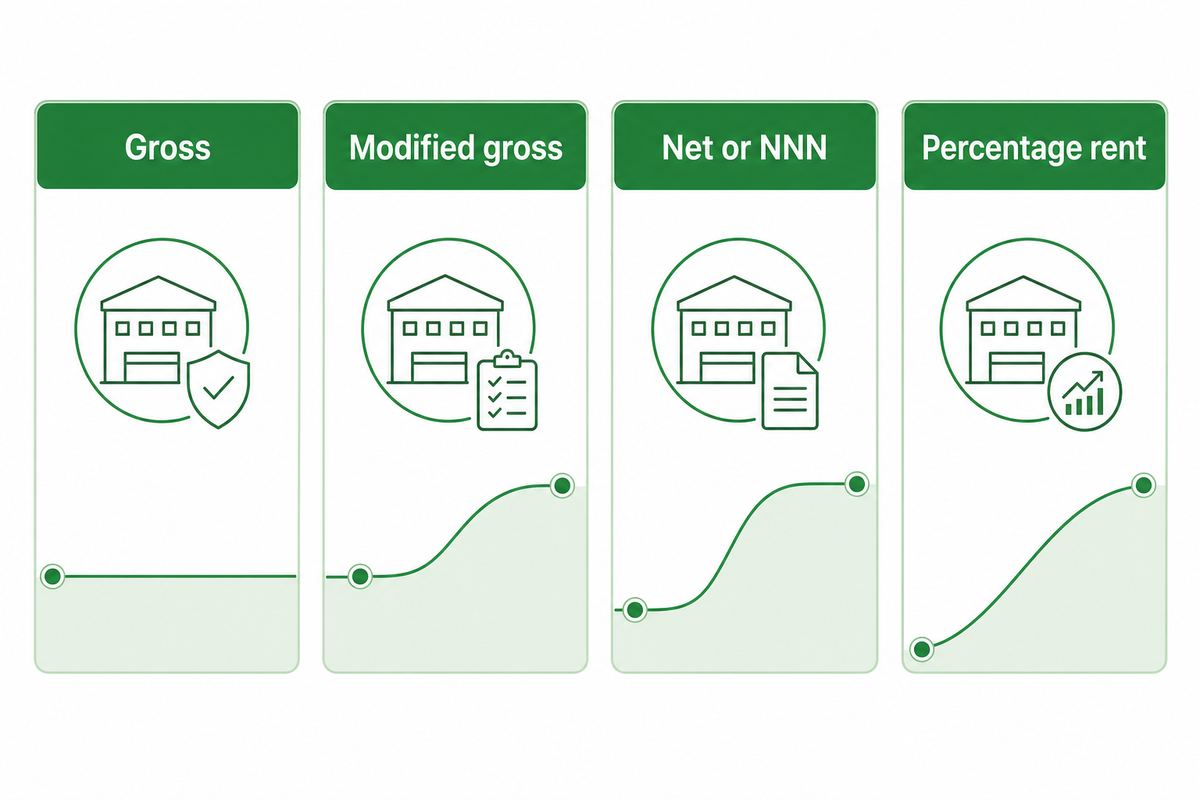
Gross rent, modified gross rent, net rent and percentage rent are not just categories. They determine the costs included in base rent and the costs handed down as pass-through charges. Public shopping-center lease exhibits show why base rent, tenant improvement contribution, insurance, common area costs, and expense caps need to be read together. A mall playground tenant should ask about taxes, insurance, CAM, utilities, security, trash, HVAC, promotion dollars, repairs, and any percentage rent based on gross receipts.
This guide does not publish a universal mall playground rent range. None of the publicly available evidence was sufficient to establish a single L1 or L2 playground-specific rent benchmark that could be applied reliably across the 50 U.S. cities, all mall types, all unit sizes, and all business models. Use commercial lease type vocabulary only as a starting point, then compare local broker comps, landlord offers, tenant sales projections, and attorney review.
Lease Type
What It Usually Means
Playground Question
Risk If Vague
Gross
Base rent includes many operating costs.
Which items are excluded or separately billed?
A “simple” rent figure may still have carve-outs.
Modified gross
Some costs are included, others pass through.
Who pays utilities, security, HVAC, and trash?
Budget surprises when the split is not written.
Net or NNN
Tenant pays rent plus taxes, insurance, and maintenance items.
How are CAM, insurance, and common-area shares calculated?
The base rent looks lower than total occupancy cost.
Percentage rent
Tenant pays a sales-linked rent above an agreed breakpoint or formula.
What sales count, what exclusions apply, and how are party deposits treated?
Revenue reporting or party-package accounting becomes a dispute.
How much to rent a space in the mall per month?
The reasonable answer depends on the mall, city, unit size, traffic, tenant mix, landlord contribution, lease term, guarantee, and whether the offer includes percentage rent. Ask for a written rent proposal and CAM history, then compare it with local retail comps and your indoor playground business plan. For a high-buildout play project, lease term and tenant improvement allowance can matter as much as monthly rent, especially when approvals delay opening. That is why rent belongs beside buildout timing and approvals.
For a brand-new playground, separate rent from cash timing. A tenant may need to pay a security deposit, design deposit, first insurance policy, permit fees, shipment balance, customs fees, and installation charges before the first ticket is sold. A lower rent offer can still hurt cash flow if free-rent is too short or the landlord allowance is reimbursed only after work is complete. Ask your accountant to model base rent, pass-through costs, buildout cash, equipment financing, staff hiring, and opening marketing expenses in the same monthly forecast.
If the landlord mentions percentage rent, agree upon specific account definitions prior to negotiating. Deposits for kids, Birthday-party deposits, returns, gift certificates, online ordering fees, sales of food or merchandise (including socks), memberships, collected taxes, and third-party commissions all need consideration for the impact they could have on gross revenues. The month-by-month ramp-up assumptions should also be separated from mature sales. Check the lease clause that covers report delivery requirements, potential inspection of financial accounts, and what is permissible if your indoor play business changes direction mid-lease.
The Playground-Specific Clause Map
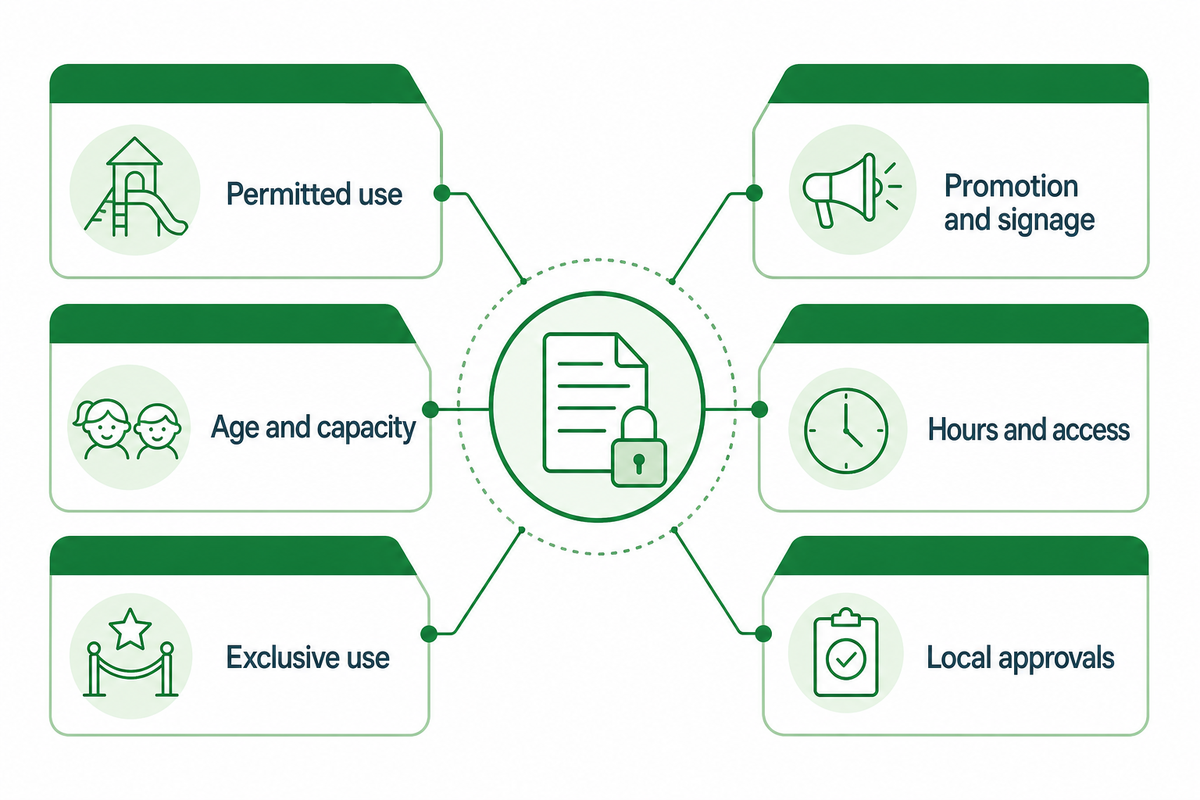
A typical storefront lease may not address the particulars of a commercial indoor playground. Create a clause map before attorney review so the lease will encompass the important business information. Retail lease explainers list common terms such as premises, rent, permitted use, improvements, maintenance, insurance, assignment, default, and renewal, while filed shopping-center lease exhibits show how those terms can connect to opening obligations and construction economics. The purpose here is not to draft the lease; it is to identify missing subject matter before the lease agreement becomes too advanced.
The permitted use should be specific: indoor playground, soft play, family entertainment center, party room, trampoline, obstacle course, daycare-adjacent activities, caregiver-related use, food service, retail add-ons, temporary attractions, and any excluded activities.
Age and capacity: target age group, posted maximum age or height limits, room capacity, party-room limits, caregiver rules, and staff-to-child supervision expectations.
Exclusive use: ask whether another tenant may open a competing play zone, arcade, trampoline park, kids fun center, FEC, or party venue in the same mall.
Promotion and signage: define storefront signs, wayfinding signs, directory listings, shopping-center digital boards, center marketing, and party-related promotions.
Hours and access: agree on mall hours, early build out, after-hours cleaning, event-hour access, emergency access, birthday-party access, and delivery routes.
Services and HVAC: outline electrical capacity, air-conditioning loads, internet, water, waste, and which party incurs costs for upgrades.
Sound levels and neighboring tenants: set sound benchmarks, complaint resolution, rules on party music, and cure periods.
Storage/back-of-house: cover shoes, lockers, strollers, event supplies, spares, cleaning gear, and service access.
Relocation: where the landlord has the right to move the tenant, clarify who pays for moving equipment, reinstallation, repairs, downtime, new approvals, etc.
Local approvals: require zoning/use approval, occupancy classification, fire review, occupant load, certificate-of-occupancy, and any landlord fit-out guide as explicit milestones.
CAM language requires particular scrutiny. Retail lease commentary often notes that caps, exclusions, pooling, admin fees, tenant’s share, and audit rights all must be carefully drafted. A mall playground may use public corridors, stroller parking, queue lines, restrooms, waste areas, and security more extensively than a quiet store, so do not take pass-through arrangements for granted until you have examined the substance.
Another key provision is landlord control over the tenant’s alterations. Playplace equipment may seem modular, but the project can still require flooring, wiring, safety padding, wall graphics, lighting, counters, fences, shoe storage, party room walls, and anchoring. Requiring every modification to receive approval can delay repairs and seasonal updates. On the other hand, permitting too much leeway could let a new attraction interfere with lease provisions, insurance coverage, or local review later. A better lease specifies which drawings require approval, the approver’s response timeline, and the distinction between maintenance and material change.
Another feature to review is the landlord’s right to move the tenant. At a shopping mall, a landlord may want flexibility to relocate tenants after an anchor-tenant change or wing renovation. For a mall playground, relocation can be far more costly than moving shelves. The clause should address disassembly, new drawings, delivery crews, downtime, post-move reinspection, signage, grand-opening promotion, and rent abatement.
Buildout, Work Letter, and Opening Timeline
The work letter is where a playground concept begins to take shape as a building. It should identify who supplies the shell, who pays for improvements, who finalizes drawings, who owns installed items, who restores the premises, and how delays affect opening.
Actual retail lease exhibits can include base rent, commencement obligations, tenant improvement contribution, insurance, CAM costs, and expense-cap language. These provisions are a reminder that the lease must connect commercial arrangements to construction arrangements. You should not adopt a published exhibit as your contractual form; every shopping center and jurisdiction has its own peculiarities.
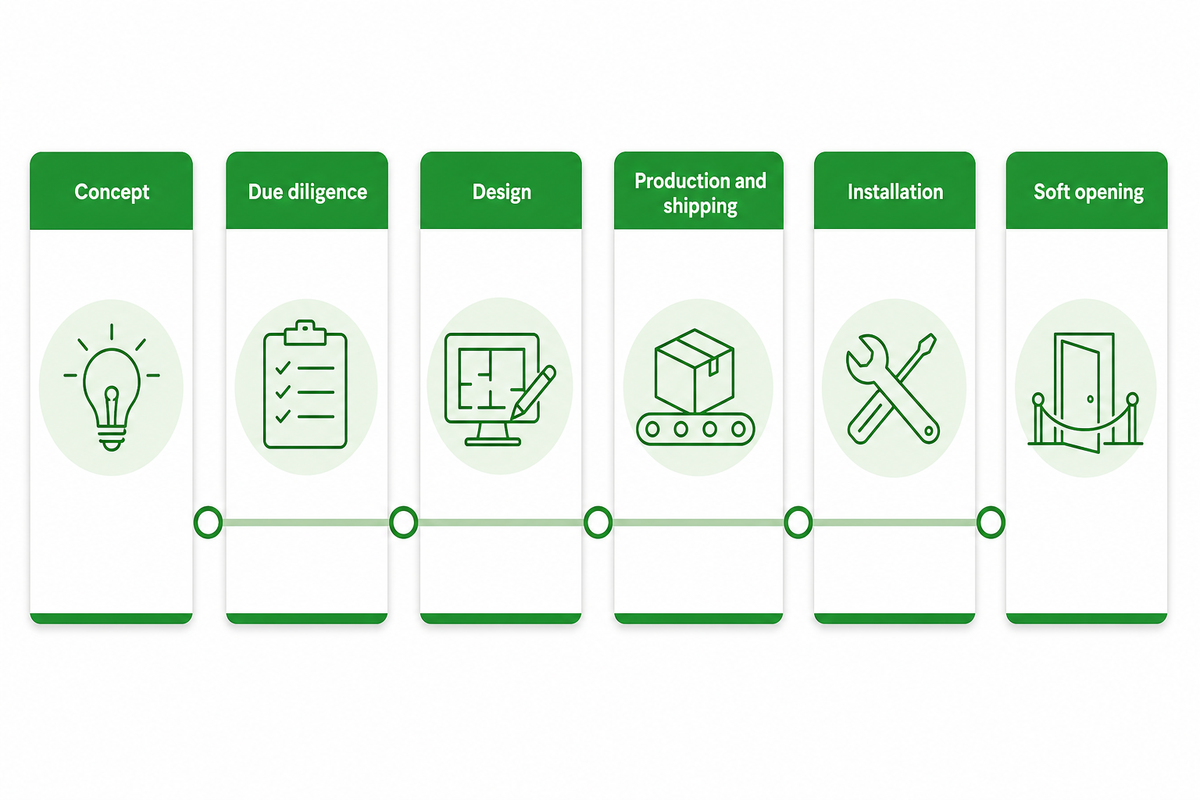
Stage
Lease Question
Playground Input Needed
Concept
Is the use allowed in this unit?
Target age, play format, ticketing, parties, and staffing plan.
Due diligence
What approvals are required before signing or opening?
Zoning/use, occupancy, fire, accessibility, insurance, and landlord guide checklist.
Design
Who approves layout, materials, colors, signs, and routes?
Floor plan, 3D design, equipment list, circulation, emergency exits, and queue plan.
Production and shipping
When does rent start if equipment is delayed?
Production schedule, packaging size, shipping route, customs plan, and delivery dock access.
Installation
Who controls site access, after-hours work, and landlord inspection?
Can I test a mall indoor playground with a temporary or pop-up installation first?
Optional but worth careful reading are provisions covering, but not limited to, what uses, configurations, power, fire access, insurance and rules the landlord and authorities will permit. A pop-up shop can seem less complex than a permanent shop, but it still needs safe paths of ingress/egress, age limits, sanitary procedures, adult supervision standards and accident protocols. Discuss whether a pop-up can transition into a long-term lease and whether it involves restoration/removal obligations.
Large projects also need opening-date protection. Lease signing is only one milestone; play equipment production, ocean freight, customs clearance, mall delivery appointments, on-site installation, and staff training all move on their own timelines. If rent starts on a fixed date before opening is delayed by landlord review, fire department comments, or certificate-of-occupancy timing, cash can be consumed for months before income begins. Ask who drives drawings, what decision triggers production, which approval triggers rent, and how each party’s delay is treated.
Plan removal before signature. Some indoor playground elements come out cleanly, while others affect ceilings, walls, floors, or mechanical systems. The lease should say whether the landlord can require removal, whether pre-approved improvements may remain, and how patching, repainting, floor replacement, and removal costs are allocated.
Safety, Accessibility, Insurance, and Inspection Responsibilities
This section needs the cleanest scope control in the whole mall playground lease guide. Do not merge safety, accessibility, insurance, play-space operating rules, and local permits into one vague “compliance” clause. Each topic may have a different reviewer, source, cost owner, and update cycle.
Accessibility planning needs a named owner. The U.S. Access Board play-area guide offers useful questions for public play areas, soft-contained play elements, and accessible routes. The guide is not a substitute for local expert review, but it helps the lease define who checks accessible pathways to the unit, verifies the play entrance, reviews nearby restrooms and routes, and pays for corrections.
ASTM F1918 is relevant to soft-contained play equipment safety scope. It should not be used as a stand-alone answer for ADA, fire, occupancy, building-code, or lease-allocation questions. If your attraction mix includes trampolines, ninja courses, climbing elements, inflatables, or other play structures, classify each equipment type before assigning standards and inspection routines.
Safety guidance can also change. The CPSC announced final updates to its Public Playground Safety Handbook in a 2025 Federal Register notice, which is a reminder to check current versions and source scope instead of reusing old checklist language.
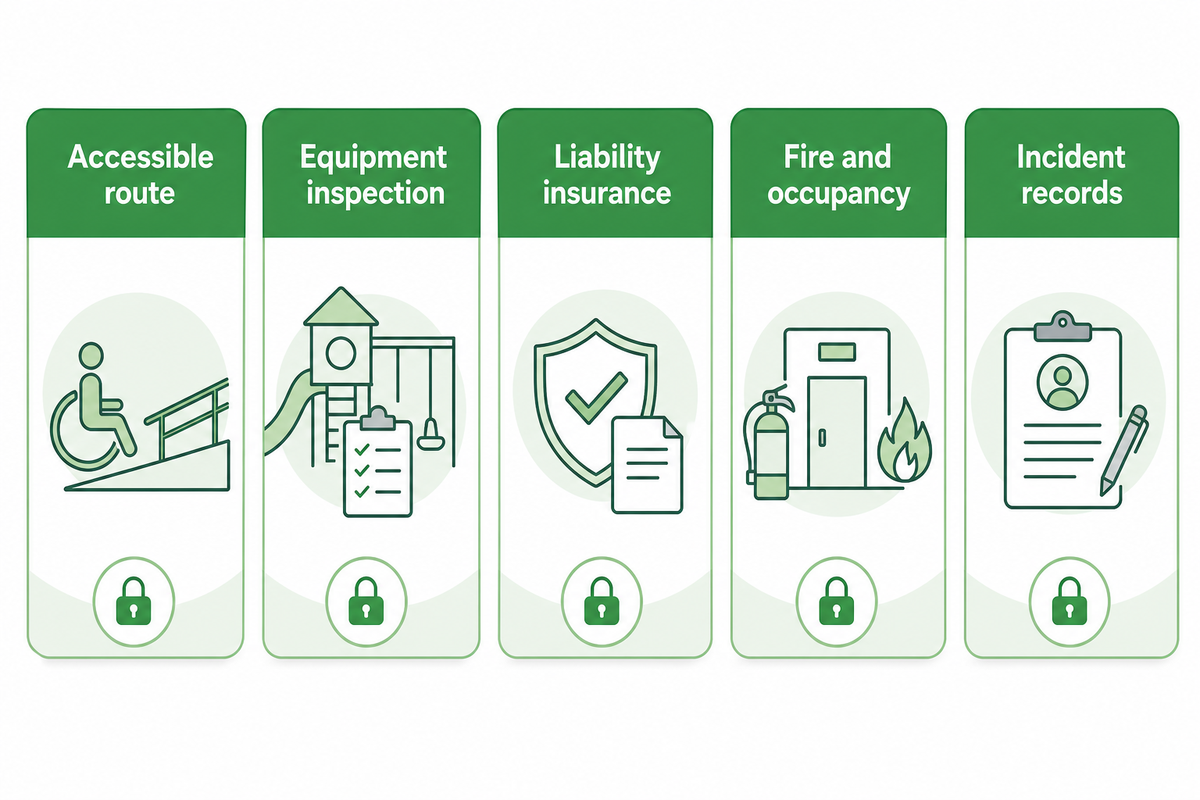
Topic
Ask Who Owns It
Reviewer
Document to Request
Accessible route
Landlord, tenant, or shared
Accessibility consultant/local official
Route plan and responsibility note
Equipment inspection
Operator or qualified service party
Supplier/inspector/insurer
Inspection checklist and frequency
Liability insurance
Tenant, landlord additional insured, or both
Insurance broker
Certificate, exclusions, claim procedure
Fire and occupancy
Project-specific
Local code/fire official
Occupant-load and approval record
Incident records
Operator, with reporting to landlord if required
Attorney/insurer
Incident log and notice process
What permits are needed for an indoor playground?
Permit needs vary by jurisdiction and project type. Ask about business registration, permitted use, change of use, occupancy classification, building permit, fire review, sign permit, food-service approval if relevant, and certificate of occupancy. Do not assume a former retail store can open as an indoor playground without local review.
What kind of insurance do you need for an indoor playground?
Ask a broker who understands children’s play, commercial indoor playground equipment, party events, and premises liability. Review general liability, umbrella coverage, property coverage, workers’ compensation, product/equipment issues, additional insured language, exclusions, deductibles, incident notice, and whether activities such as trampolines or obstacle courses change underwriting.
Equipment type also changes risk. Insurers and municipal reviewers may treat a soft play structure, trampoline, climbing wall, ninja course, inflatable structure, arcade area, toddler zone, or daycare-style room differently. Before final signature, prepare a one-page risk sheet for each attraction, with age or height requirements, supervision structure, use policies, and maintenance procedures. Share it with the insurer, attorney, landlord, and equipment supplier so the lease does not define the project more narrowly than the play area you plan to operate.
Incident records cannot be treated as paperwork only; they are part of the operating system. Confirm the lease notice requirements to the landlord and the insurer’s notice requirements. Decide where incidents are recorded, which photos or witness notes are saved, how cleaning or temporary closures are documented, who can access records, and when supplier maintenance notes should be added.
The Lease Risk-to-Owner Matrix is a practical review tool for a shopping mall play area. It helps an owner, investor, or operator ask the right questions before the attorney drafts or negotiates final language. Use it alongside source documents such as ADA Title III landlord-tenant allocation guidance and public shopping-center lease exhibits. It does not replace the attorney, insurer, code official, or landlord construction team.
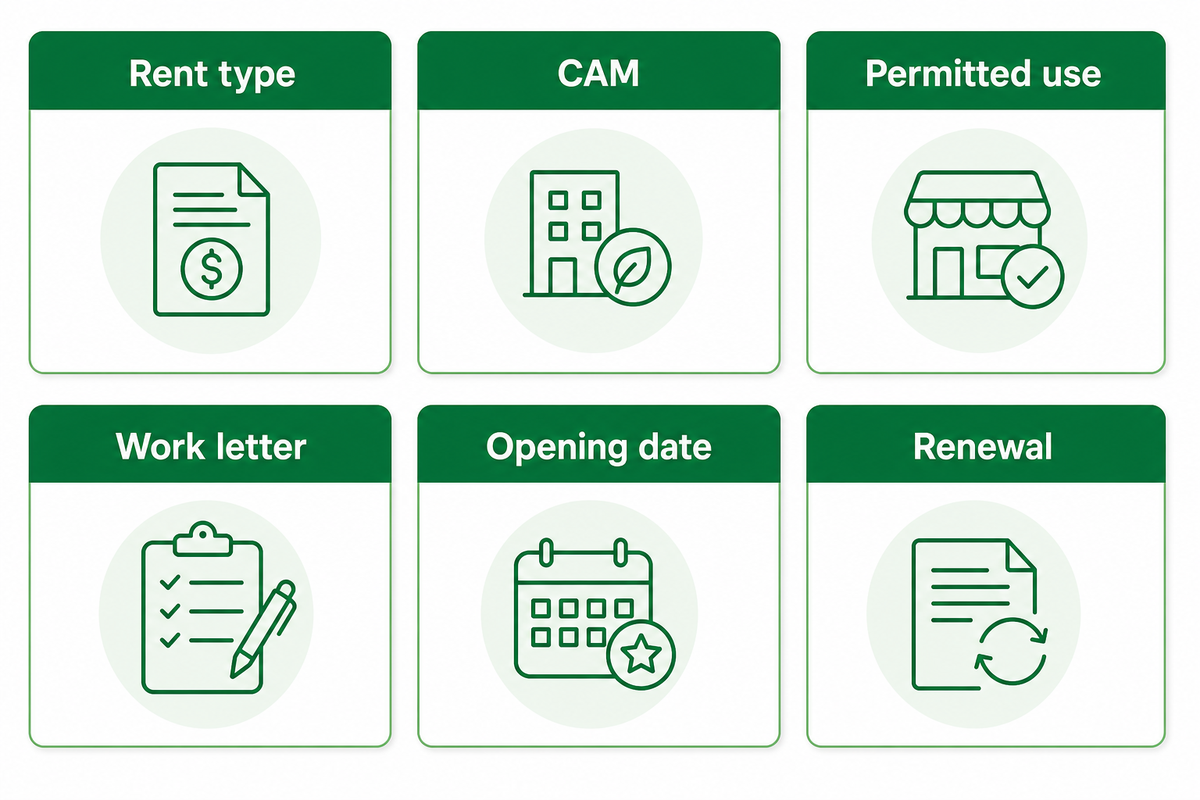
Term Type
Risk If Vague
Negotiation Ask
Reviewer
Rent type
Total occupancy cost is unclear.
Define base rent, pass-throughs, and sales-linked formulas.
Attorney/accountant
CAM
Uncapped or poorly defined costs.
Ask for exclusions, caps, true-up, and audit rights.
Attorney/accountant
Permitted use
Parties, food, trampoline, or daycare-like use may be disputed.
List attraction types and excluded uses.
Attorney/landlord
Exclusivity
Another tenant can copy the play model.
Define protected categories and exceptions.
Attorney
Signage
Families cannot find the site.
Secure storefront, directory, wayfinding, and event signage rights.
Landlord/brand team
Work letter
Design and approval costs shift late.
Tie allowance, approvals, shell condition, and handover dates to drawings.
Attorney/project manager
Opening date
Rent starts before approvals or installation finish.
Define rent commencement, force delays, cure periods, and soft opening.
Attorney/landlord
Maintenance
Equipment or flooring care is underfunded.
Set inspection, cleaning, repair, and replacement duties.
Supplier/insurer
Insurance
Activities may be excluded.
Confirm covered activities, additional insured, and notice rules.
Broker/attorney
Accessibility and code
Lease allocation is mistaken for public compliance.
Assign review steps, correction costs, and documentation duties.
Code/accessibility reviewer
Renewal
Payback period and lease term do not match.
Ask for option periods and clear rent-setting method.
Attorney/accountant
Assignment
Exit, franchise, or sale plan is blocked.
Define consent, buyer qualifications, brand transfer, and fees.
Attorney
Review the LOI if possible. If you need to sign a letter of intent, use the matrix before commercial terms feel locked. A short phrase such as “tenant to build indoor playground” can leave your lawyer negotiating later over what kind of work is permitted, who approves it, who pays for it, and when rent starts.
Similarly, if equipment financing is being sought and the real-estate lease structure is problematic, equipment financing will not protect the investment by itself. Competitive loan terms will not help if relocation, short lease term, or limited use can disrupt operations. Examine the premises lease first; then make an equipment purchase, equipment financing, or staged investment decision.
The values listed below are not rent or revenue benchmarks. They are example fields to replace with your own data before sign-off by a lawyer, landlord, supplier, insurer, or code reviewer.
If your attorney wants placeholder thresholds for review, keep them visibly marked as examples: landlord drawing response within 14 days, permit contingency review within 21 days, production buffer of 45 days, repair escalation within 72 hours, renewal notice at 180 days, first-year review after 12 months, signage review within 7 days, and cleaning-record retention for 30 days can all be changed before signature.
Parameter Type
Example Field to Confirm
Who Confirms It
Space
Leased area such as 200 m² and usable play area such as 150 m².
Landlord/designer
Height
Clear ceiling such as 3.5 m and lowest beam such as 3200 mm.
Landlord/designer
Access
Delivery door width such as 2400 mm and delivery window such as 12 hours.
Landlord/project manager
Power
Available load such as 15 kW and added circuit review within 10 days.
Electrician/landlord
Approval
Landlord drawing response within 10 days and permit response within 5 days.
Landlord/attorney
Fit-out
Rent-free fit-out period such as 30 days and opening cure period such as 15 days.
Attorney/accountant
Safety
Inspection interval such as 30 days and incident notice such as 24 hours.
Insurer/operator
Schedule
Production buffer such as 45 days and shipping buffer such as 20 days.
Supplier/logistics
Finance
Sales report deadline such as 10 days after month-end and CAM audit window such as 90 days.
Accountant/attorney
Queue
Stroller or queue lane such as 1200 mm and party turnover such as 90 min.
Designer/operator
Flooring
Sample flooring thickness such as 40 mm and route check such as 1 m.
Supplier/reviewer
Storage
Spare-parts storage such as 2 m² and maintenance access such as 24 hours.
Operator/landlord
Signage
Directory sign size such as 1 m and landlord approval such as 7 days.
Landlord/brand team
Cleaning
Daily reset such as 2 hours and deep-clean record such as 30 days.
Operator/insurer
Training
Opening staff session such as 4 hours and refresher interval such as 1 year.
Operator/supplier
Repair
Repair response such as 48 hours and parts escalation such as 72 hours.
Operator/supplier
Renewal
Option notice such as 6 months and renewal term such as 3 years.
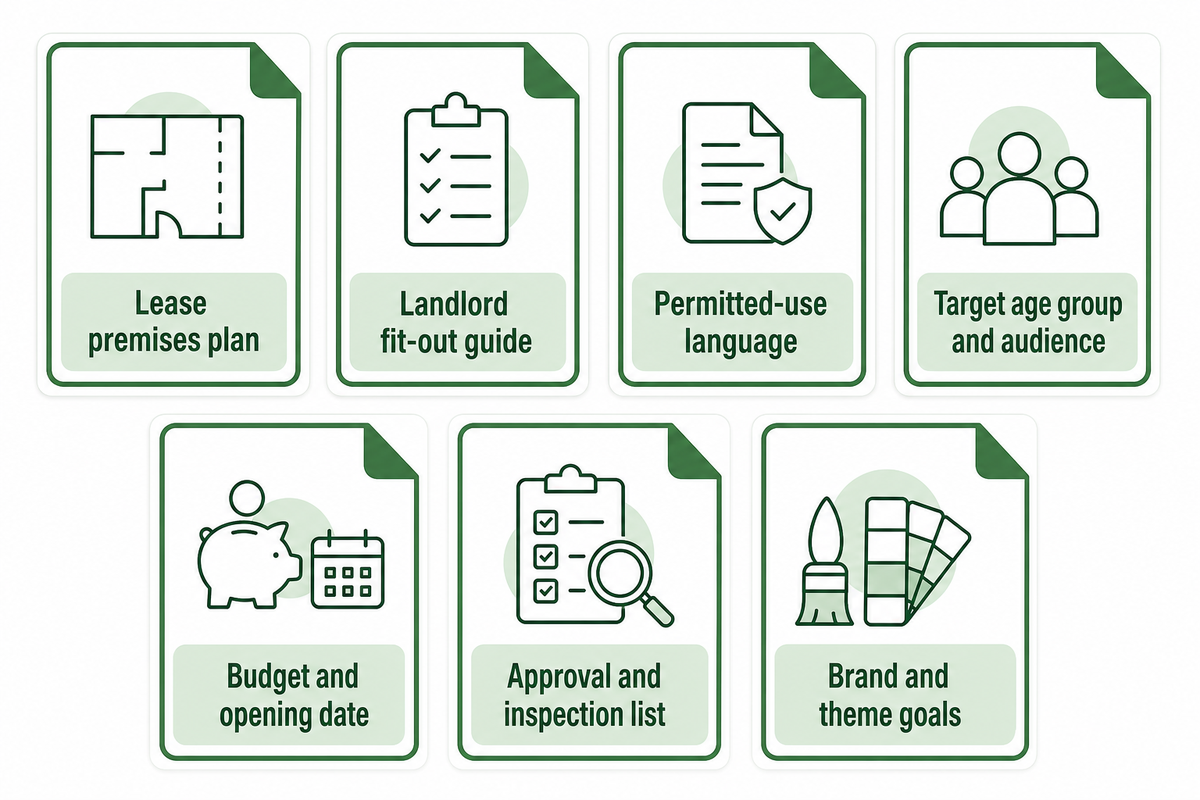
The Lease-to-Layout Handover Pack is where the lease links to play design. The supplier cannot design the right equipment from square footage alone; it needs business objectives, target age group, local market, theme, budget, ceiling height, columns, exits, landlord provisions, power, HVAC, accessible aisles, and inspection expectations. For example, play-area accessibility guidance and equipment-scope standards such as ASTM F1918 should be translated into project questions before the layout is frozen.
Dreamland Playground supports clients from the first idea to final installation, including space planning, floor plan design, 3D design, equipment production, shipping, installation support, and after-sales service. For a shopping mall play area, that process works better when the tenant shares lease constraints, landlord design rules, delivery access, approval comments, target age group, budget, and opening schedule before the final indoor playground design is approved. Dreamland’s mall entertainment zone page can also help frame the project scope before design.
Document or Fact
Why Dreamland Needs It
Lease premises plan
Confirms boundaries, columns, storefront, exits, and back-of-house limits.
Landlord fit-out guide
Shows material, color, signage, ceiling, and review rules.
Permitted-use language
Keeps play equipment, parties, retail, and attractions aligned with the lease.
Keeps design, production, shipping, and installation within budget and schedule.
Approval and inspection list
Helps prepare drawings and records for landlord, code, fire, and insurer review.
Brand and theme goals
Connects the play space to the mall’s family experience and business needs.
Dreamland has its own production team and quality control process. Materials, structures, parts, surfaces, packaging, and production details can be checked during the project. For each product type and target market, Dreamland can design equipment around relevant EN and ASTM safety requirements, while the final site still needs the local approvals and professional reviews described in the lease.
A useful handover pack also reduces redesign. For example, if the landlord later rejects a sign, requests a different storefront opening, limits ceiling attachments, or changes the common-area entrance, the playground layout may need adjustment. When Dreamland receives the lease plan, landlord guide, approval comments, and business targets early, the team can design play structures, soft play equipment, toddler zones, party rooms, and circulation around those constraints instead of correcting them after production starts.
For investors working across more than one shopping mall, keep the handover pack in a repeatable folder. Each location should have its own floor plan, lease clauses, permit notes, insurer comments, target audience, theme direction, equipment budget, and opening schedule. That makes it easier to compare locations and decide which mall is ready for a full indoor playground and which one should start with a smaller children’s play area.
Retail real estate trend analysis and location-based entertainment reports are part of many mall repositioning discussions, but broad market reports do not prove that a specific mall playground has stronger bargaining power. Treat the 2026 context as a due-diligence checklist, not a rent forecast. Public small-business counseling resources are also useful when lease decisions, financing, and facility planning overlap.
Ask the landlord for property-level evidence: current vacancy, anchor changes, family traffic, tenant mix, nearby schools or hotels, weekday versus weekend pattern, planned mall events, contribution budget, co-tenancy issues, and whether the mall wants a family entertainment center, free children’s play amenity, or paid indoor play business.
A mall play area can add value when it fits the property’s family draw and when the lease, buildout, operator staffing, and play equipment all support the same business goal. It’s weaker when the space has poor visibility, difficult approvals, unrealistic rent, no common-area support, or a landlord who treats the playground like a normal quiet retail shop.
Turn that context into negotiation questions. If the mall wants more families, ask whether it will support wayfinding, directory placement, event marketing, birthday-party pickup rules, stroller parking, and common-area queue control. If the landlord wants to fill a difficult unit, ask whether a tenant improvement allowance, phased rent start, or shorter pilot term is available. If the mall is already strong, expect the landlord to care more about tenant quality, brand fit, operating discipline, and guarantees than broad industry trends.
For more project-planning context, review Dreamland’s mall entertainment zone solutions and prepare the Lease-to-Layout Handover Pack before final design.
Mall Playground Lease FAQ
Is this article a mall playground lease agreement template?
No. It is a negotiation guide and review checklist, not a copy-paste legal template or mall playground lease agreement form. Use it to prepare retail space questions for your attorney, landlord, insurer, code official, and playground supplier. For broader project context, check out our guide to mall entertainment zone planning, then adapt the questions to your site, budget, operating model, and local approval process before anyone signs. Keep the checklist separate from the agreement your attorney drafts for signature.
Should a mall playground tenant choose gross rent or net rent?
Choose after comparing total occupancy cost and upfront costs, not just base rent. Ask which taxes, insurance, CAM, utilities, maintenance, security, and marketing charges are included or excluded, and model how each rent structure affects cash before opening day and renewal.
What should be included in a mall playground permitted-use clause?
Name the indoor playground format, age group, attractions, party use, retail add-ons, food service if any, hours, events, and excluded activities. This helps the playground company design the right equipment and helps the landlord understand whether the site is an indoor play area, indoor play center, or larger concept tied to the indoor playground business plan and playground design.
Who is responsible for playground safety inspections in a mall lease?
The lease should say who performs inspections, how often they happen, which checklist is used, who keeps records, who pays repairs, and when the landlord or insurer must receive notice. Final duties depend on the lease, law, insurer, and local review.
Can a mall test a temporary play area before signing a long lease?
Possibly, but the temporary plan still needs use approval, safe routing, insurance, staff supervision, cleaning, and clear removal duties. Ask whether temporary approvals can support a longer lease later, and confirm whether the test installation creates restoration costs or landlord approval conditions.
Should I lease or buy playground equipment for a mall project?
Equipment leasing is separate from the real-estate lease. Leasing equipment may reduce upfront costs, while buying may give more control and long-term ownership. When you compare leasing or buying, review competitive financing options, tax laws, maintenance duties, customization limits, and the length of the mall lease before deciding.
When should I contact a playground supplier during lease negotiation?
Contact the supplier before final lease language if possible. Early input on space needs, ceiling height, layout, safety flooring, access, shipping, installation, and inspection documents can prevent expensive redesign later. Dreamland can review the lease-to-layout handover pack for a mall entertainment zone before production starts.
Which search terms should I research before I start an indoor playground?
Before startup, owners often search “how much does it cost,” “how much to invest,” “open an indoor playground,” “building an indoor playground,” and “indoor playground for your business.” Use those questions to compare playground leasing, leasing offers, equipment financing, saving money claims, and whether you can pay for it over time. Then check the lease, not only the lender’s high approval rates.
For new retail projects, ask whether the site can attract more visitors, whether the indoor playground industry fit is local, and whether the landlord will let the supplier install your playground on the needed schedule. Keep helpful resources, frequently asked questions, and your expert team notes in one folder. An indoor playground is a great concept only when the lease, permits, playground installation, operating plan, and supplier handover all match.
Plan the Lease Before You Freeze the Layout
Dreamland Playground can help turn your mall entertainment zone lease constraints into a practical floor plan, 3D design, equipment production plan, shipping schedule, and installation support checklist.
Dreamland Playground publishes practical planning guides for commercial indoor-play projects, including family entertainment centers, shopping malls, hotels, restaurants, churches, and other venue types.
Use these guides to frame the questions that should be resolved before concept selection: venue size, intended age groups, project location, attraction mix, operating priorities, timeline, and delivery constraints. Final recommendations should be based on the real site and applicable local requirements.
Start With The VenueFloor area, clear height, site location, intended audience, and target opening date create the working brief.
Clarify The ScopeConcept, equipment, production, shipping, installation, and operating inputs can vary from one project to another.
PROJECT / VENUE / TIMELINE
Prepare Your Project Brief
Venue TypesFEC · Mall · Hotel · Restaurant · Church
Start WithFloor area · Clear height · Age groups · Country