Get in touch with Dreamland Playground Company

Business planning guide
An arcade business plan works well when any number in it can be pulled back to a visit, a square foot, a machine, a fixed cost or a cash decision. Try this test to see if it is right for you before you sign a lease or order a machine.
What an arcade business plan must prove
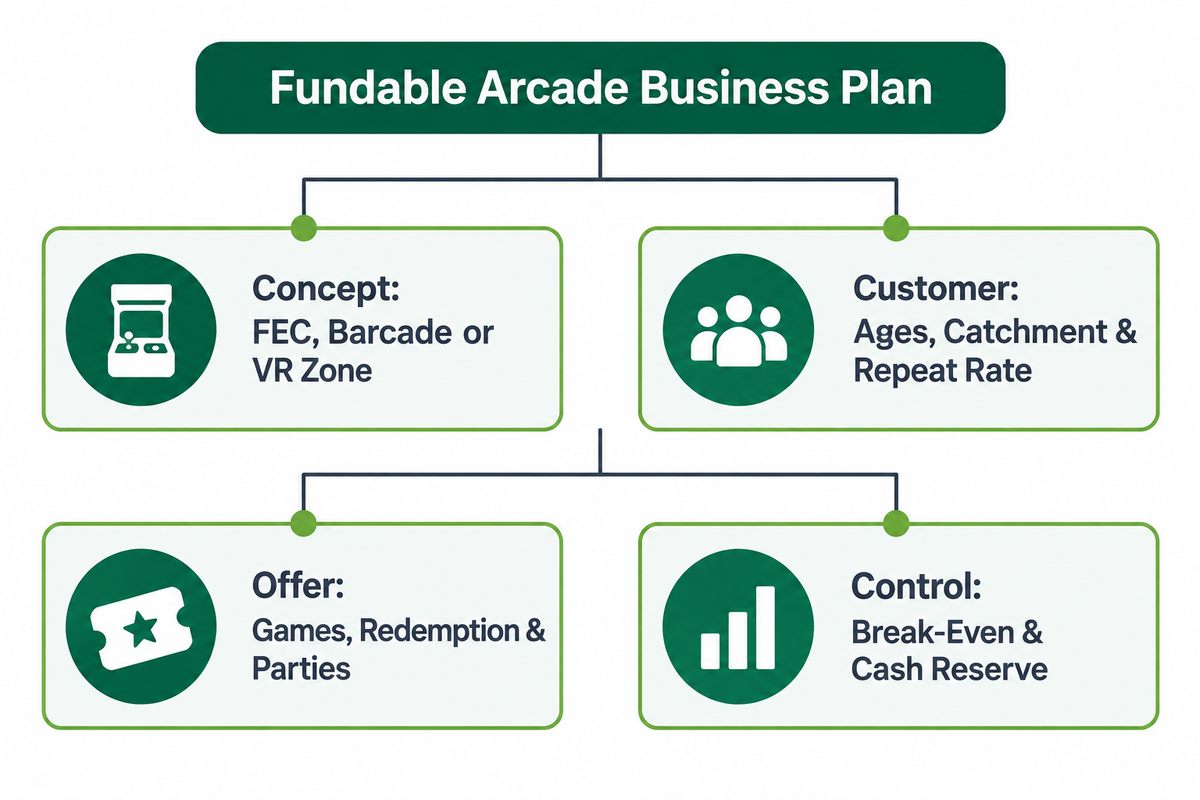
An entrepreneur looking to open an arcade business needs to answer five questions. Who will visit? Why will they choose this venue? How much usable space creates the experience? Which revenue streams pay for that space? How much cash survives a slow month?
The Small Business Administration planning guide recommends market research, competitive analysis, startup-cost calculations and break-even work before funding decisions. For a new arcade, replace “the area has families” with catchment, age bands, alternatives, price points and a test you can run before the full fit-out.
To start a business around arcade gaming, establish the concept before selecting the business name. A local arcade that caters to parents and children has different hours and spending assumptions from a vintage arcade serving adult enthusiasts. Record the market size within a realistic travel radius, then check whether household gaming preferences actually translate into visits.
What makes an arcade business plan fundable?
It connects demand to a model that can be recalculated. Demonstrate the concept, the room, the machine mix, the operating assumptions, the ‘uses of funds’ and a downside case. A lender or investor should be able to alter visits, average spend or rent and view the cash impact without rebuilding the whole plan.
- The concept may be a game-only arcade, family entertainment center, barcade, VR-led venue or arcade zone within another business.
- Customer: target ages, group size, visit occasion, catchment & repeat rate.
- Offer: games, redemption, parties, memberships, food, drinks or any other add-ons.
- Control: break-even visits, cash reserve, maintenance response and approval owners.
Build the revenue model from visits and spend
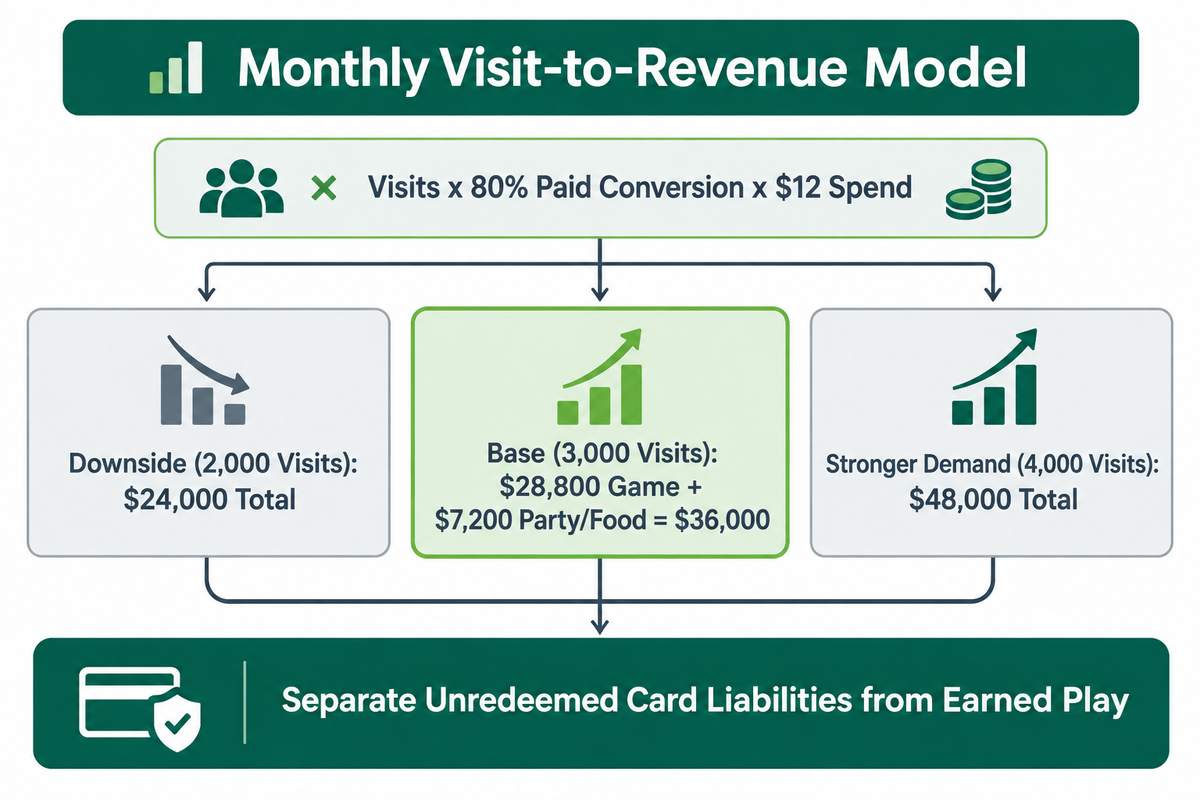
Start with the operating unit you can see: a visit. A straightforward simple monthly model is:
Monthly game revenue = visits×paid-play conversion×average game spend per paid visit
Next model these other streams as single streams as well. Party packages, memberships, food, drinks, prizes and merchandise do not have the same margin, or staffing profile, as a game play. Keeping them in separate rows makes the forecast easier to test.
| Driver | Question to answer | Evidence to collect |
|---|---|---|
| Visits | How many people enter in a normal and a peak month? | Catchment, comparable venues, pilot traffic and opening hours |
| Conversion | What share of visitors pays to play? | Ticketing or card-system data from a pilot or comparable operator |
| Average spend | How much does a paying visitor spend? | Price ladder, session length, prize and membership assumptions |
| Secondary spend | Which add-ons are incremental rather than cannibalizing? | Party bookings, food margin, membership usage and redemption cost |
Model payment settlement separately from revenue. A cashless card solution can bring reporting clarity, but cash loads, refunds, bonus credits and unredeemed balances all need clear accounting policies. Loading a dollar onto a game card isn’t automatically an earned dollar that day: reconcile cash collection to redeemed paid play and the remaining liabilities on cards.
A worked revenue case with explicit assumptions
Consider a hypothetical small arcade planning 3,000 monthly visits. Assume 80% buy paid play and each paying visit produces $12 of earned game revenue, excluding tax. The game line is 3,000 × 0.80 × $12 = $28,800. A further $7,200 of separately earned party and food revenue produces $36,000 total monthly revenue.
| Monthly input or result | Downside | Base | Stronger demand |
|---|---|---|---|
| All visits | 2,000 | 3,000 | 4,000 |
| Paid-play conversion | 80% | 80% | 80% |
| Paying game visits | 1,600 | 2,400 | 3,200 |
| Earned game spend per paying visit | $12 | $12 | $12 |
| Game revenue | $19,200 | $28,800 | $38,400 |
| Party/food revenue, modeled separately | $4,800 | $7,200 | $9,600 |
| Total earned revenue | $24,000 | $36,000 | $48,000 |
| Party/food revenue per total visit | $2.40 | $2.40 | $2.40 |
| Total earned revenue per total visit | $12 | $12 | $12 |
| Game share of total earned revenue | 80% | 80% | 80% |
The party and food lines scale proportionally only for clarity in this arithmetic example. In a real model, party bookings depend on room slots and conversion; food and drinks depend on buying customers, average basket and direct cost. Keep party game credits out of walk-in game revenue if they are already included in party packages.
Unlimited play and membership programs will require a further calculation: paid admissions or members multiplied by the actual price, with their game usage tracked as capacity demand. Do not charge for those exact plays again in the per-play forecast. This often causes double counting when arcade owners combine payment systems.
Turn floor space into capacity
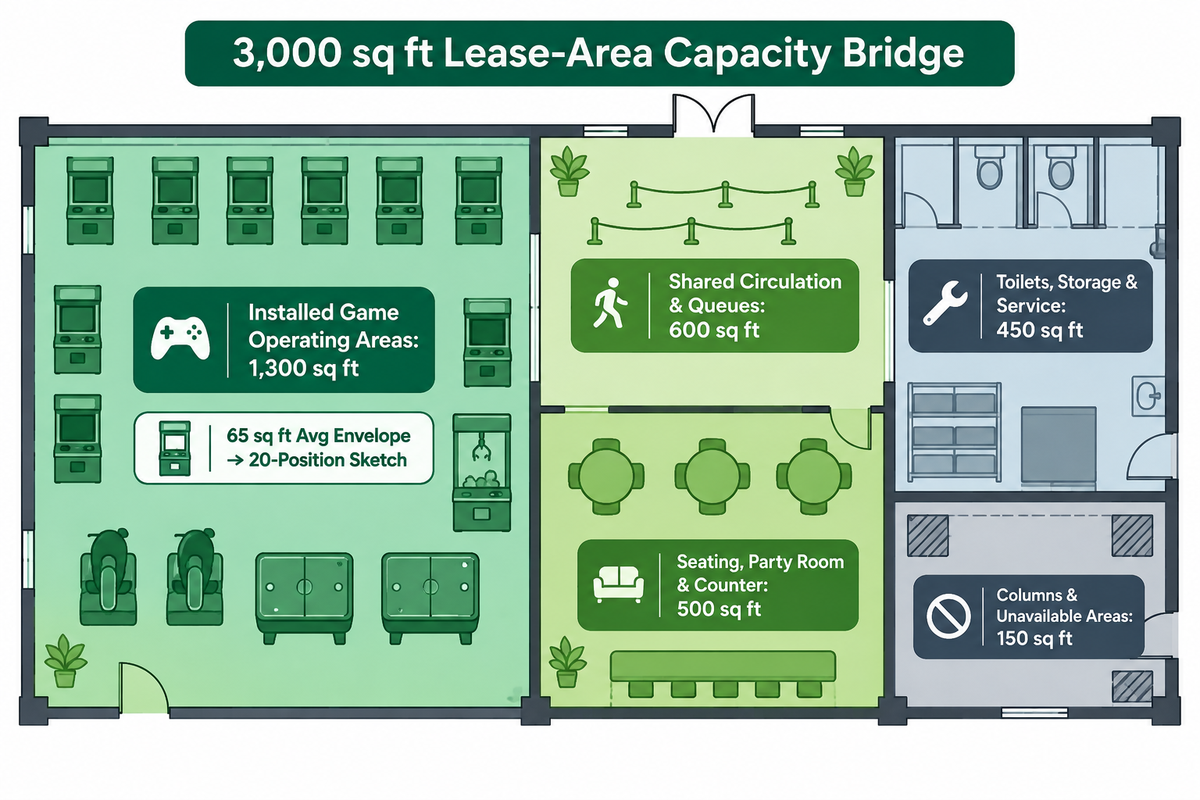
Gross square footage is not earning capacity. A layout must reserve space for circulation, queues, seating, party rooms, toilets, storage, staff areas, electrical access and exits before it assigns a footprint to machines.
Use a gross-to-usable bridge:
- Write down the total Lease Area and the Clear Height beneath the lowest obstruction.
- Take out zones where play can’t happen: toilet areas, back-of-house, pillars, service zones and all egresses.
- Reserve circulation and queue paths so the entrance and high-demand games do not choke each other.
- Divide the remaining play area by the footprint + clearance for each machine family.
- Assess the outcome for things such as power, noise, sight lines, age separation and staffing.
How much floor space does an arcade need?
The required floor area includes the operating envelopes of the machines plus shared circulation, queues, seating, toilets, storage and service areas. A driving cabinet, pinball machine, redemption bank, VR station and crane game each create different clearance and supervision needs. Freeze the count after recording the actual room, clear height and circulation.
Dreamland Playground’s public project workflow starts from a floor plan and clear height, then uses space planning, floor-plan design and 3D review before production. Move the capacity discussion before equipment ordering.
| Allocated area | Square feet | What must be checked |
|---|---|---|
| Installed game operating areas | 1,300 | Actual cabinet, player and service envelopes |
| Shared circulation and queues | 600 | Accessible routes, exits and peak queues |
| Seating, party room and counter | 500 | Party-slot capacity and staff sight lines |
| Toilets, storage and service rooms | 450 | Landlord drawings and local requirements |
| Columns and other unavailable areas | 150 | Measured survey |
| Total | 3,000 | Every area counted once |
Assuming 65 sq ft average installed operating envelope, 1,300 ÷ 65 gives you an initial 20-position sketch. That’s arithmetic, not a green light to site 20 machines. Check every arcade game machine against its own dimensions and clearances; shared circulation stays in its separate 600 sq ft allocation.
For U.S. projects, the Access Board’s accessible-route guide explains minimum clear widths and additional space at turns and passing points. As route necessities, these do not list a standard arcade machine buffer. Have the project designer check the full layout against the applicable local rules before treating an equipment count as approved capacity.
| Constraint | Evidence needed | Decision owner | Cash consequence |
|---|---|---|---|
| Electrical supply cannot serve peak load | Machine schedule and electrical survey | Designer/electrician | Upgrade quote before deposit |
| Queue spills into entrance | Peak-use layout and entrance sight line | Operations | Remove or relocate a position |
| Large machine cannot enter the unit | Crated dimensions and measured delivery route | Procurement | Reassembly or alternative model |
| Cashless system outage disables play | Vendor outage procedure and recovery test | Operations/finance | Lost play and refund exposure |
Choose the arcade game mix and sourcing model
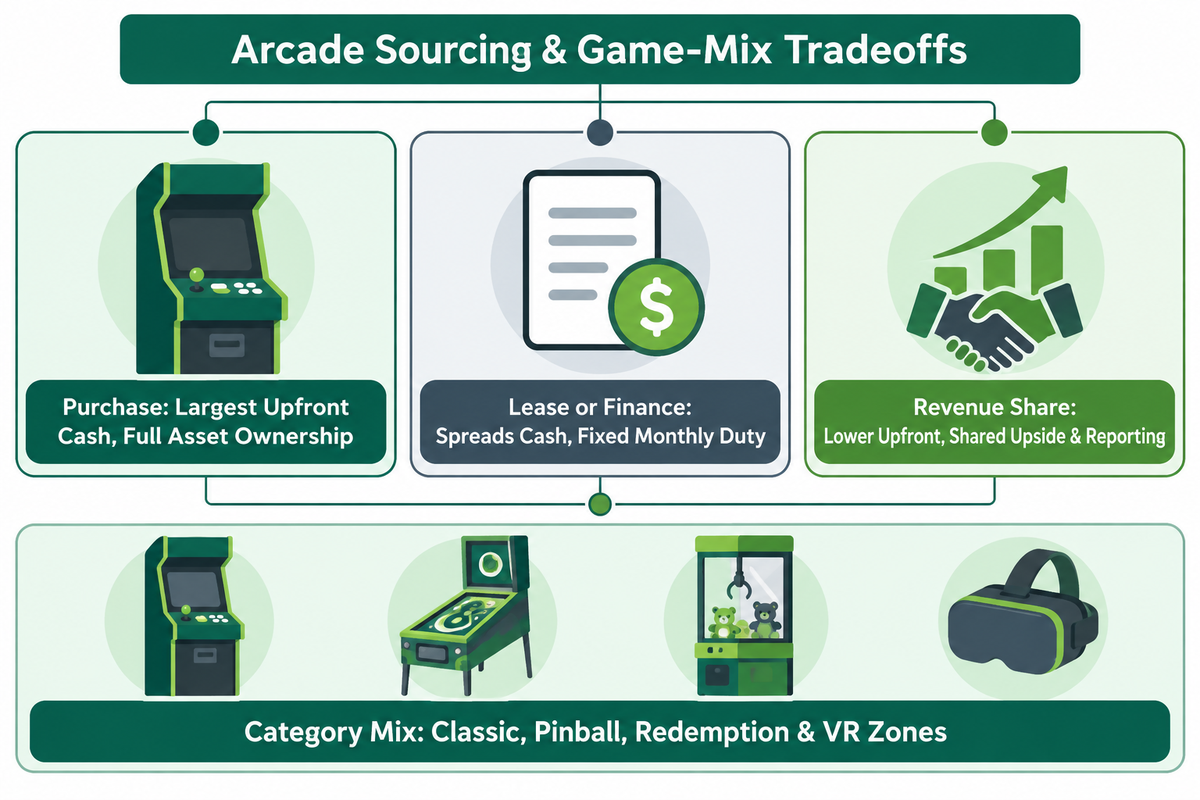
Buying every attractive machine at once is an easy way to turn a concept into a cash problem. Assign points for a game family by their expected usage, size, age alignment, service access, pay method, prize or consumable cost and replacement risk.
| Option | Cash effect | Control question |
|---|---|---|
| Purchase | Largest upfront commitment; asset remains yours | Can the reserve cover repairs and low-season replacement? |
| Lease or finance | Spreads cash use but adds fixed obligations | Does the payment survive the downside visit case? |
| Revenue share | Lower upfront cash, shared upside and reporting dependency | Who controls settlement data, maintenance and uptime? |
Mix age groups and types of games rather than replicate the competition machine list. A family entertainment center may need toddler, redemption, party and higher-energy zones; a game-only venue may need a narrower mix and a different staffing model.
- Classic arcade games and pinball machines: test nostalgia demand, parts availability and technician access. An experienced gamer may value a well-maintained arcade cabinet more than a larger but unreliable collection.
- Redemption games and a claw machine: include landed prize cost, stock losses and payout configuration. Confirm local prize rules before committing.
- VR experiences: a VR arcade needs a plan for booking time, staff assistance, hygiene, content rights and headset downtime, not just headset purchases.
- New machines: ask what commissioning, spare parts and warranty response actually include. Assess popular games by their profit margins per occupied operating position, accounting for usage, prize or consumable costs and maintenance.
Visualize the discussion between two new operators comparing ownership to a route operator. The owner keeps more upside but pays for an unavailable machine; a revenue-share offer may transfer some maintenance work while charging a minimum guarantee. Look at how the contract defines revenue, reports of settlement, response to maintenance, termination rights and residual ownership before you choose the cheaper opening day alternative.
Check statutory limits alongside the contract. For transactions covered by Texas’s coin-operated-machine rules, certain owner-to-custodian payments are restricted. A proposed split therefore needs to be lawful for that location and transaction before finance uses it as an assumption.
An arcade machine business based on placements in other venues has different economics from a staffed destination. If you start an arcade business inside a larger attraction, allocate shared rent and labor consistently. Otherwise a seemingly competitive arcade area might merely appear lucrative as its costs are being subsidised by another department.
Use a family entertainment center model when the customer offer combines several activities and you can budget the extra zones, supervision and party capacity. Use a game-only model when the visit is primarily for games and the room, audience and staffing support that narrower offer. This is a planning comparison: test the demand and cost of each activity rather than assuming that more attractions produce a better business.
Build the startup budget before signing the lease
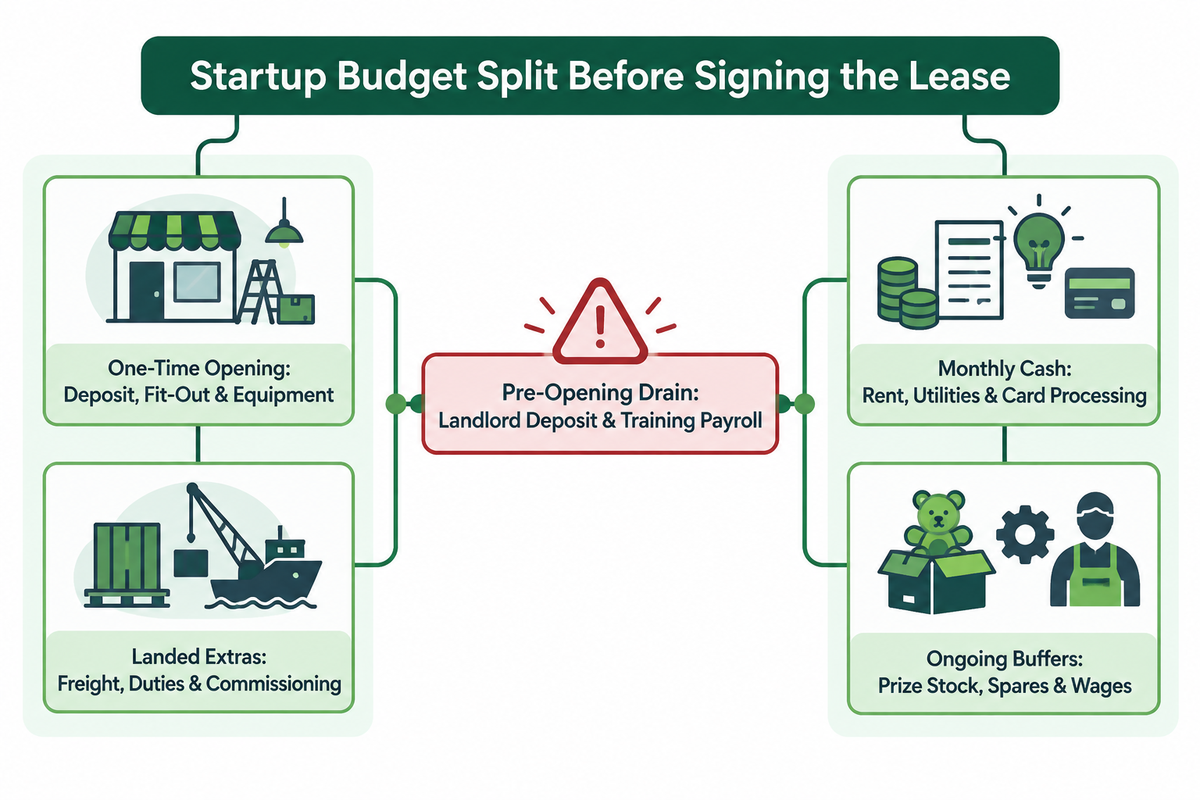
The equipment invoice is one line in the use-of-funds table. The Small Business Administration startup-cost guidance suggests putting one-time and monthly expenses in separate columns to make the amount of funding needed easy to see.
Attach a quote, payment date and a named budgetholder to each major line before starting the business. Some new business costs are paid months before opening. A landlord deposit and payroll pre-opening eat cash even where the income statement reports no operational revenues.
“organize your expenses into one-time expenses and monthly expenses.”
A mixed-use project also needs to resolve the premises before ordering games. Use the mall playground lease guide to frame landlord questions when a play zone forms part of the venue; confirm the arcade’s own permitted use and obligations separately.
| Cost category | Opening commitment | Recurring cash requirement | Evidence owner |
|---|---|---|---|
| Premises | Deposit and pre-opening rent | Rent and property charges | Owner and landlord |
| Fit-out | Construction and finishes | Cleaning and premises repairs | Designer and contractor |
| Game equipment | Purchase or finance deposit | Lease, finance or revenue-share payments | Procurement |
| Payment system | Readers, installation and setup | Processing fees and software | Finance and system vendor |
| Electrical and utilities | Survey and agreed upgrades | Electricity, connectivity and other utilities | Electrician and operations |
| Logistics | Freight, duties, unloading and commissioning | Replacement-part deliveries | Procurement |
| Approvals and insurance | Applicable permits, professional fees and setup | Renewals and premiums | Owner and advisers |
| People | Recruitment, training and pre-opening payroll | Wages and employment costs | Operations |
| Consumables | Opening prize and sales inventory | Replenishment and stock losses | Operations and finance |
| Maintenance | Initial spares and tools | Repairs, service and replacement reserve | Technician and finance |
| Customer acquisition | Launch campaign and booking setup | Measured marketing and promotions | Owner and marketing |
Freight, duties, unloading and commissioning can sit outside the equipment price. Make a side-by-side comparison of who bears each cost, based on the quoted delivery term, named place and installation scope. A less expensive equipment quote might still result in the larger landed project.
Control cash and test break-even
The Small Business Administration’s break-even framework is:
Break-even units = fixed costs ÷ (sales price less variable costs)
For an arcade, a “unit” can be a paying visit, a party booking or another defined transaction. Select a single unit, one at a time and then reconcile that total to the monthly model. Include a buffer for surprises and seasonal fluctuations instead of treating the formula as a guarantee.
Which startup cost lines should the plan show?
Display deposit, fit-out, equipment, freight, installation, permits, insurance, payroll, marketing, software, prizes and working capital. Then display the month in which the reserve dips below its trigger. This makes cash management an operating task with an assigned owner, not an executive summary paragraph.
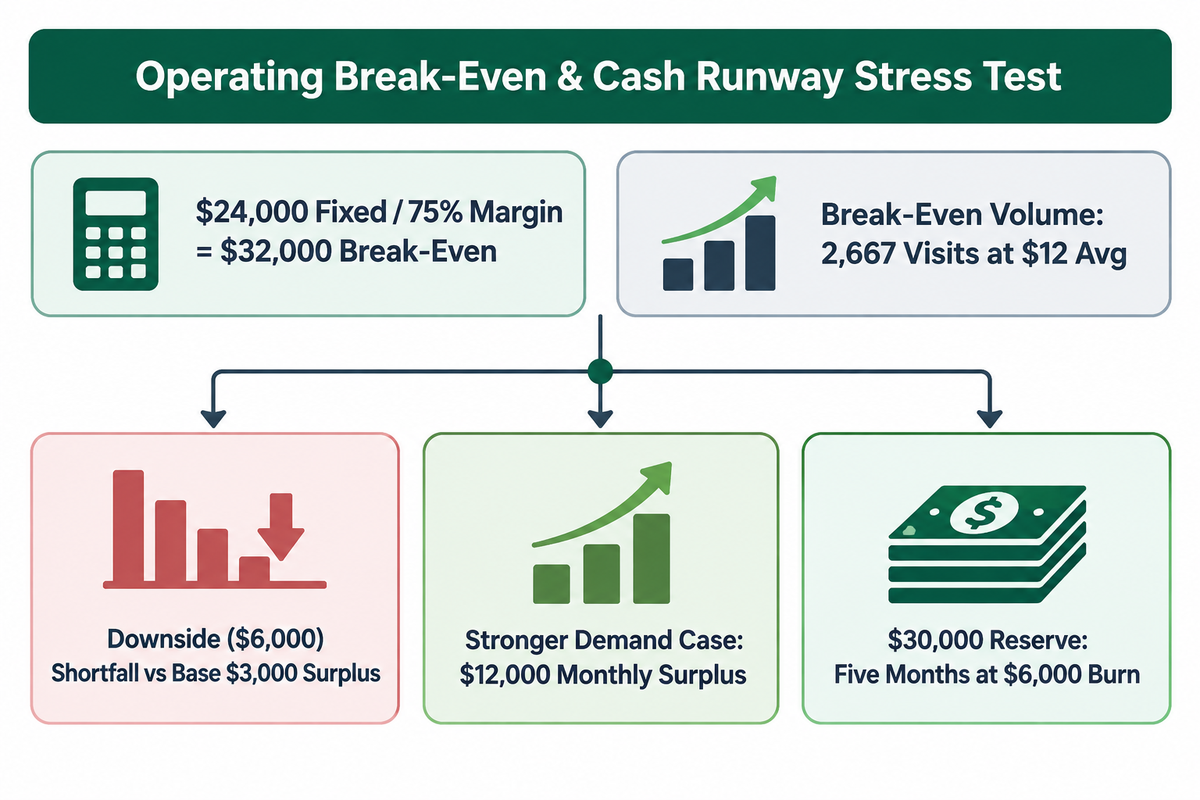
Continue the worked-example revenue cases with assumed monthly fixed operating costs of $24,000 and variable costs equal to 25% of earned revenue. The contribution-margin ratio is 75%; operating break-even is $24,000 ÷ 0.75 = $32,000 monthly revenue. If the revenue mix holds at $12 earned revenue per total visit, that requires about 2,667 visits, rounded upward.
| Result | Downside | Base | Stronger demand |
|---|---|---|---|
| Earned revenue | $24,000 | $36,000 | $48,000 |
| Variable costs at 25% | $6,000 | $9,000 | $12,000 |
| Contribution | $18,000 | $27,000 | $36,000 |
| Fixed operating costs | $24,000 | $24,000 | $24,000 |
| Operating surplus/(shortfall) | ($6,000) | $3,000 | $12,000 |
This basic operating result does not include financing, tax, depreciation, replacement capital expenditure or timing differences. It does not prove net profit or free cash flow. Two weak months at the modeled $6,000 shortfall consume $12,000 before those additional cash requirements.
In this worked example, a $30,000 unrestricted reserve lasts five months at a constant $6,000 monthly cash burn, only if that burn includes all cash obligations. Develop a weekly cash forecast that is dated and that reflects deposits, taxes, debt principal, equipment and refunds through the opening ramp. Adjust the spend plan when the forecasted minimum bank balance goes below the agreed-upon reserve.
Reconcile card loads to earned revenue and bank cash
Dave & Buster’s fiscal 2025 annual filing describes recognizing entertainment revenue primarily when game credits are used and deferring amounts for unused credits and future prize-redemption rights. This is the operator’s accounting policy, not a universal tax rule. Have an accountant define your treatment of card balances, promotional credits, refunds, breakage and tax before configuring reports.
- Match paid card loads, cash sales and refunds to till and point-of-sale reports.
- Separate promotional credits and unspent paid balances from consumed paid play.
- Match card-processor settlements and fees to bank deposits, recording settlement delays.
- Reconcile redeemed prizes to inventory and purchase cost; investigate unusual differences.
- Have a second person approve refunds and adjustments, then resolve exceptions before the monthly close.
Payback measures recovery of the defined initial investment through net cash flows. As Yotpo’s explanation of payback limitations notes, it omits cash flows after recovery. Recovering the investment does not remove next month’s rent, labor, repairs or replacement needs. An owner deciding whether to make a profit must keep operating break-even, project payback and spendable cash separate.
Set operating, licensing and maintenance controls
The rules on licensing and occupancy are local, and old checklists may be inaccurate. New York City’s official repeal notice says its dedicated Gaming Café or Amusement Arcade license ceased to be required on January 16, 2022. But that same notice preserves other conditions, so repealing that license does not eliminate every condition of operation.
Review machine and prize categories before seeking to freeze the game mix. For example, the Gambling Commission’s family entertainment centre guidance distinguishes licensed gaming-machine offers from arrangements requiring a local permit in Great Britain. Physical arcades could thus be in scope of gambling regulation where an online gambling revenue stream is not necessarily relevant to the business plan.
Venue eligibility and revenue-share terms also need local review before they become model inputs. Florida’s amusement-machine statute distinguishes machine and premises categories; Texas’s coin-operated-machine code limits certain owner-to-custodian compensation arrangements. These examples apply to their defined transactions and locations, rather than every arcade or partnership.
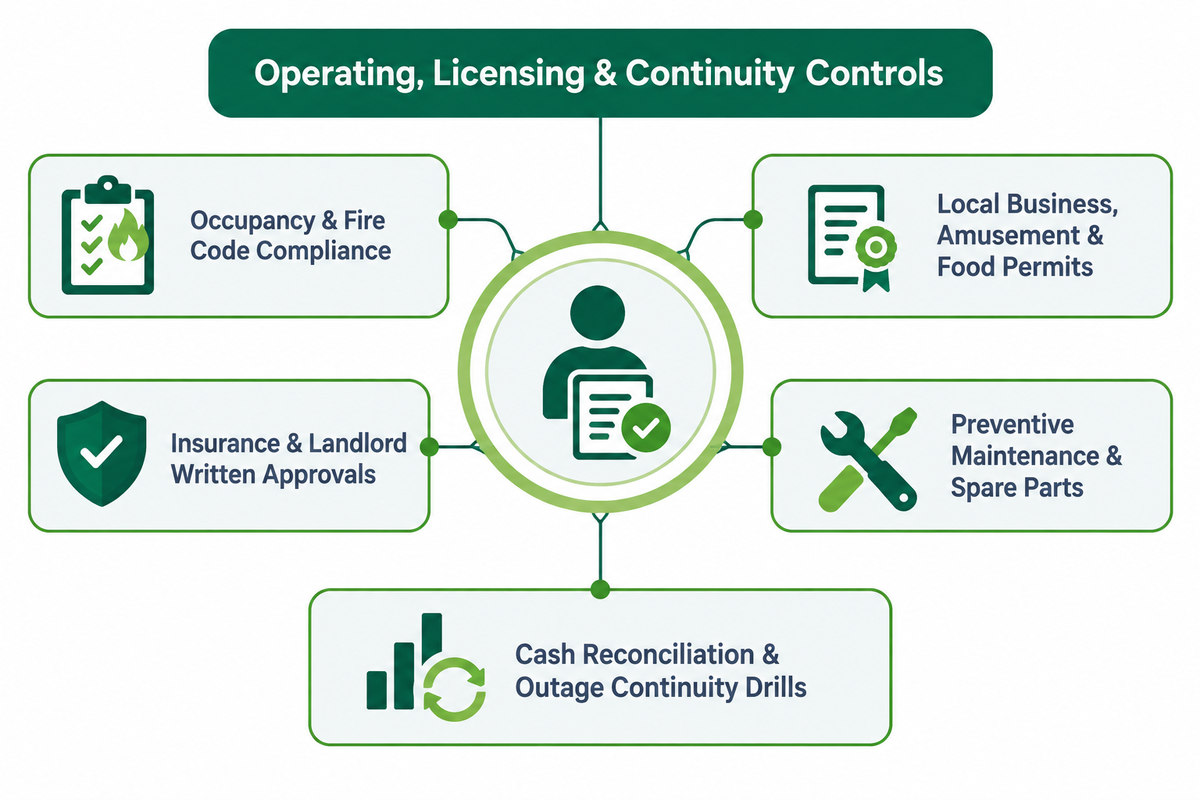
Use a control table with an owner and evidence for:
- occupancy and fire requirements;
- business, amusement, food or alcohol permits where applicable;
- insurance requirements and landlord approvals;
- preventive maintenance, spare parts and downtime response;
- cash reconciliation, refunds and payment-system access.
Ready.gov’s business-continuity guidance provides an operating pattern: identify risks and impacts, develop strategies, define teams and tasks, and test the plan. For an arcade, the test can cover a power outage, card-system failure, flooded zone, unavailable technician or prize-stock interruption.
Hand the approved case to an equipment supplier
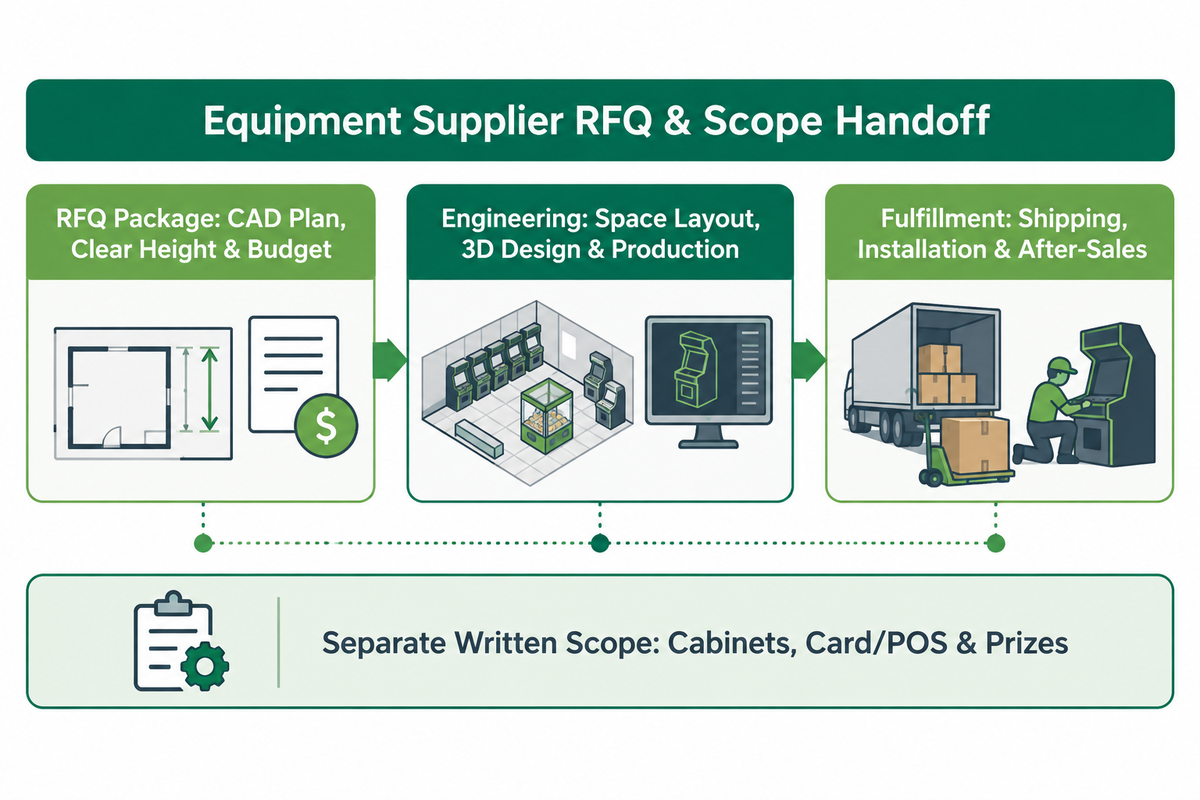
What should an equipment supplier receive before quoting?
Once the model passes its downside case, send a supplier an RFQ that can be compared line by line. Include the floor plan, clear height, columns and obstructions, age bands, target market, theme, opening date, budget range, preferred incoterm and installation preference.
Dreamland Playground says it can work from a CAD file or a dimensioned sketch, then move through layout, 3D design, production, shipping, installation support and after-sales. Those are first-party supplier statements; use them to define the handoff, not to imply that a supplier grants local approval.
Dreamland’s stated scope is playground equipment and family-entertainment-center project solutions. Obtain separate written scope confirmation for arcade cabinets, game software, card/POS systems, prize stock and food-service equipment, including who supplies and supports each item.
build a complete FEC investment case when the project needs a broader family-entertainment-center model with activity zones, parties and operating assumptions.
Ready to test the room?
Send the layout plan, clear height, age bands, target market, opening date and budget. Dreamland Playground can use those inputs to generate a project discussion and quotation path.
Industry outlook: test the gaming experience locally
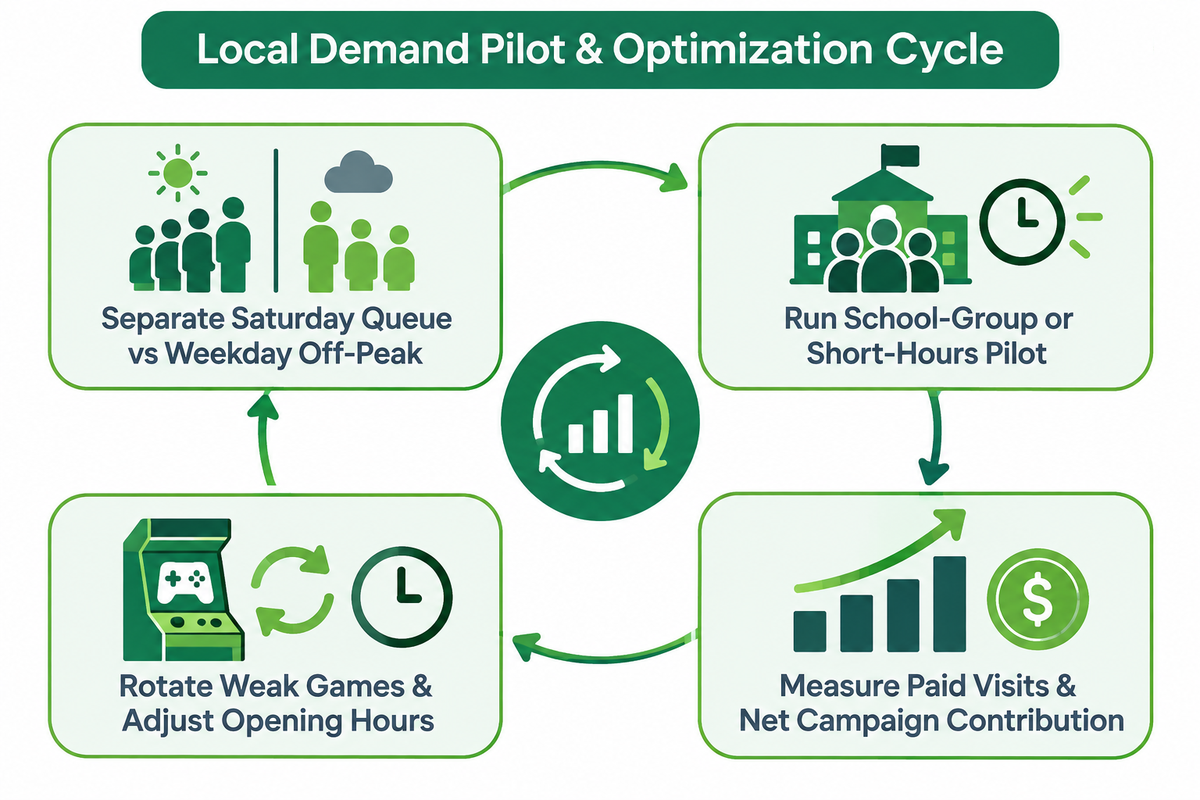
The current state of the arcade cannot be inferred from a general video-game market forecast. Evaluate industry trends through actual nearby venues: machine mix, observed use at different times, admission models, parties and the reasons customers return. Add new games only when the expected contribution justifies their installed space and support burden.
Consider a venue with a long Saturday queue but empty weekday afternoons.
Running a business like that needs separate weekday and weekend assumptions. Would a new big attraction increase the peak queue with no net increase in weekday demand?
A school-group offer or short-hours trial tests a different hypothesis.
Use social media as a measurable acquisition channel. A TikTok clip can generate attention, but the test is tracked paid visits and contribution after the campaign cost. When creating a website, make hours, location, age fit, booking terms and prices clear. The family entertainment center marketing guide covers the broader venue context; measure enquiries and completed bookings rather than impressions alone.
To grow your arcade business, compare repeat visits and contribution by offer. Careful planning involves pausing a weak membership campaign, changing an underutilised game or reducing opening hours when the evidence justifies it. To make your arcade business viable, the paid gaming experience must support the cost of delivering it.
Frequently Asked Questions
How profitable is an arcade business?
Arcade operating profit is earned game, party and secondary revenue less operating costs. Visits, paid conversion, average spend, machine mix, rent, staffing and maintenance drive that result. Calculate contribution margin and break-even visits using local costs. Then test lower attendance, higher repair costs and delayed opening. A positive operating result still needs to cover financing, taxes and replacement spending before it becomes cash available to the owner. Published machine-revenue figures cannot establish the profitability of your site.
How much does it cost to start an arcade business?
The startup budget must cover equipment, freight, installation, fit-out, deposits, permits, insurance, payroll, marketing, software, prizes and working capital. Ask suppliers to quote the same floor area, machine mix, delivery terms and installation scope. Add the cash needed during the opening ramp, and identify which costs fall due before the first paid visit.
Is an arcade business worth it?
It can be worth testing when local demand, the concept, pricing and the room support a credible operating model. Count competing venues, test an offer with real customers and price the fitted space before committing. In this guide’s hypothetical case, 3,000 monthly visits generate a $3,000 operating surplus, but the downside case loses $6,000 before financing and other excluded items. Those assumptions show how sensitive the decision is; they are not an expected return.
Do you need a license to run an arcade?
Requirements depend on the location, occupancy classification, equipment, food or alcohol service and local amusement rules. Check the authority having jurisdiction, landlord and insurer before freezing the layout. A supplier can provide project documents but does not replace local approval.
How many arcade machines fit in a given floor area?
Calculate an initial count by dividing the usable game zone by each selected machine’s installation envelope, then test the actual layout. In the hypothetical example, 1,300 sq ft divided by an assumed 65 sq ft gives 20 positions. Shared circulation is allocated separately. Actual player space, service access, queues, accessible routes and exits still determine whether those positions work.